


Key takeaways
- Generative AI in retail is helping businesses create content faster, personalize shopping journeys, and improve supply chain operations. As adoption grows, businesses are finding more ways to apply it across customer-facing and internal processes.
- With the generative AI retail market forecast to reach $21,092.02 million by 2035, businesses are increasing investments in AI solutions to create better customer interactions and improve efficiency.
- Product design, personalized recommendations, visual search, and demand forecasting are some of the popular use cases of generative AI in retail.
- Key benefits of GenAI in retail include improved productivity, reduced manual work, faster decision-making, and better support for teams handling daily retail processes.
- Data quality, legacy system integration, compliance requirements, and AI reliability remain major challenges businesses must address before expanding GenAI adoption.
The retail industry is going through a digital shift, and shopping is no longer limited to a store visit or a simple online purchase. Customers now move between apps, websites, and physical stores.
Along the way, they expect the experience to remain consistent across channels. At the same time, retail businesses have to respond to demand that can change quickly.
This is where Generative AI in retail is starting to attract attention from businesses looking for practical solutions.
Changing shopping habits have added pressure on retailers. They are expected to keep products moving efficiently, understand demand, respond to customers, and keep everyday operations moving without adding unnecessary complexity. AI in retail is giving businesses a way to handle some of this work more efficiently.
There is a clear shift from curiosity to practical interest in GenAI across retail. Precedence Research projects the global generative AI market in retail will reach $21,092.02 million by 2035.
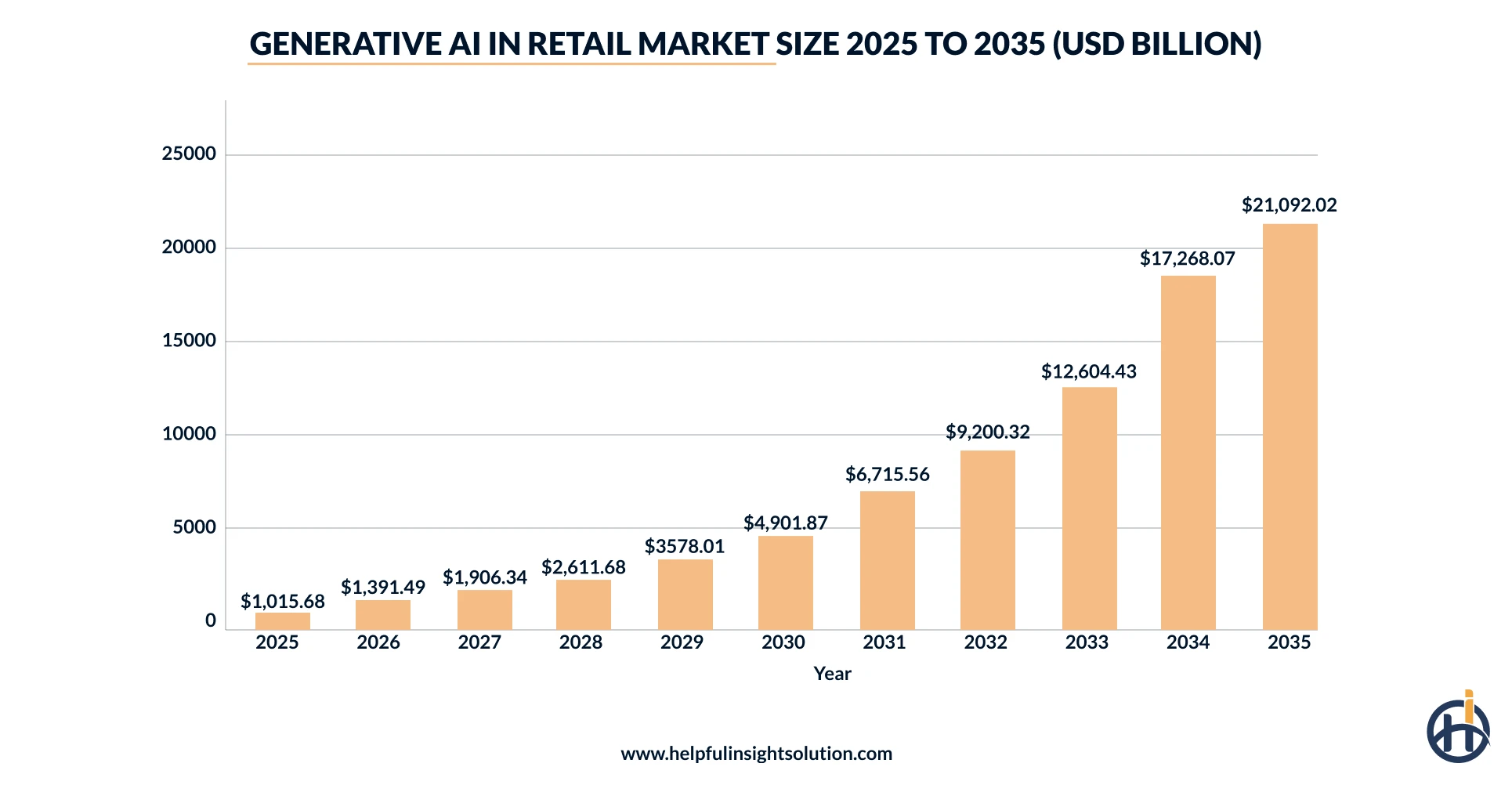
With adoption moving forward, businesses are starting to ask less about what GenAI can do and more about where it can actually support their goals.
What is generative AI in retail?
Generative AI in retail refers to the use of AI models to create or adapt original content such as images, text, and videos. It can also generate responses using existing customer, product, and business information.
Retailers can use it for product recommendations, marketing content, virtual shopping assistance, and parts of inventory planning.
Generative AI in ecommerce and retail can create more relevant online shopping experiences while helping reduce the manual effort involved in everyday tasks.
What are the top use cases of generative AI in retail?
Retailers are using generative AI to support both customer interactions and day-to-day business operations, from copilots and personalized experiences to product content and decision support.
Its value goes beyond automation, with multimodal AI helping retailers work across text, images, and other data.
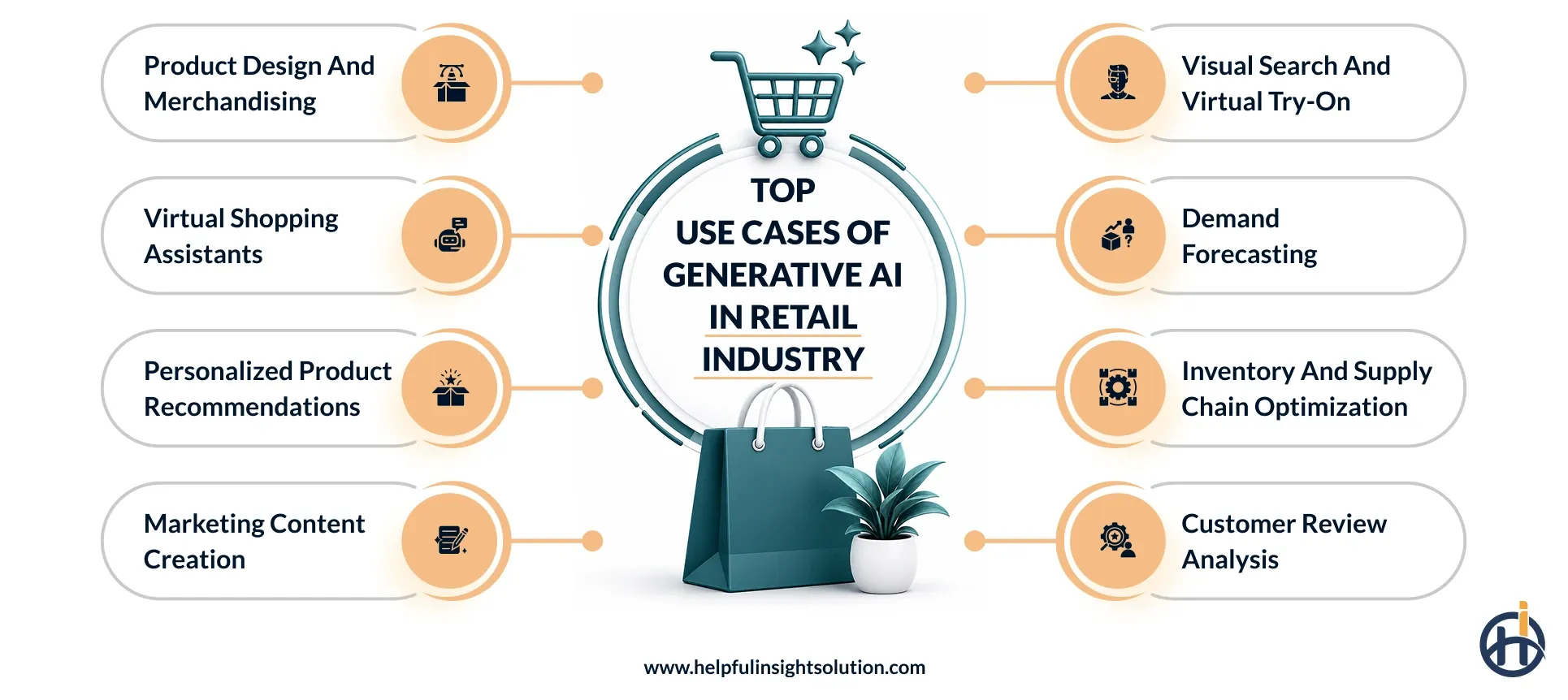
Below, we explore the most relevant applications of generative AI in retail industry and where they can create value.
Product design and merchandising
Product ideas can take several rounds of work before a retailer knows which ones are worth pursuing. Generative AI in the retail industry can give teams a head start by turning customer preferences, past sales, and market trends into different product concepts, packaging ideas, and color options.
This means retailers can review multiple directions without physically producing each version first. Merchandisers benefit the same way.
Instead of waiting on physical samples, they can visualize and adjust store layouts and display concepts on screen, catching what won’t work before it ever reaches the sales floor.
Virtual shopping assistants
A customer may know what they want but still have questions before placing an order. A virtual shopping assistant can help with those smaller decisions, such as comparing products, checking features, or finding an alternative.
With GenAI, the conversation can continue as the shopper asks follow-up questions. A standard AI chatbot for eCommerce may not handle the same exchange as well, particularly when the customer moves away from its predefined questions.
Personalized product recommendations
Many traditional recommendation systems still rely on past purchases and general customer segments. While useful, those signals do not always tell retailers what someone wants at that moment.
Generative AI in retail can consider current searches and browsing activity, allowing product suggestions to reflect the shopper’s immediate interests rather than patterns across a wider customer group.
The result is faster, more relevant personalization at scale. Some platforms adjust their suggestions mid-session when they detect cart abandonment signals, offering a relevant alternative before the customer leaves empty-handed.
Marketing content creation
Writing thousands of product descriptions or adapting a campaign for different audiences can take up a large part of a retail marketing team’s time.
GenAI can take approved product details, campaign goals, and brand guidelines and turn them into usable drafts.
Marketing teams can then edit and approve the output rather than build every piece manually. Among generative AI applications in retail industry, this can be especially useful for content localization and channel adaptation across large product ranges.
Visual search and virtual try-on
Finding a similar product online is not always easy when the customer cannot describe it accurately. GenAI for retail can help by interpreting an uploaded image and matching it with products in the catalog.
Virtual try-on takes this a step further. It shows shoppers how an item might actually look on them. Retailers can also use multimodal AI here.
It connects visual inputs to product attributes. This gives customers a simpler way to browse and decide.
Demand forecasting
Demand does not always follow last year’s sales pattern. A change in weather or a local event can quickly affect what people buy. AI in demand forecasting can bring these factors together with recent sales data to give planning teams a better view of what may be needed.
GenAI can also summarize the forecast and flag unusual changes. This gives retailers better visibility into inventory, helping them make more informed stocking decisions.
Inventory and supply chain optimization
A supply chain can become difficult to manage when information sits across purchasing, warehouses, suppliers, and stores. Generative AI for retail and eCommerce can bring these updates together and give a clearer view of what needs attention.
For example, it can flag delayed supplier shipments, explain which stores may be affected, and help planners review replenishment options.
Supplier risk monitoring adds another layer by helping spot issues before they disrupt product availability.
Customer review analysis
A five-star rating does not tell a retailer much about what the customer liked or disliked. The written review often has useful detail.
Generative AI technology in retail can go through those comments and pick out recurring themes, such as product quality, delivery experience, or sizing.
Retail businesses can review the summary instead of sorting through every response manually. This makes customer feedback easier to use when deciding what needs attention.

Benefits of generative AI for the retail industry
For retailers, the bigger opportunity with GenAI is not simply doing existing tasks faster. It is finding better ways to support the people, processes, and decisions behind the shopping experience.
From content operations and customer service to merchandising and supply chain planning, the technology can fit into several workflows.
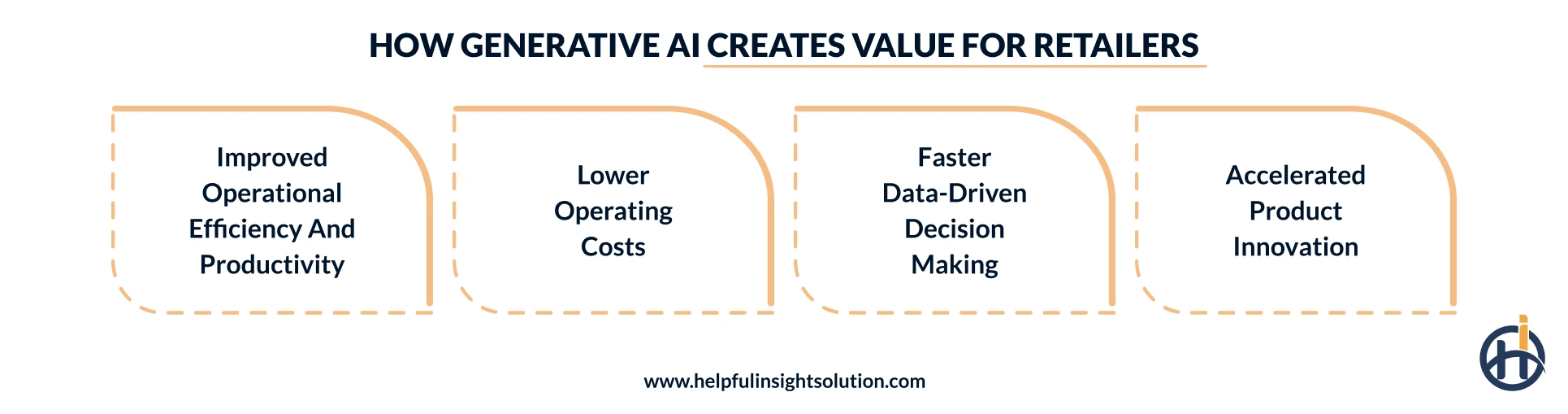
In this section, let’s explore the main benefits of generative AI in retail sector and what they mean for the business.
Improved operational efficiency and productivity
Employees spend a lot of time on routine work such as finding information, preparing updates, and answering the same internal questions, which can take up hours that could be spent on more important decisions.
GenAI can handle some of this work, giving employees more time for customer and business decisions. Deloitte’s survey reflects this need, with 56% of respondents ranking improved efficiency or productivity as the leading expected benefit of generative AI retail.
Lower operating costs
Generative AI can reduce operating costs by cutting down the manual work behind everyday retail processes. For example, it can turn product and order information into customer-ready responses, reducing the need to prepare each one manually.
It can also help identify repeated service requests or inefficient processes that add unnecessary expense. Generative AI systems offer a practical way to reduce this workload while keeping essential operations moving.
Faster data-driven decision-making
Business decisions often depend on information coming from several places, which can take time to review. As generative AI in retail market grows, retailers can use the technology to bring sales activity, customer behavior, and market information together.
When paired with machine learning, it can also identify patterns that may need attention and support faster decisions.
Accelerated product innovation
New product development can slow down when every idea needs to be researched, sketched, and tested separately. GenAI can help by generating different concepts using customer feedback, sales patterns, and market trends.
Retail businesses can review these ideas before creating physical samples. Generative design also makes it easier to explore variations quickly, shortening early development cycles and helping promising concepts move forward sooner.
Read more: Computer vision in retail
How are leading retailers using generative AI: Real-world examples
Generative artificial intelligence is already making its way into the day-to-day operations of some of the world’s largest businesses.
From AI shopping assistants to faster product development, these companies are using the technology in practical ways.
Looking at generative AI for retail examples gives a clearer view of how GenAI is being applied and the benefits it can deliver beyond the hype.
Amazon
As one of the largest retailers globally, Amazon has integrated generative AI into nearly every layer of the shopping experience.
It has changed the way people search and decide while shopping online. Shoppers used to scroll through hundreds of listings just to find one decent option.
Now tools like Rufus and Alexa+ let them ask a question, compare a couple of products, or get a suggestion without all that digging.
What makes these assistants useful is that they actually pick up on product details and shopping context, not just keywords.
Amazon reported that customers who use Rufus are over 60% more likely to actually complete a purchase. That’s a meaningful number, and it says something about how much friction disappears once discovery actually understands what someone wants.
Walmart
Walmart has built generative AI into a network of specialized “super agents,” each handling a different part of the business, including Sparky for shoppers and Marty for sellers and suppliers.
Search has changed too. Type something like “cozy weekend getaway essentials,” and instead of a basic keyword match, customers can get related products such as blankets, loungewear, and travel accessories grouped into one result.
Store associates get similar support, using AI tools to find product details faster while helping customers on the floor.
It is a practical example of what generative AI in retail customer experience looks like when applied across different touchpoints.
Sephora
Another popular example of generative AI in retail is Sephora, a leading beauty retailer that has started taking its advisory experience into ChatGPT.
Customers can talk through what they are looking for, ask questions, and get product suggestions along the way. This is different from simply showing a list of matching products.
The AI can use the conversation to understand what the shopper actually needs, making product discovery more useful for skincare, makeup, and other beauty purchases.
Target
Target is using generative AI in areas that affect both shoppers and employees. Its Store Companion tool gives store associates quick answers about processes and procedures and has been rolled out across nearly 2,000 stores.
The retailer is also bringing conversational shopping into ChatGPT, where customers can discover products through natural questions instead of traditional searches.
With ChatGPT traffic to Target growing 40% on average each month, the retailer is exploring new ways customers discover and shop for products.
How to implement generative AI in retail: Step by step
There is a fair amount to consider before bringing generative AI for retail into everyday operations. Retailers need to know what problem they are trying to solve and whether the available data and systems can support it.
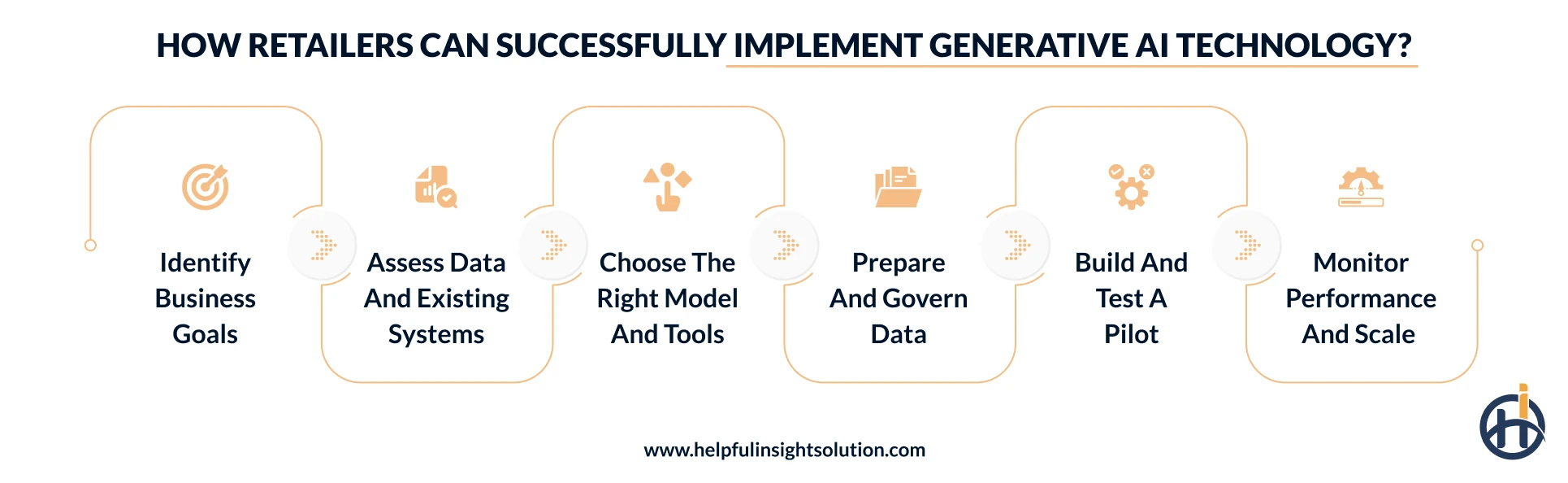
Security and human review also need to be planned early. The following steps explain how to approach GenAI implementation:
Identify business goals
Before bringing GenAI into the business workflow, first decide what needs fixing. It could be slow customer support, high content costs, or poor product discovery.
Look at how the process works today and note the current numbers. Then set a realistic target. This baseline gives retailers something concrete to compare once the AI solution is in use.
Assess data and existing systems
Take a close look at the systems supporting the retail process before introducing GenAI. Map where customer, product, order, and inventory data is stored, then check how these systems share information.
If the existing setup needs custom APIs, data pipelines, or AI integration, AI development services can help connect the GenAI solution with the systems already in use.
Choose the right model and tools
The right GenAI setup depends on what the retailer needs it to handle. Start by comparing ready-made tools with open-source or custom options. Then check how each one performs with the required data, systems, and expected workload.
Privacy and operating costs also matter, especially when customer or business information is involved.
Choose the option that meets these requirements without adding technology that the business does not actually need.
Prepare and govern data
Once the systems are mapped, the data itself needs work. Data usually comes from multiple sources, so duplicate records and missing fields are common.
Clean this up before connecting anything to a model, and set clear access controls around customer information, accounting for regulations like GDPR and CCPA where they apply.
Build and test a pilot
Start with a small pilot project instead of introducing the generative AI system across the entire retail operation. Pick one manageable process and define what success should look like.
Run the solution with real data and gather feedback from employees and other users. Check accuracy, response quality, and workflow issues. A controlled pilot makes it easier to identify problems before scaling the solution.
Monitor performance and scale
A successful pilot is not the point where monitoring stops. Keep checking response quality, system speed, user feedback, and the business metrics tied to the original goal.
Refresh the data when needed and fix issues as they appear. When the results remain consistent, generative AI capabilities can be expanded gradually across additional channels and operations.
Challenges of implementing generative AI in retail
Getting generative AI into a retail business is not just about picking a tool and putting it live. The harder part usually comes afterward: making sure the data is usable, systems can support the technology, and people know how to work with it.
These areas often decide whether generative AI applications in retail operations deliver real value or create new problems.
The following section covers common challenges and solutions that can help businesses adopt GenAI more effectively.
Poor data readiness
Many GenAI projects face problems before the technology is even introduced. The issue is often the data behind it.
Business information is stored across different platforms, follows different formats, or contains old records that no longer reflect current operations.
When AI works with incomplete or unclear information, the output may not be useful enough for everyday decisions.
The solution
Bring key data sources together, remove outdated information, and establish governance processes. A well-managed data environment gives GenAI systems a more reliable foundation for decision-making.
Legacy system integration
Many retail companies have years of data and processes running on legacy systems. The challenge appears when they try to add generative AI on top of that setup.
Older platforms may not have the right connections or data flow required for AI applications. As a result, simple AI use cases can take longer to support than expected.
The solution
Replacing old systems completely is not always practical. Businesses can instead connect existing platforms with GenAI using APIs, middleware, and cloud-based tools that help different systems exchange data and work together.
Governance and compliance
Data protection becomes a bigger concern when GenAI tools are connected with customer or business information. A process that works for one team may not always work for another, especially when access rules are unclear.
Retail companies need proper controls around generative AI usage while keeping regulations like GDPR and IT compliance regulations for industries in the US in mind.
The solution
Define how data moves through AI systems and assign responsibility for monitoring usage.
Following requirements like GDPR and other data protection standards helps keep GenAI workflows secure and controlled.
AI hallucination and reliability
GenAI tools can process large amounts of information, but they may still produce incorrect or incomplete answers when the right context is missing.
In shopping assistants, product search, or support workflows, these errors can create confusion.
Generative AI retail applications need accurate data sources and proper validation to make sure AI responses match real business information.
The solution
A practical way to improve accuracy is to ground AI responses in verified information. RAG, approval checks, and ongoing monitoring help ensure generated answers stay relevant and fact-based.
Conclusion
Generative AI is changing how retailers engage with customers and manage their internal operations, but the next phase likely won’t be about applying it everywhere.
It will come down to being deliberate, using it specifically where the impact is measurable. Building a useful GenAI solution requires more than choosing an AI model.
It requires understanding how a business operates, where customers face friction, and which processes take unnecessary effort.
This is the approach our generative AI development company follows when helping retailers explore GenAI opportunities.
We assist businesses in identifying practical use cases, preparing the right technology foundation, and creating solutions that support real workflows.
Here’s what that looks like in practice. A mid-sized retail business in the USA came to us with a challenge around customer support.
Their team was spending significant time answering repeated product and policy questions.
We helped design an AI chatbot connected to their business information, letting customers get faster answers while cutting down the manual workload on their support team.
If GenAI is something you’re considering for your retail operations, connect with our team. We’ll go over your requirements and help map out an approach that actually fits.
Frequently Asked Questions
Generative AI is being used in the retail industry to speed up marketing content creation, power shopping assistants that actually understand what a customer’s asking, personalize the shopping experience, and take some of the load off customer service teams handling repetitive work.
The cost of implementing generative AI in retail can range from around $15,000 to $60,000 for basic solutions, while custom, enterprise-grade systems can cost $60,000 to $200,000 or more. The final cost depends on factors such as the AI use case, level of customization, data preparation needs, system integrations, security requirements, and ongoing maintenance.
Implementing GenAI in retail typically takes 6 to 12 weeks for a basic solution, such as a chatbot or product description tool. Custom solutions with deeper integrations usually take 4 to 6 months or longer.
The future of generative AI in retail will focus on more personalized shopping experiences, more capable AI assistants, and smarter business operations with less manual effort. As the technology matures, autonomous shopping journeys and better-connected systems will probably become the norm for both customers and internal teams.