

Key Takeaways:
- Retail businesses use computer vision for inventory tracking, security monitoring, and customer analytics, which improve accuracy and reduce costs.
- Computer vision analyzes visual data to personalize shopping, optimize store layouts, and enhance in-store experiences.
- With computer vision, store managers can minimize errors, improve operations, and support smart decision-making across retail businesses.
- You must select the right AI platforms, run pilot projects, and optimize trained models to get long-term business value.
How many times have you encountered retail issues like misplaced products, customer dissatisfaction, and stockout problems? After installing high-resolution cameras, you are still not able to cope with these challenges because of a missing link. The integration of computer vision in retail offers automated inventory, customer analysis, loss prevention, and planogram compliance.
This technology bridges the gap between traditional retailers and modern innovations by empowering existing hardware devices through AI models and algorithms.
According to Grand View Research, the object detection & tracking platforms hold a share of 29.5% in the technical segment. Additionally, supermarkets & hypermarkets have a combined share of 34.7% in the end-user segment. Top platforms like Amazon and Walmart are using this AI technology to boost their sales, retain customers, maintain trust, and reduce shrinkage.
This blog comes with great insights, like computer vision retail case studies, benefits, use cases, and the integration process. Businesses will also explore some crucial challenges with CV-driven systems and their future projections in detail.
What is computer vision in retail?
Computer vision technology uses AI and enhanced camera networks in retail platforms to analyze visual data and generate instant security feeds. It helps store managers to automate inventory management, prevent self-checkout fraud, optimize store layouts, and streamline shopping experiences. The implementation of AI in retail is enhancing fraud detection, visual search, and planogram compliance.
The computer vision retail automation market is currently valued at $2.5 billion in 2026, with North America having a share of 37% across the globe. The revenue will increase to $12.6 billion by 2033, as the market is rapidly growing at 25.4% CAGR between 2026 and 2033.
-
How does computer vision work in retail stores?
For a business investor, it is crucial to know how computer vision works in the retail market. In this section, we will focus on the key steps that are generally followed by AI algorithms to process data.
- Various hardware devices like cameras and motion sensors capture marketplace activities, like entrance or checkout, in real-time.
- Through computer vision retail analytics, the data is processed by breaking images into pixels to identify products and customer movements.
- AI detects misplaced items, wait times, stock limits, and shelf arrangements with object recognition algorithms.
- The system identifies anomalies and prepares a report for empty shelves, fraud scans at checkouts, and long queues in stores.
- At last, AI generates automated alerts, allowing workers to take appropriate actions based on the complete analysis.
Top computer vision use cases in retail
Cashless checkout, virtual try-on, product verification, and more are the key computer vision retail use cases. We will discuss the major CV applications in the retail industry, covering daily market operations.
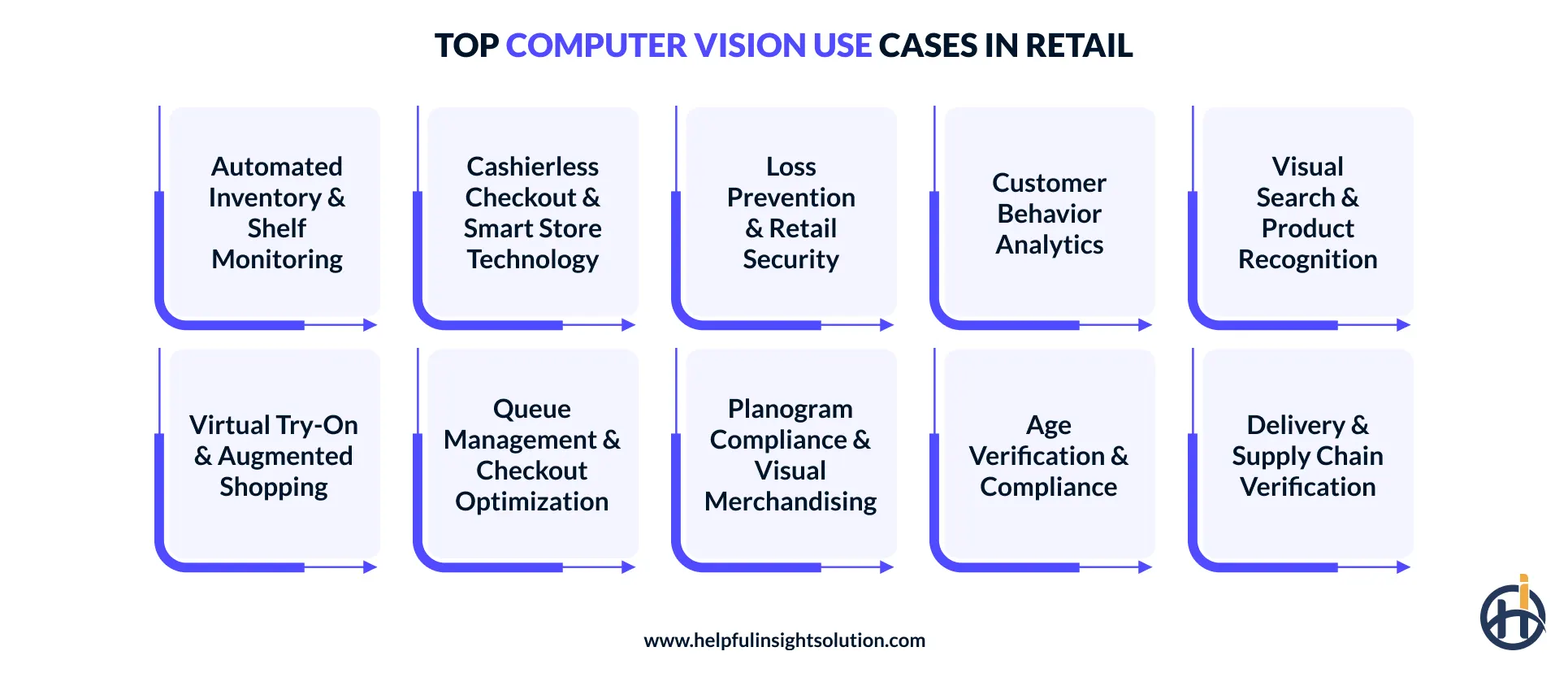
1. Automated inventory & shelf monitoring
AI-powered computer vision systems regularly monitor shelves to analyze what products are available and if the shelves are in good condition. Cameras that use AI can immediately see when shelves are empty or when products are not in the right place. They can also see when items are running low without anyone having to check, helping stores keep the amount of products updated and work better.
How to implement: You must deploy AI-enabled shelf cameras integrated with inventory and POS systems to monitor product availability continuously. Train vision models to recognize stock levels, misplaced products, and shelf gaps in real time.
2. Cashierless checkout & smart store technology
In retail, advanced computer vision platforms keep track of what customers do with products and regularly keep track of what they pick up as they shop. When you combine this with artificial intelligence and advanced sensors, customers can buy things without going to a checkout counter. This makes shopping easier and faster, allowing people to buy more in a limited time frame.
How to implement: It is beneficial to install ceiling-mounted cameras and sensor networks that track product selection and customer movement throughout the store. Integrate the system with digital payment platforms to automate purchase completion.
3. Loss prevention & retail security
Various retail businesses integrate computer vision technology to focus on suspicious activities, like someone trying to get into a store when they are not supposed to or someone trying to steal something. It does this by looking at video from store cameras, generating instant alerts when it sees something. This helps keep the store safe in real-time and prevents products from being stolen.
How to implement: Implement AI-powered surveillance devices at store entrances, exits, and high-risk areas to monitor suspicious activities. Configure automated alerts and integrate them with the store’s security management system for rapid response.
4. Customer behavior analytics
With computer vision solutions for retail, storekeepers can constantly observe how customers move around the store, what they buy, and how they interact with products. Stores can learn a lot about different customer preferences, buying patterns, and purchase history from this information. They can use this data to make the store better and to give customers a personal experience.
How to implement: Position computer vision sensors to capture customer movement and shopping interactions across different store zones. Connect analytics dashboards to convert visual data into actionable business insights for decision-making.
5. Visual search & product recognition
Computer vision lets customers find products by taking a picture of them or typing what they are looking for. Artificial intelligence can then find products and give customers more information about a specific product or item. This makes it easier for customers to find what they want when they are shopping online or in the store.
How to implement: You should develop an AI model trained on a comprehensive catalog of product images and attributes. Integrate image-based search into mobile apps or eCommerce platforms to enable visual product discovery.
6. Virtual try-on & augmented shopping
This computer vision application in retail helps people see what things will look like on them before they buy, such as clothes, glasses, makeup, and accessories. This is done by integrating Computer vision, artificial intelligence, and augmented reality. It makes people feel more sure about what they’re buying, and they are less likely to return things.
How to implement: It is crucial to build AR-powered applications using facial or body tracking technologies to accurately overlay virtual products. Optimize AI models for realistic rendering across different devices and lighting conditions.
7. Queue management & checkout optimization
This use case of computer vision is common in the retail ecosystem, allowing managers to handle how many people are waiting in line to pay for products. Businesses can use computer vision development services to open more checkout lines or move staff according to the number of people. This helps vendors to reduce long waiting times and improves overall customer satisfaction through instant queue management services.
How to implement: Deploy overhead cameras at checkout areas to monitor customer flow and queue lengths continuously. Configure AI to trigger staff allocation recommendations whenever congestion exceeds predefined thresholds.
8. Planogram compliance & visual merchandising
Computer vision retail metrics make sure products are displayed correctly in stores with accurate descriptions and see store layouts in real time. If something is not right, this technology finds the problem by analyzing images and generating updated notifications. This increases stores’ consistency and makes sure people see the products in a reliable manner.
How to implement: Capture shelf images regularly using fixed cameras or employee mobile devices for automated analysis. Compare store layouts against digital planograms and generate corrective action reports for merchandising teams.
9. Age verification & compliance
When people buy things like alcohol or tobacco, computer vision tries to figure out their age through facial recognition. This helps stores make sure they are selling the right products to people who are old and suffering from diseases. Computer vision also helps with identity verification, making the process faster and more accurate.
How to implement: Implement AI-powered facial analysis with secure identity verification workflows at self-checkout counters or kiosks. Configure the solution to comply with local regulations while protecting customer privacy.
10. Delivery & supply chain verification
Advanced CV-powered retail platforms constantly monitor received packages and shipping labels to make sure everything is correct. Additionally, it checks to see if things are damaged or if the wrong things were sent, reducing mistakes and ensuring trust. It can automate supply chain verification by validating incoming shipments, detecting missing items, and matching purchase orders with inventory movements real time.
How to implement: Install computer vision systems at warehouses and distribution centers to inspect packages during receiving and dispatch. Integrate AI with logistics software to automatically validate shipments, packaging quality, and delivery accuracy.
Key benefits of computer vision in the retail industry
Businesses must know the benefits of computer vision in retail, such as accurate inspections and secure audits. These advantages motivate enterprises to understand more about this technology before investing.
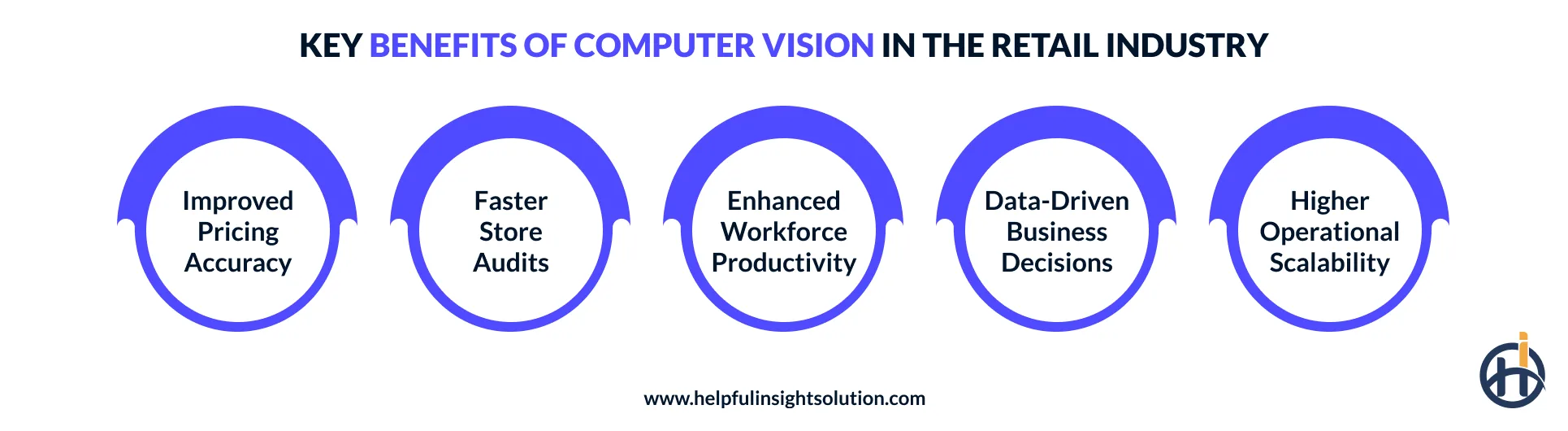
1. Improved pricing accuracy
Computer vision helps retailers to easily eliminate manual shelf audits by continuously scanning price tags and comparing them to centralized pricing databases. Additionally, it also raises discrepancies before they reach the checkout and create disputes.
2. Faster store audits
Businesses can optimize store audits regularly by implementing computer vision in the retail industry, ensuring staff replacement and inventory monitoring. It detects stockout conditions, misplaced items, and sold products, which reduces administrative expenses.
3. Enhanced workforce productivity
By automating visual tasks like inventory counts and checkout monitoring, computer vision allows store workers to perform higher-value activities. These include customer assistance, sales monitoring, and stocking management without adding headcount.
4. Data-driven business decisions
Store managers use computer vision to transform static cameras into active data sensors that offer analytical precision and real-time insights. This capability of computer vision in business innovation helps to boost sales, manage inventory loss, and reduce overhead.
5. Higher operational scalability
Unlike other traditional audit processes, a computer vision platform can monitor shelf compliance, queue lengths, and loss events. It replaces the requirement of physical presence for hundreds of retail stores and supermarkets from a single dashboard.
ROI analysis: Is computer vision worth the investment?
Investment in computer vision for retail businesses is worthwhile, as it is applied to repetitive tasks where error management is costly. Store activities like labor reallocation, reduced defect rates, and proactive maintenance help managers to drive ROI.
It is crucial to adjust to environmental complexities and ensure proper integration. In this section, we will focus on all these points and understand how they are impacting retail ROI.
- Labor reallocation: Computer vision automates repetitive visual tasks, allowing staff to focus on customer service, sales, and higher-value operational activities.
- Yield recovery & defect reduction: AI-powered visual inspection identifies errors and defects early, reducing waste and improving product quality and inventory accuracy.
- Preventive maintenance: Computer vision detects equipment anomalies before failures occur, helping retailers reduce downtime and maintenance costs.
- Risk and audit avoidance: Automated visual records and compliance monitoring simplify audits while reducing regulatory and operational risks.
Businesses must also know about various risky parameters that can reduce ROI and can prevent revenue generation. These points must be addressed quickly to keep the growth on track.
- Underestimating environmental complexity: Retail environments with varying lighting, layouts, and product appearances can significantly affect model performance if not properly planned for.
- Overlooking data requirements: Successful computer vision systems require large volumes of high-quality, well-labeled visual data to achieve reliable accuracy.
- Integration challenges: Connecting computer vision solutions with existing POS, ERP, inventory, and security systems can increase implementation time and complexity.
Major computer vision integration challenges in retail systems
Data privacy, legacy systems, and increased costs are the key challenges of computer vision in retail. You will study all these integration issues along with their respective solutions with detailed information.
1. Legacy system compatibility
The lack of processing power, outdated POS terminals, and limited data transmission are the key legacy system issues. The integration of modern systems can increase operational burden and downtime, leading to system failure.
Solution: The use of an Enterprise Service Bus (ESB) to link legacy platforms with AI models, which support data formats and protocols.
2. High infrastructure investment
Advanced hardware systems, complex CV models, and constant network spikes increase the overall integration cost. Trained AI models require regular maintenance, as they can malfunction due to changes in real-world conditions.
Solution: You can use cost-effective processing units, cloud feeds, and computer vision models to reduce operational expenses and overhead burden.
3. Model accuracy across systems
The accuracy of computer vision is dependent on environmental settings, like poor lighting, motion blur, and occlusions. Additionally, it is difficult to state differences between products with minor parameters, like flavors or sizes.
Solution: Businesses should integrate a hybrid edge-cloud infrastructure with model pipelines to ensure the accuracy of AI models and algorithms.
4. Data privacy and regulatory compliance
Retail platforms gather a vast amount of customer data, which requires dynamic storage and secure transmission. Most businesses do not follow compliance due to strict regulations, which can affect growth and user trust.
Solution: It is crucial to implement computer vision retail security systems that can easily identify security risks before execution.
How to implement computer vision in your retail store
From ideation to system optimization, we will cover each step to integrate computer vision in retail. The following stages are crucial for businesses, as they help in budget planning, cost estimation, and scalability.
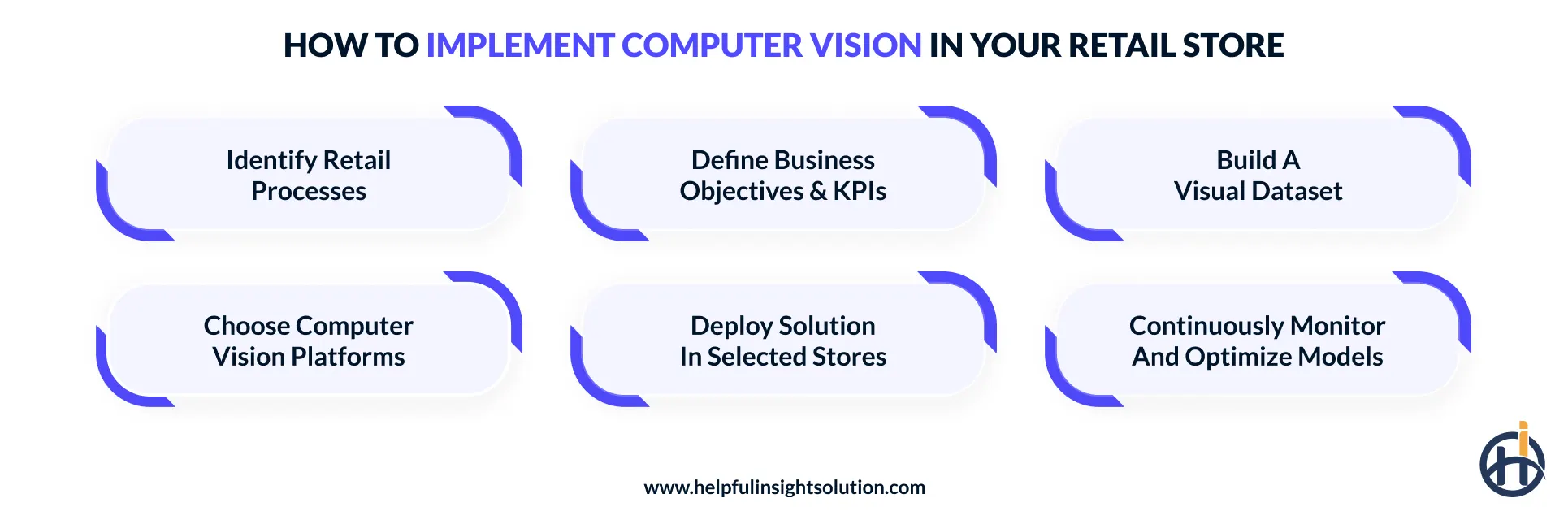
1. Identify retail processes
To get started you need to analyze retail operations to find out where computer vision can be easily implemented. You should focus on repetitive tasks that require greater accuracy, efficiency, or system automation. It is crucial to prioritize workflows, which ensures higher investment returns and user retention.
2. Define business objectives & KPIs
You need to set goals like improving operational efficiency, reducing costs, increasing sales, or enhancing customer experiences. Additionally, it is important to measure KPIs, such as processing speed, accuracy, operational expenses, and scalability. Investors must track the computer vision retail implementation process to know their business objectives.
3. Build a visual dataset
Enterprises should collect multiple high-quality pictures and videos from their stores that show products, store layouts, and real-time customers. You need to organize this data so that it can be used to train various AI models to recognize things correctly. This helps store owners to ensure accuracy and enhanced performance across regions.
4. Choose computer vision platforms
Now, you can choose a computer vision platform that can help you develop AI models, process information in real time, and work with your existing systems. An AI development company helps you to decide on cloud, edge, or hybrid systems based on the project and budget requirements. These platforms are flexible and reliable, allowing businesses to ensure long-term growth.
5. Deploy solution in selected stores
Entrepreneurs should start using the computer vision systems in a few stores to analyze performance and errors in real-time. They must observe system accuracy, user adoption, and business outcomes before deploying at a large scale. This systematic approach will help investors to reduce market risks and optimize platform adjustments.
6. Continuously monitor and optimize models
You should regularly monitor the AI model performance by using real data and system feedback to make improvements. Additionally, it is also crucial to retrain models, update algorithms, and adjust workflows according to market changes. These computer vision retail metrics ensure long-term accuracy, scalability, and increased business value.
Real-world examples & case studies
Grocery vendors and supermarkets use the top computer vision retail applications, such as Amazon Go and Nike Fit. You will study them and understand how CV is enhancing their day-to-day operations in detail.
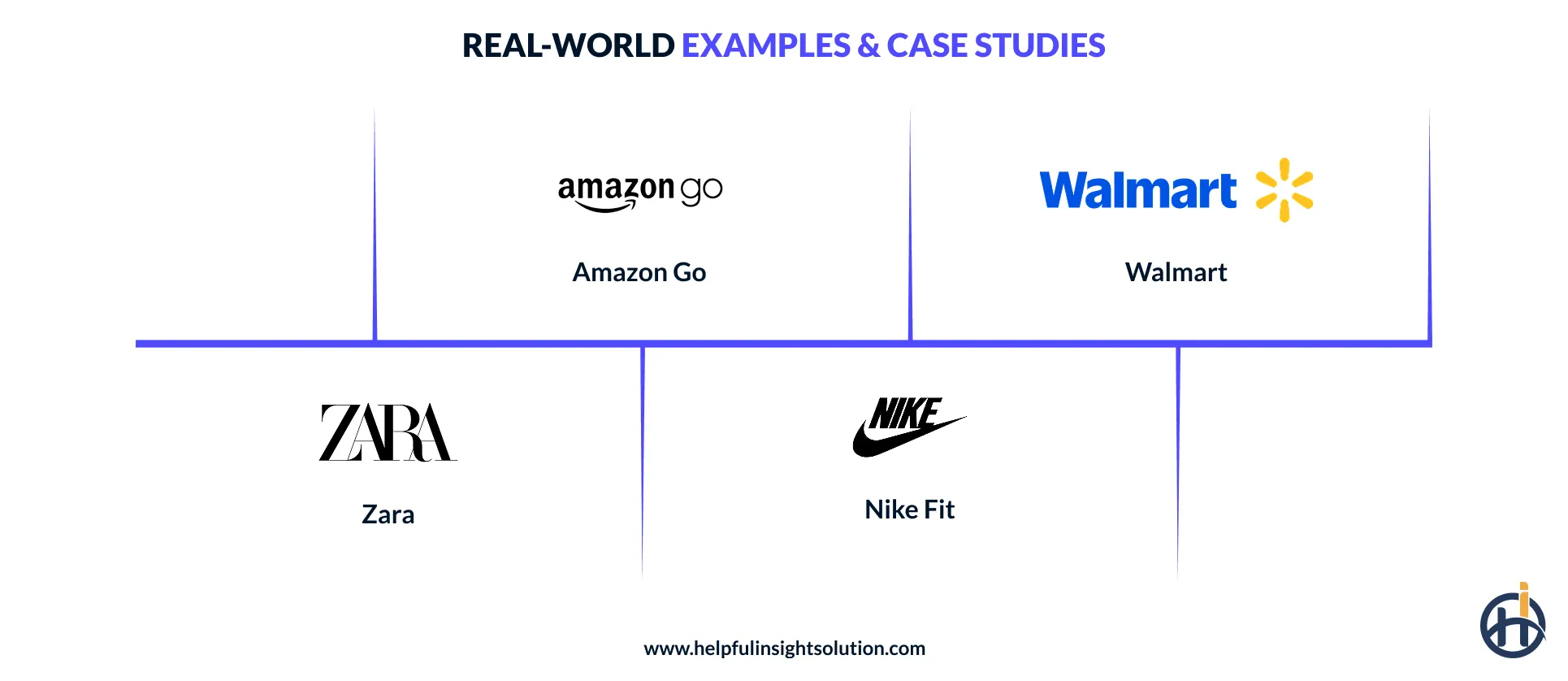
1. Amazon Go
Amazon Go allows users to easily pick up selected products and leave without traditional checkouts, as it uses computer vision and AI. The computer systems can automatically identify purchased items and charge customers through their linked accounts.
Impact on users: This eliminates checkout lines, enabling a faster, frictionless shopping experience with automatic payments.
2. Walmart
Walmart’s computer vision retail smart stores monitor store operations, identify out-of-stock products, and improve shelf availability across regions. The AI-powered systems help employees fix problems with the inventory quickly and ensure a better shopping experience.
Impact on users: It improves product availability by reducing out-of-stock situations, helping shoppers find the items they need more consistently.
3. Carrefour
Carrefour monitors shelf inventory, detects out-of-stock products, and verifies planogram compliance by enabling improved store accuracy. AI-powered visual analytics also analyzes customer traffic patterns and shopping behavior, which optimizes store layouts and enhances the overall retail experience.
Impact on users: This platform provides better product availability and faster shopping experiences to customers, reducing the chances of out-of-stock items.
4. Nike Fit
Nike Fit uses computer vision to scan customers’ feet through a mobile phone camera and identify their shoe size. This enhances recommendations, reduces product returns, and increases confidence among buyers at online or offline stores.
Impact on users: It delivers accurate shoe size recommendations, increasing purchase confidence while reducing sizing-related returns.
Future of computer vision technology in retail
The future of computer vision for retail is surrounded by multiple technical innovations, such as edge AI and hyper-personalization. We will discuss all the major future technologies in this section that you must focus on.
1. Hyper-personalized store experiences
Computer vision can easily analyze various user preferences and buying habits to give them personal suggestions and deals. This increases conversion rates for shop owners by increasing overall customer experiences and allowing them to buy more products.
2. Multimodal AI retail intelligence
Various multimodal regulations help stores make decisions on product sales, market selection, and user demands. These computer vision retail trends integrate with generative AI, voice assistants, IoT devices, and predictive analytics for better productivity.
3. Edge AI for real-time processing
Edge AI allows storekeepers or workers to observe pictures and videos on local devices without any cloud infrastructure. This improves decision-making, data privacy, retail operations, and market reach for regional vendors.
4. Sustainability-focused retail operations
Computer vision uses AI insights to monitor energy consumption, optimize resource utilization, and minimize product waste. It helps the store save money, increase scalability, enhance customer shopping habits, and improve user engagement.
How does Helpful Insight ensure seamless computer vision integration in retail platforms?
Now, we have discussed a lot about computer vision in retail, and it’s time to take a step forward for business success and customer engagement. You should hire an experienced firm that can provide a skilled team of automation experts who understand computer vision closely.
Businesses must use their AI-powered software development services for integrating advanced technologies in their existing systems or developing new platforms from scratch. We assist our clients in selecting the right model based on budget analysis, target audience, and market potential.
With our smart computer vision retail management solutions, managers can improve store efficiency, remove manual errors, and retain loyal customers. This enhances brand visibility, increases the revenue cycle, processes billing with accuracy, and optimizes shelf occupancy.
You are not late but must not delay the digital transformation of your retail chains.
FAQs
The overall timeline (9+ months) is divided into three important phases, which start with data gathering and planning that takes 1-2 months. The next phase is AI model training and integration, which is the rate-determining step and may take up to 2-6 months. At last, the project testing and rollout phase may take a total time of 6-9+ months or increase more.
The average cost of implementing computer vision in the retail industry for small pilot projects ranges from $40,000 to $100,000. For enterprise-grade systems, the overall price may increase to $200,000 due to compliance and security features. To get full automation for a full-scale platform, businesses may have to spend between $150,000 and $300,000.
Businesses must regularly monitor customer data, retail shifts, and seasonal trends to prevent model degradation. Some of the key methods that ensure the accuracy of predictive models are discussed as follows:
- It is beneficial to implement MLOps platforms to monitor conversion rates and order value.
- You can retrain existing frameworks to manage repetitive tasks by analyzing historical data.
- Enterprises must set strict data contracts to prevent wastage and enhance retail governance.
Computer vision processes data, such as customer movement, that is gathered from different hardware devices. The most important sensory and tracking devices are described in the following manner:
- IP cameras: They capture high-resolution images of humans and monitor shelf count.
- Edge servers: Devices like NVIDIA Jetson AGX process data and deliver on-time suggestions.
- Autonomous retail robots: These bots help people to find product categories and check prices.
The computer vision technology in retail provides out-of-stocks monitoring, planogram deviations, and real-time item tracking. The installation of high-quality assistants in retail stores and supermarkets helps customers find the right products. Additionally, automated barcode and label tracking allows vendors to easily identify the number of verified items.
In retail stores, computer vision uses AI and cameras to analyze and track various items, whereas RFID depends on radio waves and physical tags. CV can identify product damage, expiration dates, and human behavior, but RFID provides item descriptions and locations. Computer vision is expensive due to AI and hardware complexities, but RFID expenses include product tags and readers.
Businesses can implement computer vision under various privacy laws, such as GDPR in Europe and CCPA in California. It tracks and collects sensitive customer information, like facial expressions, body movements, and biometric signatures. Most CV-based retail platforms blur human faces, use necessary data, and ensure local data processing standards.