


Key Takeaways
- AI claims processing automates intake, document reading, coverage checks, fraud scoring, and simple settlements. Adjusters keep the complex, disputed, injury, and litigated claims.
- Most teams start with intake and documents because the payoff is easy to measure, then move on to fraud scoring and settlement.
- A production system works best as ten layers, each with one job. Two mistakes cause the most trouble: bolting on human review late and postponing explainability until a regulator asks.
- The main benefits are faster cycles, lower handling cost, less leakage and better fraud catch, consistent decisions with an audit trail, and more adjuster time for hard cases.
- Start narrow: pick one claim type, clean and label your data (it often takes longer than building the model), keep adjusters in the loop, and pilot next to the manual process before expanding.
Think about the last time you waited on something important. You sent the same document twice, called for an update, and still heard nothing. That is what filing an insurance claim feels like for many people.
In its 2026 study, J.D. Power found homeowners waited about 40.7 days on average, from first notice of loss to final payment.
The delay is usually not one big mistake. It is small manual steps piling up: someone reads each document, checks the policy, and passes the file along.
AI in insurance claims processing takes over those steps. It reads the paperwork, checks coverage, spots possible fraud, and pays simple claims on its own. Your team then spends its time on the claims that need a human.
In this guide, we will explain how it works: use cases, architecture, benefits, how to build it, and what it costs.
What is AI in insurance claims processing?
AI in insurance claims processing means using software that learns from data to do claims work people used to do by hand. That covers taking the first report, reading attached documents, checking the policy, scoring fraud risk, estimating damage from photos, and deciding where the claim goes next.
The technology is a mix, not a single tool. OCR and document intelligence turn scans and PDFs into usable fields. Machine learning in claims management predicts things like fraud likelihood and claim severity, and computer vision reads photos.
A large language model (LLM) summarizes files and drafts letters. A rules system applies the policy terms, and the approval limits the carrier already set.
For simple claims, automated claims processing in insurance means a small windshield claim goes from report to payment with nobody touching it. Insurers call that straight-through processing. A bodily injury claim with a lawyer involved does not go that way, and it shouldn’t.
The goal is to lift the repetitive load off adjusters so their time goes where judgment matters. None of this removes the adjuster. It changes how the adjuster spends the day. Helpful Insight builds systems like this for carriers through its insurance practice.
AI claims processing market: Size and adoption statistics
Regulator surveys show how widely carriers use AI for insurance claims today. Analyst reports show where spending is heading. The two come from different methods, so they are listed separately. Claims automation also sits inside wider digital transformation in insurance programs.
Adoption among insurers
- Claims is the top AI use among auto insurers. The NAIC’s 2022 private passenger auto survey covered 193 insurers. 88% used, planned to use, or were exploring AI or machine learning, and 135 already used it in claims operations.
- Homeowners insurers follow. In the NAIC’s 2023 homeowners survey of 194 insurers, 70% used or were interested in AI. 54% reported using it for claims.
Homeowners insurers follow. In the NAIC’s 2023 homeowners survey of 194 insurers, 70% used or were interested in AI. 54% reported using it for claims.
- Health insurers report heavy use. An NAIC survey of 93 health insurers across 16 states found 84% currently use AI.
- Regulation is catching up. As of October 2026, 29 jurisdictions have adopted the NAIC Model Bulletin on insurer AI use.
Market size estimates
- According to Technavio, the market adds $1.39 billion between 2024 and 2029, a 28.4% yearly rate. This is growth added, not total size.
- Market.us projects the global market at $2,761 million by 2034, up from $514.3 million in 2024, growing 18.3% a year. The US market was $172.65 million in 2024, growing 17.7% per year.
- Fortune Business Insights reports that claims processing was the largest application segment of the AI in insurance market in 2025.
AI use cases in insurance claims processing
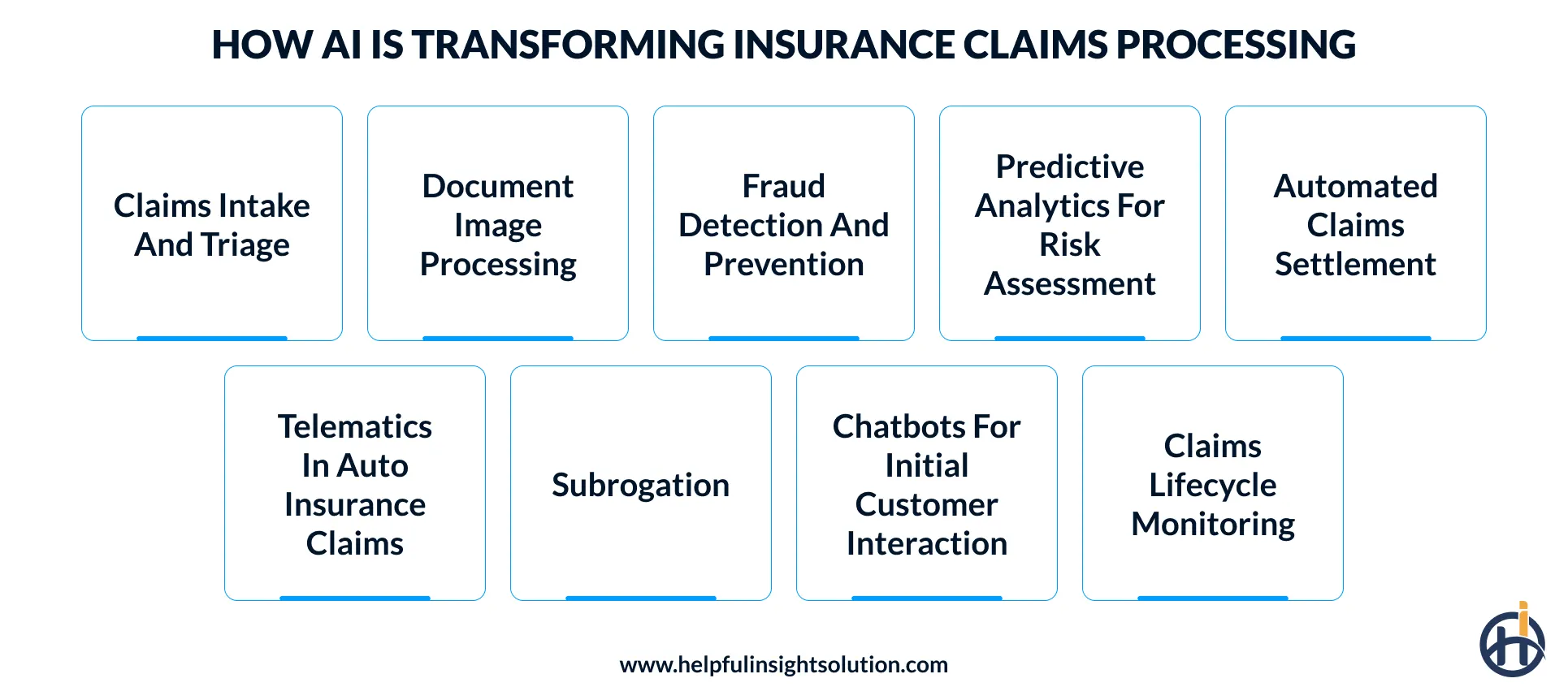
These nine use cases come up most often in real AI claims processing projects. Most teams start with intake and documents because the payoff is easy to measure, then move on to fraud and settlement.
Summaries and chat are the exceptions, since they use generative AI in insurance to write and answer instead of only classify.
Claims intake and triage
A first notice of loss can arrive as a web form, an email with three photos, or a call transcript. The system pulls out what happened, when, and who was involved, then sorts the claim. A cracked windshield goes to the fast lane.
A rear-end collision with a reported neck injury goes to a senior adjuster the same day. Good claims triage mostly removes the time a file sits in a shared inbox. Teams usually tune this first, because a bad routing rule is easy to spot and cheap to fix.
Document image processing
Repair estimates, medical bills, police reports, and invoices arrive in every format imaginable. OCR reads them, and models flag a missing page or a name that doesn’t match the policy.
Handwriting and blurry phone photos still trip these tools up, so low-confidence reads go to a person. A large language model then adds a short file summary, so the adjuster doesn’t open forty pages.
Fraud detection and prevention
Models compare each claim with past claims, known schemes, and shared phone numbers, addresses, or repair shops. A high score doesn’t deny anything. It sends the file to a special investigation unit (SIU). The Coalition Against Insurance Fraud estimates US property and casualty fraud at about $45 billion a year.
Its $308.6 billion all-lines figure includes life insurance and government health programs. Some researchers dispute how these estimates were built. Investigators care most about false positives. A model that flags everything gets ignored within a month.
Predictive analytics for risk assessment
Machine learning in claims management can estimate what a claim will probably cost, using the first few facts on file. That is severity prediction. Reserves land closer to reality sooner, and experienced adjusters see expensive claims early. Some carriers also score the likelihood that a claim ends in litigation, because catching that early changes how they handle the file.
Automated claims settlement
Automated claims processing handles small, clear-cut claims. The system checks coverage, applies the deductible, works out the amount, and sends payment.
People decide the rules and the dollar limits. Anything above the limit, or anything the model isn’t sure about, drops into an adjuster’s queue.
Telematics in auto insurance claims
Phones and connected cars record speed, hard braking, and the moment of impact. After a crash, that data helps confirm what happened and who was at fault, which cuts a lot of back-and-forth.
It can also start a claim report before the driver ever calls. Consent and privacy rules vary by state, so carriers have to be careful about what they collect.
Subrogation optimization
Subrogation means recovering money from whoever was actually at fault. Models read the claim file for signs that a third party is responsible and estimate how much is recoverable.
Recovery teams then work the files most likely to pay back, instead of going through the pile in order.
Chatbots for initial customer interaction
A chat or voice assistant walks the claimant through the first report, asks the follow-up questions an adjuster would ask, and requests missing documents. It can answer “Where’s my claim?” at 11 p.m.
The handoff to a person has to be easy, because someone reporting a house fire isn’t in the mood for a bot.
Claims lifecycle monitoring
Dashboards follow each claim from first report to closure. Models flag claims that have stalled, files drifting past service targets, and cases that look odd next to similar ones. Managers see the problem in week two instead of discovering it in a quarterly review.
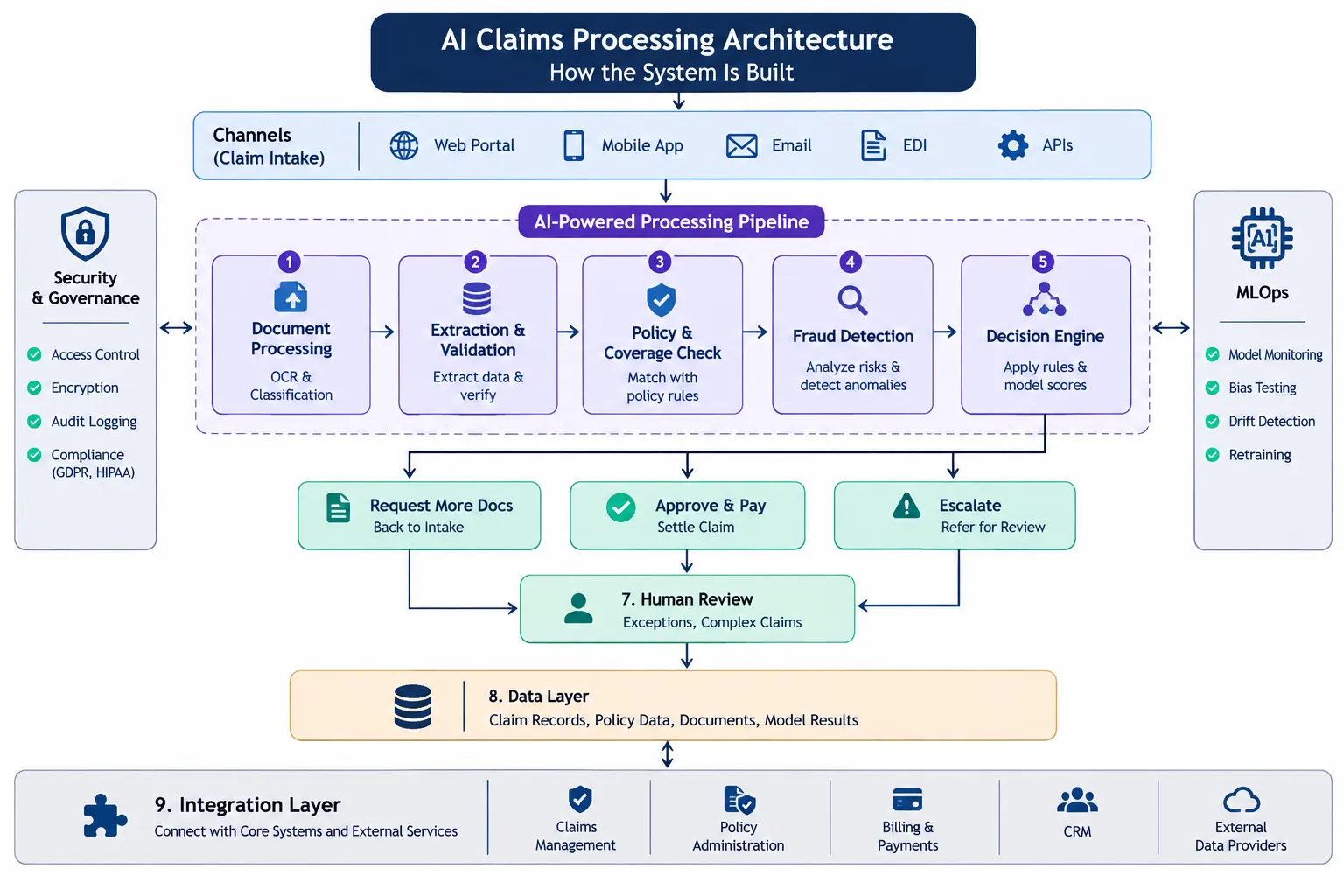
AI Claims Processing Architecture: How the System Is Built
The system works best as ten layers, each with one job. That layout lets a team swap a model, add a claim type, or answer an auditor’s question without rebuilding everything. Many carriers integrate these layers into their existing claims management software instead of replacing it.
Claim intake or ingestion layer
Claims come in through portals, mobile apps, email, call transcripts, EDI feeds, and partner APIs. This layer gathers them into one format and assigns a claim ID. Messy inputs are normal here, so the layer should accept them rather than reject them.
Document processing
OCR and document intelligence classify each file, a repair estimate versus a medical bill, and read the text. Quality checks run first. A skewed or low-resolution scan gets flagged before bad text moves downstream. Damage photos go through computer vision models that flag the type and extent of damage.
Data extraction and validation
Dates, amounts, policy numbers, and parties get pulled out and normalized, then checked against source records. A mismatch between the reported date of loss and the policy period shows up here, not three steps later.
Policy and coverage verification
The system confirms the policy was active, the loss type is covered, and the limits and exclusions apply. Rules handle clear terms. An LLM can read an ambiguous endorsement and cite the clause it used, so an adjuster can verify it.
Fraud detection engine
This layer scores each claim and links related parties across files. It mixes models trained on confirmed fraud with anomaly detection for patterns nobody has labeled yet. The output is a score with reasons, never an automatic denial.
Decision or rules engine
Business rules, approval limits, and model scores combine to pick the next step: pay, request documents, escalate, or refer. Keeping rules separate from models lets a claims manager change a threshold without a code release.
Human-in-the-loop review
Uncertain, high-value, or flagged claims land in an adjuster’s queue with a summary and the reasons behind the flag. Every correction is saved as training data. The human in the loop is how the models keep improving.
Integration layer
This layer connects everything to the core claims platform, policy admin, billing, payments, and CRM through APIs and message queues. On most projects, it takes longer than the models, especially with older systems.
Security, compliance, and audit trail
Role-based access, encryption, and a log of every decision with its inputs. Examiners ask why a claim was approved or denied, and explainability depends on those logs. The NAIC AI model bulletin expectations also get documented here.
MLOps and model monitoring
Models drift. Repair costs change, fraud schemes change, and the claim mix shifts after a hailstorm. This layer tracks accuracy, tests for bias, and triggers retraining.
Teams building AI for insurance claims tend to make two mistakes. Human review gets bolted on late, which leaves no labeled data and no safety net. Explainability gets postponed until a regulator asks.
Both are cheaper to build in from the start. Monitoring belongs in the first sprint too, because models nobody watches degrade quietly.

What are the benefits of AI in claims processing?
Results from AI claims processing depend on claim mix, data quality, and the share of work that gets automated. That is why teams track cycle time, cost per claim, and error rates before launch, so later gains can be measured against real numbers.
Faster cycles
Most claim time isn’t work. It’s waiting for someone to open the file, for a document to be keyed in, for a coverage check to get picked up. Automated claims processing removes those gaps.
Intake, extraction, and coverage checks run in minutes, so a simple claim can close in days rather than weeks. Complicated claims speed up too, because the file reaches the adjuster already organized. Track days from first notice to payment by claim type, since averages hide the slow ones.
Lower handling cost
Keying data, forwarding emails, and chasing missing documents eat a large share of an adjuster’s week. AI in insurance claims processing cuts that work and lowers the cost of each claim. Robotic process automation handles much of the routine keying and forwarding.
It also changes how a carrier handles surge volume. After a hailstorm or hurricane, automation handles simple claims while adjusters focus on badly damaged properties, so nobody scrambles to hire temporary staff.
Less leakage, better fraud catch
Manual review samples a few claims. A model looks at every one. That’s how duplicate payments, coverage mistakes, and repeat claimants turn up. Fraud teams benefit too.
They get a ranked list with reasons instead of a random queue, so investigators spend their hours on files with a real chance of being fraudulent. Recovered dollars and avoided payments are both worth tracking, though avoided payments are harder to prove.
Consistency and audit trail
Two adjusters can read the same claim differently. Rules and models apply the same logic every time, and they log every step with its inputs. That supports fair treatment of policyholders.
It also makes a market conduct exam far less painful, because the evidence already sits in one place. The NAIC bulletin expects that record anyway.
Adjuster capacity and claimant experience
Adjusters who aren’t retyping forms have time to call a policyholder, explain a denial, and negotiate a hard case. Claimants notice. They get status updates without asking, and one clear list of documents instead of three separate requests.
That’s what people remember when they decide whether to renew. Keeping experienced adjusters matters here as well, since training a new one takes months.
How to develop an AI claims processing system?
Projects that work start narrow, and AI claims processing is no exception. These six steps are written for carriers, MGAs, and third-party administrators. A team without in-house engineers can hire an insurance software development company for design and build.
1. Define goals, KPIs, use cases, and compliance needs
First, choose one claim type to begin with. Auto glass and low-value property claims are common picks because the rules are clear and the volume is steady.
Write down the numbers that should move: days to close, cost per claim, share of claims paid with no manual touch, and fraud referrals that pan out. Then list the regulations that apply, including state rules, the NAIC AI model bulletin where adopted, and HIPAA for anything health-related.
Compliance is far cheaper to plan now than to retrofit. Keep the first scope small enough to finish in one quarter.
2. Collect, clean, and label data
The data for this step comes from past claims, policy records, documents, photos, and adjuster notes. It is rarely clean. Expect gaps, duplicates, and fields that mean different things in different systems. Labeling is the next job.
Adjusters need to mark which past claims were fraud, which were denied, and what each one settled for, and that usually means sitting down with samples. Personal data should be masked early, before the files reach the model.
This step needs real time in the plan. Weak data sinks more projects than weak models do, and cleaning and labeling often take longer than building the model.
3. Design architecture and choose the tech stack
Start by mapping the ten layers against what the carrier already has. Then check how any new piece will connect to the core claims platform, especially if the carrier still runs a legacy system, because integration tends to eat the schedule. With that known, decide what to build, what to buy, and what to access through an API.
A commercial OCR service may beat a custom one, while fraud scoring often needs the carrier’s own history to work well. Write down which team or vendor owns each layer, so ownership is clear when something breaks.
4. Build and train AI models with human-in-the-loop review
Begin with document extraction and claims triage, since both are easy to validate. Add fraud scoring and damage assessment once the base is stable. Set a confidence threshold for each model.
Claims that fall below it go to an adjuster, and the adjuster’s corrections are saved for retraining, along with a note on why each override happened. Without that loop, accuracy stalls because the model never learns what it got wrong.
This is why machine learning in claims management depends on steady human feedback.
5. Integrate, test, and validate
Connect the system to claims, policy, payment, and CRM platforms. Then test against historical claims where the outcome is already known. Check accuracy by claim type, look for bias across protected groups, and probe security and odd cases such as a claim filed twice.
Adjusters should run the user acceptance testing, since they’ll spot problems a test script never will. Set the pass mark before testing begins, not after the results come in.
6. Pilot, deploy, monitor, and improve
Run the pilot on a slice of live claims, ideally next to the manual process so results can be compared claim by claim. Expand in stages. After launch, watch for model drift, retrain on new data, and review the KPIs every month.
Launch day is where the work starts, not where it ends. Keep a rollback plan, so a problem means a pause rather than an outage.
Common Claims Processing Challenges and How AI Solves Them
Insurance claims teams deal with piles of paperwork, tight timelines, and the constant risk of fraud. Here is where things usually go wrong and how AI helps fix each problem.
Claim registration
When a claim comes in, someone has to type in the same details again and again and check each document by hand. It’s slow and boring work, and tired people make mistakes. Small errors at this stage can quietly cause bigger delays later.
Solution
AI takes over the repetitive data entry and fills in the forms automatically. It can also read emails, PDFs, and scanned documents and pick out the key details, like names, dates, and policy numbers. Claims get logged faster, with fewer typos and far less manual effort.
Estimating claim cost quickly
Insurers need to know early how much a claim might cost. But their teams often spend more time cleaning up and preparing data than actually working out the numbers. By the time the estimate is ready, the situation may already have changed.
Solution
AI can quickly pull together past claims and current trends to give a reliable estimate early on. That frees up the team to focus on decisions instead of data prep. Settlements and reserve planning become faster and more accurate.
Spotting fraud
Roughly one in ten property and casualty claims in the US involves some kind of fraud. Catching it late means money is already gone, and it hurts the insurer’s overall results. Checking every claim by hand is not realistic.
Solution
AI scans claims for unusual patterns that people could easily miss, and it gets sharper as it learns from more cases. It gives each claim a risk score, so investigators can focus on the suspicious ones first. Honest customers also face fewer unnecessary checks and delays.
AI claims processing compliance and governance
There is no single federal rulebook for AI in claims. Most of the pressure comes from state insurance regulators, who are applying existing fair-claims and unfair-discrimination laws to AI.
California, Colorado, New York, and Texas have also issued their own insurance AI rules, on top of the NAIC bulletin. The table below shows what to plan for and where in the system to build it.
| Area | Type | What it means |
| Written AI program | Regulator expectation | A written program covering governance, risk controls, internal audit, and third-party AI. |
| Exam documentation | Regulator expectation | Regulators can request information and documentation about your AI systems. |
| Fairness and bias | Law plus expectation | The aim is to prevent AI decisions that are arbitrary, unfairly discriminatory, or in breach of unfair trade practice laws. |
| Vendor oversight | Regulator expectation | The insurer stays responsible for vendor models’ outputs. |
| Health information | Law (HIPAA) | Applies when claims include health data. |
AI claims processing development cost and timeline
No single price fits every AI claims processing project. Development firms publish planning ranges, and those are a rough guide, not a quote. The table below shows AI claims processing development costs by stage.
| Stage | Cost range | Timeline | What it covers |
| Proof of concept | $15,000 to $40,000 | 4 to 8 weeks | One claim type, one use case such as document extraction |
| Production MVP | $60,000 to $180,000 | 8 to 16 weeks | AI added to an existing claims system through APIs |
| Enterprise platform | $300,000 to $3 million or more | 6 to 18 months | Multiple claim lines, deep integrations, full governance |
| Running costs | $3,000 to $15,000 a month | Ongoing | API-based build, after launch |
Four things move the number most: data quality, the age of the systems being connected, how many claim lines are covered, and the compliance scope. For a feature-level breakdown, read our guide on claims management software development cost.
What’s the future of AI in claims processing?
Consultants and insurers largely agree on where this is heading. AI will take over more of the routine work, help prevent losses before they happen, and people will keep a firm role in the decisions that matter.
Agentic AI managing entire claims workflows
Until now, AI has mostly helped with single tasks, like reading a document or flagging a suspicious claim. The next step is AI agents that can handle a whole workflow from start to finish, including fraud checks and settlement recommendations.
IoT integration for real-time incident detection
Cars and smart homes are filled with sensors that can tell when something has gone wrong. In the future, a connected car might detect a crash and start the claim itself, or a home sensor might report a leak right away.
This closes the gap between the moment of loss and the moment the insurer finds out. Faster notice means faster help, and often less damage overall.
Predictive AI anticipating claims before they happen
Instead of waiting for a loss, AI models may spot warning signs early so insurers can step in. A simple example is a leak sensor that detects water and shuts off the supply before a pipe floods the kitchen.
The customer avoids the stress and disruption of a major claim, and the insurer avoids a big payout. It’s a win for both sides.
Shift from promise to pay to promise to protect
Traditionally, an insurer has promised to pay when something goes wrong. Some insurtech leaders, including Quensus, believe that’s changing. They see claims teams becoming resilience teams that work to stop losses in the first place, not just compensate people afterward.
The goal is to keep customers safe and their lives running smoothly.
Human-in-the-loop remains vital for judgment and accountability
Even with all this automation, experts are clear that people can’t be removed from the process. Cowbell’s chief product officer calls human review non-negotiable.
McKinsey’s Claims 2030 research likewise expects injury claims and litigated claims to need human judgment for the foreseeable future. These cases involve empathy, nuance, and responsibility, which a machine cannot fully take on.

Conclusion
AI in insurance claims processing works today for intake, documents, triage, fraud scoring, and simple settlements. Teams that get good results start narrow, clean their data, keep adjusters in the loop, and build governance from day one. Expansion is easier once one claim type has proven itself.
If you are planning to design and build AI systems for claims or integrate AI into existing claims platforms, Helpful Insight can help you. A short consultation call can settle scope, data needs, and a realistic first release. Let’s connect.
Frequently Asked Questions
It’s the use of machine learning, computer vision, OCR, and large language models to automate claims work such as intake, document reading, coverage checks, fraud scoring, and simple settlements. Adjusters handle the complex or uncertain cases.
A claim arrives through a portal, app, email, or API. The system reads the documents, pulls out the data, verifies coverage, scores fraud risk, and applies the carrier’s rules. Simple claims go to payment. Uncertain or high-value ones go to an adjuster with a summary.
No. Automated claims processing in insurance takes on repetitive steps and low-complexity claims. Complex, disputed, injury, and litigated claims still need human judgment, and regulators expect human oversight of AI-driven decisions.
It can be, when governed properly. As of October 2026, 29 jurisdictions have adopted the NAIC AI model bulletin, which expects a written AI program, testing, documentation, and vendor oversight. HIPAA also applies to health claims. Carriers should confirm requirements with counsel.
A proof of concept usually takes 4 to 8 weeks, a production MVP 8 to 16 weeks, and an enterprise platform 6 to 18 months. Data readiness and the number of integrations set the pace.