

Key takeaways
- Predictive analytics in marketing uses historical data and machine learning to identify patterns that can help businesses anticipate future behavior and plan their marketing efforts accordingly.
- Businesses commonly use predictive analytics for churn prediction, lead scoring, CLV prediction, audience segmentation, and personalized recommendations.
- Predictive analytics can improve ROI, create better customer experiences, reduce decision-making risks, and help businesses respond faster to changing customer needs and opportunities.
- Amazon, Starbucks, and Sprint are examples of major brands using predictive analytics in different areas of their marketing.
Marketing teams have access to more customer and campaign data than before. They can see which ads received attention, which customers made a purchase, and how people interacted with different marketing activities.
The challenge is converting large amounts of data into useful signals about customer behavior, campaign performance, and where marketing efforts may deliver better results. Predictive analytics in marketing looks at these patterns and estimates how customers or marketing efforts may respond in the future.
With predictive analytics, a business can see which leads may be worth pursuing, which customers could be at risk of leaving, and where demand may be heading. It can also help with decisions about offers and audiences. Marketers have relied on research and experience for a long time. The main change is that modern tools can handle much larger amounts of information in less time.
For businesses, the bigger question is whether this approach can make a real difference over time. A Market.us report found that 86% of executives who had been using predictive analytics tools for more than two years reported improved ROI. That does not mean every organization will see the same results, but it does show why more companies are bringing predictive analytics into their regular marketing processes.
In this guide, we look at how predictive analytics is used in marketing, what implementation involves, and some of the common challenges businesses may run into.
What is predictive analytics in marketing
Predictive analytics in marketing is the use of historical data, statistical methods, and machine learning to estimate future customer behavior and marketing campaign outcomes. In day-to-day marketing, this can help a business decide who to reach, what to show them, and when to make contact. The model works with earlier customer activity and looks for patterns that may be useful later.
For example, an online store can use predictive analytics to find shoppers who look at the same product category twice in a week and then open the next email to buy soon after. The store can then send those shoppers a relevant offer based on their predicted purchase intent.
What are the top use cases of predictive analytics in marketing
Businesses can use predictive tools in different areas of marketing activities, from customer targeting and lead scoring to demand planning and budget allocation. These applications can help reduce guesswork and give marketing teams more information when making key decisions.
Below are some of the high-impact use cases of predictive analytics for marketing.
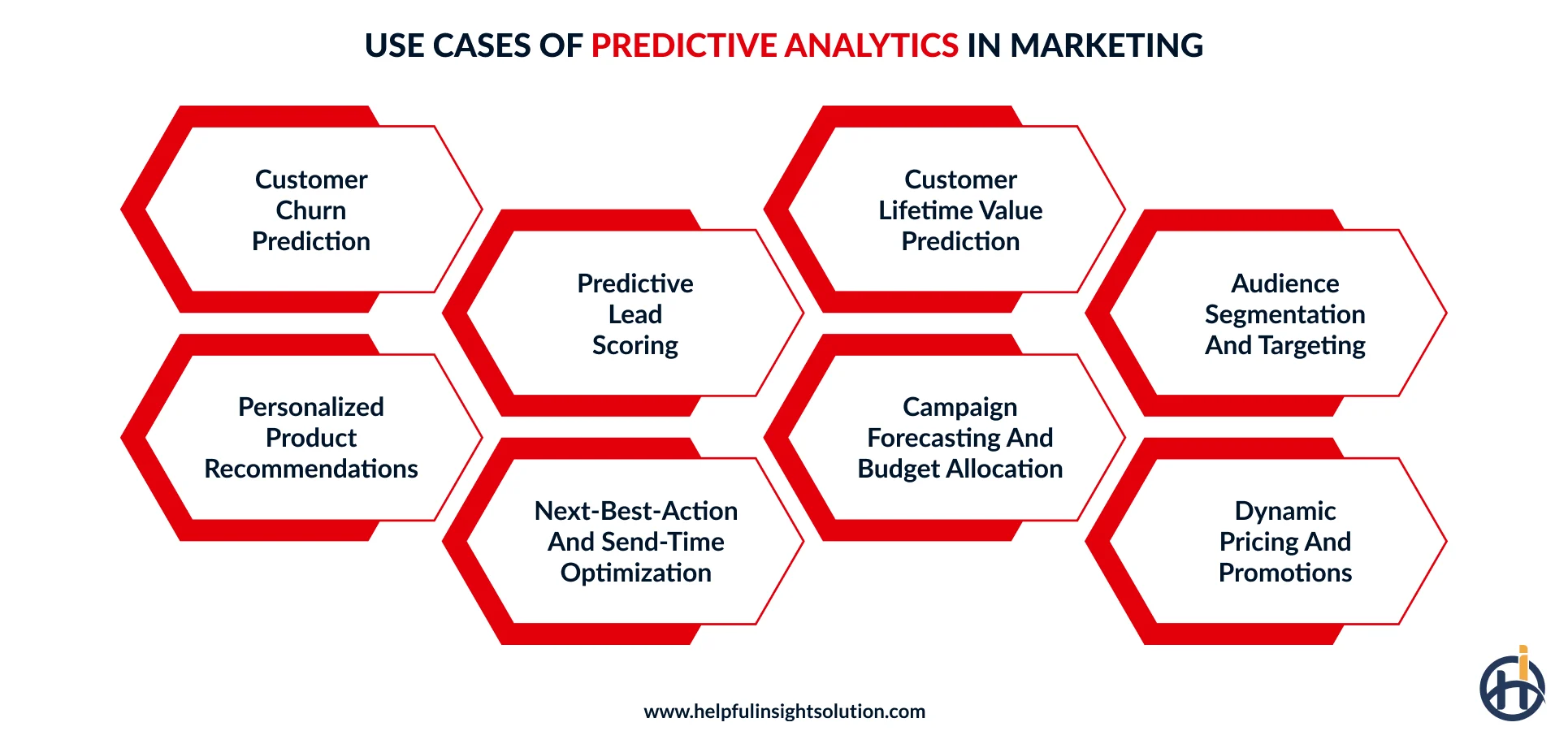
1. Customer churn prediction
When customer activity starts to change, it can be a sign that interest is dropping. Predictive analytics software looks at details such as buying patterns, product usage, website activity, and support history to find these changes. The marketing specialists can use these signals to reach out with relevant offers or support before customers decide to leave.
2. Predictive lead scoring
Predictive lead scoring uses signals such as website visits, content engagement, and email clicks to identify leads showing stronger purchase intent, helping sales teams prioritize them.
A model can consider website visits, content engagement, email clicks, past enquiries, and other buyer intent signals.
This gives the marketing and sales team a better idea of where to spend their time. It also makes lead prioritization more consistent than judging prospects only by basic profile details. For instance, an e-commerce AI chatbot can use predictive insights to identify likely product interests and suggest relevant items based on a shopper’s browsing and purchase history.
3. Customer lifetime value prediction
CLV prediction is used to estimate the value a customer may bring over time, not just from their next purchase. The estimate can be based on things like previous orders, buying frequency, and average spend.
Using predictive analytics, companies can use this information when planning customer acquisition, deciding where to put their marketing budget, and finding customer groups that may have more long-term value.
4. Audience segmentation and targeting
The same product or offer may not work for every customer. Audience segmentation looks at things like buying habits, website activity, and past interactions to see where customer behavior differs.
AI predictive analytics can find patterns in this data and group people with similar interests. Marketers can then use customer targeting to decide which products, content, or offers to show each group.
5. Personalized product recommendations
A shopper’s past activity can give an idea of what they may want to buy next. Predictive analytics tools for marketing use details such as products viewed, previous orders, searches, and cart activity to make those suggestions.
They can find patterns in this data and select products that fit a shopper’s interests. For an eCommerce platform, this can make product discovery more relevant and create opportunities for cross-selling.
6. Next-best-action and send-time optimization
A customer may need a different type of message depending on where they are in their buying journey. Next-best-action uses past interactions to decide what that message could be. The timing is a separate part of the decision.
Predictive models can bring both pieces together by looking at opens, clicks, purchases, and other customer engagement data. Businesses can then adjust their outreach instead of using one fixed schedule for everyone.
For example, predictive analytics in retail may suggest a loyalty offer for a frequent buyer and schedule the message when they usually engage.
7. Campaign forecasting and budget allocation
Marketing budgets often have to be divided between several channels, such as paid search, social media advertising, and email marketing, which makes forecasting useful before spending begins. Campaign forecasting uses past performance and current market data to estimate how different activities may perform.
This approach is especially useful because it gives a clearer idea of where additional spending may make sense and where reducing spend could be more practical.
8. Dynamic pricing and promotions
Before changing a product’s price, marketing agencies can look at how customers reacted to similar offers in the past. Predictive analytics in marketing strategies makes it easier to examine those patterns alongside sales and demand data.
The findings can point to products where a discount may be useful and others where it may not change much. That makes promotion planning more deliberate and gives pricing decisions a stronger connection to actual customer behavior.
Key benefits of using predictive analytics in marketing
Using predictive marketing analytics can help companies improve conversion rates, reduce customer acquisition costs, and allocate campaign budgets more effectively. The benefits of predictive analytics can be seen in several practical areas of marketing, including the following.
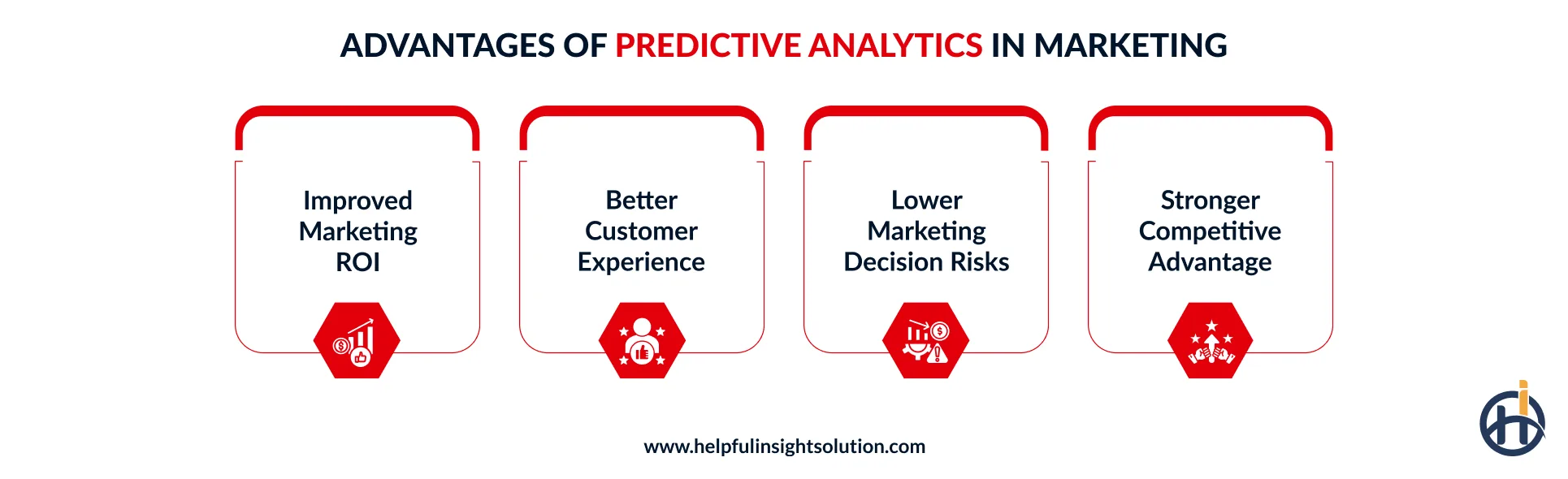
1. Improved marketing ROI
A marketing campaign budget can lose value when too much money goes toward activities that bring little back. AI for predictive analytics in marketing campaigns helps estimate future returns and compare different spending options.
Marketing teams can then make adjustments based on those estimates. This can bring down customer acquisition costs and make the existing budget work harder without adding more to the overall spend.
2. Better customer experience
A business does not need to send more messages to improve customer engagement. The messages need to be relevant for the person receiving them. Using AI and predictive analytics can assist with that by using existing customer data to guide future communication.
This can make offers and content more relevant and reduce the amount of promotional messages customers simply ignore.
3. Lower marketing decision risks
Every marketing decision involves some risk, particularly when a large budget is involved. Predictive analytics can give enterprises useful information before they commit that budget. They can compare possible outcomes, review previous results, and decide what is suitable.
This can reduce wasted spending and make marketing decisions less dependent on guesswork.
4. Stronger competitive advantage
Knowing what customers may want before that demand becomes obvious can give a business some extra time to act. Predictive analytics software can provide early signals from customer and market data. A business can use them to plan an offer, promotion, or new marketing activity before competitors react to the same change.
Mobile apps add another source of customer information. Searches, product views, and in-app engagement can show what users are paying attention to. Predictive analytics for mobile apps can turn these signals into useful insight for future marketing decisions, such as which products or offers may deserve more attention.
Real-world examples of predictive analytics in marketing campaigns
Several well-known companies already use predictive analytics for things such as product recommendations, customer targeting, and campaign planning. The following predictive analytics for marketing examples show how leading brands apply these methods in real campaigns.
1. Amazon
When a customer shops on Amazon, there is a lot of information about what they are interested in. Amazon uses this information, along with past purchases and browsing activity, to recommend products.
The recommendations are not the same for everyone. They depend on the customer’s activity. This is one way predictive analytics can be used to personalize product recommendations and support marketing activities such as email campaigns.
2. Starbucks
Starbucks is a global coffeehouse company with a large presence in countries around the world that uses predictive analytics for marketing. Its Deep Brew platform uses customer and purchase data to help create more personalized offers. For example, Starbucks can use information from previous purchases and customer activity to make its promotions more relevant.
The Starbucks Rewards program also uses customer purchase information. For example, someone who often buys the same drink may see an offer related to it in the app. Using this type of customer data allows the brand to make its promotions more relevant. This is one way predictive analytics technology can be used to support repeat purchases.
3. Sprint
Sprint applies predictive analytics to its customer retention efforts by identifying customers who may be considering leaving. Its system analyzes customer information and provides recommendations that can help with retention offers. These recommendations are available to customer service representatives during customer interactions.
How to implement predictive analytics in marketing: Step by step
Before using predictive analytics, it is worth getting a few things straight. What should the model predict? What information can be used? And where will the results fit into the existing marketing process? Answering these questions gives the implementation a clear starting point.
Let’s have a look at the marketing predictive analytics implementation process.
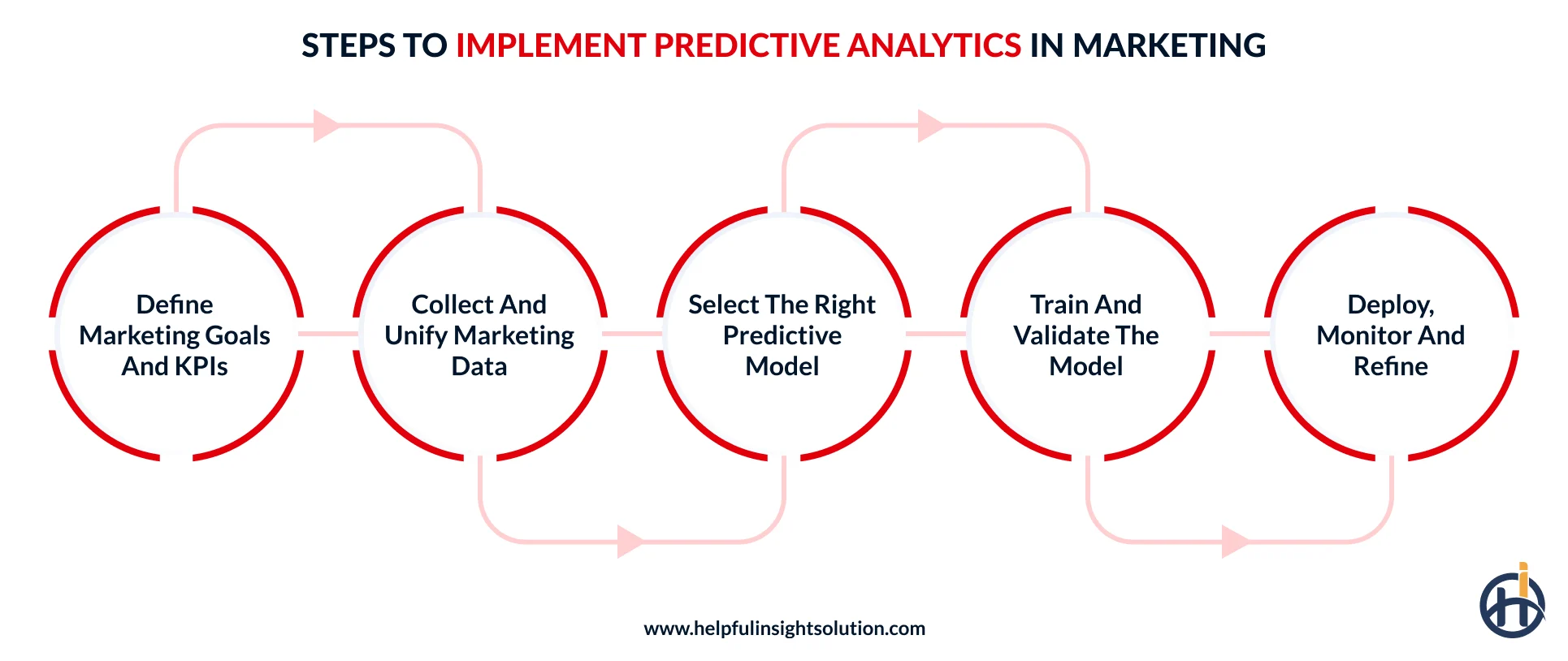
1. Define marketing goals and KPIs
First, decide what goal you want to achieve or what marketing problem you want to solve. For example, predictive analytics for lead generation may help bring in more qualified leads. If email marketing is the focus, you may want more clicks or sales.
Then choose a few marketing KPIs to measure the result. This gives the predictive model a clear purpose from the beginning.
2. Collect and unify marketing data
The next step is to collect the marketing data needed for your project and this may come from your CRM, website, email campaigns, customer records, or other platforms. Once collected, the data should be brought together in a consistent format.
Data cleaning is also important here. Remove duplicates, fix missing or incorrect values, and check that the information is accurate before using it for predictive analysis.
3. Select the right predictive model
Choosing a model starts with a simple question: What do you need the system to predict? Regression models can estimate figures such as future sales, while classification models can sort customers or leads into different outcomes. A random forest model may be useful when many inputs are involved. An AI development company can help select and test the approach that fits your data and marketing goal.
4. Train and validate the model
Once a model is chosen, it needs to learn from your existing data. Historical marketing data is used to train it and make predictions based on the information provided. The model is then tested with data it has not seen before. This model validation shows how well it may perform on new data and helps check whether the predictive marketing analytics is reliable enough to use.
5. Deploy, monitor and refine
After the model goes live, its performance needs to be checked regularly. Connect it with the tools used for your marketing activities and compare its predictions with actual results. As new data comes in, the model may need to be updated or retrained. This helps maintain its accuracy and keeps the predictive analytics solution useful instead of relying only on older customer information.
Challenges of implementing predictive analytics in marketing and their solutions
Adopting predictive analytics can bring several challenges that businesses should be well aware of in advance to ensure smooth implementation.
Below are the challenges of predictive analytics for marketing along with practical solutions.
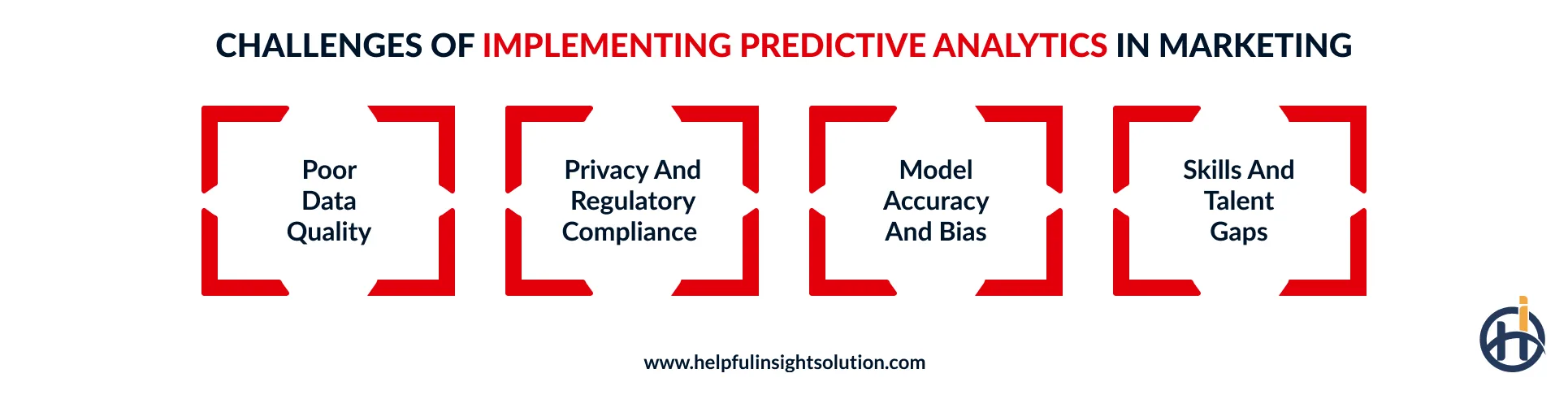
1. Poor data quality
The quality of a marketing prediction depends heavily on the data going into the model. When data is outdated, incomplete, or spread across different systems, the model may pick up patterns that are not really there.
For example, a campaign may look like it is performing well because duplicate leads were counted, affecting marketing data analytics and future targeting decisions.
How to overcome
Connect marketing data sources through a consistent data management process. Regularly clean customer records, standardize formats, and monitor incoming information so inaccurate data does not continue affecting campaign analysis or predictive models.
2. Privacy and regulatory compliance
There is a lot of customer information available to marketers today, and predictive analytics marketing solutions can use it to identify trends, predict customer actions, and guide marketing decisions.. But there are rules around how personal data can be collected and used.
Not following requirements under GDPR, CCPA, or other relevant IT regulations can create compliance issues, including financial penalties and lawsuits.
How to overcome
Keep the data going into your predictive model limited to what you actually need. Make sure customer permissions are recorded, restrict unnecessary access, and remove old information when there is no reason to keep it. Regular checks can help keep the whole process under control.
3. Model accuracy and bias
A predictive model learns from the data you give it, so problems in that data can show up in the predictions too. If some customer groups are missing or certain behaviors are overrepresented, the model can get a distorted view of your audience.
That can affect predictive analytics system performance, especially targeting and customer segmentation.
How to overcome
Use customer data from different audience groups when training the model. Then compare its predictions with real campaign results. If certain groups are consistently missed or predicted poorly, update the data and retrain the model instead of continuing with the same assumptions.
4. Skills and talent gaps
The tricky part is not always building the model. Sometimes the bigger issue is having the right people who know what to do with it. A marketer may understand the campaign but not the model output, while a data specialist may not know enough about the campaign to use those findings properly.
How to overcome
Train marketing staff to work with basic data and model outputs. This reduces the need to depend on specialists for every task and helps the team make better use of analytics in day-to-day campaign planning.

The future of predictive analytics in marketing
Predictive analytics is already helping marketing teams understand customers, plan campaigns, and make better use of their data. What gets interesting is where these capabilities go next.
As models improve and marketing data becomes easier to connect, there is plenty to watch. Let’s look at the predictive analytics market trends shaping the future of marketing.
1. Generative AI integration
As generative AI becomes more closely connected with predictive models, marketing teams may be able to move from “what might happen?” to “what should we create next?”
A predictive system could identify likely customer interests, while a generative AI solution produces suitable content or recommendations. This could make personalized marketing faster without removing human control from the process.
2. Agentic AI campaign automation
Imagine a campaign running overnight without someone checking the dashboard every few hours. Future agentic AI systems could monitor the campaign and respond when audience behavior or performance starts changing.
Predictive models could give the system another layer of information, helping it decide whether a change is worth making before a marketer steps in.
3. Real-time customer intent signals
Customer intent does not always stay the same throughout the day. Someone might be comparing options in the morning and be ready to buy a few hours later.
Real-time customer intent signals could help systems notice those changes as they happen. In the future, we can expect predictive analytics in modern marketing software to make campaign responses much more timely.
4. Self-learning marketing models
Customer behavior changes, and a model trained on last year’s data may not understand what is happening today. Self-learning marketing models could address that by learning from fresh results as they come in.
Over time, predictive analytics could become more responsive, with audience scores, campaign forecasts, and other predictions adjusting as new information becomes available.
How can Helpful Insight help you implement predictive analytics in marketing
Marketing decisions have usually been based on what happened in earlier campaigns. That is changing with predictive analytics for marketing. By looking at customer behavior and other marketing data, businesses can get a better idea of what could happen next. It can help them use their budget more carefully and avoid putting effort into campaigns that are unlikely to deliver.
At Helpful Insight, our predictive analytics services are built around the actual needs of your business. We first look at your marketing goals, available data, and the areas where better predictions could make a difference. From there, we shape practical use cases that turn marketing data into useful insights for campaign planning and decision-making.
We combine experience in data, AI, and business solutions to find practical ways to use predictive analytics. If you are thinking about implementing predictive analytics for your marketing, reach out to our team and let’s talk about what you want to achieve.
FAQs
The cost of implementing predictive analytics for marketing can range from about $10,000 to $50,000 for a smaller pilot to $150,000 to $400,000+ for a production-scale project. Data cleaning, integrations, custom models, security, and ongoing monitoring are some of the main factors that push costs higher.
It starts with collecting useful marketing data from places like CRM systems, websites, and past campaigns. Once the data is cleaned, a predictive model looks for patterns and uses them to estimate what customers may do next. Those predictions can then guide campaign decisions.
Predictive analytics in marketing requires customer behavior, sales records, transactional history and campaign data. Keeping these data sources accurate and connected helps produce more useful predictions.
Salesforce Marketing Cloud Intelligence, HubSpot and Adobe Google Analytics are some of the top predictive analytics marketing tools.