

Key Takeaways:
- Computer vision is an AI technology that can be integrated with modern security systems for threat analysis and fraud prevention.
- It has a wide range of applications, which include object classification, face recognition, PPE compliance, and behavior analysis.
- This technology is used in surveillance cameras, alarm systems, and integrated sensors to analyze risks and deliver solutions.
- Computer vision-driven systems follow compliance standards, such as GDPR and CCPA, with advanced AI components.
As you know, the current systems are being operated digitally, so the risk of cyber threats has increased by 73% in 2026 from the previous year. From the reported cases, 62% of them are from North America, registering more than 1300 cases daily across the region.
This number is increasing rapidly due to poor infrastructure and a lack of AI technologies in cybersecurity systems. It is rare that businesses use computer vision and other components for fraud prevention and threat analysis.
The use of AI-powered algorithms in surveillance software is now trending among entrepreneurs, as they are aware of their capability to handle complex malware. There are various use cases of computer vision in security systems that target different human situations and environments. This helps in identifying multiple threats accurately and predicting the best security measures.
You are going to study the important benefits, work, use cases, and associated challenges of computer vision for surveillance in this blog. It’s time to tighten your seatbelts and come along with us on this secure and safe journey.
What is the Role of Computer Vision Technology in Security?
The computer vision AI technology acts as a transformative element that ensures proactive and real-time risk monitoring. It enables machines to identify, analyze, and classify multiple objects or people based on different environmental parameters. The computer vision in security and surveillance can perform advanced tracking, automated access control, and false alarm detection.
Additionally, it helps to prevent theft, adverse crimes, trespassing, and other unusual activities with real-time algorithms. The use of AI in cybersecurity is to ensure safety, prevent fraud, increase system accuracy, and enhance scalability. This reduces the risk of threats through biometric authentication and facial recognition.
- It helps to detect environmental hazards like smoke, fire, earthquakes, and accidents.
- This ensures complete system security through various compliance standards and regulations.
- Computer vision helps to take real-time actions based on accurate risk analysis.
How do Computer Vision Surveillance Systems Work?
Before integrating computer vision for security, it is important to know how AI-enabled surveillance systems work. In this section, you will study the key working steps of advanced security platforms.
1. Image Acquisition
It is a fundamental process where the system gathers information through multiple sources for analysis. Images or videos are captured using external hardware devices, which include integrated cameras, alarms, and sensors.
2. Image Preprocessing
The computer vision surveillance software performs enhancement techniques, like resizing, noise reduction, and contrast adjustment. It detects key features, such as edges or corners, using deep learning CNN models.
3. Object Detection and Segmentation
It is beneficial to use AI deepfake generators to detect harmless or virtual objects by analyzing size, color, and occupancy. These systems convert image pixels into raw binary data, preventing the need for human supervision.
4. Feature Extraction and Classification
Now the information is stored by using advanced AI algorithms, such as support vector machines and 3D modeling. They generate a histogram that identifies gradients and different structures based on the shape and scale.
5. Interpretation and Action Logic
An ordinary CCTV camera can produce valuable information by dividing images into multiple frames and segments. Additionally, it can trigger a response based on normal or unusual activities, increasing threat prevention.
Benefits of Using Computer Vision for Security
The computer vision technology helps security systems to improve threat detection, enhance monitoring, and reduce errors. Some of the best advantages of this technical advancement are discussed in this section.
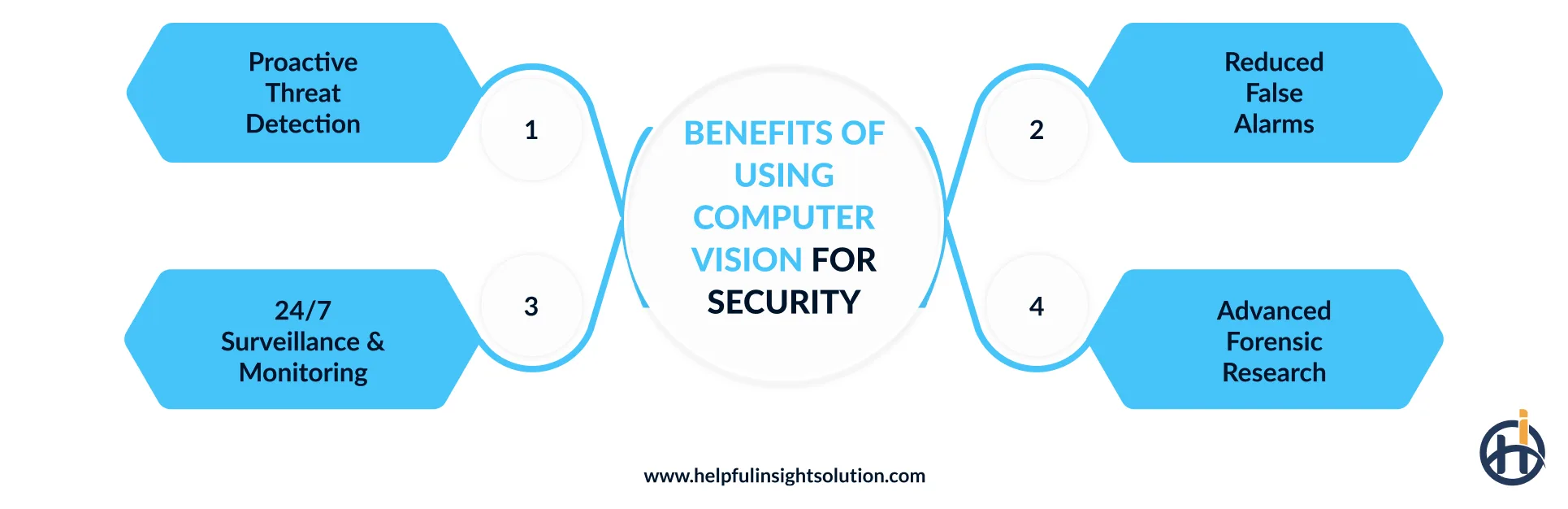
1. Proactive Threat Detection
With computer vision, you can easily identify potential criminal activities, like vehicle theft, commercial fraud, and collateral damage. It analyzes behavioral patterns and classifies different objects by using advanced AI models that understand data complexity with real-time algorithms.
2. Reduced False Alarms
It is one of the best AI technologies that reduces false alarms and enhances security systems through supervised learning models. Computer vision detects harmless activities and real threats by monitoring the environment based on object size, speed, target area, and intention.
3. 24/7 Surveillance & Monitoring
Businesses use AI-driven computer vision security systems, like surveillance cameras and movement tracking sensors, to monitor physical threats. It reduces human errors and helps investigators detect criminal evidence, track suspicious activities, and manage warehouses.
4. Advanced Forensic Research
AI can analyze different images and videos to detect human fingerprints, crime spots, weapons, and persons through advanced segmentation algorithms. Additionally, it also helps in accurate biometric analysis by identifying eye movements and facial expressions.
8 Best Use Cases of Computer Vision in Security
Here, you will study the top use cases of computer vision in surveillance, such as object detection and behavior analysis. These applications help businesses to resolve multiple security risks in real time.
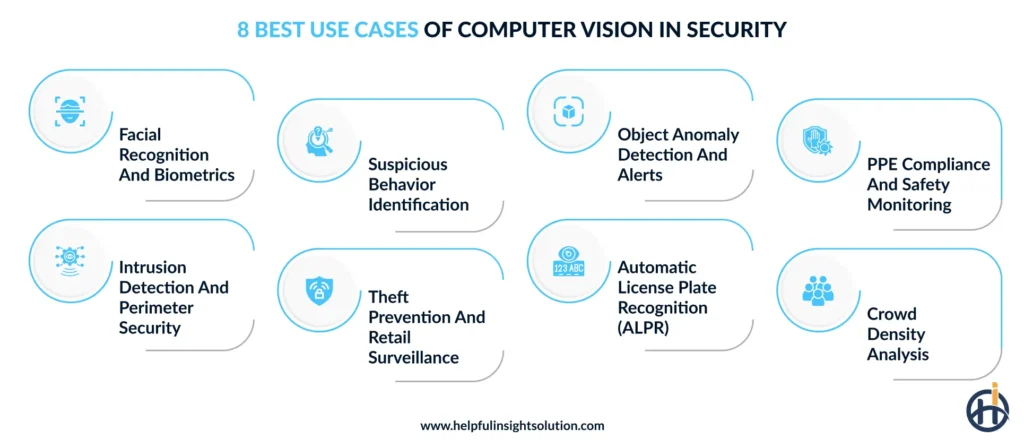
1. Facial Recognition and Biometrics
Computer vision can study different facial expressions, complexions, and sensory organs to match the database. AI-powered security systems are used in banks, ATMs, government departments, and hospitals to monitor listed criminals. Additionally, it helps to verify videographics and other biometric parameters, such as fingerprints and blood samples.
Key Impact: It enhances access control and accuracy by reducing unauthorized entries by up to 90% in high-security environments.
2. Suspicious Behavior Identification
This technology enhances security standards by monitoring videos to identify abnormal activities and generate automated alerts. It is a secondary use case that targets restricted zones, such as military areas, official buildings, and schools. With this, it is easy to capture ethical gestures and movements, ensuring complete safety across multiple groups of people.
Key Impact: This enables real-time threat detection, helping security teams respond to various unusual activities at a 60% faster rate.
3. Object Anomaly Detection and Alerts
It is a common application of computer vision in security that helps to detect stolen items, unidentified packages, and lost bags or suitcases. These systems are installed in public places, such as markets, airports, and metro stations. They generate alarms to notify local authorities, allowing them to check for dangers and report emergencies.
Key Impact: This minimizes security risks by instantly identifying unattended or prohibited objects in restricted zones.
4. PPE Compliance and Safety Monitoring
Various factories, manufacturing units, and medical centers have advanced computer vision systems that ensure the safety of workers. They analyze particular outfits, such as headgear, gloves, face masks, and safety boots. For example, cybersecurity in healthcare ensures standard compliance, like OSHA, which helps in better administration for employees.
Key Impact: It improves workplace safety by automatically detecting missing helmets, gloves, or vests with high precision.
5. Intrusion Detection and Perimeter Security
Landowners, hotel managers, and corporate officials can identify unknown persons through computer vision security software. It is one of the most important AI-based surveillance use cases that captures accurate fencing images, reducing false alerts. The AI technology ignores environmental aspects, like rain and trees, to detect physical security breaches.
Key Impact: This improves perimeter protection through 24/7 automated monitoring and instant threat notifications.
6. Theft Prevention and Retail Surveillance
Advanced security systems help to prevent theft by monitoring precious items, such as jewelry, premium commodities, and foreign goods. They are highly used in the e-commerce and retail industry, ensuring product safety and authenticity. These platforms have evolved from traditional barcode scanners and POS systems, which handle bulky items.
Key Impact: It reduces shoplifting losses by tracking suspicious customer behavior and unauthorized product movement in real time.
7. Automatic License Plate Recognition (ALPR)
In case of accidents, robberies, and kidnappings, it is important to track the suspected vehicle through the license plate or registration number. It is among the crucial computer vision security applications that allow police officials to investigate accurately. An automated message is sent to all the nearby tracking devices, ensuring quicker actions.
Key Impact: This optimizes vehicle identification and traffic monitoring with rapid and accurate plate-scanning features.
8. Crowd Density Analysis
It is easy to calculate the number of people in a movie theater, a public auditorium, and local markets through automated surveillance software. This helps to handle the crowd in emergencies, like fires, floods, and earthquakes, reducing the damage. Additionally, in stadiums and religious places, these systems can prevent stampedes.
Key Impact: It prevents overcrowding and enhances public safety by monitoring crowd movement in different places.
Top Computer Vision Security Innovations
Several computer vision surveillance systems are used to perform security activities and track unusual threats. You will study the best innovations that use advanced AI technology to prevent malware risks.
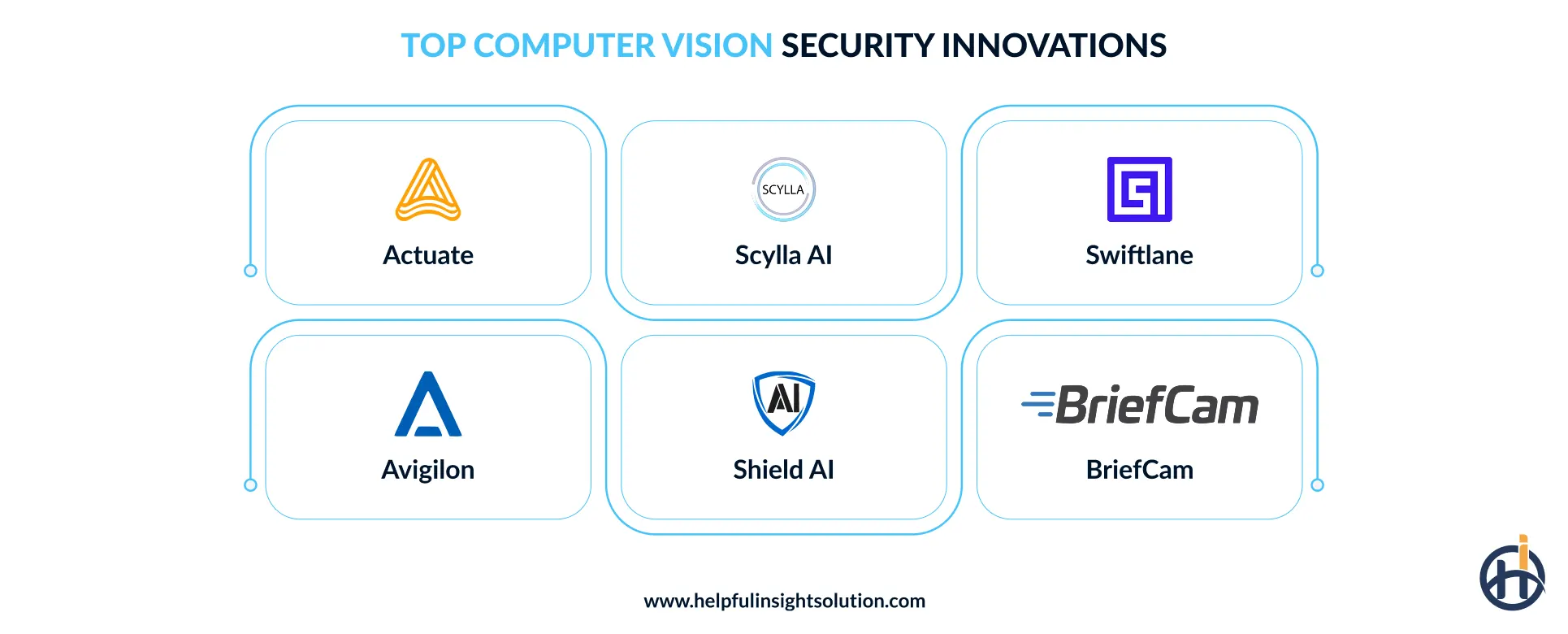
1. Actuate
It is an AI-based platform that helps to detect weapons, such as handguns and rifles, reducing the real threats. The security teams scan public areas to identify firearm risks through high-resolution cameras.
2. Scylla AI
This platform helps in physical threat detection and monitoring suspicious activities through active videography. It can be installed in drones for picturing areas between 50m and 100m with 8K capacity.
3. Swiftlane
Swiftlane offers touchless access control and video intercom systems with facial recognition. It is among the best security solutions using computer vision for secure communication and detecting intrusion signals.
4. Avigilon
Avigilon can be integrated with AI voice receptionists for unusual motion detection (UMD) through appearance search. It captures human activities and answers questions based on the video information.
5. Shield AI
It builds security solutions for defense, tracking unidentified drones, jets, and UAVs for complex missions. Shield AI uses a Visual Detection and Ranging system, which can sense human activities.
6. BriefCam
BriefCam converts surveillance footage into computer-based data through deep learning algorithms. It is widely used in advanced forensic research to predict the criminal from the facial and biometric information.
Integrating Computer Vision with Security Solutions
For a business investor, it is crucial to know how to integrate computer vision in security platforms. In this section, we will understand the complete process with key steps that are important for businesses.
1. Set Data Requirements
The first step allows businesses to study different market parameters, such as budget, user needs, and demographics. With this, they can set requirements and future goals by observing growing trends in computer vision technology. It is crucial to know various security risks that can harm your business before moving forward with AI components.
2. Audit Existing Infrastructure
Businesses should understand the condition of their existing systems, such as cameras, network modules, alarm systems, and power supply. It is important to determine that these hardware devices are working properly with a good internet connection. Additionally, you must ensure regulatory compliance, such as GDPR, NIS2, CCPA, and BISP, for threat prevention.
3. Train the AI Model
You should hire a computer vision software development company that provides experts who can train different AI models. They must know how to implement CNN and YOLO algorithms with the integrated devices for anomaly detection. Businesses can add more data to refine deep learning concepts and generative transformers according to their needs.
4. Integrate AI with Hardware
Now, it’s time to use Edge AI, Intelligent Video Analytics (IVA), and AI Boxes to combine AI-powered computer vision in security and surveillance systems. You must use multiprocessor units, smart IP cameras, integrated AI chips, and human tracking sensors. Artificial intelligence will help you to ensure interoperability, data privacy, and instant response generation.
5. Test & Deploy Project
Various KPI standards, such as precision, recall, and response time, are important to test data quality and scalability across devices. Through the integration pipeline tools, like Plainsight, businesses can easily deploy the AI-enabled security system. Now, you can use the software solution to detect various unethical tasks and prevent cyber fraud in real-time.
Growing Trends in Computer Vision for Security
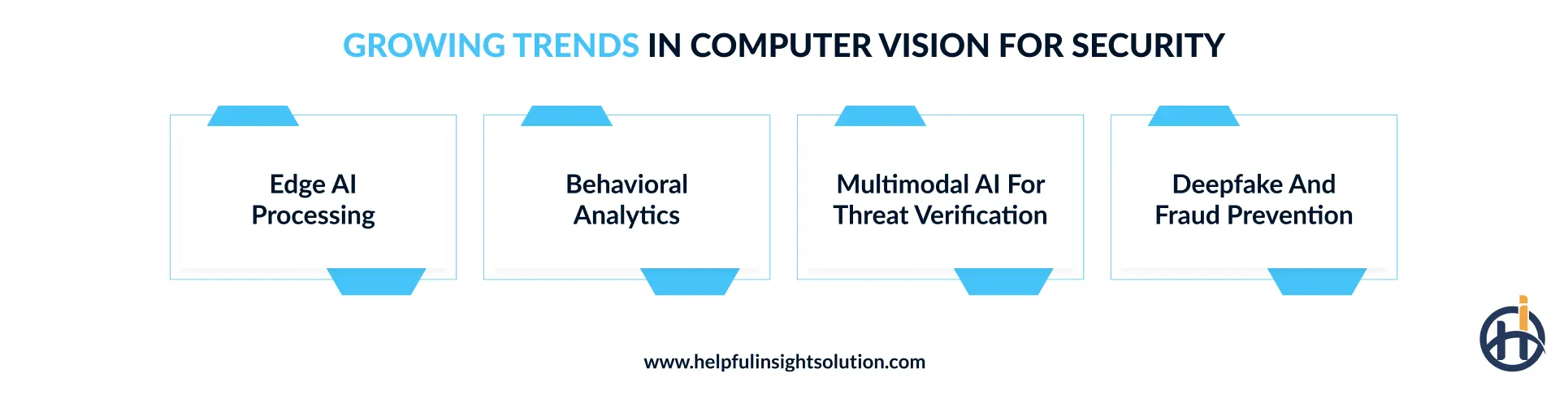
The computer vision cybersecurity systems will become more enhanced through future AI technologies, like edge computing. This will prevent unauthorized access through user verification and fraud analysis.
1. Edge AI Processing
It offers smart intelligence, shifting the AI workload from cloud to integrated devices, like cameras, sensors, and AI boxes. Edge AI can process visual data in milliseconds and can also track various human activities, such as running, fighting, and unexpected falls.
2. Behavioral Analytics
Advanced AI algorithms for computer vision intelligence in security surveillance help to monitor human behavior and detect various unethical activities. They can analyze crowd movements in case of emergencies, like fire, terrorist activities, and vehicle rush.
3. Multimodal AI for Threat Verification
You can hire dedicated developers to integrate multimodal AI frameworks into computer vision for gathering visual information from audio, text, and sensors. These metrics are processed by using various models that reduce the gap between cyber and physical security.
4. Deepfake and Fraud Prevention
Computer vision is used in modern system software to prevent advanced spoofing techniques, like deepfake videos, 3D masks, and screen replays. It uses Generative Adversarial Networks (GANs) to detect anomalies in videos that show human behavior.
Major Challenges with Computer Vision in Surveillance
You must know various challenges that prevent the development of computer vision surveillance platforms. Here, you will observe some major technical issues with their respective key solutions.
1. Image Quality Analysis
Various computer vision defect detection systems may have quality issues due to poor image resolution. This creates a problem in identifying the right object and can show various errors due to overlapping.
Solution: The experts should train AI models on different imaging parameters that can also analyze low-resolution data.
2. Hardware Compatibility Issues
Some computer vision-powered security solutions may not be compatible with the hardware devices due to port issues. It can result in inaccurate tracking, delayed image processing, and fragmented data packets.
Solution: You must implement “AI Boxes” and smart IP cameras that can handle complex image or video tracking tasks.
3. Privacy and Ethical Concerns
It is difficult to ensure the privacy of system software, as it can be directly accessed by unauthorized accounts. These platforms can be misused for unethical human tracking and support criminal activities.
Solution: It is mandatory to follow compliance standards such as GDPR, CCPA, and BIPA to empower computer vision.
Choosing Helpful Insight for Secure Computer Vision Integration
Your business is waiting to become more secure, compliant, and robust to get future-ready for handling complex privacy issues. Entrepreneurs who are looking to integrate computer vision in security solutions must approach the right partner with good experience and skilled experts.
We are a leading AI agent development company that ensures complete support, a business-friendly ecosystem, and seamless cooperation for creating AI-driven security systems.
Our IT professionals have advanced technical knowledge and can easily access modern tools and frameworks. They can make high-quality security and surveillance systems with computer vision, ensuring overall scalability. This will bring more confidence by enhancing movement tracking, optimizing threat analysis, and increasing user trust.
FAQs
There are multiple issues with old-fashioned security systems, such as high maintenance costs, less adaptability, and increased response time. They have a higher false alarm rate, a slow detection process, and hardware risks, increasing threat chances. These systems cannot handle complex security problems due to their limited scalability and compatibility.
Businesses can implement computer vision in various security devices, like surveillance cameras, integrated sensors, and protected alarms. This technology helps in threat detection, fraud prevention, and system compliance through advanced AI algorithms. Various industries, such as retail, construction, and fintech, use computer vision to ensure security.
The computer vision technology uses AI-powered algorithms that are 90% effective in preventing false threat alerts. It develops various models based on different situations and can easily differentiate between harmless activities and real security risks. Through behavioral context, object classification, and constant learning, computer vision can easily reduce human errors.
In general, most security systems that use computer vision technology are not compliant with the local privacy laws. But it can be made compliant by using various standard regulations, like GDPR, CCPA, and local biometric laws. This can help in continuous monitoring, facial recognition, and detecting data breaches, which prevent manual threats.