

The healthcare industry is considered one of the most important and fastest-growing sectors globally, but it also has some big challenges. One of the biggest problems is handling the huge amount of patient data and meeting the growing demand for personalized care.
At the same time, medical costs are going up, and there just aren’t enough doctors and nurses to take care of everyone. So, what’s the solution? The answer is AI in healthcare.
Artificial intelligence has already started making prominent changes in the healthcare sector by transforming how doctors diagnose, treat, and monitor patients.
The global AI in healthcare market is forecasted to grow from $39.25 billion in 2025 to $504.17 billion by 2032, showing just how important and powerful AI has become in the medical field.
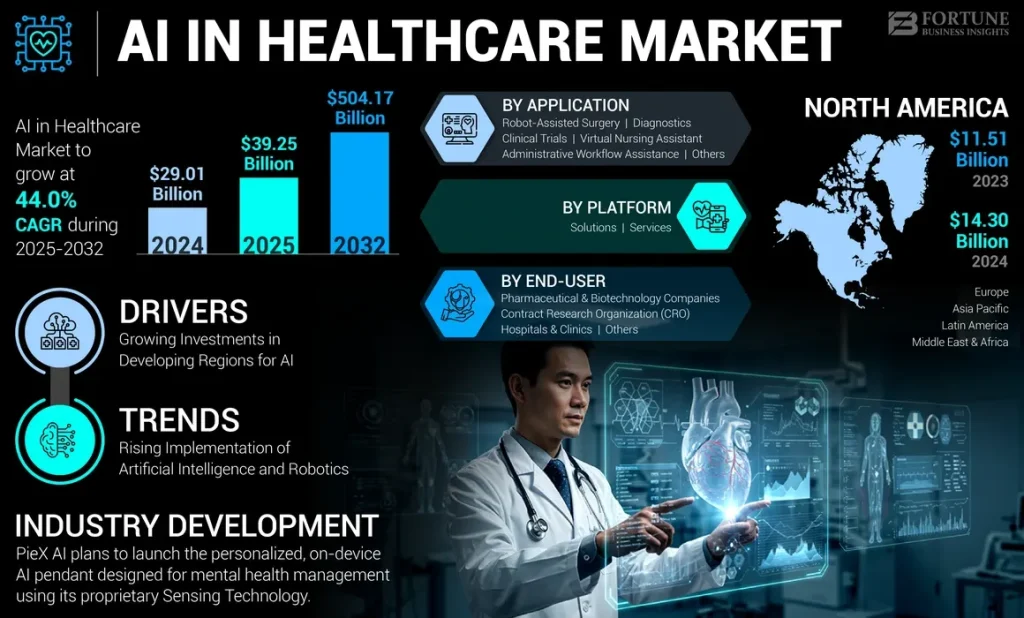
By using AI, hospitals can become faster and more efficient, helping more people get the care they need. New AI tools and platforms are constantly being developed to meet different healthcare needs, which will grow the use of AI in healthcare industry.
In this blog, we will explore AI use cases in healthcare, its benefits, challenges, and many more things to understand how AI is revolutionizing the healthcare sector.
AI in Healthcare: An Overview
AI in healthcare simply means using advanced technology, like machine learning and deep learning, to help medical professionals deliver the best treatment and care to patients.
It is important to understand that artificial intelligence is not here to replace doctors, but it’s a helpful tool that makes their work easier.
It helps improve the quality of care, makes decisions better, and saves time by managing data efficiently. By analyzing lots of medical data, it can create better treatment plans and detect problems early.
It can also assist with both patient care and hospital tasks, like managing appointments or administrative tasks. AI applications in healthcare are immense and will grow alongside technology advances.
Benefits of Using AI in Healthcare Industry
The use of artificial intelligence in healthcare is growing at rapid pace and can bring numerous benefits across different areas of the healthcare industry. Some of the key advantages are:
The use of AI in healthcare app development services is growing at rapid pace and can bring numerous benefits across different areas of the healthcare industry. Some of the key advantages are:
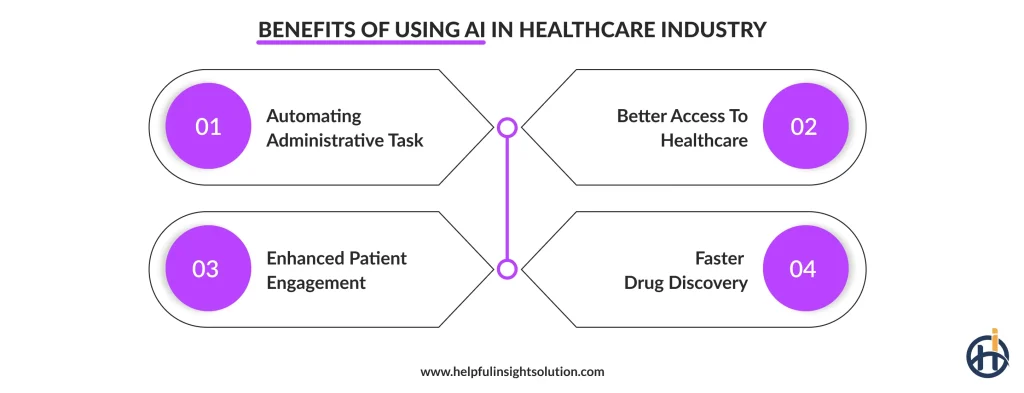
1. Automating Administrative Task
Every hospital and clinic has a lot of admin tasks like managing patients records, billing, etc which hinder their capability to provide dedicated patient care. AI can handle repetitive and tedious tasks like scheduling, billing, and managing patient records. This lets healthcare workers focus more on providing better care to patients.
2. Better Access to Healthcare
AI makes quality healthcare services available to more people, no matter where they live. Telemedicine powered by AI connects rural areas with expert doctors. Diagnostic tools let local clinics offer advanced care without needing expensive equipment. This means more people can get the care they need on time, even in remote locations.
3. Enhanced Patient Engagement
AI for healthcare helps patients take care of their health by reminding them to take medicine and attend appointments. Chatbots and virtual assistants provide 24/7 support, answer questions, and offer health advice. This makes patients feel more informed and in control, leading to better health choices and stronger doctor-patient relationships.
4. Faster Drug Discovery
Artificial intelligence in healthcare can speed up the process of finding new medicines. By quickly analyzing large amounts of data, it helps researchers identify which drugs are safe and effective. This process is much faster than traditional methods, which can take years. AI can also help discover new uses for existing drugs and make treatments available sooner.
Read Also; AI in Mobile Apps: Use Cases, Benefits, And Cost
Top AI Use Cases in Healthcare
There are so many use cases of AI in healthcare, and researchers are continuously working to discover more AI applications in healthcare that will help provide better quality healthcare services.
Below are some of the popular AI in healthcare use cases:
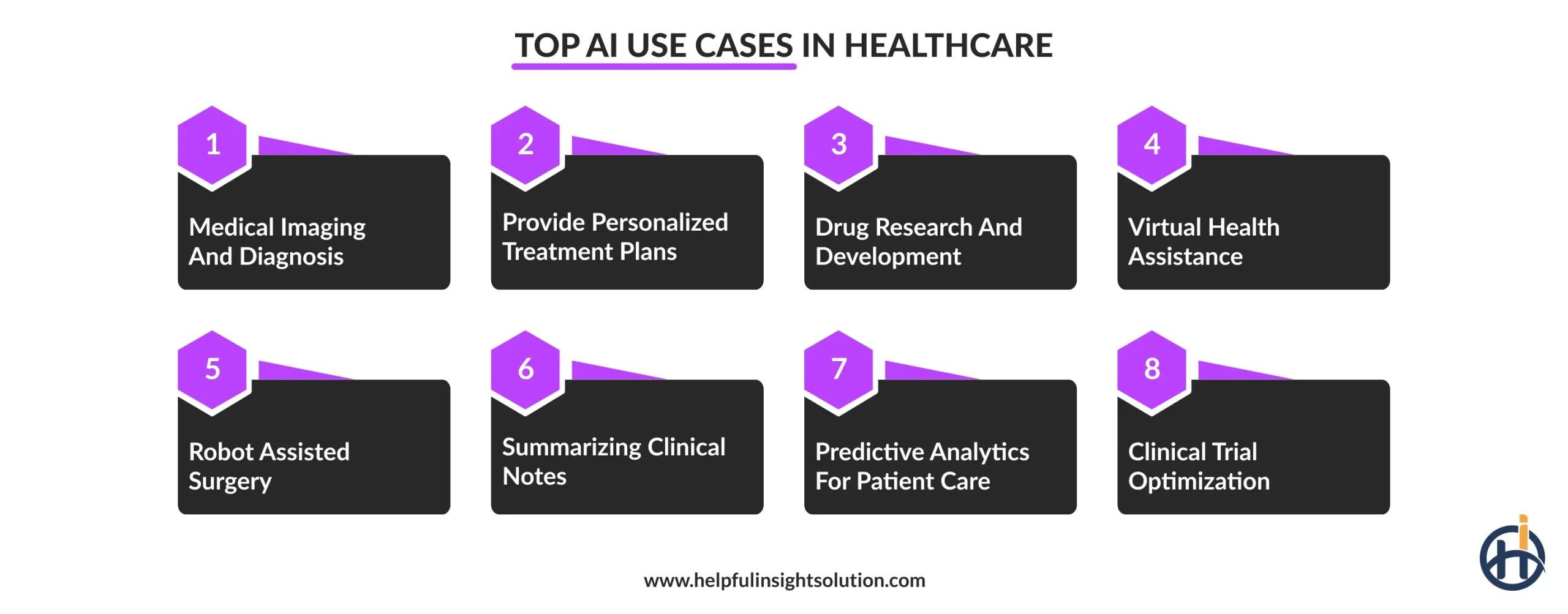
1. Medical Imaging and Diagnosis
AI in medical field helps doctors analyze medical images like CT scans, and MRIs. By quickly spotting problems such as tumors or broken bones, AI makes diagnoses faster and more accurate. This is especially helpful for detecting diseases early.
For example, AI tools can scan dental X-rays to find cavities or gum issues before they become serious. This helps doctors treat problems on time and improve patient health.
2. Provide Personalized Treatment Plans
With AI its become easy to provide personalized attention to each and every patient. AI analyzes patient’s health history, genetics, and lifestyle to create personalized treatment plans. This helps doctors choose the best treatment plans for each person.
AI also helps doctors understand how similar patients responded to certain treatments, improving their decisions. By using data, doctors can create customized plans that work best for the patient.
3. Drug Research and Development
Artificial intelligence is speeding up how new medicines are created. It helps researchers study huge amounts of data to predict which drugs will work best and which ones might be harmful. AI can also find new uses for old drugs, making it faster to find treatments.
By using AI, scientists can quickly test many drug options and avoid wasting time on ones that won’t work. BenchSci created a new AI tool, ASCEND, which helps speed up the early stages of drug research by finding key disease information.
4. Virtual Health Assistance
AI-powered virtual assistants are changing the way patients get healthcare services. Instead of visiting a doctor in person, patients can use AI chatbots to get health advice, ask questions, and manage their care. This is among the most popular AI in healthcare use cases.
Ada’s AI chatbot is a prominent example of AI virtual health assistant, which helps patients figure out if their symptoms are serious and what to do next, without needing to see a doctor immediately.
Read Also: Top 7 Use Cases of Generative AI Amongst Various Industries
5. Robot Assisted Surgery
This AI healthcare use case is truly beyond imagination, as AI is making surgeries safer than ever before. Robots, controlled by surgeons, use AI to guide their actions during operations, enabling more precise procedures. This technology allows doctors to perform surgeries with greater accuracy.
For example, the da Vinci Surgical System is a robotic assisted platform that helps surgeons make tiny, precise cuts with 3D vision, leading to faster recovery times and fewer complications for patients.
6. Summarizing Clinical Notes
AI in healthcare assists doctors and nurses in summarizing long patient records into short, easy-to-read notes. This saves time and makes it easier for healthcare workers to understand a patient’s history quickly.
AI-generated summaries help doctors make decisions faster, improving patient care and reducing stress. AI tools can read through medical records and highlight key points, helping doctors quickly understand a patient’s medical history without reading long notes.
7. Predictive Analytics for Patient Care
This is one of the highly popular healthcare AI use cases, where AI helps doctors predict a patient’s health risks before major problems occur. By looking at data like health history and test results, AI can predict things like future diseases or hospital readmissions.
This allows doctors to act early, helping patients avoid serious health issues. For example, AI can predict which patients are more likely to get sick again after being discharged, so doctors can offer extra care before they return to the hospital.
8. Clinical Trial Optimization
Using artificial intelligence in healthcare helps make clinical trials faster and more efficient. It can match patients with the right trials by looking at their medical records, improving trial designs, and predicting how the trial will turn out.
For example, AI in healthcare can look through patient records and find people who are a good match for a specific clinical trial, speeding up the process.
Key Technologies Used to Develop AI-Based Healthcare Solutions
To create an AI healthcare system, artificial intelligence developers need to use some advanced technologies, which are:
| Core Technologies | Description |
| Machine Learning | Machine learning teaches computers to learn from data to find patterns and make predictions without being explicitly programmed for every task. |
| Natural Language Processing (NLP) | NLP enables computers to understand human language. It turns spoken or written notes into useful information, like creating patient records. |
| Deep Learning | Deep learning is a type of machine learning that mimics how the human brain works. It’s good at analyzing complex data, like medical images, to find problems. |
| Computer Vision | Computer vision allows AI to understand images and videos. It’s used to look at medical images like MRIs or X-rays to spot problems and help with patient monitoring. |
| Predictive Analytics | It uses data to predict health problems before they happen. By analyzing patient history, AI can foresee diseases, helping doctors give early treatments. |
Challenges of AI in Medicine and Healthcare
AI use cases in healthcare are expanding quickly, bringing many new uses with time. However, there are still key hurdles to overcome for broad acceptance. Resolving these challenges is crucial for AI healthcare app development companies to ensure widespread adoption of AI applications in healthcare. The main challenges are:
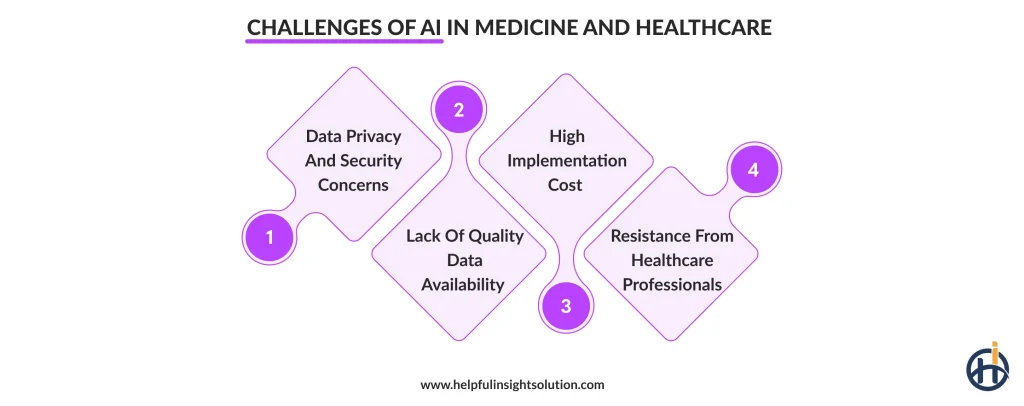
1. Data Privacy and Security Concerns
One big challenge with AI in healthcare is to keep patient data safe. AI systems uses a lot of sensitive information, which can be hacked or misused if not protected properly. To solve this, strong security measures like encryption, access control, and regular checks are needed to keep data safe from breaches.
2. Lack of Quality Data Availability
To ensure that the applications of AI in healthcare works accurately, AI systems need reliable and quality data. Sometimes data is often incorrect, or spread out across different systems, making it hard to train AI properly. Healthcare organizations must improve how they collect and store data, and share it responsibly.
3. High Implementation Cost
Indeed, implementing AI in healthcare is expensive. Healthcare businesses need to buy advanced tools, collect quality data, and train staff. The cost of implementing AI can be a barrier, but starting with a MVP and outsourcing AI software development can help reduce costs and share the load.
4. Resistance from Healthcare Professionals
Doctors and nurses are worried about AI taking their jobs with the growing use of AI applications in healthcare. They might not trust machines to make decisions, especially if they haven’t been trained in how to use AI. To overcome this, healthcare organizations can provide training and show how AI can help, not replace, their work.
Read Also: Best Health Apps For Android And iOS That You Should Know
What Is the Future of AI in Healthcare?
The introduction of AI in healthcare has already begun to reshape the industry, transforming the way people interact with the healthcare services and how hospitals operate. It’s just the start; there is much more to come.
From automating admin tasks to improving patient care, AI will do much more than that in the coming years.
AI is expected to help with the shortage of workers and reduce costs in healthcare. In the future, we’ll see more AI-powered tools to create more efficient, adaptable, and productive ways of working.
Moreover, we can expect healthcare organizations to increasingly use agentic AI to improve how efficiently they operate and to provide better care for patients.
Overall, the future of AI in healthcare is really bright. While some advancements are easy to predict, there are many surprises ahead. The possibilities are huge, and we’re just scratching the surface of what AI can do for healthcare.
Partner with Helpful Insight to Build Intelligent AI-Powered Healthcare Platform
The integration of AI in healthcare represents a significant technological advancement that is revolutionizing the industry and leading to remarkable improvements. The AI in healthcare use cases we discussed above are only a few, the list is long. Businesses that adopt AI now will be ahead of the curve, while those that wait may fall behind.
If you run a healthcare business and want to implement artificial intelligence, we can help. Helpful Insight is a leading AI development company in the USA. We specialize in creating custom, secure, and feature-rich AI healthcare solutions.
Our qualified AI developers use the best tech stack to ensure a high-quality solution is developed. We will not only develop the AI solution but also smoothly integrate it into your existing workflow.
Moreover, when you partner with us you get:
- End-to-end AI development services
- Faster-time-to-market
- Affordable solutions
- Access to experienced healthcare AI experts
Contact dedicated developers at Helpful Insight today to get your AI project started.
FAQs
There are so many uses of AI in healthcare, such as:
- Offering personalized treatment plans for patients
- Analyzing medical images to detect diseases early
- Accelerating drug discovery and development timelines
- Automating administrative tasks to free up staff, among many others
There are various factors which affect the cost to develop AI powered healthcare apps like app complexity, the number of features, UI/UX design, AI model development and training, technology stack, and the location of the developers. On average, the cost for building an AI healthcare app can range from $30,000 to $150,000 or more.
To get a custom cost estimate, feel free to get in touch with our team.
The development timeline for an AI healthcare platform depends on various factors, including project complexity, the level of customization, data availability and quality, integration with existing systems, and the testing process. Because of these variables, it’s difficult to provide an exact timeline upfront. However, once you share your AI project requirements with us, we can provide a detailed timeline estimate.
The potential risks associated with the use of AI in healthcare include:
- Data privacy and security breaches
- Algorithmic bias leading to health disparities
- Misdiagnosis due to software errors
- Job displacement for healthcare professionals