


Key takeaways
- Machine learning for business means using data to find patterns, understand what’s happening, predict what may happen next, and make more informed business decisions.
- There are different types of machine learning such as supervised learning, unsupervised learning, semi-supervised learning, and reinforcement learning. Each approach differs in how it learns from data and solves business problems.
- Machine learning in business helps improve operational efficiency, support data-driven decisions, forecast demand accurately, and personalise customer experiences.
- To implement machine learning in business, define your requirements, organize the necessary data, select an appropriate algorithm, evaluate its results, and monitor its growth.
Every organization will have records of its sales, customers, payments and stock. But these records do not always help when it is time to make a decision. A retailer may know what products sold well last year but still be unsure about what customers will buy next season. Machine learning for business helps analyze past sales and customer activity to spot patterns that can better predict what to expect.
Companies are exploring machine learning use cases in different parts of their operations. However, not every application will be relevant to every firm. It comes down to the problem they want to address and the data they have.
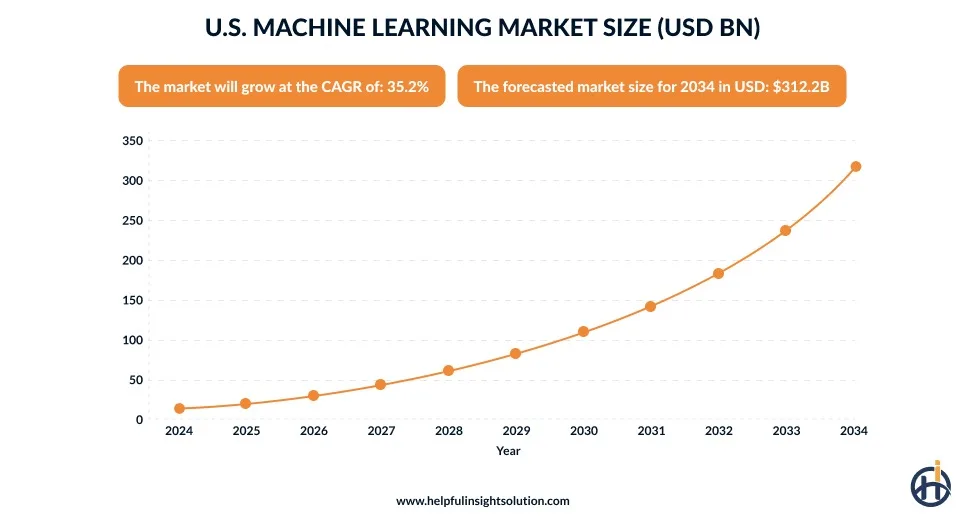
The US machine learning market is expected to reach $312.22 billion by 2034, according to Market.us. This growth reflects the increasing attention organizations are giving to ML and its possible applications.
If a business is considering adopting machine learning, it should first understand how the technology works and what it can be used for. This blog looks at its main benefits, applications, and implementation steps.
What is machine learning for business?
Machine learning for business refers to using data-driven algorithms to analyze current and historical data and learn from it. These algorithms can predict future outcomes, spot anomalies, and support everyday business decisions.
Unlike conventional software, which operates according to a fixed set of rules, ML models change their output as they are fed new data. Companies use them to support decision-making and perform a range of tasks in sales, finance, and operations.
Types of machine learning business leaders should know
Machine learning is not a single method. It’s a range of different learning approaches, each of which works in its own way to process information and produce a result. Let’s look at the four main types and see how they work.
1. Supervised learning
In supervised learning, a model is given examples and the correct answer to those examples. The model learns from those examples what the relationship is between the information and the answer. Once it’s been trained, it can use that knowledge to make predictions when it sees new information.
It’s used by businesses to detect fraud, forecast sales and identify customers who are likely to churn. In the context of machine learning app development, it could be used to add a feature that recognizes a customer’s request or can predict what a customer is likely to do next.
2. Unsupervised learning
Unsupervised learning is useful when a business wants to explore data but does not already know what it is looking for. It can sort similar records into groups and bring unusual entries to attention.
This makes it useful for business analytics, where companies may need to explore customer records, sales information, or other data to find connections they had not noticed.
3.Semi-supervised learning
Preparing the labelled data takes a long time, particularly if you’ve got thousands of records to go through. Semi-supervised learning helps to alleviate that by training the model on a small number of labelled examples and a much larger set of unlabelled data.
The model learns from both sources to identify patterns. The approach can be used by businesses for document classification, image recognition and all sorts of other tasks where it’s impractical to label every single record.
4. Reinforcement learning
Some business decisions need to be adjusted repeatedly as conditions change. Reinforcement learning helps train a system for these situations. It learns by trying out different actions and then using the feedback to work out what it should do next. This can be of use in a range of business ML applications such as inventory management and price optimization.
Key benefits of machine learning for businesses
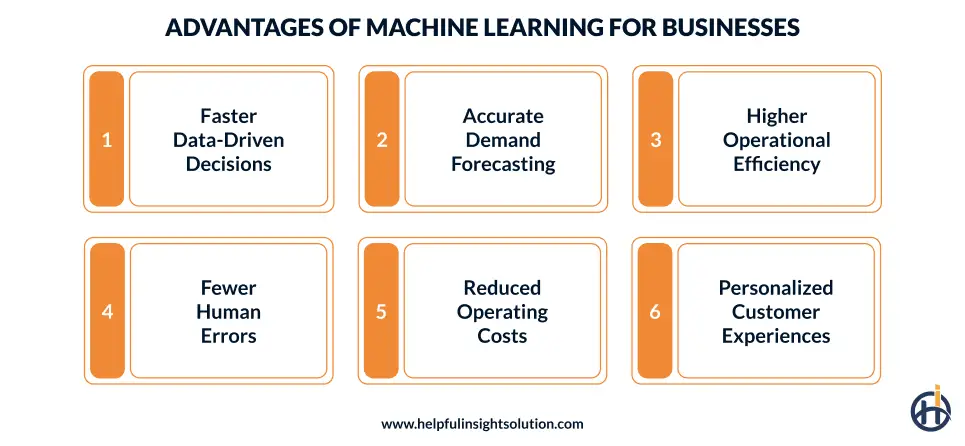
The value of machine learning in business goes beyond automating routine work. It can be used to help teams work through large datasets, detect changes in customer behavior and make decisions on the basis of better supported evidence.
The benefits listed below are all tangible examples of how this technology makes a practical difference.
1. Faster data-driven decisions
Machine learning can cut the time between data collection and decision-making. It can pull in data from a variety of sources, identify the key points, and give managers a far superior basis on which to make their plans.
They can also react far more quickly to changes in customer demand, sales performance or market conditions rather than being forced to wait for reports which may already be a bit out of date.
For example, machine learning in healthcare can help doctors go through the clinical data much more quickly. Making relevant findings available earlier can help doctors review patient information more efficiently and support timely clinical decisions.
2. Accurate demand forecasting
Ordering too much stock will tie up cash in products which may take months to sell. Ordering too little means losing customers when the item they want is out of stock. AI and machine learning in business can help companies estimate what they may need in the coming weeks and months. That, in turn, gives purchasing and supply chain teams a much better starting point for determining stock levels and placing orders.
3. Higher operational efficiency
So many of the day-to-day tasks involve people going through a series of steps, such as sorting the incoming requests, checking records, updating reports, etc. Machine learning models in business can do some of that work automatically, so employees spend less time on mundane tasks.
For instance, a logistics company could use ML to look at delivery information and assist with route planning. It would make day-to-day running of business operations much easier and give staff more time to focus on tasks that actually require their attention.
4. Fewer human errors
Implementing machine learning in business operations helps prevent mistakes in tasks that involve checking, sorting, and processing large volumes of information. It can be used to compare entries, spot the odd one out and flag up possible inaccuracies.
This means fewer errors will go undetected. Staff will spend considerably less time on the reconciliation process, and the company will have more reliable records and consistent results across the board.
5. Reduced operating costs
Machine learning enables organizations to manage running costs by reducing unproductive work, eliminating waste, and making better use of available resources.
It can also be used to predict when a piece of equipment might require attention, giving the maintenance team the opportunity to schedule the repair prior to a breakdown impacting production. This makes it much easier to plan maintenance budgets and avoid unexpected costs.
6. Personalized customer experiences
A customer who regularly buys from a particular category may not want to see the same general offers as everyone else. ML can make recommendations based on individual interests and past activity.
It can also tailor the content that a customer sees, resulting in a more relevant experience and saving them time when looking for products they want.
Predictive analytics solutions can add to this by helping businesses to work out which products or offers might be of interest to different customers. More relevant interactions will lead to greater customer satisfaction and give people a reason to come back.
How to implement machine learning in your business: Step-by-step
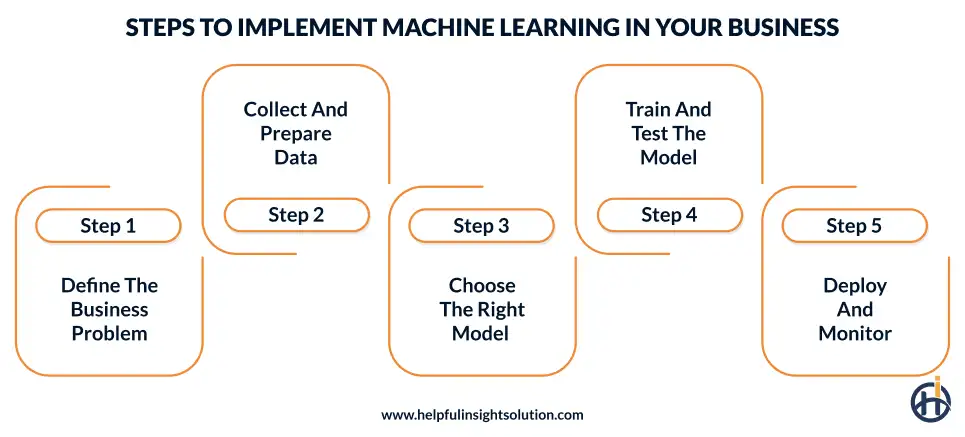
Getting started with machine learning can seem complicated at first, particularly if you’re not quite sure where to start. A step-by-step plan breaks the work into manageable stages, from setting the goals to using the model.
Let’s look at the key steps in a machine learning implementation roadmap.
1. Define the business problem
Start by identifying where your business would benefit from better decisions or more accurate results. That might be in understanding shifting customer demand, identifying customers at risk of churning, or reducing delays in daily operations.
Once you’ve established what you want the machine learning system to achieve, consider the available data and technical requirements to choose a suitable model and development approach.
2. Collect and prepare data
Once you’ve established the goal, gather the historical data that can help the model identify relevant patterns. This will come from a range of sources such as customer databases and sales records.
The data needs to be checked for missing or duplicate values, cleaned and structured properly before it can be used for model training. Businesses can consult experts or hire machine learning developers to handle data preparation and training requirements.
3. Choose the right model
Once data’s ready, pick a model that’s appropriate for the problem you’re trying to solve. Use a classification model when you’re dealing with categories, and a regression model when you’re trying to estimate a numerical value.
Clustering can group similar records together without any pre-defined labels. When choosing machine learning models in business, you need to consider data quality, prediction accuracy, training time and how easy it is to understand the results.
4. Train and test the model
Having selected the model, now train it on the prepared dataset. It learns from historical records and uses those learned patterns to make its predictions. Test it out on a separate dataset to see whether the results are good enough for your business.
This helps assess whether machine learning in business analytics is actually working.
5. Deploy and monitor
Once testing confirms the model meets your requirements, it can be made available to the teams and systems that need to use it (this may involve integration with existing software, business apps, or APIs).
You’ll need to continue reviewing the model’s predictions against actual outcomes. If the data patterns change over time, retrain the model to ensure it continues to perform as required.

How to measure the ROI of machine learning for your enterprise
As machine learning trends continue to grow, more businesses are considering how this technology can improve their operations. But before investing, it’s important to know whether the expected benefits justify the cost. Understanding how to calculate returns helps you assess its actual business value.
Here’s how to calculate the ROI of machine learning.
1. Calculate total investment costs
To measure ROI accurately, first determine how much your ML project actually costs. This includes development, data management, system integration, licensing, and regular updates. Also factor in ongoing costs, as they add to the total cost of ownership (TCO) over time.
2. Set performance benchmarks
Start by measuring the results your enterprise achieves without machine learning. Depending on the project, this may include processing costs, employee productivity, or customer churn. Comparing these figures with post-implementation results helps show the actual contribution of machine learning in business.
3. Convert results into financial gains
Once you measure performance improvements, turn that into a financial figure. How much are you saving through faster processes? How much are you making through improved customer conversion? Subtract the total cost of ownership from these financial gains and use the ROI formula to calculate the return as a percentage.
Formula
ROI (%) = (Financial Gain − Total Cost) ÷ Total Cost × 100.
4. Monitor returns over time
Check your machine learning investment every few months to understand how returns change. Account for maintenance, cloud usage, and model updates alongside financial gains. Regular ROI tracking shows whether the project continues to meet its business goals.
Common challenges in adopting machine learning and how to overcome them
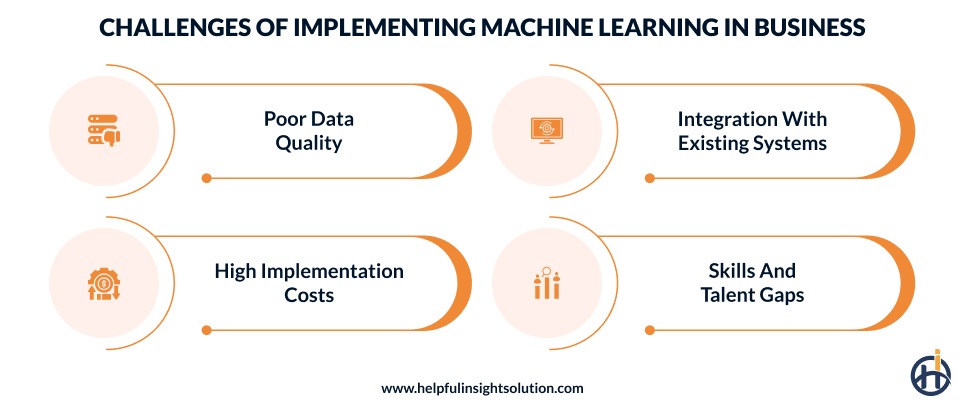
Implementing machine learning can bring certain difficulties, especially when businesses are new to the technology. Issues with data quality, costs, or technical expertise can affect implementation. It’s better to understand these hurdles beforehand.
Below are common machine learning challenges in business and practical ways to address them.
1. Poor data quality
The quality of the data available directly affects how well a machine learning model performs. If the customer records, sales data, or other business information are incomplete or inaccurate, the model will make the wrong inferences. You could end up making decisions based on misleading predictions rather than useful data insights.
The solution
Start by reviewing the available datasets and correcting missing values, duplicates, and formatting issues. Establish good data management practices so that as new records are added, the data remains consistent. An experienced AI development company can also help establish data preparation processes before model training begins.
2. Integration with existing systems
A business may have multiple systems handling different operations, and it’s not always easy to get them all to work with a new ML model. The older systems may not have the interfaces needed and the various platforms may have data in different formats.
These compatibility issues can make AI and ML integration a real pain and can quite easily prevent a team from using the model outputs where they actually are required.
The solution
Check whether existing software can connect to the new model via APIs or another integration tool. Start with one workflow, test data exchange, and sort out compatibility before rolling it out across the rest of the business systems.
3. High implementation costs
For many businesses, managing the investment required for ML is a major concern. The cost of training models, handling large datasets, and maintaining infrastructure all is a real concern.
If you don’t plan the scope of the project properly, then development costs can easily go over the original budget, which makes it very difficult to justify the value of the value of machine learning for business analytics.
The solution
Begin with a small project that addresses a clear business need instead of investing in a large system immediately. Estimate development and maintenance expenses in advance, then expand the implementation as the results justify further spending.
4. Skills and talent gaps
The use of AI and machine learning in business operations often requires a level of expertise that an organization may not possess in-house. They need know-how in data preparation, algorithm selection, and model training.
When those skills are missing, the company may end up relying on specialists or external resources, which can, in turn, affect project timelines and long-term management.
The solution
Start by identifying the skills your current team lacks, then provide relevant technical training. You can also work with external ML specialists who can help with implementation and help staff gain experience with the technology.
Conclusion
Machine learning for business is revolutionizing the way companies understand their markets and plan for the future. Rather than simply looking at past reports or relying on static business rules, companies can now use data patterns to anticipate what their customers want, detect changes in buying patterns and make better decisions as the situation develops.
In the coming years, its role is likely to grow beyond individual tasks, becoming part of how enterprises develop products, manage resources, and find new ways to serve customers. Companies that understand where this technology fits into their operations will be in a better position to put it to practical use.
Making this possible requires technical experience and a clear understanding of business needs. Helpful Insight is a reputable machine learning development company with hands-on experience implementing ML across different business operations. Our certified AI and ML engineers help identify suitable use cases, choose the right approach, and build solutions around specific business requirements.
Get in touch with us now to start your machine learning project.
FAQs
Machine learning is important for businesses because it helps identify useful patterns in large datasets, supports better decision-making, reduces the amount of manual work and helps understand customer behavior. It also enables businesses to respond more effectively to changing business requirements.
Yes, small businesses can use machine learning to understand what their customers like, manage stock more accurately, automate routine tasks, and make better decisions without necessarily having a large technical team.
Traditional business analytics examines historical data to explain past results, while machine learning identifies patterns in data to predict future outcomes and support automated decisions.
Yes, machine learning can connect with existing CRM, ERP, and database systems through APIs, allowing businesses to use model predictions without replacing their current software.