


Key takeaways
- Loan origination software refers to a digital tool that automates a loan’s journey from submission to disbursement.
- The core features of a loan origination system include identity verification, automated document processing, AI-driven risk assessment, and a credit decisioning engine for underwriting.
- Lending institutions need a loan decision system to speed up loan processing, reduce application drop-offs, improve the customer experience, and manage compliance.
- Developing simple loan origination software with basic features typically costs $30,000 to $80,000. An enterprise-level system can cost anywhere from $160,000 to $300,000 or more.
Approving a loan involves several decisions, not just collecting an application. Lenders need to confirm borrower details, check the supporting paperwork, and assess whether the applicant meets their lending criteria. If each task is handled separately, applications may sit waiting for checks to be completed.
This is where loan origination software development becomes relevant for lenders looking to digitize their lending operations.
The requirements are not the same for every lender. A credit union handling personal loans may need a different process from a fintech company offering business credit. Emerging fintech trends are also changing how loan applications are handled online and how lending platforms connect with other financial systems.
Digital lending is getting more attention from banks, credit unions, and non-bank lenders, and investment in loan processing software is growing. Business Research Insights puts the global loan origination software market at a projected $27.74 billion by 2035.
Before investing in a new loan origination platform, lenders need a clear idea of what they want it to do. This means looking at the features required for their lending process, the systems the software must connect with, and the likely development cost.
In this guide, we’ll explore how to develop loan origination software, its benefits, the features that matter most, and the key considerations lenders should address before starting a project.
What is loan origination software?
Loan origination software (LOS) is a digital system that helps lenders automate and manage a loan application from submission to approval and disbursement. Most loan applications go through the same checks, such as borrower verification, document review, credit assessment, underwriting, and compliance.
The software moves each application through the steps set by the lender. Staff doesn’t have to enter the same details again and again or keep asking for updates. The system also saves approval records, which makes audits easier.
Loan origination vs. loan management software: What’s the difference
Loan origination and loan management software may seem similar at first. However, one helps process a loan application, and the other handles the loan after disbursement. Before choosing software for a lending business, it’s worth knowing how the two differ.
| Aspect | Loan Origination Software | Loan Management Software |
| Primary purpose | Handle loan applications and decide whether to approve them. | Manage loans once the money has been released to borrowers. |
| Key functions | Application intake, KYC and document checks, credit review, underwriting, agreement signing | Payment schedules, repayment tracking, interest calculation, collections, statements, loan closure |
| Process stage | From application to loan disbursement | After disbursement through loan repayment |
| Main users | Loan officers, underwriters, and credit analysts | Servicing teams and collection officers |
How does a loan origination system work
From the time a borrower applies, several checks take place before the lender makes a decision and releases the funds. These steps may vary by loan type. Here is the typical loan origination system workflow.
Application intake
A borrower fills in an application on the lender’s app or website. Income, employment, and the amount they want to borrow go straight into the system. From there, the file is on record, and the review can begin.
Identity and document verification
Verification comes before any assessment. The applicant’s identity is checked, and documents such as bank statements and income proof are compared with the details on the application. If a figure doesn’t match or a page is missing, the software flags it.
Credit and financial assessment
The system pulls each applicant’s income, existing loans, and credit history into one view. That gives a clear picture of their finances. Most files move ahead on their own through automation. If something looks unclear, it goes to the underwriting team for a closer look.
Loan decision and approval
The software checks the application against the lender’s rules and helps decide if the loan can be approved. If something doesn’t look right, the case goes to a loan officer. Once approved, the loan amount and repayment terms are set.
Documentation and fund disbursement
Once the loan is approved, the LOS prepares the loan agreement and sends it to the borrower for signing. After the documents are signed, it connects with the bank’s system to transfer the approved amount to the borrower’s account.
Essential features to include in a loan origination platform
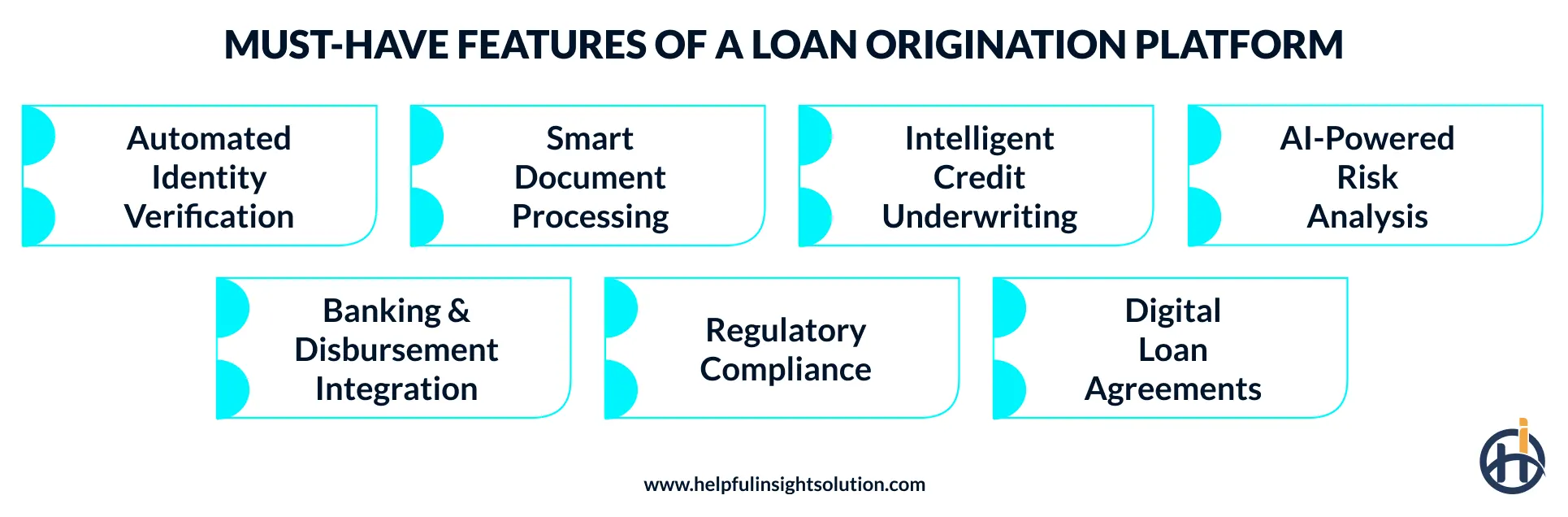
A modern LOS system should do more than collect loan applications. It should help banks and lending institutions manage their work from one stage to the next without adding unnecessary steps. The right features are an important part of loan origination software development and the platform’s long-term use. Here are the ones to include.
Automated identity verification
A lender can’t approve a loan without knowing who is applying. Automated identity verification matches the applicant’s details with official records and catches false or borrowed identities early.
Depending on the system, facial matching can provide an additional check. This feature helps reduce identity theft and strengthens cybersecurity in fintech during loan processing.
Intelligent document processing
Most loan delays start with paperwork. Intelligent document processing reads the bank statements, payslips, and tax forms a borrower uploads and pulls out the key figures using OCR. Good loan processing software then sorts each file and fills the fields, so staff don’t retype numbers.
Credit decisioning and underwriting engine
Two applicants can look alike on paper and still carry different risks. The rule engine looks at income, repayment history, and existing debt, then scores the application against the lender’s rules. Adding this functionality means risk assessment is consistent, and weaker files get a closer look.
AI-powered risk assessment
Checking an applicant’s salary and credit score does not always show whether they can manage another loan. AI can review other financial details and pick up signs that may need a closer look.
This gives another way to assess repayment risks through digital loan origination software.
Core banking and disbursement integration
A loan officer should not have to enter the same loan details into two different systems after approval. The software can send these details to the bank’s system and help process payments through ACH, wire transfers, or real-time payment rails.
This is worth keeping in mind when you build a fintech app and plan to connect it with the LOS.
Regulatory compliance management
Auditors ask simple questions. Which checks were done, which documents were collected, and who approved the file? A compliance feature in an automated loan origination system keeps those answers on record, so regulatory checks don’t have to be rebuilt later from emails and notes.
Electronic loan agreements
Paper agreements get lost. A digital lending platform lets borrowers sign online using an e-signature and saves the signed copy automatically. Lenders get a paperless record for later use.
Different types of loan origination software
LOS systems come in multiple types, each designed to meet different lending needs. The features and processes can vary depending on the kind of loans being handled. This is worth considering before you begin loan origination software development.
Consumer loan origination software
When a person applies for a car loan or personal loan, the lender has to check their details and credit history before approving anything. This software brings those checks into one process instead of spreading them across tools.
It can also verify the applicant’s identity. Staff doesn’t have to run each check separately, and the file reaches a decision sooner, even when applications arrive in large numbers.
Mortgage loan origination software
Mortgage loan origination software is built around the specific requirements of home financing. The system tracks the property valuation, title papers, and disclosures along with the borrower’s financial details. Since everything sits in one place, lending teams can quickly spot what’s still open, and fewer items get pushed to the final days before closing.
Commercial loan origination software
Commercial loan origination software handles loans for businesses, whether the money is for expansion, new equipment, or another large expense. These files are bigger than a personal loan file. They carry financial statements, business assets, and sign-offs from more than one person.
The software holds it all in one place and shows the current approval stage. Integration with insurance software can also help verify coverage for financed business assets.
Why do digital lenders need a modern loan origination system
Loan volumes keep rising, and so do customer expectations. Banks and lending firms that once managed with manual steps now find that approach hard to sustain.
This shift is part of the wider digital transformation in financial services, and many lenders now plan to build loan origination software.Here are the reasons the need keeps growing.
Faster loan processing
Most of a lending team’s day goes to chasing documents, confirming borrower details, and following up on pending files. The actual decision on the loan keeps getting pushed to later.
Custom loan origination software brings these steps into a more organized process and cuts down repetitive work. When the LOS handles the follow-ups, the team can focus on reviews, respond to borrowers sooner, and manage it all with the same headcount.
Preventing application drop-offs
A borrower starts a loan form, sees how many fields there are, and stops. Time and effort are the usual reasons. Loan decisioning software takes out repeated data entry and makes information checks easier. The loan application process gets faster, and more borrowers get to the submit button.
Limits of legacy systems
A legacy loan system works until the business needs something new. Each new feature or third-party integration tends to need custom fixes, and the cost adds up as technical debt. Moving to a modern fintech architecture changes that.
With an LOS platform, teams can connect APIs faster, adjust loan workflows when rules change, and add new loan products without working around old infrastructure.
Changing compliance requirements
Every loan application has to be checked against the current rules. Confirming the applicant’s identity is part of that. Old processes make changes slow and messy.
Automated loan origination puts these checks inside the workflow, so a bank can update them when requirements change and is less likely to miss a compliance step.
How much does loan origination software development cost?
The cost to develop loan origination software typically ranges from $30,000 to $80,000 for a simple solution, $80,000 to $160,000 for a mid-level platform, and $160,000 to $300,000 or more for enterprise software.
Several factors influence the overall loan origination software development cost, including:
- Number of features and modules
- Types of loans supported
- Third-party integrations required
- Security and compliance requirements
- UI and UX design complexity
- Technology stack and architecture
- Team size and location
A simple platform that handles applications and documents costs less. Add automated credit checks, many integrations, and detailed reports, and the price goes up. Every extra feature adds work and increases loan origination software pricing.
Make two lists before you fix a budget. One is what the system must do on day one. The other is what can wait. As a result, the cost to create software stays lower, and the system can still grow when new requirements come up.
How to build custom loan origination software (step by step)
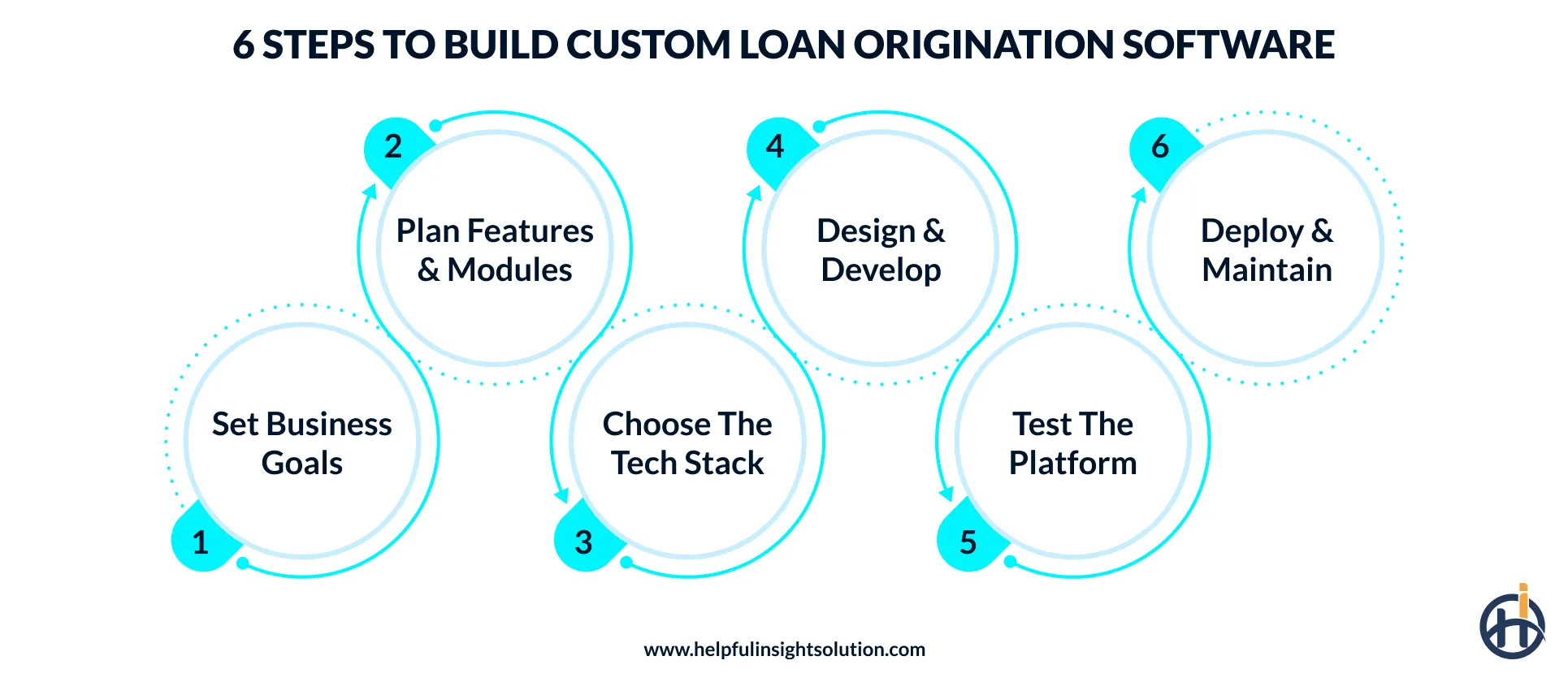
There is a lot to consider when building a system for loan applications. You need to plan the work, choose the features, and check the system before putting it into use. Below, we cover the steps involved in loan origination software development.
Define business requirements
Start with the basics: which loans will the system cover, and how should an application move from start to approval? Decide who will use it and what information they need at each stage. Include identity checks and other required rules. Having these points clear makes it easier to plan loan origination software around your actual process.
Plan features and modules
Next, write down what the system must do at every stage of a loan application. Most projects end up with a module for customer details, one for document verification, one for credit assessment, and one for loan agreements.
Not every feature is worth building. A software consulting and development company can guide you in selecting the right ones for your loan origination software, so you pay only for what the business needs.
Select technology and architecture
In this stage, decide what technology the loan origination system will be built on. For the frontend, choose between React, Angular, and Vue.js. For the backend, look at Java, Python, and Node.js.
The fintech software developers will also need to choose a database and hosting environment. A good software architecture keeps daily loan processing smooth, keeps customer data secure, and doesn’t fall apart when the business needs something new.
Design and develop the platform
Once the plan is ready, fintech design team can work on the screens users will see. Forms should be quick to fill out, and staff should be able to review an application without confusion.
Developers then build those screens and link them to the system’s core functions. Getting this right makes the loan origination software far more useful for your business.
QA and testing
The QA engineers will conduct rigorous testing to check the software and look for bugs as well as other issues before real applications are processed. They will check each feature, from entering applicant details to reviewing documents.
The team will also check data security and system speed to make sure the loan processing system is ready for daily use.
Deploy and maintain the software
The software can be made live after all the required tests are complete. It is often better to start with a small group, check how the system performs, and then roll it out to more users. After launch, regular updates, security checks, and bug fixes keep the loan origination system running properly.
How Helpful Insight can help you build custom loan origination software
Loan origination software is changing how financial businesses manage lending, from the first application to the final decision. As digital lending grows, these systems are moving beyond basic application management towards more connected processes, data-based decisions, and flexible workflows.
Future loan origination systems should be flexible enough to handle new types of loans, changing customer needs, and updated rules without making big changes to the software.
Getting there takes more than picking features. It takes a team that understands lending rules, risk, and integrations as well as code. At Helpful Insight, our financial software development company builds secure and scalable loan origination platforms around a lender’s own products, approval rules, and compliance needs. We start with the core loan workflow, connect the systems you already use, and expand in phases as your volumes grow.
Planning a loan origination system? Talk to our team and share your project requirements. We would love to help you.
Frequently Asked Questions
Building a simple loan origination system usually takes 3 to 6 months. An enterprise-level platform can take 9 to 12 months or more. Scope, feature complexity, UI/UX design, third-party integrations, and compliance requirements are the main factors that impact the timeline.
Yes, AI can automate several loan processing tasks, including document checks, credit assessment, fraud detection, and application reviews. It can also speed up loan decisions.
Choose custom software if your loan process needs specific features or integrations. Off-the-shelf software suits businesses with standard requirements and a smaller budget.
There is no single best option, because it depends on loan type. Encompass suits mortgage lenders, nCino suits banks on Salesforce, and LoanPro, MeridianLink, and Blend suit digital and consumer lending.