

Key takeaways
- Predictive analytics in mobile apps examines available app data with statistical methods and machine learning to spot patterns that indicate possible future outcomes.
- Predictive analytics can improve user engagement, support more relevant personalization, and give businesses data-driven insights for better mobile app decisions.
- Predictive analytics supports use cases such as churn prediction, recommendation engines, demand forecasting, and real-time fraud monitoring within mobile apps.
- Amazon, Uber, and Netflix are among the leading apps using predictive analytics to better understand user behavior and anticipate future needs.
Predictive analytics for mobile apps is used to forecast future outcomes from historical and current app data. Machine learning and statistical models can analyze patterns in user activity, transactions, engagement, and other app data to estimate what may happen next. These predictions can be applied to areas such as churn, purchases, demand, recommendations, and fraud detection.
The practical application of predictive analytics varies based on the outcome being forecast. User activity can help identify possible churn, purchase data can support demand or sales forecasts, and transaction patterns can be examined for signs of unusual activity. The resulting predictions can be used within the app or connected to processes outside it.
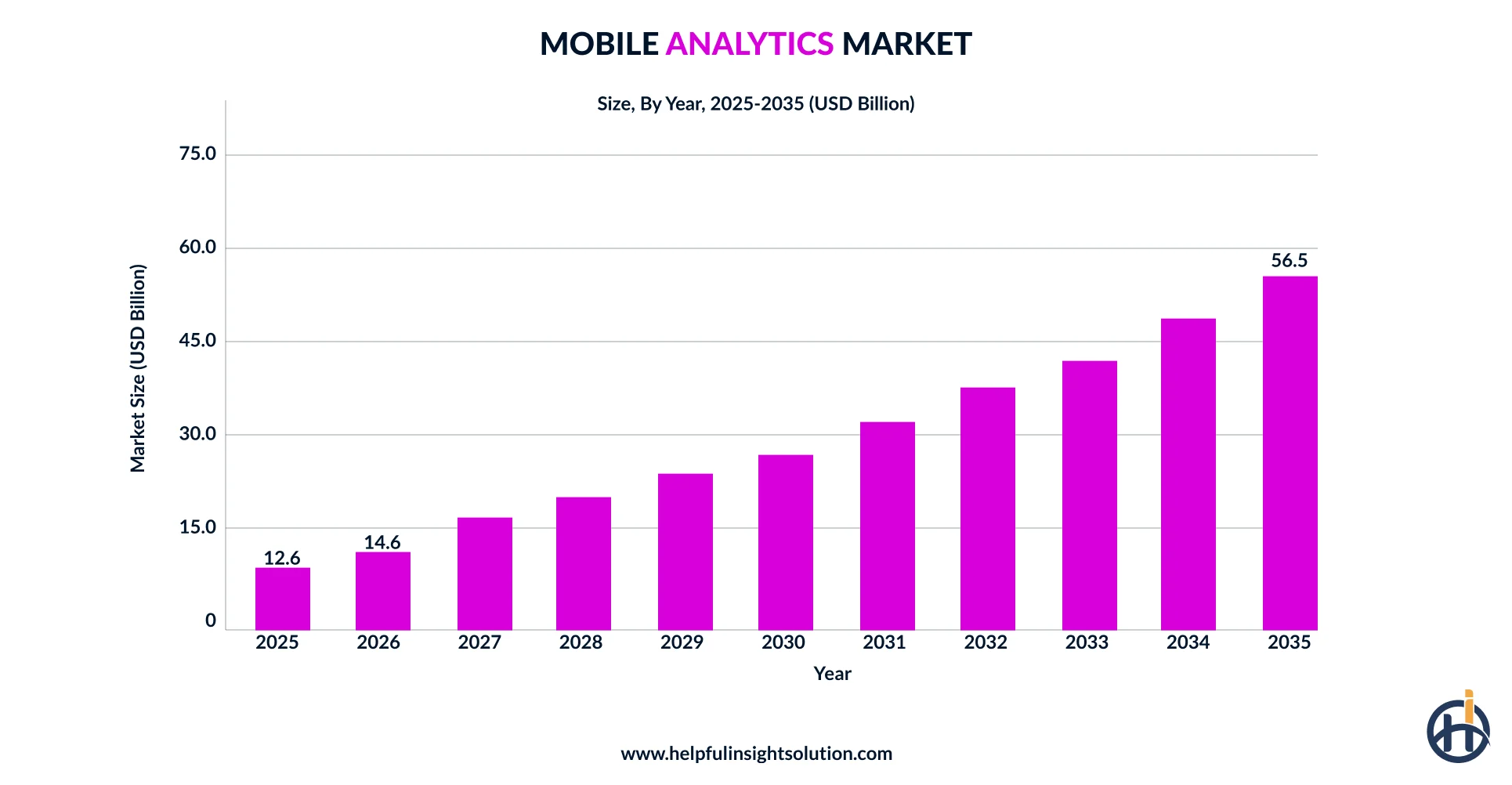
The amount of data available from mobile apps has also made analytics an important part of product planning. Grand View Research projects the global mobile analytics market to reach $56.5 billion by 2035, up from $14.6 billion in 2026. Analytics can go beyond measuring past app performance, allowing teams to use available information when planning for future user activity and demand.
Putting predictive analytics into a mobile app involves more than selecting a machine learning model. Data quality, the choice of model, integration, and ongoing performance all need to be considered. In this guide, we’ll cover the benefits, use cases, implementation steps, and challenges involved in using predictive analytics in mobile apps.
What is predictive analytics in mobile apps?
Predictive analytics in mobile apps uses historical and current app data, statistical methods, and machine learning models to estimate future outcomes. The information collected through an app can reveal changes in how users interact with it.
For example, when activity in an app starts to fall, it may suggest that a user is losing interest. Past purchase patterns can also provide some indication of future behavior. It is important to understand that traditional analytics identifies patterns in data, while predictive analytics uses them to forecast likely behavior.
How does predictive analytics work in mobile apps?
App activity generates behavioral data that can be used to identify trends and support predictive analysis. Let’s look at how predictive analytics for mobile applications works, from data collection and model training to generating useful predictions.
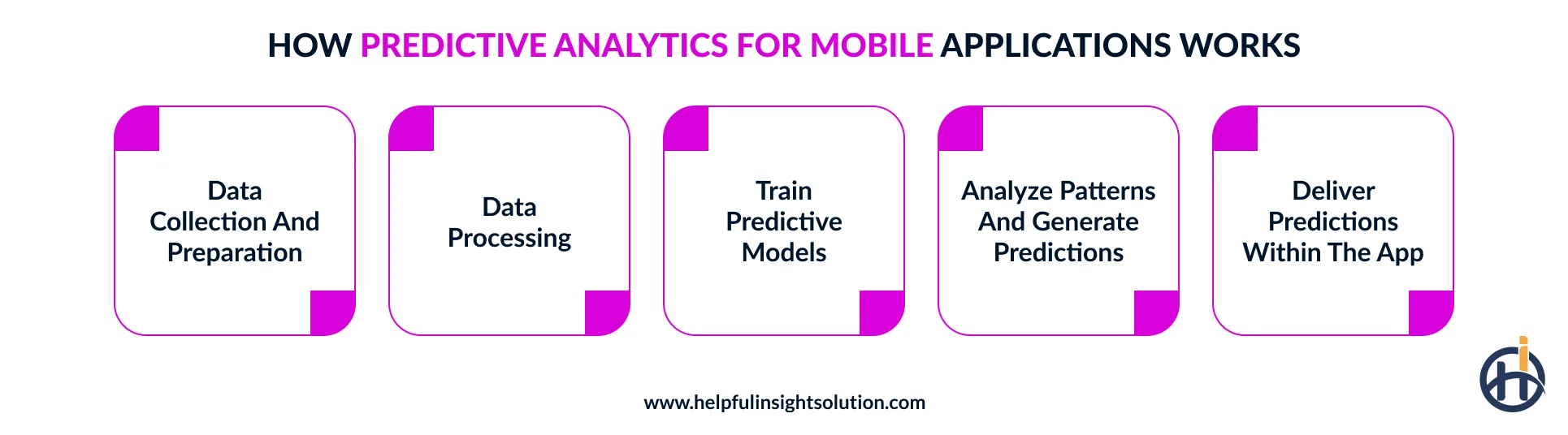
1. Data collection and preparation
A predictive model needs relevant data to work with. Mobile apps can provide user behavior data, transaction records, engagement history, and other information collected during normal use. That data is checked and cleaned first, since incomplete or inconsistent records can affect the quality of later predictions.
2. Data processing
Prepared data is organized into a usable format through data preprocessing. Relevant values are extracted from user activity, transactions, and other records so ML models can work with consistent information during the next stage of analysis.
3. Train predictive models
Data scientists train models using historical app data to identify patterns linked to specific outcomes. For example, in healthcare app development, past appointments or patient activity can be used as input data for a model designed for a defined prediction task, subject to validation and privacy controls.
4. Analyze patterns and generate predictions
Once the model has been trained, new app activity can be compared with patterns in earlier data. This user behavior data can provide signals that a model uses to estimate specified outcomes, such as purchase or churn probability.
5. Deliver predictions within the app
The prediction can then be used within the app to support different user interactions. Real-time predictions may trigger a recommendation, notification, offer, or another response based on what the user is doing.
What are the benefits of implementing predictive analytics in mobile apps?
Mobile applications can use predictive analytics to find useful patterns in existing data and act on them earlier. From user engagement prediction to demand forecasting, these insights can support several areas of an app.
The following benefits show how predictive analytics in mobile app development can create practical value.
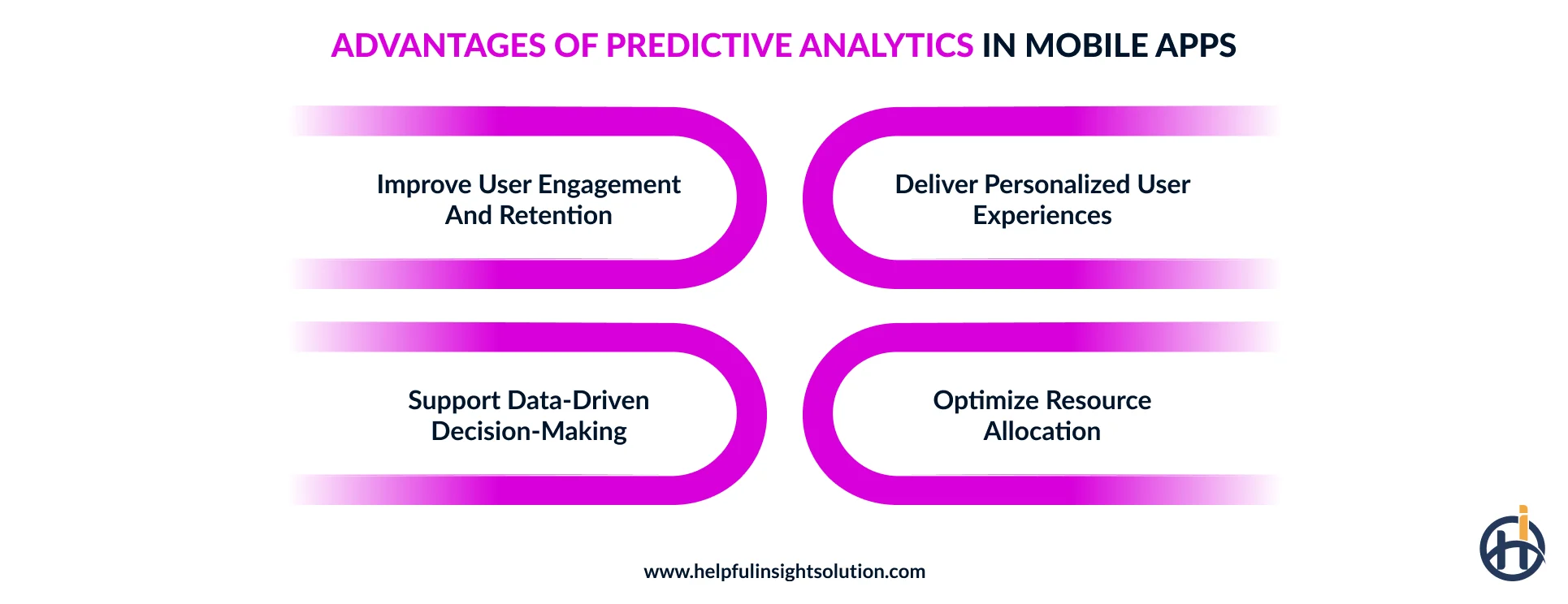
1. Improve user engagement and retention
Regular app users can gradually become less active without leaving any obvious sign. Fewer sessions, shorter visits, or reduced feature usage may show that interest is dropping. Looking at these engagement patterns gives predictive models a way to flag possible churn, helping businesses decide when a reminder, recommendation, or other retention action makes sense.
2. Deliver personalized user experiences
Mobile apps using predictive analytics can take past searches, purchases, and interactions into account when deciding what to show next. A shopping app, for example, might surface products related to earlier activity. This makes the experience more relevant without relying on the same recommendations for everyone.
3. Support data-driven decision-making
A lot of decisions around an app are based on what the business can see in its existing data. Predictive analytics adds another view by looking at what that data may indicate about future activity. Predictive modeling can provide insights that enterprises can consider when prioritizing features, anticipating changes in demand, or planning resource allocation.
4. Optimize resource allocation
Resources are easier to plan when there is some indication of how much demand is coming. Past traffic, transactions, and usage can be used for demand forecasting to spot periods of heavier activity. An enterprise can use this information to adjust cloud capacity, support resources, or other operational needs without adding capacity that may sit unused.
Top use cases of predictive analytics for mobile apps
The use cases for predictive analytics for mobile apps vary based on what an app needs to predict or improve. From identifying possible churn to forecasting demand and detecting unusual transactions, predictive models can support different parts of the mobile experience.
The following use cases show how predictive analytics in mobile app development is being used across different industries.
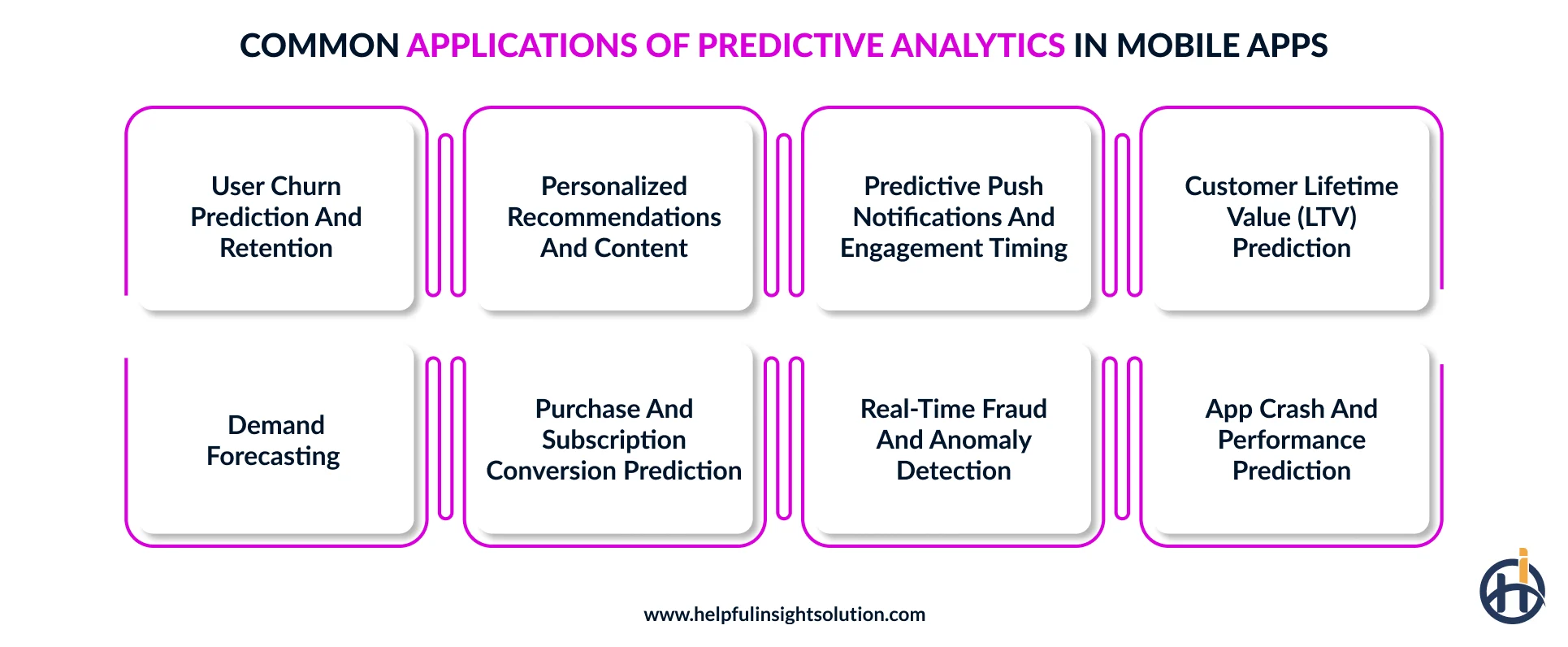
1. User churn prediction and retention
Retention becomes more targeted when an app can identify users who are gradually becoming less active. Churn prediction models can examine changes in sessions, interactions, and recent activity to estimate which users may leave.
That information gives product and marketing teams time to respond. Rather than sending broad campaigns, they can focus retention strategies on users showing meaningful changes in behavior and choose an appropriate action based on those signals.
2. Personalized recommendations and content
Recommendations should not stay the same when a user’s interests have moved on. Predictive analytics helps an app pick up those changes from everyday activity, such as searches, clicks, views, and purchases.
With predictive analytics in on-demand app development, these signals can inform which content or services receive more visibility. If recommendation updates are part of the system, suggestions can be refined as user activity changes.
3. Predictive push notifications and engagement timing
Rather than choosing one notification time for everyone, predictive analytics allows a mobile application to adjust delivery based on individual activity. Engagement prediction uses previous notification responses, session timing, and interaction history to estimate when a user is more likely to engage.
The app can then schedule messages around those predicted periods. This approach helps improve notification timing while reducing unnecessary alerts and giving users a more relevant communication experience.
4. Customer lifetime value (LTV) prediction
Not every app user contributes the same amount of revenue, and that difference can become clearer with predictive analytics. By looking at a user’s early spending and engagement, an app can estimate how their value may develop over time.
Customer lifetime value prediction gives teams a clearer idea of what different users may be worth. They can use this when setting acquisition budgets, comparing user groups, or planning retention efforts. It adds a forward-looking view to everyday marketing decisions.
5. Demand forecasting
For mobile applications that connect customers with products or services, predictive analytics can provide an early view of upcoming demand. The system can compare past orders with factors such as seasonality, location, and recent usage to spot likely changes.
These demand predictions can then feed into inventory planning, workforce allocation, or delivery capacity. This helps the app business prepare for busy periods and avoid having too little supply when demand rises.
6. Purchase and subscription conversion prediction
A mobile app can use predictive analytics to spot changes in behavior that often come before a purchase or subscription. It may look at conversion signals such as product views, paywall visits, feature usage, and pricing interactions.
These signals can be used to estimate conversion probability for a defined period or event. Instead of sending every free user the same upgrade message, the app can change what it shows based on the signals it has about their behavior.
7. Real-time fraud and anomaly detection
Fraud patterns are rarely the same across mobile apps. In a banking app, predictive analytics can spot an unusual transfer based on a user’s normal transaction habits. An e-commerce app might notice a sudden change in purchase behavior or payment details.
Machine learning models can assess these signals as activity happens and assign a risk level. The app can then request additional verification, hold a transaction, or allow normal activity to continue.
8. App crash and performance prediction
Mobile apps can use predictive analytics to identify patterns that often appear before a crash or performance problem. The analysis can bring together crash history, device type, OS version, network conditions, and app usage to see where issues are more common.
This gives dedicated developers an earlier view of potential trouble. If a new release starts affecting a particular group of devices, they can investigate that area first and prioritize the fix before the issue becomes more widespread.
Real-world examples of predictive analytics in mobile apps
The best way to understand the practical use of predictive analytics is to look at apps where these capabilities are already in use. The examples below cover different industries and show how predictive analytics for mobile app development services can support personalization, risk detection, forecasting, and other decisions.
1. Netflix
One of the most popular examples of predictive analytics in mobile apps is Netflix. The app looks at viewing habits such as what users watch, skip, pause, or finish, along with browsing activity and viewing time. It can also consider the device being used and when content is viewed.
This user behavior analytics gives Netflix useful signals for predicting which titles may be worth showing to each viewer.
2. Uber
Uber is a good example of predictive analytics in mobile apps because many trip details are estimated before a ride even begins. The app looks at signals such as the rider’s location, past journeys, traffic, time of day, and route conditions.
This data helps with ETA prediction, route estimates, and driver-rider matching. If traffic builds up or driver availability changes, those estimates can be adjusted while the trip is in progress.
3. Amazon
When users browse products on Amazon, their activity creates useful data. Searches, clicks, product views, and previous purchases can reveal patterns in how customers shop. Amazon uses predictive analytics to interpret those patterns and make product suggestions or search results more relevant.
Regional buying patterns also give the app useful signals about what customers may need next. This data supports inventory forecasting and demand forecasting, helping the company plan stock for different locations. It also helps reduce the gap between product availability and changing local demand.
How to implement predictive analytics in a mobile app: Step-by-step
Are you wondering how to integrate predictive analytics into mobile apps in a way that fits the product? The following steps break down the practical considerations, from choosing the right analytics models to connecting predictions with actual app workflows.
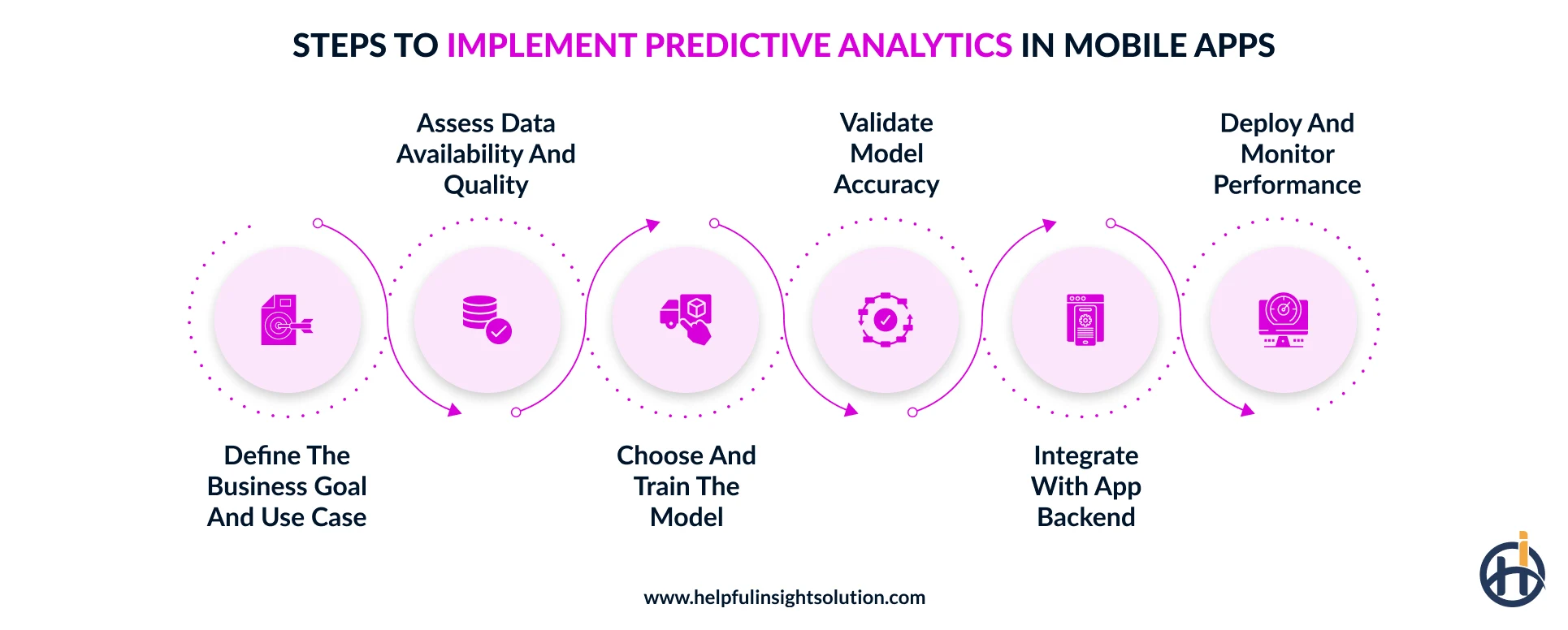
1. Define the business goal and use case
Before getting into models or data, be clear about the problem the app needs to address. For a food delivery app, that might mean predicting which users are unlikely to order again. A banking app may need to identify unusual transaction behavior.
Defining one measurable outcome first makes the predictive analytics strategy easier to shape and gives the development team a clear purpose for the data they collect.
2. Assess data availability and quality
Before you build a mobile app using predictive analytics, check whether you have enough reliable data to support the use case. Review sources such as user profiles, session activity, purchases, and clickstream events. Look for missing fields, duplicate records, inconsistent values, or tracking gaps.
This data quality assessment matters because predictive models rely on accurate and relevant data from sources such as transaction history and other relevant data sources.
3. Choose and train the model
Model selection depends on what you want the app to predict. A subscription app looking for potential churn may use a classification approach, while a delivery app estimating arrival times may need regression.
Set aside part of your training data for later testing, and use the remaining records to teach the model how different user actions, timings, and other variables relate to the outcome you are trying to predict.
4. Validate model accuracy
Use the separate test data to check the model’s predictions against known results. Review how closely they match and look at the cases where the model gets things wrong. This can show whether the model is ready for the intended app use case.
5. Integrate with app backend
Once the model has been validated, connect it to the mobile app’s backend through secure APIs. Decide how predictions should reach the application, whether through real-time requests or scheduled processing.
Keep the prediction service separate from the core app logic where practical. This makes maintenance easier. It is also important to plan for changing traffic levels so predictive analytics for mobile apps do not slow down the rest of the application.
6. Deploy and monitor performance
Deploy the model after it has passed the required validation checks, then monitor how it performs in the live app. Pay attention to prediction accuracy, errors, response times, and the quality of incoming data. These metrics can shift as user behavior changes.
Keep model monitoring as part of regular app maintenance. Review performance at set intervals and look for signs of declining accuracy. When fresh training is needed, use recent data, validate the updated model, and replace the existing version only after it meets the required checks.
Challenges of implementing predictive analytics in mobile apps and how to address them
Predictive analytics brings some practical challenges when it is added to a mobile application. Data protection, model performance, infrastructure requirements, and responsible use of user information all need attention. These concerns do not always appear during initial testing.
The challenges discussed below focus on what businesses should watch for during implementation and how they can handle these issues as the app, its users, and its data continue to change.
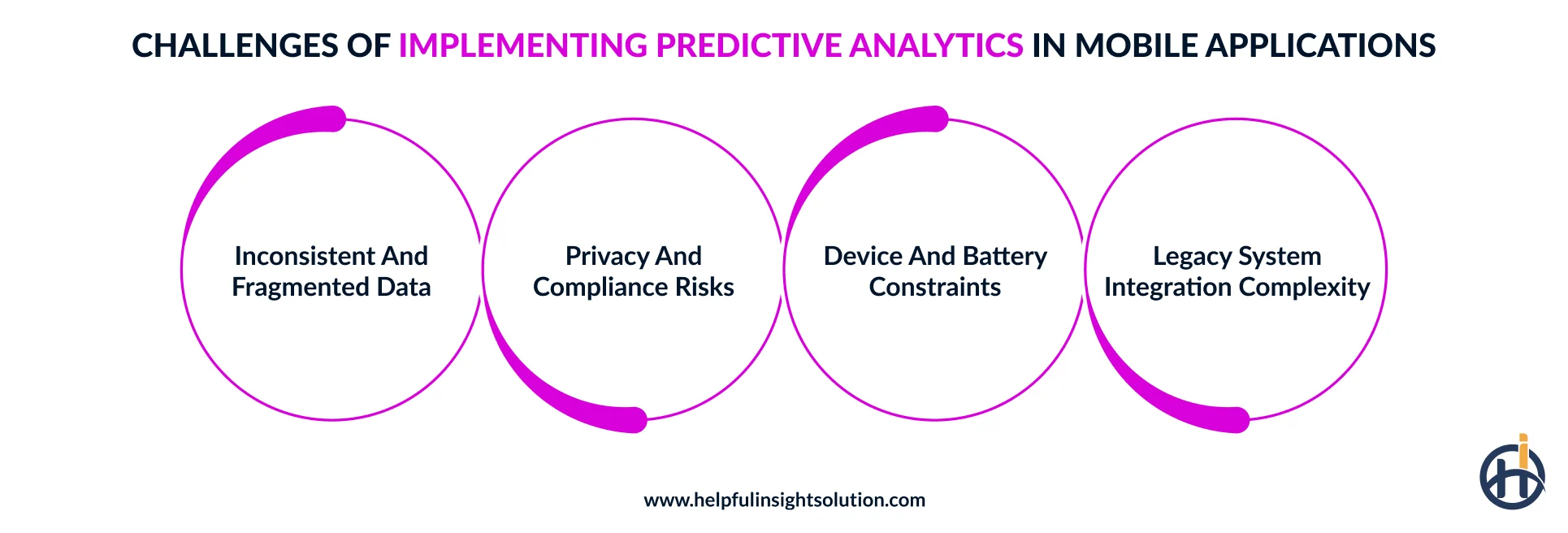
1. Inconsistent and fragmented data
Mobile app data often comes from several places, including different devices, operating systems, app versions, and tracking tools. Not every source records information in the same way. Without consistent data structures, bringing everything together becomes difficult and can leave predictive models working with incomplete or conflicting information.
The solution
Start with a shared data format across app versions and external sources. Add automated data cleansing and validation checks to identify problems as records arrive. This reduces inconsistencies before they affect model training or predictions.
2. Privacy and compliance risks
Privacy can become more complex when an app uses personal information for predictions. Location data, usage history, and account details may all be part of the data used for analytics. The challenge is to collect only what the prediction task requires and handle it in line with relevant IT compliance regulations.
The solution
Start with data minimization by collecting only the information required for the prediction. Use role-based access controls, define how long data should be retained, and protect it with appropriate security measures. The app should also follow applicable privacy requirements, such as GDPR in the EU or relevant U.S. state and federal privacy laws, based on where the app operates.
3. Device and battery constraints
Mobile devices have different hardware capabilities, and available memory or battery power can vary considerably. Running complex calculations too often can affect responsiveness and battery life.
Enterprises planning to implement predictive analytics in mobile apps need to consider on-device processing carefully, particularly when predictions are expected to happen frequently or in the background.
The solution
Keep only time-sensitive predictions on the device and shift heavier workloads to the backend. Model compression can further reduce memory requirements, helping predictive features run without putting unnecessary load on processing power or battery life.
4. Legacy system integration complexity
Older backend systems were often built without the APIs or data structures that modern predictive features expect. Connecting them to a mobile app can mean dealing with slow data exchange, outdated interfaces, and separate databases.
These predictive analytics challenges in mobile apps can make integration more time-consuming and introduce delays between the app and existing business systems.
The solution
Introduce a middleware layer between the mobile app and older backend systems. Use APIs to manage data exchange and keep the integration controlled. A gradual migration approach also lets businesses modernize selected components without replacing the entire legacy infrastructure at once.
Future of predictive analytics in mobile app development
What comes next for predictive analytics is not just about making better forecasts. Mobile apps are getting better at responding to changing patterns and using data in real time.
With advances in AI, machine learning, LLMs, and natural language processing, predictive features could become more useful and easier to act on, while automation may take care of routine decisions. There are plenty of possibilities worth exploring.
Let’s have a look at the future trends of predictive analytics in mobile apps.
1. On-device and edge AI
More predictive tasks may move closer to the user’s device as mobile hardware and edge AI technology continue to improve. On-device and edge processing can reduce dependence on constant server communication, which may help with response time and privacy. For mobile apps, this opens up more scope for offline AI and faster, locally generated predictions.
2. Context-aware predictive experiences
Future mobile apps may use context-aware AI to make predictions based on more than past user activity. Signals such as location, time, movement, and device conditions can provide additional context for each interaction.
This creates opportunities for an AI development company to build features that adapt predictions to a user’s current situation rather than relying only on past behavior.
3. Predictive app self-optimization
Predictive analytics may eventually support apps that adjust certain functions based on expected usage. Historical patterns could help with resource allocation, content loading, or background tasks before demand occurs. Such optimization could reduce unnecessary processing and improve responsiveness without requiring users to change settings manually.
4. Multimodal predictive analytics
Multimodal predictive analytics is likely to become more practical as mobile devices handle different forms of data more efficiently. An app could combine voice input, device signals, text, images, and usage patterns when analyzing a situation.
For predictive analytics in mobile apps, combining multiple signals can provide useful context when those signals are relevant to the prediction and are of sufficient quality.
Conclusion
Businesses do not need predictive analytics tools simply because mobile apps are generating more data. They need it when that data can answer a useful question before a decision has to be made.
Looking at user behavior, historical activity, and relevant data signals can reveal patterns that would otherwise go unnoticed, giving teams something practical to work with rather than another layer of reporting.
At Helpful Insight, we approach predictive analytics services with that practical starting point. We consider the application, data sources, existing systems, and business objectives before deciding how predictive capabilities should be implemented.
From model selection and data preparation to API integration and deployment, we focus on the technical foundation needed to make predictive features useful within the mobile application.
If you are planning to implement predictive analytics in your mobile app, connect with our team to discuss the right approach for your application.
FAQs
The cost to implement predictive analytics to a mobile app depends on the level of integration. A simple API-driven implementation may cost $10,000 to $30,000, while custom integrations range from $30,000 to $100,000 and enterprise solutions can exceed $100,000 to $300,000+.
Predictive analytics looks at past user behavior and app data to spot patterns that may point to what happens next. Apps can use those insights to offer relevant recommendations and more useful interactions.
The core components include data collection, data preparation, machine learning models, prediction logic, APIs, and monitoring. Each plays a role in turning app data into predictions.
Yes, predictive analytics can be added to an existing mobile app. The approach depends on the app’s architecture, available data, backend systems, and the type of predictions you want to introduce.