

Key Takeaways:
- It is crucial to identify business issues, target users, data requirements, and measurable outcomes before starting ML application development.
- AI experts follow a dedicated process, which includes data collection, app integration, testing, deployment, and performance monitoring.
- A business investor should prioritize high-quality data, secure processing, privacy measures, and scalable infrastructure for ML-powered apps.
- To maintain accuracy and ensure a better user experience, businesses should track ML models and retrain them with new data.
Have you ever understood how e-commerce apps provide user-specific products or an OTT platform knows what viewers want to watch? It is all possible through smart technologies like machine learning, which can support recommendations, predictions, pattern recognition, and task automation.
The machine learning app development process is increasingly used alongside traditional approaches for apps that benefit from data-driven capabilities, allowing businesses to focus on modern innovations. Banking, healthcare, supply chain, and other domains are benefiting greatly from this AI-powered technology.
From user personalization and chatbots to fraud detection, machine learning in mobile app development has transformed the way enterprises handle multiple operations. ML is a foundational approach used in natural language processing, computer vision, and many generative AI systems. This makes it one of the major components in mobile apps, enhancing accuracy, optimizing experiences, and reducing errors.
This blog helps businesses to understand how they can create advanced mobile applications using machine learning technology. Additionally, key features, benefits, tech stack, timeline, and challenges of ML are also discussed in the content. So, come along and get the valuable insights.
What is a machine learning app?
It is a mobile app that uses one or more ML models to analyze data and generate predictions, classifications, recommendations, or other outputs. An ML app can analyze data, identify patterns learned during model training, and produce predictions or classifications when requested.
Machine learning models allow mobile apps to extract data from multiple sources and process it on their own. Various machine learning use cases include recommendations in streaming platforms, prediction in navigational apps, and recognition in camera apps.
How do machine learning applications work?
A business investor must know how a user interacts with ML-powered mobile applications in real-world settings.
- Users input multiple data points, and the system stores the information on a local server.
- Data cleaning and feature extraction models are used to refine the generated raw data.
- The algorithm identifies patterns in the historical data and matches them with probable outcomes.
- Now, the processed information is transferred to the user interface in an easy-to-read format.
- The system analyzes user actions and stores the feedback in the loop for future training.
Benefits of machine learning app development
User personalization, workflow automation, and better decision-making are the key benefits of machine learning app development. We will discuss all these major advantages that are offered by ML-driven apps in this section.
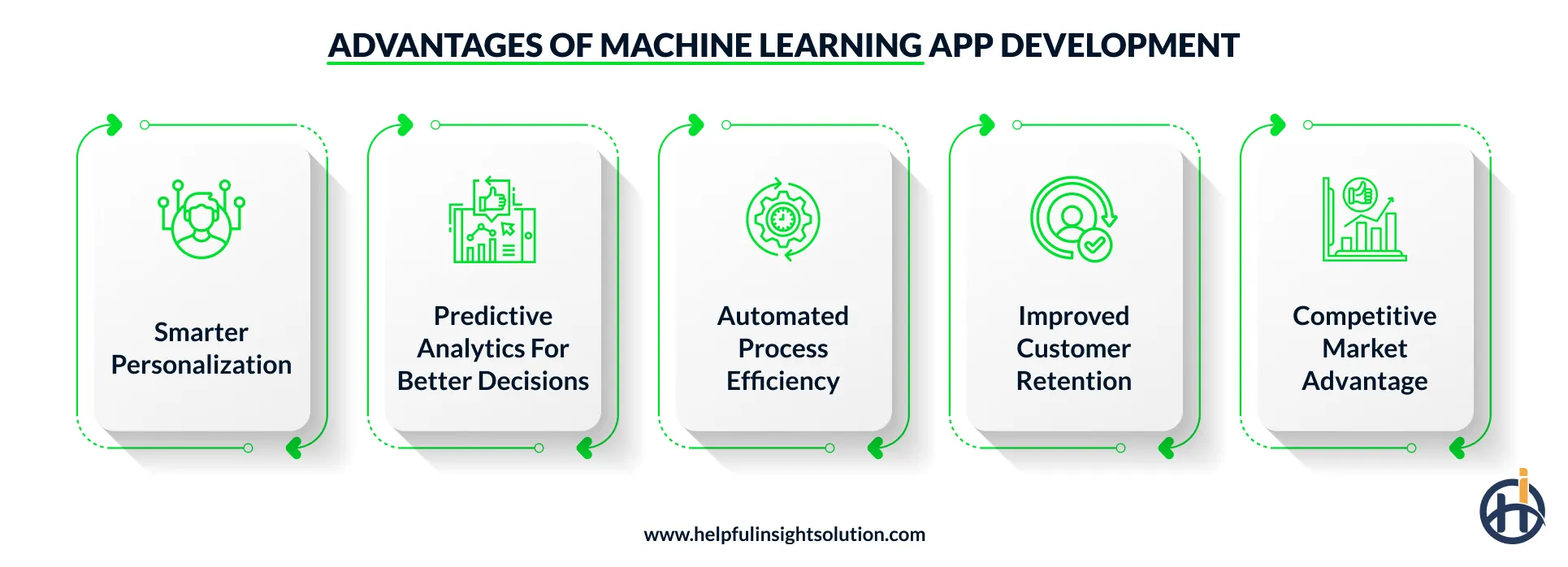
1. Smarter personalization
Various ML-powered mobile apps understand user behavior, preferences, and history, providing specific content, recommendations, and products in real-time. They can ensure constant user engagement, which may increase overall conversions and loyalty for businesses.
2. Predictive analytics for better decisions
ML models analyze past and present data, recognize trends, and generate predictions that can support decisions, with performance depending on data, model, and evaluation method. With predictive analytics services, companies get better-informed insights that enable them to make timely decisions.
3. Automated process efficiency
In most industries, various time-consuming tasks can include data entry, processing documents for compliance, and routing workflows. Automation with ML takes over those operations so team members can work on higher-value tasks while making workflows much faster.
4. Improved customer retention
Apps that use machine learning models can spot customer churn at early stages by analyzing usage behavior and decreased engagement levels. This issue can be quickly addressed with targeted measures, which increase customer lifetime value and overall retention rate for enterprises.
5. Competitive market advantage
By implementing machine learning, businesses can easily increase product innovation, react to market changes instantly, and create more intelligent products than their competitors. This technical advantage helps organizations become industry leaders, gaining long-term growth in the market.
Must-Have features of a successful ML app
From recommendation engines and fraud detection to model feedback, a machine learning-powered app offers multiple features. We are going to discuss essential features in this section that businesses can implement.
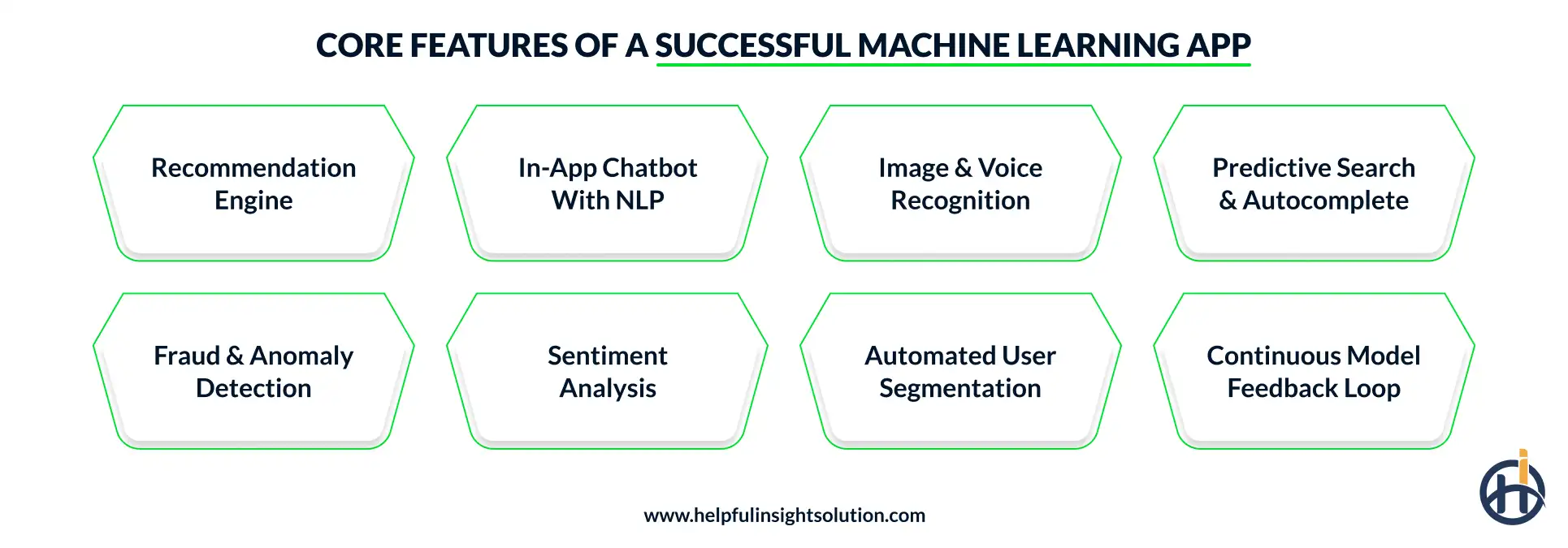
1. Recommendation engine
The system recommends various products and content based on the user’s preferences and behavior. This can support engagement or conversion when the data and recommendation strategies are effective in real-time.
2. In-app chatbot with NLP
This type of chatbot uses natural language processing to provide fast support and answer questions. It minimizes support costs as well as provides faster solutions and a better experience for users in the app.
3. Image & voice recognition
This enables an app to process the visual and audio data of the user to perform functions that include search, identification, or accessibility. This provides a more natural interaction that doesn’t require much effort from the user.
4. Predictive search & autocomplete
This feature learns what a user is trying to search for before they finish typing it. This helps the app eliminate delays or frustration for the user by proactively suggesting a relevant term.
5. Fraud & anomaly detection
This feature ensures machine learning-based anomaly detection and flags unusual transactional patterns in real time. It protects businesses and users from fraud while maintaining trust and regulatory compliance across sensitive operations.
6. Sentiment analysis
It can interpret user reviews, feedback, or messages to gauge emotional tone and satisfaction levels. It helps businesses respond proactively to concerns and refine products based on genuine customer sentiment.
7. Automated user segmentation
This feature clusters users into segments based on their behavior, demographics, or preferences. It can additionally use generative AI for highly targeted marketing, personalization, and campaign workflow strategies.
8. Continuous model feedback loop
ML models are constantly trained with fresh data and new user interactions using a feedback loop. This can help the model adapt to changing data patterns, but relevance and accuracy still need continuous evaluation.
How to develop a machine learning app?
To build a machine learning app, enterprises should analyze major issues, choose a suitable model, and integrate it with the app. Here is a detailed ML app development strategy, which includes various generally used steps.
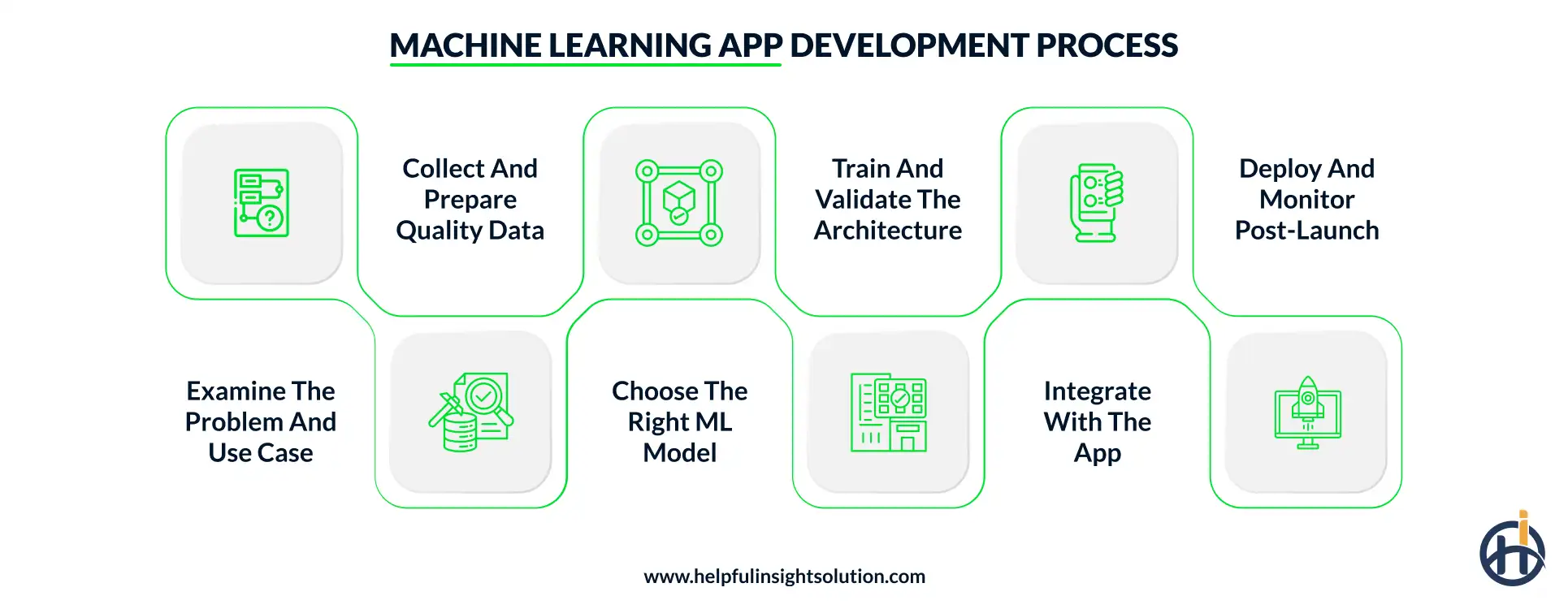
1. Examine the problem and use case
In this step, it is essential for enterprises to clearly define the business problem that machine learning will solve with the desired outcome. This process helps them to make clear decisions, from data requirements to model selection and success metrics.
- It is crucial to define measurable KPIs to track project success accurately.
- You must identify stakeholders and end-users impacted by the solution.
- Enterprises should assess technical feasibility against available budget and timeline.
2. Collect and prepare quality data
The accuracy of machine learning models depends on the volume, relevance, and cleanliness of the data. This stage helps the development team to easily collect the information from multiple sources and allows them to clean, label, and organize it for training.
- Remove duplicate records and inconsistent formatting across datasets.
- This handles missing values using imputation or exclusion methods.
- You can easily split data into training, validation, and testing subsets.
3. Choose the right ML model
For a business investor, it is necessary to choose the right algorithm for machine learning development, such as classification, regression, clustering, or generative. It depends on the problem type, data structure, and desired output, which helps to prevent rework expenses at later stages.
- This compares supervised, unsupervised, and reinforcement learning approaches carefully.
- It can evaluate model complexity against available computing resources.
- Consider interpretability needs for regulated or sensitive industries.
4. Train and validate the architecture
Model training involves optimizing model parameters using training data, so they learn statistical relationships based on the targets, followed by rigorous testing against unseen data. The validation of machine learning models ensures that they generalize results rather than memorizing training examples.
- Use cross-validation techniques to reduce overfitting risks.
- Fine-tune hyperparameters to optimize model performance metrics.
- Benchmark results against baseline models for comparison.
5. Integrate with the app
Now, you can hire a machine learning app development company to incorporate the model into the mobile app through APIs or SDKs to connect it with the front-end and back-end. This step connects models with the app so the team can evaluate latency, output quality, and user experience under the intended workload.
- Build lightweight APIs for real-time model inference calls.
- Ensure compatibility between model outputs and the app’s UI layer.
- Test integration under real user-traffic simulation scenarios.
6. Deploy and monitor post-launch
During this phase, the model is integrated into a production environment where it interacts with users or data in real-time. With ongoing maintenance, AI specialists can track performance, observe drift, and initiate retraining when the accuracy drops.
- Set up automated alerts for model performance degradation.
- Track latency and resource usage under production load.
- Schedule periodic retraining cycles using fresh incoming data.
Technologies for developing machine learning apps
For machine learning mobile app development, AI experts use ML frameworks, data-processing tools, deployment infrastructure, APIs, databases, and monitoring tools. These include Python as a programming language, TensorFlow frameworks, Docker containers, and MongoDB for database management.
By using them, you can make an AI-powered language learning app, health monitoring platform, banking solution, or order tracking service. The following table provides key components with their respective tools and descriptions.
| Component | Tools/Technologies | Description |
| Programming Language | Python, R | Core languages for building ML models and pipelines. |
| ML/DL Frameworks | TensorFlow, PyTorch, Scikit-learn | Build, train, and deploy machine learning models. |
| Data Processing | Pandas, Apache Spark, NumPy | Clean, transform, and prepare large-scale datasets. |
| Model Training Infrastructure | AWS SageMaker, Google Vertex AI | Scalable cloud infrastructure for training ML models. |
| Vector Databases | Pinecone, Weaviate, Milvus | Store embeddings for semantic search and retrieval. |
| LLM/GenAI Frameworks | LangChain, LlamaIndex, Hugging Face | Build apps powered by large language models. |
| Model Deployment | Docker, Kubernetes, TensorFlow Serving | Package and deploy models into production environments. |
| MLOps & Monitoring | MLflow, Kubeflow, Weights & Biases | Track experiments, versions, and model performance. |
| API Integration | FastAPI, Flask, REST/GraphQL | Connect ML models with front-end app logic. |
| Backend & Database | Node.js, PostgreSQL, MongoDB | Handle app logic, storage, and data persistence. |
What is the timeline to build a machine learning-powered app?
For an entrepreneur, the machine learning app development timeline matters because most platforms with advanced functionalities take longer to build. Mobile app complexity is one of the major factors, which includes multiple parameters affecting the overall duration.
By studying them, businesses can invest in NLP, GenAI, or chatbot development for a mobile application. Here is a table that describes the average time for creating different types of ML-driven mobile platforms.
| Complexity Level | Development Timeline | Description |
| Basic ML MVP | 2–3 months | Simple model, single use case, limited features |
| Standard ML App | 3–5 months | Custom model, app integration, moderate data complexity |
| Advanced ML App | 5–7 months | Multiple models, real-time processing, third-party integrations |
| Enterprise-Grade ML Platform | 7–10 months | Complex pipelines, scalable infrastructure, multi-module functionality |
| Highly Customized AI System | 10–12 months | Deep learning, large datasets, ongoing model retraining |
Major challenges in creating machine learning mobile solutions
Businesses that want to create a machine learning app must know various development challenges, like data privacy and model accuracy. In this section, some of the most important issues are discussed with their solutions.
1. Data privacy and compliance risks
Various healthcare or fintech apps collect user location, contacts, or biometric data, which may increase the exposure risk during transmission and storage. Also, it is difficult to handle large training sets across the globe due to strict compliance laws like GDPR, HIPAA, or CCPA.
Solution: It is crucial to train models on decentralized mobile devices and add controlled statistical noise to model updates to prevent backtracking of user profiles.
2. Model accuracy degradation
To run complex ML models on hardware, experts use the quantization method, which may affect accuracy. For example, a mobile keyboard trained on the historical data using predictive analytics gets degraded when new emojis or trends suddenly evolve.
Solution: Implement federated learning to adapt to user habits, set up lightweight telemetry to monitor prediction distributions, and run the new model in shadow mode.
3. High computational demands
In mobile machine learning, high computation is a major issue because smartphones have limited processing power, memory, and battery life compared to cloud servers. Several complex AI models require powerful GPUs, which may lead to battery drainage, slow processing, and delayed functioning.
Solution: AI/ML experts should perform model pruning, build mobile-friendly architectures, use built-in mobile chips, and deploy a remote server.
Use cases of an ML-driven application
Various domain-specific use cases help investors to develop a machine learning-powered app based on their needs. We will cover major industries in this section that use AI and ML models on a large scale.
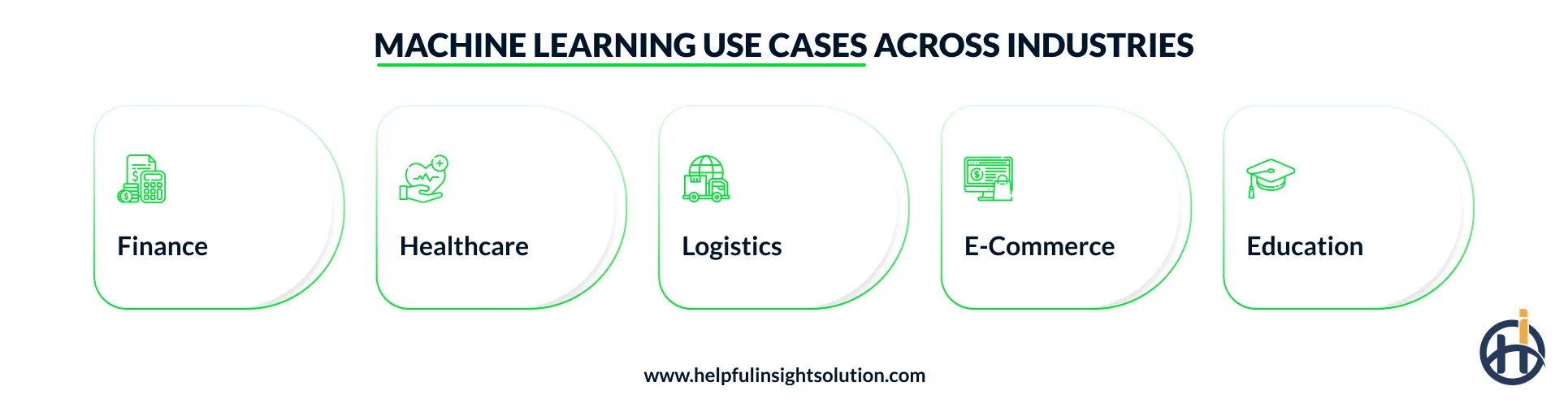
1. Finance
Fraud detection, credit scoring, and automated trading strategies can be powered by ML with high accuracy. They allow financial organizations to minimize losses while providing their customers with speedier approvals and more tailored guidance.
2. Healthcare
Businesses use machine learning in healthcare to access medical data, supporting early diagnoses, treatment options, and patient monitoring. This enhances clinical accuracy, providing users with speedy and personalized healthcare.
3. Logistics
ML enhances route planning, forecasting demand, and managing inventories throughout the supply chain in real time. This results in minimizing delays and lowering costs while improving logistics operations for a supply chain management business.
4. E-commerce
It is used by e-commerce sites to provide recommendations, apply dynamically changing prices, and evaluate stock needs based on buying habits. This boosts customer engagement and conversions while also reducing backend delays.
5. Education
ML drives adaptive learning platforms that can personalize content according to the performance and pace of a student. This enhances the overall learning outcome and enables teachers to easily assist students who need extra help.
How does Helpful Insight assist enterprises in creating smart machine learning solutions?
To create a machine learning app with proper strategy and budget management, it is crucial to approach an experienced and reliable partner. We are a renowned AI development services provider, helping our clients to build and deploy smart solutions that fulfill user expectations.
ML helps businesses to easily understand customer behavior through past records and deliver features based on their searches, medical data, or saved preferences. Our experts can develop business-specific machine learning models, which can ensure accurate result forecasting, faster query redressal, and strong threat analysis.
We provide cloud-based solutions that help enterprises to manage custom machine learning app development costs, which include several AI algorithms and frameworks.
So, developing an ML-driven mobile application requires expert guidance, advanced technical knowledge, and constant support. An entrepreneur can boost revenue, increase ROI, ensure user retention, and reduce losses through a machine learning app.
FAQs
A full-scale industry-grade ML platform may cost between $150,000 and $400,000, due to strict compliance and automated pipelines. The cost of making a basic MVP model may range from $25,000 to $70,000 based on API integrations and data classification. Computer vision technology, predictive analytics, LLMs, and agentic workflows all influence the development cost.
Healthcare, fintech, retail, and manufacturing are the key sectors that experience major benefits through ML applications. These platforms ensure fraud detection, enhanced diagnostics, predictive maintenance, and inventory management. Modern AI and ML algorithms analyze large datasets to deliver user-specific services, such as automation, prediction, and decision-making.
Outsourcing ML development is beneficial for early-stage MVPs and faster market reach, ensuring cost efficiency. Businesses can build in-house ML teams for IP ownership, security & control, and daily iteration. They can choose a hybrid approach, where an agency is hired to build an MVP, and then an internal team scales the product to deployment.
Machine learning is now accessible for small-scale businesses through cloud platforms and pre-built tools. Off-the-shelf solutions help investors to automate tasks and build basic AI workflows on a limited budget. These ML platforms are helpful in customer support, sales forecasting, and marketing personalization, reducing overall expenses.
Federated learning, homomorphic encryption, and secure multi-party computation (SMPC) are privacy-preserving techniques used by developers. Other methods include data minimization, API protection, and model integrity. They keep data on the user’s hardware to prevent network exposure and server vulnerabilities.