


Key takeaways:
- Generative AI in healthcare creates new content, clinical notes, medical images, patient data, rather than just analyzing what’s already there.
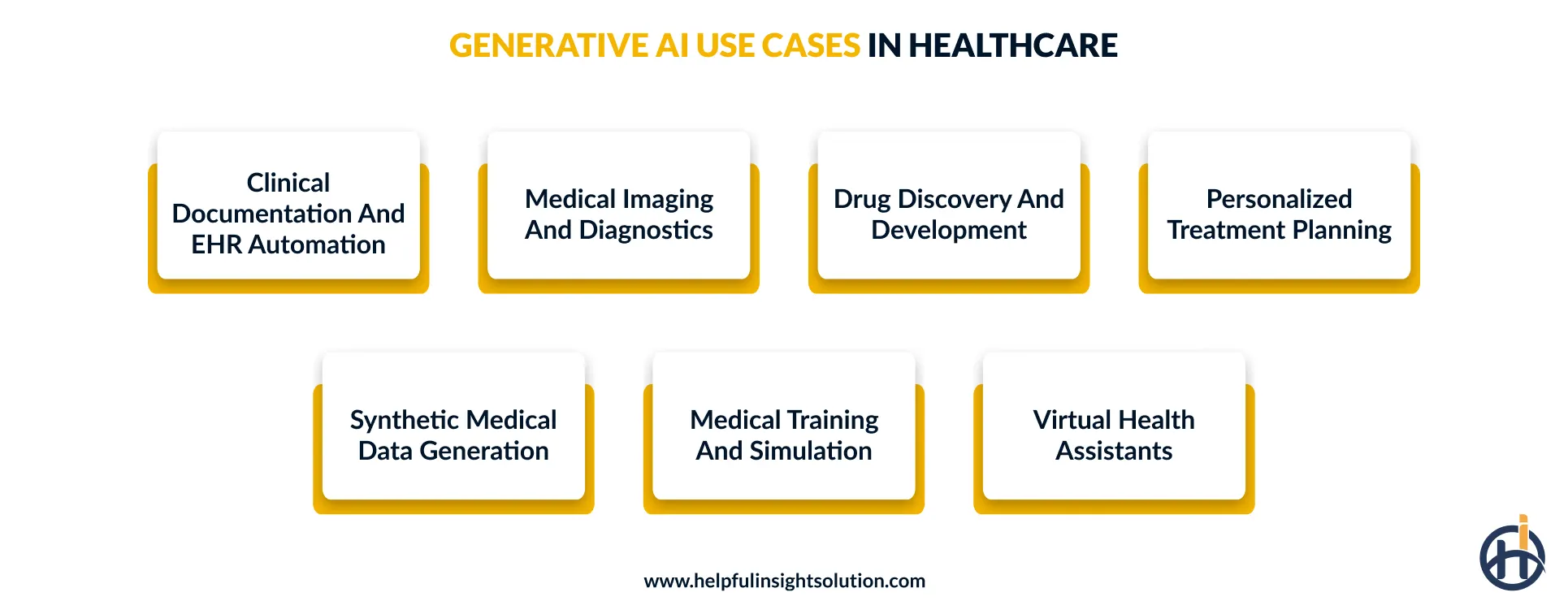
- Clinical documentation, medical imaging, drug discovery, and AI-powered virtual assistants are among the most widely adopted use cases of gen AI in healthcare.
- Benefits span both sides of care; lower operational costs and less paperwork for providers, shorter waits and personalized treatment for patients.
- Personalized treatment planning alone makes up close to 25% of the entire generative AI in healthcare market right now.
The strain on healthcare organizations isn’t new. What’s different is the scale of it. Clinical teams are overloaded, operations teams are doing more with fewer people, and outdated systems add friction at every step. A prior authorization that should take an hour still takes two days at a lot of hospitals.
Generative AI in healthcare is addressing this directly by streamlining administrative operations, supporting faster medical imaging analysis, and speeding up drug discovery. It is becoming foundational, not optional.
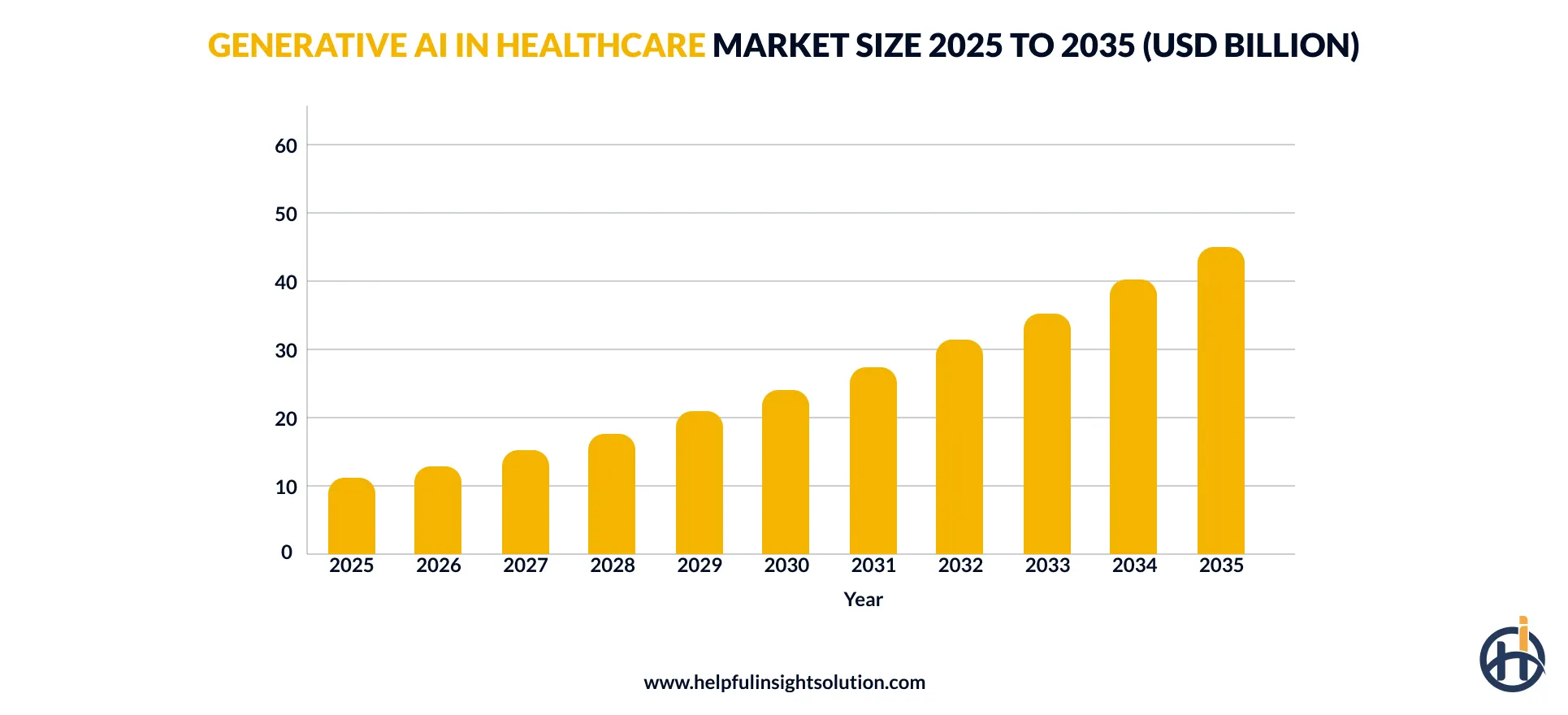
And this isn’t some small experiment anymore. Precedence Research puts the global generative AI in healthcare market at $3.57 billion in 2026, growing to nearly $48.23 billion by 2035. Few industries are growing at that pace right now. Healthcare enterprises aren’t funding this out of curiosity either, they’re chasing real cuts in administrative cost and faster diagnosis times, which is why budgets keep moving toward it even as other IT spending gets trimmed.
Whether you’re a hospital network, a health insurance provider, or a healthcare technology company, the question isn’t really if generative AI belongs in your operations anymore. It’s where to start, what to prioritize, and how to do it right, which is exactly what this guide walks through.
What is generative AI in healthcare?
At its core, gen AI in healthcare is a type of AI that creates new content instead of just analyzing existing data. That could be a clinical note written from a doctor’s voice recording, a synthetic dataset used for research, or a first-pass read on an X-ray.
It’s built on large language models, a form of deep learning, and unlike traditional machine learning, which is mainly trained to predict or classify (like flagging a risk score), generative models are trained to produce new output entirely.
Top generative AI use cases in healthcare industry
The real value of generative AI in healthcare comes from where it actually gets used every day. From cutting down documentation time to speeding up drug discovery, below are some of its most valuable applications across the healthcare ecosystem.
1. Clinical documentation and EHR automation
This use case is about AI turning spoken doctor-patient conversations into finished EHR documentation without someone typing it up later. It helps clinicians reclaim hours lost to paperwork each week and cuts down the burnout tied to after-hours charting.
Cleaner notes at the source also reduce downstream billing and coding mistakes. AWS HealthScribe works this way, pairing speech recognition with generative AI to build clinical notes automatically.
2. Medical imaging and diagnostics
Radiologists going through dozens of scans in a single shift can miss the small things, something easy to overlook when you’re moving fast. AI in medical imaging helps address this challenge by using models trained on large imaging datasets to pick up on patterns in X-rays and CT scans, including signs linked to diabetic retinopathy, tumors, or Alzheimer’s disease.
Gen AI tools don’t replace the radiologist’s read, it just flag what deserves a second look before the final call gets made.
3. Drug discovery and development
Another one of the well-known generative AI in healthcare use cases is drug discovery and development. Pharma R&D teams normally lose months just screening compounds before a single one reaches the lab.
Generative models speed this up by proposing new molecular structures with the properties researchers are actually looking for, then narrowing down which ones are worth testing based on predicted behavior and side effects.
4. Personalized treatment planning
Every patient reacts differently to the same treatment, but most care plans are still built around standard protocols for a diagnosis rather than the individual. Generative AI models are starting to change that by analyzing a patient’s genetic data, medical history, and daily habits to suggest treatments that are better aligned with what actually fits them.
Personalized treatment plans account for roughly 25% of the gen AI in healthcare space, more than any other use case. That share reflects how much clinicians are catching warning signs earlier and pointing patients toward therapies more likely to actually work for their health profile.
5. Synthetic medical data generation
Rare disease research runs into a wall almost immediately when there just isn’t enough patient data to work with, and privacy rules make sharing what exists even harder. Generative AI for healthcare is solving this by creating synthetic patient data, records that behave statistically like real medical data without belonging to an actual person.
Research teams can train models or run studies on these datasets without the compliance risk tied to handling real PHI.
6. Medical training and simulation
Gen AI systems in hospitals create realistic virtual patients and full emergency room scenarios where students make real diagnostic calls and see the outcome play out, all without any risk attached. This is one of the more overlooked generative AI use cases in healthcare, since it’s less about patient care directly and more about building sharper clinicians before they ever touch a real case.
7. Virtual health assistants
Patients forget to take medication sometimes. Booking an appointment over the phone is a hassle for a lot of people. And when something small comes up, like a headache that won’t go away, most don’t bother calling in to ask if it’s worth a visit.
AI chatbots in healthcare now handle a lot of this directly, taking over the back-and-forth of scheduling, reminders, and basic symptom checks so both patients and staff aren’t stuck managing it manually. Patients get answers faster, and admin teams have less on their plate too.
Benefits of generative AI for healthcare providers and patients
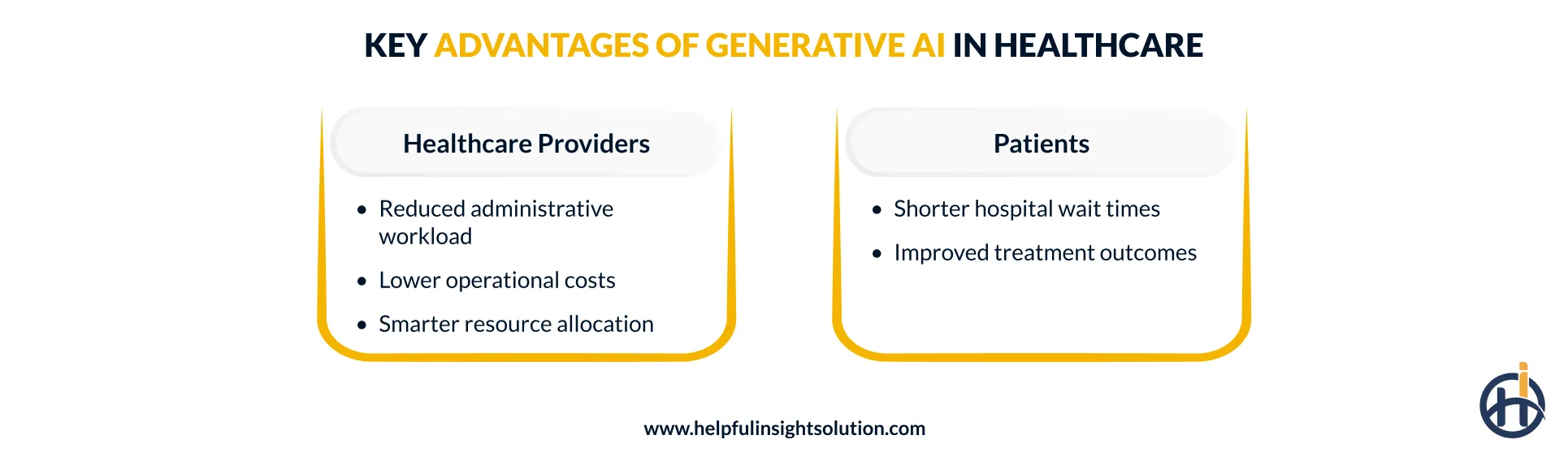
The benefits of generative AI in healthcare go beyond operational efficiency metrics on a dashboard. Administrative teams see less documentation backlog and fewer diagnostic errors slipping through.
On the patient side, that same technology means quicker answers and treatment plans that fit their actual history, not a generic protocol.
(A)Healthcare providers
1. Reduced administrative workload
A large share of medical staff workday goes toward paperwork rather than patients. Generative AI now handles message drafting, record organization, and routine documentation directly, cutting into that imbalance. This shift is one of the more measurable outcomes as the generative AI in healthcare industry matures beyond pilot projects.
2. Lower operational costs
Staffing, manual claims review, and repetitive administrative processes account for a large share of healthcare spending. As generative AI in healthcare industry adoption grows, hospitals are automating these exact functions, cutting the labor hours tied to routine tasks.
Fewer manual touchpoints on billing and documentation translate directly into lower overhead without reducing care quality.
3. Smarter resource allocation
Predicting patient volume has traditionally relied on rough estimates and past-year comparisons. Medical generative AI improves on this by analyzing multiple data points at once, admission trends, local health events, seasonal patterns, giving hospitals a more accurate basis for staffing decisions and reducing wait times during peak periods.
(B). Patients
1. Shorter hospital wait times
Paperwork and manual scheduling are usually behind long hospital waits, more than staff shortages ever are. Gen AI in healthcare now handles patient intake digitally and predicts appointment demand with better accuracy, which shortens the gap between arrival and being seen for tests or consultations.
2. Improved treatment outcomes
Catching a condition earlier consistently leads to better treatment results, and this is one area where the role of generative AI in healthcare is making a real difference for patients. It helps clinicians identify warning signs sooner and narrow down treatment options suited to that specific case. Healthcare enterprises are increasingly building this capability directly into healthcare app development from the start.

How to calculate the ROI of generative AI in healthcare?
Most healthcare leaders still hesitate before committing budget to AI development and implementation, and that caution is reasonable. But the returns from generative AI solutions in healthcare are measurable and proven. Here’s a practical way to calculate what this investment actually delivers for your organization.
1. Start with a baseline measurement
Before deploying any AI solution, document your current numbers, average documentation time per patient, appointment wait times, claim denial rates. Without this baseline, any improvement claim after implementation is just an assumption. Most healthcare organizations skip this step entirely and end up unable to prove ROI later, even when the technology is genuinely working.
2. Identify costs and expected returns
List every cost tied to the rollout, software licensing, cloud infrastructure, staff training, integration with existing EHR systems. Then map these against realistic returns like hours saved on documentation and faster patient throughput.
3. Account for hidden implementation costs
Factor in hidden costs such as recurring maintenance, periodic security audits, and custom integrations, none of which are usually part of the upfront pricing. There’s also a productivity dip while staff get comfortable with the new tool, a gap that affects output but rarely gets budgeted for.
4. Set a realistic payback timeline
Full return on investment won’t show up in month one, and treating it like it should is where a lot of these evaluations go wrong. Generative AI needs a stretch of time for staff to actually adopt it and for workflows to settle into the new process. Judge the numbers too early and you’re measuring a system still mid-transition.
Formula to Calculate ROI of Gen AI in Healthcare
ROI = (Total Benefits − Total Costs) / Total Costs × 100%
Key challenges of implementing generative AI in healthcare
Rolling out generative AI in healthcare operations isn’t effortless, but it’s far more manageable when you understand the obstacles in advance. This section breaks down the key challenges organizations run into most often during implementation.
1. Data privacy and HIPAA compliance
One of the biggest challenges healthcare organizations encounter is keeping patient data secure while still feeding it into gen AI systems. PHI exposed during model training or even a single prompt can trigger HIPAA violations and significant legal penalties.
The Solution
Control where data goes like private cloud deployment, strict data anonymization, and encryption at every stage of the pipeline, all while following HIPAA compliance and GDPR requirements.
2. Legacy system integration barriers
Even today, most hospitals and clinics run on legacy systems never built to connect with AI. These platforms are stable and deeply embedded in daily operations, which is exactly why replacing them isn’t realistic. But they also can’t exchange data with modern generative ai for healthcare tools without significant custom work, creating a real bottleneck for adoption.
The Solution
Build secure APIs and middleware adapters, then migrate data gradually to interoperable cloud platforms.
3. Unreliable outputs and AI hallucinations
AI models can sound completely confident while being factually wrong. In a clinical setting, that’s not a minor glitch, a hallucinated drug interaction or invented diagnosis can directly harm a patient if it goes unchecked. This unpredictability is a major reason healthcare providers hesitate to adopt AI in the first place.
The Solution
Ground outputs with retrieval-augmented generation, require clinician sign-off, and test regularly for accuracy.
How to implement generative AI in healthcare
Knowing the challenges going in changes how an organization actually approaches rollout. Some start small with a single department, others pilot across multiple use cases at once. Either way, a few core steps repeat across nearly every successful generative AI in healthcare deployment. Let’s have a look at them.
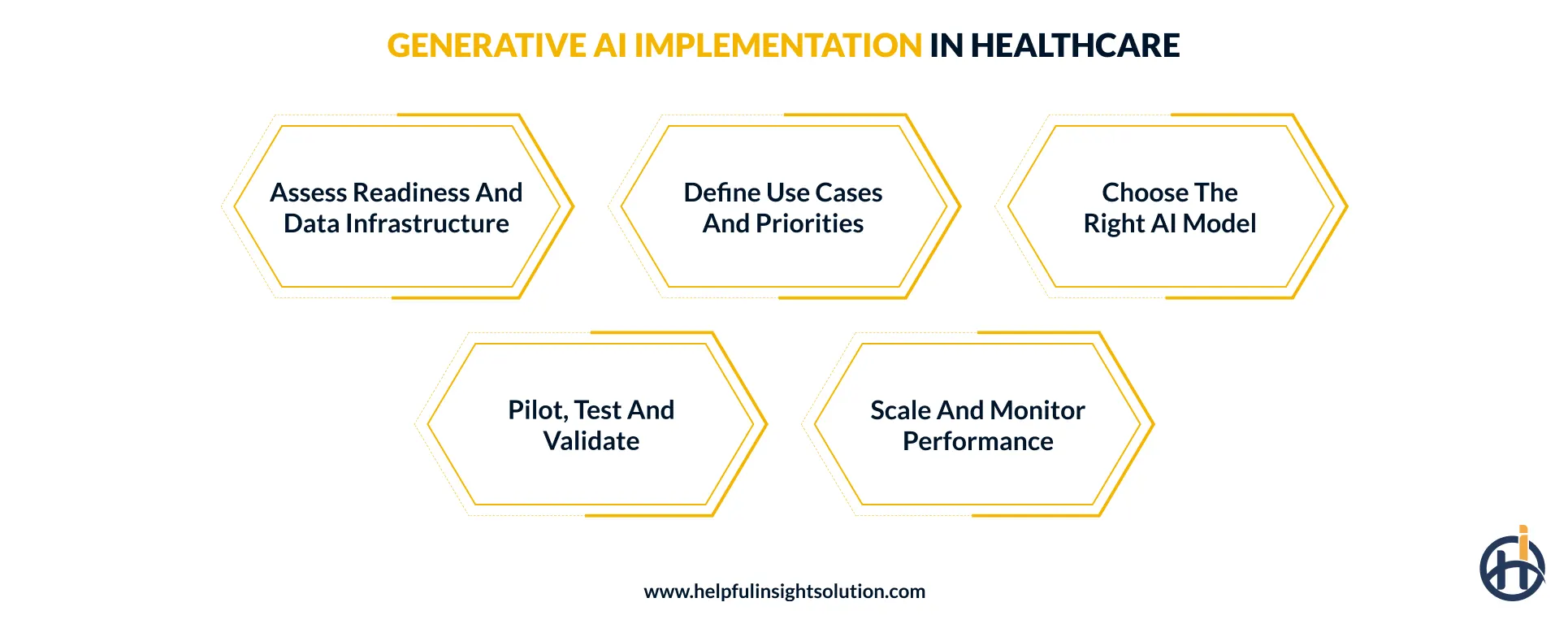
1. Assess readiness and data infrastructure
To begin with, audit your current systems and data setup. Patient records need to be clean, centralized, and actually accessible, not scattered across five disconnected platforms nobody fully trusts. Team readiness matters just as much here, a strong system with an untrained staff still stalls at rollout.
2. Define use cases and priorities
Then figure out exactly what problem you want generative AI to solve. Documentation, scheduling, and claims processing tend to be common starting points because results show up quickly. Identify one clear use case first, weigh effort against value, then commit before adding more to the list.
3. Choose the right AI model
Not every use case needs the same model. Scheduling tools can run on a general AI model, while anything involving patient data needs stricter privacy controls and HIPAA-aligned architecture. So, carefully pick the model.
4. Pilot, test and validate
Once you’ve chosen the model, run it in a single department first rather than deploying it out hospital-wide. Get clinicians actively reviewing the outputs. Watch closely for errors or bias before expanding access to more teams.
5. Scale and monitor performance
After the pilot proves out, expand access gradually rather than switching the tool on organization-wide overnight. Keep tracking accuracy, feedback, and healthcare revenue cycle analytics well past launch, as performance shifts as usage grows and patient data evolves. A regular review cycle catches issues before they affect operations and care.
Future of generative AI in healthcare
A lot of what generative AI in healthcare is doing today, including catching sepsis risk before symptoms escalate and generating personalized treatment plans, would have felt impossible not long ago.
Healthcare enterprises actively using it are already seeing the payoff. For anyone planning implementation now, understanding the future of AI in healthcare matters just as much as today’s use cases.
In this section, we will explore future AI trends in healthcare and the medical sector.
1. Agentic AI workflows
Gen AI is already assisting with single tasks like notes and scheduling. We can expect it to soon handle entire workflows end to end, like completing a prior authorization from request to approval without staff stepping in at every stage.
2. AI-designed drug candidates
Drug discovery is moving past just narrowing down existing compounds. AI is expected to design entirely new molecular structures from scratch, cutting years off the early research phase for rare and complex diseases.
3. Predictive resource planning
In the future, we can see hospitals forecasting equipment and staffing needs weeks ahead. With the use of predictive analytics in healthcare, we can easily predict seasonal trends and local outbreak data, helping hospitals anticipate demand and prevent shortages before they actually happen.
Conclusion
Generative AI in healthcare has completely transformed the sector. What started as pilot projects a few years ago is now reshaping core parts of healthcare delivery, from diagnostics to documentation to patient engagement.
Still, technology alone isn’t what determines success; execution is. Moreover, the use case chosen first, the costs accounted for early, and selecting the right development partner, one that has actually done this work before. If you’re planning to implement it, Helpful Insight can make that difference.
We’re a generative AI development company with a decade of experience building secure, HIPAA-compliant AI solutions for healthcare organizations, from hospital networks to health-tech startups. Our team of certified healthcare developers has worked across use cases ranging from clinical documentation automation to diagnostic imaging tools.
One mid-sized clinic network came to us needing an AI-powered documentation assistant. We built and implemented it end-to-end. Within four months, they saw a measurable drop in after-hours charting time. Coding-related claim rejections dropped too.
If you are ready to move from evaluation to implementation, share your project requirements with our team.
FAQs
The cost to implement generative AI in healthcare typically ranges from $20,000 for a single-use SaaS integration to $300,000 or more for a fully custom, enterprise-wide platform. Final cost depends on data complexity, model customization, HIPAA compliance requirements, and whether you’re building in-house or partnering with a development team.
Clinical documentation, drug discovery, personalized treatment planning and medical imaging are some of the top gen AI use cases in healthcare.
It can be safe, but only with strict data security, human oversight, and regular testing in place. Unsupervised use carries real clinical risk.
Some real-life examples of gen AI in healthcare include:
- Stanford Health Care uses AI to draft patient message responses
- NHS deploying AI for faster radiology scan analysis
- Ada Health AI symptom checker used to help patients assess symptoms