

Have you ever used a healthcare app and seen a chat box pop up to help you book an appointment or check symptoms? Do you think a human is answering you? Most of the time, it is an AI chatbot, a human agent steps in only when the situation requires urgent medical attention.
AI chatbots in healthcare has completely transformed how healthcare organizations operate and deliver care services. Healthcare AI chatbots can help in many areas, from automating tasks and providing 24/7 support to scheduling appointments.
Businesses in the healthcare industry are recognizing the powerful capabilities of AI chatbots and planning to implement them. In fact, 76% of hospitals are already using AI technology, and AI chatbots are a big part of it.
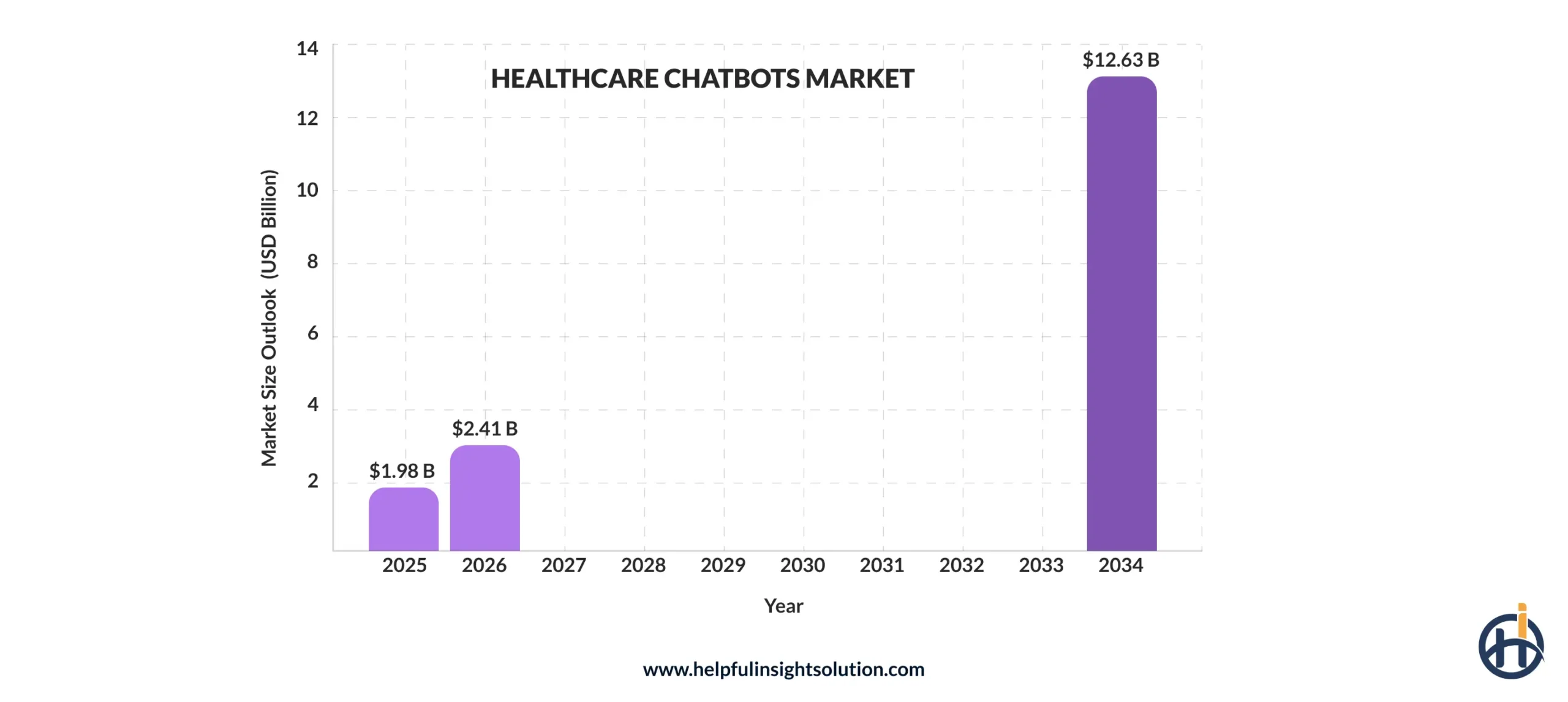
This is just the beginning. The healthcare AI chatbot market is expected to grow from $2.41 billion in 2026 to $12.63 billion by 2034.
If you are a healthcare business planning to implement an AI chatbot, go ahead, your competitors are already doing it and reaping the benefits. If you are still unsure and can’t decide whether to implement it or not, this guide will clear your doubts. So keep reading until the end.
Benefits of AI Chatbots in the Healthcare Industry
Using chatbots in healthcare can bring so many benefits that help healthcare providers deliver the best care and improve their operational efficiency.
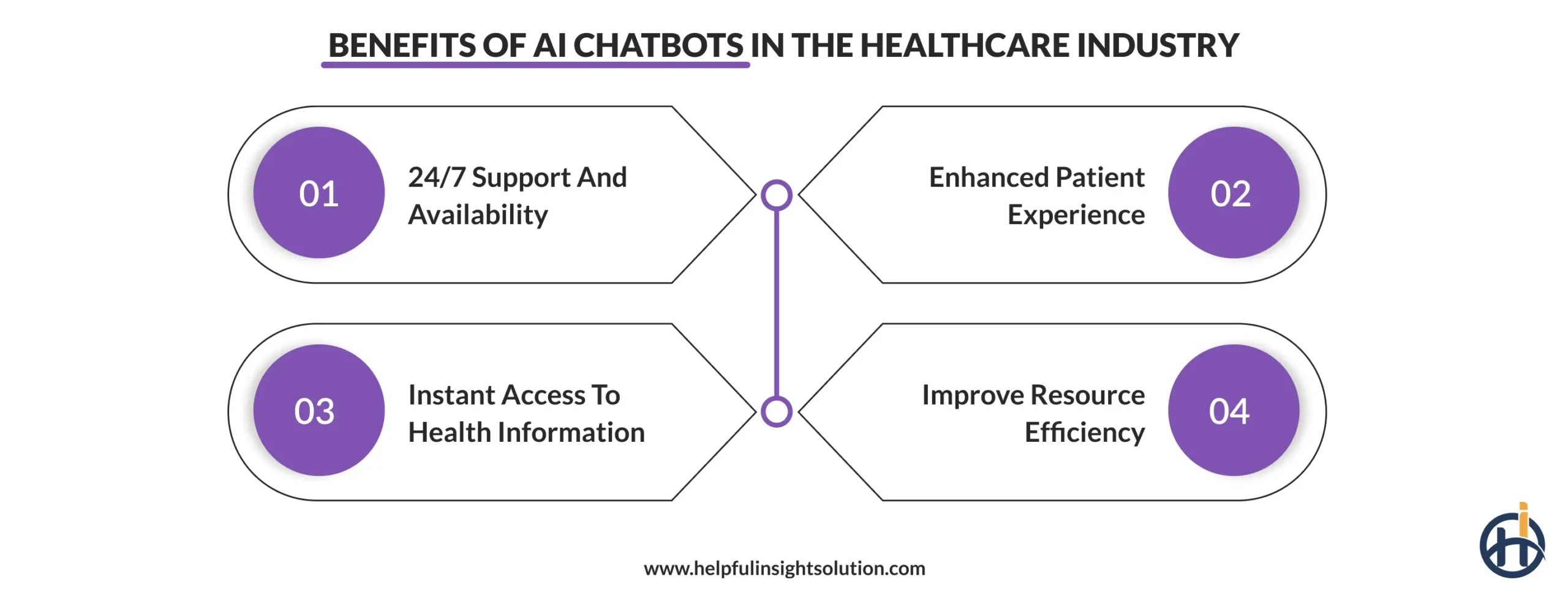
Key benefits of chatbots are:
1. 24/7 Support and Availability
One big benefit of AI chatbots in healthcare is that they are available all the time. Medical emergencies can happen anytime, and chatbots can help people fast when they need advice. They can guide patients and answer basic questions until a doctor can help.
2. Enhanced Patient Experience
Chatbots improves patient satisfaction because they answer questions quickly, even if the same question is asked many times. A medical AI chatbot can help many patients at once, which a human cannot do.
Patients and caregivers can easily book appointments and check symptoms without going to the hospital. This saves time and makes care feel more personal.
3. Instant Access to Health Information
In healthcare, timely delivery of the right information can save lives. AI chatbots in healthcare app development can provide information about nearby hospitals and pharmacies.
They can also answer simple questions about health problems, such as what to do in an emergency or what to expect during a procedure. This helps people get answers quickly without waiting.
4. Improve Resource Efficiency
Healthcare organizations that use AI bots can make better use of their resources without overburdening staff. How? AI chatbot solutions can manage appointments and answer common questions.
This frees up medical staff to focus on real medical care. Chatbots can also handle many patient requests at the same time without slowing down.
Top Use Cases of AI Chatbots in Healthcare
For healthcare businesses like health tech startups and hospitals that are looking to develop AI chatbots, it is vital for them to understand how to use them to gain maximum benefit.
In this section, we will explore the top use cases of AI chatbots in healthcare:
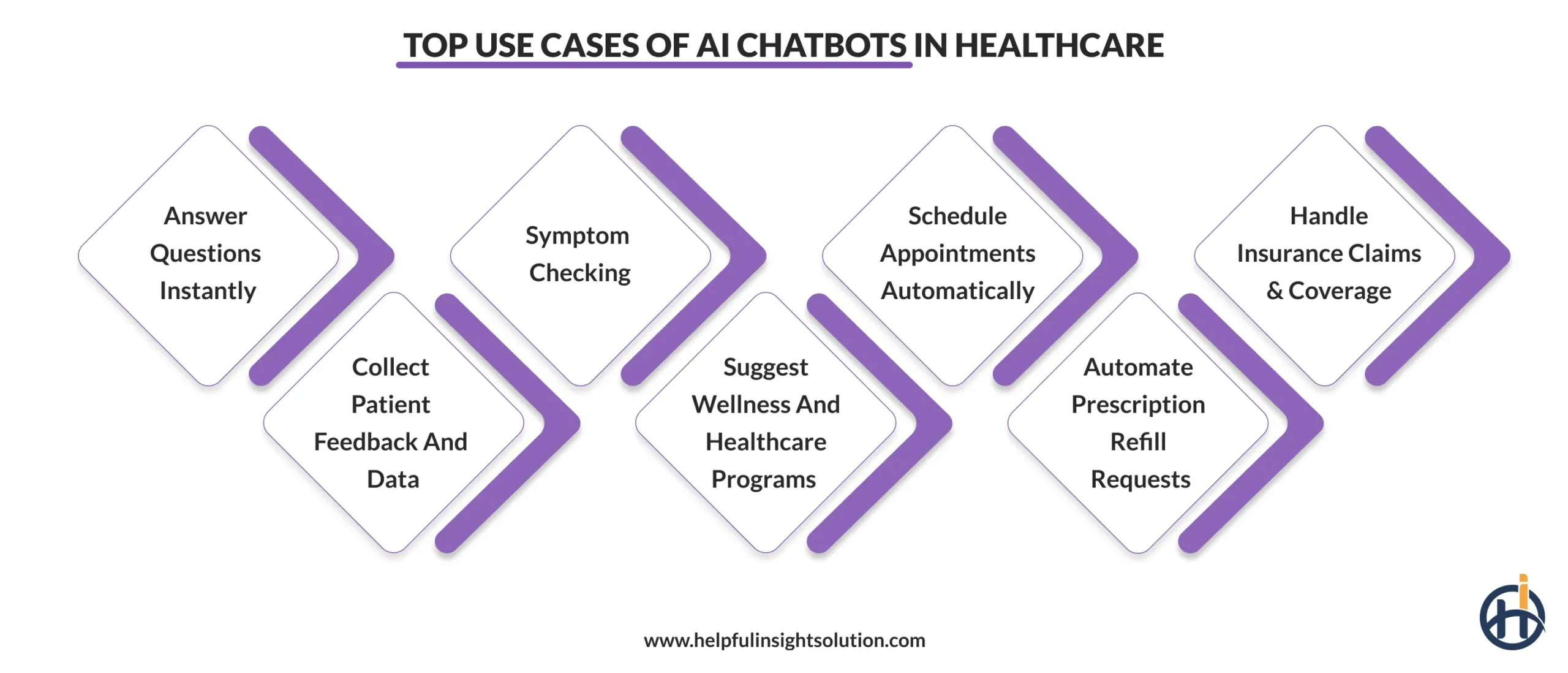
1. Answer Questions Instantly
Sometimes, it happens that patients often have simple health related questions but do not want to wait or consult a doctor. In that case, conversational AI chatbot in healthcare can be of great help as it can answer common questions instantly, anytime.
The bots are trained on quality and vast datasets which enable them to easily give answers.
In this way, chatbots also reduce pressure on medical staff by handling basic questions and they can focus on serious cases that truly need human attention.
Example:
Sensely’s conversational AI chatbot Molly helps patients by answering their questions related to healthcare. It uses NLP to understand what people say.
2. Symptom Checking
AI chatbots are also used by patients to check their symptoms if they are feeling unwell and assess what medical issue they have without the need to visit a doctor. AI chatbots in healthcare apps ask some questions, and according to the answers, the chatbot gives guidance on what to do next.
It may suggest rest, home care, or seeing a doctor. This helps patients decide faster without panic. Symptom checking chatbots also reduce unnecessary hospital visits and help patients take the right action at the right time.
Example:
Ada’s health assistant asks simple questions to check symptoms like headaches or fevers and suggests what to do next, helping users decide whether to rest or see a doctor.
3. Schedule Appointments Automatically
Earlier, patients faced difficulty booking appointments, often needing to call clinics or wait in long queues. Doctors also struggled to manage schedules. But an AI chatbot has been the ultimate solution for this.
It helps patients choose a date and time to book an appointment while checking doctor availability and confirming appointments instantly.
The chatbot also send reminders before the visit so patients do not forget. This reduces missed appointments and also keeps track of patient visits, making easy for healthcare providers to access later if needed.
Example:
Northwell Health use an AI chatbot to book and manage appointments. The chatbot reduced phone calls by half and helped staff focus more on patients needs.
4. Handle Insurance Claims and Coverage
AI chatbots in healthcare app development can help patients understand and easily manage
their health insurance with less stress. Instead of calling hospitals or insurance agencies and waiting on hold, patients can chat anytime to check what their plan covers.
The AI chatbot for healthcare can explain medical bills, tell if a treatment is covered, and help send claim forms. Doctors and healthcare organizations can also use it to quickly check approvals. This saves time, avoids confusion, and makes insurance easier for patients to handle.
Example:
Cigna uses an AI chatbot to answer insurance questions. It helps users check coverage, copays, and claim status anytime, so they don’t need to call customer support.
5. Collect Patient Feedback and Data
Collecting patient data and feedback is one of the top use cases of conversational AI in healthcare. They ask simple questions about symptoms, medicines, allergies, or how a patient feels. After visits, chatbots send short surveys to learn if care was good.
This helps doctors understand patients better and improve treatment. Since data is collected automatically, medical staff save time, records stay organized, and patients feel more involved in their own care.
Example:
Buoy Health uses a chatbot to ask users about symptoms. It collects health details and gives guidance, then checks back later to see if the person feels better or worse.
6. Suggest Wellness and Healthcare Programs
AI chatbots in healthcare industry can guide people toward better health by suggesting wellness programs. By chatting with the people, the bot understands a user’s needs and recommends healthy food tips, exercise plans, or stress relief ideas.
Using natural language processing, a healthcare chatbot can understand what a user is feeling and asking. Based on this, it can suggest healthcare plans that best match the user’s needs.
Example:
One Remission helps cancer patients and survivors with daily wellness tips. It gives simple tips about food, exercise, and healthy habits to help them feel better.
7. Automate Prescription Refill Requests
AI medical chatbots help patients refill their medicines easily. Instead of calling clinics or pharmacies, patients can use the chatbot. It checks with each pharmacy to see whether the prescription is available or not and then informs the patient about the prescription status.
This use case can also assist healthcare professionals, as they can focus more on caring for patients instead of spending time calling pharmacies. It also keeps patients informed about their medications and appointments, so they don’t miss doses.
Example:
CVS Pharmacy uses an AI chatbot that is integrated within its mobile app to help patients refill medications, check availability, and take their medicine on time.

What is the Cost of Developing Healthcare AI Chatbots?
The cost of building and implementing AI chatbots in healthcare depends on many factors, such as the chatbot’s complexity, platform choice, number of features, conversation design, system integrations,
AI model training, and more. Developing a simple AI chatbot that handles tasks like appointment scheduling and basic interactions can cost between $15,000 and $80,000.
On the other hand, building an advanced healthcare AI chatbot capable of providing personalized recommendations and analyzing symptoms can start from $80,000 to $150,000 or more. The final cost depends on the type, size, and scale of the chatbot you choose to develop.
Share your AI chatbot requirements with us, and after analyzing them, we will provide you with a custom quote.
Challenges of Implementing AI Chatbot Solutions for Healthcare
During the implementation of medical AI chatbots, certain challenges may arise. Businesses and healthcare app development company should be prepared in advance to manage these obstacles, ensuring there are no surprises and the implementation process remains smooth.
To help you understand this better, the table below outlines the potential challenges and their solutions.
| Challenge | Its Effect | The Solution |
| Patient Data Privacy and Security | Chatbots collect personal, private medical details to help patients, which can make them targets of data breaches or cyberattacks. | Use strong encryption, limit data access, and store patient information safely to avoid misuse. |
| Integration with Existing Healthcare System | Every healthcare organization uses different EHR or EMR systems, making integration difficult. | Connect healthcare AI chatbot solutions step by step and test them with existing systems before full use. |
| Managing Inaccurate Responses | Chatbots might give wrong advice or answers that can confuse patients and may cause health risks or delayed treatment. | AI developers should train chatbots using reliable and accurate data verified by medical experts. |
| Low Patient Trust | Patients may avoid chatbots if they feel they are unsafe, give wrong suggestions, or lack human empathy. | Be transparent about how the bot uses shared information and allow an easy switch to human agent when needed. |
| Handling Regulatory Compliance | If the AI chatbot doesn’t follow healthcare compliances, it can lead to fines, legal trouble, and service shutdowns. | Ensure the AI chatbot is built following healthcare compliances such as HIPAA and GDPR. |
What the Future of Healthcare and Medical AI Chatbots Looks Like?
AI in healthcare is one of the most transformative advancements that have revolutionized patient care, and AI chatbots are one of the top contributing factors. The adoption of chatbots is high in the healthcare sector with different types of AI chatbots available offering varied use cases.
What started as simple rule-based logic tool that answered basic questions has now evolved into intelligent systems that can even provide personalized recommendations to patients.
It is so exciting to think about what these bots can do in the future. So, let’s explore what we can expect healthcare AI chatbots to accomplish in the coming years:
- We can expect AI chatbots to help doctors during emergencies by sharing patient history quickly and suggesting next steps while medical teams prepare treatment.
- In the future, chatbots could study past health data and daily habits to warn patients early about possible health problems before symptoms become serious.
- In coming years, AI virtual health assistants may look at photos of rashes to understand health problems better and give helpful advice.
- In the future, chatbots may understand your voice or words to know how you are feeling and reply with kind, caring messages instead of only giving basic information.
Trust Helpful Insight to Build Your Healthcare AI Chatbot
AI chatbots are changing how care services are delivered and how healthcare organizations daily operations are managed. They bring convenience to both care providers and patients. The potential benefits are immense,
which is why healthcare organizations are eager to develop and implement AI chatbots into their operations. If you are one of them, Helpful Insight can help.
We are a trusted AI chatbot development company with the expertise to build intelligent, feature-rich, and secure AI chatbots for the healthcare industry. Our team includes qualified AI chatbot developers who can build bots for healthcare businesses of all types and sizes.
We understand the challenges your business faces and design bots that solve real-world problems. Whether your goal is to improve patient care or better manage administrative tasks, we will develop the right bot to help you get the most out of your investment.
Connect with our team today and share your AI chatbot requirements.
FAQs
An AI chatbot for healthcare is a virtual assistant that helps healthcare organizations like hospitals and other medical businesses improve patient care and streamline operations. By integrating these bots on websites or apps, they can assist with tasks like booking appointments and sending medication reminders. They utilize natural language processing technology to understand what users type and respond as if a real person is answering.
There are various types of healthcare AI chatbots, some of them are:
- Appointment booking and scheduling chatbots
- Symptom checker bots
- Mental health and therapy chatbots
- Medication management bots
The steps required for healthcare chatbot development include:
- Decide what your chatbot will do
- Select AI model and technology stack
- Design the conversation flow
- Build and train healthcare AI chatbot
- Integrate the chatbot with existing systems
- Test with real users
- Launch and keep improving the bot
If you are developing AI chatbots for healthcare, some of their must-have features are:
- 24/7 Chat Support
- Appointment Booking
- Symptom Checker
- Medication Reminders
- EHR Integration