

“Identify important healthcare development issues to get their solutions on time.”
By developing healthcare applications, you not only provide digital solutions to doctors or patients but also give them a way to improve medical efficiency and treatment planning.
Businesses invest in this industry to create a smooth healthcare ecosystem, offering advanced diagnostics, telemedicine, and inventory management. But certain major challenges in healthcare app development lead to security risks, increased operational costs, and compliance issues.
Resolution of these obstacles enhances digital workflow, improves healthcare features, and ensures data privacy. Additionally, following standard healthcare regulations such as HIPAA, GDPR, and HL7 is also mandatory for better delivery of services.
But, should know all these aspects before implementing them in your business model.
In this blog, we will understand real-world issues and solutions of developing healthcare apps with detailed information. At last, you will study the differences between various approaches towards the development of healthcare apps. So, let’s not waste much time and dive into the content.
Reasons Behind App Failure in the Healthcare Industry
Before everything else, you must know the top challenges in healthcare mobile apps that lead to market failure. For a business investor, studying them is important to identify loopholes and improvement areas:
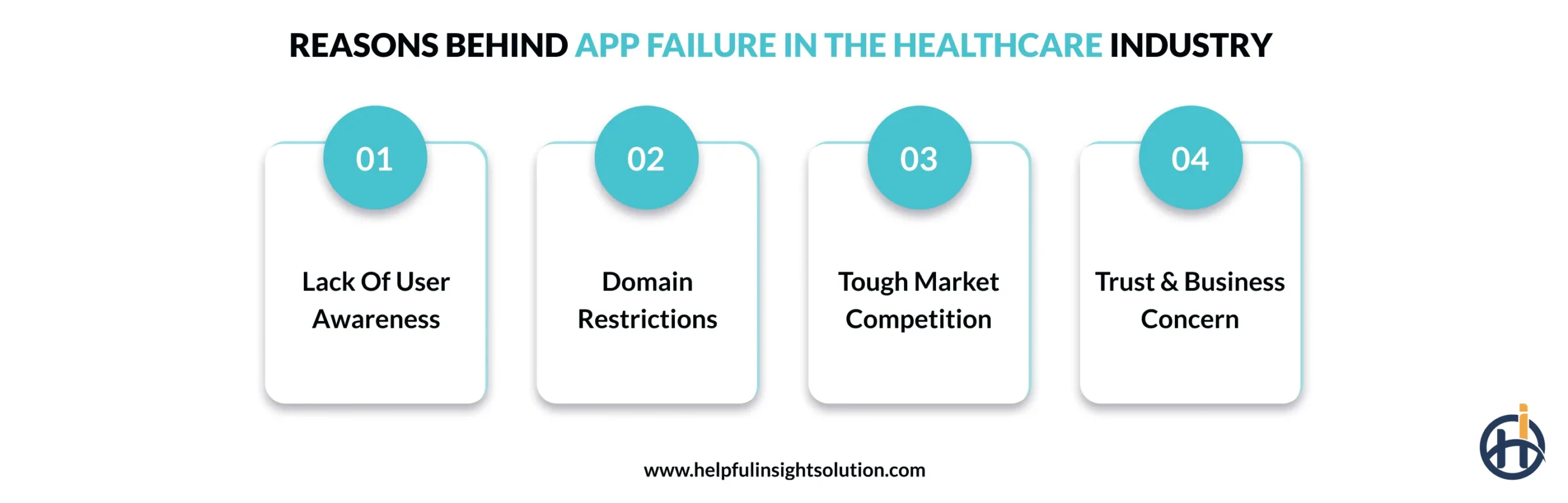
1. Lack of User Awareness
Many healthcare apps fail because users are unaware of their existence or do not understand their value. Poor onboarding, weak marketing, and unclear benefits reduce user adoption and long-term engagement. Some challenges of healthcare software design also restrict people from using medical apps.
2. Domain Restrictions
Healthcare apps must comply with strict regulations like HIPAA and data privacy laws. This can limit features and app scalability, resulting in declined industry growth. If businesses fail to resolve these domain constraints, then it may lead to delayed market launches or legal roadblocks.
3. Tough Market Competition
The healthcare app market is highly saturated with well-funded and established medical brands. New platforms struggle to differentiate themselves from the best health apps due to their high popularity. This results in low market visibility and user churn across various regions.
4. Trust & Business Concern
Users hesitate to adopt healthcare apps due to concerns about data security and reliability. A lack of transparency, credibility, or clinical validation quickly decreases user trust and business growth. Additionally, this harms the overall business model and market structure.
Top 10 Challenges in Healthcare App Development
We are going to discuss some common challenges in developing a healthcare app that an entrepreneur must know. Additionally, you will get the solution for each with detailed information in this section:
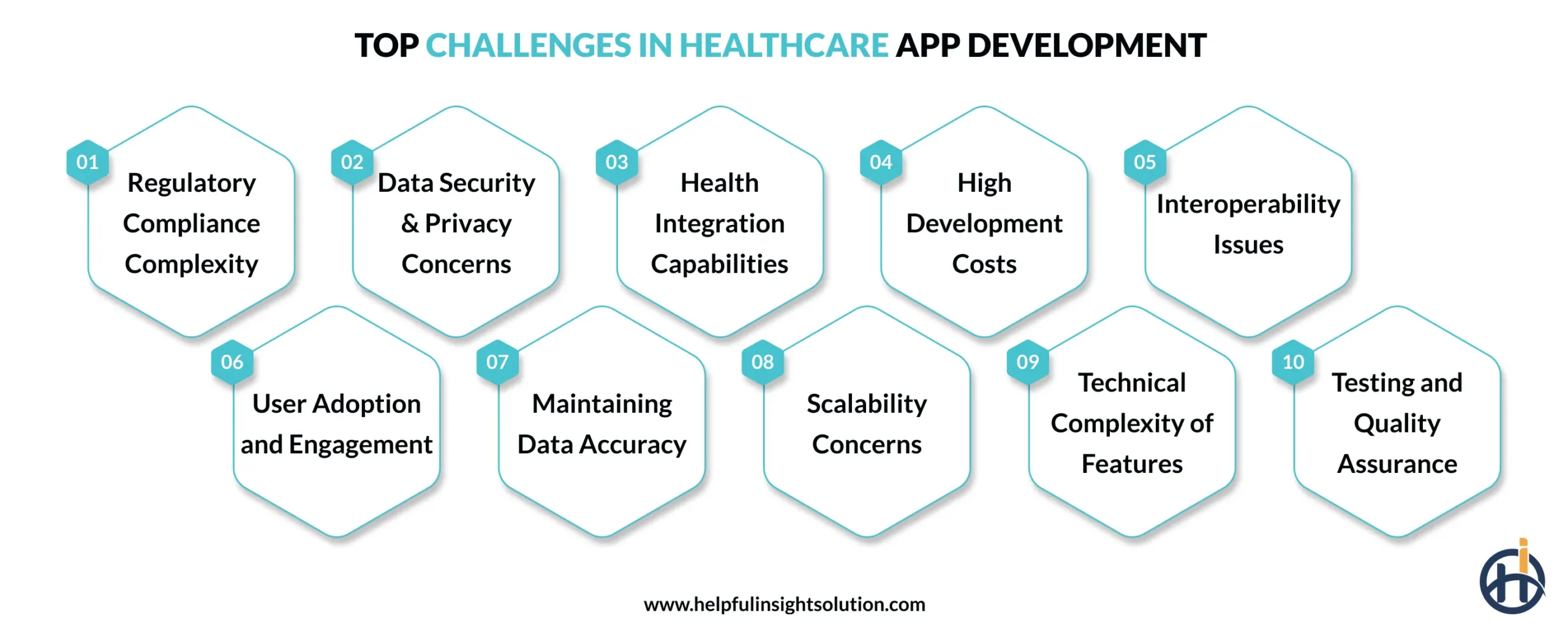
1. Regulatory Compliance Complexity
Healthcare apps must comply with strict regulations such as HIPAA, GDPR, and regional healthcare laws. These rules govern how patient data is collected, stored, and shared. Constantly evolving regulations make healthcare compliance difficult to maintain.
Non-compliance can lead to legal penalties, data breaches, and loss of user trust.
Solutions:
- Implement compliance-ready frameworks (HIPAA, GDPR) from the initial design stage.
- Use automated compliance monitoring and documentation tools.
- Consult healthcare legal experts during development and updates.
2. Data Security & Privacy Concerns
Healthcare applications handle patient information, making them prime targets for cyberattacks. A healthcare app development company helps you to ensure encryption, authentication, and control.
Any security lapse can result in data breaches, which are among the most common challenges in developing healthcare mobile apps. Building user trust depends heavily on robust data privacy protection.
Solutions:
- Apply end-to-end encryption for data at rest and in transit.
- Use multi-factor authentication and role-based access control.
- Conduct regular security audits and penetration testing.
3. Health Integration Capabilities
Healthcare apps often need to integrate with EHRs, medical devices, and third-party systems. Achieving seamless data exchange across platforms is technically challenging. Inconsistent data formats and APIs slow down integration.
Poor integration can disrupt workflows and affect patient care quality, that are one of the major healthcare mobile app development problems.
Solutions:
- Use standardized APIs like HL7 and FHIR for smooth data exchange.
- Partner with certified EHR and medical device providers.
- Build modular integrations to simplify future upgrades.
4. High Development Costs
Developing healthcare apps requires advanced features, compliance measures, and rigorous testing. Hiring of dedicated developers, security experts, and medical consultants may increase the overall costs.
Additionally, ongoing app maintenance and updates also add to healthcare expenses. Budget constraints in the development process can limit innovation and scalability.
Solutions:
- Adopt MVP-based development to reduce initial investment.
- Leverage cloud infrastructure and reusable healthcare components.
- Outsource specialized tasks to experienced healthcare app developers.
5. Interoperability Issues
Healthcare systems use diverse standards, technologies, and data formats. Ensuring smooth communication between different platforms is a major challenge.
Lack of interoperability leads to data silos and inefficiencies, which are the major challenges in creating a healthcare app. This can negatively impact clinical decision-making and patient outcomes.
Solutions:
- Follow global healthcare data standards and protocols.
- Use middleware solutions to bridge incompatible systems.
- Perform continuous interoperability testing across platforms.
6. User Adoption and Engagement
Mobile healthcare apps must be interactive and easily navigable for patients, doctors, and hospital staff. Complex app interfaces can discourage regular usage and lead to a decline in user satisfaction.
Low engagement reduces the app’s effectiveness and the overall ROI for businesses. Continuous UI/UX improvements and personalization are essential to increase and retain users.
Solutions:
- Design intuitive UI/UX tailored to patients and clinicians.
- Integrate reminders, gamification, and personalized insights.
- Offer onboarding tutorials and in-app support.
7. Maintaining Data Accuracy
Accurate medical data is critical for medical diagnosis, treatment, and monitoring. Errors in data entry can lead to serious health risks, resulting in one of the key challenges in healthcare mobile app development.
Real-time app updates and validation mechanisms are required at regular intervals. Maintaining consistency across multiple data sources remains a challenging task for investors.
Solutions:
- Enable real-time data validation and automated error checks.
- Integrate data only from verified medical sources.
- Allow clinician review and correction workflows.
8. Scalability Concerns
As the healthcare or fitness app engagement grows, it is important to handle increased data and traffic. Poorly designed systems are one of the crucial healthcare mobile app development challenges that increase performance issues.
Scalability planning requires a robust cloud infrastructure and architecture for the system. Failure to scale healthcare applications can disrupt the overall medical services.
Solutions:
- Use a cloud-native, microservices-based architecture.
- Optimize databases for high-volume healthcare data.
- Perform load testing to prepare for user growth.
9. Technical Complexity of Features
Healthcare apps often include features like real-time monitoring, AI diagnostics, and telemedicine. The implementation of these advanced technologies requires high technical expertise.
The most common challenges in healthcare software development are ensuring reliability and accuracy with complexity. Any malfunction in the health app can directly affect patient safety and data privacy.
Solutions:
- Break complex features into manageable development modules.
- Use AI and automation frameworks to simplify logic.
- Maintain detailed technical documentation for teams.
10. Testing and Quality Assurance
Other critical challenges of developing healthcare appsrequire extensive testing to ensure accuracy, security, and compliance. Bugs or performance issues can have serious consequences for healthcare applications.
Mobile testing must cover multiple devices, platforms, and real-world scenarios. Continuous QA is essential to maintain app reliability and trust.
Solutions:
- Conduct manual and automated testing across devices.
- Include clinical validation and real-world usage testing.
- Implement continuous testing throughout the development lifecycle.
Best Practices to Overcome Digital Healthcare Challenges
Here, we will explore the best practices to overcome healthcare mobile app development challenges. This is going to help you improve medical services based on user preferences and advanced technologies:
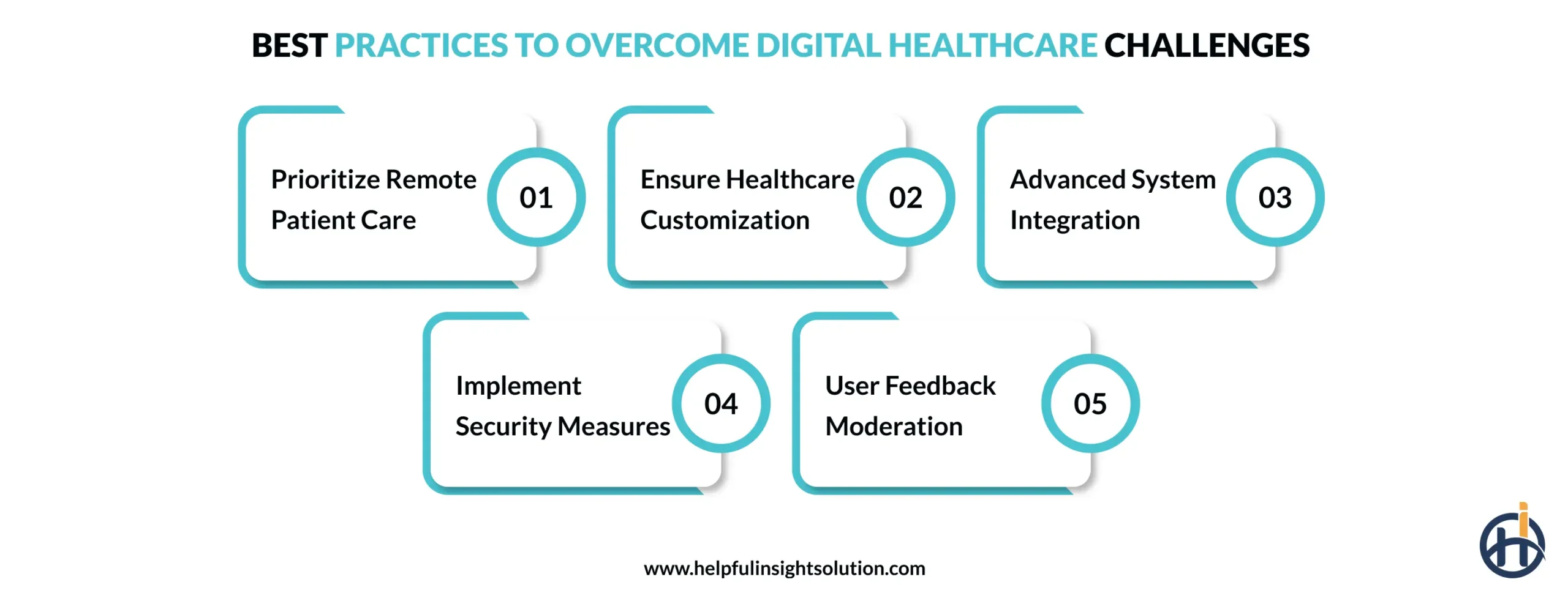
1. Prioritize Remote Patient Care
Remote patient care enables continuous monitoring and virtual consultations, reducing hospital visits and improving access to healthcare services. Additionally, it enhances patient engagement while ensuring timely medical support regardless of location.
2. Ensure Healthcare Customization
Healthcare customization allows providers to tailor treatments, recommendations, and digital experiences based on individual patient data. This approach improves patient satisfaction and resolves long-term challenges in building a health app.
3. Advanced System Integration
Advanced AI in healthcare connects EHRs, medical devices, and third-party platforms into a unified digital ecosystem. It reduces various problems in the development of healthcare apps, like manual errors and operational inefficiency across medical systems.
4. Implement Security Measures
Robust security measures protect sensitive patient data from multiple cyber threats and unauthorized third-party access. Compliance with different healthcare regulations builds trust among users while safeguarding digital healthcare infrastructures.
5. User Feedback Moderation
User feedback moderation helps healthcare platforms identify issues, improve usability, and refine digital services. Regular analysis of patient input ensures continuous improvement and better user experiences by tracking healthcare software development challenges.
Hybrid Development vs Native Development: Which Approach is Best in 2026
After going through some unique challenges of mobile app development for healthcare, it’s time to decide on the development approach. Entrepreneurs looking for full-stack development must know about hybrid and native platforms that target different business requirements.
For developing healthcare applications, let’s look at the key differences between the two approaches through the following table:
| Component | Hybrid App Development | Native App Development |
| Performance | Uses a single codebase with a bridge layer, offering acceptable performance for most non–graphics-heavy healthcare apps. | Delivers top-tier performance by directly leveraging platform-specific APIs, ideal for real-time and data-intensive healthcare features. |
| Security & Compliance | Relies on framework-level security, which is sufficient for basic HIPAA compliance but needs support for sensitive health data. | Provides stronger security controls at the OS level, making it better suited for strict healthcare compliance like HIPAA, HL7, and GDPR. |
| Development Cost & Time | Faster development with one codebase reduces cost, making it ideal for MVPs and budget-conscious healthcare startups. | Higher cost and longer timelines due to separate codebases, but it ensures long-term stability for enterprise healthcare solutions. |
| Device & Hardware Integration | Limited access to advanced device features, which may restrict deep integration with medical wearables and sensors. | Full access to device hardware like biometric sensors, wearables, and medical IoT devices for advanced healthcare use cases. |
| User Experience (UX) | Provides a near-native mobile app experience, suitable for patient portals and appointment scheduling apps. | Offers the best UX with platform-specific design and smooth interactions, critical for clinician-focused and real-time care apps. |
Now you can easily judge which platform is suitable for the growth of your healthcare business. This contrasting table will guide you in selecting the best development approach based on the requirements and user needs.
Read Also: Healthcare App Development: A Complete Guide
How Helpful Insight Helps Businesses in Finding the Best Solutions for Healthcare Development Challenges?
You have understood almost all the challenges in creating an app for healthcare, along with their solutions and methods for overcoming them. But the question is, how will you find and implement these solutions to manage these issues in developing healthcare mobile apps?
We follow a certified and natural process to identify the best findings that can be used in any situation:
Regulatory Compliance: This ensures healthcare laws like HIPAA or GDPR are in compliance throughout the development lifecycle.
User-Centered Design: Focus on personalized experiences that meet the needs of patients, doctors, and healthcare providers.
Interoperable Technology: Use standard architectures with APIs to support data exchange and future growth across healthcare systems.
Healthcare App Developers: Partner with skilled healthcare app developers who understand medical workflows, compliance standards, and health technologies.
Now, you can easily target mobile app development services to start your online healthcare business. It is essential to keep these significant challenges of building healthcare apps in mind during the entire process. So, you can improve your system and ensure consistent market growth.
FAQs
To create a mobile healthcare application, it is mandatory to ensure regulatory standards and compliance, such as HIPAA. The average cost of building HIPAA-Compliant health applications starts from $25,000 and may reach $60,000 or more based on region-specific requirements. The overall development cost can be reduced by targeting healthcare policies that ensure good governance.
Business investors must know that by resolving compliance issues, they can easily develop healthcare applications. A few important methods are described in the following manner:
- Understand and comply with healthcare regulations like HIPAA, GDPR, and health data laws.
- Involve legal and compliance experts early in the app design and development process.
- Maintain proper documentation, audits, and regular updates to meet evolving regulations.
Interoperability is a general term that in healthcare refers to the secure access and integration of electronic health data. Some of the major hurdles regarding interoperability in health app development are:
- Integrating data from multiple systems using different standards and formats.
- Ensuring seamless data exchange between legacy systems and modern platforms.
- Maintaining data accuracy and consistency across interconnected healthcare systems.
It is important to know the ways to optimize data privacy risks for medical health applications. A few of the best strategies are discussed in the following points:
- Implement strong encryption for data storage and data transmission.
- Use role-based access control and multi-factor authentication for users.
- Conduct regular security testing, audits, and vulnerability assessments.