

Key takeaways
- There’s no single best company. The right one depends on what you’re building and what you can spend.
- Decide first whether you need a platform vendor, a development partner, or both.
- Shortlist two or three firms of the same type, and score each on the same 8 points.
- Call at least two insurance references per vendor, and ask what went wrong.
- Pay for a 2–6 week discovery phase before you sign a large build contract.
- Agree who owns the code and cloud accounts before work starts.
Most insurance software projects don’t fail because of bad code. They go wrong because the vendor never learned how a policy moves from quote to bind to endorsement, or what a claim file must show when a state regulator asks for it.
That’s why choosing a development partner is harder in insurance than in most industries. We build insurance software ourselves and answer these RFPs, so we see the questions buyers ask. We also see which answers make them walk away.
This list covers 11 companies with real insurance delivery and a US presence. Each is strong at something different. Some run multi-year programs for large carriers. Others can ship a claims portal for a 20-person MGA.
Top insurance software development agencies in the USA
| # | Company | US office | Established | Best for | Public insurance proof |
| 1 | Helpful Insight | New York, NY | 2016 | AI in underwriting and claims on a mid-market budget | Legacy underwriting modernization for a regional US insurer; AI damage assessment for auto claims |
| 2 | Velvetech | Sunny Isles Beach, FL | 2004 | Custom insurance platforms for insurtechs and online agencies | 15+ projects for Insureon over six years |
| 3 | Cleveroad | Claymont, DE | 2011 | Custom insurance apps, web and mobile | Car insurance management system and app for a US auto insurer |
| 4 | Itexus | Chicago, IL (office) | 2013 | Insurance and financial software with heavy business rules | AI claims auditing system for a medical insurance company |
| 5 | Geniusee | Austin, TX | 2017 | Cloud and AI products for insurtech founders | Lists insurance among its core industries |
| 6 | Itransition | Denver, CO | 1998 | Insurance portals, policy and agency systems | Financial module for a US health insurance platform serving the CHIP program |
| 7 | Infosys | New York, NY | 1981 | Core modernization at large carriers | Claims platform for a Fortune 500 US life insurer; acquired Guidewire specialist Stratus in 2026 |
| 8 | DICEUS | Wilmington, DE | 2011 | Custom builds plus ready-made insurance modules | Work for UNIQA, WTW, BriteCore, Fairfax and Vienna Insurance Group |
| 9 | Intellectsoft | New York, NY | 2007 | Enterprise digital transformation for insurers | Self-service and case-processing platform for EuroAccident |
| 10 | ScienceSoft | McKinney, TX | 1989 | Enterprise claims, fraud and underwriting systems | Claims product for Brush Claims; underwriting system for a global aviation insurer |
| 11 | EPAM Systems | Newtown, PA | 1993 | Large-scale engineering for big carriers | 300+ insurance projects across 50 insurance clients |
How these 11 companies were chosen
The list started with every firm that appears on the main US vendor lists and B2B directories for insurance software. Anyone who couldn’t pass all four tests below was cut.
1. Insurance is an active practice. The company offers insurance software as a named service, not just “financial services”.
2. A real US footprint. A US headquarters or office that serves US clients.
3. A public delivery record. Case studies, press releases or verified reviews. Where a firm has few named insurance clients in public, its entry says so.
4. Clear strengths. Each company had to be clearly good at one thing, so the list can tell you when to pick it.
Each firm’s delivery model (onshore, nearshore or offshore) was also noted, because it shapes cost, time-zone overlap and where your data can sit.
What this list doesn’t do: it draws on public sources only, with no inside knowledge of these companies’ projects and no access to their private references. Treat it as a shortlist to start from. Your own reference calls should make the final decision (the checklist further down shows how).
Software vendors like Guidewire, Duck Creek and Applied Systems are left out. They sell platforms. They aren’t development partners you hire to build your own software. The section after the profiles explains the difference.
11 best insurance software development companies in the USA
1. Helpful Insight
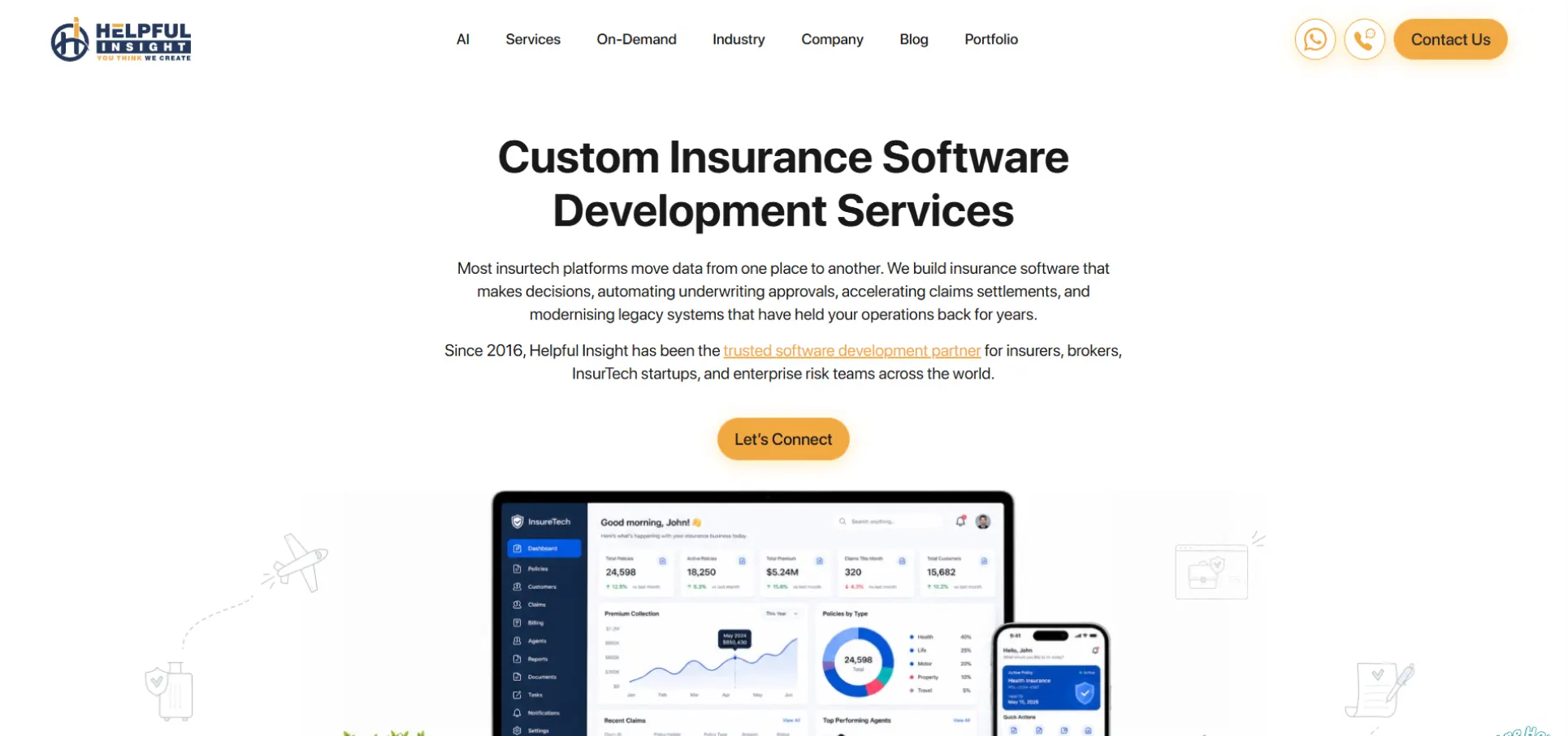
Established In: 2016
Company Size: 100+ employees
Projects Delivered: 2,000+
Best For: AI in underwriting and claims on a mid-market budget
Clutch Rating: 5/5 (116 reviews)
Helpful Insight is an AI-first software development company that builds underwriting, claims and policy software for insurers, MGAs and agencies. Its team puts AI into the steps that take staff the most hours: reading submissions and documents, checking photos of damage, and routing claims to the right person. It works with AI agents, language models, NLP and computer vision. Its legacy underwriting modernization for a regional US insurer moved the insurer’s rules and data to a modern platform without stopping new business.
Key Strengths:
- AI built into underwriting and claims workflows, not added later
- Legacy system replacement with no break in new business
- A US contact plus an engineering team in India, which keeps costs within reach of mid-size carriers and MGAs
- Insurance case studies: US underwriting modernization, AI damage assessment for auto claims, commission software for an agency in Melbourne
Services Offered:
- Custom insurance software development
- Underwriting software development
- Claims management software
- Policy administration and commission systems
- AI agents and document processing for insurers
- Insurance portals and mobile apps
2. Velvetech
Established In: 2004
Company Size: 101–500 employees
Best For: Custom insurance platforms for insurtechs and online agencies
Velvetech’s best-documented insurance work is a six-year partnership with the online small-business agency Insureon. In that time, it delivered more than 15 projects, from a drag-and-drop application form builder to sales automation and QA. Its engineers worked as part of Insureon’s own team.
Key Strengths:
- A long-running partnership with a US digital insurance agency
- Team extension that fits inside your existing engineering team
- .NET development and AI-based process automation
Services Offered:
- Custom insurance software development
- Application, quoting, and agency tools
- AI claims processing and underwriting automation
- Staff augmentation
3. Cleveroad
Established In: 2011
Company Size: 201–500 employees
Projects Delivered: 200+
Best For: Custom insurance apps, web and mobile
Cleveroad builds complete products, from discovery and design to web, mobile, and support. Its best-known insurance project replaced a US auto insurer’s legacy system with a new car insurance management platform. That included KYC checks, claims handling, CRM integration, and a Flutter mobile app, and it let the client launch a subscription model.
Key Strengths:
- Full-cycle product delivery, from first workshop to support
- Experience replacing a legacy system at a US insurer
- Reports ISO 9001 and ISO/IEC 27001 certification
Services Offered:
- Policy and claims management systems
- Agency and broker management software
- Quoting and underwriting tools
- Customer mobile apps
- KYC and fraud-check integrations
4. Itexus
Established In: 2013
Company Size: 90+ developers
Best For: Insurance and financial software with heavy business rules
Itexus is a fintech-focused engineering company that also builds for insurers and insurtechs. Its work leans toward rules-driven systems. One example is an AI claims auditing system for a medical insurance company: it checks hospital bills, cuts audit costs, and flags likely fraud and errors.
Key Strengths:
- Complex business rules built correctly the first time
- AI for claims review and fraud checks
- Fintech experience that carries over to premium and payment flows
Services Offered:
- Insurance platform development
- Underwriting automation
- Claims workflow and auditing systems
- Analytics and reporting
5. Geniusee
Established In: 2017
Headquarters: Austin, TX
Best For: Cloud and AI products for insurtech founders
Geniusee builds custom products for fintech, edtech and other sectors, and lists insurance among its core industries. It suits founders who want one team for product design, cloud setup and AI features.
Key Strengths:
- Product design and engineering under one roof
- Cloud-native builds that can grow with a startup
- Strong fintech background
Services Offered:
- Insurtech product development
- Cloud platforms and migration
- AI features and data work
- Financial and payment integrations
6. Itransition
Established In: 1998
Company Size: 3,000+ engineers
Best For: Insurance portals, policy and agency systems
Itransition is a large custom software firm with a dedicated insurance practice. For Maximus, it added a financial module to a health insurance management platform used by US government staff to serve millions of children in the CHIP program. It also built a Salesforce CRM for a US insurance buyout agency that, it reports, brought in 54% more leads.
Key Strengths:
- Large teams for long-running programs
- US public-sector health insurance experience
- Salesforce and CRM work for insurance sales teams
Services Offered:
- Policy management software
- Agency management and quoting tools
- Insurance portals and customer apps
- Insurance document management
- Support and maintenance
7. Infosys
Established In: 1981
Company Size: 330,000+ employees
Best For: Core system modernization at large carriers
Infosys is one of the world’s largest IT services firms, with a long-standing insurance practice. It designed a claims platform for a Fortune 500 US life insurer that, it reports, cut claims processing time by 20%. Its Atlanta-based unit, Infosys McCamish, runs life insurance and annuity administration for US carriers. In April 2026, Infosys completed its purchase of Stratus, a Guidewire specialist serving P&C insurers and MGAs.
Key Strengths:
- Scale for multi-year, multi-team programs
- Life, annuity, and P&C experience under one roof
- Guidewire expertise through Stratus
- Its own AI and cloud platforms
Services Offered:
- Core system modernization (policy, billing, claims)
- Guidewire implementation and cloud migration
- Life and annuity policy administration
- Claims transformation and automation
- Data, analytics, and AI
8. DICEUS
Established in: 2011
Clutch Rating: 4.9/5 (49 reviews)
Best For: Custom builds plus ready-made insurance modules
DICEUS works almost entirely in insurance. It builds custom systems and also offers ready-made modules, such as an AI underwriting workbench, a policy administration system, and customer and broker portals. Named clients include UNIQA, Willis Towers Watson, BriteCore, Fairfax, and Vienna Insurance Group. It was a finalist in the British Insurance Technology Awards 2026.
Key Strengths:
- Insurance-only focus
- Ready-made modules that shorten delivery time
- Official implementation partner for the Fadata INSIS platform
- Apps built for the BriteCore P&C core platform
Services Offered:
- Custom policy, claims, and underwriting modules
- CRM implementation and system integration
- Data warehouse and reporting
- Legacy data migration and modernization
- Testing and QA
9. Intellectsoft
Established In: 2007
Company Size: About 230 people
Best For: Enterprise digital transformation for insurers
Intellectsoft builds enterprise software and has a dedicated insurance practice. Its best-known insurance project is an award-winning platform for EuroAccident that moved customers to self-service and sped up case processing. It’s also known for usage-based (telematics) insurance apps.
Key Strengths:
- Enterprise integration with CRM, ERP and finance systems
- Customer self-service and case automation
- Mobile and telematics experience
Services Offered:
- Insurance quoting solutions
- Claims management systems
- Agency and omnichannel customer software
- Workflow integration and automation
10. ScienceSoft
Established In: 1989 (insurance IT since 2012)
Company Size: 501–1,000 employees
Best For: Enterprise claims, fraud and underwriting systems
ScienceSoft’s public insurance work leans toward claims, fraud and underwriting. It built a new claims product for the insurtech Brush Claims, moving it off a legacy system onto Azure. It also built an underwriting system for a global aviation insurer.
Key Strengths:
- Long track record in custom enterprise software
- Security practice since 2003
- Claims and fraud detection experience
Services Offered:
- Claims management platforms
- Fraud detection software
- Underwriting automation
- Insurer and policyholder apps
- Legacy modernization
11. EPAM Systems
Established In: 1993
Company Size: About 61,000 employees
Best For: Large-scale engineering for big carriers
EPAM is an S&P 500 engineering firm with $4.7B in 2024 revenue. Its insurance practice has run for more than 15 years across P&C, life, group benefits and reinsurance, with 1,700+ delivery professionals. It added health insurance specialist Netsoft USA in 2014 and Swiss insurtech developer Conzylum in 2024.
Key Strengths:
- Engineering depth for very large programs
- Combined consulting, design and engineering
- Insurance-focused acquisitions
Services Offered:
- Underwriting and risk platforms
- Digital sales and servicing
- Data, analytics and AI
- Core system modernization
Development partner or platform vendor: which do you actually need?
A lot of “top insurance software companies” lists mix two kinds of firms. It’s worth separating them before you send an RFP.
| Platform vendor | Development partner | |
| Examples | Guidewire, Duck Creek, Applied Systems, Majesco | The 11 companies above |
| What you get | A licensed core system (policy, billing, claims) that you configure | Software designed around your process, or changes to a platform you already own |
| You pay for | Subscription or license, plus an implementation partner | Team time (fixed price, time and materials, or a dedicated team) |
| Who owns the code | The vendor | Usually you (check the contract) |
| Best when | Your products are fairly standard and you want a proven core | Your workflow is what sets you apart, or the platform can’t do what you need |
In practice, many insurers use both. They license a core platform, then hire a partner for the portals, integrations, data and AI around it. That surrounding work is where most firms on this list do their insurance projects.
How to choose an insurance software development company
Pick the company that can show named insurance clients, explain your workflow back to you, and put its team and contract terms in writing. The list gives you names. These five steps help you choose between them. Buyers who end up happy with their choice usually follow some version of this.
Step 1: Write down the problem before you talk to vendors
One page is enough. What process is broken, who uses it, how many policies or claims go through it, and which systems it has to connect to. Vendors who get this page give you quotes you can compare. Vendors who don’t will each quote a different project.
Step 2: Shortlist by type, then by fit
First decide the type: platform specialist, custom builder or onshore team (see the table above). Then pick two or three companies of that type. Comparing a Guidewire integrator with a five-person design studio tells you nothing useful.
Step 3: Score every vendor on the same 8 points
- Insurance proof you can check. Named insurance clients, or a case study with your line of business (P&C, life, health, specialty)
- They know your process. Ask them to explain your workflow back to you, for example, FNOL to settlement or submission to bind. Do they get it right without being prompted?
- Integration experience. They’ve connected to the systems you run, such as a policy admin core, rating engine, payment gateway, ISO, or other data sources
- Security and compliance in writing. Which certifications they actually hold (SOC 2 Type II, ISO 27001), and how they handle data covered by HIPAA, GLBA, or state privacy laws
- Named team, not a bench. The CVs of the people who will work on your project, plus their time-zone overlap with your team
- A plan for your legacy data. How old policies and open claims will be migrated and reconciled
- Clear ownership terms. You own the source code, documentation, and cloud accounts when the contract ends
- Support after launch. Response times, who’s on call during renewal season or a catastrophe event, and what that costs
Step 4: Ask references the questions vendors can’t answer for you
Call at least two of each vendor’s insurance clients. Skip “were you happy?” Ask these instead:
1. What went wrong, and how did they handle it?
2. How close was the final cost to the first estimate?
3. Did the people from the sales calls actually work on your project?
4. Would you hire them again for your core system, or only for smaller projects?
Step 5: Start with a paid discovery phase
Before you sign a large build contract, pay for 2–6 weeks of discovery. You get a backlog, architecture and an estimate. You also see how the team works before most of your budget is committed. If the relationship doesn’t work, you leave with documents another vendor can use.
Onshore, nearshore or offshore: what it means for cost and control
Where the team sits affects your bill more than almost anything else. It also decides how many working hours you share and whether your security team signs off.
| Model | Typical 2026 agency rate (USD/hour) | Working-hour overlap with US | Good fit when |
| Onshore (US) | $80–$180+ | Full | Data can’t leave the US, you need people on site, or the work is regulator-facing |
| Nearshore (Latin America) | $40–$90 | Most of the day | You want daily calls and quick feedback at lower cost |
| Eastern Europe | $35–$80 | A few hours | Complex engineering where a half-day overlap is enough |
| Offshore (India) | $20–$50 | 2–4 hours with planning | Large, well-specified builds, or round-the-clock support |
Rates are published 2026 industry estimates. They vary by seniority, skills and contract size, so use them to set a budget range, not to compare final quotes.
Most firms on this list mix models. A US lead and architect work with a nearshore or offshore build team. Ask what share of the hours each location will bill. The headline rate tells you less than that mix does.
Engagement models you’ll be offered
Fixed price: best for a well-defined module, like a quoting tool or a portal. Vendors build a risk buffer into the price, so ask what it covers
Time and materials: best when the scope will change, such as most AI and modernization work. You need someone on your side who owns the backlog
Dedicated team: a stable group of people billed monthly. Best for products you’ll keep building for a year or more
7 red flags when hiring an insurance software vendor
Any one of these is worth a direct question. Two or more, and we’d keep looking.
1. Every case study is fintech or banking. Payments experience doesn’t teach anyone about endorsements, reinsurance treaties or claim reserves.
2. They say they’re “compliant” but can’t name a certification. “We follow SOC 2 practices” is not the same as a SOC 2 Type II report you can read.
3. A fixed price before they’ve seen your data. Migrating old policies and claims is where budgets break. A serious vendor will want to look at your data first.
4. The people from the pitch disappear. If the architect from the sales call isn’t named in the contract, assume they won’t be on your project.
5. No plan for state-by-state rules. US insurance changes by state: forms, rates, filing rules. Ask how they handle a rule that applies in Texas but not in Ohio.
6. The AI demo doesn’t use your documents. Ask them to run the demo on 20 of your real claims files or submissions. Remove personal details first.
7. The vendor keeps the code or cloud accounts. You should own the repository, the infrastructure accounts and the documentation from day one.
Final take
There’s no single best insurance software development company. There’s the best one for your type of project. A carrier on Guidewire, an MGA launching a new specialty product, and an agency that wants AI to read submissions need three different partners.
If you remember one thing from this list: shortlist by type, check insurance references yourself, and pay for discovery before you commit to a big build.
Thinking about AI in underwriting or claims? Book a free 30-minute call with our insurance team. Book a free consultation
FAQs about insurance software development companies
It designs, builds and maintains software for insurers, MGAs, brokers and insurtechs. Typical projects are policy administration, underwriting, rating and quoting, claims, agent portals, and the integrations between them. Some firms also implement platforms such as Guidewire or Duck Creek.
It depends mostly on team location and scope. Agency rates run from about $20–$50 an hour offshore to $80–$180+ onshore (see the table above). Many US firms also set a minimum project size. Intellectsoft’s, for example, is $50,000.
A focused tool like a quoting calculator or a customer portal often takes a few months. Replacing a core policy or claims system usually takes more than a year, because of data migration and state-by-state testing. A 2–6 week paid discovery phase will give you a realistic timeline for your own scope.
Choose onshore if your security policy keeps data in the US or you need people on site. A hybrid team (US lead, offshore or nearshore build) is the most common setup. It cuts cost and keeps one accountable contact in your time zone.
At minimum, ask for a current SOC 2 Type II report or ISO 27001 certificate. If you handle health data, ask how they meet HIPAA. Many US states have also adopted the NAIC Insurance Data Security Model Law, so check that the vendor’s incident-response process fits your obligations.
Yes. Large firms like EPAM and ScienceSoft can work inside big platform programs. Most firms on this list build the portals, integrations and AI features around a core platform. Ask for a project where they connected to the platform you run.
Start with what you’re building. For AI in underwriting or claims, or a legacy replacement on a mid-market budget: Helpful Insight. For a new insurance app or platform: Velvetech, Cleveroad, Itexus or Geniusee. For portals and policy or agency systems: Itransition. For custom builds plus ready-made modules: DICEUS. For enterprise modernization: Infosys, Intellectsoft, ScienceSoft or EPAM. Then run the 8-point checklist above on two or three of them.
Smaller, product-focused firms tend to give small teams more senior attention. In the profiles above, Helpful Insight, Velvetech and Geniusee are the ones aimed at MGAs, agencies and insurtech founders. Infosys and EPAM are built for large budgets and formal procurement, so a small team may find them a stretch.