

Key Takeaways:
- For successful change management, it is crucial to align technical implementation with organizational goals, clinical workflows, and staff expectations.
- Healthcare professionals need proper guidance, support, and confidence to use modern digital solutions, ensuring engagement and training.
- Expert teams understand change benefits, address concerns, and ensure collaboration during technical transitions through effective communication.
- Businesses can maximize ROI by tracking performance, gathering feedback, and optimizing healthcare systems for better patient care and operational efficiency.
To keep pace with a rapidly evolving industry, healthcare organizations need to implement multiple changes. This includes technical integrations, business workflow orchestration, and cloud migration services.
But it is difficult for hospital staff to easily adopt these changes due to improper guidance, inadequate knowledge, and distrust among patients. The need for change management in healthcare is crucial to ensure smooth communication, enhanced patient outcomes, optimized workflow, and increased revenue cycle.
A report published by Springer Nature Link says that more than 70% of organizations fail to implement new changes in their healthcare systems. According to Prosci, 90% of employees are motivated to participate in healthcare change. All these facts point to the same cause, which is that change management is important for medical systems.
In this blog, you are going to review various topics, such as the adoption reasons for healthcare changes, its key models, and challenges in detail. So, let’s directly jump into the content and understand how healthcare businesses can manage changes.
What is change management in healthcare?
Change management in healthcare is the process of shifting individual teams and organizations from legacy systems to digital solutions, based on the needs. It has multiple core components, which are building urgency, engaging stakeholders, and providing continuous training. To understand this approach better, it is crucial to know these components.
- Create urgency: The experts should help the healthcare staff to understand the importance of change in the system.
- Engage staff early: It is beneficial to involve doctors, nurses, and other employees in planning to ensure trust.
- Communicate clearly: Businesses must provide reasons and the impact of this change on their daily healthcare operations.
- Provide training: The workers must learn new technologies or systems that build confidence in managing patients easily.
The integration of AR/VR, blockchain, or AI in healthcare should not create confusion and panic among the medical staff. These are implemented to reduce manual tasks, improve productivity, and ensure enhanced patient care across regions.
Why is change management hard to adopt in healthcare?
Adopting change management theories in healthcare is a typical task for medical professionals due to various reasons. We will understand why it is difficult to implement changes in clinical platforms.
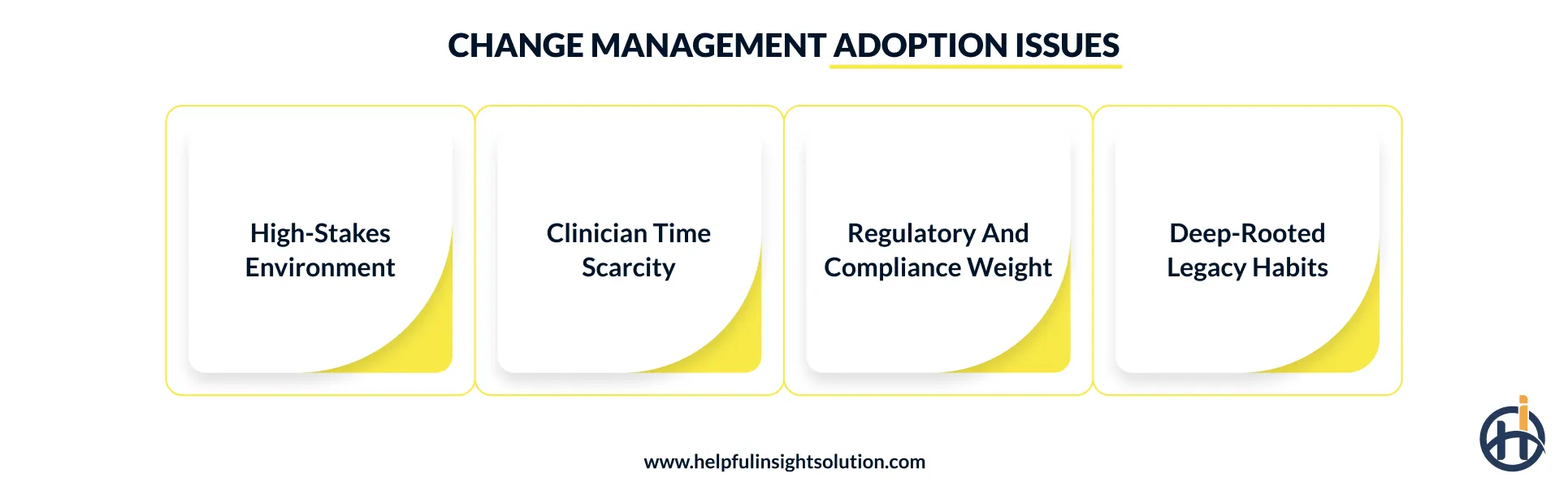
1. High-stakes environment
In healthcare, even small changes can affect patient safety in ways that differ from industries where mistakes are easier to correct. This fact makes doctors and hospital managers pay attention when new systems or workflows are introduced, ensuring everything is tested well before it is used.
2. Clinician time scarcity
Doctors and nurses are always busy because they don’t have time to learn new things during their shifts. If a new tool or system gets in the way of their work for a short time, they might not like it that can cause them to resist using it or use it slowly.
3. Regulatory and compliance weight
When something changes, like the integration of computer vision in healthcare, it has to meet various rules like HIPAA, hospital accreditation, and safety rules for patients. This means there is a lot of paperwork, approvals, and checks that make it harder and slower to bring in technology.
4. Deep-rooted legacy habits
Some ways of working in hospitals have stayed the same for a long time because these ways are often taught by staff and become part of the hospital’s culture. They are so strong that people don’t always resist technology, but they resist changing the way they have always done things.
Common reasons healthcare technology projects fail in reality
The failure of healthcare technical projects is highly influenced by workflow misalignment, poor interoperability, and inadequate user adoption.
Most change management principles in healthcare are not applicable at the organizational level because miscommunication occurs between extended medical groups. This can lead to a lack of interest in services among patients, decreasing their trust due to constant dissatisfaction and treatment loss.
| Key Reasons | Solution |
| Lack of clear implementation strategy | Define project goals, timelines, success metrics, and a structured roadmap before deployment. |
| Resistance from healthcare professionals | Involve staff early, communicate benefits, and provide hands-on training to encourage adoption. |
| Poor integration with existing systems | Ensure seamless interoperability with EHRs, medical devices, and legacy healthcare platforms. |
| Insufficient user training and support | Create continuous training programs, onboarding sessions, and dedicated technical support channels. |
| Ignoring data security and compliance requirements | Implement strong cybersecurity measures and ensure compliance with healthcare regulations like HIPAA and GDPR. |
| Unrealistic budget and resource planning | Estimate costs accurately, allocate skilled resources, and plan for long-term maintenance expenses. |
| Failure to monitor and optimize performance | Track adoption metrics, collect feedback, and continuously improve the technology after implementation. |
Core change management frameworks applied to healthcare
Here you will study the major change management models in healthcare, which follow different strategies. From EHR integration to remote monitoring, they guide medical staff in an easy manner.
1. Kotter’s 8-step model
Kotter’s 8-stage model provides structure to major change initiatives, which are listed as follows.
- Building a sense of urgency
- Creating a guiding coalition
- Developing a vision
- Ensuring a communication strategy
- Empowering others to act on the vision
- Generating short-term wins
- Consolidating gains
- Anchoring new approaches in the culture
This model works well within large-scale healthcare implementations, such as EHRs, as continued leader involvement is crucial so staff can transition and remain in the new practices.
Key Feature:
- Builds urgency and strong leadership coalition.
- Anchors new practices into organizational culture.
2. ADKAR model
Focusing on individual-level change management, ADKAR’s 5 stages include Awareness, Desire, Knowledge, Ability, and Reinforcement. In a healthcare setting, clinicians require knowledge of a new technology with genuine confidence and skill for using it before it is integrated into everyday practice.
Key Feature:
- Focuses on individual-level behavioral change.
- Builds awareness, desire, knowledge, and ability.
3. Prosci/People-centric approach
Expanding on the ADKAR model, Prosci’s methodology utilizes a people-centric approach to structured change management with distinct roles for sponsors, managers, and change agents. In multi-department hospitals, the approach assists in consistent and coordinated implementation across diverse clinical teams.
Key Feature:
- Assigns clear roles to change agents.
- Coordinates change across multiple departments consistently.
Governance, roles, and accountability in healthcare change management
The success of change management strategies in healthcare is dependent on various governing parameters. They deliver clear decision-making frameworks, distinct leadership responsibilities, and transparent performance tracking to ensure patient safety and successful adoption. In this section, we will discuss key elements with their respective roles and accountability.
| Governing Parameter | Roles | Accountability |
| Executive Leadership & Governance Board | Provides strategic direction and oversees healthcare transformation initiatives | Accountable for vision, funding decisions, and overall change success |
| Change Management Team | Plans adoption strategies, communication, training, and stakeholder engagement activities | Accountable for managing transitions and improving user acceptance |
| Clinical Leadership Committee | Aligns technology solutions with healthcare workflows and patient care requirements | Accountable for clinical validation, safety, and workflow integration |
| IT and Security Governance Team | Ensures technology infrastructure, interoperability, and healthcare data protection standards | Accountable for system performance, cybersecurity, and regulatory compliance |
| Project Management Office (PMO) | Coordinates implementation timelines, resources, risks, and project performance tracking | Accountable for execution, milestone delivery, and continuous progress monitoring |
A roadmap for managing change during healthcare tech rollout
In this section, we are going to discuss how change management in healthcare is ensured during technical innovations. The following steps are crucial to know before integrating any technology or digital asset.
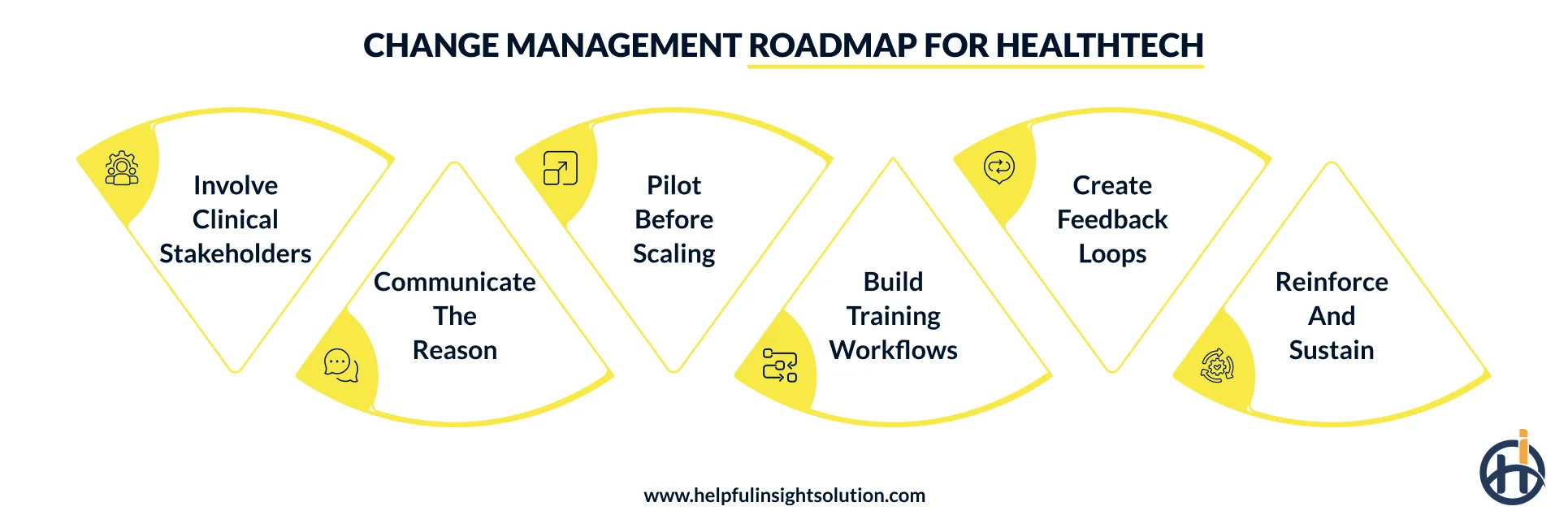
1. Involve clinical stakeholders
Successful technology rollouts begin by involving doctors and nurses from the first day. This is different from showing them a system and asking them to just accept it, but their daily experience helps to find issues with IT management. Getting them involved early also gives them a feeling that they’re part of the process that makes them more willing to support the change.
2. Communicate the reason
Employees like investment in healthcare app development when they know why it is being used, not just what it does. Talking about the benefits is important, for example, how it makes their job easier, helps patients get better, or fixes a problem they already see. Without this information, even good systems can confuse or create resistance among healthcare staff.
3. Pilot before scaling
Putting technology across an entire hospital or health system all at once makes it more likely that problems will cause big trouble. Instead, trying it in one department or unit first allows teams to find problems, get feedback, and improve the plan in a safe place. When the test works well, expanding it becomes much easier and better planned.
4. Build training workflows
Clinical training that is generic and the same for everyone usually doesn’t help medical workers get ready for how a new system works in their daily work. Training needs to be specific to each job, involve activities, and focus on the actual situations that staff face every day. This method allows workers to feel more confident and skilled faster than reading manuals or going through long introduction materials.
5. Create feedback loops
When a new system is launched successfully, there will be problems that weren’t noticed during testing or training. Setting up ways for staff to share their issues, like regular meetings, questionnaires, or a specific person to contact, helps identify and solve problems quickly. This constant communication stops annoyances from turning into staff going back to old ways of working.
6 Reinforce and sustain
Change doesn’t stop when the system is live because keeping people using the system needs ongoing support, reminders, and encouragement. Recognizing people who try the system first and celebrating small achievements can help create energy and get more people to accept the change. Checking how the system is being used regularly and making changes keeps the change working and stops it from disappearing.
How change management applies across different healthcare technologies
This section provides the core technologies that trigger the change management process in healthcare. You are going to study how they impact patient outcomes and what precautions businesses can take.
1. BPM/workflow automation
The fear that automation will erode a person’s clinical judgment and decision-making authority of how things get done is the greatest barrier to adoption in many instances.
The key to change management in this scenario will be to demonstrate how technology, through automating drudgery, actually allows more time and resources to be spent on the key, remaining decisions for which clinical judgment is paramount.
2. Cloud migration
The transition of patient data and systems to the cloud raises concerns from staff, particularly during the transition, as to whether they will still have access to records and data that are critical to day-to-day patient care.
The change management strategy here will focus on clear communication regarding data access and security issues and backup data access protocols.
3. Predictive analytics tools
Clinicians need to believe that an AI algorithm’s risk score and subsequent prediction are valid and significant enough to affect their decision-making processes.
The key to change management of predictive analytics in healthcare will hinge on the gradual inculcation of trust based on transparency in algorithm development and outcome validation.
4. Computer vision diagnostics
Before radiologists and pathologists can truly rely on AI-driven image analysis, they need to be confident that it is accurate and consistent for several critical clinical applications.
Change management here will revolve around evidence of clinical validation, involvement of the relevant stakeholders, and presentation of the technology as a collaborative aide rather than as a replacement for the human clinician.
Overcoming barriers to change in healthcare
Various change management techniques in healthcare can cause multiple challenges, influencing the system. Key staff and patient-related issues are described in this section with their respective solutions.
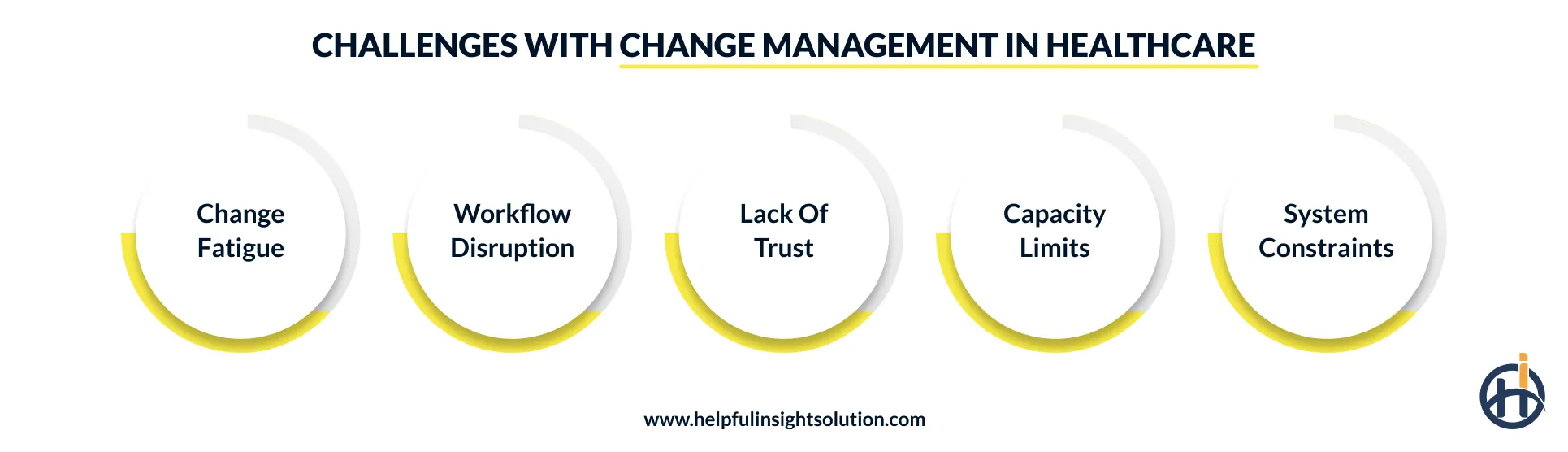
1. Change fatigue
It is a state of mental, physical, and emotional exhaustion that occurs due to fast-paced shifts in policies, technology, and workflows. This reduces patient morale, triggers disengagement, and affects recovery time, increasing operational overload.
Solution: It is necessary to involve staff in planning, ensure clear communication, and acknowledge progress to increase productivity.
2. Workflow disruption
The healthcare workflow is disturbed by too many overlaps of medical software systems, which reduces productivity in real-time. For example, the integration of BPM in healthcare leads to unfamiliar tools that slow down daily clinical tasks.
Solution: Businesses can ask doctors or nurses to test new systems and deploy experts to ensure support during final deployment.
3. Lack of trust
This issue is highly driven by poor leadership communication, fear of modern systems, and historical data inconsistency. The experts make changes without understanding daily needs, which can affect patient care due to unequal treatment.
Solution: The investors have to share information and allow workers to help with designing structures by providing proper technical training.
4. Capacity limits
Here, teams work in survival mode and face severe difficulties in adopting new clinical workflows due to a knowledge gap. Additionally, they are not able to learn modern technologies due to excessive administrative and medical duties.
Solution: The experts must remove redundant administrative tasks and create performance metrics that can justify temporary investments.
5. System Constraints
Various aspects like financial limitations, rigid regulatory environments, and fragmented operational structures are responsible for system constraints. This affects the adoption of healthcare changes when there is a rise in modern requirements.
Solution: It is crucial to co-design workflows with frontline staff and deploy flexible training structures for small real-time integration.
Best real-world examples of healthcare change management
Now, it’s time to observe some of the best examples of change management in healthcare that ensured smooth transformation. You will know how they enhanced their existing systems without losing revenue.
1. Mayo Clinic’s Enterprise EHR Transition
Mayo Clinic adopted the ADKAR Model for change management as it launched a new enterprise EHR and revenue cycle system. It provides monthly forums to educate its workforce on the integration of technologies like AI in EHR systems.
This structure ensures role-based communications with coordinated efforts among inpatient, outpatient, and researcher functions as they transitioned.
ROI Impact:
- Reduced costly rework through structured, role-based stakeholder training programs.
- Minimized productivity loss during transition via proactive workflow alignment.
2. Veterans Health Administration (VHA) Care Coordination
The Veterans Health Administration (VHA) implemented a successful nationwide rollout of its team-based Patient-Aligned Care Team (PACT) Model in more than 1,200 primary care clinics across the USA.
The change management endeavor targeted practice redesign, enhanced patient access, and coordinated care among multiple departments serving the same high-risk populations.
ROI Impact:
- Improved high-risk patient management, reducing avoidable hospital readmission costs.
- Freed provider time through a better-coordinated, team-based care delivery model.
3. Mercy Health Scheduling Redesign
Mercy Health System is one of the USA’s largest integrated Catholic health systems that decentralized problematic scheduling and communication systems.
This initiative successfully supported patients and providers, reducing temporary disruptions from centralized scheduling. It also handled local operations for the same hub that also hosted patient & provider communications.
ROI Impact:
- Reduced scheduling-related patient complaints, protecting long-term patient retention revenue.
- Maintained operational stability by preventing costly disruption during rollout.
How does Helpful Insight assist healthcare businesses with change management?
Now, you need a reliable and experienced partner that can ensure change management in healthcare systems. We have been delivering expert consulting services, helping our clients to easily allocate resources, manage budget, and increase ROI.
Enterprises can hire our experts for implementing change in healthcare to enhance patient monitoring, improve billing systems, enhance EHRs, and reduce real-time administrative expenses. The integration of modern technologies and innovations boosts overall visibility across regions and ensures consistent revenue generation.
Businesses implement AI, blockchain, and cloud computing in healthcare to manage data efficiently, optimize clinical workload, and increase productivity. It is the right time to focus on business priorities and make proper plans for execution. This will help your healthcare business to maintain trust among patients by delivering smart medical services.
FAQs
To implement changes like AI or EHRs, the average time ranges from 2 months to 12 months based on organization size, data complexity, and workflow. Basic transitions can be completed in 4 months, but mid-sized systems may take more than 8 months. For larger enterprises, the overall duration increases due to clinical functionality, revenue cycles, and extensive staff training.
Most doctors, nurses, and medical staff resist changes in healthcare systems because of disrupted clinical workflows and a lack of involvement in decision-making. Other reasons are patient safety risks, heavy workloads, and market incompetence. This helps to maintain system stability and ensure patient safety against unproven clinical ideas.
Businesses must track individual adoption, organizational performance, and project execution to measure the success rate of change management. By using frameworks like the Prosci Methodology, businesses can easily evaluate staff transition through clinical protocols. This includes various parameters, such as speed, utilization, and proficiency level with safety metrics.
With a lack of change management, the system compromises patient safety, increases medical errors, and degrades care quality. This is caused by inconsistent healthcare workflows, inadequate staff training, and severe communication breakdowns. Additionally, medication mistakes, missed diagnostics, and incomplete documentation are also key factors.
To manage change fatigue, businesses must ensure a few important steps that are commonly practiced. Here are some of the crucial points discussed in the following manner:
- You should delay low-value tasks when rolling out new tools, so daily patient care isn’t disrupted.
- It is crucial to discuss reasons and get feedback from hospital staff to fix issues.
- Provide initial training with abundant resources and track daily progress.