

Key takeaways
- Software development costs range from $30,000 for a basic MVP to $300,000+ for enterprise-level solutions.
- Project scope, team structure, technology stack, UI/UX complexity, and developer location are the primary drivers of software development price.
- Approximately 52% of software projects experience uncontrolled scope changes, making a well-defined scope critical before development begins.
- A healthcare or FinTech platform costs considerably more than a standard business application due to compliance and security obligations.
For most business owners, figuring out a realistic budget is one of the hardest parts of starting a software project. The short answer: Software development costs typically range from $30,000 for a basic MVP to $300,000 or more for a large-scale enterprise solution. That gap exists for a reason: the final number depends on project complexity, features, UI/UX design, and your development team’s location.
Startups, scaleups, and mid-sized companies are all building their own software now, not because it’s trendy, but because off-the-shelf tools eventually stop keeping up as your business grows.
It’s part of why the global software market is currently valued at $921.14 billion in 2026 and is projected to reach nearly $2,468.93 billion by 2035. More businesses than ever are investing in custom builds instead of generic tools, whether that’s a social media platform, an internal operations tool, or a full enterprise system.
Whether you’re a startup estimating your first MVP or a business owner evaluating a full software build, here’s everything you need to know about the cost to develop software for your dream project.
How much does the average software development cost
There is no single number that works for every project. A functional MVP with core features is a very different budget from a platform handling thousands of users across multiple systems. The average cost to develop software falls somewhere between $30,000 and $300,000. To provide more clarity, let’s break down the pricing by complexity level.
| Aspect | Simple Software | Mid-Level Software | Enterprise-Grade Software |
| Estimated Cost Range | $30,000 to $80,000 | $80,000 to $150,000 | $150,000 to $300,000+ |
| Timeline | 2-4 months | 4-6 months | 6 to 12+ months |
| What’s Included | Single platform, core features, standard UI | Multi-feature functionality, custom UI, basic integrations | Advanced AI-powered features, multiple integrations, custom architecture |
These ranges are a useful reference, but project size only gets you so far when estimating the average software investment cost. A healthcare platform development and a logistics tool can sit in the same complexity bracket, yet require completely different development efforts.
Here is a closer look at what development typically costs across the industries we most often see.
| Industry | Estimated cost range | What drives the cost |
| Healthcare | $20,000 to $250,000+ | Compliance, patient data security and EHR integrations |
| FinTech and banking | $50,000 to $200,000+ | Regulations, fraud detection and payment gateway setup |
| eCommerce | $30,000 to $120,000+ | Product catalog size, payment systems and custom features |
| Supply chain and transportation | $40,000 to $250,000+ | Real-time tracking, route optimization and API connections |
| Education | $20,000 to $180,000+ | Video infrastructure, user management and content delivery |
Industries like healthcare and FinTech sit at the higher end of these ranges largely because of compliance, a theme we’ll come back to in detail in the security and compliance section below.
Worth keeping in mind that none of these figures are quotes. They are planning references based on market patterns. Your actual software development budget depends on decisions you have not made yet, like which features matter most, what platform you are building for, and who ends up doing the work.
As you evaluate these investments, it’s also important to understand what is a good ROAS to ensure your software and marketing budgets contribute to profitable business growth.
The sections ahead help you work through all of that.
What affects the price of software development
Two projects can look almost identical on paper and come in at completely different prices. That happens because software development costs are shaped by several variables, not just the size of the project.
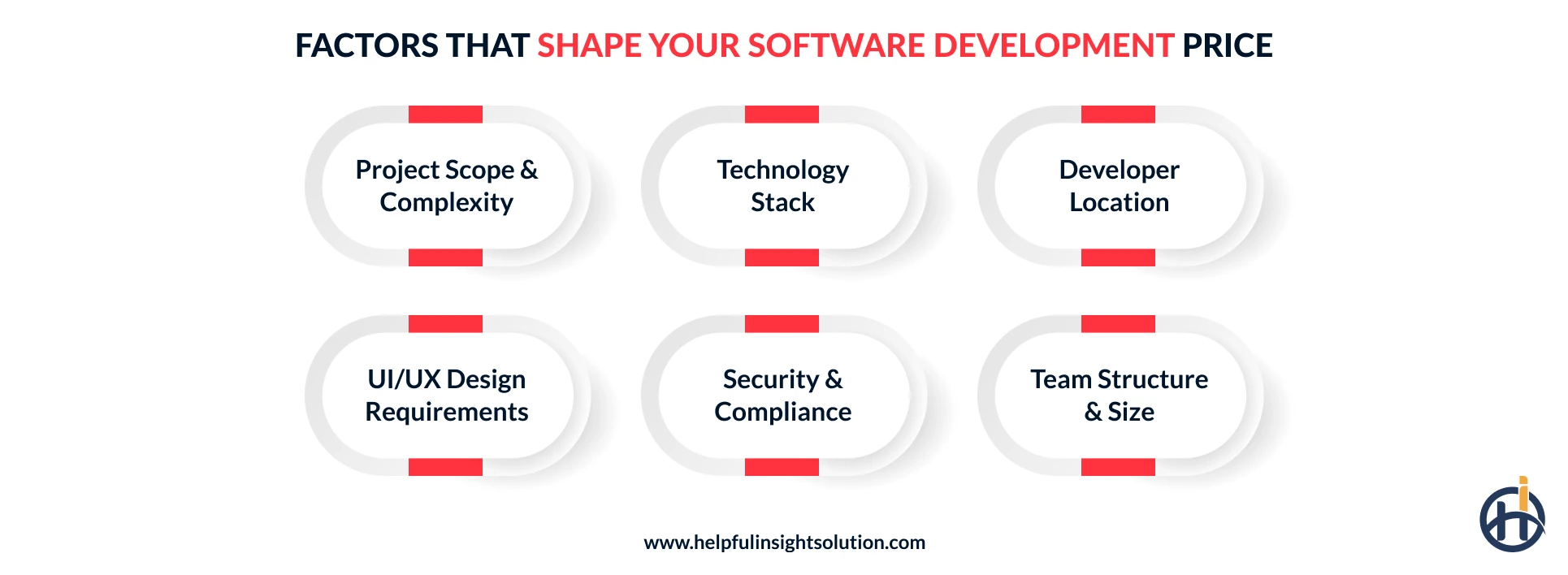
From project scope and UI/UX complexity to your tech stack, team structure, and where your developers are based, here’s what actually moves the number.
Understanding what those factors are before you start can save you from some very unpleasant budget surprises later.
Project scope and complexity
Every feature, every user role you include, and every workflow you automate adds to the software development cost. That is the scope. But complexity is a different thing. It’s the backend logic, database structure, and system architecture that users never see but developers spend most of their time on.
A poorly defined scope is where most budgets break down. Changes made mid-development cost considerably more than decisions made at the planning stage, which is why getting the scope right early really matters. You also need to factor in your technology stack decision early; whether you’re building for web, mobile, or both shapes the cost from day one.
How much you’ll spend often comes down to one decision: are you building new, upgrading, or integrating?
- Custom build (from scratch): Building from scratch means everything is custom-built. Expect to spend anywhere between $30,000 and $200,000 or more.
- System upgrade: Modernizing or extending an existing platform rather than starting over. usually between $15,000 to $150,000+.
- Integration: Connecting new software to your existing tools is the most affordable route, typically $15,000 to $75,000+.
UI/UX design requirements
Design is where a lot of budgets quietly expand. UIs using pre-built components are simple and relatively affordable. But once you move into custom layouts, branded micro-interactions, and multi-step user journeys, the hours stack up fast. And the more complex the UI, the more time frontend developers spend building and testing every interaction to get it right.
A simple interface might add $8,000 to $15,000 to your project. A fully custom UI/UX design with unique flows and animations can push that figure closer to $40,000 or more. Basically, a more complex UI means more time for frontend developers to build and test every interaction correctly.
Team structure and size
One question that comes up in almost every project discussion is how much it costs to develop software with a large team versus a smaller one. But team composition matters as much as team size.If you’re not sure where to start, understanding how to hire software developers before committing to a model can save you from costly missteps.
A frontend developer, backend developer, QA engineer, designer, and project manager each serve a different function in the build. Reducing the dedicated developers’ team size to lower initial costs frequently results in quality issues, delayed timelines, and post-launch corrections that generate expenses beyond the original budget.
Developer location and hourly rates
Another factor that influences the cost of software development is where your development team is based. Developer hourly rates vary significantly from one region to another. A senior developer in the USA bills at a very different rate than one with the same skills in Europe.
Working across time zones demands more coordination. Language gaps and unfamiliarity with regional industry standards add to that. All of these quietly affect timelines and, by extension, what the project ends up costing.
Here’s how hourly rates compare by region and experience level:
| Region | Junior developer hourly rates | Mid-level developer hourly rates | Senior developer hourly rates |
| North America | $50 to $70 | $75 to $120 | $120 to $200+ |
| Western Europe | $50 to $80 | $70 to $100 | $100 to $180 |
| Eastern Europe | $25 to $40 | $40 to $70 | $70 to $110+ |
| Asia | $15 to $22 | $25 to $45 | $45 to $75+ |
Security and compliance requirements
A basic business tool operates under very different requirements than a platform handling medical records or financial transactions. Industries like healthcare, FinTech,eCommerce, and insurance are subject to regulatory frameworks such as HIPAA, GDPR, and PCI-DSS.
Building to these standards involves encrypted storage, access controls, vulnerability testing, and ongoing audit requirements. Each of these adds to the development scope in ways that are difficult to estimate without a clear understanding of which regulations apply to the specific project.
Here is what security and compliance typically add to your software development cost:
| Category | Estimated cost |
| SSL certificates and data encryption setup | $1,000- $5,000+ |
| Penetration testing and vulnerability assessment | $5,000- $18,000+ |
| Security audit | $3,000- $45,000 per audit |
| Ongoing compliance monitoring and updates | $2,000- $8,000+ per year |
These aren’t optional, they’re baseline requirements. Skipping or deferring them doesn’t eliminate the cost; it simply delays it to a far more expensive point when a breach or audit failure occurs.
Software development outsourcing model
Hiring a development team is one of the more consequential budget decisions you will make before a single line of code is written. The model you choose directly affects your cost structure, how much control you retain over the build, and how quickly you can scale the team up or down.
Outsourcing the entire project to an external agency and outstaffing individual developers into an existing team are the two most widely adopted approaches. Each works, but for different situations and budgets.
Here is how each option typically affects the price for software development:
Fixed Price
It is best for well-defined projects and costs that are locked in upfront, typically ranging from $30,000 to $150,000+, depending on scope.
Time and material
Billing is based on hours worked, not a fixed deliverable, making this model a natural fit for projects where scope is expected to shift. For most mid-sized projects, monthly costs typically land between $15,000 and $40,000, with the overall total shaped by how long the development cycle runs.
Outsourcing
Handing the full project to an external agency removes the overhead of salaries, office space, and recruitment. It also typically compresses timelines; you get an assembled team from day one rather than spending weeks hiring. Best suited to businesses that want a complete solution delivered without managing the build internally.
Outstaffing
Dedicated remote developers work as a direct extension of your existing team rather than as an outside vendor. Monthly costs typically fall between $3,000 and $8,000 per developer, varying by region and seniority, which is significantly less than a comparable full-time hire in North America or Western Europe without any compromise on skill.
Hidden software development costs you should budget for
Most businesses budget for development and overlook everything that follows. The hidden costs of custom software development, including post-launch expenses, cloud infrastructure, SaaS fees, and other ongoing requirements, can add up to a substantial share of your original build cost if they are not planned for upfront.
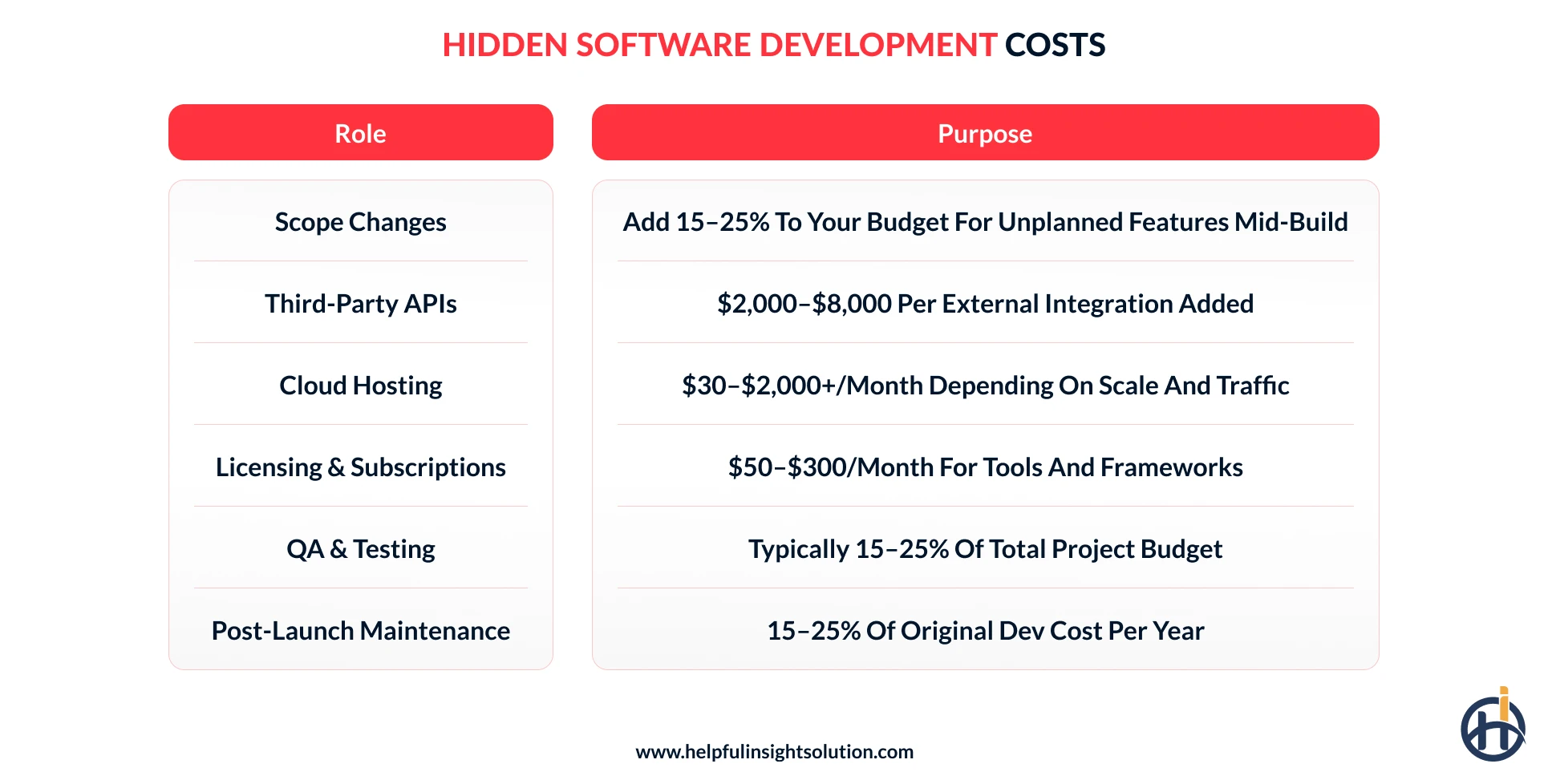
Here are the additional costs worth accounting for before finalizing your software development budget.
Feature additions beyond the original scope
According to PMI research, at least 52% of projects experience uncontrolled scope changes, making unplanned feature additions one of the most common reasons software projects exceed their original budget.
Every feature added after development begins requires additional design work, coding and quality assurance cycles. Depending on the stage at which changes are introduced, unplanned additions typically push the original budget up by 15 to 25%, sometimes more when the changes affect core architecture. This is precisely why investing time in getting the scope right upfront tends to show up very clearly in the final number.
Third-party integrations and APIs
Third-party integrations are worth accounting for early when you calculate software development costs. Each external connection, a payment gateway, a CRM, a mapping or analytics tool, requires its own development work and testing.
A single, well-documented API can add $2,000 to $8,000 to the build cost. When multiple systems need connecting, particularly legacy platforms with poor documentation, the combined cost of development, testing, and future maintenance adds up well beyond the initial estimate. The more integrations your project requires, the more this line item deserves its own budget allocation rather than being absorbed into a general contingency.
Cloud infrastructure and hosting
Cloud infrastructure is one of the more predictable additional costs in software development, yet it is consistently underbudgeted. Hosting costs scale with traffic, storage needs, and compute usage, meaning what you spend at launch is often nowhere close to what you are spending a year down the line.
A simple platform might run between $30 to $150 per month on standard cloud plans.
Systems handling higher user volumes or complex data processing typically fall between $500 and $2,000+ per month, with costs rising further as the user base grows.
Licensing and software subscriptions
Licensing and subscription costs rarely get the attention it deserves during software project cost estimation. Most modern software development environments rely on a combination of proprietary tools, third-party frameworks, and premium APIs, each carrying its own fee structure that continues beyond the build itself.
Perpetual licenses involve a one-time upfront payment, while subscription-based tools bill monthly or annually. Combined, these typically add $50 to $300 per month to ongoing operating expenses, depending on the tools your project requires. Small individually, but across a full software stack, they compound quickly over a year.
Testing and quality assurance
Testing is one of the most consistently underestimated line items in a software development pricing until businesses see the cost of skipping it post-launch.
Every function, workflow, interface, and system integration needs to be tested before anything goes live. As a baseline, QA typically accounts for 15 to 20% of the total project budget. Projects with stricter performance demands or regulatory requirements ( healthcare and FinTech platforms, especially) tend to land closer to 25%.
Cutting QA to reduce development costs almost always generates larger expenses after launch through emergency bug fixes, patches, and lost user trust that is difficult to recover.
Post-launch maintenance
Software does not stop costing money when it goes live; it shifts cost categories. Post-launch maintenance is an ongoing expense that most businesses fail to build into their original software development budget.
As a reliable planning reference, maintenance typically accounts for 15 to 25% of the original development cost every year. A product built for $100,000 should carry an annual maintenance budget of $15,000 to $25,000 minimum. That figure grows as the product scales, the user base expands, and the underlying technology stack requires updates to stay secure and performant.
The businesses that see the strongest long-term ROI from their software are the ones that treated maintenance as a built-in cost from day one, not a surprise that arrives six months after launch.
How to reduce software development costs without cutting quality
Understanding the cost of software development helps with planning, but what actually keeps the budget intact is the decisions made before and during development. The strategies below are not about cutting corners. They are about spending smarter so the quality of the final product is never what gets sacrificed.
Use open-source technologies
Most software projects do not need custom-built foundations. Open-source frameworks, libraries, and pre-built modules handle that layer reliably, and they have been battle-tested across thousands of projects before yours.
Choosing open-source technology rather than proprietary tools reduces the overall build cost by eliminating hours spent recreating what is already freely available. Widely adopted languages and frameworks come with large developer communities, meaning support is accessible, and integration with modern infrastructure is rarely a friction point.
For a typical mid-sized project, this decision alone can represent a saving of $10,000 to $30,000 when stacked against a proprietary alternative.
Prioritize must-have features only
Every feature added to a build carries its own design, development, and testing hours. Stack five or ten non-essential features on top of each other, and the budget takes a hit before a single user has even touched the product.
Keeping the initial build tight, only what is truly needed to launch, is one of the most effective ways to control what you spend. Everything else gets reserved for a later release, shaped by what real users actually ask for rather than what seemed like a good idea during planning. This is the thinking behind launching an MVP and in practice, it gets products out faster and for considerably less money.
Build With Agile Development
Traditional fixed-scope development locks in decisions upfront and reveals budget problems late, often after the most expensive changes have already been made. Agile works differently.
Development happens in short cycles called sprints, each with its own deliverable and cost visibility. Adjustments happen in real time rather than at the end of a six-month build. For businesses trying to maintain an accurate cost estimate throughout development, agile provides something waterfall approaches simply do not: the ability to course-correct before small changes become expensive problems.
Use AI development tools
AI-assisted development has meaningfully changed how fast and cost-efficiently software gets built. Tools like GitHub Copilot and Cursor handle the repetitive, pattern-based parts of coding, freeing developers to focus on architecture, complex logic, and the decisions that actually require human judgment.
The practical impact on the budget is real: prototyping moves faster, testing cycles shorten, and routine code review takes less time. Across a full project, the hours saved through AI tooling can reduce total development time by 20 to 30% on standard builds, a significant cost reduction without any reduction in output quality.
How to get ROI from your software investment faster
Building software is a significant financial commitment; the return on that investment depends almost entirely on what happens after launch, not just how well the product was built.
The three strategies below are what consistently separate businesses that see fast, measurable returns from those still waiting six months after go-live.
Start with an MVP
A Minimum Viable Product brings only the core features to market, nothing more, nothing that hasn’t been validated by a real user need. This keeps your software development cost tighter from the start, gets the product in front of real users faster, and critically means the feedback you use to build version two comes from actual usage rather than internal assumptions.
Businesses that launch lean consistently reach their first measurable returns sooner. Every feature you defer to a later release is both a cost saving upfront and a future improvement informed by real data. That is a compounding advantage that broad, feature-heavy launches simply cannot match.
Set measurable goals early
A software build without defined success metrics has no way to prove its own value after launch. KPIs established before development begins give every decision scope, features, timeline, and a financial reference point that keeps the project accountable from day one.
The right metrics depend on what the software is actually solving. For an internal operations tool, hours saved per week and error rate reduction are the relevant numbers. For a customer-facing platform, conversion rate, retention, and revenue per user are what matter. Whatever the measure, define it before development starts, not after launch, when there is pressure to justify the spend.
Train your team before launch
The price for software development includes more than what is invoiced during the build. Slow user adoption after launch is a hidden cost that most businesses do not account for. Staff who are trained before going live adapt faster, make fewer errors, and require less post-launch support.
That preparation directly shortens the gap between deployment and the point where the software starts generating measurable returns, which is the only gap that actually matters when someone asks whether the investment was worth it.
Partner with Helpful Insight and build high-quality software within your budget
Software development costs are one of the most important concerns for businesses when they plan to build custom software. It is one of the biggest financial commitments a business owner makes, and it should pay off. With the right knowledge, honest planning, and a trusted software development company that actually understands your goals, building premium quality software within your budget is completely achievable.
At Helpful Insight, we have spent 10+ years building software of every type and complexity across e-learning, healthcare, FinTech, logistics, eCommerce, and more. From simple internal tools to enterprise-level platforms, every project gets the same level of commitment: quality that holds up, timelines that are respected, and costs that do not shift halfway through the build.
No hidden charges. No scope surprises. Just what we scoped, built to what we agreed.
How do we calculate your software development cost
We keep the estimation process straightforward and fully transparent, no black-box pricing, no generic quotes that don’t reflect your actual project.
- Initial consultation: We review your project requirements, goals, and expected user volume to understand exactly what you need and what you don’t.
- Scope assessment: We identify the right technology stack, team structure, and development approach for your specific build, not a one-size-fits-all recommendation.
- Transparent cost estimate: We prepare a detailed breakdown covering development, design, testing, and post-launch support, so every line item is accounted for before a single decision is made.
Share your requirements with our team, and we’ll have a detailed, requirement-specific estimate back to you within 48 hours.
FAQs
Software development costs typically range from $30,000 for a basic MVP to $300,000 or more for an AI-powered enterprise platform. What you pay ultimately comes down to five things: project scope, UI/UX complexity, tech stack, team structure, and where your developers are based.
A healthcare or fintech platform will sit at the higher end of that range due to compliance requirements; a straightforward internal tool can come in well below it.
Several variables shape the final number, such as project complexity, feature count, interface requirements, technology choices, team structure, outsourcing model, and the geographic location of your developers.
For businesses operating in regulated spaces like healthcare or fintech, security and compliance requirements add another layer on top of that. No single variable tells the actual figure. It is the combination of all of them together that determines what a project actually ends up costing.
Start by outlining your full requirements, then break them down into individual tasks. From there, estimate how long each one takes, apply the hourly rates that match your team’s location and experience level, and add it up. The part most estimates skip is the buffer. Building in 15 to 20% on top of that total for revisions, QA, and the scope changes that almost always come up is what separates a number that holds from one that falls apart three months into the build.
It depends on the project and your existing team. Outsourcing typically costs less upfront you skip recruitment, salaries, and infrastructure and gets you to market faster with an experienced team ready from day one.
In-house development can work out more cost-effectively over the long term for complex, evolving products where deep product ownership and institutional knowledge reduce rework costs. For most businesses building their first custom product, outsourcing delivers better value for the initial build.