

Key Takeaways:
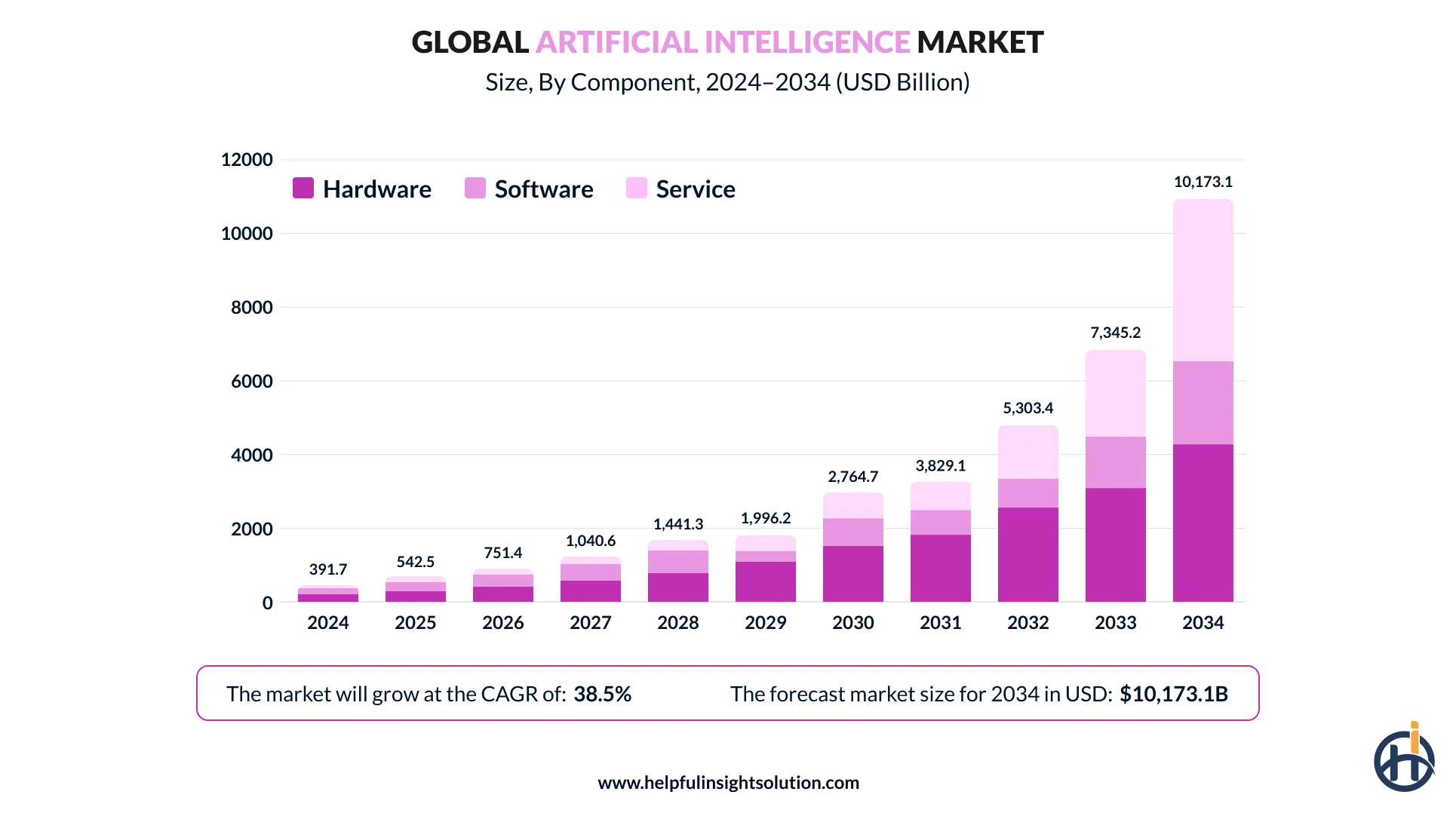
- The global AI market is heading toward $10,173.05 billion by 2034, making AI trends adoption a business priority, not a choice.
- Agentic AI and autonomous agents are moving beyond assistance to independently executing complex, multi-step business workflows.
- AI paired with cloud, IoT, blockchain, and edge computing tends to deliver outcomes that none of those technologies were producing on their own before.
- Businesses that moved on to AI early are pulling further ahead. The ones still weighing the decision are finding that the gap they need to close keeps getting bigger.
The distance between businesses leading their markets and those losing ground is increasingly measured by one thing, how deeply AI is embedded in their operations.
Across industries, AI for businesses has moved from boardroom discussion to operational infrastructure, quietly transforming how decisions get made, how customers get served, and how growth gets sustained. Emerging AI trends 2026 have played a big part in driving this shift.
The global AI market is expected to reach $10,173.05 billion by 2034. Moreover, McKinsey’s data shows most organizations are no longer experimenting with AI in one department. They have taken it further, running it across multiple functions, and half of them are doing that in three or more areas at the same time.
Most businesses have already moved past the “should we use AI” stage. The conversation now is about what to scale, what to fix, and what to build next. Agentic systems, multimodal models, and industry-specific AI are being used by companies inside their actual workflows, and the difference is showing up in their numbers.
For businesses and startups, understanding which AI business trends are gaining real traction and which ones deserve immediate strategic attention is no longer a competitive advantage. It is a baseline requirement.
In this blog, we walk through the top artificial intelligence trends shaping business decisions in 2026 and beyond.
Key AI Market Statistics and Business Adoption Numbers You Should Know
Businesses do not invest in AI solutions on a large scale without a reason, right? Spending is up, adoption is wider, and results are coming in across sectors. Still not sure if enterprise AI adoption is the right move?
The statistics below will give you the confidence to make informed decisions about investing in AI services.
- According to the Market.us report, 64% of companies believe AI will substantially increase operational efficiency and workforce productivity across business functions.
- 7% of companies have actually taken AI beyond selective use and rolled it out across the whole organization.
- 65% of CEOs are now prioritizing AI use cases based on what delivers real returns, and 68% say their organizations already have clear ways to measure whether that investment is paying off.
- According to Founder Reports, 89% of workers say they already use AI for their jobs.
- Approximately half of companies generating over $5 billion in revenue have already reached the enterprise AI adoption scaling phase, compared to just 29% of smaller businesses under $100 million in revenue.
- As per Gartner, roughly 15% of day-to-day business decisions will be made without human involvement by 2028, driven by agentic AI for business. That same year, 33% of enterprise software applications are expected to have it included as a standard capability.
- Customer relationships top the list for most business owners. Over 60% say AI will genuinely improve how they connect with clients.
What Is Driving AI Adoption in Businesses?
Not every business implements AI for the same reason. Some were losing ground to faster competitors. Others had costs that kept climbing with no clear way to bring them down. A few just had customers pushing for better, quicker experiences. The reasons vary by industry and company size, but a few core factors keep coming up when you talk to people actually making these decisions.
Let’s have a look at them.
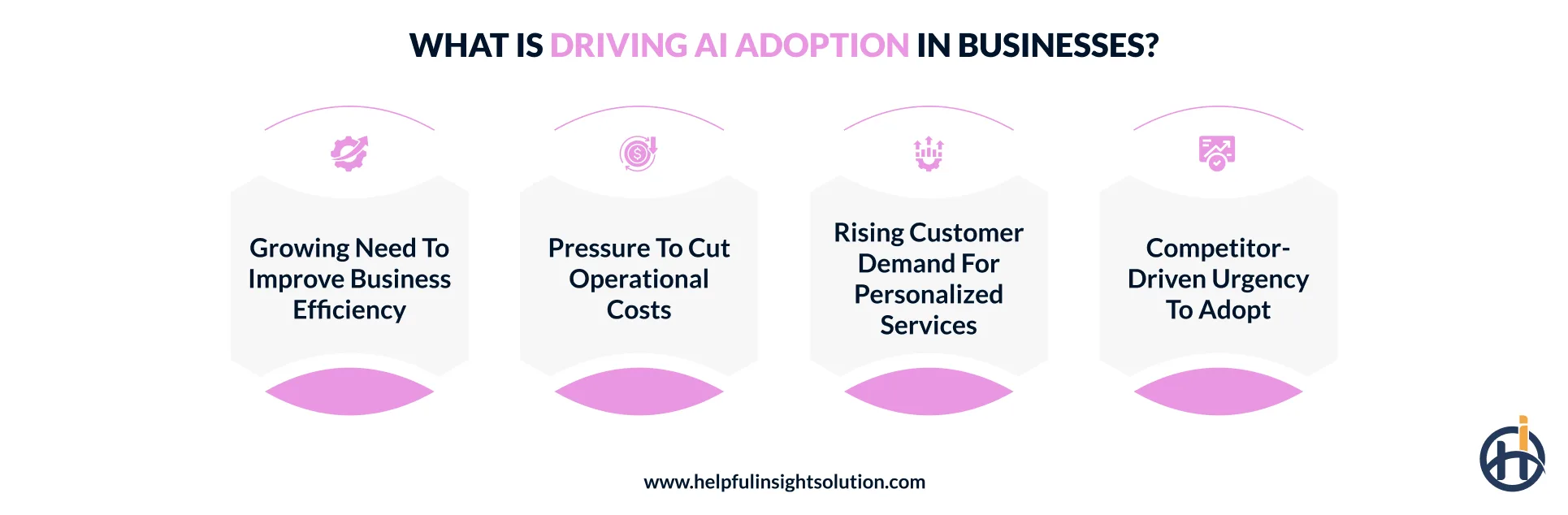
1. Growing Need to Improve Business Efficiency
Every business wants to run more efficiently. AI-powered automation just made that a lot more achievable. Repetitive work that used to slow teams down, such as reporting, data handling, and basic processing, gets taken care of by the AI tools. That recovered time tends to go toward things that actually need humans behind them.
2. Pressure to Cut Operational Costs
Cutting costs is something every business is working on. AI systems gave that effort a sharper edge. From reducing dependency on manual labor to catching errors before they turn into bigger problems, businesses found that smart automation quietly trims expenses in places they were not even actively looking.
3. Rising Customer Demand for Personalized Services
At some point, customers stopped being impressed by fast replies and started expecting relevant ones. Businesses felt that shift in their retention numbers before they fully understood what was causing it. Those who brought in AI-driven personalization found it easier to keep up with what customers actually wanted rather than guessing.
4. Competitor-Driven Urgency to Adopt
Nothing builds a stronger internal case for AI than a competitor reporting better margins and faster operations. Businesses that moved early on AI, their ROI gave others something concrete to point to in budget meetings. That shift in evidence made a lot of previously hesitant businesses and small startups move faster.
AI Trends for Businesses that are Transforming How Businesses Operate
There is no shortage of opinions on what AI will do next. What is more useful is looking at what it is already doing. The top AI trends for businesses 2026 are not predictions anymore. They are patterns showing up in how real businesses are operating right now.
If you are an entrepreneur or investor planning to invest in AI or have already started, knowing where AI business trends are heading and what they are actually capable of is worth your time.
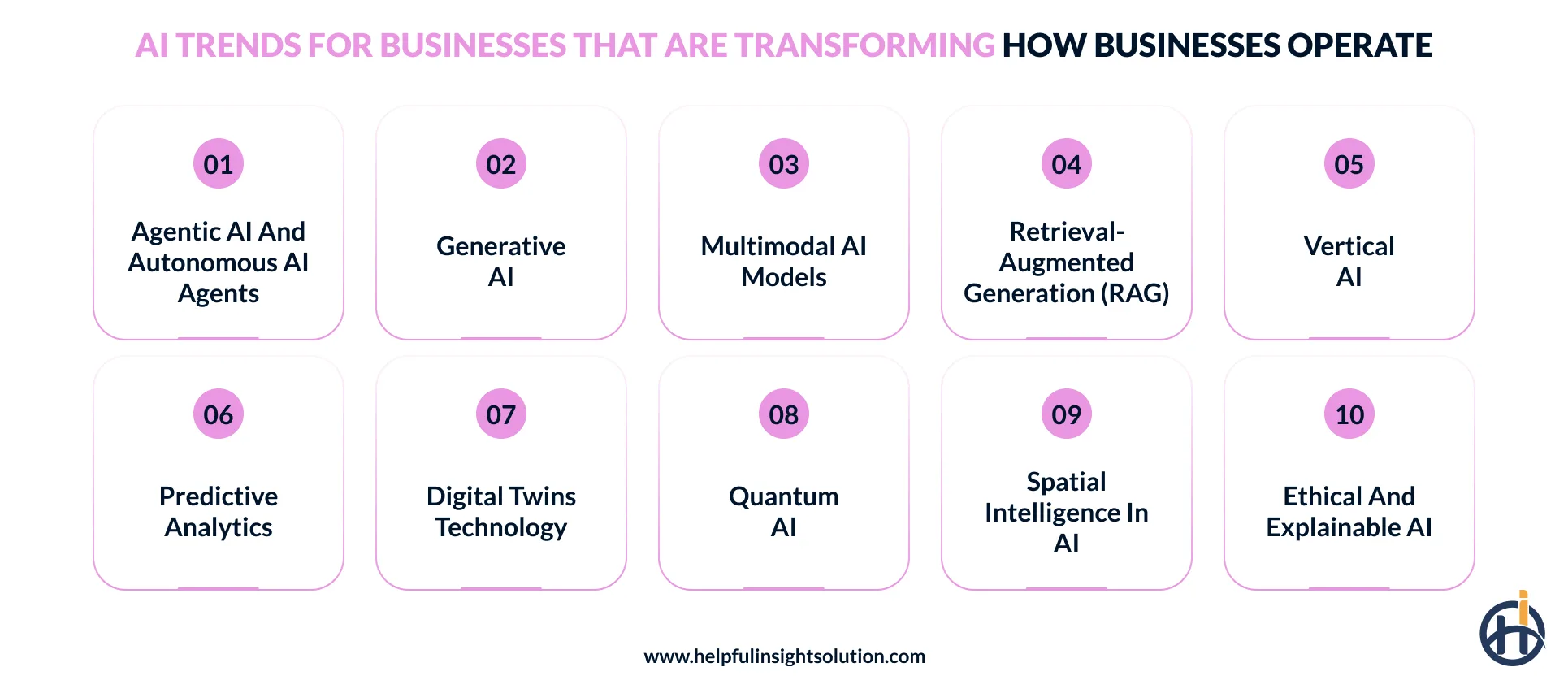
1. Agentic AI and Autonomous AI Agents
Most AI tools wait to be asked. Agentic AI for business works differently. It plans, decides, and acts on its own across multi-step workflows without needing someone to prompt it at every stage. For businesses, that means operations that keep moving even when no one is actively managing them.
What makes this AI trend significant is not just automation. It is the level of judgment these systems are starting to apply independently. Here are some real life examples that show exactly what this looks like in practice.
- A logistics company is using autonomous AI agents to reroute shipments in real time.
- Retail businesses running inventory restocking automatically based on demand patterns
- Financial firms use agentic systems to flag and escalate compliance issues without manual review
Businesses are not treating agentic AI for business as something to explore later. 96% of enterprises are already expanding their use of AI agents, and 83% of executives say investing in it is no longer optional if they want to stay competitive.
2. Generative AI
Generative AI is something most of us interact with daily, whether we realize it or not. Behind the tools people use to draft emails, generate images, or write code sits a branch of machine learning applications that not just analyze data but also creates from it. That ability to produce original output from existing information is what has made generative AI one of the most actively adopted technologies across business functions.
Here is how generative AI works across various industries:
Finance: Regulatory documents get drafted faster, financial reports get summarized without someone spending hours on them, and client ready investment summaries come together in a fraction of the usual time.
Healthcare: Diagnostic findings get interpreted more quickly, drug discovery moves faster, and treatment plans get built around what the patient data is actually showing rather than general assumptions.
Retail: Promotional material gets created without a big team behind it, and customer communication keeps running even when the team is focused on something else.
Tools like ChatGPT, Gemini, and Claude have made generative AI accessible to businesses that previously did not have the technical resources to build anything close to this internally.
3. Multimodal AI Models
Not long ago, AI tools were built to handle one thing at a time. Multimodal AI models changed that. Text, images, and audio, these systems do not treat them as separate problems. They work through all of it together.
For a healthcare provider, that might mean reading a scan and cross-referencing it with the patient’s history in the same step. For a retailer, it could mean understanding what a customer photographed and connecting it to relevant products without any manual input in between.
A few years ago, this kind of capability would have been considered advanced. Now businesses are starting to expect it as a standard part of any serious AI setup.
4. Retrieval-Augmented Generation (RAG)
Among the latest trends in AI, RAG is one that is getting a lot of attention inside enterprise teams right now. Most AI models work from what they learned during training and nothing beyond that. RAG changes that by pulling from a connected knowledge base before putting together a response. Businesses end up with answers that actually reflect current information rather than whatever the model happened to learn months or years ago.
RAG is particularly useful for:
- Building internal knowledge assistants that reference proprietary company data.
- Customer support tools that pull accurate, real-time product and policy information.
- Compliance teams that need AI outputs grounded in current regulatory documentation.
5. Vertical AI
Most AI models are built to work across everything, which also means they are not built specifically for anything. Vertical AI takes a different approach. These are models trained on industry-specific data, language, and regulatory requirements from the ground up, and that focus makes a measurable difference in how they perform inside specialized environments.
In areas like AI in banking, the difference becomes obvious quickly. General models can process financial data but vertical models built around it catch what general ones miss.
For businesses operating in regulated environments, the difference between a general model and a vertical one is not just performance. It shows up in compliance, in audit readiness, and in how much the team actually trusts the output they are working with.
6. Predictive Analytics
Businesses have always made decisions based on past data. Predictive analytics AI takes that a step further by using what has already happened to work out what is likely to happen next. Instead of waiting for a problem to show up, businesses using predictive models are catching it before it costs them anything.
The shift from reporting to forecasting is what makes this one of the more practically valuable AI industry trends right now.
7. Digital Twins Technology
A digital twin gives businesses a way to test what they are not sure about without paying the price of being wrong. It is a virtual model that mirrors how a real asset or process actually behaves.
Manufacturing teams use them to simulate line changes. Logistics companies model disruptions before they happen. The digital twin market is expected to reach $149.81 billion by 2030, which says a lot about how seriously businesses are taking simulation as a planning tool.
8. Quantum AI
Among the more forward-looking AI technology trends, quantum computing with artificial intelligence handles complexity at a level that classical computing was not built for, which is why industries with heavy data demands are watching it closely.
Businesses do not need to build their own quantum infrastructure to start exploring this. Amazon, through its AWS Braket service, already gives enterprise customers cloud access to quantum processing units, letting teams prototype hybrid quantum and classical AI workloads without the cost of building physical quantum labs from scratch.
Quantum AI is still developing, but the businesses paying attention to it now are the ones that will be positioned to use it when it becomes more widely accessible.
9. Spatial Intelligence in AI
One of the recent trends in AI that does not get talked about enough is spatial intelligence. It is less about processing information and more about understanding the environment that information exists in, distances, positions, and how things shift when something in the physical world changes.
Where businesses are applying it:
- Delivery systems that read the environment and adjust routes as conditions change.
- AR tools that connect digital information to physical spaces in real time.
- Factory equipment that picks up on spatial changes and responds without manual input.
10. Ethical and Explainable AI
Most AI models reach a conclusion without showing the reasoning behind them. For a business, that creates a problem. When an AI system makes a hiring decision, flags a transaction, or denies a loan application, someone needs to be able to explain why. That is exactly the gap that AI governance and ethics frameworks and explainable AI are built to close.
Responsible AI practices are being pushed from multiple directions at once. Regulators, customers, and partners have started asking questions that do not have vague answers anymore, who made this decision, how, and what happens when it is wrong.
Key features of Explainable AI are:
- Transparent decision making process
- Bias detection and mitigation
- Human interpretable outputs
- Audit ready model behavior
- Regulatory compliance built in
- Clear accountability at every step
How Businesses Across Industries Are Applying Trends of AI
The latest trends in AI 2026 are showing up differently depending on the sector, but the direction is the same across all of them. What? Deeper integration, real outcomes, and changing how businesses operate.
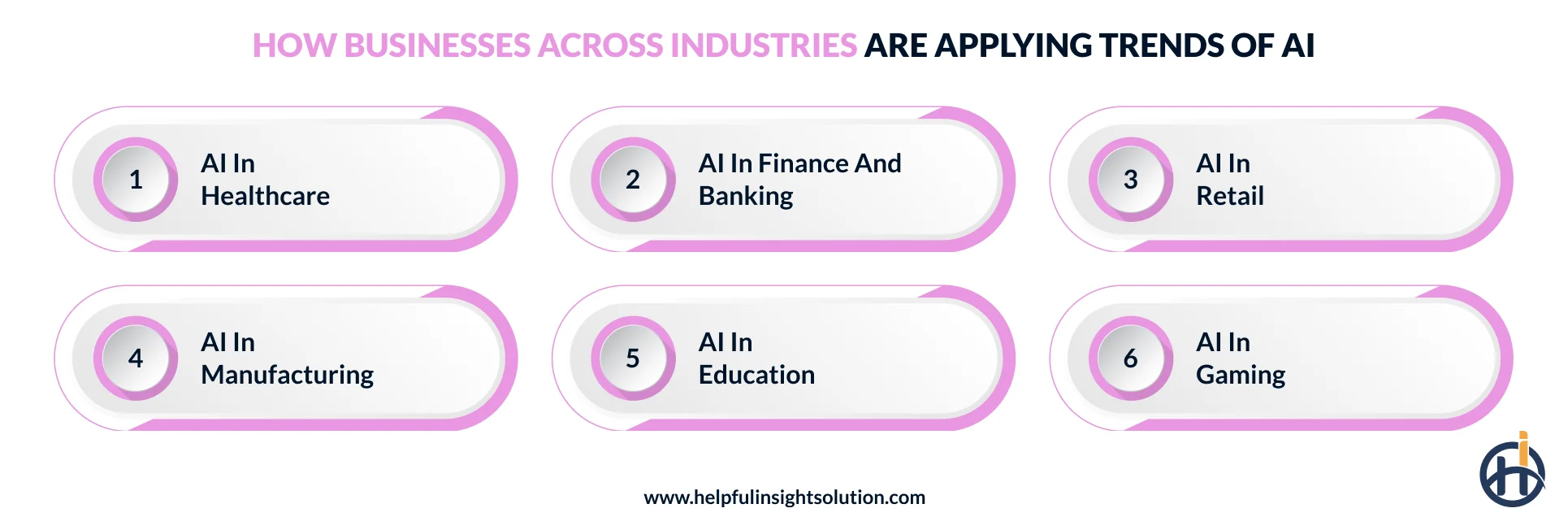
1. AI in Healthcare
Artificial intelligence in healthcare is changing how medical professionals diagnose, treat, and monitor patients. From speeding up image analysis to catching early warning signs, the technology is helping care providers make faster and more informed decisions without compromising on accuracy.
Let’s have a look at use cases of AI in healthcare:
Medical Imaging and Diagnostics
AI works through MRI scans and X-rays, picking up findings that help clinicians make faster decisions without second guessing what they are looking at.
Remote Patient Monitoring
Wearable devices collect health data around the clock and flag shifts that need attention, giving medical teams a chance to act before things get worse.
Drug Discovery and Research
AI moves through molecular data faster than any research team could, cutting down the time it takes to find candidates that are actually worth pursuing.
2. AI in Finance and Banking
Finance is one of those sectors where speed and accuracy matter equally. A wrong call on a transaction or a delayed fraud alert can cost significantly. Use of AI in finance is a way to handle both processing data at a scale and pace that manual systems were never built for.
Let’s have a look at the main applications of AI in banking:
Fraud Detection
Machine learning applications watch transaction patterns in real time and catch anything that looks out of place before it turns into a confirmed loss.
Automated Credit Scoring
Instead of relying purely on fixed criteria, AI tools build a fuller picture of a borrower’s risk profile by pulling from a wider range of data points and doing it faster.
Algorithmic Trading
AI-powered automation analyses market data continuously and executes trades based on conditions that human traders would take much longer to identify and act on.
3. AI in Retail
Retail is one of those sectors where AI trends landed fast and stayed. From the moment a customer lands on a product page to the moment an order ships, AI is involved in more of that journey than most people realize.
Below are some of the use cases of AI in retail:
Smart Inventory Management
AI tools track stock levels in real time and trigger restocking automatically before shelves run short. For example, Walmart does this using predictive algorithms that adjust pricing on slower-moving items without manual input.
Visual Search
Shoppers can take a picture of something they like and find it or something close to it instantly. AI-powered image recognition connects what a customer sees to what is available in the catalog without any manual search involved.
Dynamic Pricing
Stock levels, demand, and competitor pricing all feed into real-time price adjustments that human teams simply cannot track and action fast enough manually.

4. AI in Manufacturing
Manufacturing was one of the first industries to feel the digital transformation of AI, and it is still one of the most active areas of deployment. And the difference is showing up in output quality and operational costs.
Some of the use cases of artificial intelligence in manufacturing are:
Automated Production Scheduling
AI helps adjust workload across machines and shifts based on live floor conditions rather than fixed plans that rarely hold through an entire production cycle.
Predictive Maintenance
Around 29% of manufacturers use AI for maintenance to avoid costly breakdowns. AI software picks up signals when a machine is about to break down and flags what needs attention.
Supply Chain Optimization
A delay from one supplier can quietly throw off an entire production run. AI monitors timelines, stock movement, and demand shifts at the same time, so the warning comes early.
5. AI in Education
Classrooms look different now, and a lot of that comes down to how recent trends in artificial intelligence have changed how teachers teach and how students learn.
Use cases of AI in education cover:
Personalized Learning
Every student learns differently and at their own pace. AI adjusts what comes next based on how each student is actually performing. The Duolingo app does this well, testing where a learner stands first and then continuously adjusting difficulty based on their progress and results.
Automated Grading and Assessment
AI systems automatically grade assessments based on set criteria, giving students faster feedback and freeing teachers from spending hours on evaluation work.
Virtual Tutors and Learning Assistants
AI chatbots and virtual assistants give students direct access to get their queries answered anytime, keeping learning going outside classroom hours.
6. AI in Gaming
Gaming has come a long way from fixed rules and scripted opponents. Machine learning and neural networks are now behind some of the most interesting shifts in how games are built and how they keep players coming back.
Adaptive Difficulty Levels
No two players move through a game the same way. Neural networks pick up on individual patterns and shape the difficulty around how that specific person actually plays.
Cheat Detection and Fair Play Monitoring
AI solutions watch patterns across millions of sessions at once and catch what human moderation would likely miss.
Procedural Content Generation
Levels, environments, and scenarios get built by the artificial intelligence tool, so players are not experiencing something they have already seen and figured out.
Impact of Combining Artificial Intelligence with Other Emerging Technologies
AI technology works, but businesses getting the most out of it are the ones pairing it with other advanced technologies. The new AI trends 2026 showing the strongest results are coming out of some powerful combinations.
In this section, we will explore key technologies to use alongside artificial intelligence.
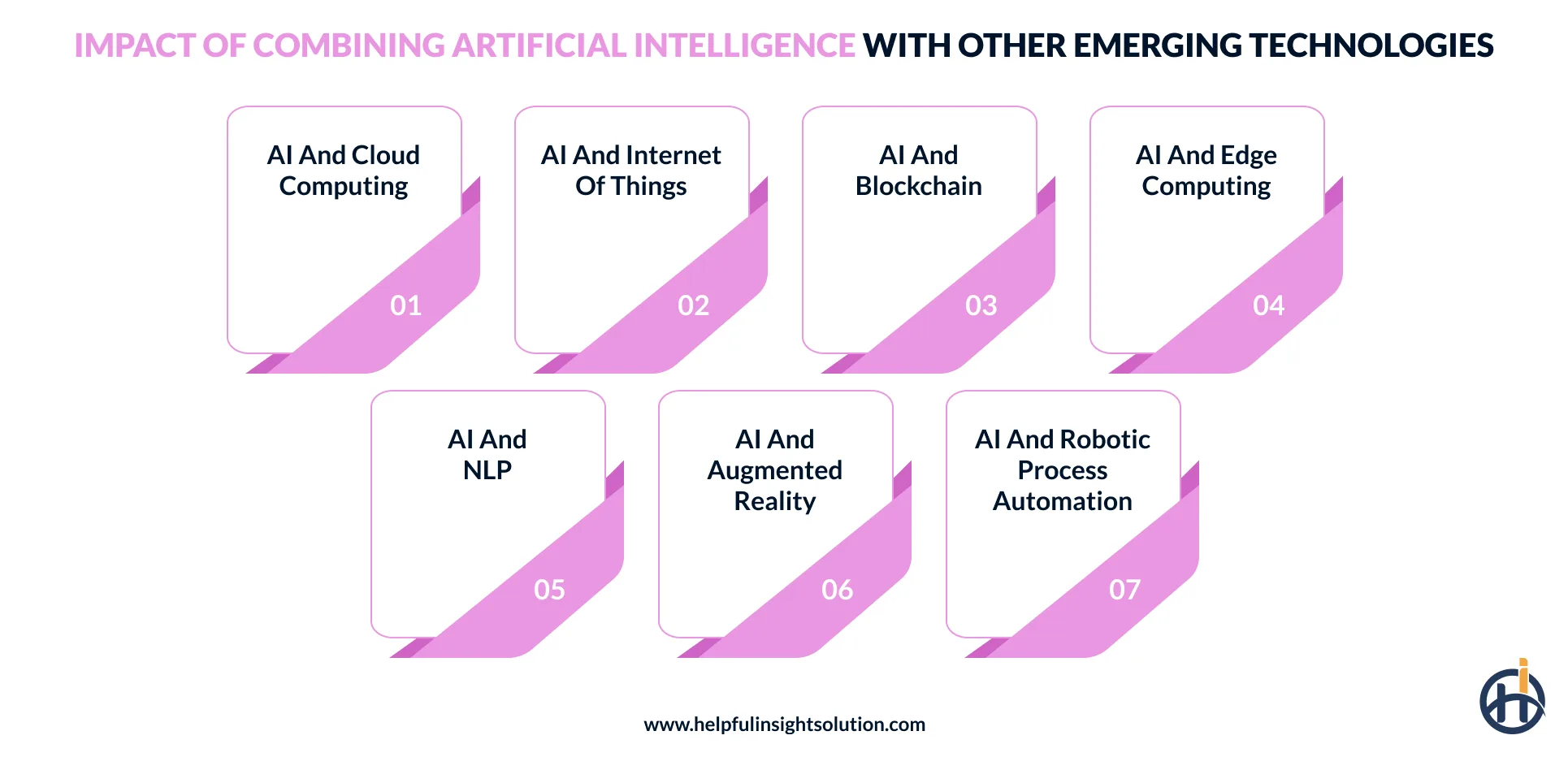
1. AI and Cloud Computing
Most businesses do not have the infrastructure to train large language models on their own hardware. Cloud computing fills that gap. It gives teams on demand access to the processing power needed to build, test, and deploy AI without the capital expense of building it themselves.
Updates happen continuously, models improve over time, and the whole setup scales with the business rather than requiring a fresh investment every time requirements grow.
2. AI and Internet of Things
Devices connected to the internet collect data constantly but collecting it was never the hard part. AI with IoT is one of the trends of AI that turned all that raw data into something actually useful. Sensors that used to just report numbers now flag problems, adjust settings, and make decisions without anyone having to check in manually.
3. AI and Blockchain
AI + blockchain technology is one of the current trends in AI that addresses something both technologies struggled with separately that is trust. AI systems produce outputs, but the reasoning behind them is not always visible. Blockchain keeps a record of every step that cannot be touched or changed after it has been written.
Together, they give businesses a way to track AI-driven decisions with a level of transparency that standalone AI systems simply cannot offer.
4. AI and Edge Computing
Most AI systems send data to a central server, wait for it to be processed, and then receive a response. Edge AI computing for enterprises moves that processing closer to where the data is actually coming from.
The practical difference shows up in environments where a delayed response is not just inconvenient but costly. For enterprises running operations across multiple locations or in environments where connectivity is unreliable, this combination gives AI deployments reliability.
5. AI and NLP
Most interactions between humans and software still require people to adapt to how the system works. Natural language processing services are shifting that around. NLP gives AI a way to work with language the way people actually use it, not just the way a system was built to receive it.
Customer support tools that used to funnel people through fixed options are now handling open-ended conversations. Internal search that needed exact phrasing now understands what someone meant rather than just what they typed.
6. AI and Augmented Reality
Augmented reality, on its own, overlays digital information onto the physical world. Add artificial intelligence to that, and the experience changes entirely. Instead of fixed digital layers, the system reads what it is looking at and reacts to it in real time.
Among the AI trends gaining ground in customer-facing and industrial environments, this combination is producing some of the more visible changes in how businesses interact with their customers.
7. AI and Robotic Process Automation
Traditional automation systems handle repetitive and structured tasks. Pairing AI with RPA is one of the AI tech trends that pushes automation beyond simple rule-following and is capable of handling complexity.
With AI behind it, robotic process automation stops needing every scenario mapped out in advance. It handles unstructured data, reads documents that do not follow a fixed format, and makes judgment calls on tasks that rule-based automation would have escalated to a human.
Future of AI in Business: What Comes Next
What AI is doing for businesses today is already significant. Startups and enterprises are still catching up with what is possible right now. What comes next makes that even more interesting to watch. So, let’s explore some of the key future trends in AI we can expect in the coming years.
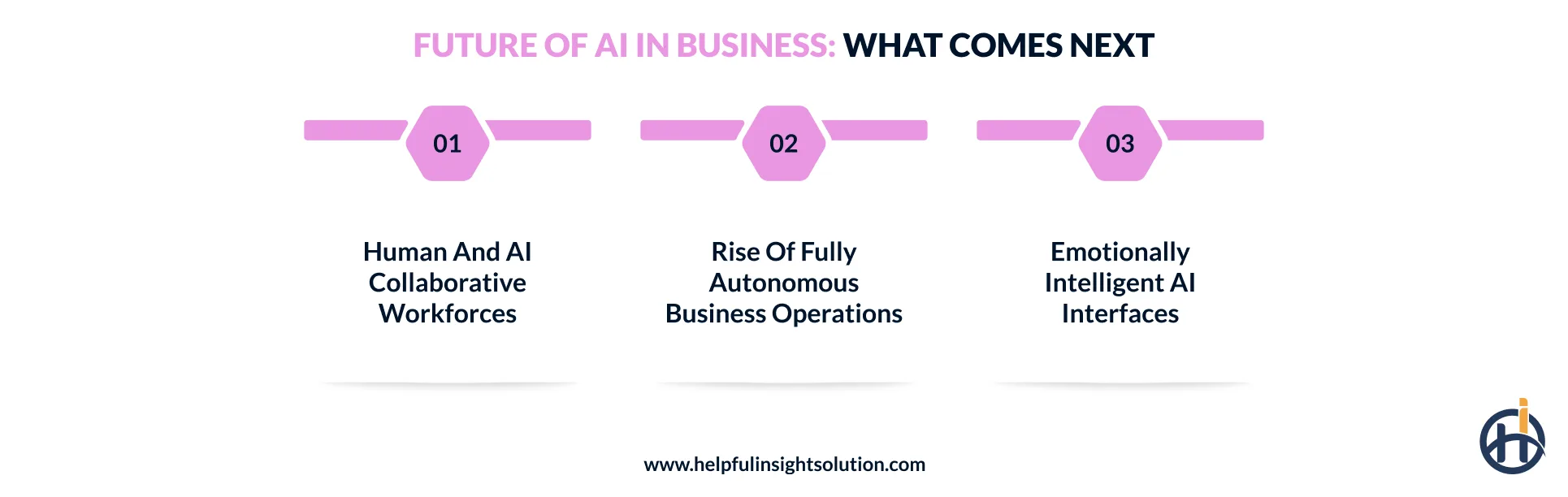
1. Human and AI Collaborative Workforces
The workplace is not heading toward humans versus AI. It is heading toward both working alongside each other in ways that play to their respective strengths. The artificial intelligence market trends around human and AI collaboration are growing fast, with collaborative work systems expected to cross $23.28 billion by 2031. AI handles data processing and pattern recognition. People bring judgment, context, and the calls that AI systems alone cannot make.
2. Rise of Fully Autonomous Business Operations
One of the more significant future AI trends is how far autonomous operations are expected to go. AI agents are already handling multi-step workflows without human prompting. What comes next is entire business functions, procurement, logistics, customer management, running end-to-end with minimal human involvement.
3. Emotionally Intelligent AI Interfaces
Among the more unexpected future trends of AI is emotional intelligence. These systems read tone, word choice, and behavioral patterns to get a sense of where someone is emotionally, not just what they typed. Research puts emotional intelligence as influencing 58% of job performance, ahead of IQ as a career success indicator. AI that picks up on this brings something different to how businesses handle customer and team interactions.
Conclusion
Every AI trend in this guide has moved past the concept stage. Businesses are already building around them. Some are running agentic systems, deploying generative tools, and building with vertical models that would have seemed advanced just two years ago. The businesses putting these technologies to work are not sitting back to see how things unfold.
If you are thinking about bringing any of these AI trends into your business, our AI development company can help you build scalable, secure artificial intelligence solutions built around what your business actually needs. Our team keeps up with the latest artificial intelligence trends so your solution does not become outdated before it delivers results.
FAQ’s
Some of the new AI trends are:
- Agentic AI
- Multimodal AI Models
- Generative AI
- Retrieval-Augmented Generation (RAG)
- Physical & Embodied AI
- Digital Twins Technology
- Predictive Analytics
- Edge AI
Artificial intelligence is completely transforming how businesses operate, as it has made its way into their workflows across departments. Here are the ways AI is changing how businesses across industries operate:
- Automating repetitive and time consuming tasks
- Predicting outcomes before problems arise
- Personalizing customer experiences at scale
- Speeding up data driven decision making
For small businesses, the future of AI is about doing more without growing the team behind it. AI automation trends are moving toward tools that handle operations end to end, from customer service to inventory to marketing, making AI for SMBs more of a standard way of running things.
There is no single right way to bring AI into a business but there are ways that tend to work better than others. Here is the AI implementation roadmap for businesses:
- Start by identifying tasks that consume the most team time
- Pick one business function to pilot AI before scaling further
- Choose AI tools that integrate with systems your team already uses
- Set clear metrics to measure what success looks like from day one
- Build internal awareness so teams understand how AI supports their work.