

Key Takeaways:
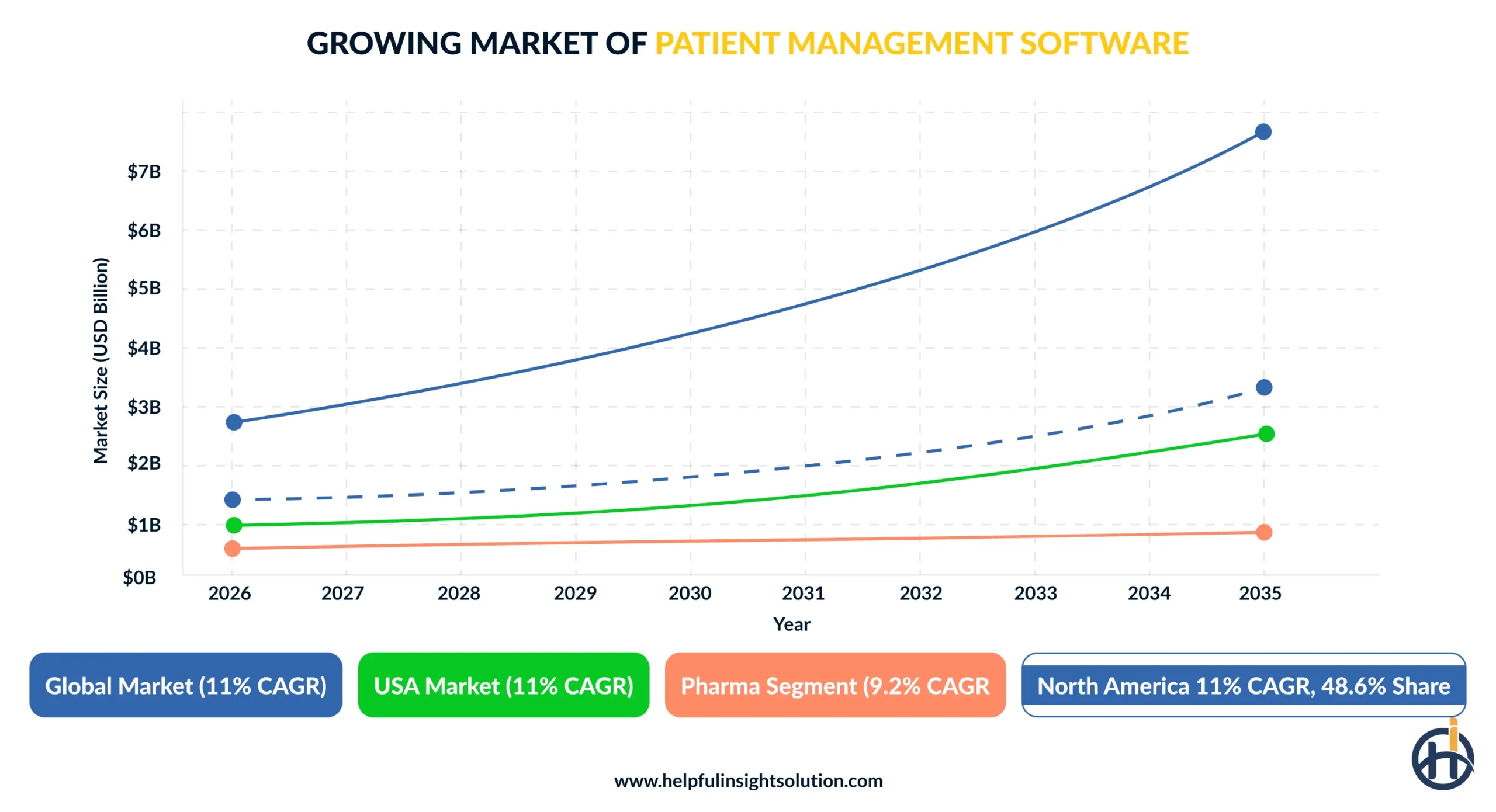
- The patient care management software market value will reach $2.9 billion by the end of the year 2027.
- A platform for patient management provides multiple facilities to hospitals, clinics, and pharmacies.
- The patient health management platform follows various compliances and EDI transactions to verify eligibility.
- The key AI technologies used in the development process include deep learning, generative models, and LLMs.
In the healthcare industry, if you place yourself in the position of a patient, then you will face various difficulties, like appointment booking, billing, and accessing medical records. Additionally, as an entrepreneur, you may struggle with missed patients, claim inaccuracies, and clinical data handling.
These situations may lead to the downfall of your businesses, affecting patient engagement. The right way to revive it is to know how to develop patient management software in the present era.
You will be surprised to know that the current revenue of patient management systems is $13.9 billion in 2026, which is growing at a 9.3% CAGR rate. With the use of advanced technologies, like AI, cloud, IoT, and AR/VR, it becomes easy to gather more patients in less time. Additionally, voice-enabled systems helped doctors to easily connect with their patients, reducing physical visits.
You are going to study the process of making hospital management software, with benefits, features, and cost, then this blog is the best option for you. Healthcare businesses will also understand other aspects that are necessary to run a successful healthcare business in this write-up.
What is a Patient Management System?
Various medical facilities, hospitals, and clinics use patient management software to automate administrative tasks and enhance workflow efficiency. It helps to manage appointment bookings, medical billings, insurance claims, and patients’ health records. Businesses must implement these digital platforms in their healthcare systems to reduce errors and manual workload.
Additionally, they enhance doctor-patient communication, improve care coordination, and save time by reducing long waiting queues. The hospital staff can easily focus on all patients by using advanced AI-enabled features, such as voice chatbots and automated scheduling.
Let’s study some market stats based on the revenue growth of the patient healthcare software market. You will observe various metrics such as regional market share, expected volume, and growth rate.
- The global market volume will reach $19.8 billion by the end of 2030, with North America having a current share of 45% across the globe.
- The Europe and Asia-Pacific regions have 28% and 18% market shares, respectively, which will increase in the next few years.
- In North America, more than 85% of hospitals and clinics use PMS to handle 250 million patients on a daily basis.
Key Advantages of Developing Software for Patient Management
Entrepreneurs must build a patient management system because it offers increased revenue and patient retention. Some of the great benefits are discussed in this section that you must know before starting.
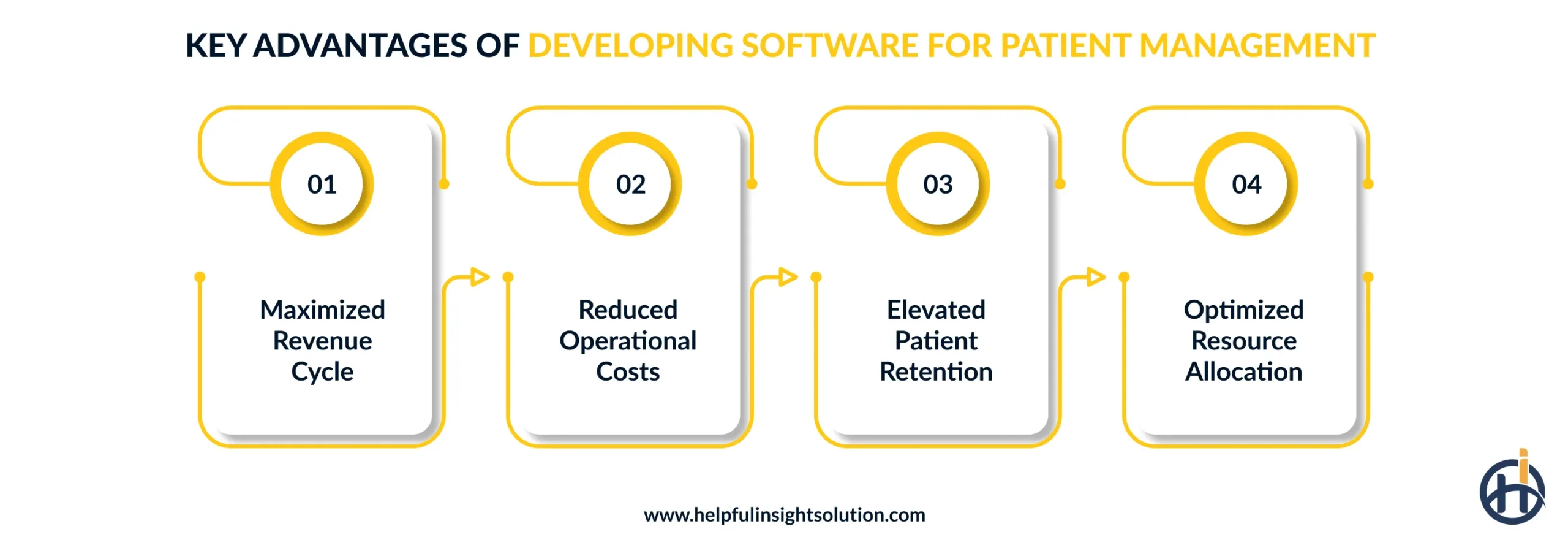
1. Maximized Revenue Cycle
With an automated patient care platform, you can improve billing, reduce human errors, optimize claim settlement, and increase business revenue. It helps to streamline the healthcare ecosystem and enhance cash flow through advanced data analytics.
2. Reduced Operational Costs
A laboratory information management system reduces workload, administrative tasks, and the overall operational expenses. This assures that hospital staff can easily focus on patients without manual documentation, paperwork, and file management.
3. Elevated Patient Retention
The use of voice technology in healthcare increases patient interaction with doctors, reduces long waiting times, and prevents missed appointments. Integrated CRMs, telemedicine, and self-service portals help businesses to improve patient engagement and retention.
4. Optimized Resource Allocation
Medical centers or clinics can handle their staff, surgical operations, and patient appointments with an advanced care management platform. Additionally, they can manage healthcare equipment, like MRI machines, hospital beds, and monitoring devices.
Who can Build Patient Management Software?
You must know the target audience of patient portal software to decide whether it is suitable for your business or not. We will focus on the key contributors who want to elevate their patient experiences.
1. Hospitals
The software helps hospitals to streamline patient records, appointment scheduling, and communication. They improve operational efficiency, reduce administrative burden, and enhance patient care coordination.
2. Private Clinics
The clinic management software handles consultations, prescriptions, patient history, and appointments. They allow clinics to deliver personalized patient experiences by automating daily medical operations.
3. Diagnostic Laboratories
Various labs build PMS to manage test reports, track blood samples, and secure data sharing. They can use AI in medical imaging systems to improve accuracy and enhance laboratory workflow management.
4. Pharmacies
Pharmacies handle prescriptions, medication inventory, and refill reminders with pharmacy management software. It also supports seamless coordination between doctors, patients, and pharmacy operations.
5. Health Insurance Companies
PMS improves claims processing, eligibility verification, policy management, and healthcare data exchange. It reduces paperwork, increases transparency, and accelerates healthcare workflows.
How to Develop Patient Management Software?
To build patient management software, it is necessary to know a dedicated process, from planning to market release. The following development stages are generally used by skilled and experienced experts.
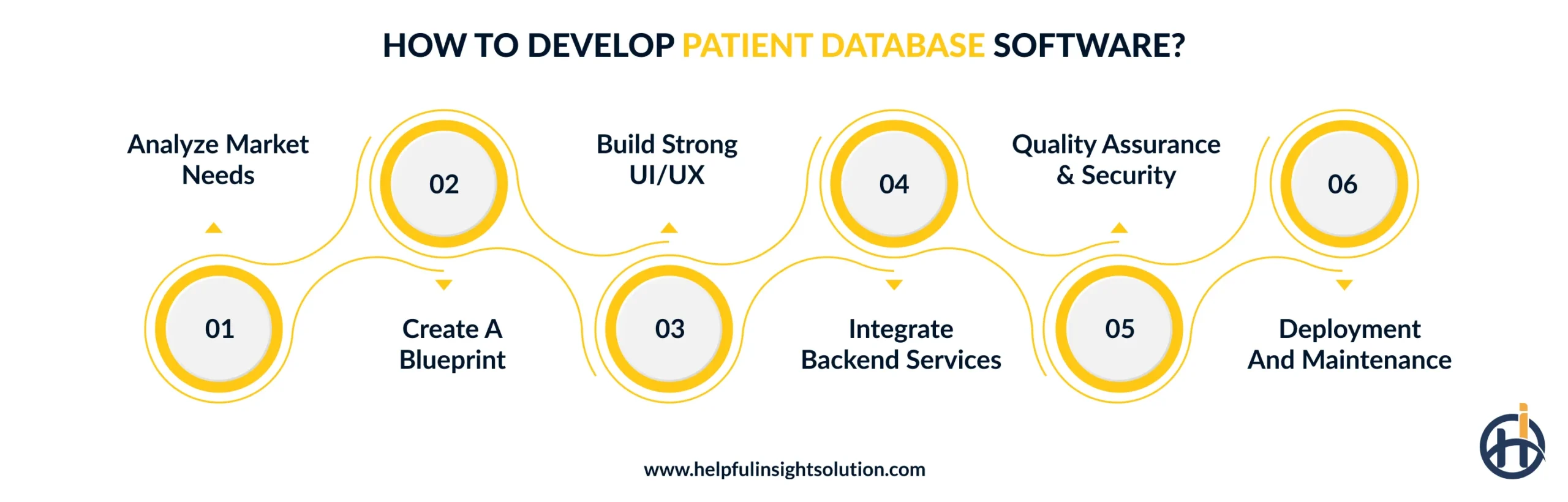
1. Analyze Market Needs
At the initial level, businesses should focus on arranging valuable resources and the budget that are common. Additionally, they must know their target audience, user pain points, current healthcare trends, and the basics of medical terminology.
It is necessary to focus on the key industry players, such as Epic Systems, Athenahealth, and CureMD, to understand their market growth. You must choose the right business model based on the requirements, patient demands, and industrial needs.
2. Create a Blueprint
Now, it is crucial to prepare a blueprint plan that includes core patient software features, necessary tools, and innovative technologies. To streamline this process, you can approach a reliable healthcare software development company that has experience in the healthcare domain.
It will help you to easily select the important tech stack based on the project specifications and the budget, reducing additional expenses. As an investor, you must check all the possible options before choosing these resources, which will avoid inefficiency.
3. Build Strong UI/UX
An interactive user interface is important to engage patients and deliver a comfortable booking, scheduling, and consultation experience. Figma is the most common tool that helps to wireframe key software elements and design themes.
For web-based healthcare platforms, JavaScript is a highly preferred language that allows developers to make them responsive. C++ and C# are used for system software that runs on a desktop and is dedicated to particular tasks, like claim management and billing.
4. Integrate Backend Services
The integration of advanced database structures, RESTful APIs, and cloud-based platforms is important to handle complex patient data. The backend experts use the Java programming language, SpringBoot framework, MongoDB for databases, and Postman for APIs.
To check the software functionality, it is beneficial to use Docker containers that run on different servers in an isolated environment. AWS and Azure are the most widely used cloud services that help to centralize patient data for instant access.
5. Quality Assurance & Security
For quality assurance, usability, acceptance, penetration, and load testing methods are available that help to detect all possible errors in the software system. Additionally, IEC 62304 and ISO 13485 are the most important medical software integration standards for risk prevention.
The diagnostic lab software must ensure healthcare compliance, like HIPAA and GDPR, with various security encryption measures. These include AES-256, TLS 1.3, role-based access control, and audit logs that safeguard protected healthcare information.
6. Deployment and Maintenance
It is necessary to check the applicability of the PMS on different devices and operating systems, ensuring communication through protocols like HL7 and FHIR. Additionally, the system must transfer healthcare data to doctors, pharmacies, labs, and patients securely.
Businesses should monitor the platform regularly to check security issues, performance, and data backups, reducing the risk of technical failure. This prevents various attacks, data breaches, and information loss with a strong and scalable architecture.
What Features Does Patient Record Management Software Provide?
Here, we will see some common patient management software features, such as billing, telehealth, and analytics. They help patients to easily access their records, fix appointments, and consult with doctors.
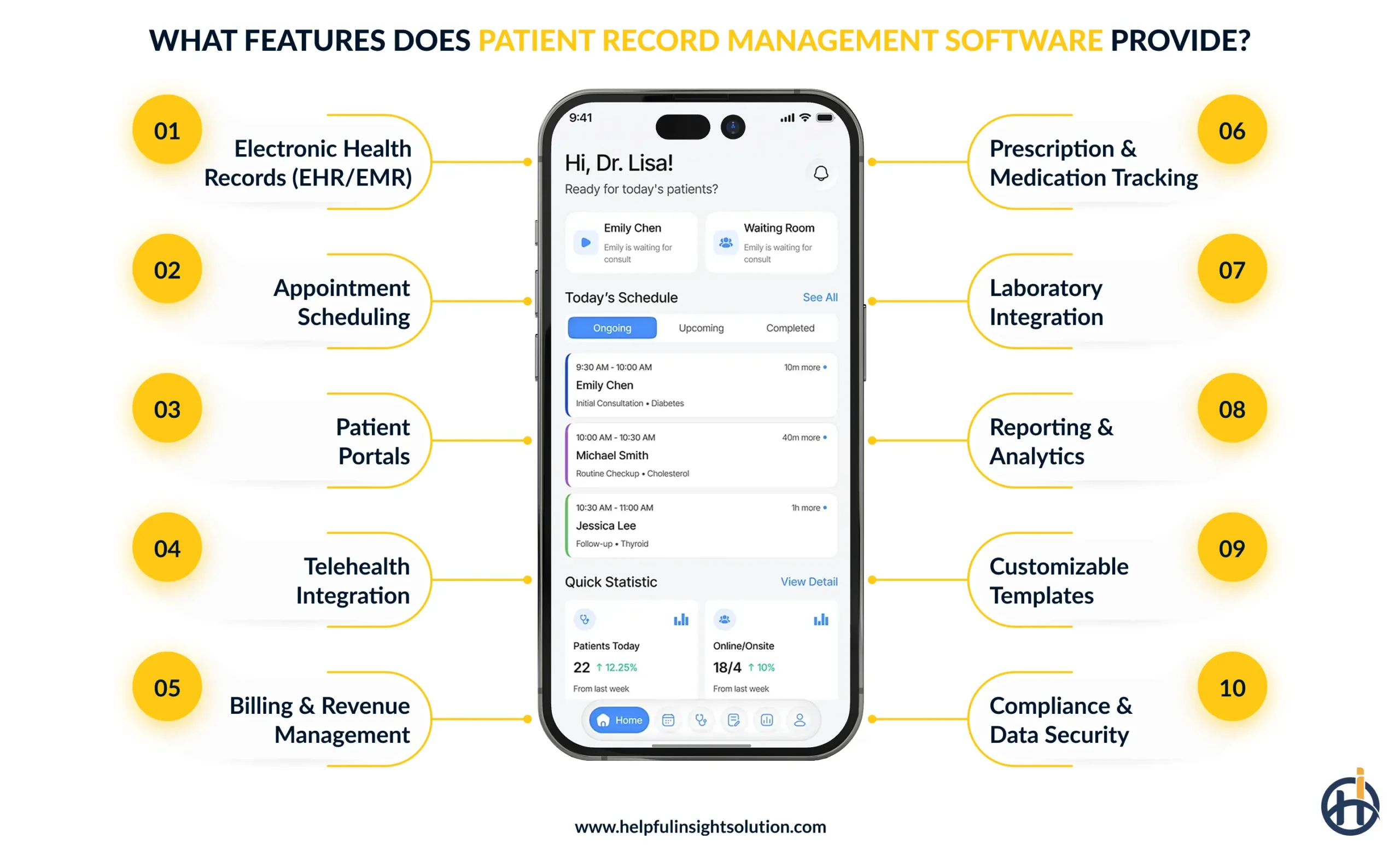
1. Electronic Health Records (EHR/EMR)
The electronic health records software manages patient medical histories, prescriptions, and treatment plans. Doctors can access patient information quickly and improve care coordination across departments.
2. Appointment Scheduling
This feature allows patients and healthcare staff to book, reschedule, and manage appointments. These tools reduce scheduling conflicts, minimize missed appointments, and optimize clinical workflows.
3. Patient Portals
It provides secure online access to medical records, prescriptions, appointment details, and claims. They enhance patient engagement by enabling self-service healthcare management and real-time information.
4. Telehealth Integration
This enables virtual consultations, remote monitoring, and secure video communication between patients and doctors. It improves healthcare accessibility by reducing manual visits and overall operational costs.
5. Billing & Revenue Management
The medical billing software systems automate invoicing, insurance claims, payment tracking, and reimbursements. They reduce billing errors, improve cash flow, and streamline financial operations.
6. Prescription & Medication Tracking
Doctors manage digital prescriptions, medication history, dosages, and refill reminders with prescription management software. It improves medication accuracy and reduces the risk of prescription-related errors.
7. Laboratory Integration
This feature connects diagnostic labs with PMS to automate test requests, report generation, and result sharing. It enhances workflow efficiency, improves data accuracy, and accelerates diagnosis processes.
8. Reporting & Analytics
Various analytics tools provide real-time insights into patient data, financial records, and healthcare trends. The facility supports instant decision-making that optimizes healthcare services and enhances experiences.
9. Customizable Templates
It allows doctors to create clinical forms, treatment plans, prescriptions, and medical records based on their needs. This facility improves the overall productivity and standardizes healthcare documentation.
10. Compliance & Data Security
The HIPAA-compliant patient management software maintains privacy, prevents data breaches, and ensures compliance. It uses encryption, secure access controls, and regulatory standards in real-time.
Role of Healthcare EDI Transactions for Managing Patient Data
The healthcare EDI transactions help hospital staff to monitor different medical processes, like claim submission. These standards focus on the request, response, and eligibility of patients in real-time.
1. EDI 270/271: Eligibility, Coverage, or Benefit Inquiry & Response
It allows healthcare providers to verify a patient’s insurance eligibility, coverage details, and benefits before treatment. This process reduces manual verification errors, accelerates approvals, and improves patient billing accuracy.
2. EDI 278: Health Care Services Review – Request and Response
They are used to request and manage authorizations, referrals, and healthcare service reviews between providers and insurance companies. These transactions streamline medical approval workflows and ensure faster treatment processes in real-time.
3. EDI 837: Health Care Claim Submission
This enables hospital staff to submit medical claims electronically to insurance payers for reimbursement processing. The use of electronic data interchange in healthcare improves claim accuracy, reduces paperwork, and speeds up clinical payment cycles.
4. EDI 276/277: Health Care Claim Status Request and Notification
These transactions help providers to check the status of submitted healthcare claims and receive updates regarding approvals or denials. Additionally, they improve transparency in tracking claims and reduce delays in reimbursement management.
5. EDI 835: Health Care Claim Payment/Advice
It provides electronic payment details and remittance advice from insurance companies to healthcare providers after claim settlement. They automate payment processing, improve financial accuracy, and streamline revenue cycle management.
How to Migrate Patient Data from the Legacy Systems?
To shift patient information from traditional platforms to digital ecosystems, you should follow a structured ETL (Extract, Transform, Load) process. This ensures data integrity, regulatory compliance, and enhanced patient care through healthcare planning, data mapping, testing, and deployment.
- Planning: It is crucial to gather all structured and unstructured information, such as clinical notes, bills, and policies. You must know which part should be migrated according to the system requirements.
- Extraction: The experts can extract the patient’s EHR by using API connectors, database dumps, or recording modules. It is important to ensure backup plans to prevent accidental data loss.
- Transformation: You should remove duplicate entries and resolve formatting issues to align with new healthcare systems. Additionally, it is crucial to ensure compatibility with data exchange standards like HL7 and FHIR.
- Loading: The developers must use ETL tools or custom scripts for a parallel migration approach. It helps to minimize downtime, reduce data entry problems, and enhance patient care.
- Testing: It is beneficial to perform testing methods in a sandbox environment to prevent external changes. User Acceptance Testing (UAT) is a crucial process to ensure data accuracy, accessibility, and functionality.
- Post-Migration: The system constantly trains the hospital staff on various resources and data modules. It regularly monitors the system performance, ensuring data recovery and management.
Tech Stack Required for Patient Management Software Development
A business investor must select the right tools and technologies for developing patient record management software at reasonable prices. You can hire dedicated developers who ensure the use of advanced AI models, integrated platforms, and modern frameworks. Here is a table showing the tech stack for telehealth software development with APIs, databases, and data analytics.
| Component | Tools/Technologies | Description |
| Frontend Development | React.js, Angular, Vue.js | It builds responsive and interactive user interfaces for healthcare staff and patients. |
| Mobile App Development | Flutter, React Native, Swift | This enables cross-platform or native mobile healthcare application development. |
| Backend Development | Node.js, Django, Laravel | It manages server-side logic, APIs, authentication, and system workflows. |
| Database Management | PostgreSQL, MySQL, MongoDB | This stores and manages patient records, appointments, and healthcare data securely. |
| Cloud Infrastructure | AWS, Microsoft Azure, Google Cloud | It provides scalable hosting, storage, backup, and healthcare cloud services. |
| API Integration | REST APIs, GraphQL, HL7 FHIR APIs | This ensures seamless communication between healthcare systems and third-party services. |
| Healthcare EDI Integration | X12 EDI, HL7, and FHIR | It supports secure healthcare claims, eligibility checks, and patient data exchange. |
| Security & Compliance | OAuth 2.0, JWT, AES Encryption | This ensures HIPAA-compliant authentication, encryption, and secure patient data protection. |
| Telemedicine Integration | Twilio, Agora, Zoom SDK | It enables video consultations, virtual appointments, and remote patient communication. |
| AI & Analytics | TensorFlow, Power BI, OpenAI APIs | This powers predictive analytics, AI-driven insights, reporting, and healthcare automation. |
Major Challenges in the Development of a Patient Record System
Several challenges are present in the process of making patient database software for hospitals and clinics. In this section, you will study some of the most important development risks with their respective solutions.
1. Data Exchange Issues
Most healthcare systems use different terms, like ICD-10, that are difficult for a receiver platform to understand. Also, the system cannot accurately link the patient records with the existing infrastructure.
Solution: Businesses must adopt universal standards like HL7 and FHIR by using AI or NLP models in healthcare systems.
2. Security & Compliance
Various phishing, ransomware, and DDoS attacks are the key patient data management challenges for medical units. Some platforms do not ensure healthcare compliance because of regional difficulties
Solution: It is crucial to integrate different security methods, such as MFA and end-to-end encryption, with HIPAA standards.
3. Healthcare Workflow Disruptions
The hospital staff may not know the use of AI-powered systems, or there may be some design issues. This affects the documentation process, decreasing the overall user experience and platform performance. Solution: You can implement virtual health assistants that understand patient behavior and predict results accordingly.
Need for Regulations, Compliance & Risk Management
Patient management software must safeguard data privacy, prevent medical errors, and ensure enhanced patient care. Through risk management, healthcare businesses can reduce financial penalties, avoid data breaches, and build trust between patients and medical institutions.
PMS manages sensitive health information through various compliances, which include HIPAA, GDPR, and CCPA. The medical tools that are used for managing patient records must follow the USA-based FDA guidelines or the European MDR standards.
For secure and safe healthcare data transmission, HL7 and FHIR regulations are popular, which ensure smooth communication between hospitals, pharmacies, and patients.
It is mandatory to follow various protocols and cybersecurity measures to prevent ransomware attacks. The system automatically detects security issues and raises the problem to the server, helping staff to make the right decisions.
What is the Cost of Creating Health Management Systems for Patients?
The patient management software development cost is an important aspect that businesses must know before investing in the process. It is dependent on the budget requirements, project needs, and user preferences. For SaaS-based solutions, the average subscription cost is between $2,000 and $5,000 due to instant deployment and cloud services.
Entrepreneurs who want to create the software from scratch with custom features may have to spend between $50,000 and $150,000. The cost of an enterprise-grade platform with integrated pharmacy, laboratory, and patient portals may reach up to $350,000.
Several factors influence the overall cost of making patient management systems, which include security, complexity, and deployment models. It is beneficial to use a cost calculator to estimate the right price based on different market parameters. The key cost-affecting factors are discussed as follows:
- Feature Complexity: The overall rate is affected by the software features, such as AI chatbots and appointment scheduling.
- Platform Type: Businesses can build cloud-based solutions or custom management platforms according to their needs.
- Developers’ Experience: You can hire senior professionals for full-stack software and junior developers for small integrations.
- Hiring Model: Freelancers are affordable, but do not ensure complete support and are not suitable for enterprise platforms.
- Geographic Factor: It is beneficial to hire experts from offshore regions like India due to high affordability and quality.
Choosing Helpful Insight for Secure Patient Management Solutions
It’s time to get ready with all your resources, budget needs, and MVP requirements, which will help in managing additional expenses. Businesses can hire a custom healthcare software development company that ensures security and scalability across devices.
We are a leading partner in the healthcare sector, helping investors to make highly advanced patient handling platforms with modern innovations. You can experience a collaborative environment with user-friendly services and solutions.
Our skilled experts help you to understand various types of healthcare software, such as telemedicine, appointment booking, and medical billing. So, you can easily integrate all the necessary features in a single platform. To enhance record management, you must target EHR software development services, which ensure consistent growth and engagement.
FAQs
The average time to build software for patient management with limited features, like appointment bookings, is between 3 months and 6 months. This duration may increase to 12 months or more due to additional requirements, such as AI and Cloud integration. It is highly dependent on the development process, budget specifications, and available resources.
For a business investor, it is crucial to know the maintenance costs of patient management platforms that depend on bug fixing and feature updates. The cost to maintain healthcare software is between 15-20% of the original development charges. If the overall cost of a healthcare system is $50,000, then the maintenance rates will range from $7,500 to $10,000.
Entrepreneurs must use a compliant software architecture by signing a Business Associate Agreement (BAA) with the vendor. It is necessary to implement key security standards, encryption, role-based access, and audit logs. Additionally, you must analyze various risk factors before implementing HIPAA regulations in the software.
You must know the process of hiring a suitable partner who can build platforms for patient care. The key steps to hiring a healthcare software-making company are discussed as follows:
- The first stage is to identify their expertise in the healthcare and medical sector.
- Now, you should analyze their previous work, portfolio, and client testimonials.
- It is important to judge their technical knowledge through personal interviews.
- Businesses must ensure that the developers have ethical skills and work integrity.
- You can discuss the project outcomes and future goals with the IT experts.
Hospitals, clinics, and medical laboratories in the USA use multiple patient management platforms. The leading healthcare solutions are described in the following manner:
- Epic Systems: It is made for large hospitals and medical institutions, offering advanced CRM features.
- Athenahealth: This is a cloud-based platform for clinics that provides EHR and medical billing services.
- CureMD: The software enhances clinical workflow and patient engagement with customized interfaces.