

“Manage data in your healthcare system by integrating EDI components and transactions.”
The healthcare industry is highly dependent on patient medical data, claims processing, staff records, and delivery information. Additionally, it also holds billing cycles, medical coding, and pharmacy listings in manual documents, which can lead to sabotage and data theft.
This increases the importance of electronic data interchange in healthcare industry, as it helps the entire clinical ecosystem. According to a survey, the EDI can save $1 per claim for payers, $1.5 for experts, and $0.9 for hospitals.
The current market value of healthcare EDI systems is $6.4 billion in 2026, which will rise to $13.4 billion by 2034 at 9.6% CAGR in this period.
This shows that businesses are rapidly accepting EDI for healthcare transactions, such as insurance processing, patient management, and regulatory compliance. To know better, you need the best guide that tells about various EDI concepts in detail.
Here, we provide the crucial EDI benefits, components, types of transactions, and implementation process. You will also study future trends & innovations in electronic data interchange in further sections. Let’s put all your focus towards this blog and get the best out of it.
What is EDI in Healthcare?
Medical electronic data interchange is the exchange of secure and standardized information, such as claims, payments, and appointments, between different systems. This reduces manual work, boosts healthcare administration, ensures compliance, and maintains data accuracy.
In simple terms, it is the transaction of different types of clinical data, ensuring productivity and efficiency. The role of EDI in healthcare’s digital transformation is to manage insurance claims, authorization, and the supply chain in real-time.
It has different components that encrypt information, perform transmission, and validate responses for multiple healthcare operations.
- It increases productivity by automating manual tasks for various healthcare providers.
- This technology uses standard data formats that reduce errors and complications.
- The data is transmitted in a secure network where it is validated for response generation.
Key Benefits of Using EDI in Medical Systems
There are several benefits of EDI in healthcare, such as cost management, data handling, and platform security. Let’s study these crucial advantages in this section before moving forward in the blog.
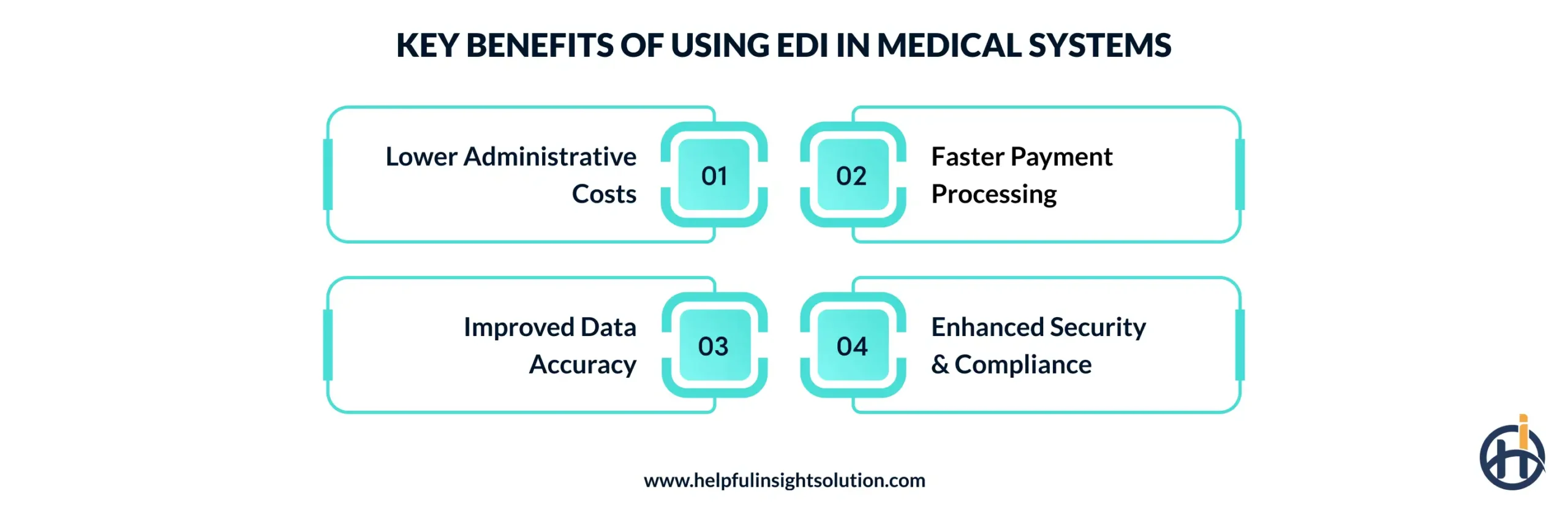
1. Lower Administrative Costs
It is one of the best benefits of HIPAA EDI implementation that reduces manual data errors, avoids paperwork, and automates healthcare tasks. This boosts efficiency and decreases expenses, like printing, mailing, faxing, and storing documents.
2. Faster Payment Processing
The use of EDI for healthcare claims processing is beneficial because it helps to automate insurance, payment advice, and fund transfers. This can improve cash flow and manage claim rejections in real-time through standard healthcare transactions.
3. Improved Data Accuracy
By integrating EDI in healthcare for patient data management, you can easily handle various typing or data errors and ensure clinical accuracy. The use of data analytics in healthcare helps to standardize data formats and maintain consistency across devices.
4. Enhanced Security & Compliance
The security of protected health information is among the main advantages of EDI for hospitals and healthcare providers. It follows HIPAA compliance, HTTPS standards, audit trails, and authentication protocols, ensuring secure digital transactions.
Major Components of Electronic Data Interchange in Healthcare
We will explore the key components of electronic data interchange in healthcare, which help in secure transmission. They ensure stability and transparency across different clinical networks in real-time.
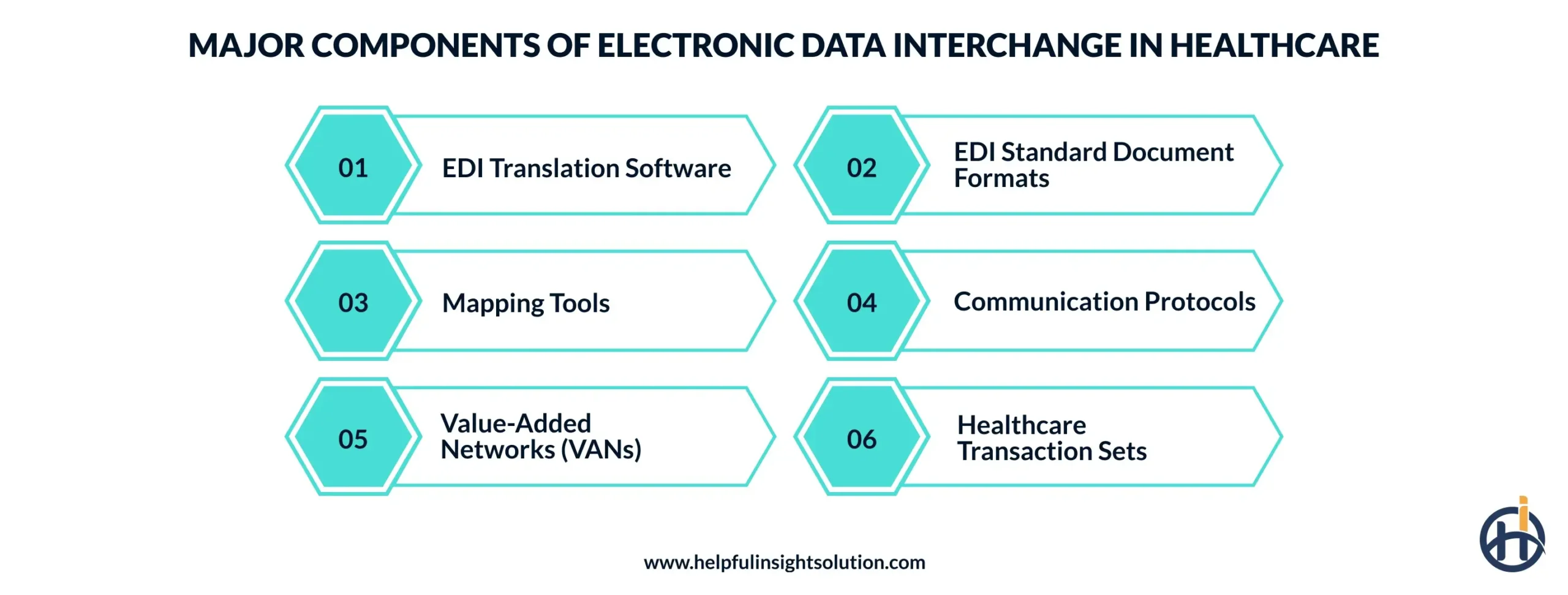
1. EDI Translation Software
It converts unstructured data, like spreadsheets and EHR documents, into standard EDI formats that ensure secure transmission. The HIPAA EDI software solutions enable automated processing of patient queries and authorization requests that improve operational efficiency.
This component allows seamless communication between various healthcare systems.
2. EDI Standard Document Formats
They are structured and secure digital transaction sets that machines can easily read, which include ANSI X12 as a primary entity. The essential EDI functions in healthcare operations involve NCPDP and HL7, which are used for drug management and processing lab reports.
These formats help to increase the rate of payment cycles, improve cash flow, and reduce errors.
3. Mapping Tools
The mapping tools help in linking the internal healthcare data with EDI formats, like EDIFACT, for secure communication and data validation. They provide a graphical interface that uses the drag-and-drop method to map source and target fields.
With EDI adoption in healthcare, various solutions like XMLSpy and PilotFish are offering this mapping facility.
4. Communication Protocols
These are the standard rules, which include AS2, SFTP, and SOAP, that ensure safe data transfer, reduce costs, and prevent system errors. HTTPS is the best EDI connectivity for hospitals, used in web-based applications for secure transmission, and is integrated with dynamic APIs.
This ensures reliability and allows different healthcare systems to easily exchange data.
5. Value-Added Networks (VANs)
This is a secure, private, and third-party facility that can manage data translation, security, and routing to ensure HIPAA compliance.
The use of VAN-based EDI in the healthcare industry helps to provide advanced monitoring, error notification, and onboarding services. It is a 24/7 electronic mailbox, where patients can send, receive, and translate their information.
6. Healthcare Transaction Sets
In EDI medical systems, these transaction sets are used for various tasks, like claim processing, payments, administration, and eligibility. For example, 837 is a claim submission set, 270 is an eligibility inquiry set, and 834 is a maintenance set.
They allow healthcare providers to increase accuracy, enhance productivity, and ensure security compliance in real-time.
Various Types of EDI Transactions in Healthcare
The use of electronic data interchange in healthcare is to perform various transactions for compliance, supply chain, and patient care. You will understand the major transaction types in this section that are commonly used.
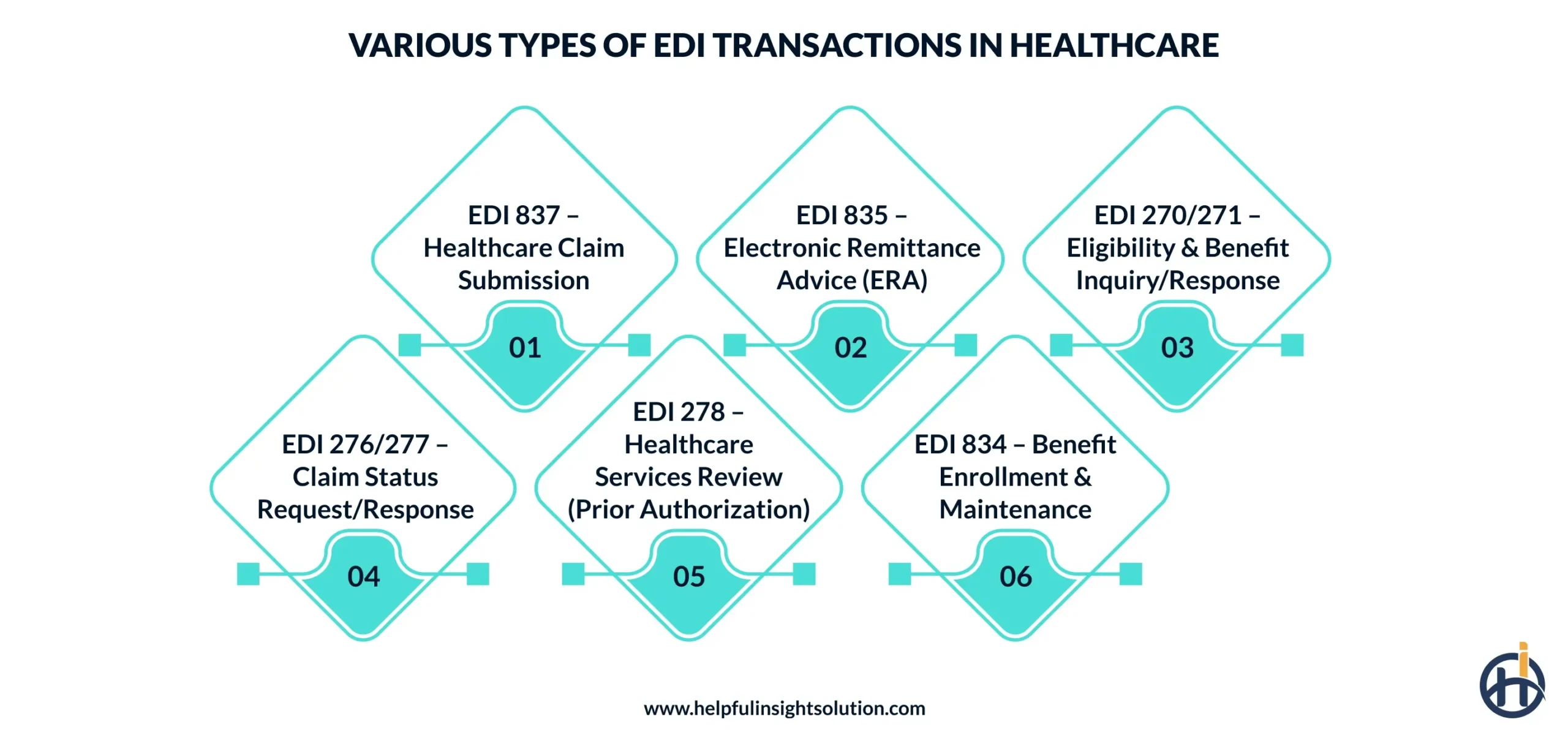
1. EDI 837 – Healthcare Claim Submission
It is a HIPAA-compliant electronic transaction that is used to submit insurance claims for processing. These EDI transactions in healthcare transmit patient medical history, diagnosis data, and services like ICD codes. It involves various professional, institutional, and dental formats that target different healthcare providers.
- The providers send a request to the payers through this claim submission set.
- It contains different levels of claims for billers, subscribers, and patients.
2. EDI 835 – Electronic Remittance Advice (ERA)
This is one of the most widely used X12 medical EDI transactions that allows insurers to send payment details and status information to hospitals.
It helps to understand the processing and delivery of various healthcare claims. Additionally, it also reduces manual posting and supports automation by providing a trace number to match with EFT.
- The components are claim information (CLP), service lines (SVC), and remark codes (RARC).
- It is a parallel channel that is used in revenue cycle management and acts as a payment side.
3. EDI 270/271 – Eligibility & Benefit Inquiry/Response
It is a pair of HIPAA EDI transactions that automate healthcare insurance verification, where EDI 270 sends a request, and EDI 271 generates a response. They include the patient’s coverage status, active claims, deductions, and payments.
The 270 protocol is used by hospital staff to check insurance activity, and 271 is used by agencies to verify claims.
- A functional acknowledgement, EDI 999, is used to confirm the receipt.
- This reduces claim rejections, automates transactions, and improves patient experience.
4. EDI 276/277 – Claim Status Request/Response
These electronic data interchange healthcare transactions help to identify the current status, like pending or denied, of different claims. The EDI 276 is a request protocol that is generated after the 837 transaction set, and EDI 277 sends a response, showing the claim status.
The 277 claim acknowledgement function works without 276 and provides automated responses.
- It improves efficiency by automating inquiries and avoiding manual website checks.
- This includes patient information and claim numbers for generating real-time status.
5. EDI 278 – Healthcare Services Review (Prior Authorization)
It comes under HIPAA 5010 standards that allow providers to request initial authorization for medical services and procedures.
The insurance payers generate a response based on patient scheduling and admission status. These EDI transactions for the healthcare industry are used for referring patients to different providers and authorizing clinical operations.
- The X12 standard systems will be shifted to FHIR-based healthcare platforms.
- It reduces paperwork, increases efficiency, and ensures faster treatments for patients.
6. EDI 834 – Benefit Enrollment & Maintenance
These healthcare EDI transactions act as a digital link between health plan sponsors, like government departments, and insurance agencies. It is used to automate health plan membership by introducing secure data exchange systems.
The core functions of EDI 834 are new enrollment, changes, statements, and termination, which are based on employee eligibility.
- Its components are the envelope segment, member-level detail, and health coverage.
- This allows fast claim processing, reduces human interference, and enhances scalability.
How to Implement EDI in Healthcare Platforms?
Here, businesses will know the process of integrating EDI in healthcare systems with a step-by-step approach. From market research to deployment, we are going to study each step with detailed information.
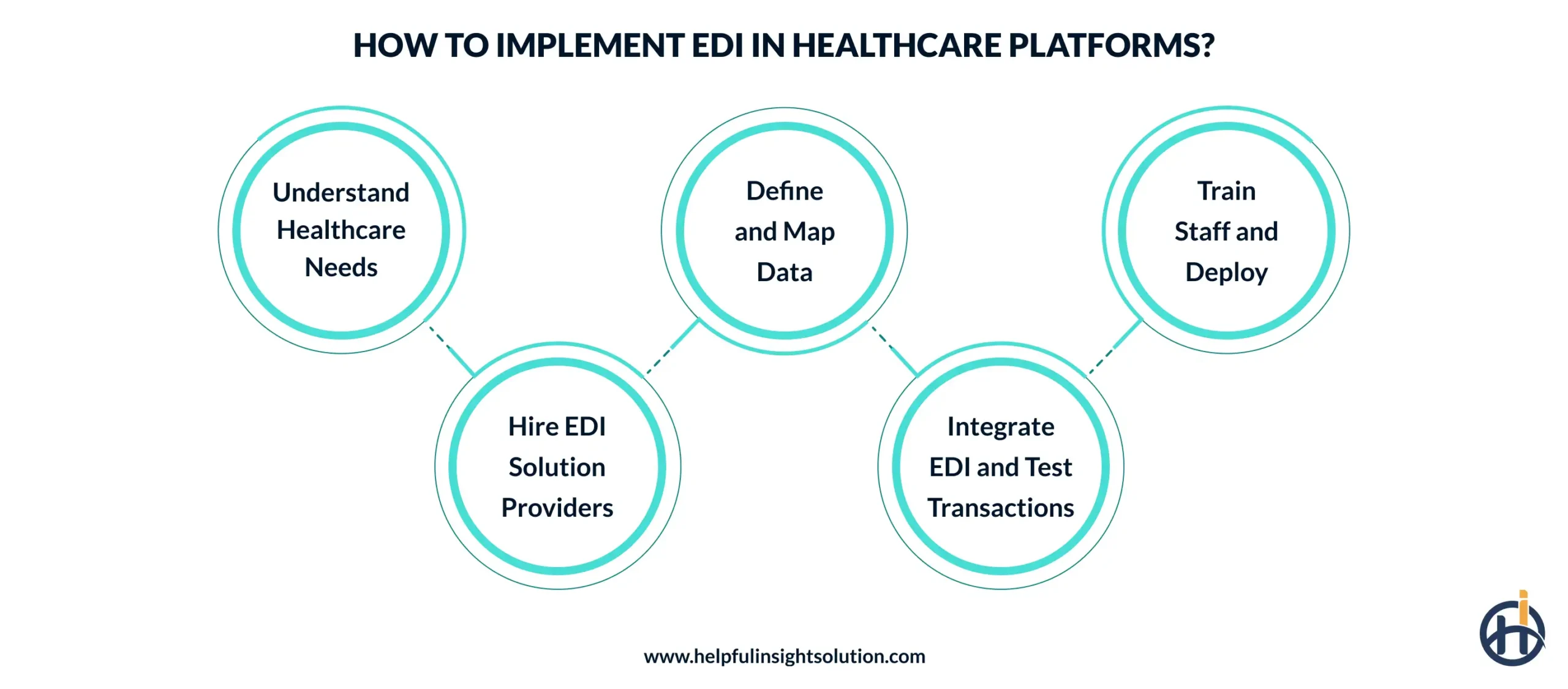
1. Understand Healthcare Needs
To implement EDI in healthcare software, you must know various requirements, like workflow efficiency, cost, accuracy, and compliance. Additionally, it is also necessary to find various EDI components and transaction sets that are used for different clinical operations.
You should identify user pain points and the target audience, such as payers, labs, and pharmacies, for creating an ecosystem.
2. Hire EDI Solution Providers
Businesses must hire the best talent from a reliable healthcare software development company that can connect medical systems with clearinghouses and transaction sets.
The experts must deliver secure solutions, managed services, and customized resources for EDI implementation in healthcare. Additionally, they must ensure medical compliance, EDI mapping, and system integration.
3. Define and Map Data
You can create a data-centric healthcare EDI solution by mapping internal EHR and billing platforms with external trading partners, which may decrease manual errors.
Various standards, like ANSI X12 and HL7, are mapped with transaction sets, such as 837, for claim processing. The information is collected from the database, and then it is processed with EDI elements based on the translation rules.
4. Integrate EDI and Test Transactions
The electronic data interchange systems in healthcare use various standards and protocols to automate EHR workflow, reduce costs, and ensure security. The experts follow syntax, compliance, functional, and end-to-end testing methods to detect issues at the initial stages.
This helps in real-time data exchange, assess system performance, and manage audit trails for various networks.
5. Train Staff and Deploy
By using AI & ML in electronic data interchange, experts can help businesses to train the medical staff and avoid inefficiency, errors, and complications.
It is important to focus on HIPAA compliance, X12 or HL7 standards, and functionalities that are used for exception handling. You should select a cloud-based platform that enables communication protocols like AS2 in EHR and billing systems.
Future of Electronic Data Interchange with Blockchain
It is highly beneficial to use Blockchain technology with EDI in healthcare solutions to improve data exchange. Some future trends are discussed in this section that are important for business investors.
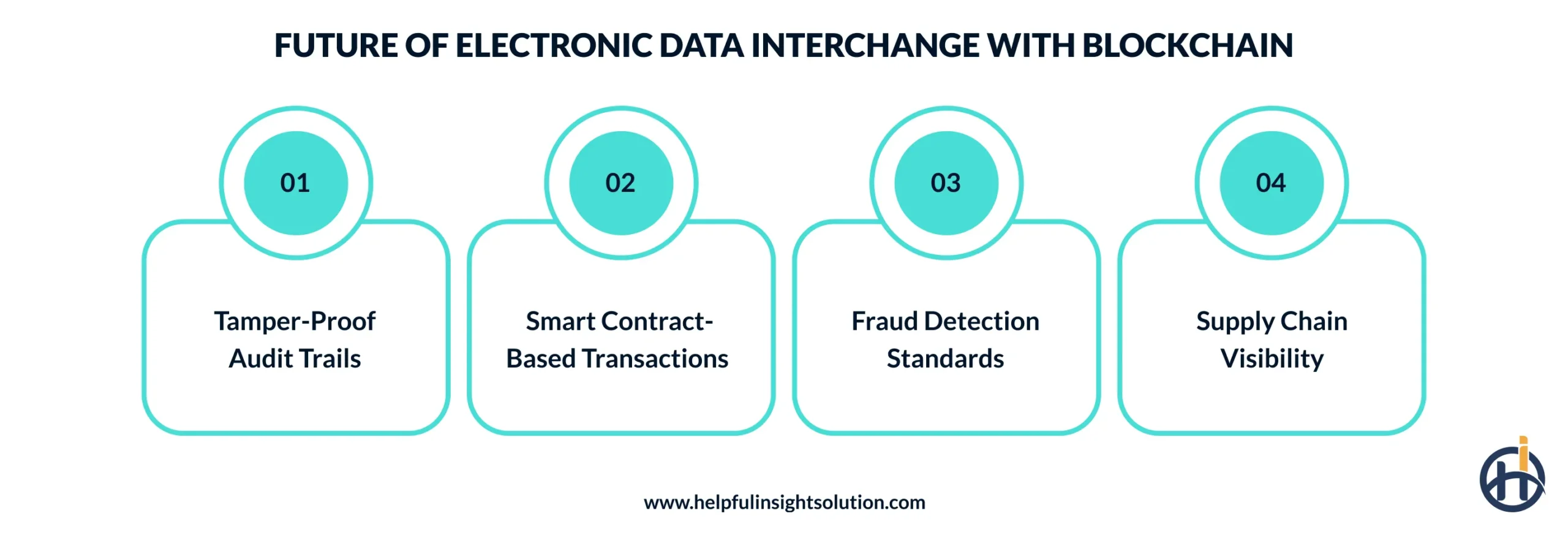
1. Tamper-Proof Audit Trails
The blockchain-based EDI systems in healthcare provide a decentralized database structure that prevents harm and unethical data access. The audit trails cannot be modified, which ensures trust and enables the integrity of digital clinical records through HIPAA standards.
2. Smart Contract-Based Transactions
The role of blockchain in electronic data interchange is to streamline claim processing and manage administrative tasks through smart contracts. It is a layer-2 blockchain technology that improves data security, transaction scalability, and patient record automation in real-time.
3. Fraud Detection Standards
Various AI-based innovations in healthcare allow medical professionals to easily detect fraud and prevent data theft in billing operations. An EDI solution provider uses clinical standards like ICD-10 with AI-driven models and Blockchain development services, such as Ethereum.
4. Supply Chain Visibility
Businesses should implement EDI in the healthcare supply chain to prevent unethical drugs and damaged clinical equipment from entering the medical ecosystem. The integration of IoT with standard blockchain networks enhances communication and increases response rate.
Let’s Summarize!!
As we have studied, the role of EDI in healthcare is to manage the transfer or exchange of medical data with security and transparency. So, it is highly beneficial to implement this technology in your clinical systems and improve their working efficiency.
You can hire dedicated developers from a renowned partner who know how to integrate and use the electronic data. Additionally, they must be aware of the challenges of EDI in the healthcare sector and provide solutions for them.
This guide to EDI in healthcare has explained everything, from benefits to modern blockchain-based innovations. Now, it is the right time to understand the existing problems in your healthcare systems, invest in the right company, and build an EDI medical platform.
This will ensure trust among patients and allow you to retain them easily by increasing data safety and protection.
FAQs
The implementation of EDI in the medical field is important as it automates data exchange between insurers and pharmacies in a secure manner. It helps to reduce administrative costs by 30% and increase clinical efficiency in real-time. Additionally, it speeds up claim processing and ensures standard regulatory compliance, like HIPAA.
The electronic data interchange system allows the exchange of patient information between different servers and devices. The working steps of EDI for healthcare are described in the following manner:
- First, the data is prepared and formatted according to the requirements.
- Then it is transferred to the clearinghouse through an encrypted channel.
- Now, the data is verified and checked for regulatory compliance.
- The data is now shared with the respective payer, such as an insurance agency.
- The payment is processed after the acknowledgement is received.
The EDI systems have a wide range of functionalities in the healthcare industry, which include secure data exchange and reducing manual paperwork. The key functions are managing claims, verifying patient eligibility, processing payments, and authorizing users. It follows several transaction standards for compliance, inventory, and patient management.
Yes, EDI ensures the security of patient data, such as medical records, prescriptions, lab reports, and appointments. It uses various encrypted channels, such as AS2, SFTP, or HTTPS, for secure data transmission. Additionally, it uses standard formats, like ANSI X12, with HIPAA regulations to ensure authenticity and prevent data breaches.
The integration of EDI in the healthcare systems is a necessary but complex procedure due to the high sensitivity of data. Some of the major challenges are discussed as follows:
- Most businesses work on traditional IT systems that are not compatible with modern standards.
- The mapping of business data is time-consuming and may deliver various technical errors.
- The cost of EDI integration in the medical systems is very high due to advanced functions.