

Key Takeaways:
- The market of health collaboration systems is growing rapidly across the world, generating more than $5 billion in the next half-decade.
- Advanced clinical communication tools provide services for patient management, staff scheduling, and teleconsultation.
- They reduce manual tasks, administrative load, and delays, improving the accuracy and security of healthcare systems.
- Various tools like Doximity, Luma Health, and TigerConnect are used for handling different medical operations in a hospital.
Every industry worldwide requires efficient communication between the providers and the users. Think of a healthcare venture where patients are not able to connect with doctors or clinical staff.
They cannot book appointments, get insurance claims, or undergo instant therapies due to constant human intervention. Here, the need for creating healthcare communication platforms arises to ensure patients’ trust, increase their experiences, and enhance medical workflow efficiency.
The advanced communication systems for healthcare providers are used to streamline telemedicine services, patient management, staff scheduling, and claims processing. The RIS system segment has a market share of 58.4% because of integrated services like PACS and EHR. This helped modern startups and existing enterprises to start with new technologies and innovations.
This blog tells about various things, like benefits, features, processes, and the cost of making a secure medical messaging app or software. A business investor must go through each topic for better understanding and growth.
Understand the Healthcare Communication Market
As you know, healthcare is a vast industry that allows businesses to invest and make consistent profits through healthcare revenue cycle management. Before moving forward, let’s understand some key aspects that determine the growth and increased ROI for entrepreneurs.
- In 2025, the medical communication market revenue was $2.9 billion, with North America having a 38.2% market share.
- By the end of 2030, the overall volume will rise to $5.3 billion, as the market is growing at a rate of 13% CAGR during this period.
- In this market, the software segment has a share of 65% in the market, and healthcare providers have 56.5% share in the end-user segment.
- The Asia Pacific region is growing rapidly at a rate of 18% CAGR, where cloud-based solutions have a 44.1% market share.
- The USA market revenue is $0.6 billion in 2026, which will reach $1.6 billion by the end of 2035 at an 11.4% CAGR rate.
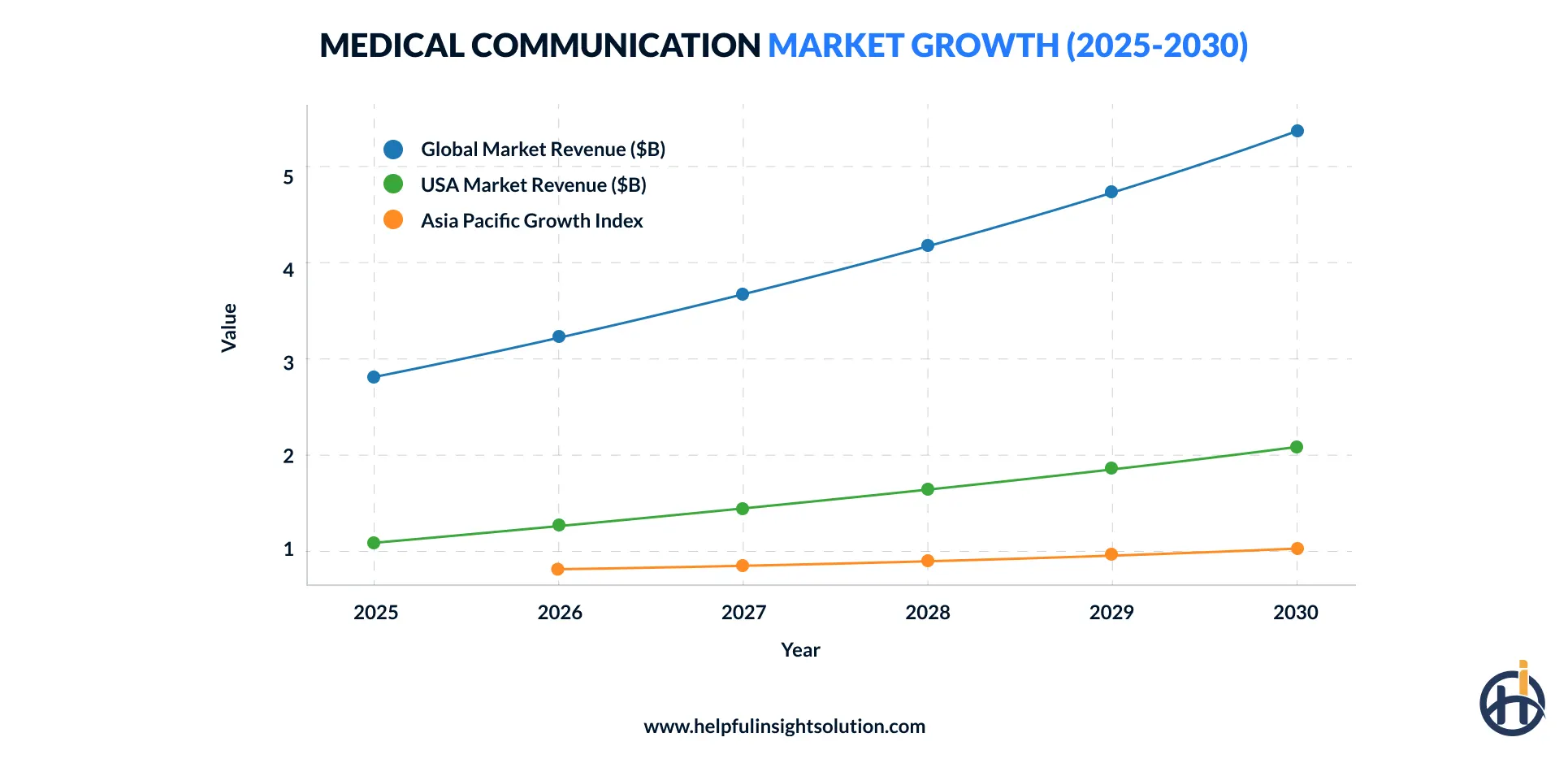
You can create communication and collaboration platforms to streamline healthcare systems, as the market is growing rapidly across the world. Additionally, there is a lot of scope for all types of medical enterprises in this segment to become an industry leader.
What are Healthcare Communication Platforms?
The healthcare communication platforms are mainly used in hospitals or clinics to ensure smooth communication between doctors, medical staff, and patients. They are highly secure and HIPAA-compliant, improving care coordination and enhancing patient engagement. These clinical tools streamline workflow through voice/video calls, integrated EHRs, and instant messaging.
Businesses use healthcare management software that provides automated alerts on appointment bookings, medical scheduling, and claims processing. This reduces time consumption, improves data routing, and caters to patient urgency.
- These platforms believe in workflow automation and increasing response rate.
- They deliver teleconsultation services with enhanced medical communication.
- It is easy for hospital staff to reduce operational expenses with this software.
Business Benefits of Clinical Communication Software
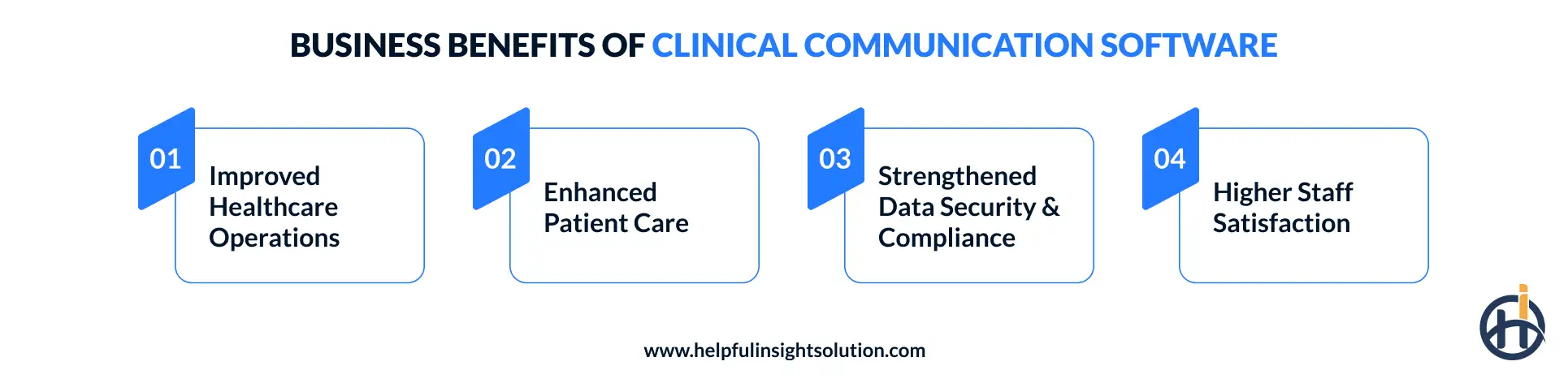
Businesses must know the benefits of healthcare patient communication platform to increase user trust and experiences. It helps to manage various medical tasks, improve care, and deliver security to patients.
1. Improved Healthcare Operations
The healthcare communications apps deliver real-time messaging features with enhanced care coordination that reduce administrative loads. They offer patient safety through healthcare compliance, which improves clinical decision-making.
2. Enhanced Patient Care
The use of IoT in healthcare coordination platforms helps medical experts to track patients’ data, such as heart rate, blood pressure, and sugar level, through EHRs. These tools allow two-way messaging that ensures instant response and quick recovery.
3. Strengthened Data Security & Compliance
Businesses can integrate healthcare communication software development services to ensure security, compliance, and privacy for users. By using encryption methods and role-based access, they can enhance overall experiences and trust in real-time.
4. Higher Staff Satisfaction
In a hospital, these coordination platforms create a balance between doctors and medical staff, like nurses, machine operators, and lab experts. This improves clinical efficiency as they can easily focus on personalized patient care through virtual chats.
Key Features of a Medical Communication Platform
The patient communication platforms offer multiple features, which include clinical notifications, telehealth, and more. They enhance patient experience and optimize clinical operations in real-time.
1. HIPAA-Compliant Messaging
Various communication platforms based on HIPAA compliance protect patient information through encryption. It minimizes the risk of data breaches, enhancing healthcare communication legally.
2. EHR/EMR Integration
The integration of AI in EHR systems allows data access to patients within the communication platform. This reduces manual data entry, improves clinical decision-making, and ensures updated information.
3. Real-Time Medical Alerts
The real-time medical systems notify healthcare providers about critical patient updates, lab results, or emergencies. This can reduce response times and enhance patient safety in high-risk clinical situations.
4. On-Call Scheduling Integration
Different patient communication platforms provide staff scheduling systems, ensuring instant messaging and alerts. It improves coordination, reduces confusion, and ensures continuous patient care coordination.
5. Telehealth & Video Conferencing
A patient-doctor communication app with telehealth features allows doctors to conduct virtual consultations. This enhances accessibility, reduces physical visits, and supports remote healthcare.
6. Secure Data Sharing
This feature enables the transfer of medical files, images, and reports using encrypted channels. It ensures that sensitive information remains protected during data exchange within healthcare teams or networks.
7. Audit Trails & Analytics
A doctor communication app tracks all activities, providing patients’ medical records based on analysis. Analytics tools help doctors to monitor performance, identify inefficiencies, and ensure compliance.
8. Device Interoperability
It ensures that the platform can connect and communicate with various medical devices and systems. This enables secure data exchange, better monitoring, and improved integration within the healthcare ecosystem.
How to Develop Healthcare Communication Software?
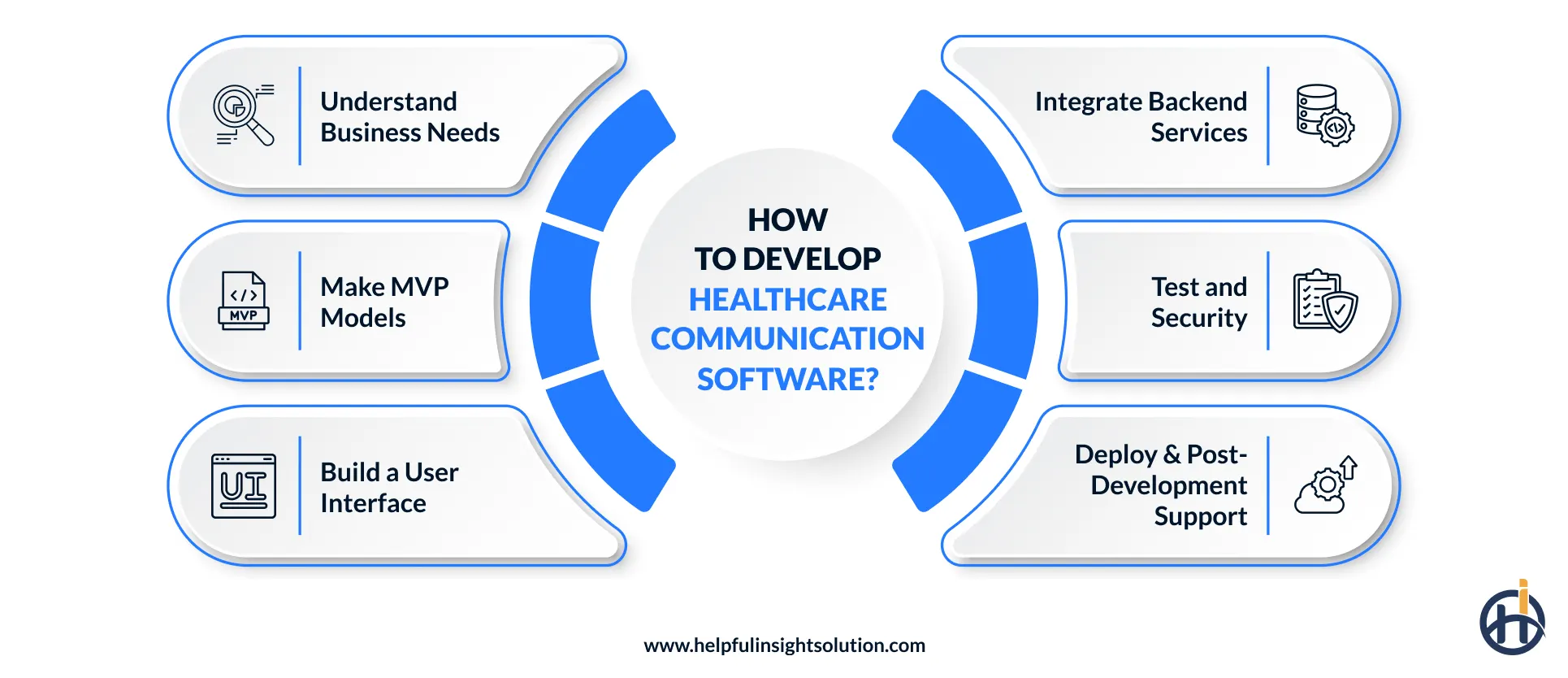
To create the top clinical communication systems, you need to follow a dedicated development process. Here, the commonly used steps, from planning to deployment, are discussed with detailed information.
1. Understand Business Needs
The first step includes the study of various topics, like business needs, current trends, user pain points, and technical innovations. To build a healthcare communication platform, you must identify the target audience, such as hospitals, clinics, or medical professionals.
It is necessary to plan the budget and resources before investing in the industry, enhancing overall platform efficiency, scalability, and security.
2. Make MVP Models
You should build prototypes of collaboration systems that help in identifying core medical features, technical stacks, and software frameworks. A healthcare software development company delivers advanced services, from consulting to maintenance, which ensure transparency.
An MVP allows businesses to easily reduce exceeding costs through platform assessment, feature optimization, and role-based healthcare job scheduling.
3. Build a User Interface
An engaging healthcare collaboration platform helps businesses to easily attract patients through smooth navigation, seamless page scrolling, and interactive themes. For mobile platforms, experts use various frameworks, like Flutter, which is affordable due to cross-platform services.
Web platforms require different JavaScript libraries, such as React.js, that include key functions, which help in user interface design with attractive elements.
4. Integrate Backend Services
It is crucial for an entrepreneur that a healthcare communication software development company ensures smooth backend integration with advanced tools. These include RESTful APIs, securely accessible databases, and centralized cloud-based solutions.
In most cases, runtime environments, like Node.js, are used to manage requests between the server and clients, ensuring enhanced communication and data sharing.
5. Test and Security
Businesses need to focus on platform testing to understand various system errors by implementing load, usability, penetration, and unit testing methods. Additionally, it is necessary to report these technical issues to security experts who can implement various encryption standards.
Some of the common measures include AES, role-based access control, HIPAA compliance, MFA, and OAuth 2.0 that target different segments for data protection.
6. Deploy & Post-Development Support
Now, your doctor-patient communication software is ready for beta testing, that help in gathering user feedback on performance, efficiency, and security. To resolve these issues, businesses implement maintenance services that include bug fixing, version updates, and feature optimization.
This task is important, ensuring regular upkeep of the medical communication tool, increasing patient trust, enhancing care coordination, and reducing manual tasks.
Top 5 Medical Collaboration Tools
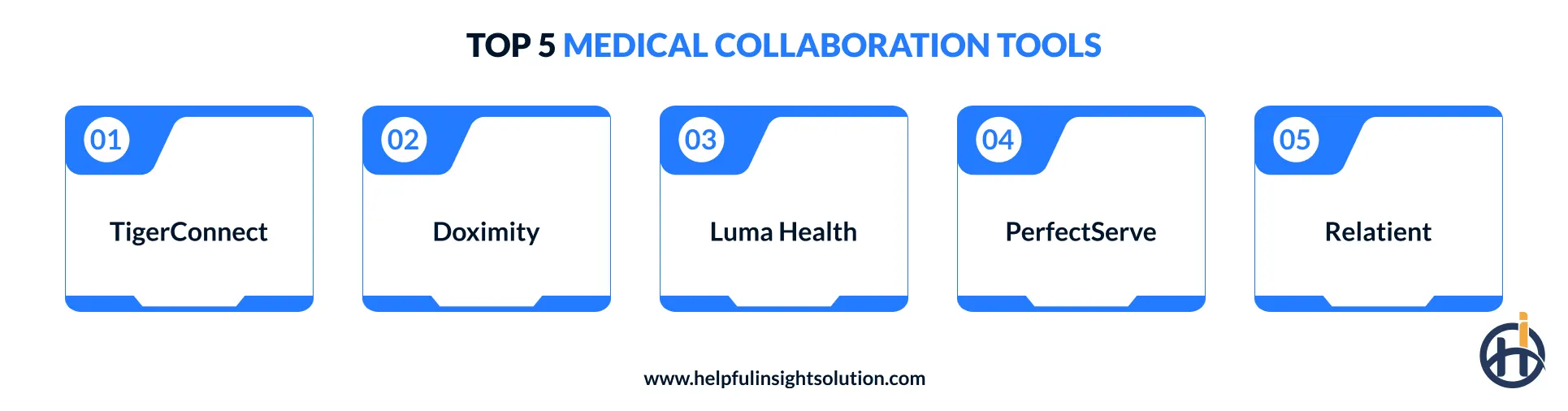
In this section, we will study the best clinical communication platforms for healthcare that deliver exciting features. They allow doctors and patients to connect easily through advanced and secure services.
1. TigerConnect
It is a HIPAA-compliant platform for communication between doctors and patients that offers EHR integration and messaging. This tool provides a web portal for patient engagement, generating automated alerts and managing schedules.
2. Doximity
This clinical communication and collaboration software provides a dialer that manages calls, a scribe for reporting, and a GPT for medical assistance. It is the most widely used service that enhances communication and documentation in real-time.
3. Luma Health
Luma Health is a patient-physician communication platform that provides a Collaboration hub, Spark AI, and Workflow Builder to manage tasks. It integrates with EHR and imaging systems to track patient data and process information through automation.
4. PerfectServe
For electronic data interchange in healthcare, PerfectServe is the best tool that provides secure messaging, call routing, and patient management. Additionally, it also manages the scheduling of doctors with automated notifications and alerts.
5. Relatient
Relatient is a medical communication software that integrates with EHRs to manage appointments, lab reports, and online prescriptions. It uses AI voice agents that communicate with patients and understand their issues, generating real-time solutions.
What is the Cost to Build Software for Healthcare Communication?
The healthcare communication software development cost is a variable entity and is dependent on various market factors. These include budget specifications, security charges, integration needs, and design complexity.
There are some hidden factors, like maintenance and platform hosting, which influence the overall rate for businesses. Each cost-affecting factor varies according to the business requirements, allowing the cost to increase or decrease accordingly.
For example, if an entrepreneur hires experts from Western countries, like the USA, the total cost may increase due to the expensive development resources.
It is beneficial to use a cost calculator to estimate the right cost, as it considers different elements for accurate estimation. Here, some key factors are discussed that are important for market investors.
Feature Complexity: Some advanced features, like EHRs and medical imaging, increase the overall cost of a medical communication tool.
Security & Compliance Cost: As platform security is important, the use of advanced encryption standards expands the total charges.
Healthcare Integration: Various technologies, such as IoT or Blockchain, use complex and expensive methods to track patient activities.
Expertise of Developers: Businesses can hire senior experts to develop professional medical tools that ensure complete support, but they are expensive.
Future Scope in Healthcare Coordination Software
The modern clinical communication systems will experience technical advancement in the future. Some of the most important innovations are discussed that an entrepreneur must know before investing.
1. Agentic AI Systems
Businesses must implement AI in healthcare coordination platforms to revive disconnected systems through automation and predictive analytics. This technology uses conversation models to develop dedicated agents for patient care in a healthcare ecosystem.
2. Bidirectional Interoperability
A communication system for healthcare allows data exchange between different users, such as doctors, hospital staff, patients, and pharmacies. Generative AI and machine learning processes patient information through various sources, like EHRs, wearables, and labs.
3. Proactive Healthcare Monitoring
Various connected systems can easily track patients’ data through the Internet of Medical Things and use AI models to analyze different patterns. With predictive analytics, it is easy to deliver accurate healthcare recommendations and ensure patient safety.
4. Personalized Patient Engagement
Users may connect with expert doctors through a clinical communication and collaboration platform that offers advanced personalization features. Through automated notifications and voice assistants, it becomes easy to discuss various medical issues and get remedies instantly.
Choose Helpful Insight for Healthcare Communication Software Development
If you want to channelize your business growth by improving communication between the clinical staff and patients, then it is beneficial to make healthcare communication platforms. You need a reliable and experienced partner who can ensure platform security, smooth integration, and effective development.
We help businesses to hire dedicated developers who are skilled with advanced tools, technologies, and frameworks. Additionally, they create a collaborative environment to build healthcare platforms.
You can deploy software or apps for patient-doctor communication, delivering secure messaging and teleconsultation features. Now, patients can easily get on-time prescriptions, therapies, and treatments without standing in a long queue.
So, you must invest in a medical information exchange system to boost business scalability and revenue, impacting a global audience.
FAQs
A platform for medical collaboration allows healthcare teams to connect with patients through secure features. The working of clinical communication tools is described in the following manner:
- The mobile or software system allows medical professionals to share data.
- It uses EHR to access patients’ records to schedule healthcare appointments.
- Users can connect with healthcare experts and discuss various problems.
- These tools allow messaging for urgent use cases and delayed chats.
- The medical teams can easily study reports and analyze symptoms.
On average, the maintenance cost of digital healthcare collaboration systems ranges from 15-20% of the overall development charges. It is dependent on various factors, which include bug testing, feature enhancements, and performance analysis. The cost of maintenance is between $15,000 and $20,000 for a project of $100,000, which may increase due to additional needs.
The timeline for creating a tool for clinical communication is affected by multiple parameters, such as the development process and business requirements. The duration for a simple platform with basic functionalities, like messaging, may range from 3 months to 6 months. The overall time may increase to 12 months or more due to advanced EHR integrations.
The advanced health management tools implement a multi-layered security approach, which includes encryption, access control, regulatory standards, and audit trails. HIPAA compliance, role-based access, MFA, and AES are some common security measures that businesses use. They ensure data privacy, transparent file sharing, and the prevention of cyber attacks.
Artificial intelligence helps to automate various administrative tasks, which reduces manual tasks and enhances overall healthcare workflow efficiency. It uses NLP and conversational models to understand complex patient issues and provide better solutions. Additionally, it helps to predict the revenue cycle for business growth and user engagement.