


How does a hospital manage increasing patients, insurance claims, and appointment scheduling? With healthcare revenue cycle analytics, all these tasks become easy and fast, allowing businesses to focus on revenue management.
Additionally, it monitors various medical operations and EHRs to predict the right model that boosts business growth. More than 90% of healthcare premises in the USA have adopted advanced AI-driven predictive analytics for data tracking.
This is the importance of revenue cycle analytics in healthcare, which helps investors to resolve existing issues and improve the delivery of services. It can be integrated with cutting-edge technologies, such as IoT for data gathering and cloud for secure sharing. You must know about these growing health analytics trends before implementing them in the systems.
Here, you will study various topics, like challenges, benefits, features, and development of analytics software for healthcare. It’s time to ensure a dedicated path to your success and lead the market with improved patient and revenue management.
What is Healthcare Revenue Cycle Analytics?
It is a structured process to track, analyze, and optimize the healthcare payments of a patient with real-time services. The system monitors tasks from appointment booking to final payment, enhancing cash flow and reducing claim denials.
With hospital revenue cycle analytics, it is easy to verify insurance and review medical coding, which decreases the gap between users and EHR systems.
AI is the main technology that predicts claim approvals or rejections, personalizes patient experiences, and automates clinical operations. An interactive dashboard with engaging UI/UX design provides enhanced visualization with data tracking.
- It helps in tracking various healthcare processes like consultation and therapies.
- The system provides multiple KPIs based on patients’ data, like claims and assets.
- To reduce administrative loads, the software integrates with advanced EHR platforms.
Insights for Healthcare Revenue Growth
For end-to-end revenue cycle management in healthcare, businesses must know the growth of this industry by studying various aspects. Here, we will discuss the key market statistics that provide a broader view of the business revenue, ROI, and user adoption.
- The healthcare analytics market revenue is $36 billion in 2026, which will reach $262.5 billion by the end of 2034.
- This sector is growing at an increasing rate of 28.2% CAGR, with North America having the maximum share of 49% in the market.
- In 2026, the medical revenue cycle market is $225.7 billion, and it is growing at a whopping rate of 12.1% CAGR between 2026 and 2034.
- At the end of this tenure, the revenue will reach $570.8 billion, with integrated systems having 82% market share.
- The USA’s market value is $81.3 billion in 2026, which will reach $207.1 billion by 2034 due to various healthcare IT innovations.
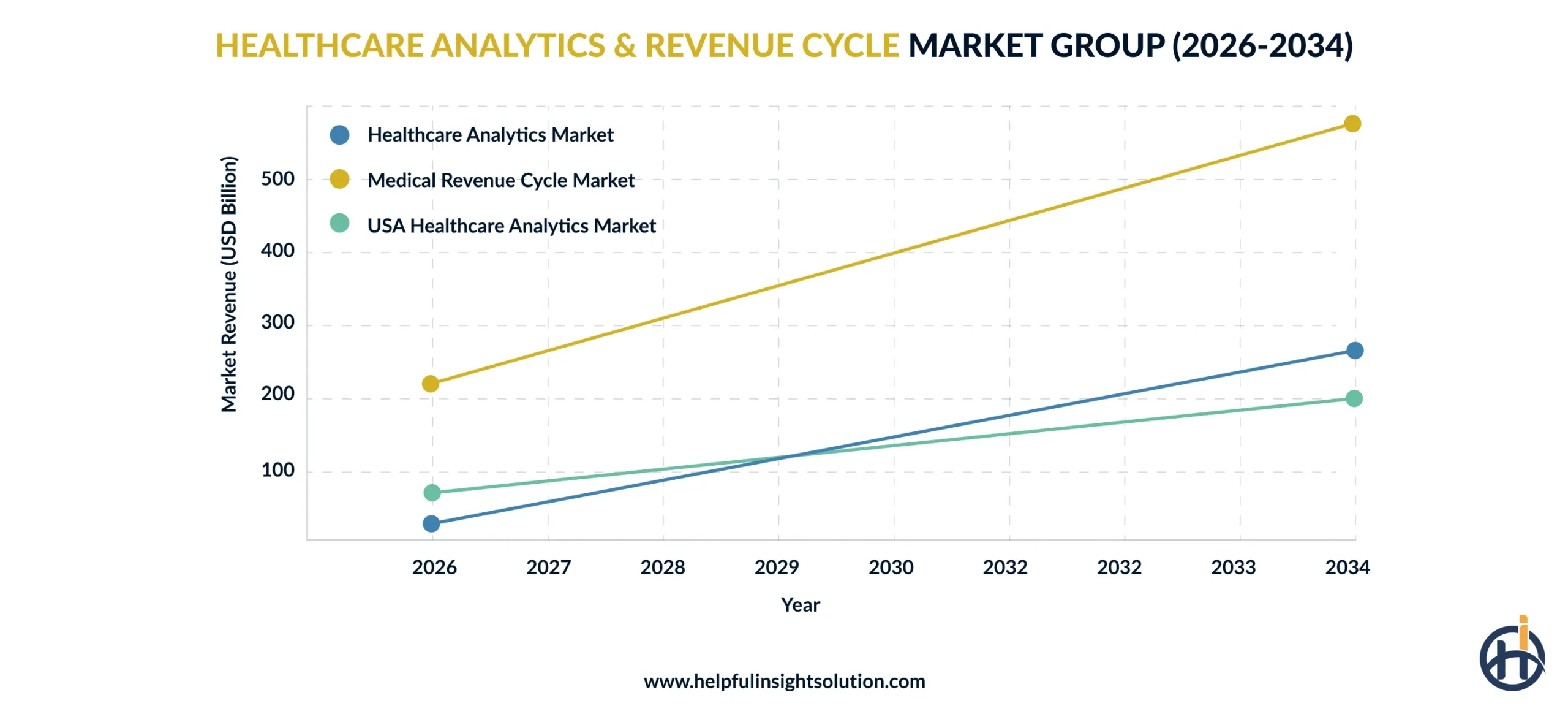
These figures will encourage businesses to streamline insurance claims, medical billing structures, and payment management. They can implement advanced technologies, such as AI and IoT, for better efficiency, accuracy, and scalability of the systems.
Challenges with the Analysis of Healthcare Revenue Cycle
There are various analytical challenges in healthcare revenue cycle management, which include insurance claims and medical data. A few data risks are discussed in this section with their respective solutions.
1. High Volume of Claim Denials
The main cause of these challenges is the lack of authorization, coding inaccuracies, and patient eligibility issues. Additionally, inadequate information leads to model failure, increasing unethical requirements.
Solution: An automated screening process is used by healthcare providers to check the eligibility of patients for insurance.
2. Exchanging Medical Data
It is difficult to convert clinical information into precise billing codes within a secure infrastructure. This affects data communication and medical workflow, increasing inconsistency for healthcare systems.
Solution: Integrated AI models are used that enhance RCM data analytics through predictive algorithms and generative transformers.
3. Adhering to HIPAA Compliance
High-volume healthcare data can be fragmented and insecure due to interoperability issues, such as network stability. It restricts the sharing of PHI because of unidentified financial audits and logs.
Solution: In hospitals, various HIPAA-compliant tools are installed that ensure secure data storage and transmission across systems.
4. Credentialing
Various issues like slow enrollment, staff workload, and complex regulatory requirements affect data analytics. This also influences the accuracy and data integrity, reducing the reliability of the system. Solution: Businesses have implemented advanced healthcare analytics solutions that verify healthcare data before registration.
How does Revenue Cycle Management Enhance Hospital Systems?
With healthcare revenue cycle analytics, businesses can improve cash flow, manage clinical errors, and reduce costs. Here, some of the major use cases are explained that you must follow to ensure user trust.
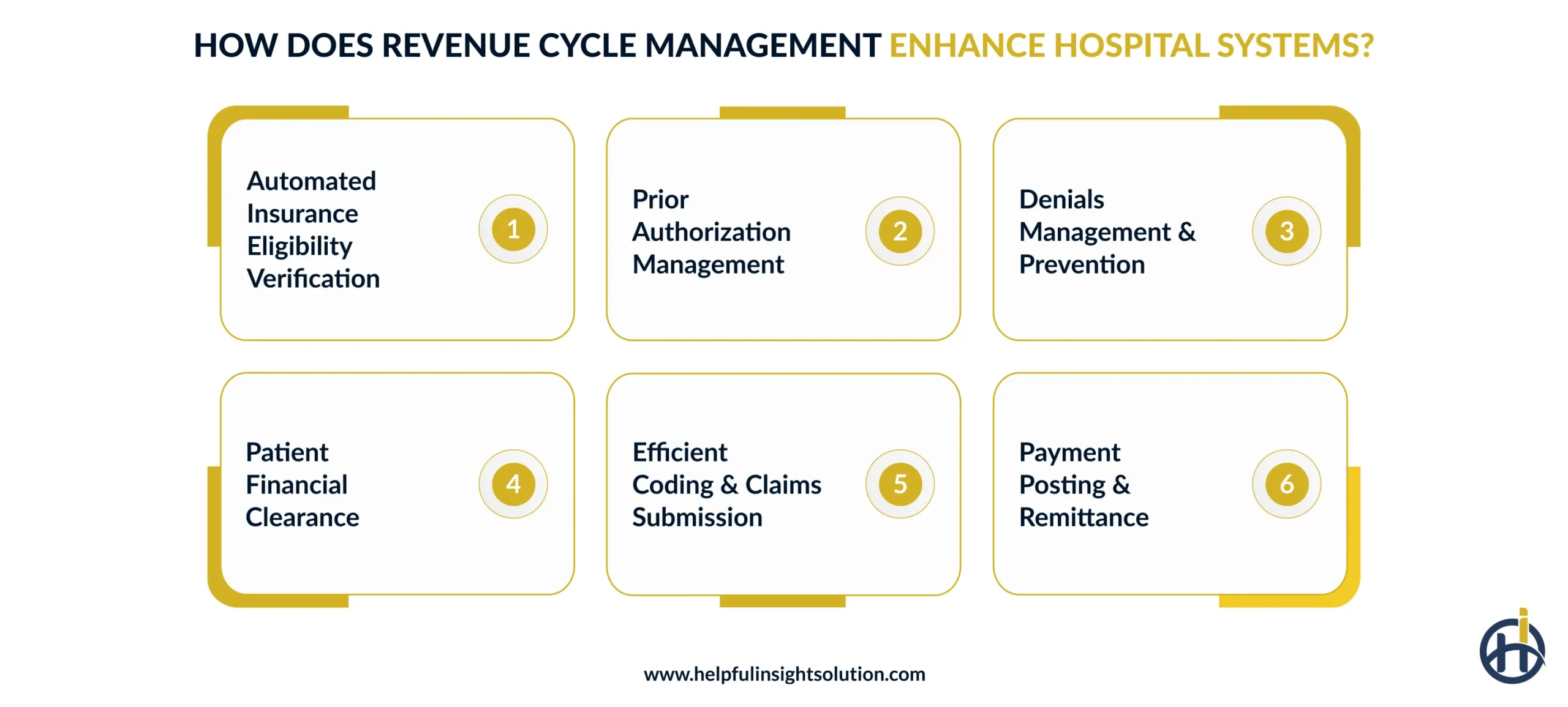
1. Automated Insurance Eligibility Verification
It uses various healthcare transactions, like X12 270/271, to verify the eligibility of the insurance based on several healthcare parameters. The system implements a request-response model with AI automation to reduce claim denials, boost payments, and manage staff schedules.
2. Prior Authorization Management
With RCM data analytics, businesses can deliver healthcare services by verifying insurance claims and securing approvals, which increases cash flow. The management system ensures the authorization of PHI through administration, data optimization, and compliance.
3. Denials Management & Prevention
The income management systems integrate with various frontend, clinical, and backend processes to enhance medical workflow and reduce expenses. It analyzes the root cause of claim denials and builds an automated model to prevent future financial risks.
4. Patient Financial Clearance
To enhance clinical efficiency and optimize point-of-service, the healthcare revenue analytics systems calculate insurance premiums by analyzing financial records. They streamline medical operations and improve billing cycles, avoiding unethical data sharing.
5. Efficient Coding & Claims Submission
It is beneficial to ensure electronic data interchange in healthcare systems for automated coding and instant claim submission, resulting in increased revenue. The clearinghouses help to review unsettled claims and check eligibility before releasing the amount.
6. Payment Posting & Remittance
Businesses can enhance hospital systems through medical revenue cycle analytics, which automate payments and Electronic Remittance Advice (ERA). The healthcare transaction EDI 835 is activated to track AR days and enhance the compatibility of EHR systems.
What Features Does Healthcare Revenue Cycle Analytics Software Provide?
A revenue cycle analytics platform delivers real-time features to track medical operations for revenue management. They help businesses to monitor payments, optimize audits, and manage EHR systems.
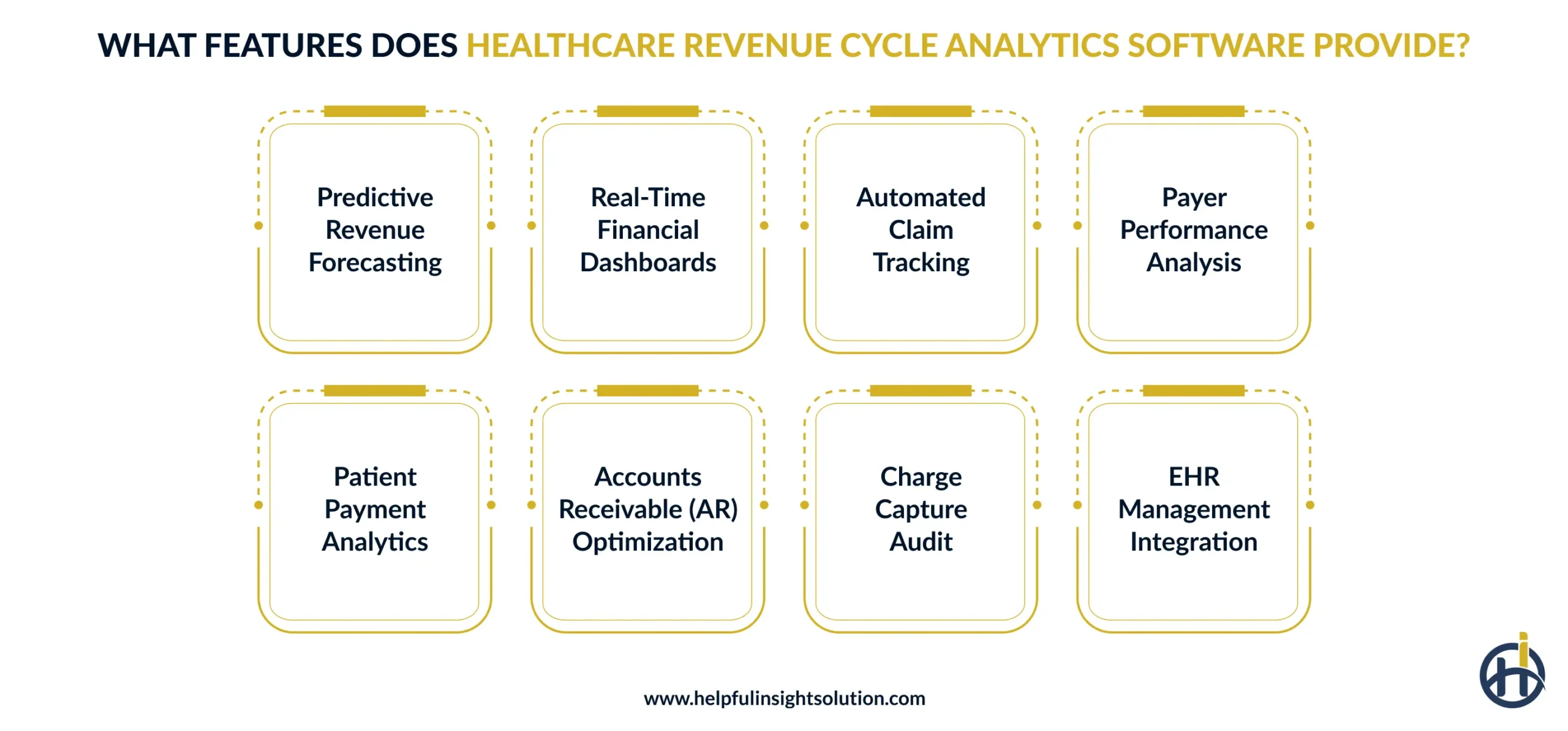
1. Predictive Revenue Forecasting
This feature helps hospitals to detect cash flow, manage payment delays, and optimize healthcare resources. The software tracks various parameters, which include claim rates and the overall yield.
2. Real-Time Financial Dashboards
A top-tier revenue cycle analytics software enables businesses to view healthcare KPIs, like collection rate. It analyzes denials and tracks financial status to predict services based on bills and demographics.
3. Automated Claim Tracking
An AI-powered software checks claim status, verifies eligibility, manages denials, and automates payments. It reduces errors, prevents delays, and boosts patient management within an EHR system.
4. Payer Performance Analysis
The revenue cycle performance analytics becomes easy with the tracking of a payer’s performance based on workflow. AI helps to judge the cause of denials, underpayments, and revenue blockage for patients.
5. Patient Payment Analytics
The agents can track payment delays and other KPIs through advanced data analytics in healthcare systems. They use risk modeling tools to predict the denial condition and set rules for automated appeals.
6. Accounts Receivable (AR) Optimization
An RCM analytics healthcare system uses AI to predict AR days and enhance cash flow, reducing system errors. It helps to fix complex billing issues by tracking the payer’s behavior and ensuring compliance.
7. Charge Capture Audit
A healthcare billing analytics platform provides coding validation and automated charges to compare clinical documents. The algorithms help to detect gaps based on the service volume and demographics.
8. EHR Management Integration
Advanced EHR platforms ensure financial visibility, automated coding, and claims processing, which reduces manual entries. This improves healthcare reporting, medical efficiency, and data accuracy.
Key Technologies for Healthcare Revenue Analytics
For healthcare revenue cycle management analytics, various technologies like AI are used with advanced services. They enable seamless data collection, processing, and execution through the latest integrated tools.
1. Artificial Intelligence (AI)
The use of AI in healthcare helps businesses to optimize revenue models through advanced generative and agentic AI tools. The implementation of AI in revenue cycle management for medical systems is beneficial due to advanced prediction and forecasting.
2. Internet of Things (IoT)
The Internet of Medical Things (IoMT) helps in gathering various data, like blood sugar and oxygen levels, through smart devices. Additionally, it tracks different healthcare shipments, such as medication, ventilators, and monitoring machines, enhancing data collection.
3. Cloud Computing
Various cloud platforms, like AWS, help healthcare providers store large amounts of data in a secure infrastructure with regulatory standards. These tools use cloud-native APIs and compliance, such as FHIR and HIPAA, enabling data exchange between EHR systems.
4. Robotic Process Automation (RPA)
The RPA technology uses highly trained bots, allowing businesses to access structured data that helps to automate clinical decisions in real-time. It improves revenue cycle analytics in healthcare systems through logical operations and pre-defined data models.
How to Build Healthcare Revenue Cycle Management Software?
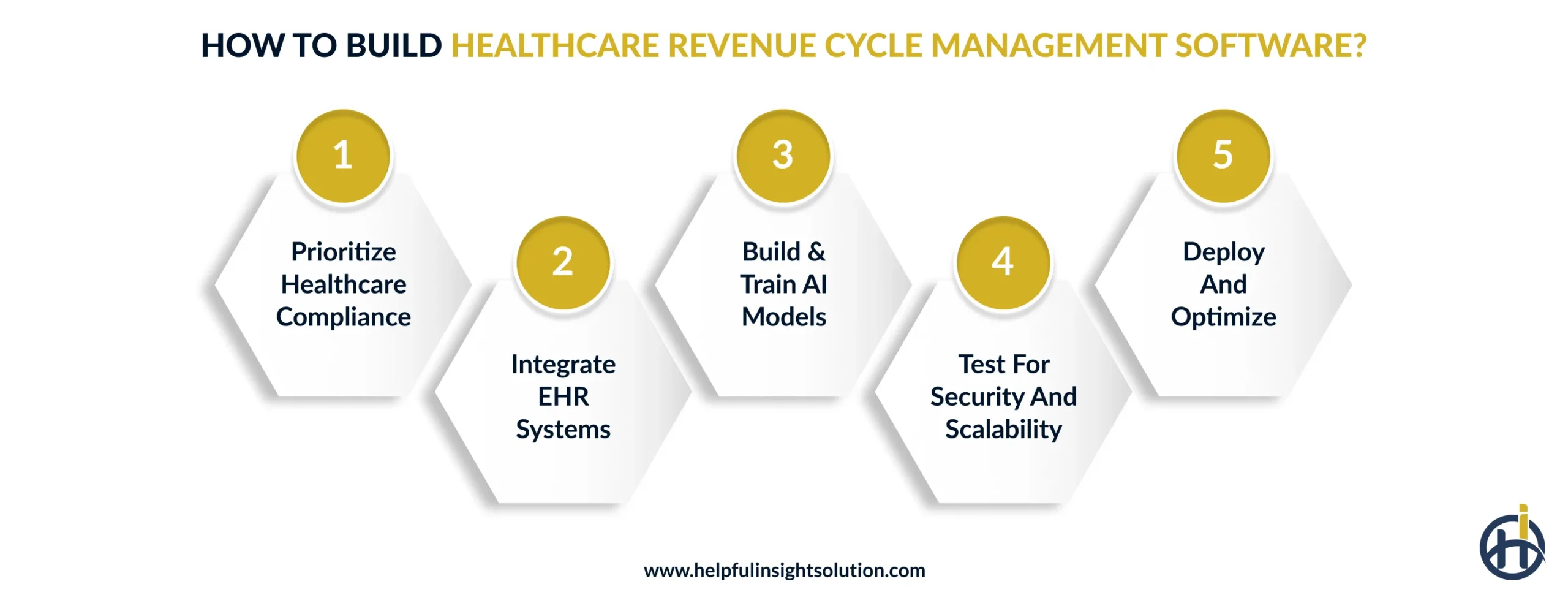
To create highly scaled revenue cycle analytics software, it is necessary to know various development stages. From planning to deployment, we are going to study every step with detailed information.
1. Prioritize Healthcare Compliance
The first development stage is to ensure various healthcare compliance, such as HIPAA, FHIR, and HL7, for data security and protection.
The healthcare analytics solutions must be safe for PHI, which stores sensitive medical information, like prescriptions and payments. So, it is important to follow different rules and regulations with data encryption standards.
2. Integrate EHR Systems
An analytical system monitors EHRs to predict revenue cycles, optimize clinical operations, and enhance patient management.
You can hire dedicated developers who have experience with integration services and access to advanced technologies. The EHR provides various information, such as lab reports, inventories, supply chain, and insurance.
3. Build & Train AI Models
The experts must create new AI models through generative, predictive, and agentic transformers to track various clinical tasks in real-time.
The use of predictive analytics in the healthcare revenue cycle helps businesses to target different healthcare parameters. It is crucial to train the existing models based on multiple human and machine data for automation.
4. Test for Security and Scalability
For better patient scheduling, billing, coding, and insurance, it is crucial to test the accuracy and efficiency of the transformative models.
This helps to predict the number of denials and the acceptance rate based on the behavior of payers and patients. Various methods, like RBAC and audit trails, are commonly used to ensure the security of the analytics platform.
5. Deploy & Optimize
It is crucial to map various healthcare workflows, deploy cloud-based services, and reduce denial rates. The importance of optimizing revenue cycle management analytics is high due to insurance verification, charge capture, and payment posting.
You must implement various rules, like ICD-10 and CPT, that ensure the protection of surgical methods and clinical services.
Why Choose Helpful Insight for Developing Revenue Cycle Management Software for Healthcare?
The future of healthcare revenue cycle analytics will be effective due to advanced technologies like machine learning and natural language processing.
You must be aware of these modern innovations to build the latest analytical models that boost revenue and ensure increased growth. It is beneficial to approach an experienced and reliable healthcare software development company that can implement effective services and provide affordable resources.
Businesses can develop modern healthcare analytics solutions or transform existing ones to reduce claim denials, enhance forecasting, and improve healthcare management.
This will ensure consistency in medical surgeries, medication, patient appointments, and staff scheduling. So, grab this opportunity right now and give your business a direction for automated growth.
FAQs
It is necessary to track patients’ financial records and medical status to optimize data collection, billing cycles, and insurance claims. You should measure various KPIs, which include patient eligibility, denial rates, accounts receivable, and automated tools. This strategy helps businesses to monitor payer performance, improve staff scheduling, and enhance user performance.
The software development cost for healthcare revenue cycle management is dependent on various market factors. These include feature/platform complexity, security requirements, and integration costs with advanced AI technologies. On average, the cost ranges from 40K to 200K, which may increase due to additional data models.
Artificial intelligence uses machine learning and predictive analytics to reduce claim rejections, automate payments, and optimize financial workflows. The technology prevents manual errors by using NLP models that ensure accuracy and compliance. It helps to forecast revenue, improve insurance claims, and enhance healthcare efficiency in real-time.
There are various AI-powered tools available to analyze complex healthcare financial data that offer the necessary features. Some of the best data analytics platforms are discussed in the following manner:
- Health Catalyst: It focuses on operational and financial tasks that support clinical revenue cycles.
- Arcadia: This tool specializes in risk analysis and value-based care, reducing costs and denials.
- Fusion Cloud EPM: It enhances medical efficiency through enterprise performance management.
This AI component analyzes historical data and uses ML algorithms to forecast claim approvals, coding errors, and reimbursements. It helps to identify various patterns, such as missing data, for raising high-risk claims before sending them to payers. This enhances healthcare transactions, allowing businesses to manage user traffic and improve collection rates.