

“Improve health data management by using artificial intelligence in EHR platforms.”
Nowadays, record management has become a hectic task for every healthcare professional across the world. In the USA, hospitals have more than 52% EHR market share, but the data handling issue is not resolved yet.
Only the integration of AI in EHR systems can help businesses to overcome the problem of managing protected health information. This technology can automate data entry, predict patient outcomes, and analyze medical information with high accuracy.
The use of advanced AI-powered EHR platforms has reached 70% in US hospitals for risk prediction, disease detection, and treatment planning. This is a huge advantage for businesses that want to innovate modern solutions to help patients and doctors.
To use AI-driven tools in their EHR system, they must know various use cases and challenges.
This blog brings the most valuable information for entrepreneurs who are looking to transform existing platforms. Through AI-powered EHR consulting and integration, it is easy to improve patient experiences. To understand more in detail, let’s move forward.
Market of AI-Powered EHR Solutions
A rise in the use of AI for EHR systems helped businesses boost their revenue, market growth, and returns on investment. This technology has improved healthcare services, such as data management, patient care, and the supply chain.
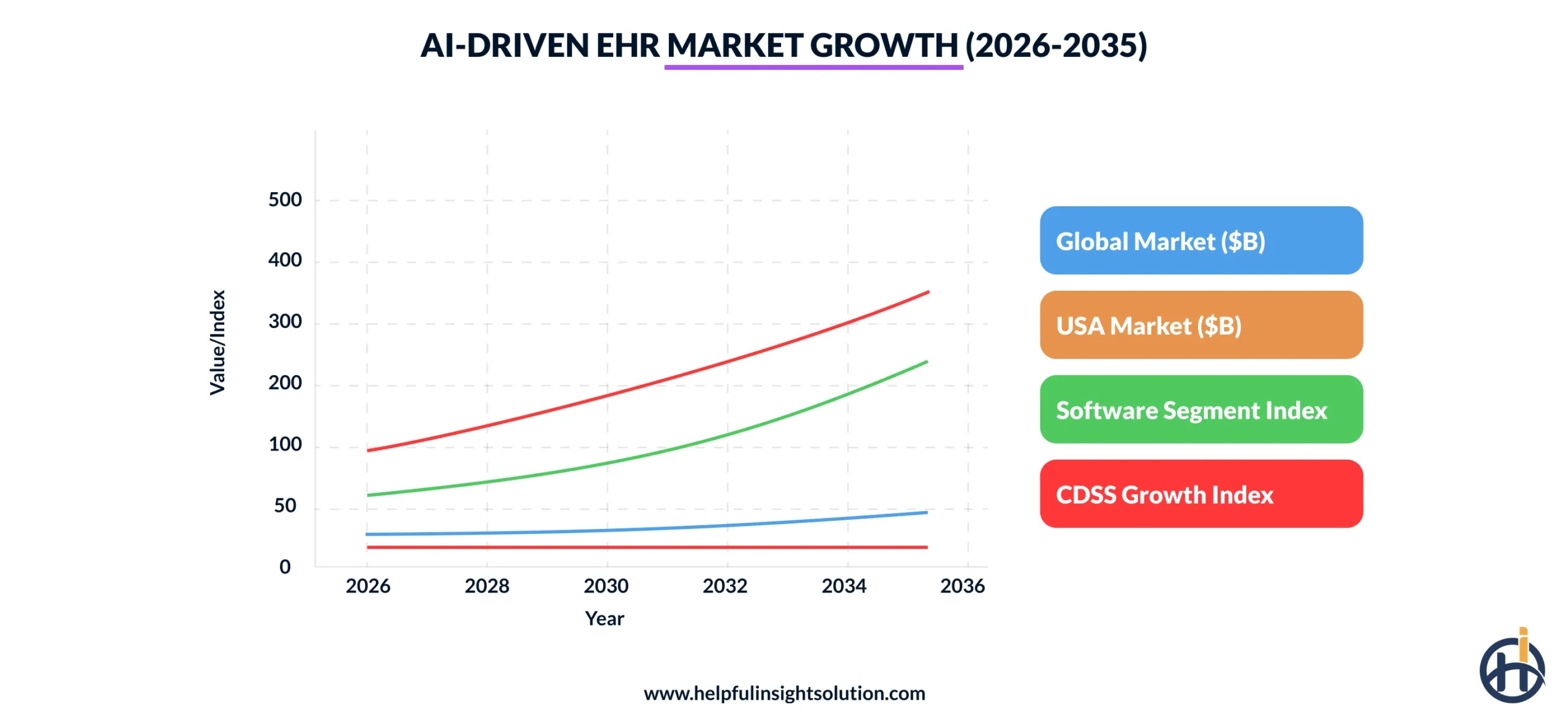
- The global AI-driven EHR market volume is $30.3 billion in 2026, with North America having 46%, or $12.1 billion, market share.
- By the end of 2035, the overall revenue will increase to $46.4 billion, as the market is growing rapidly at 4.9% CAGR between 2026 and 2035.
- The USA market is going to generate $9.8 billion in 2026, which will reach $15.3 billion by the end of 2035.
- The software segment has the largest market share of 61.4%, which is rapidly growing at 8.7% CAGR over this tenure.
- The clinical documentation holds 24.2% market share, where CDSS is growing rapidly at 9.5% CAGR between 2026 and 2035.
The idea of building AI-powered EHRs is beneficial for modern startups and small enterprises because this healthcare segment will grow rapidly in the future. Multiple opportunities will be available for business investors to create their own health record system.
How is AI Enhancing EHR in Healthcare?
Businesses are using artificial intelligence in EHR systems to predict healthcare risks, automate tasks, and generate faster responses. Some of the key AI benefits are discussed in this section that you must know.
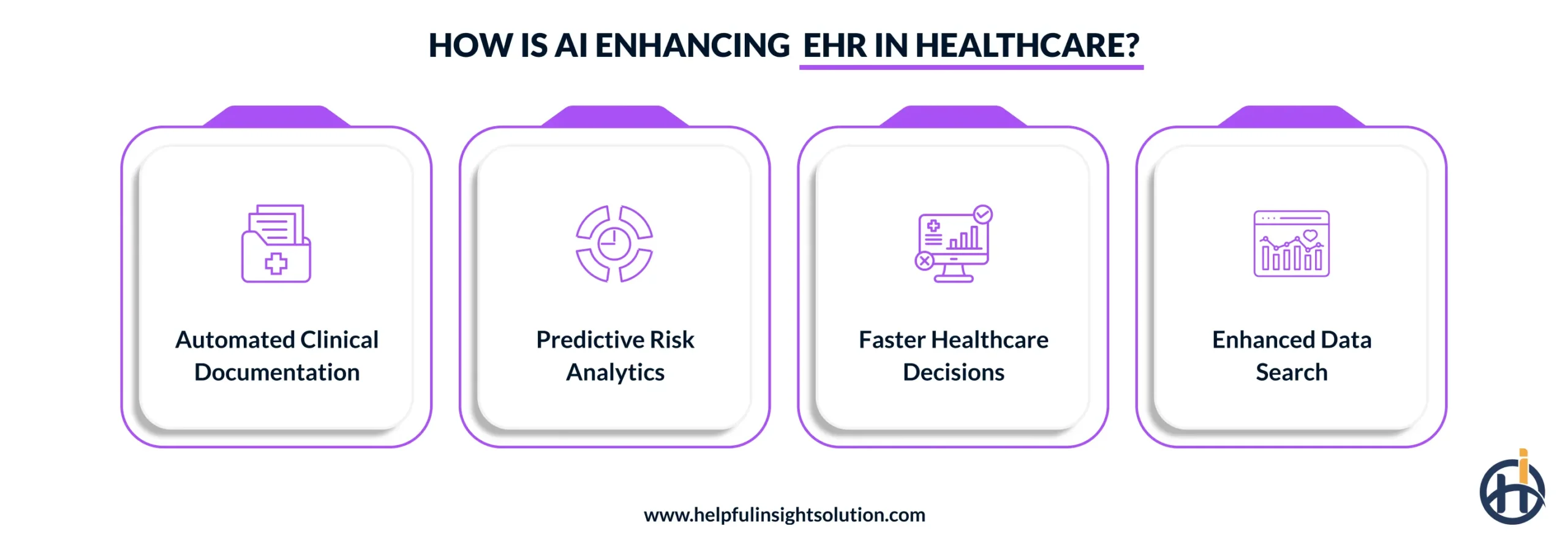
1. Automated Clinical Documentation
Various AI chatbots integrated with EHR systems help to reduce administrative loads and improve accuracy. They use NLP, voice transcription, and ML technologies to create high-quality medical documents in real-time with optimized efficiency.
2. Predictive Risk Analytics
The use of AI in healthcare is to identify different risks, such as equipment failure, expired drugs, and system inefficiencies. You can integrate artificial Intelligence for EHR management, as it supports clinical decisions and optimizes medical resources.
3. Faster Healthcare Decisions
You should implement advanced AI assistants for EHR systems that help doctors in diagnosis, treatment planning, and medical suggestions. This technology provides personalized options based on patient history and clinical preferences, increasing workflow.
4. Enhanced Data Search
Businesses can convert static data storage systems into dynamic digital platforms by implementing AI technology in EHR software. It uses NLP for unstructured data analysis that improves medical diagnosis and enhances efficiency for data management.
Top Use Cases of AI in EHR Systems
Here, we will study the best use cases of AI EHR systems that help in decision-making, patient management, and billing. They improve healthcare workflow and enhance experiences in real-time.
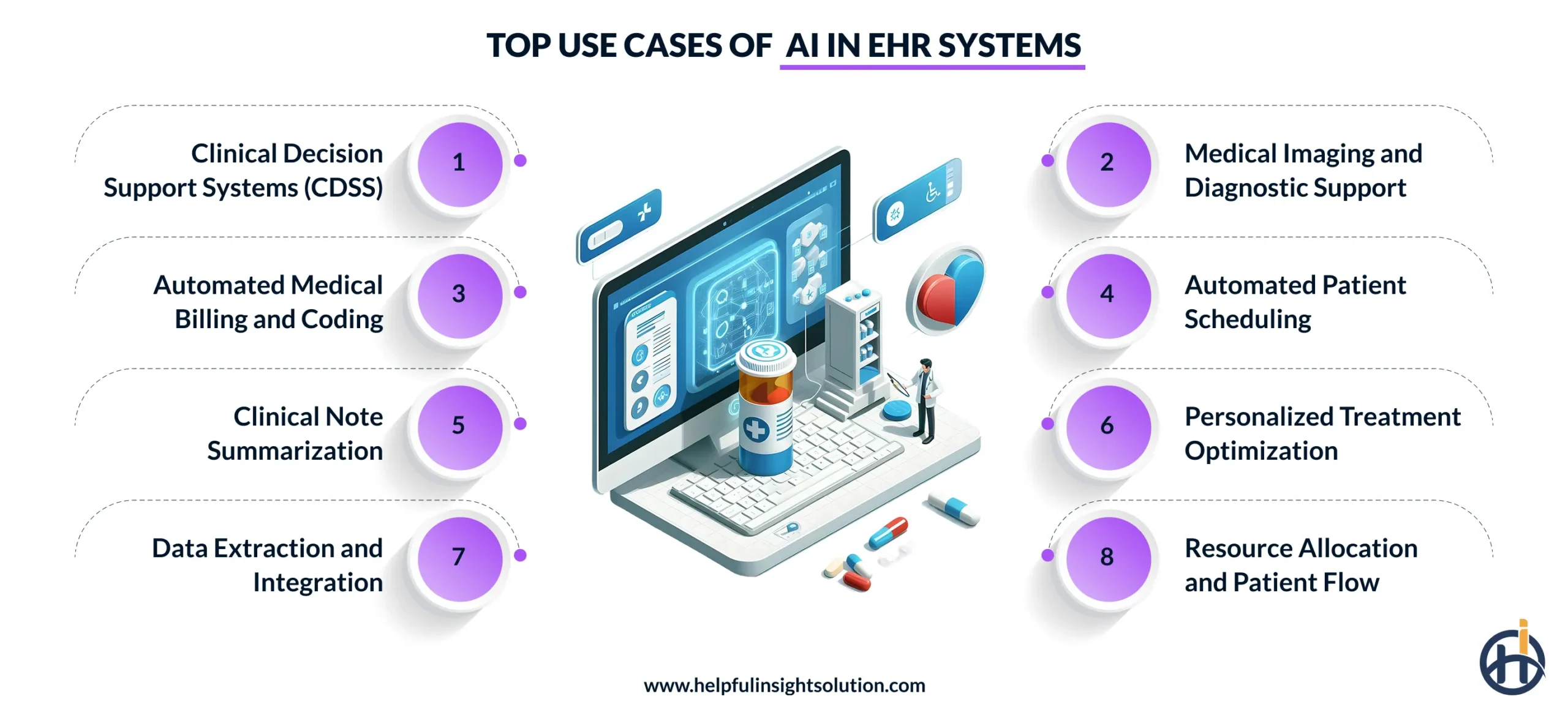
1. Clinical Decision Support Systems (CDSS)
With machine learning and NLP, AI-powered EHR Software can analyze large patient data to provide automated alerts and predictive analytics.
It is widely used in radiology, risk assessment, and diagnosis, ensuring accuracy across devices. AI in clinical systems can reduce expenses and enhance patient care experiences in real-time scenarios.
2. Medical Imaging and Diagnostic Support
Businesses must invest in AI-enhanced medical imaging integration with EHR systems that help in analyzing X-Rays, CT scans, and MRI scans.
It helps to identify various diseases, like cancers, with high accuracy and predictive methods. This can reduce manual workloads, allowing healthcare professionals to focus on complex medical cases.
3. Automated Medical Billing and Coding
In this application, NLP is widely used to modify clinical documents into standard codes, which helps to decrease billing errors.
By integrating AI in healthcare software development, you can automate medical coding and claim submission, reducing time consumption. It analyzes a patient’s medical history to identify claim status for processing.
4. Automated Patient Scheduling
It helps to optimize clinical workflow and reduce administrative costs by using standard AI models in EHR systems. Artificial intelligence helps to manage appointments, staff scheduling, and consultation services for doctors.
This improves healthcare efficiency, reduces cancellations, and enables secure data access for patients and hospital staff.
5. Clinical Note Summarization
The use of large language models (LLMs) to convert patient data into SOAP notes helps to reduce errors, save time, and improve accuracy. It is one of the best AI use cases for EHR integration that can easily summarize medical reports for patients.
This enhances care quality and allows faster communication between patients and physicians.
6. Personalized Treatment Optimization
Various AI-powered solutions in EHR use machine learning to monitor genetic and lifestyle data, enabling customized care for patients. It ensures predictive analytics, precise medication, and real-time monitoring, improving efficiency.
AI helps to promote gene analysis to detect multiple disorders and deliver personalized healthcare remedies.
7. Data Extraction and Integration
The AI-powered fraud detection tools in EHR systems help to collect and verify data from different images or documents.
This reduces manual errors and boosts patient data access, enhancing accurate healthcare decision-making. Artificial intelligence works as an integration layer that connects various sources to the EHR software for instant care.
8. Resource Allocation and Patient Flow
AI is used for various hospital operations, such as bed and queue management, which reduces time consumption for patients. It is among the best use cases of AI for EHR systems that focus on patient care and optimizing emergencies.
Businesses can manage resources, prevent complications, and ensure regulatory compliance based on patient requirements.
How to Integrate Artificial Intelligence in EHR Systems?
If you want to deliver the best health data management services, then you must know how to integrate AI in EHR systems. We will study a step-by-step process in this section through which you can easily implement AI in your systems.
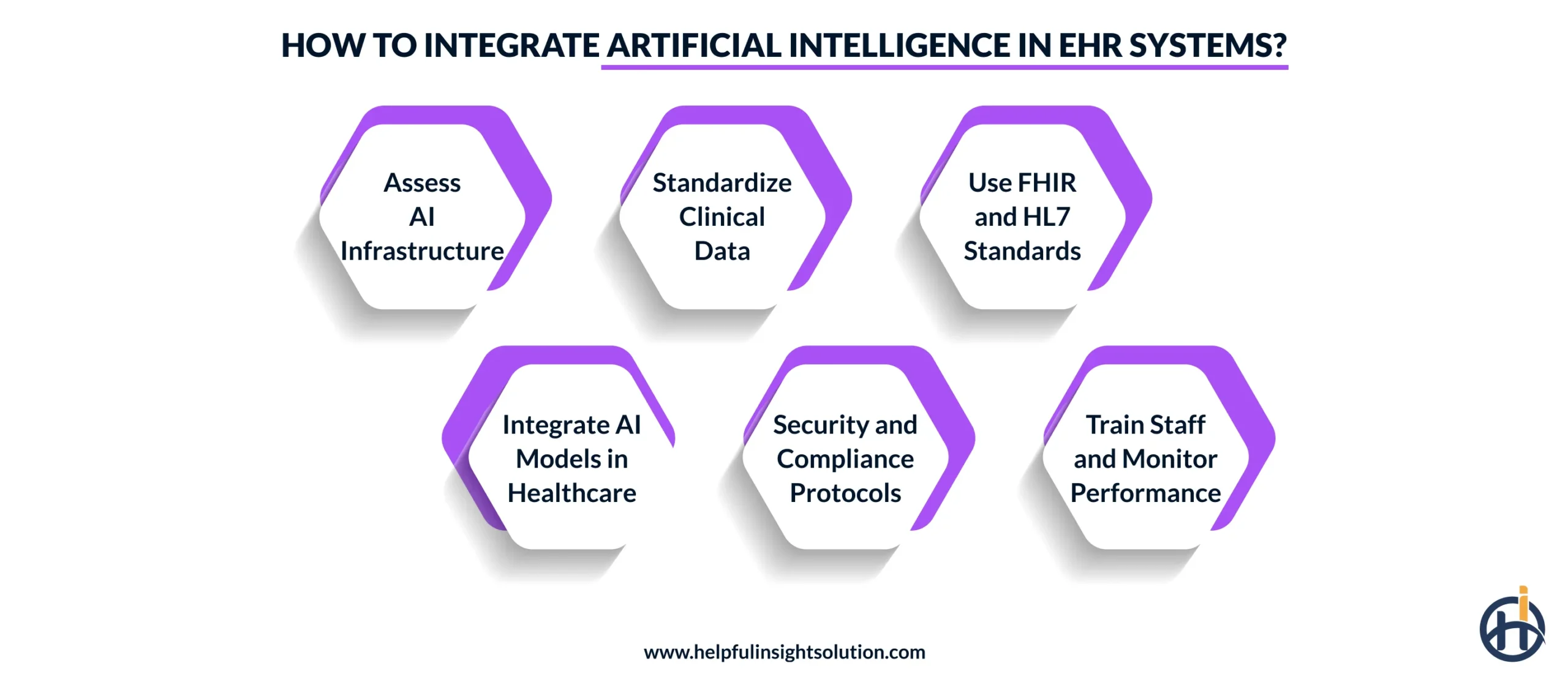
1. Assess AI Infrastructure
For AI integration in EHR systems, businesses must use a secure and scalable infrastructure that ensures quick data access.
It must remove inconsistencies without disturbing the clinical workflow, security, and connectivity. Additionally, you must assess compliance tools, like SMART on FHIR, that can be easily integrated with AI models.
2. Standardize Clinical Data
As 80% of the healthcare data is unstructured, it is necessary to standardize raw information into AI-driven data.
For building an AI-enabled EHR system, you should collect data from various sources, like lab reports and medical imaging. Various standards, such as ICD-10 and DICOM, ensure that AI models are accurate and consistent.
3. Use FHIR and HL7 Standards
These standards transform fragmented data into structural entities that can be easily read by machines, ensuring stability across devices.
You can hire dedicated developers to implement HL7 v2 for administration and FHIR for data access. It is crucial to use transformation tools, secure authorization, and API gateways to manage data volumes.
4. Integrate AI Models in Healthcare
You should integrate AI models to convert the passive storage systems into smart assistants. Various technologies like NLP, ML, and predictive analytics are used to reduce errors and provide personalized care. For example,
AI-powered image recognition with EHR systems focuses on Explainable AI techniques to deliver transparent outputs.
5. Security and Compliance Protocols
It is important to implement various HIPAA, GDPR, and NIST frameworks that ensure compliance and security. Additionally, RBAC and BAAs are necessary to safeguard PHI and ensure the secure functioning of EHR systems.
You must hire experts who implement encryption standards like AES-256 and SOC 2 to prevent data breaches and cyberattacks.
6. Train Staff and Monitor Performance
After AI-powered EHR development, businesses must allow hospital staff to learn to use advanced data management systems.
Additionally, it is important to monitor performance and improve the efficiency of EHR software. You should track the accuracy of AI tools in different medical operations, like diagnosis, treatment planning, and claim processing.
Key Implementation Challenges of AI for EHR Systems
You know that security and compliance are the common challenges of AI Implementation for EHR platforms. We will study more obstacles like these in this section, with their respective solutions.
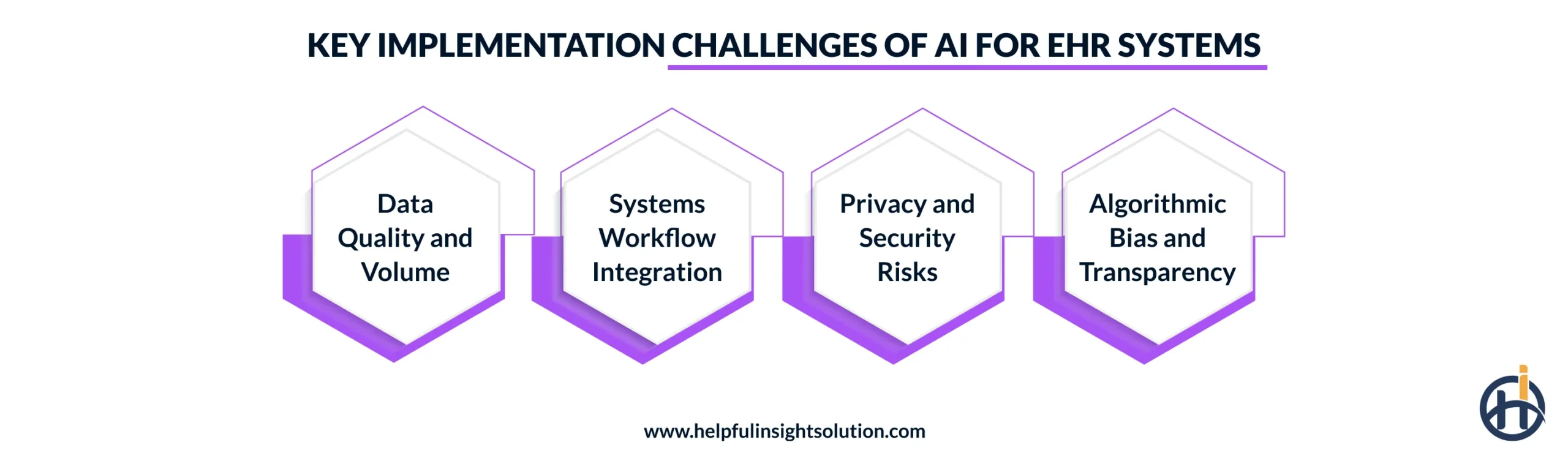
1. Data Quality and Volume
An EHR system contains a vast amount of data, which can be distributed and unstructured for AI models. Additionally, they are used for billings that do not require AI technologies for analysis and prediction.
Solution: It is good to implement AI governance models that help to correct errors, ensuring consistency, accuracy, and increased lifecycle.
2. Systems Workflow Integration
AI cannot be easily integrated with data management systems, which decreases productivity and efficiency. It is one of the major challenges of AI for EHR that occurs due to poor connectivity and architecture.
Solution: Businesses must use HL7 and the FHIR frameworks that ensure smooth data exchange and improve accuracy for administrators.
3. Privacy and Security Risks
Various security risks may occur because AI is connected with sensitive datasets that can be attacked easily. The large amount of PHI can affect data transmission and storage, creating accountability issues.
Solution: You should use Federated Learning, Differential Privacy, and Homomorphic Encryption methods with smart contracts.
4. Algorithmic Bias and Transparency
It triggers the “black box” problem, which arises due to unethical data and complex algorithms, reducing trust. For example, a model may work for lightweight people but may be ineffective for obese patients.
Solution: It is beneficial to use Explainable AI technologies with human-centric models for better healthcare results and care.
Build AI-Driven EHR Solutions with Helpful Insight
We have already covered key topics in this blog, which will guide you to easily develop AI-based EHRs for hospitals and medical professionals. Businesses should connect with a reliable partner, Helpful Insight, to integrate these innovations in healthcare systems.
It provides the best talent who are skilled with advanced technologies and helps to manage the cost of integrating AI in EHR systems. The experts help businesses to make a plan with a specific budget and business outcomes.
It is crucial to follow the future trends of AI in electronic health records for delivering smart data management services. Our professionals provide market insights to know the key factors affecting the cost of AI EHR software.
So, you can easily start preparing a blueprint, invest in MVP resources, and integrate the latest AI technologies in data storage systems.
FAQs
The cost of building AI-enabled EHR platforms depends on factors such as compliance, device compatibility, AI/ML models, and databases. On average, the overall price ranges from $30K to $400K, which may increase due to additional requirements. The cost of creating EHR prototypes is lower than that of enterprise-grade solutions.
Various EHR systems with AI capabilities can be HIPAA-compliant if they include data encryption, access control, and a Business Associate Agreement (BAA). AI helps to manage unauthorized access, automate the data entry process, and reduce theft chances. It does not directly ensure healthcare compliance but uses different techniques.
The average time required for building AI-enabled EHR software is between 3 months and 6 months due to chatbot integration and third-party services. The overall duration may increase to more than 12 months for enterprise-grade solutions with computer vision and regulatory compliance. It is influenced by various factors like design requirements and training period.
The predictive maintenance method in EHR uses AI and IoT technologies to detect failures in the IT infrastructure, server, and software. This does not affect the healthcare workflow by improving performance, reducing issues, and enhancing data security. Additionally, it helps to increase the lifespan of assets and manage resource planning.
Artificial intelligence uses various components, such as NLP and ML, for transcription, record management, and streamlining bills or invoices. They enhance clinical operations through advanced diagnosis, image analysis, and administration. This improves remote patient care, regulates data entry tasks, and supports medical decisions in real-time.