

“Generate AI-powered deepfakes that ensure your business legacy with authenticity.”
Presently, AI is a powerful technology that holds almost all the major industries that work on human data. It has multiple branches like machine learning, deep learning, natural language processing, and more, which use numerous algorithms to automate tasks and predict results. If we talk about AI deepfake generators that work on the principle of Deep Learning, they mainly convert human images by swapping one or more faces with other persons.
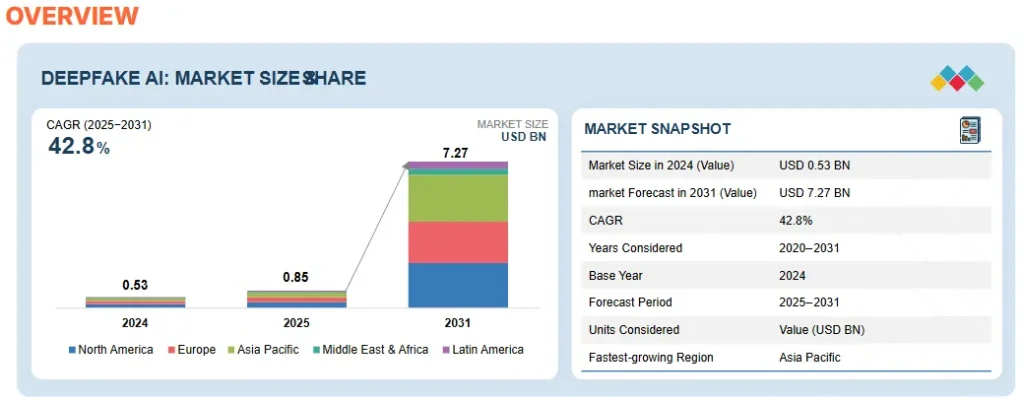
Entrepreneurs can find a great opportunity in this business, as the expected revenue is $7.27 billion by 2031 at a rate of 42.8% CAGR. Additionally, the ratio of using an AI deepfake video generator among people has increased from 8 to 10 users due to exciting features. For this, you need to study various aspects related to the Deepfake technology and modern software.
Here, we will observe some important topics that will include the introduction of deepfake generators, technologies, the latest software, and how to create AI deepfakes. So, let’s dive into this blog and grab more information.
What is Deepfake?
Deepfake is a concept that runs on Deep Learning technology of AI, used to create morphed content across various formats like text, audio, video, and image. It has numerous applications in industries such as media, logistics, finance, and healthcare, enabling quick error resolution.
An AI deepfake image generator uses this technology to convert human images by swapping their faces with clarity and smoothness. It is used in industries where millions of databases are managed, such as travel or education. Deepfake technology can be integrated with the top AI agents to create modified content in less time.
- Create realistic digital characters or de-age actors in films.
- Produce personalized video ads using AI-generated faces/voices.
- Simulate real-life scenarios for medical, corporate, or defense training.
What is an AI Deepfake Generator?
For creating images, videos, audio, and texts with modified or morphed content, AI-powered deepfake generators are used. They use powerful AI algorithms and deep learning concepts to transform the files without changing the original quality.
Various AI deepfake generators like Resemble AI and JoggAI help users to create millions of voice or image clones with advanced algorithms. These platforms are one of the top AI app ideas that help multiple industries automate content generation through various Generative AI models.
- Enables realistic visual effects and content creation for movies and marketing.
- Facilitates personalized education and training simulations with lifelike scenarios.
- Assists in creative projects like virtual avatars and entertainment experiences.How Do AI Deepfake Creators Work?
How Do AI Deepfake Creators Work?
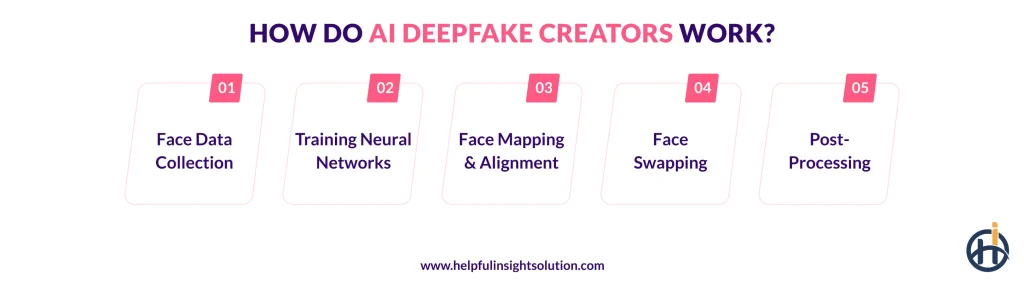
An AI deepfake maker uses a gathering and processing method to produce different content. In this section, we will discuss the working mechanism of AI-generated deepfake platforms:
-
Face Data Collection
First, the face data is collected from various sources based on different parameters like gender and age. Then, the information is stored in dynamic databases that can be easily accessed wherever required.
-
Training Neural Networks
Now, developers train neural networks so they can recognize images according to the given structure and features. It has multiple layers that help to understand patterns and predict accurate data for output.
-
Face Mapping & Alignment
The neural network matches multiple faces, considering the ratio and proportion of the original structure. Several of the best AI voice generators help to align the size of the ears, nose, and other elements.
-
Face Swapping
An AI deepfake photo generator now swaps the faces of two different people with the original background. You can swap the faces of two opposite genders, but their structures should match.
-
Post-Processing
After face swapping, the image is refined by using advanced tools that remove extra pixels through extraction. Additionally, they adjust the contrast of the image by using the pattern compression tool.
Major Tools & Technologies Used in Deepfake Generators
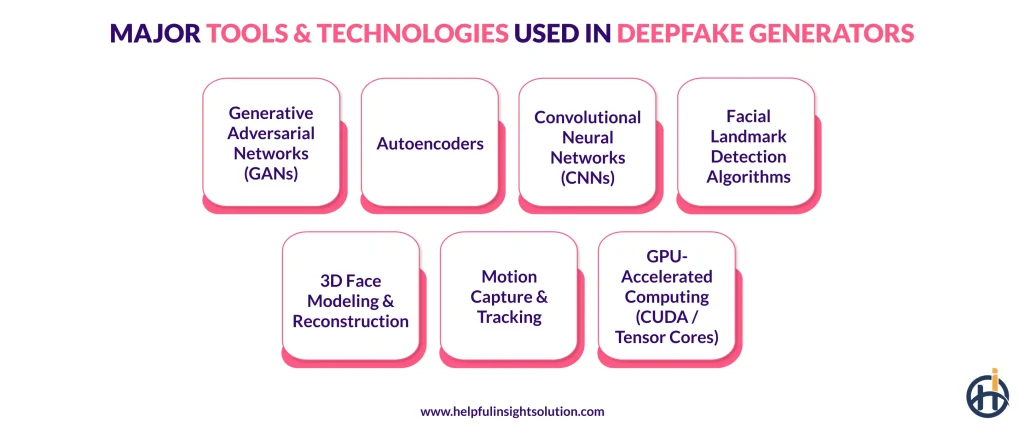
It is important to know the technologies that are behind AI deepfake generators that produce accurate and advanced results. Here, you will study the latest deep learning concepts in detail:
-
Generative Adversarial Networks (GANs)
GANs are the core deep learning framework behind a deepfake photo generator, consisting of a generator and a discriminator competing against each other. The generator creates synthetic images, while the discriminator tries to distinguish real from fake. This adversarial training helps produce highly realistic human faces and expressions.
-
Autoencoders
Autoencoders compress facial data into a low-dimensional representation and then reconstruct the image, making them ideal for face-swapping. It is among the best AI deepfake generator tools that learn facial features and map them onto another person’s face. This architecture is widely used in early deepfake models for efficient face encoding and decoding.
-
Convolutional Neural Networks (CNNs)
CNNs extract key visual features such as edges, textures, and facial patterns, enabling accurate face recognition and manipulation. They form the backbone of deepfake pipelines for tasks like face segmentation, blending, and enhancement. Their layered structure helps generate clean, high-resolution synthetic outputs.
-
Facial Landmark Detection Algorithms
Facial landmark detection identifies key points on the face, such as eyes, nose, chin, and mouth, to guide alignment and expression mapping. The use of AI development services ensures that swapped faces match natural positions and movements in the original video. They provide the geometric foundation needed for smooth, realistic deepfake animations.
-
3D Face Modeling & Reconstruction
3D modeling reconstructs a person’s face in three dimensions, capturing depth, structure, and contours that 2D models lack. It enables more accurate expression transfer, lighting matching, and angle correction. This technology is used in advanced deepfake systems to produce highly lifelike, multi-angle facial animations.
-
Motion Capture & Tracking
Motion capture records subtle facial movements and expressions, allowing deepfake models to mimic natural behavior accurately. Tracking algorithms map these movements onto the generated face frame by frame. This results in deeply realistic lip-sync, eye motion, and emotional expression through AI deepfake video generator apps.
-
GPU-Accelerated Computing (CUDA / Tensor Cores)
Deepfake models require massive computational power, and GPUs provide the parallel processing needed for fast training and rendering. CUDA and Tensor Cores optimize neural network computations, drastically reducing processing time. Businesses should create an AI deepfake generator to make high-quality deepfakes for consumer-level hardware.
Read Also: Comprehensive Guide on Selecting the Right Tech Stack for Fantasy Sports App
Modern-Day Applications of AI Deepfake Generators
There are multiple use cases of AI deepfake generators in different industries with both positive and negative outcomes. Deepfake technology is used in legal training to recreate crime scenes or witness scenarios for better analysis. It helps professionals visualize complex events without altering real evidence. Let’s observe them and understand every aspect of these platforms:
Legal Applications
-
Film & Entertainment Industry
AI deepfake video generator and photo generator systems enable realistic character aging and CGI-free stunts, reducing costs. They also allow filmmakers to revive historical characters for storytelling.
-
Education & Training
Deepfakes create immersive role-play simulations for medical, corporate, and military training at various levels. They help learners practice real-world scenarios more effectively with a certified approach.
Read Also: The Role of Artificial Intelligence in Education
-
Marketing & Advertising
Brands use hybrid AI deepfake video generator apps to personalize ads and localize hyper-realistic content. This makes campaigns more engaging and interactive for users without costly reshoots.
-
Accessibility & Assistive Technologies
AI deepfakes help generate accurate lip-sync avatars for the hearing impaired and personalized digital assistants. They enable smoother communication for people with disabilities and health disorders.
-
Gaming & Virtual Worlds
Players can insert realistic versions of themselves into virtual worlds using deepfake avatars. Game studios, the best use case of Generative AI that can build lifelike NPCs and characters more efficiently.
-
Cultural Preservation
Deepfake technology recreates historical figures, lost languages, and cultural performances without any delays. It enables interactive museums and digital archives that keep heritage alive among users.
Unethical Applications
-
Misinformation & Fake News
Deepfakes can fabricate speeches, events, or public statements, misleading audiences on a large scale. This fuels political manipulation and erodes trust in the media, leading to social chaos and destruction.
-
Identity Theft & Fraud
Cybercriminals use advanced AI deepfake generator apps to harm individuals in video calls or security systems. This leads to financial scams, corporate breaches, and industrial risks for different businesses.
-
Non-Consensual Deepfake Content
Deepfakes are often used to create explicit videos of individuals without their consent, forcing them to do unethical activities. This causes severe emotional, social, and legal harm due to mismanagement of tasks.
-
Social Manipulation & Reputation Damage
Fake videos can be used to demolish reputations, manipulate relationships, or blackmail different targets. Such misuse spreads quickly and is difficult to disprove through ordinary legal or judiciary trials.
How to Create High-Quality AI Deepfakes?
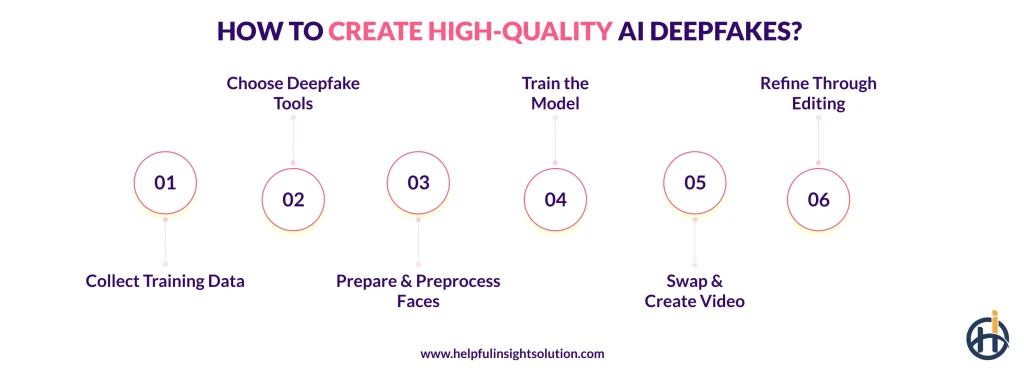
In this section, we will follow a guide to creating AI deepfakes with detailed information. The steps that are discussed below are common and generally used because of their effective approach:
-
Collect Training Data
The first step is to gather a diverse set of high-resolution images or videos of the target faces to ensure the AI has enough reference material. You must know how to build an AI deepfake with quality and variety, which are crucial to generate realistic results. It is necessary to organize the data to streamline the preprocessing and training phases.
-
Choose Deepfake Tools
People should select reliable deepfake software or frameworks that match their skill level and project goals. Various popular tools often include built-in features for training and swapping high-quality AI deepfakes. You should choose the right tool to ensure efficiency and better-quality output for all AI-generated deepfake content.
-
Prepare & Preprocess Faces
The next step is to extract and align faces from the collected data, ensuring consistent orientation and size of the image object. It is important to remove blurry or low-quality images to improve model performance and efficiency. This step uses ML modeling algorithms that are essential for accurate and realistic face generation with high resolution.
-
Train the Model
Now, users should feed the preprocessed data into the AI model and allow it to learn facial features with expressions. Training of data may take hours to days, depending on the size and hardware capabilities. Businesses must hire a mobile app development company that can regularly monitor progress to avoid overfitting and deliver natural results.
-
Swap & Create Video
You should use the trained model to replace faces in the target video, generating realistic deepfake footage from multiple sources. It is mandatory to carefully adjust placement, lighting, and expressions to match the original scene. This step transforms raw model output into usable video content through advanced computer vision and video rendering algorithms.
-
Refine Through Editing
It is the last step in the step-by-step guide to developing an AI deepfake, where users can polish the video by smoothing transitions, correcting color, and fixing minor artifacts. Post-processing ensures a seamless, professional-looking result based on various parameters. You must review carefully to maintain high-quality realism and consistency throughout the video.
Top AI-Powered Deepfake Generators in 2026
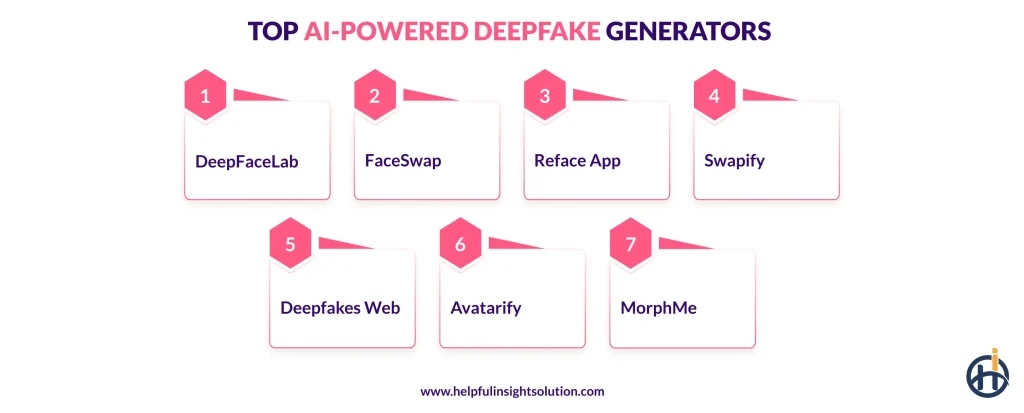
Various modern AI deepfake generators are available for users that provide exclusive features at reasonable costs. For 2026, we have a list of the trending platforms for making AI deepfake content:
-
DeepFaceLab
DeepFaceLab is an advanced deepfake AI image generator, offering granular control over face extraction, training, and blending. It’s widely used by researchers and professionals for high-quality, realistic deepfake outputs.
-
FaceSwap
FaceSwap is the best AI deepfake generator that makes face-swapping accessible with an intuitive interface and strong community support. It offers full customization through machine-learning models for accurate and convincing swaps.
-
Reface App
Reface App lets users instantly swap faces into videos, GIFs, and memes with impressive and realistic features. It is the best deepfake generator whose AI engine delivers fast and high-quality results directly on mobile devices.
-
Swapify
Swapify is a user-friendly face-swap tool that allows creators to generate AI-powered deepfakes from photos and videos. It is one of the top AI business ideas for startups that focuses on social media content creation.
-
Deepfakes Web
Deepfakes Web is a cloud-based deepfake generator that runs training and processing on powerful remote servers. It’s perfect for users wanting high-quality results without needing advanced hardware and complex editing features.
-
Avatarify
Avatarify uses real-time facial tracking to animate avatars, characters, and images with real human expressions. It is a deepfake AI generator, widely used for streaming, video calls, and fun content creation on various platforms.
-
MorphMe
MorphMe offers smooth AI-driven face morphing that blends multiple faces into a single transformation sequence. It is the best AI deepfake generator software, developed for artistic projects, entertainment videos, and creative storytelling.
AI Deepfake Detection vs AI Deepfake Generator
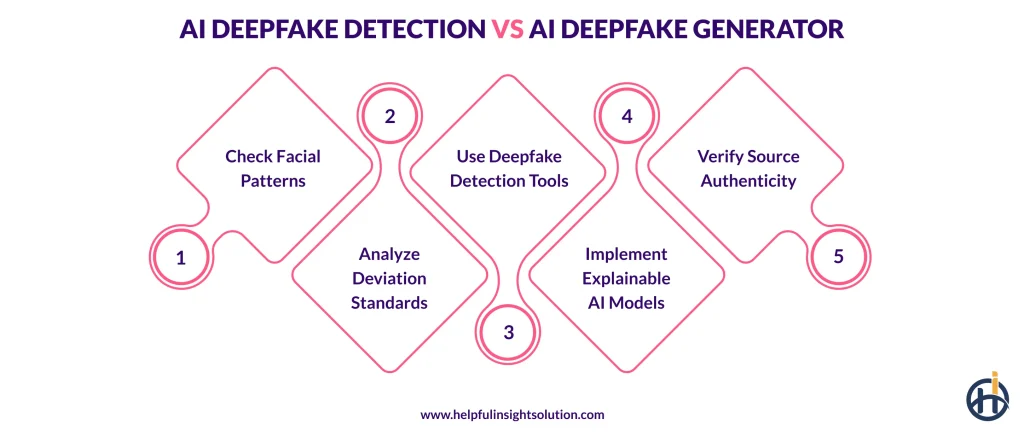
We have seen the top AI deepfake generators in the above section, providing powerful features for face swapping. It is necessary to detect morphed images or videos to prevent fraud and illegal activities. We will understand the process of detecting AI deepfakes with a certified process:
-
Check Facial Patterns
The AI deepfake detector analyzes facial patterns and delays in the expression, which confirms that the content is not real. The process of creating AI deepfakes must learn from the output and make possible corrections in the next cycle.
-
Analyze Deviation Standards
The tool examines different deviation standards by running multiple algorithms that are based on certain parameters, like pattern folding. This produces an output that represents the plot of different values along a median line.
-
Use Deepfake Detection Tools
Business investors must target full-stack development solutions for making technically advanced deepfake AI detection tools. They can be used to identify multiple faulty records in datasets, which can create errors in the realistic face generation.
-
Implement Explainable AI Models
The comparison between the AI Deepfake Generator vs AI Deepfake detector is mainly based on the explainable AI (xAI) model. The implementation of xAI may help resolve unidentified patterns, delay progressions, and value modulation.
-
Verify Source Authenticity
You should use AI to verify the source of content generation as authentic or fake and generate accurate results based on the analysis. Different parameters, like link extraction, help to examine the credibility of the generated face image.
How Much Does It Cost to Build an AI Deepfake Generator?
Thinking about building an AI deepfake generator? The first question that hits is how much is this actually going to cost? Honestly, there’s no fixed answer. If we talk ballpark figures, building an MVP with basic features like face swapping typically falls somewhere between $20,000 to $60,000. For a more advanced deepfake generator packed with high-end capabilities, you’re looking at anywhere from $60,000 to $200,000 or more.
The gap between those two numbers is big and that’s exactly why understanding what drives the cost matters before you commit to anything.
Let’s take a closer look at the key factors that directly influence the cost of building an AI deepfake generator.
- AI model complexity
- Dataset size and quality
- Platform compatibility
- Custom feature development needs
- Third-party API integrations
- UI/UX design
- Team expertise and location
- Licensing cost
- Ongoing maintenance and updates
To get a custom quote, please share your project requirements with our team.
What is the Future of AI-Enabled Deepfake Generators?
More innovations are waiting for deepfake AI generators in the future that will change the world completely. Let’s discuss some of the major future trends that businesses can follow:
1. More Realistic Outputs
There is a possibility that video generators, an alternative of AI deepfake platforms, may start producing realistic outputs. This is because AI is getting more advanced, enabling existing systems to predict faster.
2. Stronger Detection Tools
The implementation of deepfake detection tools will become more advanced and effective because of AI models. This may increase the generative AI development cost due to the complex architectural setup.
3. Increased Regulation
As people may perform unethical activities with the deepfake generators, it is important to make concrete regulations. Licensing and usage restrictions are some policies that can be implemented to prevent fraud.
4. Positive Growth
If used positively, AI-powered deepfake generators may help businesses make profits and grow consistently. With this, they can easily attract millions of users and increase their retention rate.
Why Choose Helpful Insight for Developing Deep Learning Generative Models?
As the demand for modern AI-enabled image, video, or audio generation has increased, the investment in the development of advanced deepfake platforms has also risen. Businesses can hire the best generative AI development companies, that provide valuable services. You must understand the benefits discussed below:
- Help businesses provide a guide on how to develop an AI deepfake with powerful tools.
- Methods for revenue generation and balancing the overall development cost.
- Efficient services, from consultation to market launch, that are affordable in all regions.
- Ensures security standards to protect sensitive user information and track data breaches.
You must follow the above points to start a new business with an effective blueprint model. Additionally, it is important to understand various industrial trends that are popular among users regarding the AI deepfake generators. So, it’s time for both entrepreneurs and users to begin their journey with the latest AI and deep learning models.
FAQs
In some countries, such as the USA, the generation of AI-enabled deepfakes is a legal process due to high security standards. It helps to create multiple face-morphed videos and images for different official or governance tasks. People may use deepfake technology for unethical purposes, which must be sanctioned and restricted on time.
The average time to build AI deepfakes is dependent on various parameters like image/video quality, storage capacity, and extraction model. It may take from a few hours to a complete day to develop deepfake-generated content. Based on the requirements and complexities, the overall duration may increase to more than one day.
GAN stands for Generative Adversarial Network, which is an unsupervised learning model. The key roles of GANs in deepfake generators are as follows:
- It has two models, which include a generator and a discriminator.
- The generator creates fake content, and the discriminator detects it.
- The process is repeated and forces the generator to produce realistic data.
To generate AI-powered deepfake content, multiple software or tools are available, offering advanced face-swapping features. DeepFaceLab is among the best platforms for creating deepfake videos that offer various services for free with a limited subscription plan. It generates high-quality images and videos without charging an extra amount.
No, the detection of deepfakes is not possible without using an AI model, as it regularly examines and analyzes the content through advanced algorithms. There is limited deepfake content available that can be detected with manual testing codes. But, for data processing and content extraction, the use of AI models is necessary.
Deepfake generators have some negative impact on people, which leads to fraud and unethical activities. So, it is important to know various points to legalize these platforms:
- Licensing of the software is necessary for authorized access to deepfake tools.
- Implement fees for each content generation that cannot be afforded by individuals.
- Create contractual agreements with distributors and industry experts.