

“Automate your business processes with the implementation of AI in enterprise services.
A business venture with all facilities or services is known as an enterprise, and the technology that automates processes or tasks is Artificial Intelligence. Using AI for enterprise software is a futuristic move, as it enhances the capability of resources and multiplies the working units by reducing technical faults.
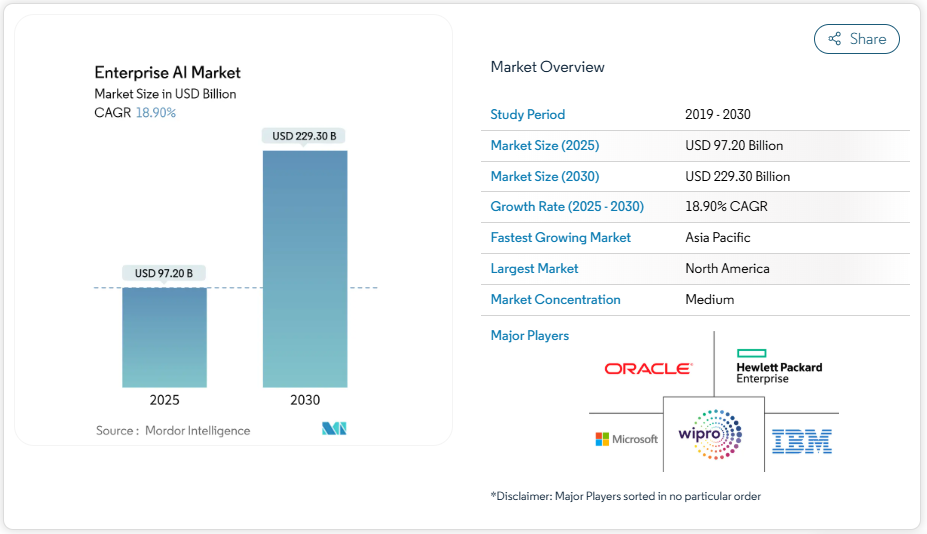
Entrepreneurs in different industries, like healthcare, logistics, and finance, are enhancing user satisfaction with AI enterprise software. The overall market investment in enterprise AI is around $97.2 billion in 2025, which will reach $229.3 billion by 2030 with a rate of 18.9% CAGR.
So, you must know how to implement AI in enterprise solutions without modifying the existing model and at affordable rates. There is a need to understand different aspects before integrating AI in enterprises.
This blog provides all the information through which it becomes easy to develop advanced enterprise solutions with the latest AI technologies. Here, we will also look at the AI use cases in enterprise to give you an idea of the market. So, let’s get started and dive into the blog.
What Is Enterprise AI?
Enterprise AI, as the name suggests, is a software program for a particular organization to streamline business processes and enhance working efficiency. To create AI for enterprise, various technologies, such as machine learning and robotic process automation, are used and integrated with existing systems.
It improves the quality of services, reduces additional expenses, and focuses on innovation with mobility. The best AI startups are investing money to implement AI technologies in enterprise solutions or to develop new platforms.
There is a high demand for AI-driven enterprise transformation, as it ensures security, supportive infrastructure, and strategic governance.
- Predictive maintenance using AI to reduce machinery downtime.
- AI-powered diagnostics to improve the accuracy and speed of medical assessments.
- Intelligent demand forecasting to optimize inventory and supply chain decisions.
What Are The Benefits Of Developing AI For Enterprise Systems?
Businesses should implement artificial intelligence for enterprise solutions, as there are a lot of benefits. In this section, we will study some of the major enterprise-level advantages:
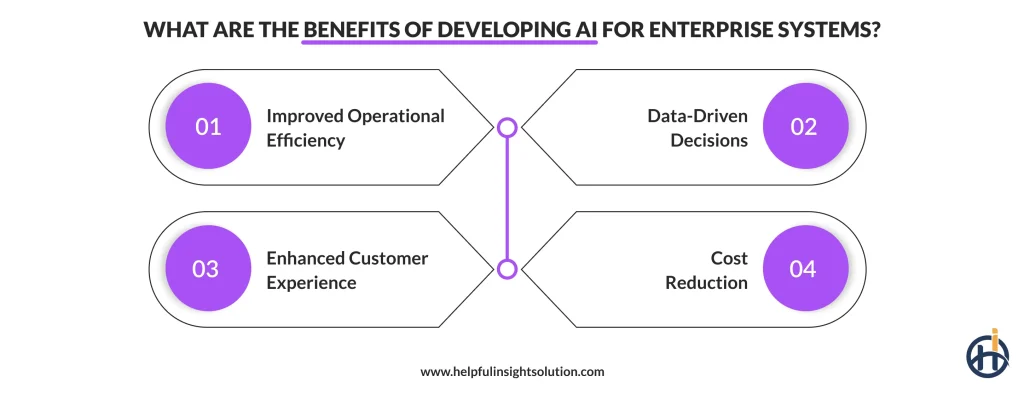
1. Improved Operational Efficiency
The implementation of AI enterprise solutions helps to enhance the efficiency level and streamline business operations. You must use AI tools at affordable rates to improve the working of the enterprise.
2. Data-Driven Decisions
Getting data-oriented results is among the best enterprise AI benefits that businesses want to become successful. You must target various AI business ideas that can help you get the desired results.
3. Enhanced Customer Experience
With AI in enterprise business solutions, you can easily enhance customer experience and satisfaction. It helps them to get automated results, personalized features, and recommended services in less time.
4. Cost Reduction
Businesses can integrate AI in the enterprise, as it is more cost-effective than other technologies. The AI algorithms are so fast that they instantly automate processes and predict user behavior at lower rates.
Major AI For Enterprise Use Cases
Here, we will observe a few important AI for enterprise use cases based on several industries. You will come to know the applications of AI in different domains for enterprise-grade solutions:
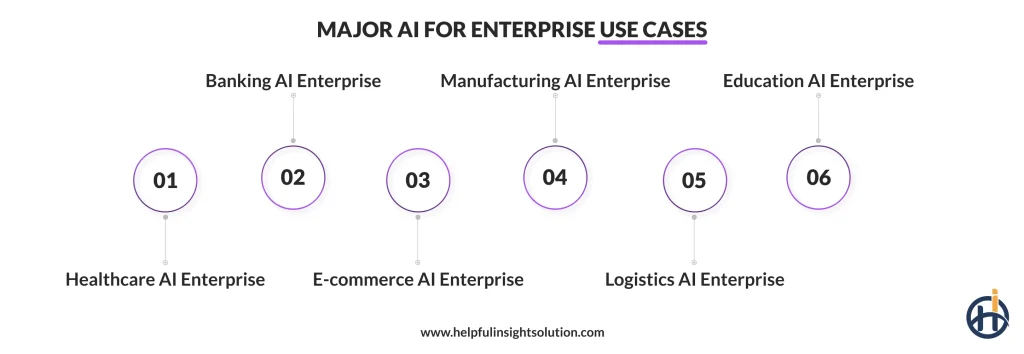
1. Healthcare AI Enterprise
Healthcare enterprise AI applications help hospitals automate diagnostics, streamline patient management, and improve treatment accuracy. AI-driven tools analyze medical images, predict diseases early, and support doctors with data-backed decisions. These systems also automate administrative tasks and enhance telemedicine services. Overall, they improve patient care while reducing operational costs.
2. Banking AI Enterprise
A banking enterprise AI solution strengthens security, automates financial workflows, and improves customer interactions. AI helps detect fraud in real time, assess credit risks, and personalize banking services. Chatbots and virtual assistants enable faster customer support and 24/7 availability. Banks achieve better compliance, reduced errors, and improved decision-making.
3. E-commerce AI Enterprise
E-commerce AI Enterprise solutions boost sales, optimize product listing, and improve user experiences. The artificial intelligence for enterprise applications analyzes customer behavior to deliver personalized shopping and pricing. Automated inventory management helps maintain accuracy and reduces waste. Generative AI in e-commerce enhances conversions, customer satisfaction, and business efficiency.
4. Manufacturing AI Enterprise
Manufacturing AI Enterprise tools support predictive maintenance, quality control, and automated production processes. It is among the best AI use cases in enterprise that analyze machine data to prevent breakdowns and reduce downtime. Vision-based inspection ensures defect-free products and higher precision. Factories achieve greater productivity, lower costs, and enhanced operational reliability.
5. Logistics AI Enterprise
Logistics AI Enterprise applications optimize fleet management, route planning, and warehouse operations. The artificial intelligence for enterprise predicts demand, reduces delivery time, and automates order tracking. Intelligent algorithms enhance supply chain visibility and minimize transportation costs. The result is faster fulfillment, fewer errors, and improved customer satisfaction.
6. Education AI Enterprise
Education enterprise conversational AI solutions personalize learning, automate administrative tasks, and enhance digital classrooms. AI analyzes student performance to offer tailored lessons and predictive insights. Virtual tutors, automated grading, and adaptive assessments improve teaching efficiency. Educational institutions benefit from better outcomes, reduced workload, and engaging learning.
Key AI Technologies For Enterprise Development
Various technologies are used to develop artificial intelligence for enterprise systems that enhance services. Let’s understand them in this section with their respective roles:
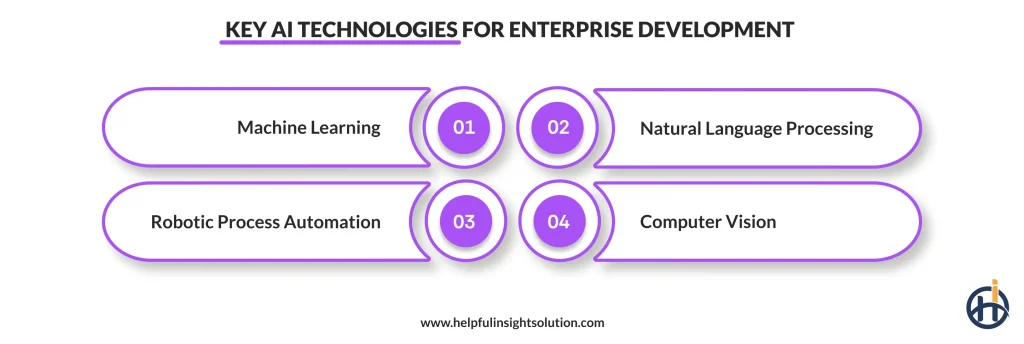
1. Machine Learning
Machine Learning helps enterprises analyze massive data and make accurate predictions. It identifies patterns, automates tasks, and improves business processes without manual programming. You can use ML to enhance productivity and reduce errors for enterprise conversational AI platforms.
2. Natural Language Processing
Natural Language Processing enables businesses to understand, interpret, and process human languages. AI in the enterprise powers chatbots, sentiment analysis, voice assistants, and customer support systems. NLP improves communication, automates support, and provides personalized user experiences.
3. Robotic Process Automation
RPA automates rule-based tasks to boost the operational efficiency of an enterprise AI application. For example, AI agents in finance reduce manual workload, minimize human errors, and speed up workflows. It helps businesses lower costs while ensuring consistent and accurate task execution.
4. Computer Vision
Computer Vision allows enterprises to analyze images, videos, and visual data for real-time insights. It supports applications like facial recognition, quality inspection, surveillance, and product automation. Businesses can improve accuracy, enhance security, and optimize operations with enterprise AI tools.
How To Integrate AI With Enterprise-Level Solutions?
As a business investor, you must know the integration process of AI for enterprise solutions. In this section, we will explore the mandatory stages generally used by professional developers:
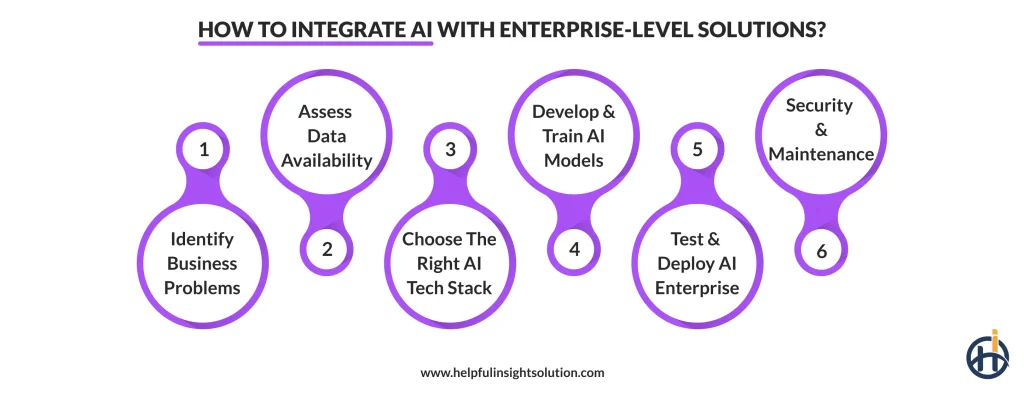
1. Identify Business Problems
Identifying business problems is the first step toward integrating AI into enterprise solutions. You need to understand various loopholes and weaknesses of the model for smart automation. An enterprise AI solution must include customer support, data processing, or operational workflows.
Clear problem definitions help avoid unnecessary development and focus on real challenges. A well-defined objective ensures that AI implementation directly contributes to business growth.
2. Assess Data Availability
AI models rely heavily on quality data, so assessing data availability is essential. Enterprises must check if they have enough structured or unstructured data to support the solution. The data should be reliable, updated, and properly organized for training.
The key benefits of AI for enterprises include collecting, cleaning, or integrating additional sources. Good data ensures accurate insights and better AI performance.
3. Choose The Right AI Tech Stack
Selecting the right AI tech stack sets the foundation for a scalable solution. This includes choosing frameworks like TensorFlow, PyTorch, or cloud platforms such as AWS, Azure, or Google Cloud. The enterprise AI tools should match the technical capabilities and long-term goals.
You must hire an AI development company to get computational power with integration and deployment environments. A well-chosen stack ensures smooth development and future scalability.
4. Develop & Train AI Models
Now, developers can build and train artificial intelligence for enterprise applications. This step involves selecting algorithms, creating machine learning pipelines, and training models with real datasets. The development team continuously examines the model to improve accuracy and efficiency.
The process may require multiple iterations to achieve ideal performance. Proper model training ensures the AI system delivers actionable and reliable results.
5. Test & Deploy AI Enterprise
Before full deployment, AI enterprise software must be thoroughly tested in controlled environments. Testing helps identify errors, performance issues, or integration challenges with existing enterprise tools. Once validated, the AI solution can be deployed across production environments.
Enterprises often roll out AI in phases to monitor real-world behavior. A smooth deployment ensures minimal disruption and maximum adoption.
6. Security & Maintenance
AI solutions require continuous monitoring, security updates, and performance tuning. AI in the enterprise must protect models and data from unauthorized access or cyber threats. Regular audits ensure compliance with internal and industry security standards.
Maintenance also includes retraining models to adapt to new data or business changes. Ongoing support keeps the AI system efficient, accurate, and secure.

Potential Risks With The Implementation Of AI In Enterprise
You should be aware of the AI for enterprise challenges that can occur due to multiple technical restrictions. We will study a few important challenges that a business investor must know:
1. Data Privacy Issues
The impact of AI implementations in the enterprise restricts security because of open-source solutions. Additionally, it prevents data servers from ensuring privacy and executing security checks for safety.
Solution: Use encrypted security algorithms such as 2FA and biometrics that ensure data protection.
2. Bias in AI Algorithms
Various algorithms for an enterprise AI solution have different priority levels that slow down the working efficiency. For example, Artificial Intelligence in education offers varied solutions that are not in sync.
Solution: Set time intervals for each AI algorithm based on the services and user preferences.
3. High Implementation Costs
For an advanced enterprise AI application, the implementation cost is high because of the increased complexity level. Many investors choose basic enterprise solutions that provide limited resources.
Solution: Target white-label resources that are affordable and provide effective results.
What Is The Cost Of Making Enterprise AI Solutions?
The cost to implement AI for enterprise is between $5,000 and $15,000 because of limited services. It is dependent upon various market factors, like the complexity and experience level. The average cost may expand to more than $20,000, which we will understand by going through the factors below:
1. Project Complexity
It is important to analyze the requirements, like features and algorithms, for developing AI enterprise software. Advanced systems are expensive because of the integrated technologies that use the latest tools. If the complexity level is lower, then the overall development cost is also decreased.
2. Data Volume & Quality
To store a large amount of data, you need to implement big data AI solutions for enterprise systems. As the volume and quality of the data increase, the total integration price also rises due to the open space. Businesses can distribute data across different servers to reduce costs and improve efficiency.
3. Technical Integrations
The AI agent development cost is influenced by the integration of various technologies, including Artificial Intelligence. It is beneficial to use advanced algorithms for developing AI enterprise solutions with priority checks. But you should manage the overall cost and resources for affordable results.
4. Development Team Expertise
The experience of a development team also influences the development and integration cost. To implement artificial intelligence for enterprise, you need to hire experienced developers, who are expensive. But they provide more assistance and technical support than junior developers.
Future Scope Of AI For Enterprise
The artificial intelligence for enterprise solutions is our future, which helps businesses in many ways. Here, we will understand the scope of AI technology in the enterprises for various entrepreneurs:
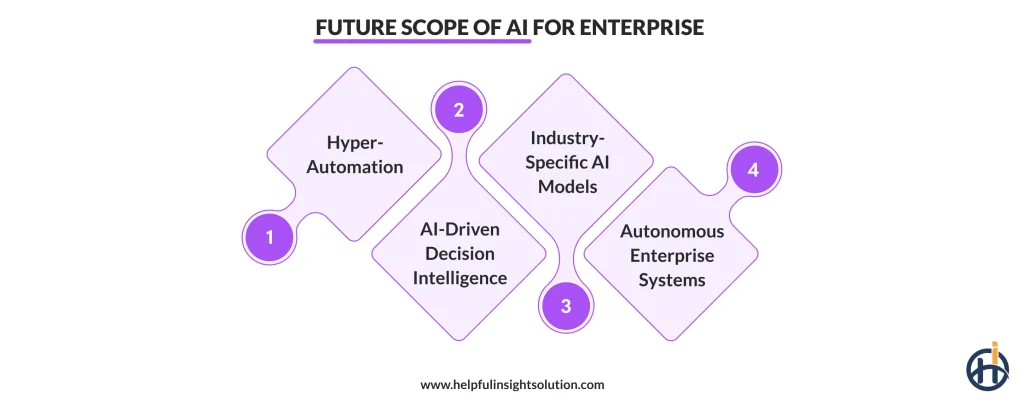
1. Hyper-Automation
With more innovations, an enterprise AI platform can deliver hyper-personalized and automated services. It can allow businesses to reduce time consumption and ensure high accuracy rates with limited resources.
2. AI-Driven Decision Intelligence
Various enterprise AI apps have the power to decide actions and provide suggestions based on the given input. In the future, these systems will become more intelligent and may predict outcomes with no data.
3. Industry-Specific AI Models
You can build top AI agents for businesses in domains like healthcare, logistics, finance, and education. This will enhance the AI enterprise software according to the market demands and user preferences.
4. Autonomous Enterprise Systems
The AI in enterprise business will allow software systems to make self-generated decisions with the available data. This will help to streamline the workflow, manage security, and improve efficiency.
Choose The Best Enterprise AI Option For Your Business
As an entrepreneur, you must choose artificial intelligence for enterprise to get the best business option. Here, we will understand what the available choices are that you can make based on your demands:
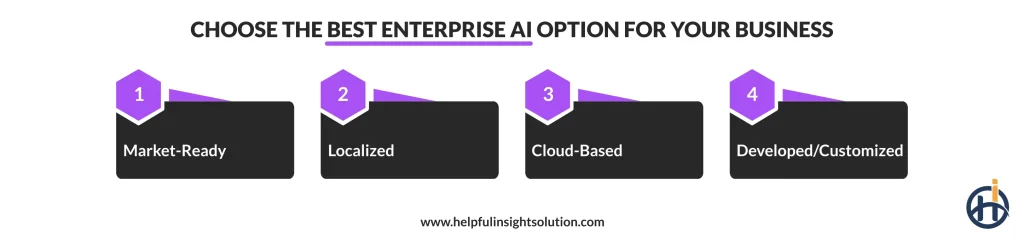
1. Market-Ready
One of the major enterprise AI benefits is that ready-made market solutions are available for business investors. They can choose this model due to a lack of time, development resources, and budget.
Why Choose: Useful for quick deployment and 40–60% ROI because it reduces time-to-market and upfront investment.
2. Localized
Businesses can hire dedicated app developers who can use localized resources and third-party services. This is also one of the best benefits of AI for enterprises, which ensures affordable system development.
Why Choose: Provide 50–70% ROI as it delivers region-specific accuracy, compliance, and user experience.
3. Cloud-Based
You can choose cloud-based AI solutions for enterprise systems, offering centralized servers and configured user data. It can be automated to manage responses and requests from the server.
Why Choose: Select this for 45–65% ROI through scalable infrastructure, lower maintenance, and flexible resource usage.
4. Developed/Customized
It is beneficial to build an enterprise AI platform from scratch that can be customized based on the requirements. You should have all the necessary resources, the tech stack, and a list of features.
Why Choose: With tailored workflows, automation depth, and long-term competitive advantage, it offers 60–85% ROI.

What Is The Role Of Helpful Insight In Integrating AI For Enterprise Development?
Now, you are ready to build advanced enterprise AI applications that can automate business processes and improve productivity levels. It is important to make proper development plans before starting with technology. You should hire a professional full-stack development company like Helpful Insight that offers the following benefits:
- Access to successful business models to make an ideal enterprise AI platform.
- Skilled and experienced developers having expertise in using advanced AI tools.
- Tips to reduce the cost of integrating AI for enterprise and generate revenue.
- Support for regular maintenance and security against data breaches.
The use of AI in enterprise business services is transforming industrial capability and enhancing the level of user satisfaction. Additionally, entrepreneurs can streamline their processes by managing AI technologies such as machine learning. So, you should start early to become a market expert with advanced AI enterprise solutions.
FAQs
Artificial Intelligence technology offers powerful tools to improve existing enterprise solutions. Some of the important steps are discussed as follows:
- AI analyzes requirements and predicts necessary changes in the enterprise system.
- It runs multiple algorithms to automate different tasks and recommend solutions.
- The technology tracks user data and provides regular security to prevent fraud.
In the USA, investment in AI enterprise development is common among entrepreneurs. This is because of the following important reasons:
- It provides automation and hyper-personalized services with prediction capabilities.
- Various ERP and CRM systems are improved through advanced AI and ML algorithms.
- The user feedback is positive, boosting the overall experience and functionality.
The average time to integrate AI for enterprise solutions ranges from 2 weeks to 6 weeks, based on the requirements. This duration may increase to more than 10 weeks because of advanced AI implementations and backend integrations. You should manage all the resources to decrease additional cost and time to deploy the system within the deadline.
It is important to regularly maintain enterprise AI for delivering high-end services. You should follow some crucial methods for the maintenance of AI-enabled enterprise solutions:
- Implement multiple layers of security to prevent unauthorized access.
- Perform maintenance tasks, like bug fixing, feature enhancements, and security checks.
- Manage beta updates to deliver personalized and enhanced solutions.
Yes, data security and privacy are ensured by Artificial Intelligence services that can track errors and provide recommendations accordingly. Enterprise systems are secured with various authentication protocols such as 2-factor authentication, biometrics, and AES. AI tracks the path of the attacker and alerts the systems by dumping all files that can be recovered easily.
Enterprise AI can be integrated with multiple technical innovations to improve resource management. Some major technologies are discussed below:
- Blockchain: Used to improve security standards, software maintenance, and accessibility.
- IoT: Helps to enable AI automation with hardware systems like sensors and actuators.
- Cloud Computing: Stores a large amount of user data on a centralized server with high security.