

Are you someone who’s into fitness and uses the best fitness apps to reach your health goals? If yes, have you noticed how some workout and exercise apps suggest personalized meal plans or workout routines that perfectly align with your goals?
Ever wondered how that’s possible, almost like you have a personal trainer, even when you don’t? Well, that’s the power of AI. Yes, you read that right, AI in fitness apps are transforming the fitness industry by offering convenient, affordable, and innovative ways to manage your health and fitness.
- In fact, the global AI in fitness and wellness market size is valued at $18.8 billion in 2026 and is predicted to reach $60.4billion by 2035.
- The overall growth rate is 12.3% CAGR between 2025 and 2035 with China having the maximum regional rate of 12.4% CAGR in the complete tenure.
AI for fitness apps doesn’t just track your steps, it can understand your habits, offer personalized workout suggestions, track progress and can do much more. There are many ways in which fitness AI apps are revolutionizing the fitness industry, that is what we are going to explore in this blog.
Understanding The Reason Behind The Rise Of AI in Fitness Apps
Have you ever wondered why there’s so much buzz around artificial intelligence in fitness apps? Why are gym and fitness club owners investing in AI fitness app solutions? The answer is simple to provide a highly personalized user experience that keeps users engaged.
In this section, we’ll share even more reasons behind the gaining popularity of AI in fitness app development.
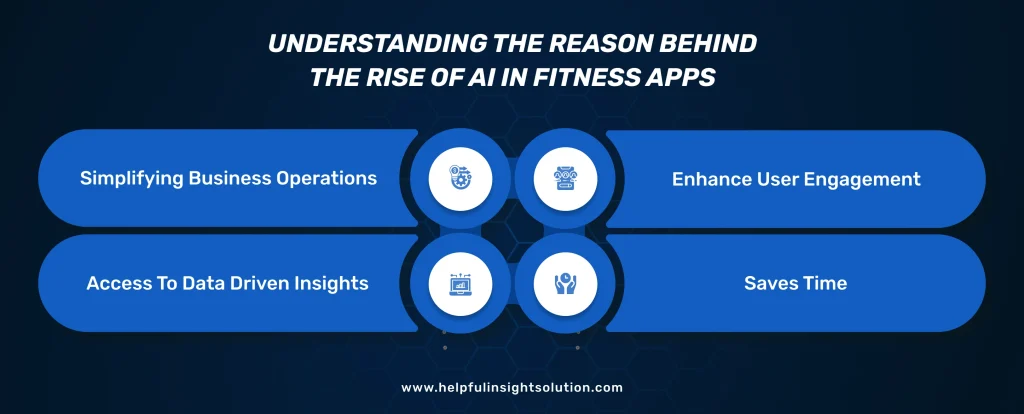
1. Simplifying Business Operations
The top reason behind the immense popularity of AI-based fitness apps is that it streamline business workflow without human intervention. AI doesn’t just help people who use top exercise apps, it also helps gym owners too.
It can do tasks like setting class times, tracking busy hours, or even answering customer queries. With AI agents doing the time consuming stuff, business in fitness industry can focus on growing and helping more people.
AI’s impact extends beyond fitness applications, with businesses across industries using intelligent technologies to automate processes, analyse operational data, and make faster decisions.
For organizations looking to connect AI capabilities with core business processes, AI in ERP systems can help streamline workflows, improve forecasting, enhance data-driven decision-making, and create more connected operations.
2. Enhance User Engagement
When fitness app developers build a fitness app, one goal they keep in mind is to add best functionalities in the app to provide the best user engagement experience and that is exactly what AI helps in. But integrating AI in mobile apps makes using apps more personalized and engaging which every app user loves, ultimately benefiting businesses.
It can learn what workouts users like and sends encouraging messages when you achieve goals. This keeps users motivated and benefits businesses by increasing retention.
3. Access To Data Driven Insights
You will all agree that data is an invaluable asset to any business, and when used wisely, it can drive great success. Artificial intelligence solutions are super smart at understanding data like people exercise habits or sleep patterns. For users, it gives better workouts and health tips based on this information.
It helps businesses to understand various user needs, so they can improve app features and enhance experiences. This shows why a health and fitness app development company requires the AI technology.
4. Saves Time
If you’ve ever used fitness apps you might know how much time it can take to find the right workout or meal plan. Even the best weight loss apps sometimes don’t match what you’re looking for.
So people want smart features in artificial intelligence gym apps that can do this task for them in seconds. It quickly chooses the best options based on your body, fitness goals, and workout history. This saves time and energy, so you can focus more on getting healthy and less on guessing what to do.
Top 12 Use Cases of AI in Fitness Industry
Everyone is talking about how AI is beautifully revolutionizing the fitness and workout industry. The integration of AI and fitness application development is creating a major shift in how people approach exercise and wellness.
AI is transforming the fitness world in many ways, and understanding its applications is crucial for both businesses and fitness app development companies aiming to build innovative and effective fitness AI app solutions.
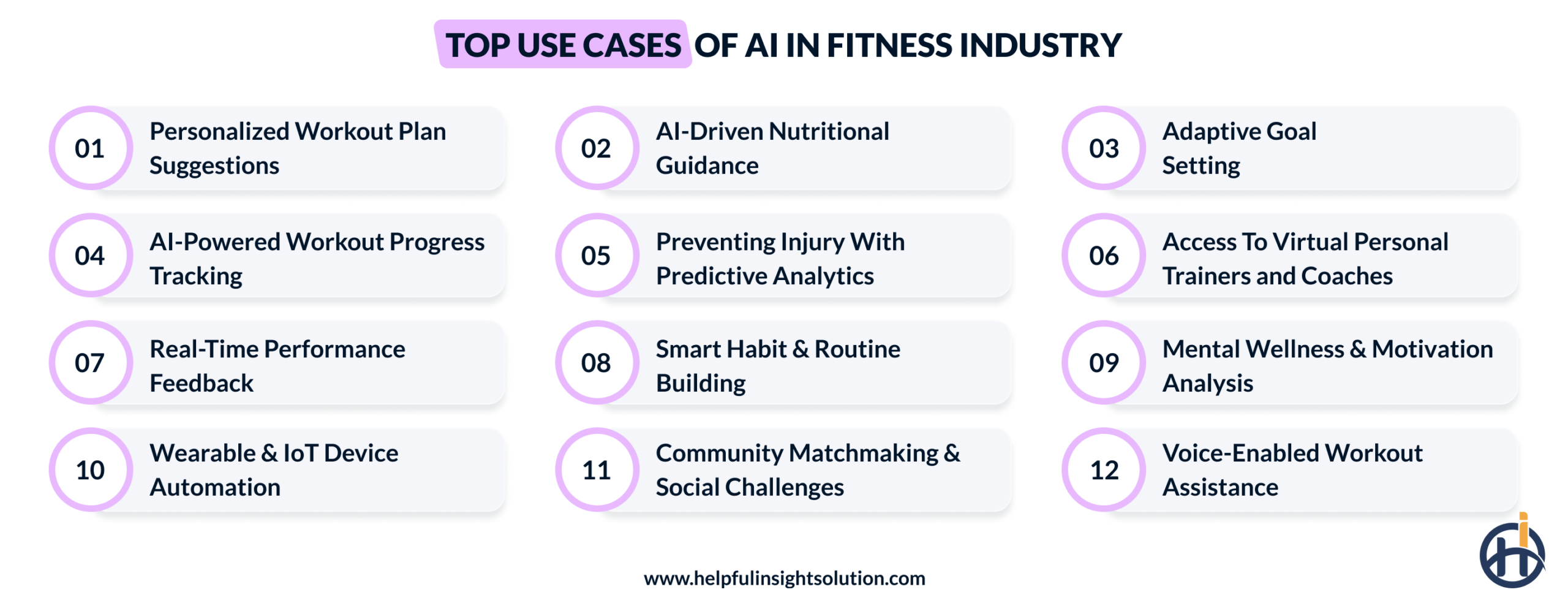
1. Personalized Workout Plan Suggestions
When you go to a gym, the trainer gives you a workout plan, but that usually comes with a high fee. Now, imagine your smartphone doing the same job just by downloading a top AI workout app. Today, offering a personalized user experience is essential, as people expect it in this tech-driven world.
That’s where AI comes in. Fitness AI apps create custom workout plans based on your age, weight, and goals. As you improve, the app updates your exercise plan to match your progress.
2. AI-Driven Nutritional Guidance
Artificial intelligence fitness apps help you understand what’s good or bad for your health by providing smart nutritional advice. AI creates personalized diet plans based on your health and fitness goals, helping you make healthier food choices.
For example, if you need a refreshing smoothie after a workout or a balanced low-fat dinner, the app suggests recipes that suit you. This makes healthy eating easier and supports your fitness journey. Hire dedicated developers integrate this feature while developing a fitness app as it is widely loved by the users.
3. Adaptive Goal Setting
AI fitness apps use smart goal setting to make your workout plans unique and adjust them based on how well you’re doing. The app sets goals for things like weight loss or strength, then changes them if you’re making progress or need a bit more help.
For example, if you’re doing well with cardio, the app will challenge you with harder workouts. This keeps you motivated and prevents getting stuck in a routine. Fitness app like MyFitnessPal change your workout plan as you improve, always keeping things exciting.
4. AI-Powered Workout Progress Tracking
In earlier times, fitness freaks had to remember how much they worked out, what level they reached, and how far they were from their goals all on their own, which wasn’t easy. But with the rise of the best AI fitness apps, tracking progress has become much simpler.
These smart apps monitor your workouts, how close you are to your goals, how hard you train, and even how much water you drink. Based on this, they give helpful tips, adjust your workouts, and show your progress clearly.

5. Preventing Injury With Predictive Analytics
AI-powered custom fitness applications help keep you safe during workouts by watching your movements and predicting injury risks. It can spot bad movement habits and signs of tiredness before they cause harm. AI looks at things like how your body moves, your heart rate, and how hard you’ve been training.
If it sees a problem, it warns you to adjust your workout. Suppose workout AI app notices you’re using the wrong form while lifting weights, so it will suggest a better way to lift, reducing the chance of injury.
6. Access To Virtual Personal Trainers and Coaches
Have you ever imagined a time when you wouldn’t need to go to a gym or fitness club to get guidance from the fitness trainers or we can say personal coaches that give full attention to you? Well, that time is now, all thanks to AI in fitness industry.
Fitness AI apps let you experience having a personal trainer right at home, you don’t have to go anywhere. AI exercise apps guide you, monitor your movements, correct your form, and adjust workout difficulty based on your progress. This is truly a revolutionary move in the fitness industry.
7. Real-Time Performance Feedback
Imagine if someone could tell you exactly how you’re doing while you’re working out, right at that moment. Sounds amazing, right? Well, with artificial intelligence, that’s now possible. The best AI workout apps track your movements using sensors or smart devices.
If your form is incorrect, they immediately guide you to fix it. The AI also gives tips to improve your form and avoid getting hurt. It’s like having a personal coach in your pocket, always there to guide, support, and help you do your best.
8. Smart Habit & Routine Building
AI fitness apps go beyond exercise tracking by shaping sustainable daily behaviors. Intelligent algorithms study a user’s work hours, sleep quality, step count, and past adherence to craft realistic routines that fit naturally into life.
The system identifies weak patterns such as irregular recovery or poor hydration and creates micro-habits like two-minute stretches or short walks after meals. Context-aware reminders are delivered at the right moment, while AI agents adjust the routine when schedules change.
9. Mental Wellness & Motivation Analysis
Modern AI in the fitness industry recognizes that performance is closely tied to mindset. These apps evaluate emotional states through quick mood check-ins, journal inputs, or wearable signals like heart rate variability. When stress or fatigue is detected, the platform suggests yoga, meditation, or lighter home workouts to protect mental balance.
Machine learning models also analyze when users usually quit sessions and generate personalized motivation to keep them engaged. Virtual trainers communicate empathetically, celebrating small wins and offering encouragement after setbacks.
10. Wearable & IoT Device Automation
Custom AI development services enable fitness platforms to control connected FitTech devices automatically. By reading data from posture sensors, smart scales, and BLE bands, AI adjusts resistance on bikes, speed on treadmills, or rest intervals between sets. The automation engine reacts to real-time biometrics so workouts remain safe and efficient.
An AI experts can design rules that lower intensity when the pulse spikes or increase load when users show strong endurance. All activity is logged without manual input, creating seamless progress records.
11. Community Matchmaking & Social Challenges
AI agents transform the social side of workouts by building meaningful digital communities. The app compares skill levels, interests, and goals to match users with compatible partners for sports and group training. It creates dynamic challenges such as weekly step battles or strength contests with fair leaderboards. Generative AI designs badges, team missions, and reward structures that evolve with participation.
12. Voice-Enabled Workout Assistance
Voice technology allows AI fitness apps to act as hands-free virtual trainers. Users can ask the system to demonstrate exercises, count reps, or explain correct form through natural conversation. Deep learning in fitness technology processes spoken commands to log sets, play adaptive music, or schedule rest periods.
This is valuable during intense sessions when touching the screen breaks focus and also improves accessibility for visually impaired individuals. AI in sports environments benefits as the assistant offers instant guidance on pacing and breathing.
Future of Fitness Industry with Artificial Intelligence
The future of the fitness industry with AI is bright because the technology can attract millions of users. Some key future trends are discussed in this section that you must know:
1. Personalized Training at Scale
AI will make one-to-one-style coaching available to millions by studying individual goals, health metrics, and daily routines. It continuously adjusts workout volume and diet suggestions as the user progresses, removing the need for generic fitness plans. This scalable personalization will help beginners and athletes receive guidance that feels truly human and adaptive.
2. AI-Powered Form Correction & Injury Prevention
With computer vision, AI tracks posture and movement during home or gym workouts to detect even small technique errors. Real-time voice and visual cues guide users to correct angles, breathing, and speed before strain occurs. Such intelligent monitoring will drastically lower injury rates while improving strength and flexibility outcomes.
3. Smarter Wearables and Connected Gyms
Next-generation wearables will use AI to predict recovery needs, fatigue levels, and ideal training intensity. These devices will communicate with connected treadmills, bikes, and weight machines that auto-configure settings for each person. This results in a seamless AI ecosystem where gyms respond to dedicated members.
4. Gamification and Behavioral AI
AI understands motivation patterns and designs challenges that match the user’s behavior and preferences. Personalized rewards, reminders, and social leaderboards keep engagement high across long periods. This blend of fun and science will turn fitness into a habit rather than a short-term effort.
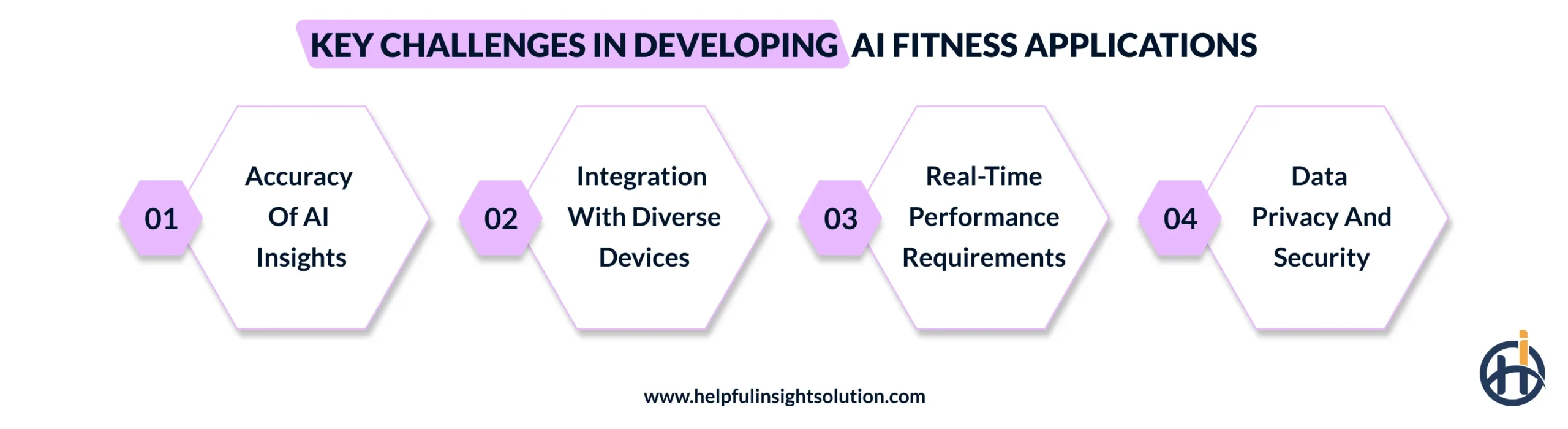
Key Challenges in Developing AI Fitness Applications
To create fitness apps with AI, you may have to face some critical market and technical challenges. We will study some key risks with their respective solutions in this section:
-
Accuracy of AI Insights
Some AI algorithms may not work properly due to compatibility issues or errors in code. This leads to inaccurate information, which can affect the result, decreasing the trust and efficiency.
Solution: Build advanced AI algorithms that can easily convert user information into assets.
-
Integration with Diverse Devices
It is difficult to integrate hardware devices with AI-powered applications because of software issues. They do not support digital drives and manual ports that allow data sharing in devices.
Solution: Use third-party solutions to integrate IoT-enabled devices with fitness apps.
-
Real-Time Performance Requirements
The role of AI in fitness apps is to deliver updated results on healthcare vitals to fulfill user needs. But irregular maintenance disturbs this effect, reducing the overall app performance.
Solution: Install packages to analyze performance and predict results based on the data.
-
Data Privacy and Security
As AI is an open-source technology, all user data is centralized and can easily be accessed. It increases the risk of information loss, security breaches, and installation of backdoors.
Solution: Implement encrypted algorithms to secure data structure and maintain user privacy.
Partner With Helpful Insight To Develop Feature-Rich AI Workout Exercise Apps
Artificial intelligence is transforming the fitness industry in so many amazing ways that no one has ever thought of. But AI has made all this possible. As a result, no business in the fitness industry wants to be left behind and wants to integrate AI in fitness apps. And why not?
Integrating AI into fitness apps enhances functionality and boosts user engagement. If you are also looking to make your own AI-based fitness app, then it is highly recommended to follow the best use cases.
We have a talented pool of experienced and skilled professionals that offers a broad range of AI app development services to both startups and established businesses around the globe. All the amazing transformative capabilities of AI in fitness industry that we have discussed in this blog, we can smoothly integrate all of these in your app.
Our team comprises expert fitness AI app developers who hold mastery in using the best AI tools and technologies to create a mobile app that brings new evolution in the fitness app market.
FAQs
Ans. AI is transforming the fitness industry by offering personalized workout plans, meal suggestions, real-time feedback, and improved user engagement. It helps users reach their fitness goals faster by adjusting exercises based on performance, while also reducing the need for a personal trainer.
Ans. To integrate AI in fitness apps, start by identifying the features you want AI to offer. Next, select the right AI technologies, create custom models, test the system, and then launch. It’s best to hire a reliable fitness app development agency USA to ensure a smooth integration.
Ans. The key technologies changing the fitness industry include AI, wearables like smartwatches, and VR/AR for virtual training experiences. These technologies help people get better results by making fitness apps more fun to use.
Ans. Some popular AI-powered fitness apps include Fitbod, Aaptiv, Freeletics, and JuggernautAI. These apps offer great features to help you meet your fitness goals. Try them out and see which one works best for you.