

Key Takeaways:
- AI automates repetitive operations, such as coding, testing, deployment, and infrastructure management, by reducing manual processes.
- In DevOps, AI uses predictive analytics, intelligent monitoring, and automated incident detection to resolve issues faster and maintain efficiency.
- Artificial intelligence predicts failures and recommends preventive measures by analyzing logs, system metrics, and historical data.
- Entrepreneurs must observe high-value use cases, integrate AI with DevOps tools, ensure data security, and monitor AI-driven workflows
Artificial intelligence has now become an important technology for coding, API integration, software testing, and deployment. From small to large-scale investors, it is delivering automated solutions that handle repetitive tasks, reduce workload, analyze patterns, and generate comprehensive customer data.
As AI in DevOps expands at scale, businesses can easily integrate development workflows with generative AI, machine learning, and NLP models. This is the advantage of AI for enterprise, which ensures constant integration and delivery across systems.
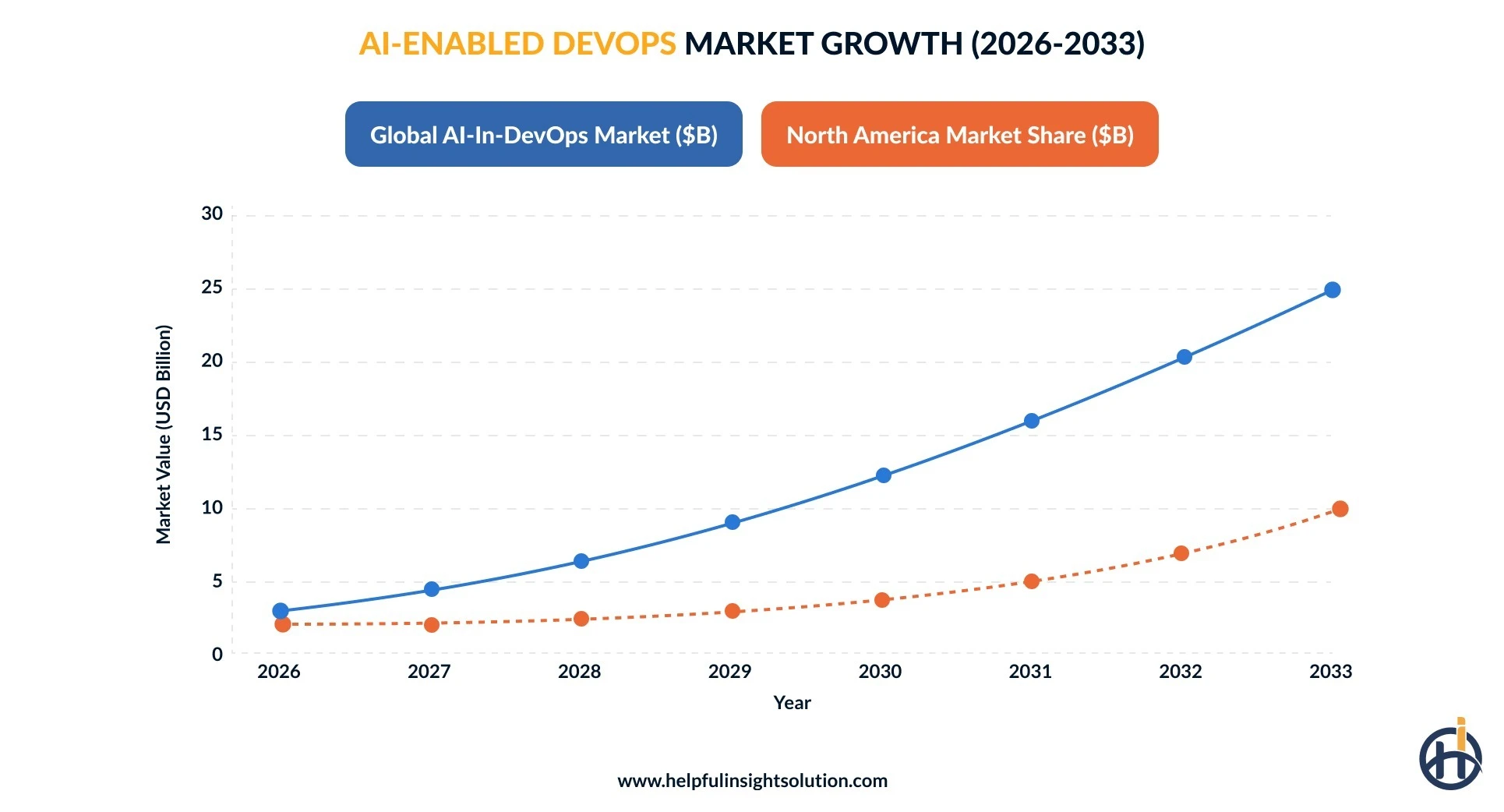
According to the US Market report, the AI-enabled DevOps market has a value of $5.5 billion in 2026, which will increase to $24.9 billion by 2033.
The growth rate of this market is 24% CAGR, with North America having the largest share of 39.4% among other regions. This shows that by adopting AI-driven tools in development and operations, businesses can expand services with great investment returns.
This blog is a complete guide that discusses key benefits, use cases, integration processes, challenges, and other important topics in detail. So, go through this write-up to ensure error-free software coding and deployment with real-world automated tools.
What is AI in DevOps?
This is the process of integrating artificial intelligence and other AI technologies into software development and IT operations to automate, accelerate, and optimize workflows.
The role of AI in DevOps is to optimize CI/CD pipelines, automate troubleshooting, predict system downtime, and review code for security.
With this, entrepreneurs can scale repetitive tasks, ensure faster recovery, and maintain trust across devices and system operations.
Key role in IT operations
By using AI for business process automation, enterprises can enhance the delivery of services, reduce overhead expenses, and optimize task management.
Some of the major AI roles in IT operations are discussed as follows:
- Detects abnormal behavior at the system level in real time before it occurs to prevent it from becoming a critical incident.
- Initiates automated actions to provide remedies for incidents without human interaction.
- Predictive analysis foresees an impending hardware or software failure so as to prevent unscheduled outages.
- Pinpoints a root cause of an incident within interconnected and complex systems in minimum time.
- It allows dynamic distribution of system resources based on actual use or real-time demand.
AI technologies used in DevOps
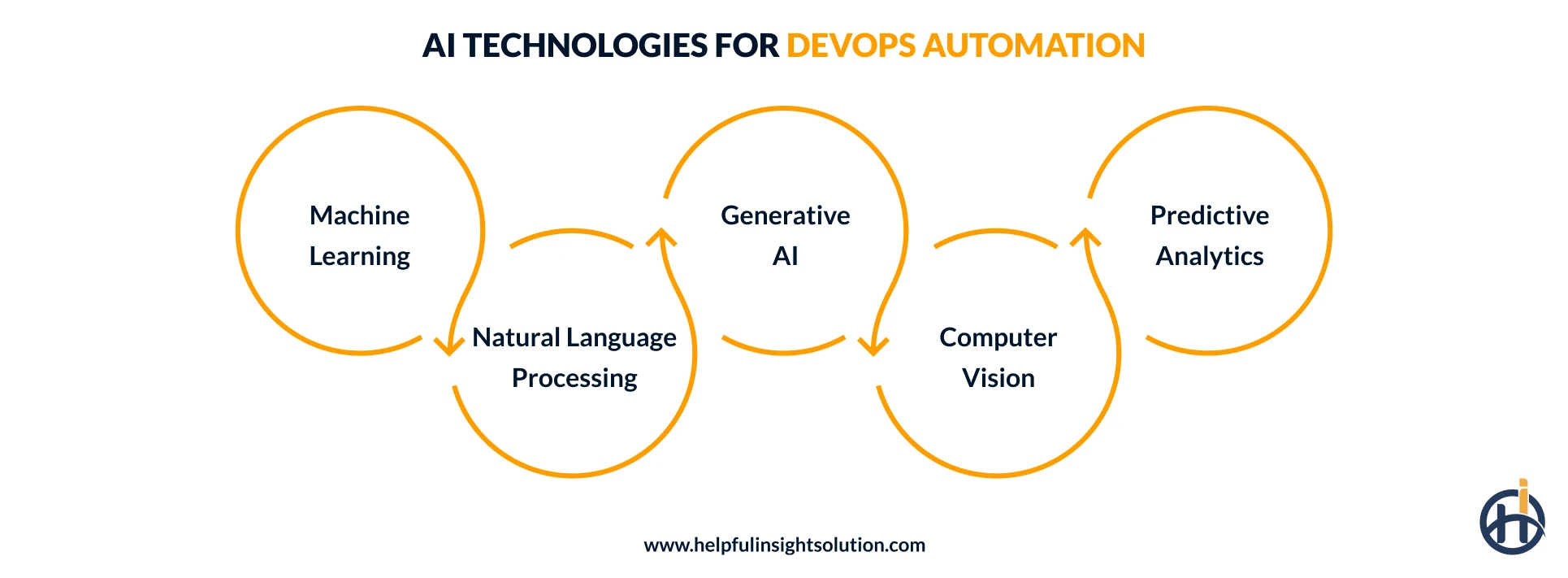
Experts integrate various artificial intelligence technologies into DevOps, including machine learning, generative AI, and more.
These technologies help businesses improve system monitoring, automate processes, analyze data, predict potential issues, and make faster, data-driven decisions.
Machine Learning
Machine learning in DevOps enables systems to analyze historical data to identify anomalies, predict potential failures, and optimize resource allocation without requiring explicit rules.
The accuracy of the model continues to improve with ongoing training against fresh operational data in real time.
Natural Language Processing
With natural language processing, DevOps tools understand and process the human language that drives chatbots to perform log analysis and manage incident summaries.
It transforms complex raw output into understandable observations, allowing teams to find documentation, query databases, and fix systems.
Generative AI
Built on LLMs, Generative AI in DevOps helps developers by writing code, producing test cases, and automating documentation in human language.
In DevOps, this is utilized to automate the generation of deployment scripts and configuration files while suggesting solutions for failed models.
Computer vision
Computer vision allows systems to process and understand visual data, such as images, diagrams, or screenshots, to generate specific and valuable outputs.
This technology is less adopted in DevOps systems and workflows compared to GenAI, as it only helps with automated scanning and visual checks.
Predictive analytics
Predictive analytics in DevOps analyzes historical and real-time data to forecast system failure, capacity bottlenecks, or performance decline before they actually occur.
The primary goal of this AI technology is to enable DevOps to support proactive planning, scheduling maintenance, and scaling resources.
Key benefits of artificial intelligence in DevOps
Enterprises must know the benefits of using AI in DevOps, such as operations management, to prevent forced implementation. These advantages, like deployment accuracy and speed, are discussed briefly in this section.
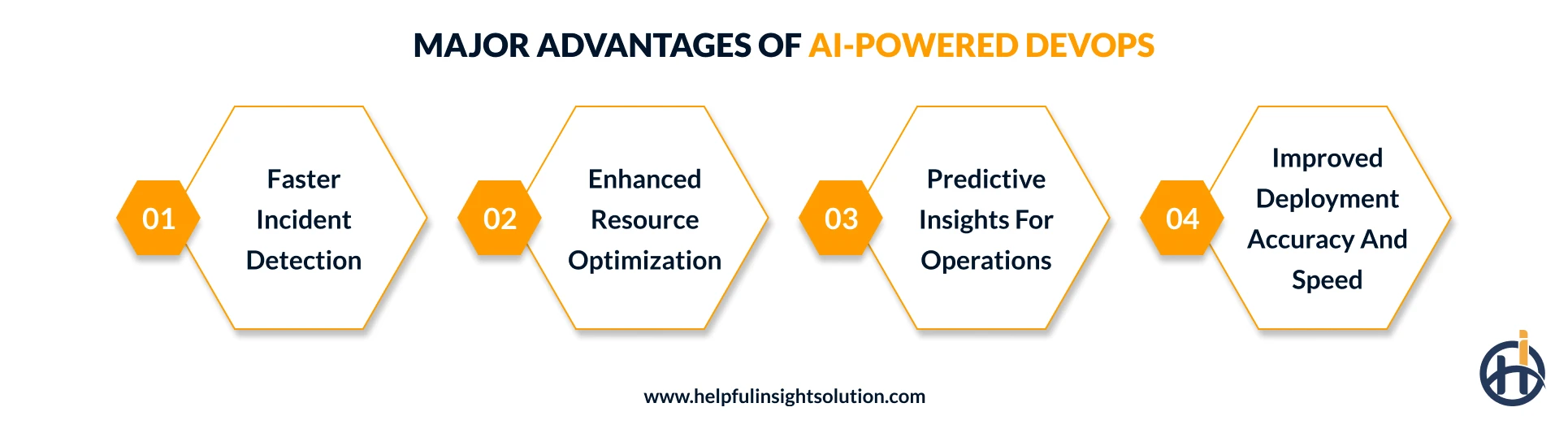
Faster incident detection
The constant monitoring from AI-driven tools helps to identify abnormalities and failures instantly from logs, metrics, and even system behavior.
This allows teams to fix issues before the risk increases and easily reduce mean time to detection MTTD and resolution MTTR from hours to minutes.
Enhanced resource optimization
These usage patterns and load demands are used by the AI to dynamically allocate computing resources to servers and self-healing infrastructure, avoiding over-provisioning and underutilization.
This enables businesses to easily manage their savings and ensure seamless performance across enterprise systems.
Predictive insights for operations
By leveraging historical trends, AI can easily learn failure patterns, capacity limitations, or decreased system performance before an event takes place.
It helps the DevOps team to implement predictive analytics instead of preventive actions, restricting operational issues on a large scale.
Improved deployment accuracy and speed
AI-powered CI/CD Pipelines can smartly test changes in the source code, predict deployment risks, and automatically avoid failed releases without manual intervention.
With this, development teams can release their software quicker, transferring code to production.
Top AI Use Cases in DevOps
This section provides the top AI use cases in DevOps that cover integration, testing, cause analysis, and code review. The following points will help businesses decide which use case to choose for future growth.
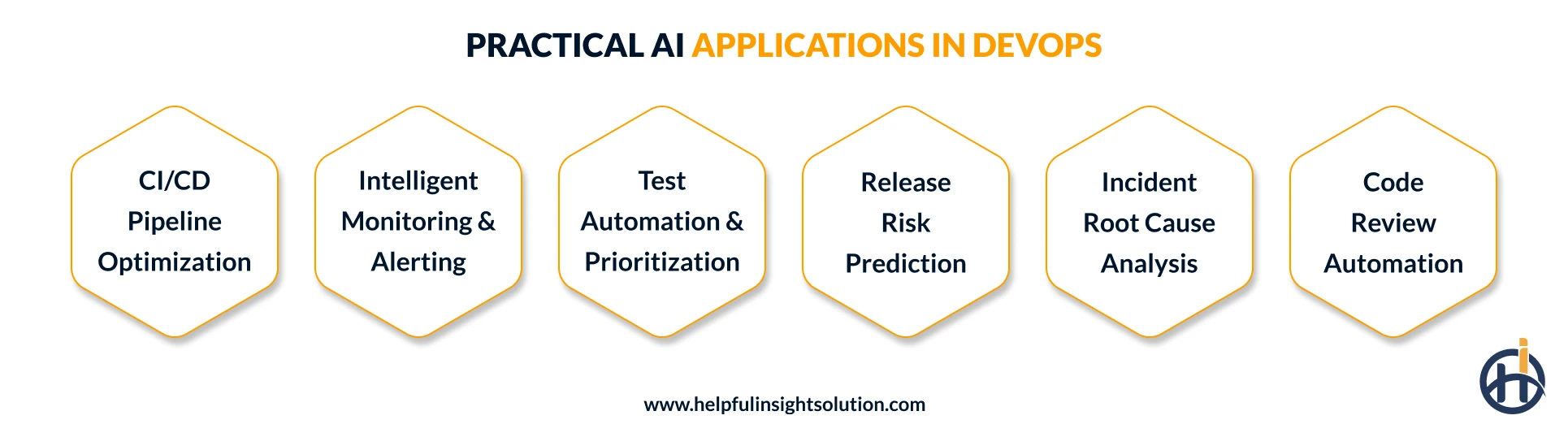
CI/CD pipeline optimization
In CI/CD pipeline optimization, AI reviews past build and deployment data to reveal issues, enhancing build sequences, parallelizing tasks, and reducing overall pipeline execution time.
By doing so, teams are able to release the code quicker without wasting resources on inefficient, redundant processing.
Intelligent monitoring & alerting
AI monitoring tools examine live performance metrics and log files to detect true anomalies by eliminating noise, as systems may generate thousands of alerts.
When a genuine issue is detected, Generative AI can analyze the context, summarize the incident, and generate an appropriate response or alert instead of relying solely on simple static thresholds.
Test automation & prioritization
AI automatically determines which tests can easily find bugs according to recent code changes, eliminating time spent on the least effective tests and prioritizing high-risk areas.
Businesses can ensure DevOps automation with AI while optimizing code quality and covering various testing processes.
Release risk prediction
AI systems utilize code complexity, recent development activity, and previous failure information to analyze which releases will most likely cause problems before launch.
The data allows teams to execute extra testing for high-risk releases or delay deployment until concerns have been resolved.
Incident root cause analysis
AI correlates data across logs, metrics, and system dependencies to quickly identify the precise root cause of the incident, preventing engineers from tracing through complex system layers.
Incident root cause analysis helps businesses to easily minimize mean time to resolution for a critical system failure.
Code review automation
AI tools for code review will automatically scan pull requests against bugs, security issues, and style inconsistencies to send instant feedback to human code reviewers.
This gives quicker review turnarounds while also identifying errors that the system may have missed manually.
Real-world examples of AI for DevOps
Various tech giants have already implemented artificial intelligence in DevOps to automate testing and code analysis. In this section, we will observe them and the key impact they have experienced after introducing AI.
Meta TestGen-LLM
Meta developed TestGen-LLM to improve existing unit tests using LLMs, targeting improved code coverage by identifying previous edge cases.
In internal testing, it improved 11.5% of all classes it was applied to, with 73% of its recommendations accepted for production deployment by Meta engineers.
Key business impact: It can reduce engineering time spent on writing and maintaining test cases manually.
JPMorgan COiN
JPMorgan’s Contract Intelligence (COiN) platform combines NLP, machine learning, and computer vision to review and extract data from legal documents and loan agreements.
Earlier, legal teams took multiple hours to review manually, but COiN processes them in seconds, reducing document search and review time.
Key business impact: It helps to minimize human error and compliance risk in high-stakes financial document review.
IBM Watson AIOps
IBM Watson AIOps solutions provide explainable AI models to the IT operations toolchain, helping teams assess, diagnose, and resolve incidents across various workloads.
It excels at predictive analytics, using historical and real-time data to forecast potential IT issues before they escalate into major outages.
Key business impact: This platform cuts operational downtime by enabling faster incident response decisions.
AI DevOps tools you should know
In modern-day coding practice, several AI tools in DevOps are available, such as GitHub Copilot, Snyk, and Dynatrace. Here, you will understand their properties and how they automate various development tasks.
GitHub Copilot
GitHub Copilot is an AI-powered coding assistant that helps to write better code completions, generates functions, and offers debugging help within the IDE using LLMs.
It also helps by creating pull request summaries and supporting workflows throughout the entire application development lifecycle.
Key feature: It allows developers to choose among various upfront AI models, such as GPT, Claude, and Gemini, on the stack.
Snyk
Snyk is a developer-security platform that employs a hybrid AI engine combining machine learning and symbolic AI to examine codebases and containers for vulnerabilities.
Beyond discovering security risks, it provides valid auto-fixes that empower development teams to identify and address potential risks before release.
Key feature: It categorizes vulnerabilities based on exploitability and business risks, not by severity score, and prioritizes what to fix.
Dynatrace
The AI-powered observability platform Dynatrace uses the DAVIS AI engine to monitor the performance of applications and infrastructure.
It utilizes predictive and generative AI to provide continuous observation with automatic anomaly detection, exact pinpointing of root cause, and intelligent recovery suggestions.
Key feature: This tool can easily visualize real-time dependencies across the complete tech stack for tracking source code.
How to implement AI in development operations?
To implement AI in DevOps, businesses follow a step-by-step process, which includes multiple stages. This section discusses key steps, from system assessment to model optimization and platform scaling.
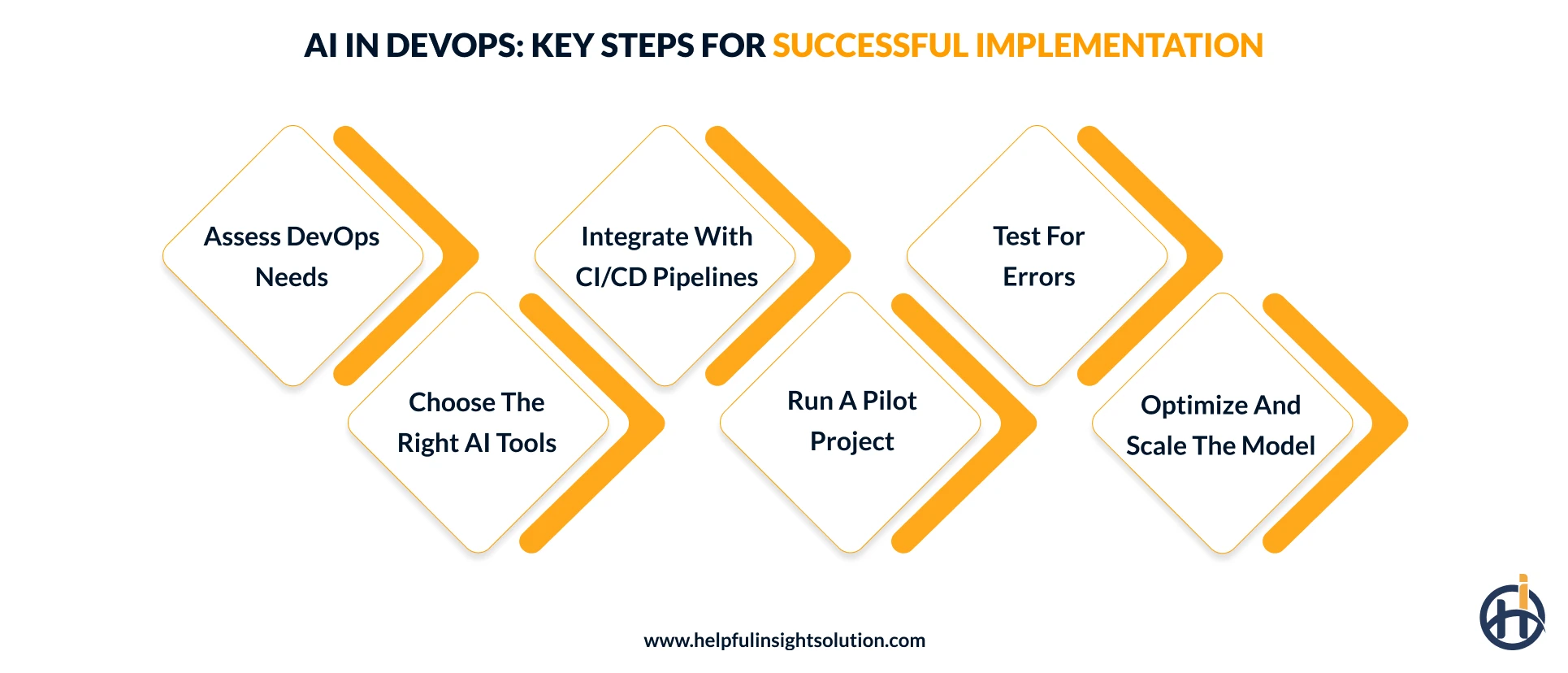
Assess DevOps needs
Initially, it is crucial to analyze DevOps workflows and identify pain points like slow incident response times, manual testing bottlenecks, or constant failed deployments.
With this, enterprises can determine AI’s impact on current processes and ensure that it can validate or estimate needs. The outcome is a well-established strategy to set realistic goals and success metrics.
Choose the right AI tools
Now, it is easy to select AI tools based on specific use cases such as security testing, code development, issue administration, or code generation.
Through AI development services, enterprises can easily focus on infrastructure compatibility, integration, scalability, and vendor support. An inappropriate tool selection may result in low adoption and wasted investment.
Integrate with CI/CD pipelines
Businesses should implement selected tools directly in their CI/CD pipelines so that insights and automation gained by AI become a natural part of the development process.
For this, it is important to use relevant APIs, webhooks, or plug-ins that allow AI tools to trigger other elements within the pipeline.
This prevents teams from switching context between different interfaces to utilize AI capabilities.
Run a pilot project
Before mass implementation, it is crucial to test AI tools on a low-risk project to assess their efficiency and gather useful data based on performance.
This pilot phase helps to find system issues or integration gaps in a controlled environment before wider deployment. Additionally, this will allow teams to gain experience working with AI tools before implementation.
Test for errors
Enterprises should evaluate AI-powered DevSecOps workflows for false positives, missed detections, and unsafe automated actions before allowing them to affect production.
They must observe each AI output that might be directly used against the real data before making it live by validating code suggestions.
This phase is necessary to increase users’ trust in the AI system before performing critical operations.
Optimize and scale the model
After successful problem resolution, businesses can easily launch the AI solution for more teams, project areas, or the entire DevOps pipeline.
They should monitor the AI’s performance closely, retrain models by using new data, and optimize settings to sync the AI with the workflow and infrastructure changes.
With ongoing optimization, it is easy to ensure the AI continues to provide value on a large scale.
Major challenges of integrating AI for DevOps
The integration of AI and DevOps includes multiple challenges, such as increased costs and security issues. We are going to study these technical and financial obstacles with their respective solutions in this section.
Data privacy and security risks
Exposed source code or API keys may be a threat to intellectual property and affect internal configurations or repositories. Attackers can manipulate open-source data to trick AI models so they violate compliance frameworks at later stages.
Solution: Businesses should apply data-loss prevention controls, secret management, access controls, encryption, audit logging, and appropriate model-hosting policies.
Toolchain compatibility issues
Deterministic software pipelines collide with non-deterministic AI models, creating compatibility issues like API mismatch and legacy system friction.
LLMs can struggle to maintain reliable context across complex configuration states and may generate incorrect parameters.
Solution: Use APIs, adapters, middleware, or workflow orchestration to normalize legacy data and use robotic process automation only where direct integration is impractical.
High initial investment
Businesses need powerful GPUs to run advanced ML models, invest in data formatting, and integrate commercial AI platforms.
This specialized hardware, expensive cloud infrastructure, and premium tooling increase the overall automation cost for various enterprises.
Solution: It is beneficial to pick a single use case, like automated test generation, and measure ROI in real time to manage future budget expansion and scalability.
Partner with Helpful Insight to ensure AI-powered DevOps solutions for your business
Businesses looking to integrate AI in DevOps should partner with a reliable software development partner with the desired experience and an agile approach.
We assist business investors in finding key metrics that ensure seamless integration, testing, and deployment. Additionally, they can experience a collaborative environment and the technical expertise of our developers.
Here, enterprises go through various business models according to their preferences and choose by analyzing system capabilities, budget, scalability, and ongoing maintenance.
Our experts use specialized AI DevOps tools that ensure intelligent testing support, automated code generation, and optimized CI/CD workflows.
This allows them to perform different tasks, from design to market launch, without any human interference. So, it is the best time to start gathering the necessary resources and propose the idea to get an edge over other competitors.
Frequently Asked Questions
Artificial intelligence will not replace DevOps engineers, as it helps them perform various tasks, like monitoring AI agents. The experts are still safe because AI does not ensure 100% accuracy in the production environment. Also, AI cannot navigate legacy systems, handle cybersecurity teams, or understand broader business goals.
Businesses spend between $40,000 and $100,000 to integrate artificial intelligence in DevOps for small to mid-sized operations. The cost ranges from $100,000 to $200,000 for an enterprise environment that focuses on multi-system integrations. The ongoing maintenance cost ranges from $3,000 to $25,000/month due to API token consumption.
AI improves incident management by automating alerts, accelerating root cause analysis, and reducing mean time to resolution (MTTR). It reduces noise, enables faster detection, and predicts failures in real time by analyzing anomalies. This helps to fix major issues, generate timelines, summarize calls, and highlight key decision points.
Yes, artificial intelligence in DevOps automates code review, predicts failures, and ensures smart testing to improve software quality. It tracks build performance, maps metrics, and triggers automatic rollbacks to monitor CI/CD pipelines. With root cause analysis, it is easy to find exact issues, reduce downtime, and configure fixes.
The future of DevOps and AI involves shifting engineers from manual scripting to high-level system design. Key AI-driven trends and innovations are discussed in the following manner:
Systems will be able to forecast failures, check performance, and flag security issues.
They will perform routine scaling, analyze log files, allocate resources, and recover files.
Voice assistants will handle incident responses and pipeline commands in real time.