

Key takeaways
- LangChain, LangGraph, CrewAI, Microsoft Agent Framework, Google ADK and Mastra are among the best AI agent frameworks.
- AI agent frameworks provide the tools and structure needed to build agents that can handle tasks, use external tools, and manage workflows.
- Python, JavaScript, and TypeScript are commonly used for AI agent development, with the choice depending on the framework and application requirements.
- Before choosing a framework, consider security, production readiness, scalability, and ongoing expenses to avoid issues as your AI agents grow.
Enterprises are looking for ways to connect work across departments, reduce manual handoffs, and make better use of available information. AI agent frameworks give the tools to build agents that can work across different applications and handle multi-step tasks.
However, adding more software does not always solve disconnected workflows. Mordor Intelligence reports that 82% of C-suite executives see functional silos as a major barrier to getting value from AI, making better system and workflow connections an important consideration.
AI agents can do more than respond to questions. Depending on their configuration, they can use tools, gather information, complete tasks, and manage multi-step workflows with varying levels of human oversight. From handling customer queries to supporting different AI agent use cases across business operations, their applications are growing.
Building an agent that works reliably across these tasks depends partly on the framework behind it. Each framework takes a different approach to workflow management, integrations, and agent coordination.
This guide compares top AI agent frameworks to help developers and CTOs find an option that fits their technical requirements and project goals.
What is an AI agent framework and why does it matter?
An AI agent framework is a software toolkit for building and managing autonomous AI agents. It provides the pre-built components agents need to understand a task, decide what to do next, use external tools, and keep track of information as they work.
Rather than making a separate model for each step of the process, you can use the framework to orchestrate the entire process.
These frameworks also reduce the amount of supporting code that developers would otherwise have to write. They assist with task orchestration, agent-to-agent communication, agent-to-system communication, and managing different stages of the workflow. This gives developers more time to focus on what the agent actually needs to do.
Top AI agent frameworks in 2027: Quick comparison table
With several frameworks available, choosing one based on its name or popularity alone may not be enough. You need to understand what each option brings to the table. The following AI agent framework comparison gives you a starting point before we look at each framework individually.
| Framework | Primary programming languages | Open source | LLM / Model Support | Best For |
| LangGraph | Python, JavaScript | Yes | OpenAI, Anthropic, Google Gemini, AWS Bedrock | Stateful production workflows |
| LangChain | Python, JavaScript | Yes | OpenAI, Anthropic, Google Gemini, Hugging Face, AWS Bedrock | Building LLM-powered applications and agents with integrations |
| CrewAI | Python | Yes | OpenAI, Anthropic, Google Gemini, Azure, and others through LiteLLM | Role-based multi-agent systems |
| Microsoft Agent Framework | Python, C#/.NET | Yes | OpenAI, Azure OpenAI, Anthropic, Gemini, AWS Bedrock, Mistral, and others | Enterprise agents and multi-agent workflows |
| OpenAI Agents SDK | Python, TypeScript | Yes | OpenAI models and 100+ other LLMs | Lightweight OpenAI agents |
| Google ADK | Python, TypeScript, Go, Java, Kotlin | Yes (Apache 2.0) | Gemini and other model providers through integrations | Multi-agent applications and Google Cloud-based projects |
| Pydantic AI | Python | Yes | OpenAI, Anthropic, Gemini, AWS Bedrock, Azure OpenAI, and many others | Type-safe, model-independent AI agents |
| Mastra | TypeScript | Yes (Apache 2.0) | OpenAI, Anthropic, Gemini, xAI, and 40+ providers | Full-stack TypeScript agents |
| Claude Agent SDK | Python, TypeScript | Yes | Anthropic Claude models | Coding agents and applications built around Claude Code |
Best AI agent frameworks for enterprise applications
Each AI agent framework has its own approach to building and managing agents. Let’s explore their capabilities and practical applications to understand how each option can support AI for enterprise and meet different business requirements.
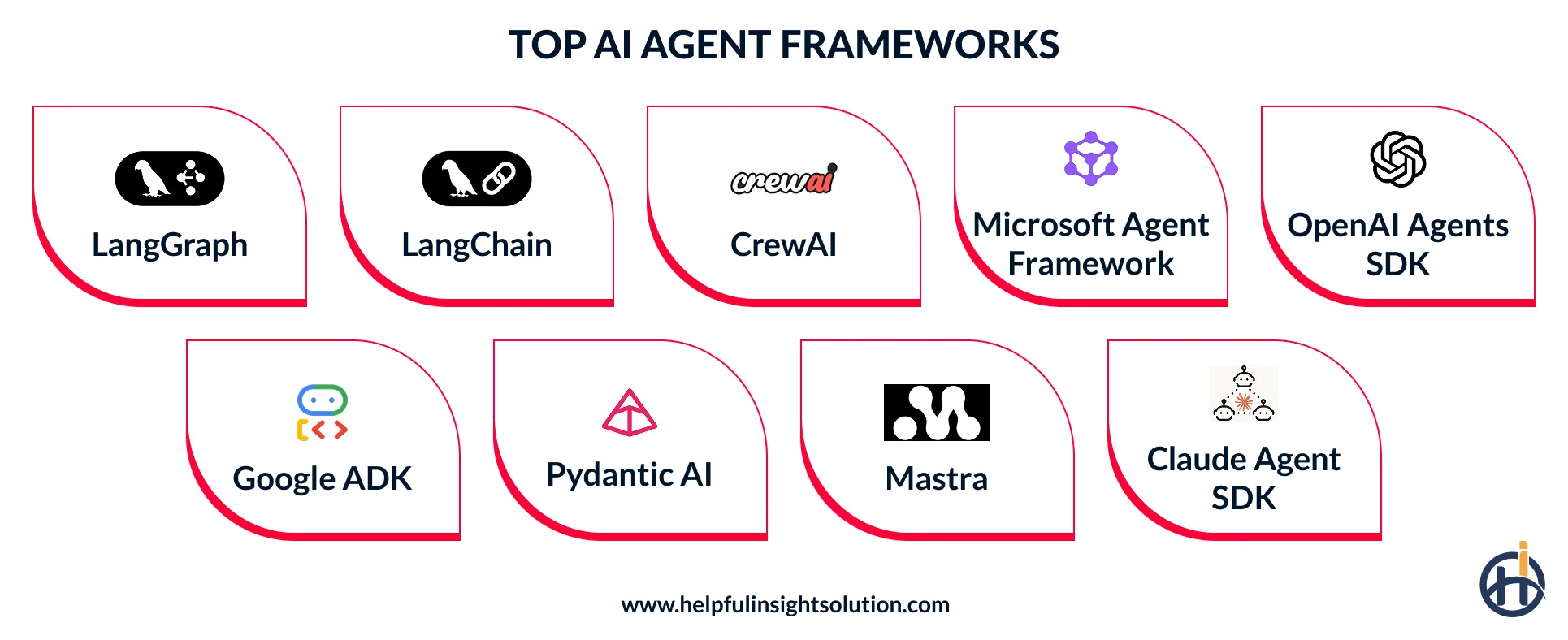
1. LangGraph
LangGraph is a JavaScript and Python AI agent framework from LangChain for building AI agents that need fine-grained control over how they operate. It’s essentially a graph where each node is a step, and you can define the workflow, conditional paths, and maintain state across interactions.
Key features
- Graph-based workflow orchestration
- Persistent state management
- Checkpointing & error recovery
- Multi-agent orchestration
Pros
- Flexible workflow customization
- Supports human oversight
- Handles complex agent workflows
Cons
- Steeper Learning Curve
- Debugging complex graphs can be difficult
2. LangChain
Developers often need more than a language model to build a working AI application. LangChain provides the additional components needed to connect large language models with data sources, APIs, and external tools.
Its modular approach creates applications by combining different functions, making it useful for projects involving information retrieval, conversational interfaces, and automated workflows.
Key features
- Extensive third-party integrations
- Modular component architecture
- Prompt template management
- Retrieval-augmented generation (RAG)
Pros
- Large integration ecosystem
- Reusable development components
- Flexible model connections
- Faster application prototyping
Cons
- Frequent API changes
- Additional setup is required for complex workflows
3. CrewAI
CrewAI is an open-source multi-agent framework that helps developers build teams of AI agents to handle tasks together. Each agent can have a specific role, goal, and set of tools. They work together to complete tasks such as research, content creation, data analysis, and other business processes.
Key features
- Role-based agent configuration
- Task assignment
- Agent collaboration
- Sequential task execution
Pros
- Simple agent setup
- Deep template ecosystem
- Intuitive role-based model
- Supports team-based tasks
Cons
- Limited workflow flexibility in some setups
- Higher costs with multiple agents
4. Microsoft Agent Framework
Developed by Microsoft, this framework enables you to build individual agents as well as functional and graph-based workflows that govern how multiple agents work together.
It also brings together the capabilities of Microsoft’s earlier AutoGen and Semantic Kernel projects into a single SDK. You can set up agent conversations, connect external tools, and orchestrate multi-agent workflows.
It also supports integration with Microsoft technologies, making it worth considering among the best AI agent frameworks for businesses using Azure and .NET.
Key features
- Single and multi-agent support
- Agent-to-agent communication
- Workflow management
- Persistent execution
Pros
- Strong Microsoft integration
- Supports multiple languages
- Built for enterprise projects
Cons
- A2A support still beta
- Non-Azure adapters need testing
5. OpenAI Agents SDK
The OpenAI Agents SDK enables developers to create AI agents that can use tools and carry out tasks in a step-by-step manner. It supports both Python and TypeScript and includes functionality for agent handoffs, response checking, and activity tracking.
This framework can be used to build AI chatbots like ChatGPT that go beyond answering questions and can also perform tasks using connected tools.
Key features
- Agent and tool calling
- Input and output guardrails
- Custom model support
Pros
- Simple agent setup
- Built-in tracing tools
- Supports external tools
Cons
- Requires coding knowledge
- Limited visual development tools
6. Google ADK
Google ADK is a development framework for developing AI agents that can handle tasks, use external tools, and work with other agents. Although it is designed to work closely with Gemini, developers can also connect it to other language models.
This Python AI agent framework supports multi-agent workflows and has a suite of tools for testing and deployment. It is a practical option for teams building agent-based applications with Google Cloud services.
Key features
- Multi-agent setup
- Agent testing tools
- Text and image support
Pros
- Easy agent testing
- Clear development structure
- Useful developer interface
- Supports different languages
Cons
- Requires framework familiarity
- Setup can be complex
7. Pydantic AI
If you’ve got a project that requires AI agents to work with structured data, then Pydantic AI is definitely worth a look. It uses Python’s type system to validate data and catch errors before they become an issue.
It’s also able to work with a range of different large language models, so you’re not locked into a single provider. This open-source AI agent framework is a useful option for those who want to work with Python.
Key features
- Typed, validated outputs
- Logfire tracing integration
- MCP support
Pros
- Best Python structured output
- Model-neutral design
- Built-in token budget caps
Cons
- Smaller ecosystem
- Frequent breaking changes
8. Mastra
Mastra takes a TypeScript-first approach to create AI agents. Rather than having a disparate set of tools for each part of the project, you get support for workflows, memory and information retrieval all within the framework. It also works with several model providers and fits into common JavaScript development setups.
Teams using React, Next.js, or Node.js can add AI capabilities on top of the stack they’re already familiar with. This TypeScript AI agent framework also includes tools to test and monitor agent performance.
Key features
- Agents plus workflows
- Suspend-and-resume workflows
- Local Mastra Studio
- 600+ models via routing
Pros
- Strong TypeScript developer experience
- Excellent type safety
- Fast runtime performance
Cons
- TypeScript only
- Heavy install size
- Opinionated defaults
9. Claude Agent SDK
AI projects sometimes require an agent to work directly in the developer’s environment rather than just responding with text. The SDK provides programmatic access to the agent runtime, tools, and capabilities that power Claude Code.
Developers can use it to build agents that inspect project files, run terminal commands, and perform multi-step coding tasks. When looking at the various open source AI agent frameworks available, the Claude Agent SDK is worth considering if you’re building an agent that will work with code, files, and other tools.
Key features
- Built-in file and bash tools
- Subagents and hooks
- Permission controls
- Persistent, resumable sessions
Pros
- Ready-made agent harness
- Isolated subagent contexts
- File change checkpointing
Cons
- Claude models only
- Very high token overhead
- Slower response latency
How to select the right AI agent framework for your business needs
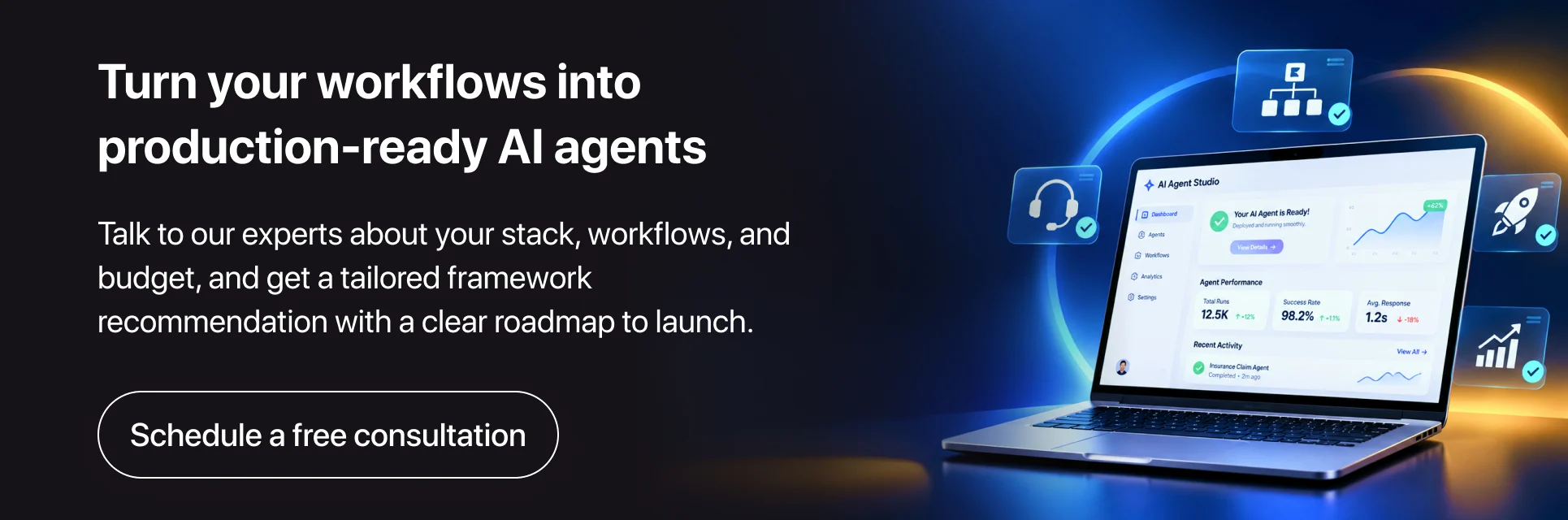
Choosing from the best AI agent frameworks requires more than comparing features. Enterprises and AI development services providers must consider their project scope, development resources, and future requirements.
Let’s look at the important factors that can help you find an AI agent framework for production that fits your needs.
1. Define business use cases
Start by identifying the exact operational problems your autonomous agents need to solve and linking them to measurable outcomes. Will they be handling customer queries, processing documents, or managing day-to-day operations?
What problems are you trying to solve, and what tasks will the agents perform? Answering these questions will go a long way toward helping you find the right framework for your business.
2. Assess workflow complexity
Not every business process requires multiple AI agents. If the work follows a fixed set of steps, a simple framework may be enough. However, if the process involves several decisions, changing instructions, or multiple agents, you’ll need more control over how each step is executed.
Review your requirements to determine what level of AI agent orchestration you need.
3. Match your tech stack
Before settling on a framework, consider how well it fits your current technology. Check whether it supports your preferred programming language, databases, and tools used across your business.
Also evaluate its API integrations and supported model providers. Strong compatibility with your existing systems can reduce integration effort and minimise changes to your current technology stack.
4. Evaluate security and governance
AI agents may need access to customer records, financial details, and other private business information. Before choosing a framework, check how it manages data access, user permissions, and activity logs.
It should also let you review important actions before they are completed. This is especially important when using AI agents for insurance to handle sensitive customer and policy information.
5. Check production readiness
Don’t judge a framework by how easy it is to build an agent with it. Think about how it will perform once deployed and handling live traffic. Look at its monitoring, error handling, and scaling options. These factors will help decide whether the AI agent framework is up to the job in a production environment.
6. Estimate total running cost
An AI agent framework may seem affordable at first, but running agents over time can bring additional expenses. Check the cost of model calls, cloud infrastructure, and ongoing support.
Also, see whether you can use less expensive models for simpler tasks. This gives you a better idea of the total AI agent development cost before making your decision.
Conclusion
AI agent frameworks are increasingly being used as part of how businesses plan their digital services and improve existing ones. The framework you choose will affect how easily agents can be incorporated into your workflows, how much control you have as their role evolves, and how easily they can be updated.
It is worth looking beyond the first use case and considering how your needs may change as more teams begin using AI agents. A suitable choice now can help avoid changes as your project develops.
Choosing an AI agent framework becomes easier when you have developers who know how different options work in practice. Our AI agent development company can help assess your requirements and select an AI agent framework that fits your use case, technical setup, and plans.
Whether you’re planning a simple task-based agent or a more complex solution, we can guide you through framework selection and development.
Book a free consultation with our team to discuss your project and find the right framework for your business.
FAQs
An AI agent framework provides tools and code libraries to build agents, while an AI agent platform offers an environment to develop, deploy, manage, and monitor them.
CrewAI, OpenAI Agents SDK, and LangChain are the best AI agent frameworks for beginners.
Python, JavaScript, and TypeScript are all used to build AI agents. Python works well for AI development, while JavaScript and TypeScript are used for web-based applications.
Yes, you can switch AI agent frameworks, but you’ll usually need to rebuild the agent’s workflows, tool connections, and orchestration logic.