

Key Takeaway:
- Building an AI prototype is easy, but making it work inside a real company is where most projects get stuck. The cause is usually messy data, old systems, and security rules, not weak AI.
- A forward deployed engineer (FDE) joins your team, writes production code in your own systems, and stays until it runs reliably.
- Projects usually fail because of messy data, integration gaps, no clear measure of success, and no owner after launch.
- You likely need one when a pilot works but breaks on real data, the problem is specific to your company, the work is regulated, a deadline depends on the AI, or people aren’t using the tool.
- Main benefits: faster path to production, a better fit with daily work, quicker feedback, safer deployment, and skills that stay with your team.
- When hiring, look for a production track record, hands-on AI skills, data and integration experience, clear communication, security judgment, and good handoff habits.
Building an AI prototype is the easy part. Getting it to work inside a real company is where most teams get stuck. The model usually isn’t the problem. The trouble is messy data, old systems, security rules, and workflows nobody planned for.
That’s the gap a forward deployed engineer fills. This person joins the client’s team, learns how the business actually runs, and writes production code inside the client’s own systems.
Companies are now hiring for this role at a fast pace: an analysis by Indeed’s hiring lab and the Financial Times found that forward deployed AI engineer postings rose 800% between January and September 2025.
This guide covers what the role involves, how it compares with similar tasks, and when a company needs one. Whether a company is looking for AI development services or trying to save a pilot that went quiet, the first question is the same: who will take responsibility for moving the AI system from prototype to production?
What Is a Forward Deployed Engineer?
A forward deployed AI engineer is a software engineer who works closely with a customer to design, build, and integrate AI-powered solutions, such as LLM applications or ML pipelines, into their existing systems. The level of involvement after launch varies by role and company.
The short name is FDE. A forward deployed engineer does the same work for AI, language model apps, search over company documents, agents, and machine learning models.
Palantir helped popularize the forward-deployed engineering model through work with government and defense customers. Palantir sent engineers to work on site instead.
The name comes from military language for putting specialists close to the action. Companies including OpenAI, Anthropic, Scale AI, Anduril, and Salesforce have advertised or described roles associated with forward-deployed engineering
The same work shows up under other titles, like applied AI engineer, deployment engineer, or AI solutions engineer. Some vendors say embedded AI engineers. The label changes, but the job stays the same: take something that works in a demo and make it work in one company’s real conditions.
A lot of today’s work is large language model development inside company systems. The engineer connects a model to internal documents, checks its answers against real cases, and makes sure it follows the company’s access and security rules.
Why Do AI Projects Stall Between Pilot and Production?
A pilot and a live system are very different things. A pilot proves the idea works in a controlled setting: a narrow scope, a small team, and a data set someone has already prepared. A live system has to handle messy data, old software, strict permissions, and users who have to trust what it says.
Here’s how often projects stop at that point:
- GoodFirms reports that close to 70% of software and AI companies have already adopted the forward deployed engineering model.
- Gartner predicted that more than 40% of agentic AI projects would be canceled by the end of 2027, citing rising costs, unclear value, and weak risk controls.
Four causes show up again and again:
- Messy data: Company records live in old databases and spreadsheets. AI tools can’t use them until someone cleans and connects them, and pilots usually skip that step.
- Integration gaps: A live system has to work with login and permission systems, data location rules, and security reviews. A pilot rarely meets any of them.
- No test for success: Nobody agrees on what good accuracy, cost, or speed looks like, so nobody can say whether the system is ready.
- No owner after launch: Monitoring and fixes fall between teams. Small problems pile up until users quit trusting the tool.
A demo agent only has to work once. A real one has to survive a tool timing out, a permission going missing, or data coming back wrong. That’s the part we focus on in our AI agent development services.
What Does a Forward Deployed Engineer Do?
This engineer takes an AI system from prototype to a working deployment in the client’s environment. Most days mix coding, data cleanup, testing, and plenty of conversations with the people who use the system.
Core responsibilities
- Discovery. Watches how people do their jobs and finds where the process breaks.
- Data preparation. Pulls scattered sources together and builds pipelines the AI system can read.
- Building. Writes production code in the client’s repository: document search, prompts, APIs, and tool connections.
- Testing. Builds test sets from the client’s own documents and tracks accuracy, cost, and response time.
- Integration. Connects the system to old databases, login systems, and logging without disturbing daily operations.
- Training and handoff. Writes down decisions, trains staff, and works alongside internal developers so they can take over.
- Field feedback. At a vendor, passes what users need back to the product team.
When a project needs its own model, the basics decide whether it holds up past the first month. Versioned training data, tests on unseen data, and drift monitoring after launch are what you should expect when you avail machine learning development services .
Skills a Forward Deployed Engineer Needs
Technical skills
- Production code in Python and at least one other language, such as TypeScript, Java, or Go.
- SQL, data pipelines, and a cloud platform like AWS, Azure, or Google Cloud.
- API design and system integration.
- Document search, prompting, and testing methods for LLM systems.
- Security basics, such as secrets management and access control.
People skills
- Listening well and turning business needs into clear engineering tasks.
- Explaining technical limits to leaders who aren’t technical.
- Managing timelines and expectations with the client.
- Staying calm in an environment with little documentation.
What an Engagement Looks Like
Engagement length depends on scope, data readiness, integrations, security reviews, and client decision-making. A narrowly scoped deployment may take weeks, while broader enterprise programs can run for several months. The work usually moves through four stages:
- Discovery. Map the current workflows, identify relevant data sources, and document technical, operational, and security constraints.
- Prototype on real data. Use real data and real users, not samples.
- Production hardening. Add security, monitoring, testing, and a plan for failures.
- Handoff. Deliver documentation and training, and set a date when the client team takes over.
An engagement that drags past a year often points to a staffing gap, not a planned model.
Forward Deployed Engineer vs Other Roles
These roles overlap a lot. The simplest way to tell them apart is to ask who owns the code in production after launch.
| Role | Stage of work | Writes code in the client environment | Main output |
| Forward deployed engineer | Post-sale, embedded | Yes | A working system in production |
| Software engineer | Product or internal team | In its own codebase | Features for many users |
| Solutions architect | Pre-sale or design | Rarely | Architecture and design documents |
| Staff augmentation developer | Under the client’s lead | Yes, as assigned | Completed tickets |
| Consultant | Project-based, advisory | Rarely | Strategy and recommendations |
1. Forward Deployed Engineer vs Software Engineer
A software engineer usually builds features for many users from specs and tickets, and feedback reaches them through product managers. An FDE builds for one customer’s problem and hears from the end users directly. Software engineers go deep in one codebase. FDEs cover more ground: data, integrations, and what the customer needs.
People often mix this role up with custom software development, and the two are close. The difference is that a custom build usually follows a written scope, while an FDE works in the middle of the client’s day-to-day operations.
2. Forward Deployed Engineer vs Solutions Architect
A solutions architect designs the system and shows it can work, usually before or during the sale. What gets handed over is a design.
A forward deployed engineer takes that design and builds it, including the problems nobody planned for. After launch, production issues rarely land on the architect. They land on the FDE.
3. Forward Deployed Engineer vs Staff Augmentation
Staff augmentation adds a developer who works on set tasks under the client’s engineering lead. It works well when the team knows what to build and can direct the work.
An FDE owns an outcome, like a working integration, and decides how to get there. If the requirement is clear and the real problem is capacity, companies can hire dedicated developers through IT staff augmentation instead.
4. Forward Deployed Engineer vs Consultant
A consultant delivers analysis and recommendations, and then the client’s team builds. An FDE writes and deploys the code. In practice, the lines blur. Some job posts use the FDE title for sales engineering or consulting work, so check the actual duties before hiring or buying.
When Do Businesses Need a Forward Deployed Engineer?
A business needs one when an AI system works in a pilot but breaks on real data, systems, or workflows, and no internal team has the time or skill to fix it. These six situations make that clear:
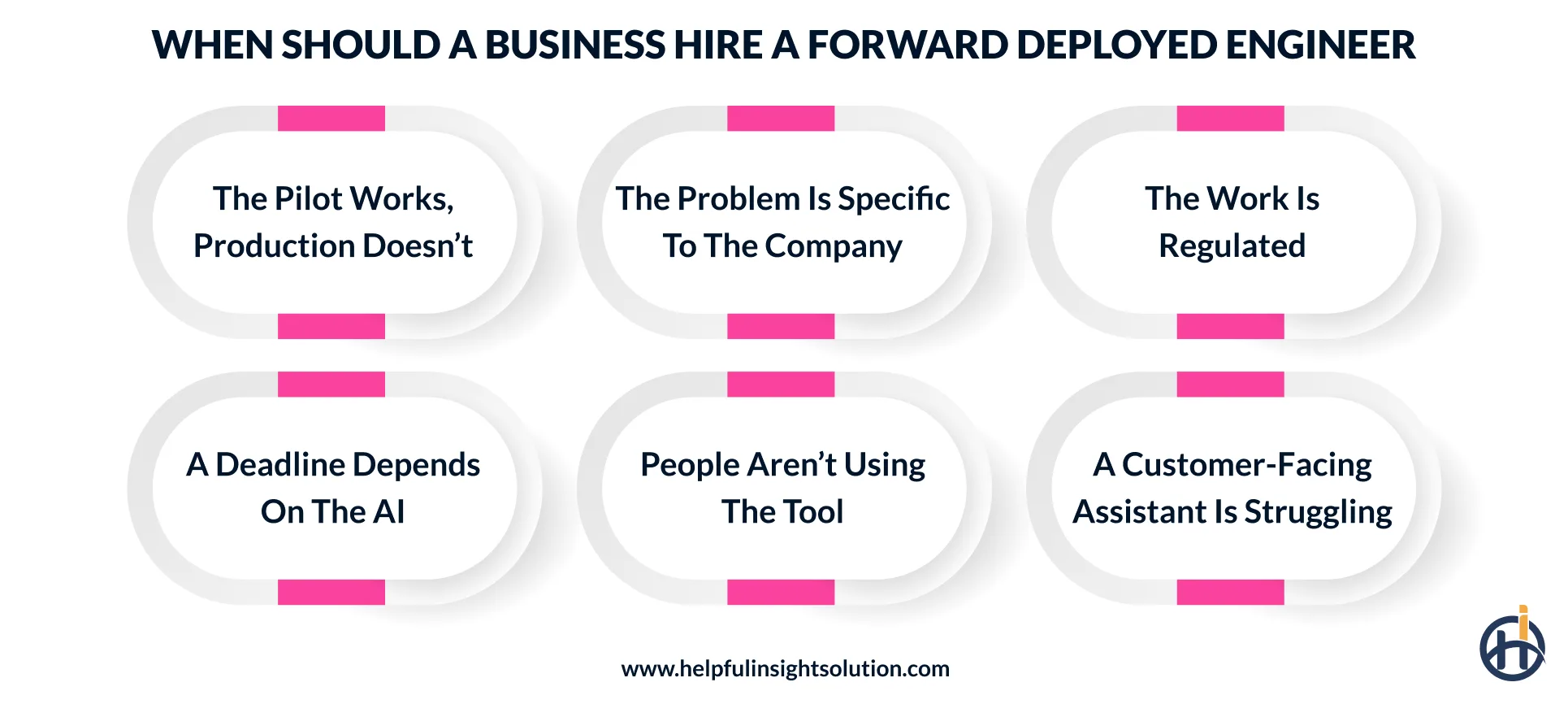
1. The pilot works, production doesn’t
Accuracy falls on real documents, costs run higher than planned, or the developer who built it moved to another project. Someone working inside the company’s systems can trace the cause and fix it directly.
2. The problem is specific to the company
A security rule, a compliance requirement, or several internal systems that have to connect can block a launch. General contractors can add features. Redesigning an architecture they didn’t build is a different job.
3. The work is regulated
Finance, healthcare, and government projects need audit logs, access controls, and data location rules from the first sprint. An engineer working on site builds them in during development instead of bolting them on at the end.
4. A deadline depends on the AI
A fixed launch date leaves no room for handoffs between a vendor, an architect, and an internal team. A clearly accountable FDE can reduce coordination gaps between teams, although delivery still depends on stakeholder availability, approvals, integration complexity, and team size.
5. People aren’t using the tool
Low trust and a poor fit with daily work usually show up only after real use. An engineer who sits with the users can see why they avoid it and change it to match how they work.
6. A customer-facing assistant is struggling
AI chatbot development is easy to demo. In production, the bot has to use current policy documents, respect account permissions, and pass tough cases to a human agent. Those gaps show up only after launch.
Why Businesses Need Them: Key Benefits
Most businesses need more than just an AI solution; they need someone who understands their challenges and can turn ideas into working systems. Forward deployed developers help bridge the gap between business requirements and technical implementation while ensuring solutions deliver practical value. Here are the key benefits businesses can gain from hiring them.
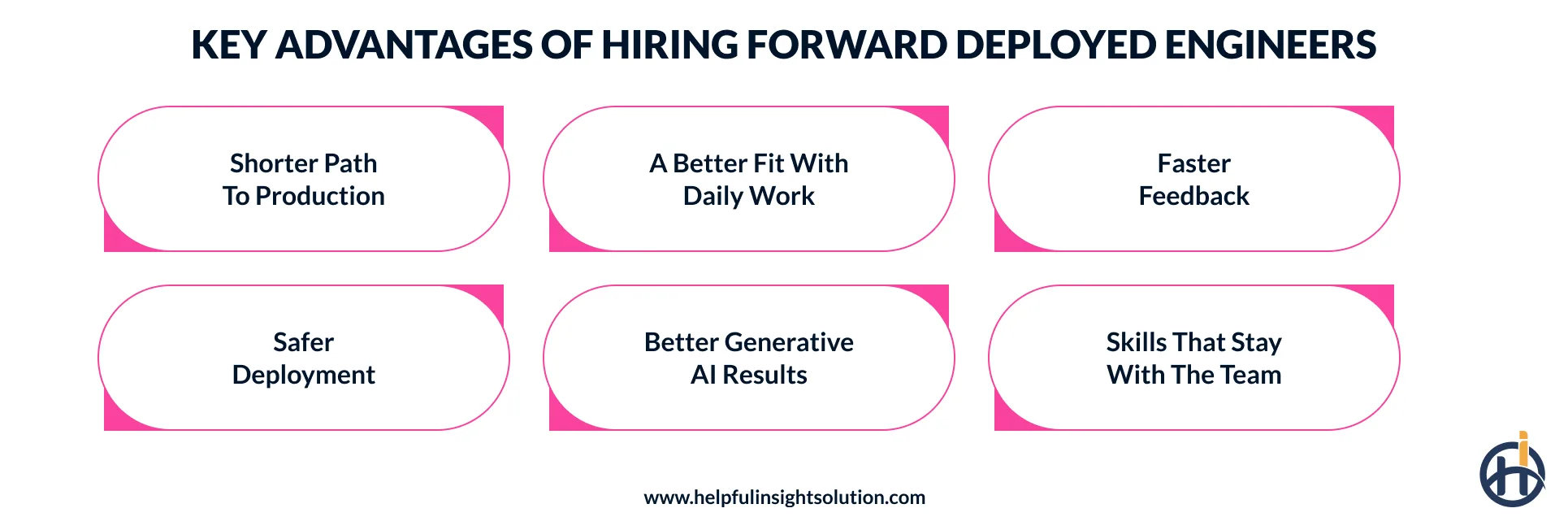
1. Shorter path to production
One engineer carries the system from prototype to launch. That removes handoffs between product, architecture, and delivery teams, which is where delays and lost context usually happen.
2. A better fit with daily work
Sitting next to users exposes edge cases that written requirements miss. A system built around how people really work meets less resistance, so adoption is easier after launch.
3. Faster feedback
Problems show up in days, not at the end of a release cycle. The engineer sees where users struggle, makes a fix, and tests it with the same people the next day.
4. Safer deployment
Access control, audit logging, and data location rules get handled during the build. Security reviews then hold fewer surprises, because those rules shaped the design from day one.
5. Better generative AI results
With generative AI development, the answers are only as good as the documents behind them. That’s why it helps to have someone on the team who can pull real files and build tests from them instead of relying on samples
6. Skills that stay with the team
A good engineer writes down decisions and works alongside internal developers, so the team can run the system alone later. Skip that step, and the client ends up depending on the engineer.
Real-World Use Cases
Public detail on individual deployments is limited, and vendors report many of the results themselves. The examples below separate documented cases from typical patterns.
1. Government and defense
Palantir created the role for government and defense agencies whose data was too sensitive to handle remotely. Engineers worked inside secure facilities, wrote production code, and fixed data pipelines on site. That’s where the practice started.
2. Frontier AI companies
OpenAI, Anthropic, and Scale AI place engineers with customer teams after a deal closes. The engineer takes the customer from API access to a working product. That means tuning document search, watching token costs, and deploying agents in the customer’s systems, as the same guide describes.
3. Merchant onboarding
Grubhub wanted to speed up how new merchants join its platform, using agentic AI. The company says its team built the workflow around real onboarding patterns, which cut friction and shortened the time to go live. The write-up gives no figures, so treat the result as the vendor’s own claim.
Typical Patterns by Industry
These are common patterns.
| Industry | Typical problem | What the engineer does |
| Financial services | Document review and compliance checks that need audit trails | Builds search and review workflows with logging and access control |
| Healthcare | Administrative and clinical documents under strict privacy rules | Connects AI to records systems inside privacy controls and tests on real documents |
| Retail and consumer goods | Inconsistent product data, demand forecasting, fraud detection | Cleans data and builds classification and forecasting pipelines |
| Manufacturing and logistics | Order and sensor data stored in separate older systems | Builds data pipelines and models that fit shop-floor and warehouse workflows |
| Customer support | Assistants that must use current policies and hand off to people | Builds document search, permission checks, and handoff logic |
Back-office automation is a common starting point. Rules-based RPA is effective for stable, structured workflows. Exceptions such as missing invoice fields or unusual contract clauses may require additional validation, document processing, or human review.
An engineer on the team can build the AI layer that reads these exceptions, routes them, and flags low-confidence cases for a person to review.
What to Look for in a Forward Deployed Engineer?
Before hiring a forward-deployed engineer, evaluate more than just their technical knowledge and AI expertise. They should understand business challenges, develop practical AI solutions, and integrate them into existing workflows. Below are key factors to consider when evaluating a forward-deployed expert for your project.
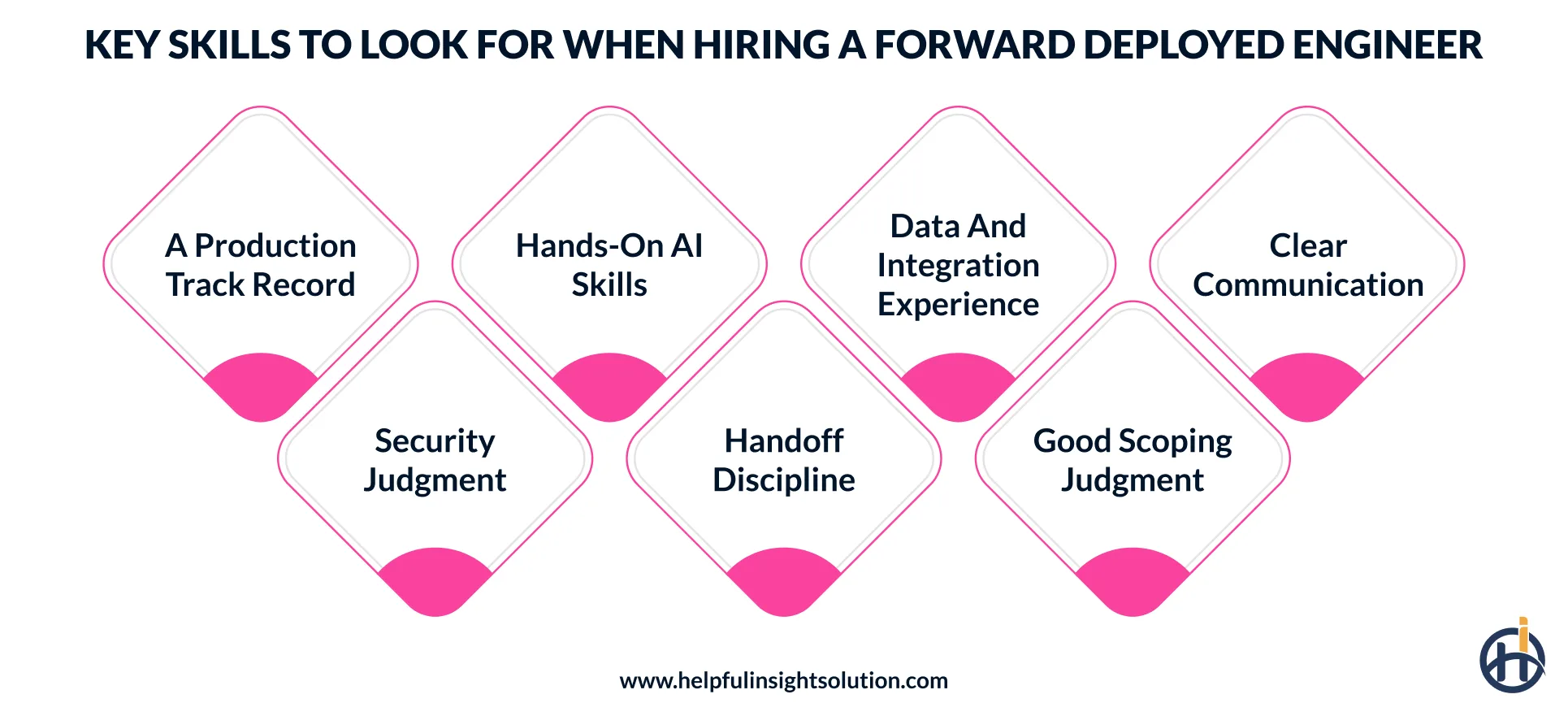
1. A production track record
Ask about systems the candidate deployed and kept running. A demo proves someone can build. A live system proves they can handle failures, users, and change after launch. Ask what broke and how they fixed it.
2. Hands-on AI skills
The candidate should know document search, testing, and agent tool use, and should track cost and response time. In production, AI systems usually struggle with quality and cost, not with whether the model runs. Ask how they test accuracy on a company’s own files.
3. Data and integration experience
Client data usually sits in old databases and mixed formats. Someone who has connected systems like that before will spot trouble early, like missing fields or broken exports. This work often takes longer than the AI itself.
4. Clear communication
In one week, the engineer may talk to executives, end users, and developers. Explaining a failure in plain words builds trust and speeds up decisions. Ask the candidate to describe a past incident to someone non-technical.
5. Security judgment
The engineer gets access to client code and data. Good judgment means flagging a leaked password or an unsafe permission instead of working around it to hit a deadline. Ask how the candidate handled security issues before.
6. Handoff discipline
Every engagement ends, and the client team has to run the system afterward. An engineer who writes things down and works alongside staff leaves a team that can maintain it. Otherwise the client stays dependent.
7. Good scoping judgment
Not every problem needs a perfect answer. A good engineer knows when a simpler version meets the current need and ships that first. It keeps the project moving and avoids months spent on features nobody uses.
If the project needs custom models too, the interview looks a lot like when companies hire machine learning developers. Ask to see something the candidate has shipped, and ask how they know it’s accurate.
Conclusion
Most AI projects don’t stall because the model is weak. They stall on data, integration, security, and adoption. A forward deployed AI engineer is one way to close that gap, and it fits best when the problem is specific to the company and the deadline is real.
It costs more upfront than a standard contractor, and it only works if someone on the client side is ready to own the system after handoff. Before hiring, settle three things: what the system must do in production, how success will be measured, and who takes over at the end.
FAQs
A forward deployed engineer is a software engineer who works inside a customer’s systems and builds production software there. The role started at Palantir in the mid-2000s. The engineer joins the customer’s team, writes code in its environment, and stays until the software runs reliably.
A forward deployed AI engineer takes AI systems from prototype to production in a client’s environment. Daily work includes cleaning data, building document search and agent workflows, testing accuracy, connecting old systems, and training staff. The engineer also writes down decisions so the client team can take over.
A solutions architect designs the system, usually before or during the sale, and hands over a plan. A forward deployed engineer works after the sale, writes the code, and owns production problems. One delivers a design. The other delivers a running system.
A business needs one when an AI system works in a pilot but fails on real data, systems, or workflows, and no internal team can fix it. Regulated work and fixed deadlines strengthen the case. If the real need is extra capacity or a strategy, staff augmentation or consulting is a better fit.
In the US, base salary averages about $172,000 a year, according to Indeed data reported by LeadDev. Reported ranges run from about $141,000 to $288,000, depending on company stage and seniority. Bonuses, equity, and benefits come on top. Vendor engagements are priced by scope and duration.
Palantir, OpenAI, Anthropic, Anduril, Scale AI, and Salesforce all hire for the role. AI labs, defense technology firms, and enterprise software companies account for most openings. Consulting firms and specialist AI vendors also place engineers inside client teams.