


Key Takeaways
- Machine learning in logistics predicts demand, delivery times, equipment failures, and risk using shipment, vehicle, and inventory data.
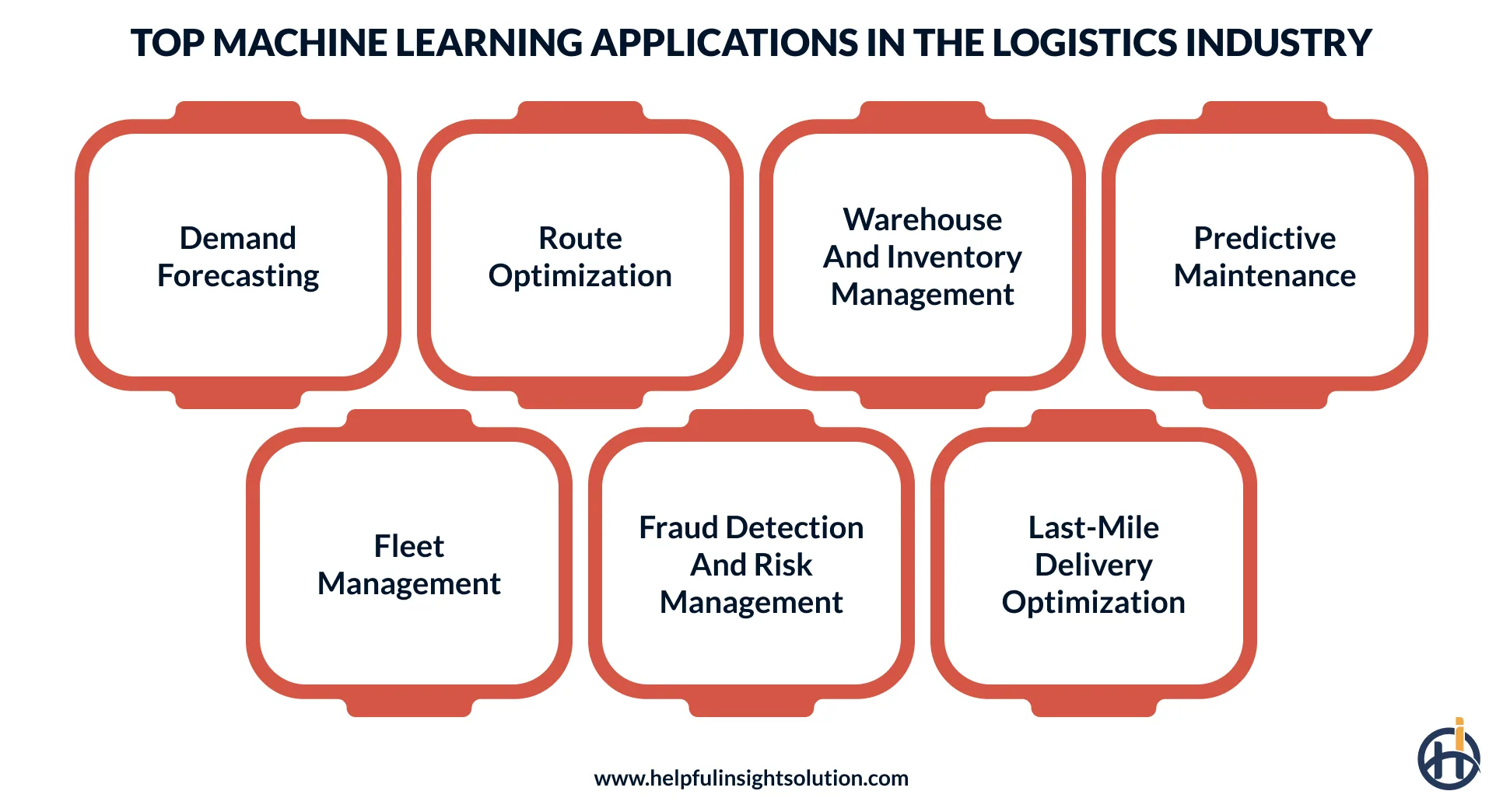
- The main use cases are demand forecasting, route optimization, warehouse and inventory management, predictive maintenance, fleet management, fraud detection, and last-mile delivery.
- McKinsey found that early adopters of AI-enabled supply chain management cut logistics costs by 15%, improved inventory levels by 35%, and raised service levels by 65% compared with slower competitors.
- Data quality, legacy systems, and unclear ROI are the most common obstacles. A narrow pilot with one KPI reduces all three.
U.S. businesses spent about $2.4 trillion on logistics in 2025, roughly 7.8% of the country’s GDP. At that scale, even small delays and wasted miles add up fast.
Logistics groups are always under pressure to deliver faster, spend less, and fix problems before a customer complains. That’s hard to do with old planning tools. They follow set rules, and things like traffic, weather, and demand vary every day.
Machine learning and AI work together. They look at your past and current data to spot patterns, so they can predict demand, pick better routes, and warn you about a delay before the shipment is late. The more data it sees, the better its predictions get. But most U.S. carriers, shippers, and warehouses don’t have their own data science team.
That’s why many logistics businesses use machine learning development services to build and set up these tools. In this guide, we’ll explain how ML works in logistics, where to use it, what it can do for you, what it costs, and how to get started.
What Is Machine Learning in Logistics?
Machine learning in the logistics industry is the use of algorithms that learn from shipment, inventory, vehicle, and demand data to predict outcomes and recommend actions. Common examples include forecasting demand, choosing delivery routes, and predicting equipment failures.
-
Machine Learning vs. AI in Logistics
AI is the big field. Machine learning is one part of it. Instead of being reprogrammed every time something changes, an ML system learns from data, such as past orders and delivery times, and gets better at predicting as it sees more. Some AI tools, like image recognition and chatbots, are also built with ML, but AI also includes tools that simply follow fixed rules.
Machine Learning in Logistics Market Size and Growth
Analyst firms report different totals because they define the market differently, but all point to fast growth. Global Market Insights valued the machine learning in logistics market at $4.3 billion in 2025 and expects $5.3 billion in 2026 and $44.5 billion by 2035, a compound annual growth rate (CAGR) of 26.7%. North America is the largest region, while Asia Pacific is growing fastest.
Market.us uses a different base, estimating $5.1 billion in 2025 and $47.6 billion by 2035 at a 24.9% CAGR. Its segment data shows where that spending sits today.
| Segment | Leading category | Share in 2025 |
| Component | Software | 68.5% |
| Deployment | Cloud-based | 58.7% |
| Organization size | Large enterprises | 62.8% |
| Application | Demand forecasting and planning | 38.5% |
| End user | Retail and e-commerce | 42.5% |
Large enterprises account for the largest share in this estimate. This figure alone does not establish the adoption stage of mid-size carriers and shippers
How Machine Learning Works in Logistics and Supply Chain Management
Machine learning in supply chain management follows a repeatable cycle: teams collect data, train a model, put it into operations, and keep it current.
1. Collect data
Sources include transportation and warehouse management systems, ERP records, GPS and telematics, and outside feeds such as weather and traffic. Sensors on trucks, pallets, and containers add live readings, which is where ML and IoT in logistics work together.
2. Prepare the data
Next, teams remove duplicates, fix missing values, and match records across systems. Data quality strongly affects model performance, but accuracy also depends on feature relevance, model choice, training, and evaluation.
3. Train the model
Algorithms then look for patterns in historical data. Supervised learning uses labeled outcomes, such as actual delivery times, while unsupervised learning groups similar records or flags unusual ones without labels.
4. Test and deploy
Before launch, the team checks accuracy on data the model has not seen. It then connects the model to planning tools through APIs, and planners see recommendations inside the systems they already use.
5. Monitor and retrain
After launch, demand, roads, and carrier performance keep changing, and accuracy drifts with them. Teams therefore track forecast errors over time and retrain the model when accuracy drops past an agreed limit, or when something big changes, such as a new carrier or a seasonal shift.
Machine Learning Technologies Used in Logistics
Multiple machine learning algorithms in logistics handle distinct tasks, and the table matches each technique to a specific task.
| Technique | What it does | Logistics example |
| Regression and time-series models | Predict a number from past data | Demand forecasts, ETA prediction |
| Classification models | Sort records into categories | Late-delivery risk, claim review |
| Clustering | Group similar records | Delivery zones, customer segments |
| Anomaly detection | Flag records that break the pattern | Billing fraud, sensor faults |
| Reinforcement learning | Learns by trial and feedback | Dynamic dispatch and routing |
| Neural networks (vision) | Read images | Pallet counts, label reading, damage checks |
| Natural language models | Read text | Bills of lading, customs forms |
Top Use Cases of Machine Learning in Logistics
Machine learning is used across logistics today, from planning to the final mile. It studies past data like orders, routes, delivery times, and vehicle readings to predict what will happen next.
In practice, that means forecasting demand, planning routes, managing warehouses, maintaining vehicles, tracking fleets, catching fraud, and delivering the last mile on time. Let’s look at the use cases of machine learning in logistics operations.
1. Demand Forecasting
Forecasting models learn from sales history, seasonality, promotions, pricing, weather, and local events. They estimate demand by product and location, which sets how much stock to hold and how much transport capacity to book.
Market.us ranks demand forecasting and planning as the largest application segment, and McKinsey notes that ML-based forecasting, paired with simple inventory tools, can cut distributor inventory by 20 to 30 percent. Because order history already exists in most companies, forecasting is a practical first project for predictive analytics solutions.
2. Route Optimization
Machine learning for route optimization weighs traffic, delivery windows, vehicle capacity, driver hours, and road restrictions. Because the models learn how long stops take in practice, not how long a map predicts, they can modify plans during the day.
An AI agent solution could, if authorized and connected to the required systems, propose or carry out actions such as re-sequencing stops and notifying customers. Approval rules and exception handling should be defined.
3. Warehouse and Inventory Management
Machine learning for warehouse management helps decide where to store items, which pick path to use, and when to reorder. Slotting models place fast-moving items near packing areas, and replenishment models trigger orders from forecast demand instead of fixed reorder points.
Computer vision solutions add image-based checks, such as counting pallets, reading labels, and spotting damaged cartons in the system. Together, these tools support machine learning inventory management by keeping stock records close to what actually sits on the shelf.
4. Predictive Maintenance
Sensors on engines, brakes, tires, and conveyors record vibration, temperature, and pressure. Models compare current readings with past failures and flag parts likely to fail soon.
Maintenance then shifts from fixed schedules or emergency repairs to planned service at a mutually convenient time, which reduces unplanned breakdowns that delay loads and strand drivers.
5. Fleet Management
Machine learning in fleet management turns telematics data into insights about drivers and vehicles. Depending on available telematics and dispatch data, models may help identify driving patterns, estimate fuel consumption, or support load-to-vehicle matching.
In transportation more broadly, the same models improve ETA accuracy because they learn typical speeds by road and hour.
6. Fraud Detection and Risk Management
Anomaly detection models learn what normal freight invoices, claims, and shipment records look like, then flag outliers, such as duplicate bills, altered delivery addresses, or unusual cargo-claim patterns, for human review.
Risk models add to this by scoring suppliers and lanes using delivery history and disruption data. Natural language processing also reads contracts, bills of lading, and customs documents, which helps catch missing or inconsistent fields early.
7. Last-Mile Delivery Optimization
The last leg has many stops, short time windows, and frequent changes. Models forecast stop duration and arrival time, group nearby orders, and estimate which deliveries may fail because of past address or access problems. As a result, customers get tighter delivery windows, and dispatchers can reassign orders before a window is missed.
Real-Life Examples: Companies Using Machine Learning in Logistics
These examples of ML in logistics come from company statements and third-party reports. Take a look:
1. UPS: ORION Route Optimization
UPS built On-Road Integrated Optimization and Navigation (ORION), a system that plans delivery routes using advanced algorithms, AI, and machine learning. Instead of relying only on fixed maps, ORION learns from the company’s past delivery data, such as how long stops usually take, how traffic behaves at different times of day, and where drivers face delays.
It uses these patterns to predict what the day ahead will look like and to pick the smartest order of stops for each driver. It also keeps adjusting as the day goes on. If a pickup is added, a road slows down, or a delivery takes longer than planned, ORION can update the route so the driver always has the best path forward. The more data the system sees, the better its predictions get.
2. DHL: Smart ETA for Ocean Freight
DHL Global Forwarding runs a supervised machine learning model that predicts arrival times for port-to-port ocean shipments. The model makes a first forecast when the vessel departs, based on past carrier schedules for the same route, and then updates the estimate with vessel GPS positions from the automatic identification system (AIS). Customers see the ETAs on the myDHLi platform.
3. Amazon: Demand Forecasting and Regional Fulfillment
Amazon uses machine learning to guess what people will want to buy. It looks at what customers bought in the past and finds patterns, then uses those patterns to predict which products will be popular.
This helps Amazon make sure the right products are in stock when customers want them. Amazon has also divided the U.S. into eight regions, so most orders come from a warehouse close to you. This means your package travels a shorter distance and reaches you faster.
Benefits of Machine Learning in Logistics and Supply Chain
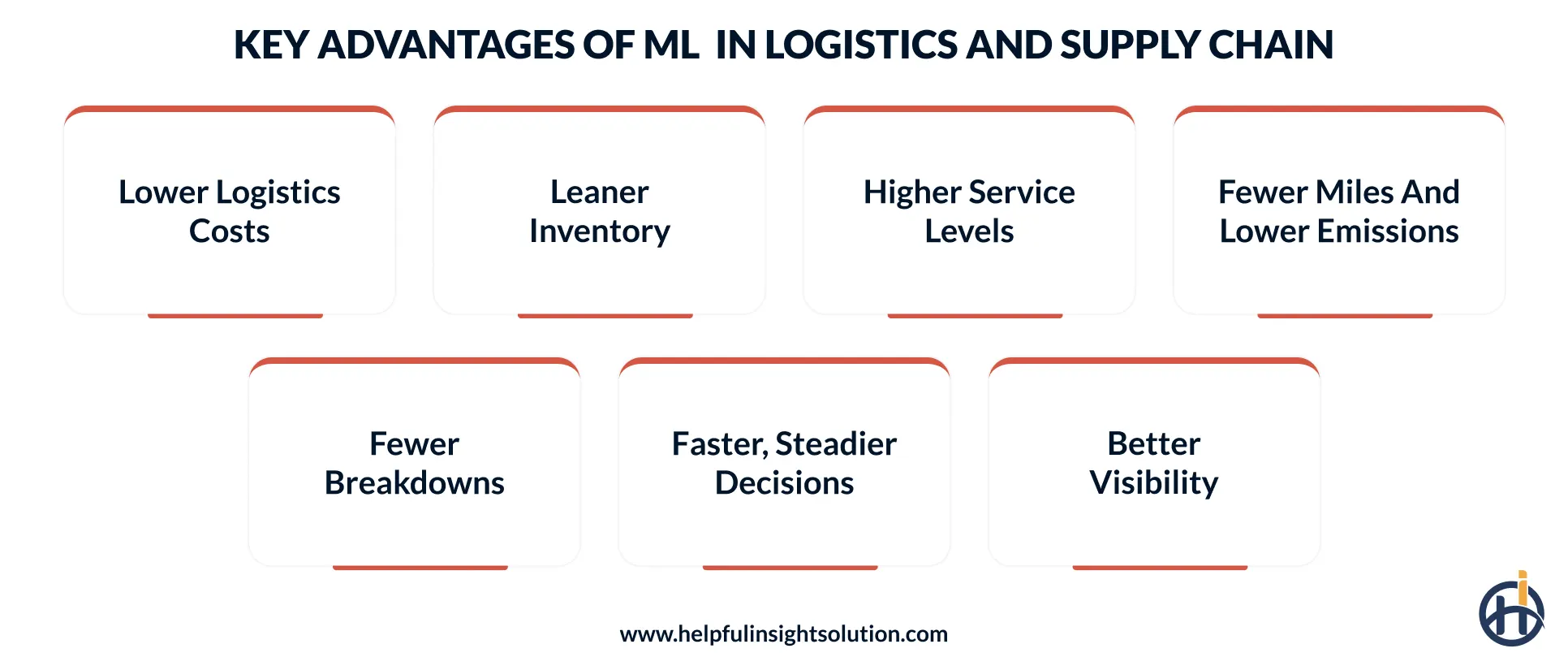
ML can support lower costs, improved inventory planning, service reliability, and risk detection when models are accurate and integrated into operations. Here are the major benefits of ML in logistics and supply chain.
1. Lower logistics costs
Models cut empty miles, excess stock, and manual planning hours. Each of these is a direct expense, and small gains in routing and forecasting add up across a large network over a full year.
2. Leaner inventory
Better demand forecasts allow companies to hold less safety stock without running out of key items. This frees up cash, reduces the storage space needed, and lowers the risk of unsold or expired goods.
3. Higher service levels
Accurate arrival estimates and fewer late deliveries mean customers receive orders when promised. Reliable service builds trust, reduces complaint calls, and helps keep customers who might otherwise switch carriers.
4. Fewer miles and lower emissions
Optimized pathways mean drivers travel shorter distances and burn less fuel. UPS credits its ORION system with yearly fuel and CO2 reductions, which also supports the company’s sustainability development goals.
5. Fewer breakdowns
Predictive maintenance lets fleets repair parts before they fail and schedule downtime when loads allow. Vehicles spend more time on the road, and delivery commitments become easier to keep.
6. Faster, steadier decisions
Models rank options in seconds, and planners review exceptions instead of building every plan by hand. Plans then stay consistent across shifts, and new staff get up to speed faster.
7. Better visibility
Accurate ETAs help shippers plan unloading, storage, and distribution. This prevents port congestion and idle labor, and it lets customer service share reliable updates when a shipment is delayed.
Results vary with data quality, project scope, and how well teams adopt the tools. Treat published gains as reference points, not guarantees.
Challenges of Implementing Machine Learning in Logistics
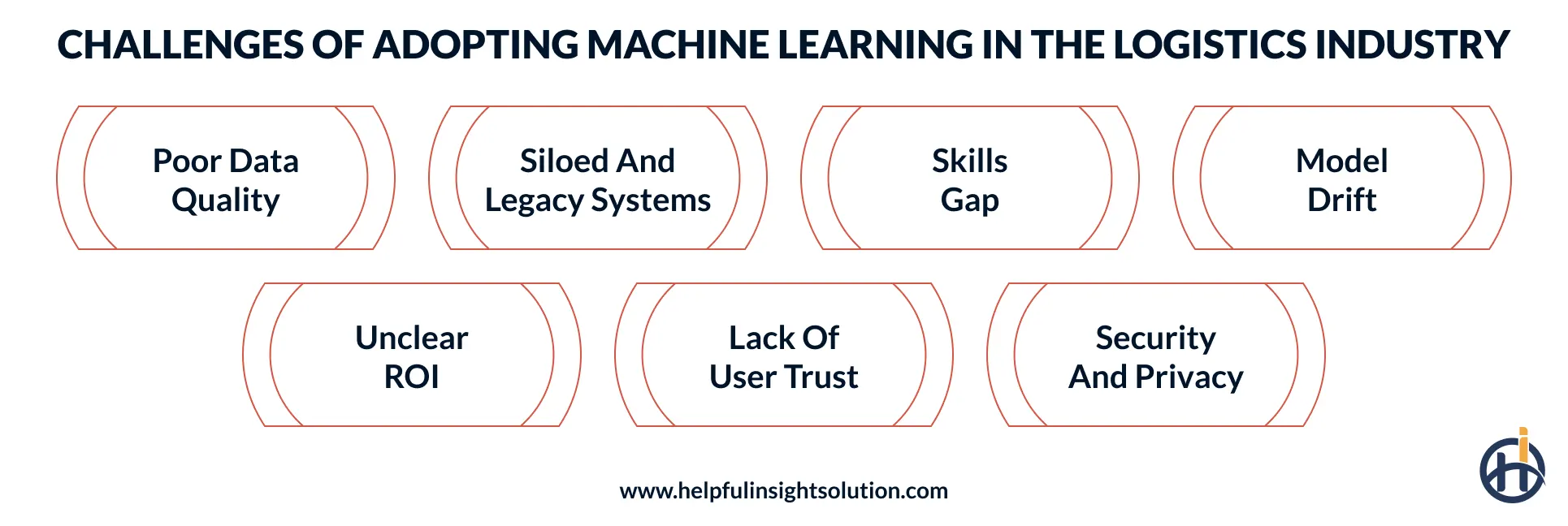
Machine learning can help logistics companies predict demand, plan routes, and avoid delays. But setting it up is not always easy. Most problems come from data and people, not the algorithms.
If the data is messy, the systems do not communicate with each other, or the team lacks the right skills, even a good model will not give good results. The good news is that each challenge below has a practical solution, so you can plan for it before it slows you down.
1. Poor data quality
Missing scans, inconsistent product codes, and duplicate records lower accuracy.
Solution: Run a data audit before modeling. Standardize codes, remove duplicates, and assign an owner for each data source to fix errors at the origin.
2. Siloed and legacy systems
Transportation, warehouse, and ERP systems commonly store data in different formats.
Solution: Build APIs and a shared data layer that connect them. A custom software development services provider can do this without replacing existing systems.
3. Skills gap
ML projects need data engineers, ML engineers, and people who know logistics operations. Few teams have all three.
Solution: Partner with an outside team for the first build, and pair its engineers with internal planners to keep knowledge in-house.
4. Model drift
Seasonal shifts, new carriers, and disruptions change patterns, and accuracy declines.
Solution: Track forecast error every month, set a threshold that triggers retraining, and keep fresh data flowing into the model.
5. Unclear ROI
Many deployments save little because goals were vague.
Solution: Define one KPI, such as forecast error or on-time rate, and record a baseline before the pilot begins. Report results against that number every month.
6. Lack of user trust
Planners and drivers may ignore recommendations they cannot explain. UPS adjusted ORION to help drivers follow its outputs and understand the reasons behind them.
Solution: Show why the model suggests each action, and let staff override it.
7. Security and privacy
Logistics data includes customer addresses and commercial terms.
Solution: Limit access by role, encrypt data in storage and transit, and set clear governance rules throughout departments before any data reaches the model.
How Much Does it Cost to Implement Machine Learning in Logistics?
The cost of implementing machine learning in logistics depends on scope, data readiness, integrations, and team location. The figures below work best as planning ranges.
| Project stage | Estimated cost | Timeline |
| Proof of concept | $15,000 to $40,000 | 4 to 6 weeks |
| Production MVP | $50,000 to $150,000 | 8 to 16 weeks |
| Full logistics software with AI features | $30,000 to $300,000+ | Varies |
It is estimated that yearly maintenance is 15% to 25% of development cost, a line item teams often underestimate. The main factors that can affect the budget most:
- Data readiness: Cleaning and labeling data adds time when records are incomplete.
- Integrations: Each connection to a TMS, WMS, ERP, or carrier API adds work.
- Model complexity: Forecasting is simpler than real-time dynamic routing.
- Compliance: Customer data and cross-border shipments add security requirements.
- Team location and seniority: Rates differ widely by region and experience.
- Cloud and compute: Training and hosting costs grow with data volume.
However, feature scope accounts for most of the machine learning app development cost. Listing the must-have models before asking for quotes keeps estimates comparable.
How to Implement Machine Learning in Logistics Operations
To implement ML in logistics operations, follow the roadmap below.
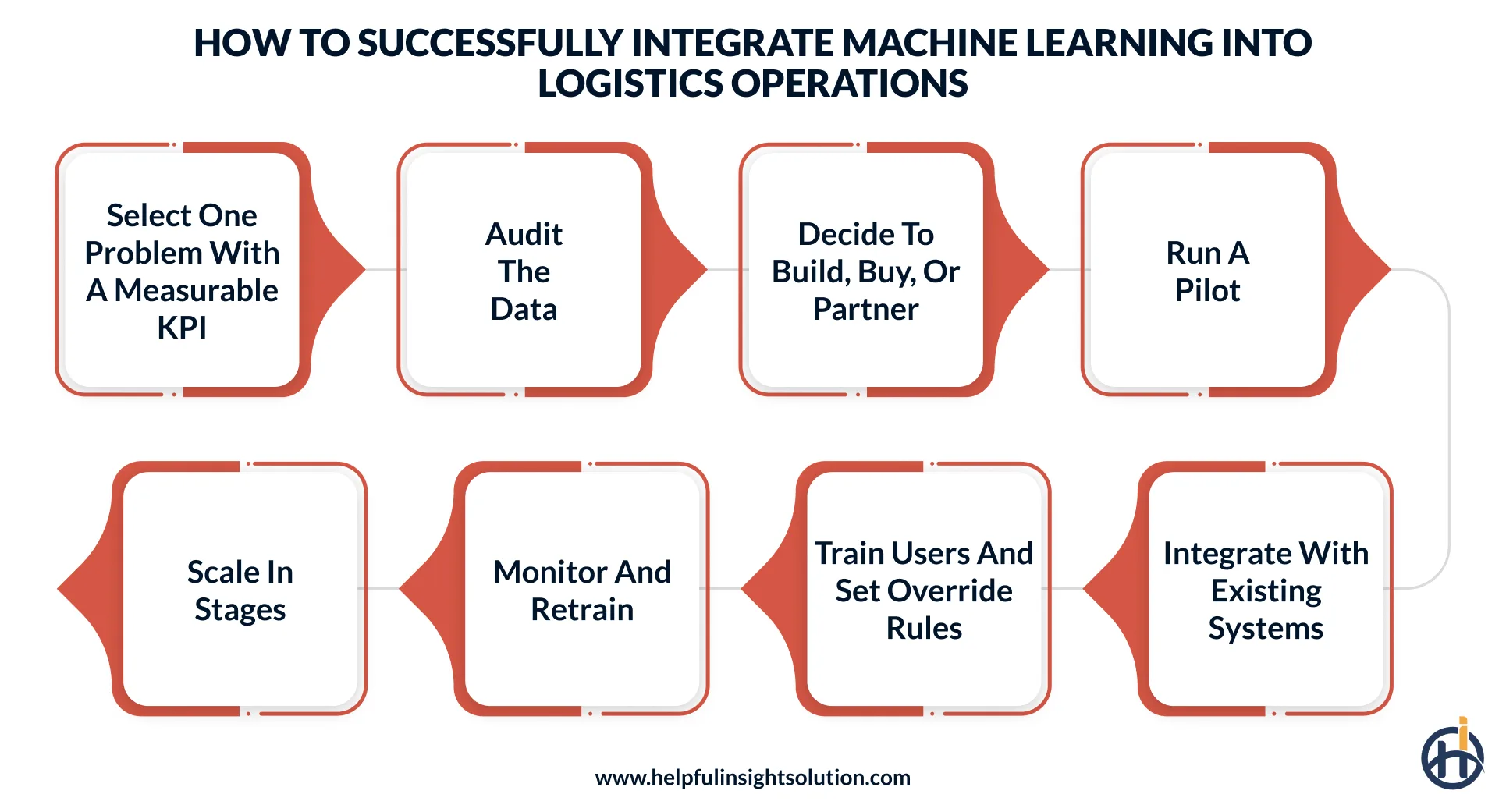
1. Select one problem with a measurable KPI
Firstly, start with a single, clear problem, such as late deliveries on one lane or forecast error for the top 100 products. Write down today’s number as a baseline. A narrow scope keeps the pilot affordable, shortens the build, and makes it easy to tell whether the model actually helped.
2. Audit the data
Next, list every system that holds relevant records, such as the TMS, WMS, and ERP. Look for gaps, duplicate entries, and mismatched formats. Forecasting needs enough history to capture seasonal patterns, which means confirming how far back clean records go. Fix the biggest gaps before any model work starts.
3. Decide to build, buy, or partner
Off-the-shelf tools suit standard needs such as ETA prediction. Custom models fit networks with unusual rules or data. Teams that lack ML skills can hire dedicated developers with machine learning skills for the pilot and have them train staff before the project ends, which keeps the skills in-house.
4. Run a pilot
Now test the model on one lane, site, or product group instead of the whole network. Vendors cite 4 to 6 weeks for a proof of concept. Run the model next to the current method on the same data, and compare both against the KPI from step one.
5. Integrate with existing systems
Building the application layer follows standard machine learning app development practice. A data pipeline, a model service, APIs, and a user interface. Planners should see recommendations inside the tools they already use, without switching screens, copying numbers by hand, or retyping data. This keeps adoption simple and cuts the errors that manual entry causes.
6. Train users and set override rules
Before rollout, explain which data the model uses and what its outputs mean. Tell staff when they can overrule a recommendation, and ask them to record why. Review these overrides weekly, because they show where the model is wrong or where users still do not trust it.
7. Monitor and retrain
After launch, track forecast error, on-time rate, and cost per mile every month. Compare each against the baseline set in step one. When accuracy drops below the set threshold, retrain the model on recent data. Assign one person to own this review to keep it from being skipped when the team gets busy.
8. Scale in stages
Once the pilot meets its KPI, extend it to more lanes, warehouses, or regions in small steps. Fix integration issues at each stage before expanding again. Add new use cases, such as predictive maintenance, only after the first one runs reliably day to day, and the team trusts its results.
Machine Learning in Logistics Trends to Watch
ML supply chain technology is moving from pilots into day-to-day operations, and four signals show it.
1. Adoption is scaling
In the 31st annual Third Party Logistics Study, 62% of logistics providers and 48% of shippers said they use Machine Learning. Shippers mostly use these ML tools to forecast demand and avoid delays.
2. Warehouses are still early
In Material Handling and Logistics’ 2026 software survey, 19% of respondents currently use machine learning, 26% are evaluating it, and 12% plan to consider it within two years.
3. Value is uneven
McKinsey’s 2026 research found that 42% of organizations say AI lowered their supply chain costs, while only 3% save more than 20%. In other words, deployment alone does not produce savings.
4. Language interfaces are arriving
DHL plans to pair its Smart ETA model with generative AI to allow staff to ask questions about shipment data in plain language, such as requesting a chart that compares shipments.
Conclusion
Logistics machine learning works best when it targets one clear problem, runs on clean data, and plugs into the systems planners already use. You have seen the published results from UPS, DHL, and McKinsey; they show real gains, but McKinsey’s 2026 data also shows that most organizations capture modest savings. For that reason, you must start with a pilot, measure against a baseline, and scale what works.
So, if you are planning to implement AI or ML in your logistics system, it is best to avail our artificial intelligence development services to optimize your logistics and supply chain operations.
FAQs
It is the use of algorithms that learn from shipment, vehicle, inventory, and demand data to predict outcomes and recommend actions. Typical tasks include demand forecasting, route planning, ETA prediction, and equipment failure alerts.
Companies use it for demand forecasting, route optimization, warehouse slotting and replenishment, predictive maintenance, fleet management, fraud detection, and last-mile delivery planning.
AI is the broad field of systems that perform tasks needing human-like judgment. Machine learning is a subset that learns patterns from data. Computer vision and language models also fall under AI, and many of them use ML.
Vendor estimates range from $15,000 to $40,000 for a proof of concept and $50,000 to $150,000 for a production MVP. Full logistics software with AI features runs from $30,000 to $300,000 or more, plus 15% to 25% of development cost per year for maintenance.
The time to implement ML in logistics, it will take around 4 to 6 weeks for a proof of concept and 8 to 16 weeks for a production MVP. Timelines depend on data readiness and the number of system integrations.