

 in software development tests whether a software idea, feature, or technical approach is practical before investing in full product development. There are several benefits of proof of concept software development, as it helps.</p>
"Pinterest")

Key takeaways
- A proof of concept (PoC) in software development tests whether a software idea, feature, or technical approach is practical before investing in full product development.
- There are several benefits of proof of concept software development, as it helps validate technical feasibility, identify risks early, cut wasted spend, and build investor and stakeholder confidence.
- The cost of developing a simple PoC can range from $3,000 to $10,000, while an API integration PoC may cost $5,000 to $12,000. AI/ML model validation can cost $10,000 to $40,000 or more.
- The key steps to develop a software PoC include identifying the problem, deciding what to test, choosing the right tools, building and testing, and reviewing the outcome.
Developing a software product without knowing whether the idea will actually work or not is a very risky proposition. What if technology simply doesn’t support the features? Or the product needs more time and money than expected?
All of these are very real issues when you’re launching a new product. That’s where proof of concept (PoC) in software development can help. It gives businesses a way to test an idea before committing to full-scale development.
The challenge is not just building the product but also planning the work and budget correctly. According to Business Research Insights, about 47% of companies deal with cost overruns and timeline delays linked to inadequate planning and unclear requirements.
Having an early way to check the idea can help businesses understand the technical work involved and make a more informed estimate of the cost to develop a software solution.
If you’re planning to build software but aren’t sure whether it’s worth the investment, starting with a PoC can help you make that decision with more clarity. But how do you develop one, what should you test, and what comes next? This guide covers everything you need to know about proof of concept software development.
Understanding proof of concept (PoC) in software development
A proof of concept (PoC) in software development is a small-scale test used to check whether a software idea or technical approach can work in practice. Rather than developing the entire product, developers focus on one feature, technology, or integration that needs to be tested.
For example, they might check whether a new payment method can connect with an existing system or whether a particular technology can support a planned feature. The findings help identify technical challenges early and decide whether to move ahead with enterprise-grade engineering.
PoC vs prototype vs MVP: What’s the difference?
PoC, prototype, and MVP may sound similar because they are all created before a complete product is ready. However, each serves a different purpose during development. Understanding these differences helps you decide whether to develop an MVP, prototype, or a proof of concept based on your project needs.
The table below highlights their key differences.
| Factor | Proof of concept (PoC) | Prototype | Minimum viable product (MVP) |
| Primary purpose | To check whether an idea or technical approach is feasible | To explore the product’s design, layout, and user experience. | To launch a basic version of the product and test it with real users. |
| Target audience | Internal team, tech leads, and decision-makers | Designers, stakeholders, investors and potential users | Early adopters and target customers |
| Development time | A few days to about 4 weeks | Roughly 1 to 4 weeks | Typically 2 to 4 months |
| Cost | Low | Low to moderate | Moderate to high |
| Level of functionality | Minimal, and often no interface | Often visual or clickable, with little or no working backend | A working product with a small set of core features |
| When to build | When you need to confirm technical feasibility before investing in full development. | Before investing in full UX design, or to get early feedback on a concept | When the core idea is validated, and you want to launch a usable version to gather user feedback. |
Key benefits of PoC in software development
Building software always comes with some uncertainty, especially when the idea involves new features or technology. A PoC helps reduce some of that uncertainty before development moves further. Investing in proof of concept software development offers several benefits, including:
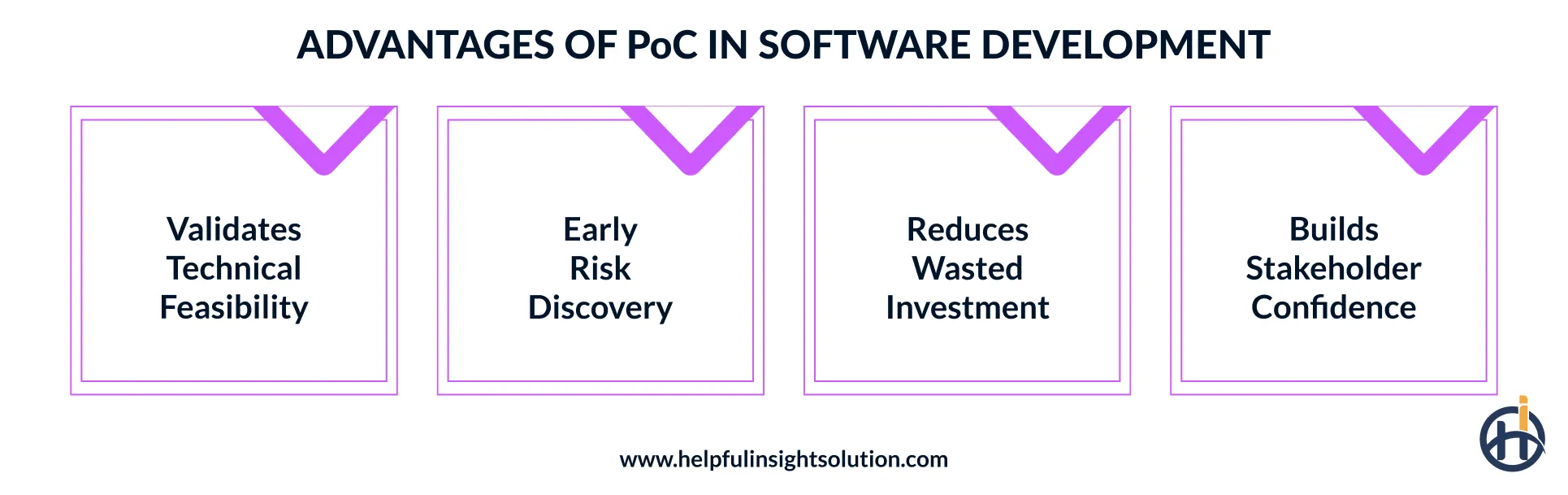
1. Validates technical feasibility
A software development PoC determines whether your idea is feasible given the available technology and resources. You take the key features or technical components and build them on a small scale to see if they actually work. It’s a way to test the technical approach early and eliminate ideas that may not be practical to develop.
2. Early risk discovery
Some technical issues only become apparent when you start testing the concept. A PoC provides an opportunity to check for integration issues, performance problems, and other technological limitations.
Once the team knows what the potential problems are, they can fix them before the project moves any further. This means fewer last-minute changes, less rework, and a much better chance of staying on schedule.
3. Reduces wasted investment
A project can easily become very expensive if technical problems or unsuitable features are discovered after development is already underway. The whole point of using a PoC to test the core concept is that it gives you an opportunity to revisit those decisions earlier.
It also makes software development methodologies much easier to plan around the actual requirements of the project rather than commit the budget on the basis of assumptions.
Builds stakeholder confidence
Stakeholders may be reluctant to go ahead with a project if they aren’t certain how the proposed technology is going to work in reality. A technical proof of concept gives the opportunity to demonstrate the concept rather than just present it.
The ability to see the results of the test can go a long way to reassuring the decision-makers and more willing to support the next stage of development.
When is a PoC worth developing (and when is it not)
Building a PoC takes time and money, so it’s entirely natural to ask whether your project actually requires one. In some instances, a PoC can be the perfect way to test an idea and avoid making expensive mistakes.
In other cases, you can quite go straight into development. The question, therefore, is when PoC software engineering is worth the investment, and when it is not.
Develop a proof of concept (PoC) when
- You plan to adopt a new framework or service that nobody has tested inside your tech stack.
- You’re working with unfamiliar technologies, frameworks, or third-party APIs that need testing before becoming part of your software.
- Your product is based on a machine learning model and its accuracy on your own training data is unknown.
- One complex feature holds up the whole product, and its technical risk justifies testing it alone first.
- Leadership/investors want evidence before they approve a budget and a working test is far better than slides in supporting a go/no-go decision.
- You’re replacing outdated software and need to check whether legacy systems can support a move to modern architecture.
- You’re choosing between vendors, open-source libraries, or hosting options, and a side-by-side vendor evaluation will show which one actually fits.
Skip the PoC when
- Your development team has already worked with the chosen technology stack and has successfully used it in similar production projects.
- An MVP/prototype has already confirmed the technical approach and dealt with the key development risks.
- Your project has a very tight launch deadline, so there’s no time for PoC development.
- The feature is so small that it would cost less to build it directly into a staging environment than it would to run a separate experiment.
How to develop a proof of concept in software development: 5 simple steps
Creating a software PoC is a strategic process that requires proper planning and a clear direction. You need to decide what to test, how to approach development, and which factors to evaluate.
Let’s look at the key steps involved in PoC software engineering
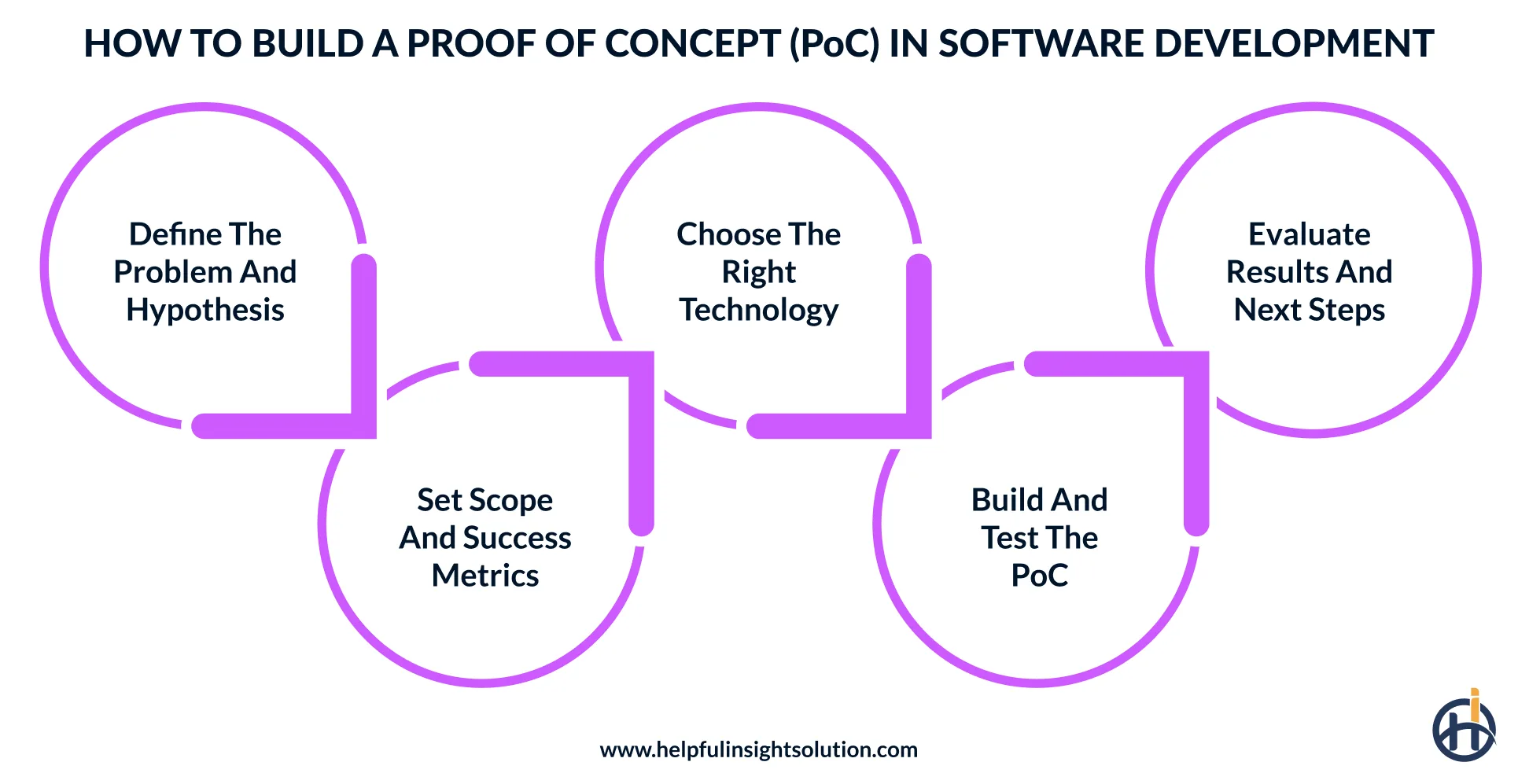
1. Define the problem and hypothesis
Before starting a proof of concept (PoC) in software development, be clear about the problem you want to address. Identify the business challenge, who is affected by it, and what your proposed solution should achieve.
Then you need to have a testable hypothesis that defines what you think the software will prove and why. That gives the PoC a real purpose and keeps it firmly rooted in the business problem that it was designed to solve.
2. Set scope and success metrics
Once the problem and hypothesis are clear, decide what your proof of concept will actually test. Test only the functions or technical components required to validate that hypothesis. Leave out anything else, such as additional features and production design.
Set a timeframe and agree on some measurable success criteria (response time, processing accuracy, whether the task can actually be completed, etc.). That keeps software development for a startup focused and makes it far easier to assess the outcome.
3. Choose the right technology
At this stage, there is no need to build a complex technical setup. Pick frameworks, APIs, and development tools that your team already knows and can use to test the required functionality.
You can also consider low-code platforms or ready-made libraries where suitable. For a proof of concept for software, the priority is to test the idea with minimal setup.
4. Build and test the PoC
Now put the proposed idea into practice by developing a basic working version of the feature or process you want to validate. There’s no need to spend time on a polished interface or production-ready code.
Run focused tests using realistic scenarios and check for issues such as slow responses, failed integrations, or incorrect outputs. These observations are important when carrying out a software development proof of concept.
5. Evaluate results and next steps
Use the test results to determine how the project should proceed. If the results confirm that the proposed approach is viable, document the key learnings and move on to the next development phase.
If they don’t, look at why and consider whether to change the approach or stop the project altogether. This exercise will determine whether the PoC software solution is worth progressing any further.
PoC software development cost and timeline: What to expect
There’s no fixed cost or timeline for developing a PoC, as each project has different technical requirements. Testing a single feature may take only a small amount of development effort, whereas testing AI models or integrating multiple systems can require much more time, specialist skills, and resources.
The following estimates show how the PoC software engineering cost and timeline can vary by project type.
| Project Type | Estimated cost range | Timeline | Main factors affecting cost |
| Simple PoC (Basic feature validation) | $3,000- $10,000 | 1 to 2 weeks | Feature complexity and development hours |
| API integration PoC | $5,000- $12,000 | 2 to 3 weeks | API requirements and system compatibility |
| Mobile application PoC | $8,000- $15,000 | 2 to 4 weeks | Core screens, platform requirements, and device testing |
| AI/ML model validation | $10,000- $40,000+ | 3 to 6 weeks | Data preparation, model training, and testing |
These figures are indicative estimates, not fixed prices. The final proof of concept development cost also depends on the dedicated development team’s location, hourly rates, technology requirements, and third-party service fees.
Keeping the scope limited to the main technical questions can prevent unnecessary expenses and make the PoC development timeline easier to manage.
Real-world examples of proof of concept (PoC)
A PoC is not limited to one type of software project. Companies across different industries use it to test new technologies and address technical challenges. Let’s look at some real examples to understand how this works in practice.
1. Walmart and IBM: Blockchain food traceability
Walmart worked with IBM to see whether blockchain could make food traceability faster and more accurate. Their proof of concept used Hyperledger Fabric to record supply chain information for mangoes in the US and pork in China. In the mango test, the system was able to trace the origin in 2.2 seconds as opposed to the previous seven-day process.
2. ING and Thought works: Data mesh on Google Cloud
ING partnered with Thoughtworks to test a data mesh architecture on Google Cloud through an eight-week PoC. Using synthetic data for a customer grievance use case, the team created a data product blueprint.
The exercise showed how domain teams could manage data products independently and improve data management and delivery.
3. Dropbox: The magic pocket prototype
Dropbox wanted more control over how it stored user files, so its engineers first built a small Magic Pocket prototype. This technical PoC helped them examine storage workloads and file distribution before developing a custom distributed storage system..
Common mistakes to avoid during proof of concept software development
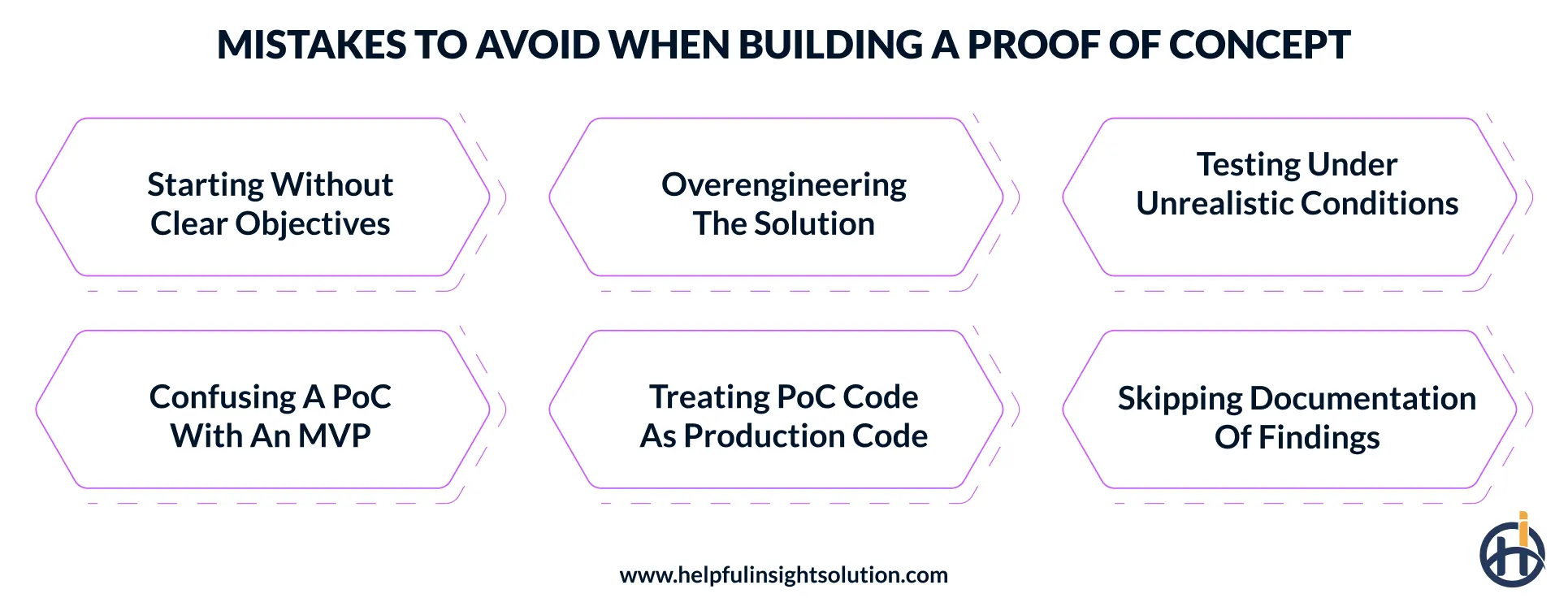
Even a well-planned PoC can run into problems if certain things are overlooked during development. Knowing the common mistakes in PoC for software development beforehand can help businesses avoid unnecessary delays, extra costs, and poor decisions.
1. Starting without clear objectives
Don’t start building a PoC simply because the software idea looks good. First, establish precisely what question the PoC is intended to answer. Otherwise, you’re just going to keep adding features without knowing whether or not they’re actually going to answer the question.
Having a clear set of objectives for PoC software development makes it a lot easier to assess the outcome and know what to do with it afterward.
2. Overengineering the solution
Trying to create a PoC that looks and behaves like a full product is a very common mistake. All the extra features, complex architecture, and design work can distract from the actual technical test you’re trying to perform.
Instead, keep the PoC in software development focused on its purpose as a proof of concept. A simple working version is quite sufficient to establish whether the proposed approach is technically feasible.
3. Testing under unrealistic conditions
A PoC may appear successful when tested with limited data and controlled conditions, but that doesn’t guarantee it will work in actual use. For instance, when adding AI in software development, test how the model handles different data inputs and less predictable situations.
Use realistic scenarios during the software development proof of concept to get a more reliable picture of its technical feasibility.
4. Confusing a PoC with an MVP
A PoC and an MVP serve different purposes, so don’t treat them as the same thing. A PoC is all about checking whether the concept is technically feasible. An MVP, on the other hand, is built to be used by early adopters.
You need to understand that distinction before going any further with development. PoC development should focus on the concept’s technical feasibility, not on building out the features that would be included in a real, market-ready product.
5. Treating PoC code as production code
Don’t assume that code written for a proof of concept is production-ready. It’s typically written to prove that an idea works, not to serve as production code. Once you’ve validated the PoC software, review the code and rebuild the components you need with proper security, error handling, and scalability in mind.
6. Skipping documentation of findings
Never finish a PoC without recording what happened during testing. Record which features worked, what problems were encountered, and where the technical approach didn’t work.
Clear PoC software engineering documentation gives developers a useful reference for future work and prevents them from repeating the same exercise in the next development stage.

How Helpful Insight can help build a PoC and validate your software idea
A proof of concept (PoC) in software development can be a useful starting point when you’re dealing with new technology, a complex set of requirements, or technical issues. That said, a PoC isn’t always the right thing to do.
You need to ask yourself at the outset whether your project actually needs a PoC and whether the time and effort involved are worth it. Having the right level of technical support in place will go a long way toward helping determine whether you actually need a PoC and what the best way forward is.
Our software development company works with businesses to assess their software ideas and decide whether a PoC is the right starting point. With over 10+ years of experience and 2,000+ completed projects, we can help you plan the scope, select suitable technologies, build the required features, and evaluate the results.
We also adhere to appropriate security practices and protect client information through NDAs and IP protection. Whether you’re a startup looking at a new product or an established business exploring a technical concept, we can help you take the next step with clarity.
Have a software idea to test? Get in touch with our team and let’s discuss your PoC requirements.
FAQs
Most software PoCs take one to four weeks to develop. However, projects with multiple systems, unfamiliar technologies, or complex requirements may take longer.
There are different types of PoC which are:
- Technical feasibility PoC
- System integration PoC
- Performance and scalability PoC
- AI and machine learning PoC
- Security and compliance PoC
No, a PoC won’t replace a prototype or an MVP. A PoC focuses on technical feasibility, a prototype on user experience, and an MVP on market validation.
Yes, a PoC can fail even when the software idea has potential. Poor planning, unclear requirements and technical limitations can affect the outcome.