

Key Takeaways:
- Financial services are becoming faster and more intelligent through AI-driven fraud detection, credit scoring, and investment management.
- By 2034, the global FinTech market will reach revenue of $1,760.2 billion due to increased investment worldwide.
- Various businesses integrate payment, lending, insurance, and banking services directly into their systems to create seamless customer experiences.
- The FinTech domain enforces a cashless economy, which includes instant payment systems, digital wallets, and cross-border payment innovations.
- To ensure customer safety, FinTech companies are investing in advanced cybersecurity, ESG-focused financial products, and RegTech.
FinTech is one of the most rapidly growing industries, with improved banking services, payments, insurance claims, and regulatory compliance. New FinTech trends are revolutionizing customer experiences through advanced technologies like AI, blockchain, and cybersecurity.
This shift is being driven by agentic AI handling complex financial workflows, the growth of real-time payments, and the tokenisation of real-world assets
A rise in embedded and open financing is also enhancing businesses across the world.
According to Fortune Business Insights, the value of the global FinTech market is $460.8 billion in 2026, as B2B businesses are contributing more in this sector.
They are powered by emerging trends in the FinTech industry that are boosting overall revenue growth and increasing market share. Businesses are using these FinTech innovations to modernise traditional banking and payment services.
This article covers top fintech trends defining the industry in 2026 that span across payments, lending, compliance, and customer experience.
The Global FinTech Landscape in 2026: Market Size and Key Numbers
Before covering the trends, here are the key market figures that show where the industry stands in 2026. You will learn how IT services in finance support sustainable revenue generation across key regions and market segments.
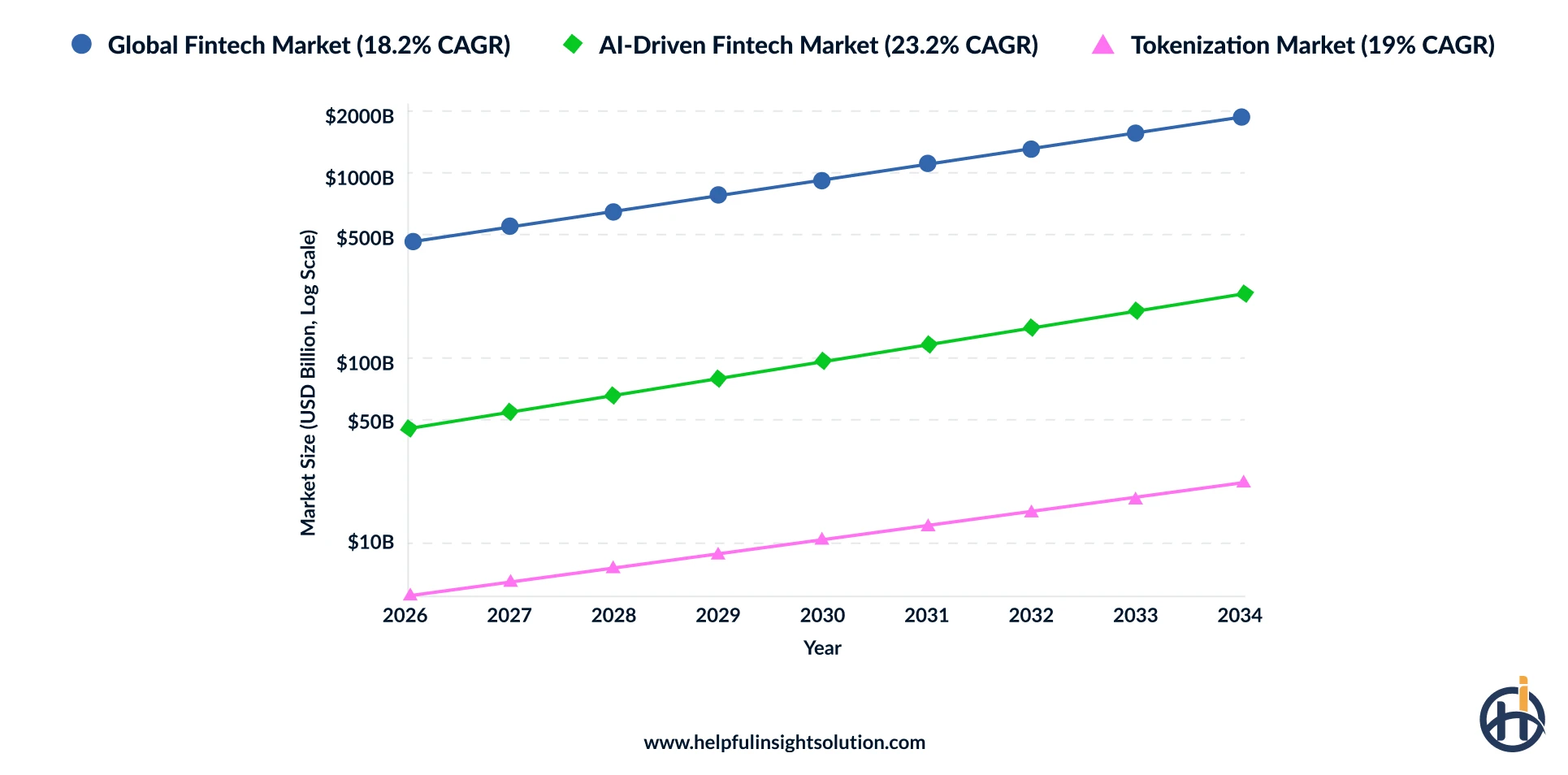
- The global FinTech market is rapidly growing at an 18.2% CAGR rate and will reach $1,760.2 billion by the end of 2034.
- North America will generate revenue of $144.5 billion in 2026, and the USA FinTech market will reach $99.8 billion in the same year.
- By application segment, fraud monitoring systems have a share of 45.3% in the market, and by end-user segment, banks have a 36.9% market share.
- The AI-driven global FinTech market size is $45.5 billion in 2026, which will reach $241.7 billion by 2034 at a rate of 23.2% CAGR over this period.
- The global tokenization market is valued at $5.6 billion in 2026, growing at 19% CAGR.
Businesses know the potential of the FinTech industry and invest accordingly to ensure growth, customer satisfaction, and data security.
The above market figures show that there are multiple opportunities for modern startups and mid-sized enterprises.
Top 13 FinTech trends for financial transformation in 2026
The following trends are the most widely adopted and highest-impact developments in FinTech in 2026.
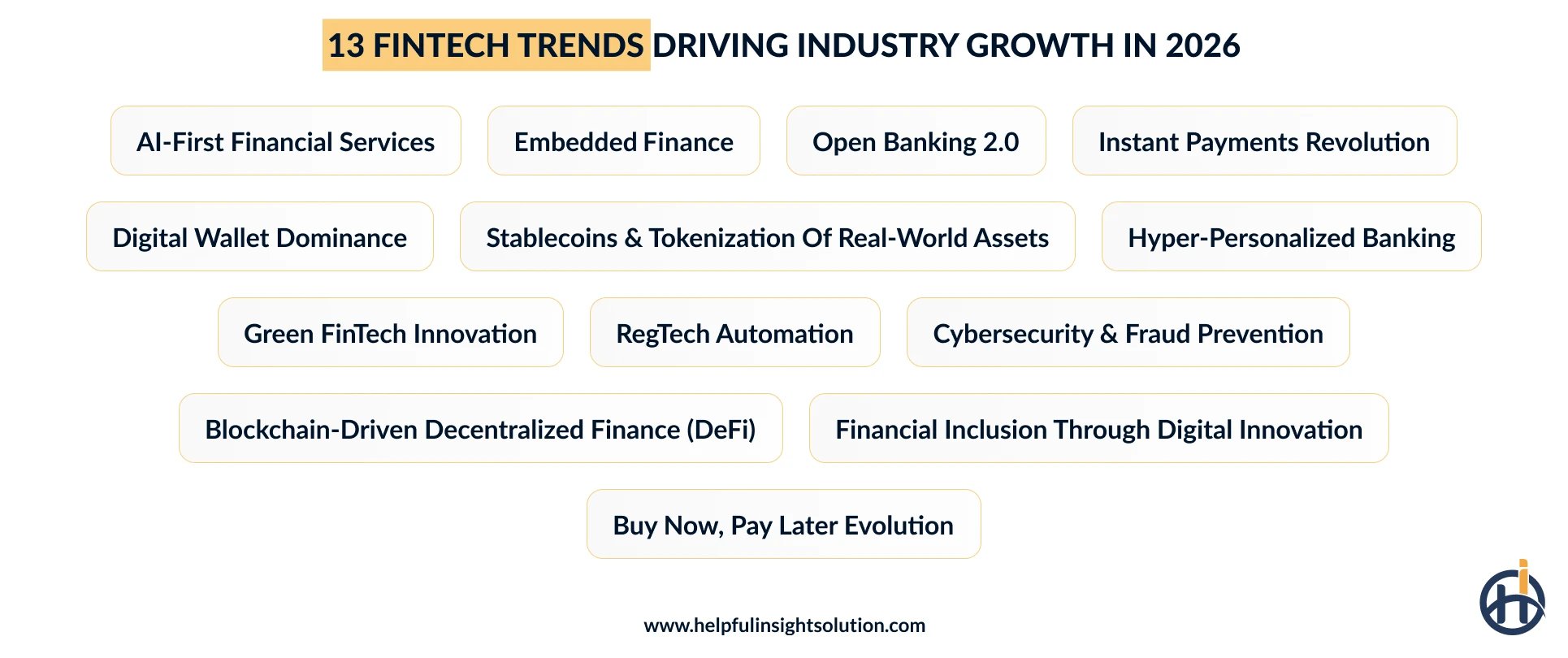
They cover AI, payments, compliance, sustainability, and the shift toward decentralized finance.
1. AI-First Financial Services
Artificial intelligence is reshaping financial services across customer support, fraud detection, and personalised financial advice. Banks and FinTech companies are using AI to make things faster and cheaper.
AI in FinTech enables faster decision-making, more accurate risk management and better customer experiences across digital banking and payments.
Real-world example: JPMorganChase uses AI to assist with fraud detection, document analysis, customer support, and risk management across its banking operations. By embedding AI into core financial services, the bank improves decision-making, reduces operational costs, and delivers faster customer experiences.
2. Embedded Finance
Embedded finance allows companies to integrate financial services directly into their digital platforms, so customers can access payments, lending and insurance without leaving the app they are already using.
Real-world example: Shopify integrates financial services such as payments, business accounts, and merchant lending directly into its commerce platform. This allows businesses to access banking services without relying on separate financial applications.
3. Open Banking 2.0
Open Banking 2.0 is the next phase of digital banking, where secure APIs enable real-time data sharing between banks and fintech companies with customer consent. Unlike traditional open banking, it supports personalized financial planning, instant lending, embedded payments, and AI-powered money management.
This allows customers to control their financial data and organizations to deliver more innovative and customer-centric banking experiences.
Real-world example: Plaid enables customers to securely connect their bank accounts with third-party financial apps through API-based data sharing. This supports personalized financial services, budgeting tools, and faster account verification while giving users greater control over their financial data.
4. Instant Payments Revolution
The instant payments revolution is transforming how money moves by enabling bank-to-bank transfers within seconds. Businesses benefit from faster settlements, improved cash flow, and quicker access to working capital, reducing wait times for customers.
Financial institutions are investing in real-time payment infrastructure and adopting ISO 20022 messaging standards to improve transaction security and transparency.
Instant payments are becoming a core part of modern financial services, improving speed, transparency, and payment efficiency.
Real-world example: The Federal Reserve’s FedNow Service enables participating financial institutions in the United States to process payments in real time, 24/7. Businesses and consumers benefit from immediate fund transfers, improved cash flow, and faster settlement.
5. Digital Wallet Dominance
Digital wallets are becoming really popular, as they are easy to use, fast, and secure. People use them to buy things in stores, shop online, pay bills, and send money to friends.
They are secured through biometric authentication and tokenisation, which significantly reduces fraud risk.
Real-world example: Apple Pay allows users to make secure contactless payments using smartphones, smartwatches, and other Apple devices. Tokenization and biometric authentication provide a fast, convenient, and secure payment experience.

6. Stablecoins and Tokenization of Real-World Assets
Stablecoins are really good at keeping the value of money steady so people can use them to buy things and pay bills without worrying about the value changing. This makes stablecoins very useful for things like paying for stuff and settling debts.
Tokenisation converts real-world assets such as property, commodities and equities into digital tokens that can be traded on blockchain networks. When you combine stablecoins and tokenization, it makes it easier for people to buy and sell things.
This helps to reduce the costs of doing business and makes it easier for people to invest in things.
Real-world example: Circle’s USDC stablecoin is increasingly used for digital payments, cross-border transactions, and financial settlements. The company is also supporting tokenized financial ecosystems that enable faster and more transparent asset transfers.
7. Hyper-Personalized Banking
Hyper-personalised banking uses AI, behavioural data, and transaction history to deliver financial services and advice tailored to each customer.
Banks can look at how a person spends their money and then give them advice on how to save, where to invest, what kind of loan to get, and how to make a budget.
This approach strengthens customer relationships, improves satisfaction and increases long-term retention.
Real-world example: Bank of America’s virtual assistant, Erica, delivers personalized financial guidance based on customers’ spending habits and account activity. It provides proactive insights, payment reminders, and tailored recommendations through AI-driven analysis.
8. Green FinTech Innovation
Green FinTech combines financial technology with sustainability goals, helping individuals and businesses understand the environmental impact of their money decisions. Green FinTech helps people understand how their money choices affect the planet.
For example, people can use platforms to see how much carbon they are producing, invest in companies that care about the environment, and support projects that use renewable energy.
Companies use green FinTech to demonstrate ESG commitment, meet sustainability reporting requirements and appeal to environmentally conscious customers.
Real-world example: Aspiration offers environmentally focused financial products that help customers track the carbon impact of their spending and support sustainable initiatives. The platform encourages responsible financial decisions while promoting climate-conscious banking.
9. RegTech Automation
RegTech uses software and automation to help financial institutions meet regulatory requirements more efficiently, covering transaction monitoring, KYC verification and compliance reporting.
It uses intelligence, machine learning, and other advanced tools to watch transactions, make sure customers are who they say they are, and make reports for the government.
Regulatory technology helps banks do all the things they need to do to follow the rules. This saves banks money, reduces mistakes, and helps them respond quickly when the rules change.
Real-world example: HSBC uses regulatory technology to automate compliance monitoring, transaction screening, and reporting processes. This reduces manual workloads while helping the bank meet changing regulatory requirements more efficiently.
10. Stronger Cybersecurity & Fraud Prevention
FinTech companies are spending a lot of money on cybersecurity because cyber threats are getting really bad. They are deploying AI-powered fraud detection, behavioural analytics and biometric authentication to protect customer accounts and financial data.
They also use encryption to monitor for suspicious activity to protect customer information, stop people from stealing identities, and make sure people trust online banking and other financial services. This helps keep banking, digital payments, and investment platforms safe.
Real-world example: Mastercard uses AI-powered fraud detection and behavioral analytics to identify suspicious payment activity in real time. These technologies strengthen transaction security and help financial institutions reduce fraud losses.
11. Blockchain-Driven Decentralized Finance (DeFi)
Decentralised finance uses blockchain technology and smart contracts to deliver financial services without traditional intermediaries such as banks or brokers.
Users can borrow, lend, trade and invest directly on these platforms. This makes it cheaper to do things and more people can use these services even if they did not have access before. Decentralized finance also lets people create financial products and have more control over their own money.
Real-world example: Aave enables users to lend, borrow, and earn interest on digital assets through decentralized smart contracts instead of traditional financial intermediaries. This demonstrates how blockchain technology is reshaping financial services with greater transparency and accessibility.
12. Financial Inclusion Through Digital Innovation
FinTech is helping people who did not have access to banking before by offering digital banking, mobile payments, small loans, and digital insurance. Some companies are using alternative credit scoring methods and building mobile-first platforms to reach customers who have no traditional credit history.
This helps people and small businesses get services without needing a traditional bank. This is reducing financial exclusion and supporting economic growth in underserved markets globally.
Real-world example: M-Pesa provides mobile-based financial services that allow users to send money, receive payments, and access basic banking without a traditional bank account. Its digital model has expanded financial access for millions of underserved people.
13. Buy Now, Pay Later Evolution
Buy Now Pay Later services are evolving beyond simple instalment plans, incorporating AI-powered credit assessment and expanding into healthcare, education and travel.
They are getting better at deciding money lending parties, as they are using intelligence to detect patterns. Businesses like this because they sell things and keep their customers, and customers like it because they can buy things and pay for them later, and they can see exactly how they will be paying. This is helpful for people who want to buy things, like products, healthcare services, education, and travel.
Real-world example: Klarna offers flexible installment payment options that allow consumers to split purchases into manageable payments. The company continues to enhance its platform with improved credit assessments and a wider range of merchant partnerships to support responsible financing.
Read more: FinTech Startup Ideas to Succeed in Finance Industry
How are FinTech trends transforming enterprises?
Businesses across sectors are adopting FinTech solutions to address long-standing operational and financing challenges. The following are the most significant operational advantages that FinTech adoption is delivering for enterprises.

Enhancing Operational Efficiency
FinTech solutions are really good at making financial tasks easier through automated payments, invoicing, and reporting in real-time. This means people do not have to do these tasks manually, which saves time and money. Businesses invest in financial software development to deploy AI and cloud platforms that make digital workflows better and faster, making things more accurate for businesses.
Personalized Customer Experiences
FinTech technologies use artificial intelligence, machine learning, and data analytics to understand customers’ behavioral patterns and purchase history. This helps businesses to deliver personalized choices to customers, suggest recommended products, and give them advice on money management. They can also allow customers to pay through different options, which increases overall user retention and enhances experiences.
Strengthening Security and Compliance
FinTech solutions protect customer data through AI-powered security tools, multi-factor authentication, and real-time fraud monitoring.
They also use ways to check user identity, which helps businesses follow the rules and money regulations. Automated compliance reporting reduces manual workload and regulatory risk as businesses expand into new markets.
Accelerating Global Business Growth
FinTech enables businesses to operate across borders through international payment platforms, multi-currency support and cross-border payment infrastructure.
FinTech solutions also use cloud platforms to make sure financial tasks are easy to do, allowing businesses to grow fast and giving customers an experience across the world. FinTech solutions are very helpful for businesses that want to work with people in different places.

Major FinTech challenges to overcome in 2026
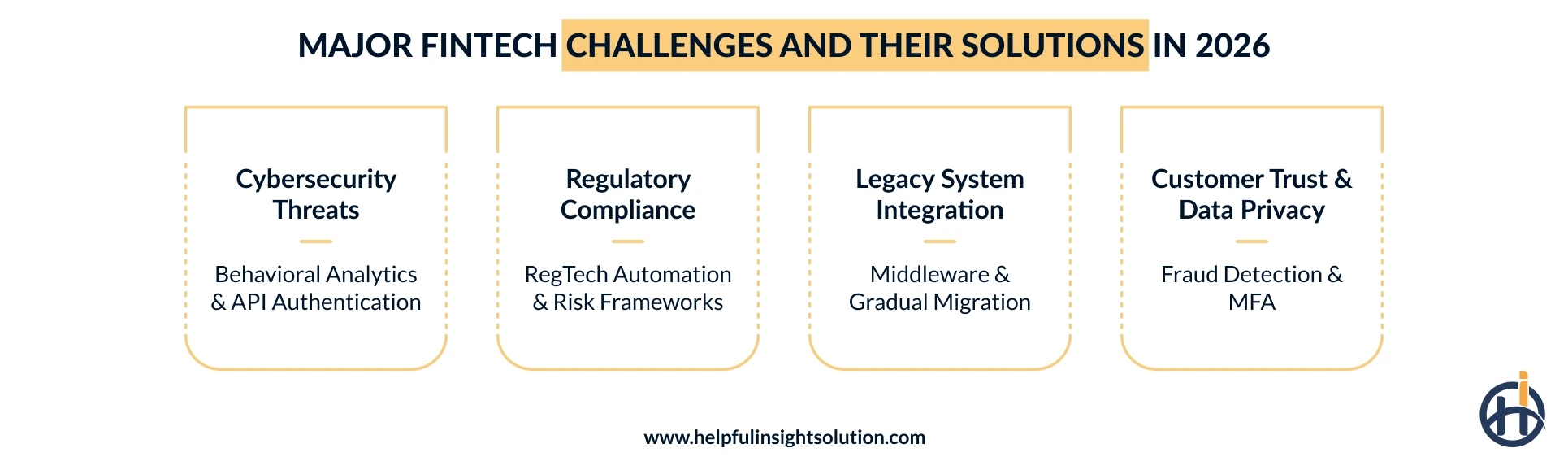
The FinTech industry trends help enterprises to overcome multiple challenges, such as digital security and compliance. In this section, we will study those challenges and understand how these trends have helped businesses to find a solution.
Increasing Cybersecurity Threats
Most FinTech businesses face dual-front cybersecurity threats, in which attackers use AI to generate personalized phishing emails. They can easily scan networks to detect system vulnerabilities and gather sensitive information faster than humans.
Solution: With behavioral analytics, API authentication, and threat exposure management, businesses can easily prevent cyberattacks in real-time.
Complex Regulatory Compliance
FinTechs may face differing regional requirements, such as MiCAR for crypto in the EU and state-by-state privacy laws in the USA. Without explainable AI models, gaps in compliance monitoring allow synthetic identities to be used for fraudulent fund transfers.
Solution: Adopting RegTech platforms to automate audit trails and implementing third-party risk management frameworks to govern BaaS provider relationships addresses this challenge directly.
Legacy System Integration
Legacy systems lack native API support, which limits cross-system communication and slows processes such as loan underwriting. Additionally, the data is stored in scattered formats that create a massive roadblock in achieving hyper-personalization.
Solution: Modern FinTech startups focus on layered architecture, middleware deployment, and gradual system migration that prevents data loss.
Customer Trust and Data Privacy
It is difficult to ensure data privacy, as FinTechs depend on generative and agentive AI for credit scoring and risk management. Modern systems with quantum computing require additional investments because traditional ones are unsafe for data handling.
Solution: Businesses have implemented fraud detection systems and multi-factor authentication (MFA) that ensure security guidelines for users.
Conclusion
The FinTech trends covered in this article are reshaping customer experiences and business operations through AI, blockchain, real-time payments and regulatory automation.
The implementation of RegTech, RWAs, DeFi platforms, and open banking systems has transformed money lending for users. Entrepreneurs investing in FinTech software development must follow these trends to ensure data protection, customer loyalty, and secure real-time transactions, which attract more users from different locations.
These finance technology trends reduce manual workload from form filling to record management by optimizing daily operations. With this, traditional banks, lending platforms, and insurance agencies have shifted from paperwork to digital documentation. You can improve your existing fintech architecture or build new platforms that deliver faster banking and financial services.
FAQs
Advanced integrations like AI-driven transaction networks, embedded finance, and agentic commerce impact digital payments. Leading FinTech innovations, such as fraud prevention, account-to-account payments, and digital wallets, ensure safety. Additionally, regulatory compliance, like AML, CFPB, and KYC, helps banks to deliver money protection in real-time.
Artificial intelligence has multiple roles in the FinTech industry, like robo-advising, credit scoring, fraud prevention, and automated trading. It also offers RegTech and conversational AI for continuous customer support, query handling, and transaction streamlining. This helps to resolve algorithmic bias, optimize investments, and reduce operational expenses.
FinTechs must adopt AI-driven frameworks, real-time KYC/AML tools, third-party risk management, and scalable API systems. It is important to adopt Banking-as-a-Service (BaaS), prepare for open banking methods, and shift to risk-first AML. You should implement robust security measures, like Verification of Payee (VoP), on digital assets, stablecoins, and instant payments.
Helpful Insight helps FinTech enterprises to manage banking services through advanced technologies, like AI and blockchain. It provides key development services that are discussed in the following manner:
- It ensures the safety of user data and money transactions through AI-driven fraud prevention.
- The experts use decentralized finance and cryptocurrencies that deliver robustness and scalability.
- Businesses can integrate embedded robo-advisors to help users with financial investing and trading.
In the FinTech sector, future opportunities include Agentic AI, embedded finance, and B2B payment integration. Advanced co-pilots track investments, optimize subscriptions, and negotiate transactions without any human intervention. With regulatory technology and digital assets, people can easily exchange money within a secure ecosystem.