


Key Takeaways
- Finance now runs on technology, so IT services for the financial industry have become core to how banks, NBFCs, and fintechs serve customers and grow.
- Digital banking is the norm, with over 4.2 billion people using it in 2026, which makes a solid digital presence essential for finance firms of every size.
- The services a finance business depends on most are custom software, mobile and web apps, cloud, cybersecurity, data management, and IT support.
- Emerging technologies like Generative AI, agentic AI, RPA, blockchain, and open banking are reshaping finance and IT, unlocking real productivity and revenue gains.
- Compliance and security are not optional in finance, and a capable partner builds rules like GDPR and PCI DSS into systems from the start.
- Partnering with a specialised IT services provider lets a finance business focus on its products while experts handle the technology behind it.
Banks, NBFCs, and fintech run on technology today, whether it is a mobile banking app, a payment gateway, or lending software. IT services for the financial industry cover all of this work, like software development, cloud setup, cybersecurity, data management, and day-to-day support.
So, IT services are a must for financial institutions today to keep money moving safely, and let customers bank, pay, and borrow digitally. However, running this technology in compliance with the finance industry requires a reliable technology partner.
A partner can manage the technology side, so the institution can work on building its products and serving customers, instead of managing systems on its own.
This blog will help you understand what IT services for fintech companies include, why they matter, key services, technology shaping their future, and how to choose a partner.
Why IT services for the financial industry matter more than ever?
Customers now expect to bank, pay, borrow, and access other financial services on their phones, and IT services are what make it possible.
53% of the world’s population, over 4.2 billion people, rely on digital banking in 2026, and in markets like the US, around 72% of adults already bank through mobile apps. Therefore, it is a must for all sizes of financial institutions to have their digital presence.
IT services are also helping businesses to boost productivity by bringing automation powered by technologies like Generative AI. McKinsey estimates that generative AI alone could add $200 billion to $340 billion a year to banking, mostly through higher productivity.
Key IT Services for financial institutions
A finance business runs on a handful of IT services, often working together. Here we have compiled a few of the must-have IT services for a finance company.
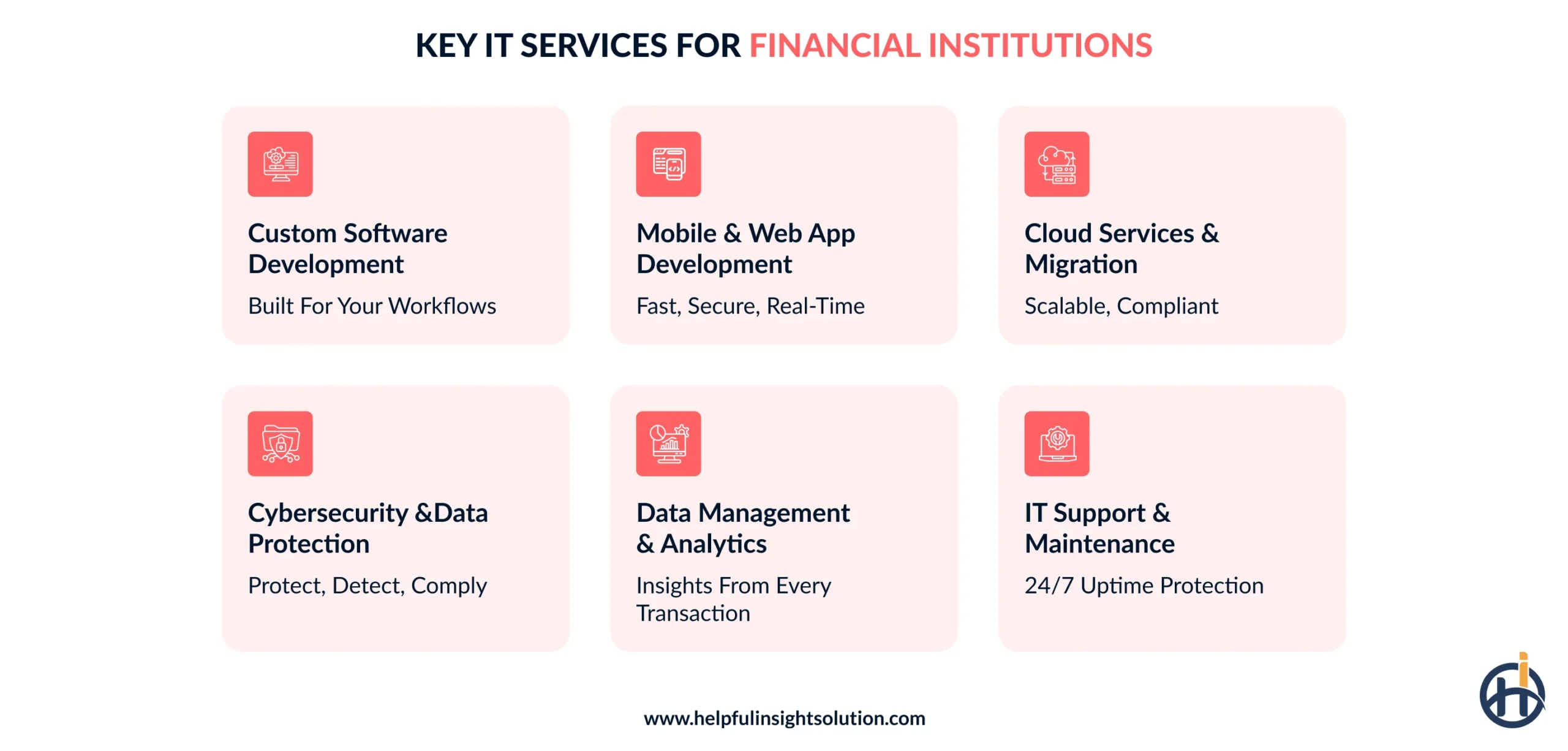
Custom software development
Every financial organization works differently, so do its software needs. Custom software development ensures that the rules and workflows specific to an organization are met and that it works as expected.
Additionally, it handles integrations with various systems that most financial firms depend on, such as credit-bureau checks, core banking connections, and regulatory reporting. It also ensures that the data can be communicated between these systems seamlessly, which off-the-shelf software often struggles to do.
Mobile and web app development
The mobile app is where most of the customer interactions are happening now, so it has to be fast, easy to use, and intuitive, while meeting the security requirements. From balance check, bill payments, money transfer, to loan applications, customers are turning to mobile applications, expecting a seamless experience. So, if your mobile app fails to deliver the same, this will drive them to your competitor.
Fintech development covers account opening, payments, fund transfers, and statements, all built to run quickly and securely on a phone. It also has to connect to back-end systems and payment rails in real time, like UPI in India or ACH and card networks in the US.
Cloud services and migration
Cloud migration for finance takes the firm’s core systems and data from on-premise servers and hosts them on cloud platforms like AWS, Azure, or GCP. These cloud platforms ensure that the system scales up or down with demand, so systems hold steady during peaks like salary days or festival-season spending.
Cloud services make it easy for financial services to eliminate the cost of buying and maintaining hardware, and also make it easy to launch new products quickly. Providers also let you keep data in a set region, which helps meet rules like RBI data localisation in India or GDPR in Europe.
Cybersecurity and data protection
The finance industry is among the more vulnerable to cyberattacks than almost any other sector, so security is a key IT service that must be embedded to mitigate risks. Cybersecurity for banks, NBFCs, and fintechs includes real-time fraud detection, anti-money laundering, transaction monitoring, encryption, and strict access control.
It also keeps the business compliant with data protection rules, like PCI DSS for card data and GDPR for personal data protection, and the growing set of regional requirements that continue to expand.
Data management and analytics
A finance company often deals with a large amount of data every day, including transactions, repayments, and customer activity. Data management IT services for a finance company ensure secure data storage and are organized in one place.
Analytics built on top of that foundation that turn raw data into decisions, like spotting patterns in customer behaviour, forecasting risk, improving product performance, and flagging anomalies that may signal fraud or compliance issues before they escalate.
IT support and maintenance
Banking and payment systems run around the clock, so they need steady monitoring and fast fixes. IT support for financial services covers continuous system updates, monitoring, security updates, performance checks, issue resolution, and a help desk for staff.
A managed IT service provider for finance industry can deliver these services proactively while aligning IT operations with the security, compliance, and uptime requirements of financial organizations.
For banks and NBFCs that cannot afford outages, this is what keeps service-level agreements (SLAs) intact. Round-the-clock monitoring and quick incident response catch problems early, while failover systems step in before an issue ever reaches the customer.

Emerging technologies shaping the future of Finance IT
The finance industry is always being a frontier in adopting advanced technologies, enabling it to serve better with security.
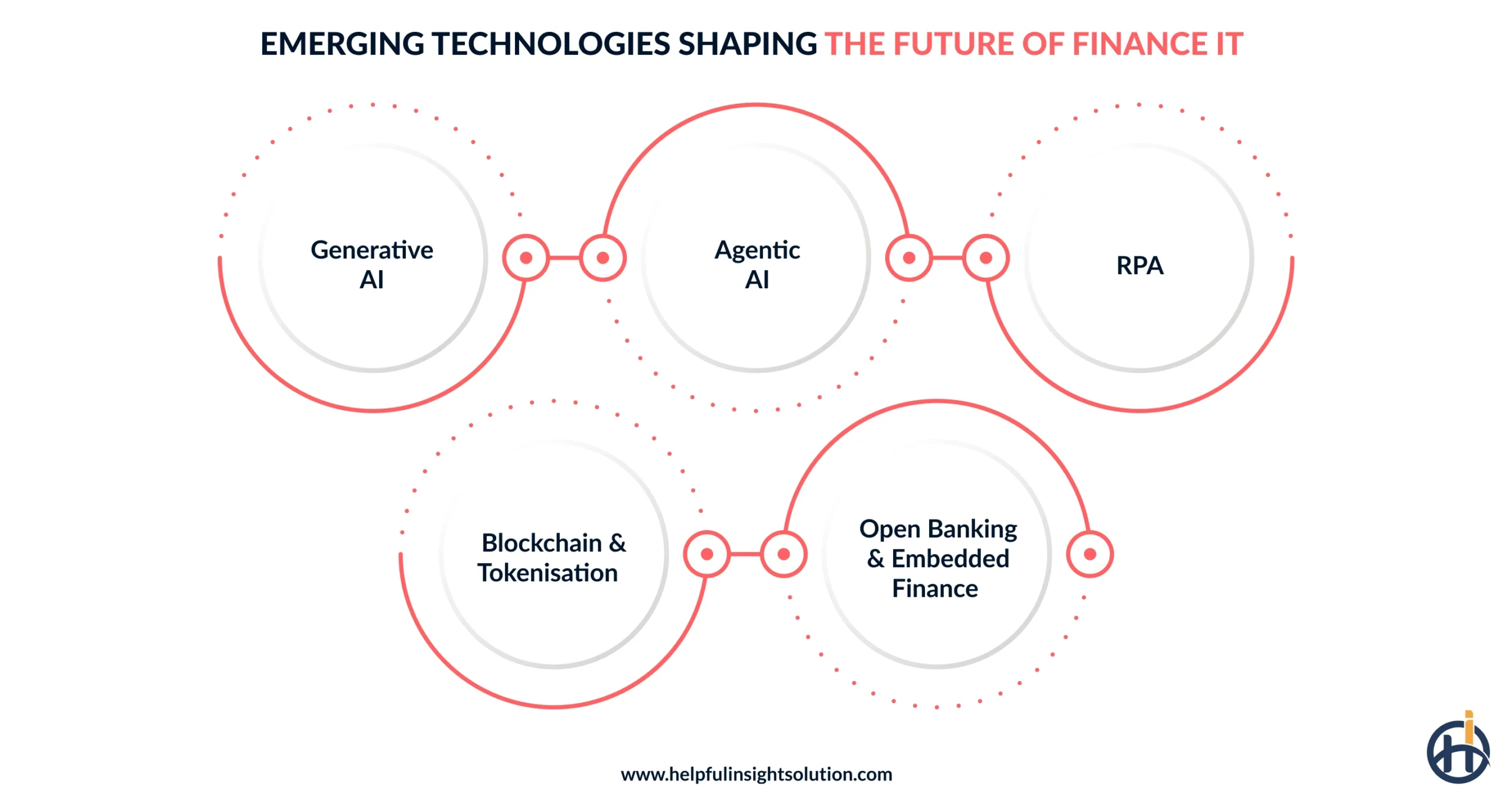
The following technologies have been reshaping how IT services are built and delivered across banking, lending, and payments.
Generative AI
Generative AI has moved beyond the simple chatbots in finance. Banks, NBFCs, and fintechs are now using it to draft credit memos and summarise compliance documents. Additionally, it handles customer queries in plain language and speeds up routine coding, which shortens how long new features take to deploy.
The use case of generative AI in the finance industry has been realised faster than in any other industry. As a result, companies are investing in generative AI development services in both customer-facing products and internal operations, with back-office productivity gains proving particularly significant.
Agentic AI
Agentic AI is the next evolution of generative AI, moving from assistive to fully automated systems. AI agents, along with suggesting an action, can perform it autonomously with no human involvement needed. For example, an agent in finance can follow up on a missing KYC document or move a loan file to the next stage without someone prompting each step.
Gartner expects 40% of enterprise apps to include task-specific AI agents by 2026, up from less than 5% in 2025. Since finance is a regulated industry, AI agent development must be performed following the guardrails and ensuring specific compliance is met.
Robotic Process Automation (RPA)
RPA replaces the repetitive, rule-based tasks that occupy finance back offices, like data entry, payment exception, compliance reporting, and statement reconciliation. Software bots follow set steps exactly, which cuts errors and frees staff for work that needs judgment.
Grand View Research valued the RPA market at $6.0 billion in 2026 and expected it to grow with a CAGR of 29%, reaching the market value of $35.8 billion by 2033. Within financial services, insurance has taken RPA furthest, where bots now manage much of the claims processing and policy work that once tied up entire teams.
Blockchain and tokenisation
Blockchain removes the delay and the middleman from cross-border payments, so a transfer that earlier took days can be settled in minutes. For financial institutions, the most useful applications are in tokenised assets, trade finance documents, and supply chain financing, where a tamper-proof and auditable record carries real operational and regulatory value.
Several central banks are now piloting CBDCs (Central Bank Digital Currencies) on distributed ledgers, a sign that the technology is maturing into real infrastructure.
Open banking and embedded finance
Open banking lets customers share their financial data securely with third-party providers through APIs, which opens the door to new products built on top of a bank’s rails. Embedded finance takes this further, enabling non-finance apps to offer payments, lending, or insurance directly inside their own platforms.
For fintechs, this is changing how IT services for fintech companies are built. BaaS (Banking as a Service) providers sit at the centre of many of these integrations, and the IT layer that connects internal systems to external APIs has become one of the most important parts of a fintech’s infrastructure.
Why financial institutions choose a specialist IT partner?
Specialisation is what makes any business excellent at what it does. As a finance business, you understand your customers and how money moves through your products better than anyone. In the same way, a partner that focuses on finance IT services brings the same depth on the technology side, understanding the compliance requirements, integration patterns, and security standards that finance runs on.
So, the smart move is to let each side do what it does best: you focus on the business, and the partner handles the technology behind it. Here is what a finance-focused partner brings:
- Finance-specific expertise: A partner who already knows finance accounts for KYC, lending workflows, payment rails, and audit trails from the start, so they do not learn the rules of finance on your budget.
- Compliance and security built in: A reliable finance software development company builds IT solutions for financial firms with GDPR, PCI DSS, and regional regulators already factored in, and keeps watching systems once they go live, so uptime stays high, and risk stays low.
- Speed and flexibility: A partner can scale a team up for a major build and reduce it once the product ships, without you carrying permanent headcount costs in between. For a fintech competitor, this can decide whether a product launches this quarter or slips to next year.
- Access to emerging technology: Skills in Generative AI, RPA automation, modern API architecture, and blockchain are hard to hire and keep, but a partner already has them ready to put to work.

Final thoughts
Technology now decides how well a financial business serves its customers and how safely it grows. Whether it is the app people open every day or the security behind each payment, all of it runs on IT services working in the background. The institutions that stay ahead treat this as core to the business, not as a back-office task.
You know your finance business. Helpful Insight knows the technology that makes it run. As a partner to banks, NBFCs, and fintechs across India, the US, and the UAE, we build and secure the systems your customers rely on, with compliance handled from the start.
So, if you are planning a new build or want to modernise what you already run, talk to our team about the IT services for the financial industry your business needs next.
Frequently Asked Questions
They cover most of the technology a finance business runs on. This includes custom software for financial services, such as core banking and lending systems, as well as cloud, cybersecurity, data management, and ongoing support.
Fintech IT services usually focus on the app and API integration, since the product is mostly digital. A traditional bank leans more on core systems and legacy modernisation. Both need strong security and compliance, but the priorities sit in different places.
Cloud migration for finance moves ageing on-premises systems onto infrastructure that scales with demand, which lowers cost and improves uptime. It also accelerates the launch of new products, which is a key part of digital transformation in finance. Most providers also let you keep data in set regions to meet local rules.
The best technology services for banks and NBFCs come from a partner who already understands finance workflows and regulations. Look for proven IT solutions for finance companies, clear security practices, and the ability to scale a team when a build gets big. Domain knowledge matters more than a low price here.
IT compliance in finance means building systems that follow rules such as GDPR, PCI DSS, and local regulatory requirements from the start. Well-built IT services bake these controls into the software and keep audit trails, so you are not fixing gaps after launch. This lowers both the risk of penalties and the cost of meeting an audit.
The cost of IT services for financial firms is not definitive; it often depends on your needs. A one-off build like a mobile app is cost differently from ongoing services such as support, cloud, or security, which are usually billed monthly. Cost also varies according to the partner’s location, complexity of the project, and compliance. Therefore, the best practice is to have a quote for the scoped work.
RegTech, or regulatory technology, is software that helps financial firms automatically meet compliance rules. It can manage tasks such as KYC checks, transaction monitoring, and regulatory reporting, thereby reducing costs and error risk.