


“Improve care facilities for cancer patients by integrating AI in the Oncology field.”
Artificial intelligence technology is helping doctors to treat multiple chronic diseases like cancer through smart analysis and accuracy. The role of AI in oncology is to identify abnormal tissue formation in a particular area by using advanced techniques and predict suitable treatment models.
As per a recent study, commercial hospitals across the globe have 48% market share, resulting in increased patient care. Additionally, North America is at the top with a 45.8% share among different regions.
This rise in AI-powered cancer treatment and recovery encourages healthcare businesses to create a certified ecosystem with advanced equipment. They can increase medical efficiency, reduce additional expenses, and enhance surgical planning by involving AI components. It is highly recommended to implement AI that boosts cancer detection and patient care.
You need to understand various things that help in the effective development of AI-enabled platforms for the oncology department. If you want to improve cancer diagnosis with AI, then it is beneficial to go through this blog and get the best insights.
What is Artificial Intelligence in Oncology?
The use of artificial intelligence in oncology means the implementation of machine learning and advanced deep learning algorithms for cancer data analysis. This enhances cancer research, diagnosis, treatment planning, and patient care through the latest NLP and LLM models.
Businesses that integrate AI in healthcare help doctors generate real-time images of tissues through various scans and predict accurate results based on the obtained information. Various tools and software are used to perform multiple AI-driven cancer treatment operations, enhancing patient experiences and medical planning.
- It helps in advanced radiology, pathology, and treatment analysis.
- AI improves clinical data and genetic prediction based on cancer data.
- This increases efficiency through drug discovery and molecular simulation.
Key Benefits of Implementing AI in Oncology
It is highly beneficial to implement AI in oncology, as it helps in better cancer treatment and recovery. Some of the best AI advantages are discussed in this section that you must observe before going forward.
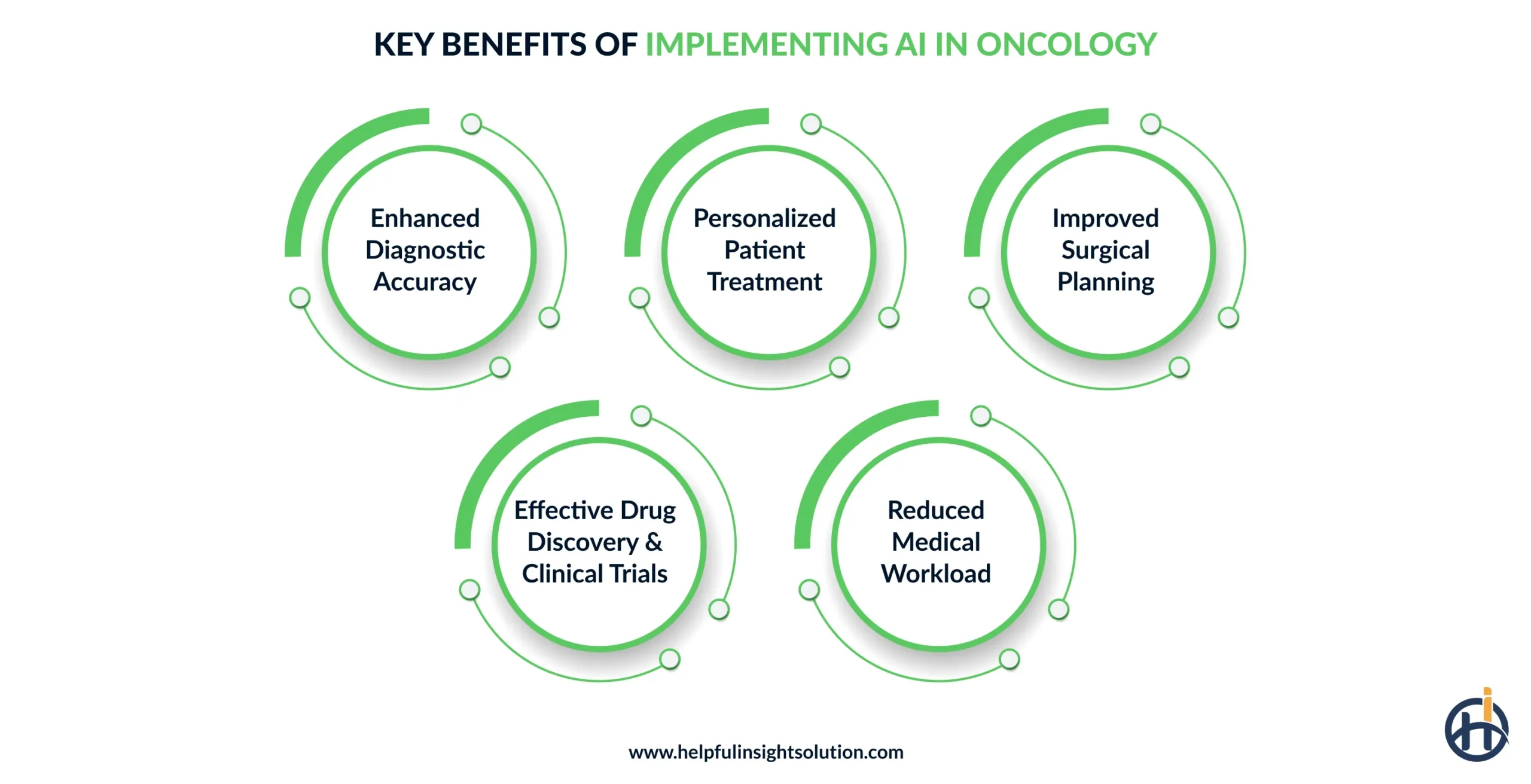
1. Enhanced Diagnostic Accuracy
For better analysis and prediction, various AI-based cancer diagnosis tools provide enhanced features that ensure data accuracy. They precisely study scanned tumor images, generate advanced clinical results, and optimize medical operations for professionals.
2. Personalized Patient Treatment
Businesses must use AI in personalized cancer treatment that analyzes complex and multi-model data for genetics, radiology, and pathology. It uses predictive healthcare models that specify the behavior of tumors and suggest remedies based on human conditions.
3. Improved Surgical Planning
With 3D modeling and image analysis, doctors can easily plan for surgeries by personalizing treatment and reducing complications. It is beneficial to use RPA in healthcare, which offers virtual simulations for better practice before clinical surgery.
4. Effective Drug Discovery & Clinical Trials
You can implement AI in oncology clinical trials that increase the speed of cancer research, ensuring cost-effective solutions. With machine learning and Generative AI technologies, it is easy to screen various drugs based on side effects and target areas.
5. Reduced Medical Workload
It is easy to resolve various clinical issues, like staff scheduling and repetitive tasks, by using the AI-driven oncology platforms. The technology improves healthcare diagnosis, treatment planning, and medical operations, increasing overall efficiency.
Top AI Applications in Oncology
We are going to discuss the best applications of AI in oncology, which include imaging, diagnosis, and drug delivery. They enhance visualization and planning through advanced AI technologies, like ML.
1. Radiology and Imaging
Various automated tools like CADe/CADx help in image construction and segmentation, which support tumor detection. The integration of AI in radiology for cancer treatment is crucial for identifying target areas like lungs, blood cells, and nerve tissues.
Various deep learning techniques, such as RAKI, enhance image transformation based on patient preferences. Different tools that use AI in medical imaging involve Rad AI, Aidoc, AZmed, and others, increasing research operations for cancer detection.
2. Digital Pathology & Diagnosis
The artificial intelligence for clinical oncology allows medical experts to identify types of tumors, severity levels, and recovery patterns. Various algorithms, like CNN and WSI, are used to handle complex data for pathological functions.
Additionally, doctors can decide on immune therapies like PD-L1 and HER2 with the help of advanced AI predictions. Paige.ai, ArteraAI, and DCS PathIMS are some of the best tools that offer standard visualization techniques to understand different adverse conditions.
3. Genomics-Driven Therapy & Molecular Profiling
It is easy to detect possible changes, like abnormal divisions, in different cells through AI-driven innovation in oncology. The technology targets multiple cancer studies, such as genomics, transcriptomics, and proteomics, that detect various tumors.
With deep learning models, it is easy to build DNA sequences for patients of different blood groups. Some of the best tools, like Tempus AI, PathAI, and CHIEF, are used for developing effective genomes based on multiple cancer data points.
4. Radiotherapy Treatment
To treat growing cancer cells, AI in radiation oncology plays a crucial role by detecting target areas through the auto-contouring process. The technology studies various scans through real-time parameters, such as blood fusion and fluid content.
The use of advanced Generative Adversarial Networks ensures the accuracy of CT, MRI, and PET scans. MVision AI, Varian Ethos, and Limbus AI are the primary software that provide better radio-based treatment procedures and recovery plans for patients.
5. Immunotherapy Response (Biomarkers)
By analyzing various cancer images and molecular data, healthcare providers can easily predict patient responses, identify swollen tissues, and optimize treatments. Various AI models detect different biomarkers, which include PD-L1 and TMB.
These machine learning algorithms help to examine the tumor environment and the effects of medication on different human organs. To manage chemical effects, the best tools are SCORPIO, LYNA, and CURATE.AI, which build highly secure medical documents.
6. Clinical Trial Matching and Patient Triage
This is one of the best AI applications in oncology, which allows medical professionals to screen cancer patients through automated measures. The technology boosts clinical trials through EHR management and enhances radio analysis of cancer images with natural language processing.
It helps to reduce manual selection processes, improving clinical support systems for doctors and hospitals. A few tools, like IBM Watson, Massive Bio, and OncoHost, help in patient trials and advanced molecular analysis.
7. Drug Discovery and Repurposing
The AI technology helps expert medical professionals to predict synthetic drug compositions and map their effects with patient outcomes. Various standard algorithms, like SVM and RNN, detect different enzymes, proteins, and other carbon components in a particular drug.
Additionally, Generative AI models, such as GAN and VAE, help doctors to develop molecular structures by targeting cancer-causing agents. CavitOmiX, DeepChem, and Recursion OS are some advanced tools that help in drug development.
How to Integrate AI Tech in Oncology?
In this section, we will understand the process of integrating artificial intelligence in oncology operations. From data gathering to patient monitoring, we will study all major stages with detailed information.
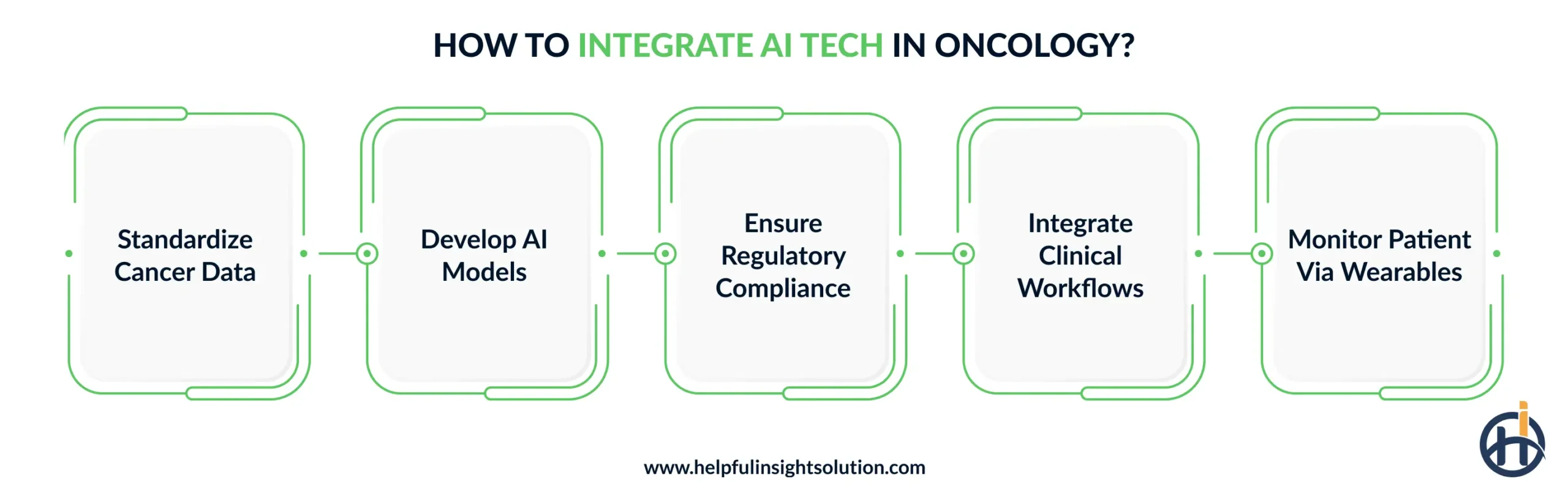
1. Standardize Cancer Data
The first step is to use standard data formats that help to transform cancer images and treatment plans into explainable datasets. It allows medical experts to perform AI-related oncology research and execute different clinical operations.
Some of the major data formats include mCODE, FHIR, and OMOP CDM, which target multiple healthcare tasks.
2. Develop AI Models
Businesses must use various models of Generative AI in oncology for data analysis, clinical pathology, imaging, and genetic transcription. It improves cancer detection, diagnosis, and the treatment process by automating the medical workflow for doctors.
You can choose different algorithmic models, like Computer Vision (CNN), LLM transformers, and SVM.
3. Ensure Regulatory Compliance
An entrepreneur must approach a reliable and experienced healthcare software development company that ensures security and regulatory compliance. It provides HIPAA, FDA, and HL7 guidelines, allowing businesses to create secure platforms for cancer detection.
These standards offer constant data monitoring and privacy, which support pilot programs for quality integration.
4. Integrate Clinical Workflows
By implementing AI in oncology, you can easily use standard EMR systems and PACS platforms with pathology, radiology, and genetic operations. With LLMs, it is easy to prepare case studies based on cancer data and perform medical trials through advanced tools.
The use of multi-modal AI technology helps in clinical decision support and diagnosis.
5. Monitor Patient via Wearables
To enable real-time monitoring of cancer patients, it is beneficial to use automated biosensors that analyze physical data and enhance early tumor detection.
These FDA-approved devices track heart rate, oxygen levels, and body temperature to provide collective information. They suggest remote care and personalized treatment through predictive analytics.
Major Challenges with AI for Oncology
Various challenges related to artificial intelligence in oncology prevent businesses from investing in this technology. We will observe some key integration risks with their respective solutions in this section.
1. Data Tracking Issues
The data are collected from various sources that can be inconsistent and lack standard formats, reducing quality. Various irregular updates in the EHR system can also affect the overall cancer screening model.
Solution: The artificial intelligence landscape in oncology demands various data models that help to standardize clinical information for patients.
2. Workflow Integration Problems
This involves various technical errors, like UI/UX design, EHR or PACS integration, and black box issues. The complex medical structure increases management costs and reduces the reliability of data.
Solution: Businesses must focus on white-label clinical solutions that offer advanced integration support for healthcare equipment and medications.
3. Generic Analytics Algorithms
AI in precision oncology offers image segmentation and predictive analytics that are common, increasing generic issues. This leads to consistent changes in the IT infrastructure and modern clinical workflows.
Solution: It is beneficial to create a systematic domain for all healthcare components that are used in cancer research and treatment.
Things to Consider for AI in Cancer Detection
A business investor should know various things before using AI in cancer treatment and healthcare planning. Here, a few important points are discussed that help in seamless data model integration.
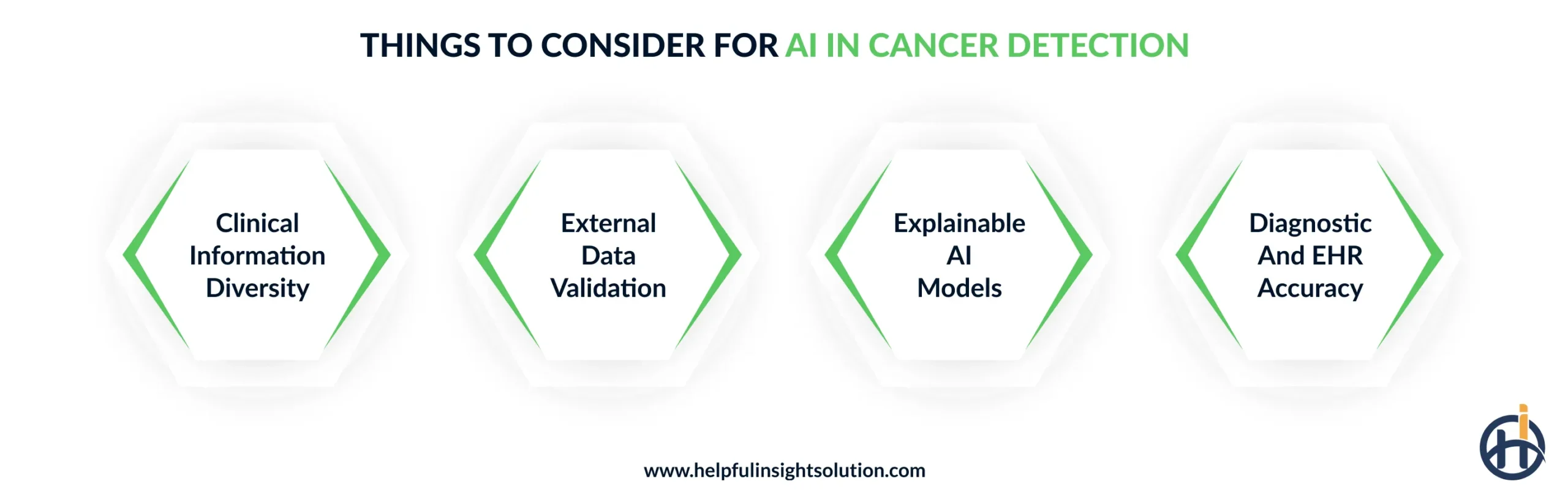
1. Clinical Information Diversity
The technology of AI for oncology is trained on similar data, which needs to be diversified through machine learning models. The information should be based on different sources, such as cancer images, EHR data, and medical equipment.
2. External Data Validation
It is crucial to ensure the correct cancer data by using electronic data interchange in healthcare, enhancing surgical operations. The validation must be performed according to different medical scanners, imaging patterns, and clinical methods.
3. Explainable AI Models
The future of AI in cancer treatment is the explainable models that ensure transparency, risk prediction, and regulatory compliance. This allows healthcare professionals to easily integrate clinical workflow with external networks and data services.
4. Diagnostic and EHR Accuracy
Businesses that want to implement AI in cancer diagnosis must generalize images generated through CT and MRI scans. Additionally, it is also important to ensure the accuracy of EHR systems, which store large amounts of user data, reducing the risk of breaches.
Why Choose Helpful Insight to Develop AI-Powered Healthcare Solutions?
An entrepreneur needs a reliable partner who has experience in the healthcare domain and can easily implement artificial intelligence in oncology. We have created hundreds of solutions that improve medical efficiency, task management, and digital workflow.
Businesses can hire dedicated developers who have enhanced technical skills to combine existing systems with AI for cancer detection. Additionally, the experts ensure support and security during the complete integration process.
You must observe the features of leading software that help medical professionals to find tumors in different body parts and make precise decisions.
The use of AI in medical oncology will allow business investors to transform healthcare services and increase patient engagement by ensuring trust. So, you must start immediately to reduce competition and become a market leader.
FAQs
AI uses machine learning and deep learning algorithms to analyze medical images, identify cancer cells, and suggest treatments. The crucial working stages are discussed in the following manner:
- It captures images from different scans and studies different patterns.
- This technology analyzes molecular data to build a genome sequence.
- Doctors can easily plan surgeries and treatment based on AI models.
- It helps in predicting the right drugs and medication to cure cancer.
- AI uses CNN and LLM to build healthcare models for accuracy.
For cancer detection and treatment, various AI-powered tools are used by hospitals and clinics that deliver accurate results with enhanced algorithms. Some of the best AI Oncology tools are described as follows:
- IBM Watson: It helps to analyze medical documents and patient records for treatment.
- PathAI: This tool allows accurate pathology diagnosis and drug discovery through ML.
- Arterys: It is a cloud-based AI imaging tool that tracks various CT and MRI scans.
The AI technology matches human cells with ideal conditions to detect cancer or tumors, resulting in high accuracy and transparency. It identifies tissue composition, abnormal cell division, and imaging patterns through advanced models. Artificial intelligence focuses on automating clinical operations and predicting better treatment plans for patients.
In the USA, the most widely used AI-driven software for detecting cancer includes Paige AI and Aidoc, targeting different medical operations. Paige AI is used to perform pathology tasks and analyze tissues, whereas Aidoc helps to capture images or scans. They are FDA-approved software, providing early results and reducing healthcare expenses.
The cost of building AI-enabled cancer detection platforms is dependent on multiple factors, like data modules, system compatibility, compliance, and maintenance. On average, the price may range from 50K to 500K, which may increase due to advanced enterprise requirements. Businesses must integrate AI for Oncology because it reduces operational costs and increases efficiency.