

“Choose the right healthcare features for mobile app development for patients and doctors.”
Have you ever wondered what makes a mobile app special? Its the features and functionalities that power up digital solutions for various industries like healthcare. An entrepreneur should find it crucial to know the features for healthcare app development before making investments in the program.
It requires a thorough analysis of the needs of patients and doctors in various regions. This helps in targeting the top healthcare app features, enabling effective treatment plans and disease control.
There is no doubt that the healthcare market is expanding all over the world, generating a revenue of $1,070 billion by 2030. Advanced technologies like AI mix with the essential features of healthcare apps that can automate symptom tracking and generate accurate medical reports. Additionally, they have a lot more applications that you will explore in this blog.
You must implement healthcare features for smooth user experience, data security, and advanced medical services. This blog provides various features based on different parameters, helping businesses to choose the best for their mobile apps.
Why Do People Need Healthcare Apps in 2026?
As an entrepreneur, it is important to know the purpose of mobile healthcare app development for people. You must understand their needs, preferences, and medical issues before choosing app features:
1. Quality Medical Services
Healthcare apps connect users with doctors, ensuring reliable treatments and solutions. In 2026, AI-driven recommendations and digital records deliver faster services with improved medical app engagement.
2. Monitor Personal Health
Various self-care apps like Finch enable tracking of vital signs and chronic conditions through smart devices. This empowers users to maintain long-term wellness by reducing frequent hospital visits.
3. On-Time Healthcare Treatment
Medical consultations, reminders, and alerts reduce delays in diagnosis and treatment. In 2026, the importance of features in healthcare app development is high due to predictive analytics and remote care.
Top Healthcare App Features for Patients
This section brings the must-have features in healthcare apps for patients, allowing them to prevent illness. These features ensure effective treatments, consultations, and accurate reports:
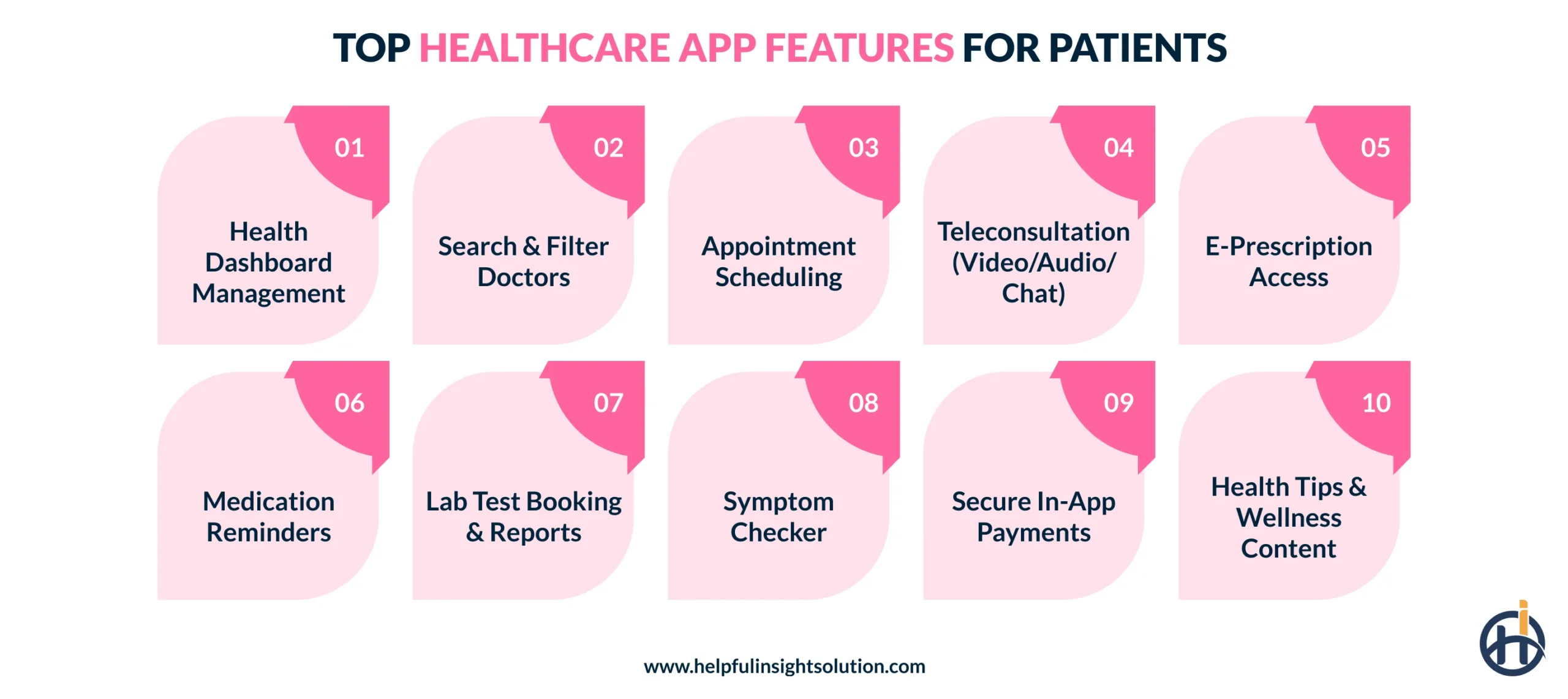
1. Health Dashboard Management
A centralized health dashboard gives patients a complete overview of their medical data. It displays healthcare vitals, appointments, prescriptions, and reports for quick access.
2. Search & Filter Doctors
It includes search options, allowing patients to easily find doctors based on specialty, location, and experience. This feature saves time and improves access to personalized medical care.
3. Appointment Scheduling
The appointment scheduling feature enables patients to book, reschedule, or cancel visits in just a few clicks. You can invest in AI physiotherapy app development to avoid long waiting times for patients.
4. Teleconsultation (Video/Audio/Chat)
Teleconsultation allows users to connect with doctors through video, audio, or chat. Additionally, it offers access to medical advice without visiting clinics through regular follow-ups and remote care.
5. E-Prescription Access
E-prescription enables patients to view and download digital prescriptions that reduces lengthy paperwork. Patients can also share prescriptions directly with pharmacies for quick delivery.
6. Medication Reminders
Medication reminders regularly notify patients to take their medication and therapies on time. It generates automated alerts that are especially useful for chronic medical care and elderly patients.
7. Lab Test Booking & Reports
Regular patients can book medical tests through the app and choose preferred labs. All test reports are uploaded digitally on the online portal for easy access, sharing, diagnostics, and record management.
8. Symptom Checker
A symptom checker helps patients identify various health conditions. Additionally, it provides preliminary medical insights and patient care remedies, ensuring informed medical consultations.
9. Secure In-App Payments
Secure payment methods allow users to pay for multiple consultations, tests, and services. Multiple payment options, such as UPI and Net Banking, ensure flexibility with convenience.
10. Health Tips & Wellness Content
Smart healthcare tips and wellness content offer expert advice on fitness, nutrition, and preventive care. Personalized information ensures medical innovations, healthier lifestyle choices, and well-being.
Essential Features of Medical Apps for Doctors and Admins
Now, you will study the features of healthcare mobile apps for hospitals, doctors, and admins.
For Doctors
They deliver advanced patient management, billing, staff scheduling, clinical, and prescription services:
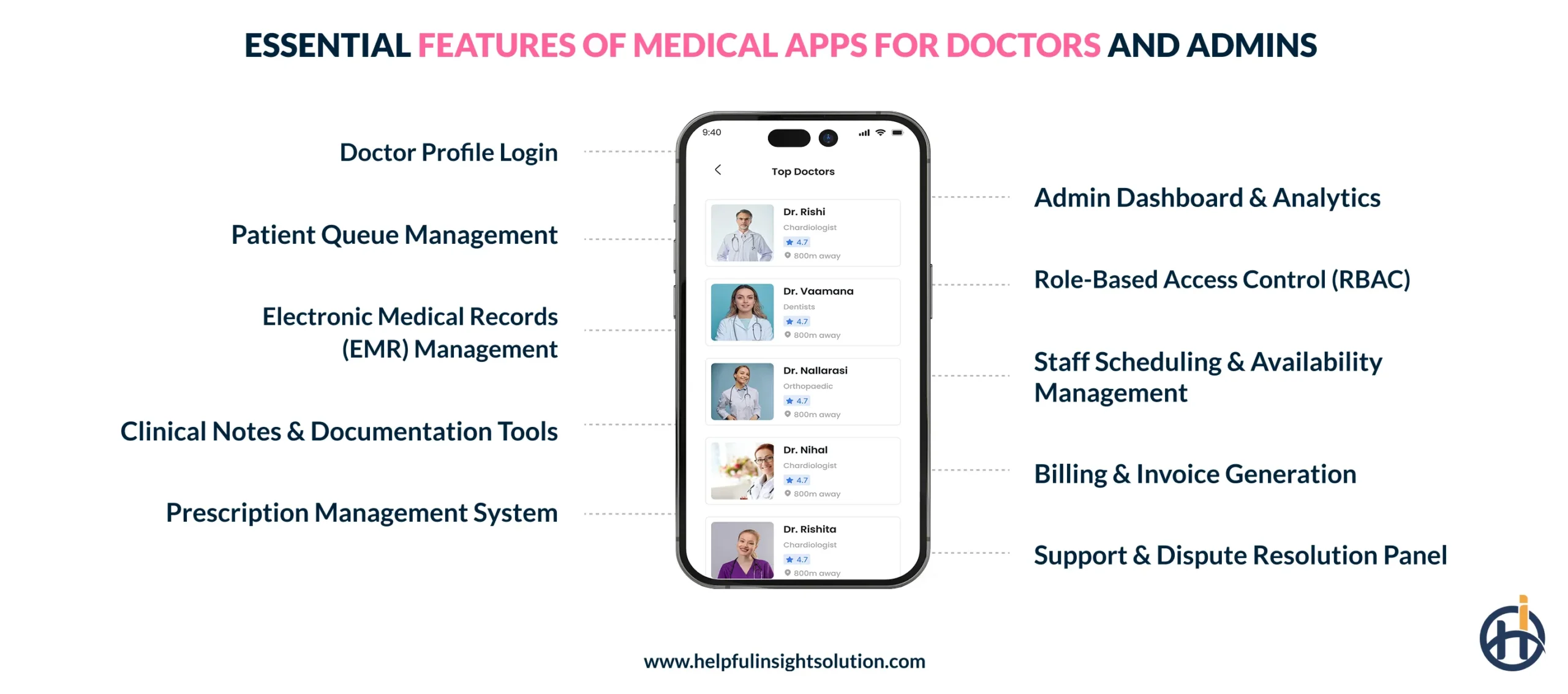
1. Doctor Profile Login
A secure login system in healthcare allows doctors to access their personalized dashboard. It ensures quick authentication using multi-factor login, maintaining data privacy and clinical workflows.
2. Patient Queue Management
Doctors can manage patient appointments and real-time queues efficiently. It reduces wait times by prioritizing cases based on urgency and appointment slots, generating automated notifications.
3. Electronic Medical Records (EMR) Management
EMR enables secure storage, access, and updating of patient medical records. The best healthcare applications allow doctors to view lab results and treatments, ensuring data accuracy and patient care.
4. Clinical Notes & Documentation Tools
Doctors can easily create, edit, and store structured clinical notes digitally. Voice-to-text feature speeds up document access by improving record accuracy, consultation time, and remote patient care.
5. Prescription Management System
This healthcare app feature allows doctors to generate digital prescriptions that reduce medical errors with regular dosage checks. Prescriptions can be shared with patients or pharmacies to ensure transparency.
For Admins
These features allow hospital staff to manage inventories, billings, and other medical tasks. They ensure a smooth workflow of healthcare solutions by analyzing medical records and managing staff timings:
1. Admin Dashboard & Analytics
The Admin dashboard provides a centralized view of all hospital and clinical operations. It offers analytics on appointments, revenue, and doctor performance, optimizing workflows and decision-making.
2. Role-Based Access Control (RBAC)
RBAC ensures users can only access services relevant to their roles, strengthening healthcare security. Admins and hospital staff receive permission-based system access based on their designations.
3. Staff Scheduling & Availability Management
This feature allows admins to manage doctor and staff schedules using advanced technologies. They track availability, shifts, and leave requests for doctors, preventing healthcare conflicts and resource shortages.
4. Billing & Invoice Generation
It automates billing processes based on doctor consultations and services. A CRM for the fitness industry generates invoices by tracking payments, medical dues, and financial reports of patients.
5. Support & Dispute Resolution Panel
Admins can manage various raised tickets and user concerns, resolving billing, appointment, or technical disputes. Timely healthcare issue resolution may improve user trust, satisfaction, and treatments.
Advanced Features for Healthcare App Development
There are some advanced healthcare app features available that a business investor must know before selecting. It includes AI, Blockchain, and other technologies that empower both patients and doctors:
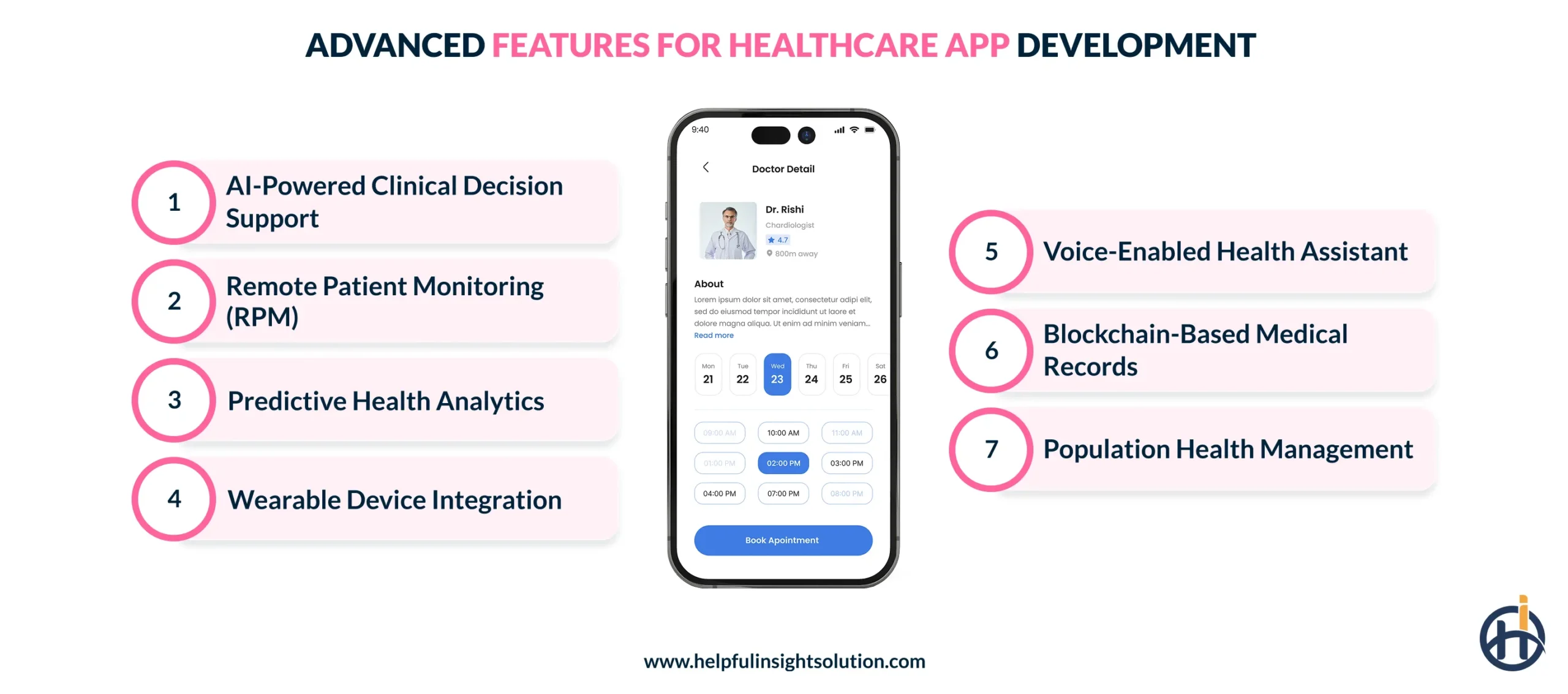
1. AI-Powered Clinical Decision Support
A clinical support system analyzes patient data, assisting doctors in diagnosis and treatment. The use of AI in healthcare reduces human error and improves clinical accuracy.
2. Remote Patient Monitoring (RPM)
Remote Patient Monitoring enables continuous tracking of vital signs using connected medical devices. It detects health issues at early stages, improving chronic disease management and reducing hospital visits.
3. Predictive Health Analytics
Predictive health analytics uses AI and big data to forecast potential health risks and diseases. It analyzes patterns for early diagnosis and prevention, delivering personalized and proactive treatment.
4. Wearable Device Integration
Wearable device integration connects fitness trackers with healthcare apps for data monitoring. It tracks heart rate, activity levels, and sleep patterns that support clinical insights and patient engagement.
5. Voice-Enabled Health Assistant
Voice-enabled chatbots use natural language commands to schedule appointments and receive medication reminders for patients. It enhances treatment and improves user experience, especially for elderly patients.
6. Blockchain-Based Medical Records
Blockchain in the fitness industry handles medical records and ensures secure data storage. It improves data transparency and sharing across patients and hospitals, maintaining patient privacy and security.
7. Population Health Management
It analyzes healthcare data across large groups and identifies high-risk populations, optimizing patient care strategies for doctors. This supports decisions for cost-effective and preventive healthcare delivery.
Key Health Compliance Features of mHealth apps
You should know that it is necessary to use some security features for mobile healthcare app development. They ensure data privacy and prevent the chance of various attacks on the system:
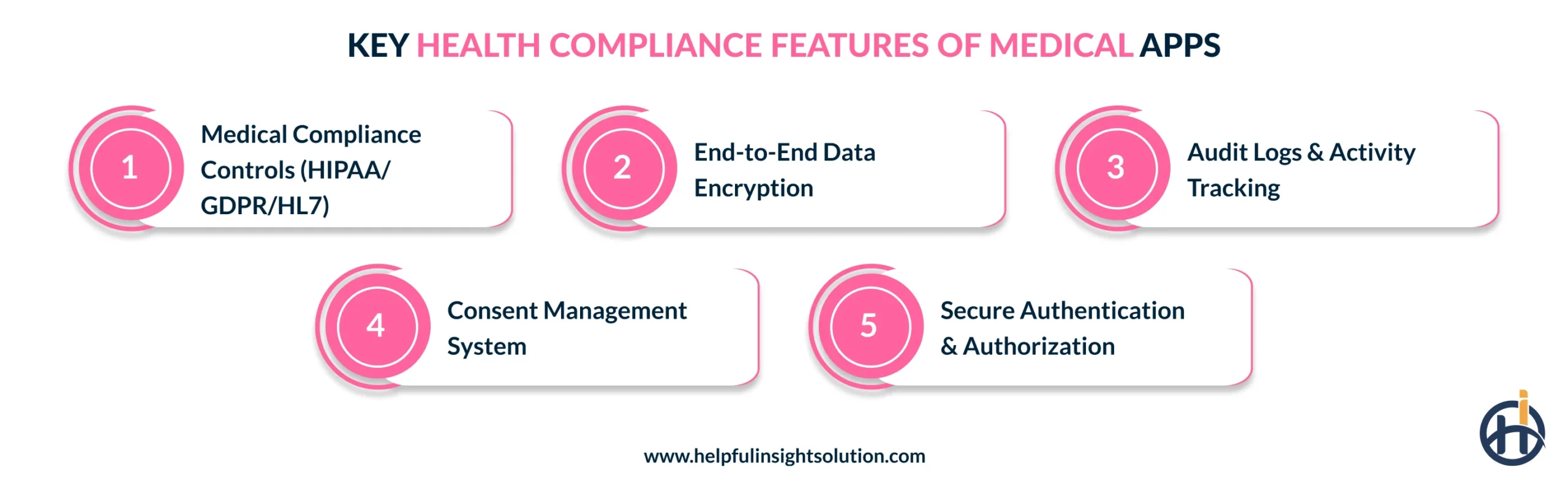
1. Medical Compliance Controls (HIPAA/GDPR/HL7)
This feature includes HIPAA for data protection, GDPR for privacy, and HL7 for secure mHealth app data. They maintain legal compliance, enabling safe information exchange among patients.
2. End-to-End Data Encryption
This healthcare security feature protects medical data during transmission, preventing security attacks. It regularly safeguards medical records, doctor prescriptions, and real-time healthcare data.
3. Audit Logs & Activity Tracking
Audit logs track user actions, data access, and system changes within a white-label fitness app. It creates transparent activity trails, ensuring accountability and regulations through medical investigations.
4. Consent Management System
This system allows users to control healthcare data collection, sharing, and use. Patients can modify permissions, ensuring transparency and compliance with privacy laws through ethical data handling.
5. Secure Authentication & Authorization
Data privacy features ensure verified access to sensitive medical data. Multi-factor authentication and biometric login reduce the risk of attacks, protecting patient data and clinical records.
How Helpful Insight Assists Businesses in Choosing the Right Features for Developing Healthcare Apps?
You have gone through the necessary mobile healthcare app development features based on core demands, advancements, and compliance. Now, it’s time to focus on key considerations for choosing a healthcare mobile app development company. It helps business investors in selecting the essential healthcare app features through the following methods:
- User-Centric Research: You work on understanding various healthcare diseases and remedies according to users.
- Align Healthcare Regulations: Know security and medical standards for each region, covering chronic disease patients.
- Use MVP Approach: This prioritizes popular healthcare app features with technical requirements and resources.
- Analyze Market Needs: Focus on the growth based on different categories, like exercise platforms or wellness solutions.
At the end, the conclusion is that before investing money in the healthcare app development, you must have a checklist of suitable app features. This will ensure high user engagement, consistent revenue growth, and increased brand visibility.
FAQs
On average, the time required to develop mobile healthcare applications with limited functionalities is between 2 and 5 months. But, as the complexity level of features increases, the overall duration also rises to 8 months or more, depending on the requirements. Factors that influence time are the development process, security, and advanced integrations.
Most healthcare applications support cloud-based APIs that offer highly dynamic storage features and functionalities. They provide an easily accessible database architecture, allowing users to store and access information anytime. Additionally, cloud-enabled features are highly secure and encrypted, ensuring data privacy through advanced algorithms.
The cost to build medical health applications for patients and doctors, including simple features, is between $10,000 and $30,000. The implementation of AI and other technologies increases the total expenses to $50,000 or more. It includes predictive treatments, AI clinical support, medical voice assistants, and remote monitoring.
Advanced security features, like authentication and audit logs, prevent data breaches in medical apps. They use the following measures to avoid potential threats and attacks:
- End-to-end encryption protects sensitive patient data during storage and transmission.
- Role-based access control limits data visibility to authorized healthcare professionals.
- Regular security audits and compliance measures detect and remove vulnerabilities.
For a business investor, it is crucial to identify the necessary features that support hospital staff management. Some of the major features are discussed as follows:
- Centralized scheduling: This system optimizes shift planning and staff availability.
- Role-based dashboards: They streamline task assignments and performance tracking.
- Communication tools: Coordination between departments is improved by these features, and platforms designed to build healthcare communication platforms are increasingly used to keep staff, doctors, and admins connected in real time.