Modernizing a Legacy Underwriting System for a Regional Insurer
Our client, a regional multi-line insurance provider operating in Texas, USA, had built its underwriting operations around a legacy platform that had become increasingly difficult to extend and integrate. As the business evolved, new policy types required workarounds and modern data sources could not be easily connected.
Helpful Insight modernized the platform with a more scalable foundation while preserving critical underwriting processes and supporting a gradual transition from the legacy environment.
The Challenges
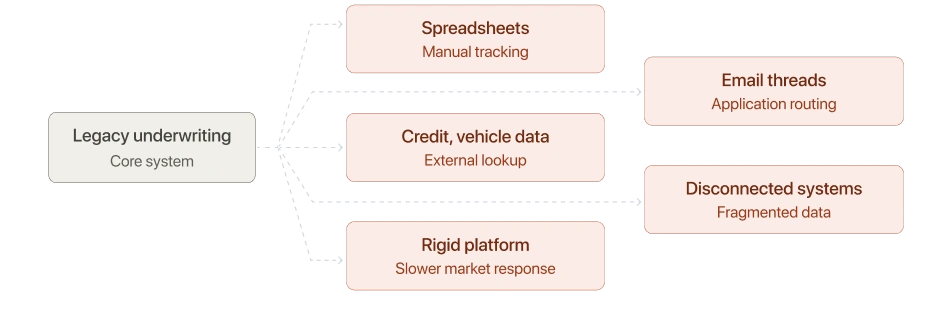
For over a decade, the client built a steady book of commercial and auto business on the same underwriting system. Lately, competitors have been moving faster, and customers expect quicker answers, but the system behind every decision hasn't kept pace.
Our Modernization Approach
We modernized key parts of the legacy underwriting platform while gradually migrating workloads to the new environment. The transition was planned around live traffic, existing data, and minimal business disruption.
Legacy System Audit
We audited the existing underwriting engine module by module, mapping every hard-coded rule and dependency before deciding what to rebuild first.
Third-Party Data Integration
We connected the modernized platform to third-party providers for credit, vehicle, property, and business data, reducing the need for manual lookups during underwriting.
Underwriting Rule Mapping
Our team mapped embedded underwriting logic and decision paths to document how rules worked before moving them into a more maintainable structure.
Underwriter Shadow Testing
Compared matched outputs from both platforms to identify differences in rules, scoring, referrals, and underwriting decisions before corresponding workloads were migrated.
Parallel Environment Setup
Ran the modernized platform alongside the client's existing system to compare application processing and decision outputs before switching over.
Data Migration and Reconciliation
We migrated active and historical underwriting records in controlled batches, validating record counts, key fields, relationships, and application status against the legacy platform.
Capability-by-Capability Modernization
We modernized core capabilities in stages, including underwriting services and document handling. Each capability was tested before being introduced into the migration plan.
Phased Business-Line Rollout
Migrated lower-volume workloads first, then expanded to higher-volume commercial and auto business once the modernized platform had been validated.
The Solutions we Delivered
Our insurance underwriting software development team modernized the client’s underwriting environment through a phased rebuild and migration approach rather than a single large-scale replacement. Key underwriting capabilities were reconstructed on the new platform, while existing processes and the legacy system remained in use during the transition.
This helped the client to adopt the modernized platform incrementally while maintaining day-to-day underwriting operations.
Modern Underwriting Platform Architecture
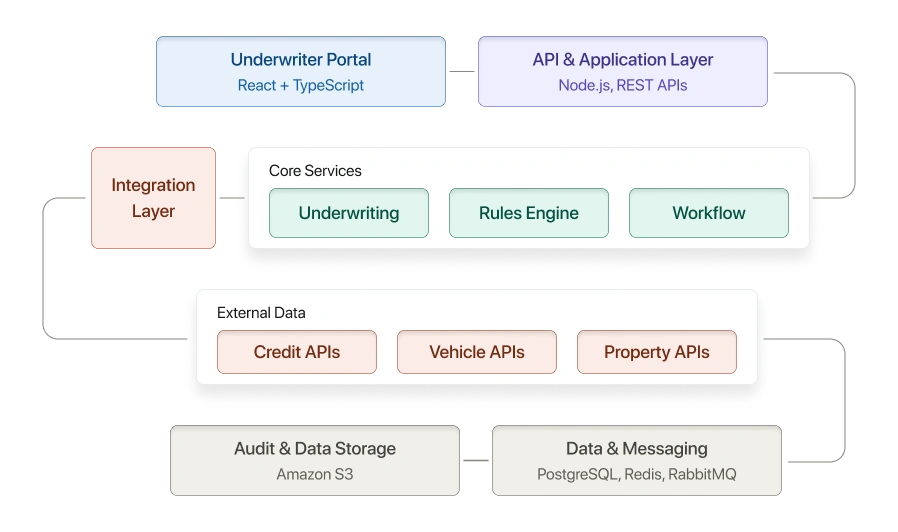
We introduced a layered architecture that separated core underwriting functions, integrations & data management. This provided a more flexible foundation for new policy products while allowing the client to migrate gradually from the legacy platform.
Underwriter Interface
Provided a centralized workspace for reviewing applications, viewing risk information, managing key referrals & completing underwriting activities in one streamlined workflow.
API and Application Layer
Provided standardized APIs for the underwriter interface and internal services, coordinating requests between underwriting, workflow, rules, data, and integration components.
Underwriting Services
Handled application intake, risk evaluation, scoring, referrals, document processing, and other core underwriting functions within the modernized platform.
Rules and Decision Engine
Managed eligibility, scoring, and referral logic separately from application code, making underwriting rules easier to maintain and update as business needs quickly evolved.
Workflow Services
Managed application routing, reviews, approvals, and referrals between underwriting teams, replacing spreadsheet-based coordination with structured digital workflows.
Integration Layer
Connected the underwriting platform with external data providers and supporting systems through standardized APIs, including credit, vehicle, property, and business data sources.
Data and Audit Layer
Stored application and policy information while maintaining decision history, user activity, timestamps, and other records required for operational review and compliance.
Tech Stack We Use to Develop Top-Notch Mobile Apps
We employ most advanced tools, technologies and programming languages to develop innovative mobile apps.

React

TypeScript

HTML5

CSS3

Node.js

Express

RESTful APIs

JWT Authentication

Role-Based Access Control

Java

Camunda

Drools

PostgreSQL

Redis

RabbitMQ

AWS

Docker

Amazon S3

GitHub Actions

AWS CloudWatch

CI/CD

Playwright

xUnit
Our Approach to Data Migration and Compliance
Helpful Insight treated migration as a controlled modernization effort. Data profiling, validation, and compliance controls helped protect the client’s operations throughout the transition.
Data Assessment and Mapping
Profiled legacy policy, application, and underwriting data, identifying outdated fields, duplicates, missing values, and dependencies before defining migration mappings.
Controlled Data Migration
We migrated required active and historical records in planned batches, using validation checks to confirm record counts, key fields, relationships, and application status.
Data Reconciliation
Migrated records were reconciled against the legacy platform, with discrepancies investigated and resolved before corresponding workloads moved to production.
Access and Data Protection
Role-based access controls were configured around underwriting responsibilities, helping restrict sensitive customer and policy information to authorized users.
Compliance and Decision Traceability
We captured decisions, rule outcomes, user activity, and timestamps while considering applicable NAIC guidance and state-specific insurance requirements.
Migration Validation
Parallel testing validated migrated data and business outcomes across platforms, resolving discrepancies before production workloads transitioned to the modernized platform.
Team Structure
Project Manager | Business Analyst | Backend Developers (2) | Full-Stack Developer (1) | QA Engineer | DevOps Engineer | Solutions Architect
28 Weeks
Dedicated Team
Parallel Run + Phased Rollout
Results we Delivered
The modernization delivered measurable improvements across underwriting speed, operational efficiency, scalability, data access, and decision traceability.
01
Underwriting rule change cycles reduced from several weeks to just a few hours for routine business updates.
02
Underwriting turnaround improved by 40%, reducing manual work & speeding application review across business lines.
03
Production migration completed with no unplanned downtime, keeping underwriting operations available throughout the rollout.
04
Manual external-data lookups reduced by 60% by bringing credit, vehicle, property, and business data into workflows.
05
Underwriting decisions became more traceable through centralized records of rules, outcomes, users and changes.
06
The modernized platform handled 2x the previous peak transaction volume during performance and load testing.
What Our Clients Say About Us
See how our clients across the USA, UK, and worldwide trust us to build scalable, high-performance digital solutions that drive real business growth.

For the past five years, I've been working with Tarun Vyas and his development team at Helpful Insight. I initially employed Tarun and his team on a small marketing project. It was a WordPress-based website. During that engagement, I was able to see that Tarun and his team had much more advanced capabilities than just working on WordPress. We soon afterwards began working on an enterprise resource... planning system that took our clients' orders all the way through delivery. I was really impressed with Tarun's team and their ability to provide high performance sites as well as a cost-effective site. So, for example, with AWS, they were able to design databases as well as utilize the data lake to store data, to work with data in a way that was very cost effective and also performed very well. More
For the past five years, I've been working with Tarun Vyas and his development team at Helpful Insight. I initially employed Tarun and his team on a small marketing project. It was a WordPress-based website. During that engagement... I was able to see that Tarun and his team had much more advanced capabilities than just working on WordPress. We soon afterwards began working on an enterprise resource planning system that took our clients' orders all the way through delivery. I was really impressed with Tarun's team and their ability to provide high performance sites as well as a cost-effective site. So, for example, with AWS, they were able to design databases as well as utilize the data lake to store data, to work with data in a way that was very cost effective and also performed very well. More
Brian Prosser
USA

I've been working with the Helpful Insight team for four years now, and whether on in-depth projects, setting up web structures, or on one maintenance project. And this at different levels of expertise, from entry-level modification to intervention requiring expert development. So, after all, I'm delighted to be working with the Helpful Insight team and its boss because of their philosophy of life, which is the same as... mine. There's always a way to find a solution, and everybody must be satisfied. So above all, I appreciate their availability, their responsiveness, their expertise, and their very human philosophy, which, as I said, means that at any given moment, you can always find a solution. Work with them. It's a real pleasure. Thanks to them. More
I've been working with the Helpful Insight team for four years now, and whether on in-depth projects, setting up web structures, or on one maintenance project. And this at different levels of expertise, from entry-level modification to... intervention requiring expert development. So, after all, I'm delighted to be working with the Helpful Insight team and its boss because of their philosophy of life, which is the same as mine. There's always a way to find a solution, and everybody must be satisfied. So above all, I appreciate their availability, their responsiveness, their expertise, and their very human philosophy, which, as I said, means that at any given moment, you can always find a solution. Work with them. It's a real pleasure. Thanks to them. More
Yann Juge
France

“I was really impressed that Helpful Insight completed my project on time and within budget. They were open, honest, and had fantastic communication. Most importantly, they truly know their stuff. If they encounter challenges, they find solutions and work until they achieve a successful outcome. I highly recommend them and look forward to working with them again in the future.”
“I was really impressed that Helpful Insight completed my project on time and within budget. They were open, honest, and had fantastic communication. Most importantly, they truly know their stuff. If they encounter... challenges, they find solutions and work until they achieve a successful outcome. I highly recommend them and look forward to working with them again in the future.” More
Sean Foster
New Zealand

We approached them regarding a project for a trading card game. Our vision was to create a modern website that includes multiple smaller and similar websites. After experiencing some disappointing work earlier, we decided to look online and discovered Helpful Insight. We presented them with a design assignment of more than 150 pages, and they didn’t hesitate for a moment. On the contrary... , they were more than happy to tackle this challenge. More
We approached them regarding a project for a trading card game. Our vision was to create a modern website that includes multiple smaller and similar websites. After experiencing some disappointing work earlier... , we decided to look online and discovered Helpful Insight. We presented them with a design assignment of more than 150 pages, and they didn’t hesitate for a moment. On the contrary they were more than happy to tackle this challenge. More
Nikolay
Bulgaria

Hey, my name is Gael, and I’m a director at Ocean Worldwide. It’s a research company in Phuket, Thailand. And I’m here just to give a testimonial for this company, Helpful Insight. Amit and Tarun, the two people I’ve been working with for two years, have been extremely good with... us. They’ve worked, um, on all kinds of different projects. And I’ve been working with them every week, and they’ve been helping me solve problems and also help me build sites. Not only one site, but several sites, with a great sense of professionalism. So, Amit, particularly as a developer, has always been here, very available and helping us develop solutions for us. So if you are looking for someone who can help you build a business online, build a site, or any kind of solution you’re looking for for an online business, I highly recommend Helpful Insight. Both Tarun and Amit are great to work with, and I can recommend them highly enough. So yeah, that’s my testimonial. I really recommend those two guys. More
Hey, my name is Gael, and I’m a director at Ocean Worldwide. It’s a research company in Phuket, Thailand. And I’m here just to give a testimonial for this ... company, Helpful Insight. Amit and Tarun, the two people I’ve been working with for two years, have been extremely good with us. They’ve worked, um, on all kinds of different projects. And I’ve been working with them every week, and they’ve been helping me solve problems and also help me build sites. Not only one site, but several sites, with a great sense of professionalism. So, Amit, particularly as a developer, has always been here, very available and helping us develop solutions for us. So if you are looking for someone who can help you build a business online, build a site, or any kind of solution you’re looking for for an online business, I highly recommend Helpful Insight. Both Tarun and Amit are great to work with, and I can recommend them highly enough. So yeah, that’s my testimonial. I really recommend those two guys. More
Gael
Thailand
Business Growth
The growth we drive for our clients is the reason behind their positive feedback & appreciation.
Our Valuable Resources
Explore expert insights to fuel your digital transformation and growth journey.