

Key Takeaways:
- The average cost of creating music streaming apps can range from $15,000 to $200,000 due to various factors, like features and platform security.
- The integration of AI-powered features, such as music recommendation and real-time analytics, affects the overall development expenses.
- Various hidden factors like music licensing, content delivery networks (CDNs), and maintenance also influence the total budget.
- Businesses should build MVPs, use cross-platform frameworks, and implement cloud-based services to reduce costs and ensure scalability.
Do you know that after a long, hectic day, most people need a relaxing moment and prefer listening to music? This is the main reason why media houses and record labels are heavily focusing on the music streaming app development cost.
They want to give the best services to their users with a little investment and without disturbing their budget. The investors are aware that platforms like Spotify, Apple Music, and Amazon Music collectively hold a 90% share in the US music streaming market.
According to a reputable journal, there are 800 million paid music streaming subscriptions across the world in 2026, which makes 23% of the total music industry. Now, the time has changed, and so have the preferences of the audience. Businesses need the right guidance so they can easily manage their expenses and ensure a reliable music listening experience for the users.
Here, you are going to study various aspects, like features, platform choice, and more, that can influence the cost of making smart music streaming platforms. Additionally, we will observe hidden factors, cost-reducing methods, and some monetization strategies in this blog.
Current music industry stats and why businesses will invest in it
The music streaming industry is expanding at an increasing speed, allowing entrepreneurs to invest more and get additional advantages. This domain has the potential to give great returns to the investors and will provide better opportunities in the future.
- In 2026, the value of music streaming market is going to reach $62.5 billion and it is currently growing at 14.2% CAGR between 2026 and 2033.
- The total market value of music streaming will reach $158.1 billion by the end of 2033 with live streaming segment growing at a 15.5% CAGR rate.
- The pop music has a share of 27.6% in the market, but the Latin music is growing at a 8.7% CAGR rate among different genres.
- In the 2nd quarter of 2026, Spotify registered 276 million premium subscribers, with a 12% year-over-year increase, reaching 696 million users in a month.
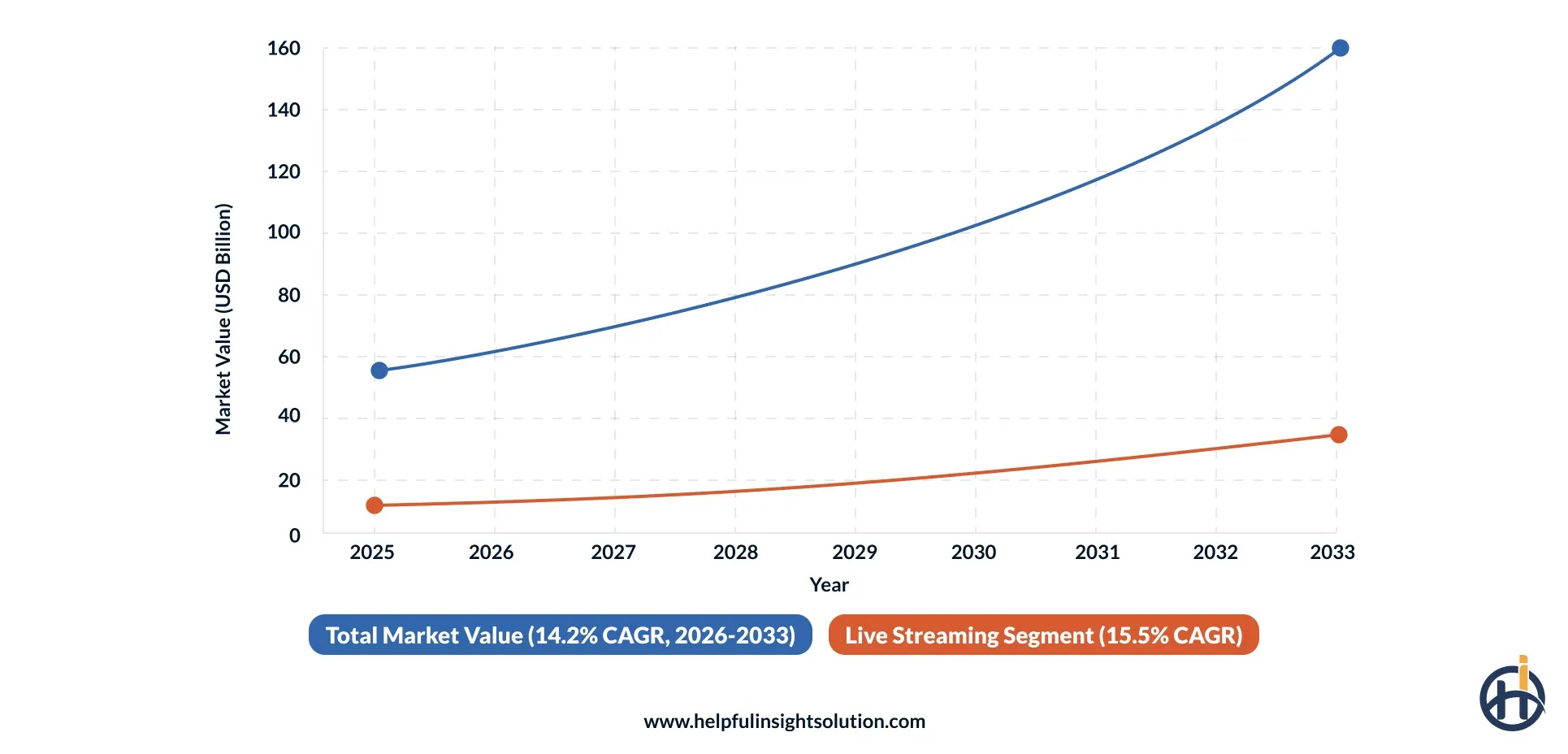
As you have seen, the future of music streaming is optimistic through increased revenue growth and segment analysis. So, it is a good choice to invest in this sector and improve user engagement by delivering smart soundboxes with AI-driven features.
Types of online music streaming applications
For a business investor, it is crucial to know various types of music platforms that are available in the market. The cost of a music app is highly dependent on this choice and directly targets user preferences.
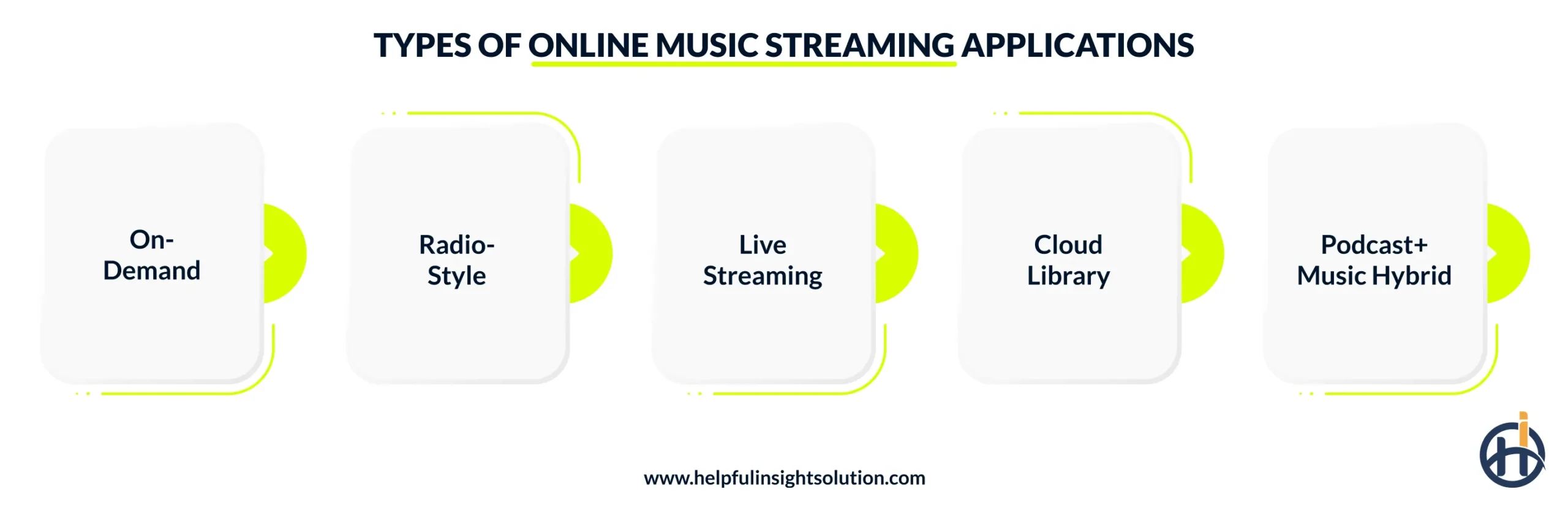
1. On-Demand
People can use on-demand music streaming apps to find and play the music they want whenever they want. They can search for songs, albums, artists or playlists. These apps give users control over what they listen to and also make suggestions based on what they like.
2. Radio-Style
Some music streaming apps are like the radio. They have stations that play music based on what kind of music you like how you’re feeling or what artists you like. You can just listen to the music. Not have to think about what to play next. This way of listening is pretty relaxed.
3. Live Streaming
There are lots of music apps that let you listen to live music. You can hear concerts, see artists perform and listen to music events in time. These apps also let you talk to people who are listening, react to what you are hearing and be a part of the experience.
4. Cloud Library
Some music apps let you store your music in the cloud. This means you can get to your music from any device. You can upload your music store it and listen to it from anywhere. This makes it easy to listen to your music on devices.
5. Podcast+Music Hybrid
You can listen to songs, audiobooks, talk shows and podcasts all, in one place. This makes it easy to find something you like to listen to. You can switch between types of audio and find something that you really enjoy. On-demand music streaming apps and podcast and music hybrid apps are both ways to listen to music and other audio.
What is the cost to build a music streaming app like Spotify?
Everybody knows that Spotify is the most popular platform for music streaming that also offers live podcasts and personalized recommendations. So, the cost to build a music streaming app like Spotify is a common topic among investors who want to launch a similar platform for their users.
As a fact, the rate of developing mobile apps is dependent on various factors that are further influenced by different parameters. To resolve this issue, you can use a cost calculator that estimates the accurate price through a simple formula.
Total Cost = (Total Development Hours * Hourly Rate) + Third-Party APIs + Legal & Licensing Fees + Infrastructure Setup
You will observe a music streaming app development cost breakdown based on the platform complexity in this section. This includes basic, medium-sized, and advanced applications that target different groups of investors. The following table helps us to understand the cost with their respective development timelines.
| App Type | Estimated Cost | Timeline | Best For |
| Basic App | $15,000–$40,000 | 2–4 Months | Startups and entrepreneurs looking to launch an MVP with essential features such as user registration, music search, playlist creation, and audio streaming. |
| Intermediate App | $40,000–$100,000 | 4–8 Months | Growing businesses that need enhanced functionality, including offline playback, social sharing, personalized recommendations, subscription plans, and analytics. |
| Advanced App | $100,000–$200,000 | 8–14 Months | Enterprises and established music platforms require AI-powered recommendations, live streaming, podcast integration, high-end security, multi-device synchronization, and large-scale cloud infrastructure. |
Music streaming app development cost based on key features
It is quite interesting to know that various music streaming app features, like playlists, AI recommendations, and sharing, also affect the overall budget. The following table helps to understand the cost to develop a music streaming app based on different mobile app elements.
| Feature | Description | Estimated Cost |
| User Registration & Profile Management | Enables users to create accounts, manage profiles, and personalize their listening experience. | $5,000–$8,000 |
| Music Search & Discovery | Allows users to find songs, albums, artists, and playlists through advanced search filters. | $6,000–$10,000 |
| Audio Streaming Engine | Delivers seamless music playback with minimal buffering and high audio quality. | $10,000–$18,000 |
| Playlist Creation & Management | Lets users create, edit, organize, and share custom playlists. | $5,000–$9,000 |
| Offline Listening | Enables downloading songs and playlists for playback without an internet connection. | $12,000–$20,000 |
| AI-Powered Music Recommendations | Suggests songs and playlists based on user behavior, preferences, and listening history. | $20,000–$35,000 |
| Subscription & Payment Integration | Supports premium memberships, recurring billing, and secure payment processing. | $8,000–$15,000 |
| Social Sharing & Community Features | Allows users to share music, playlists, and activity across social platforms. | $7,000–$12,000 |
| Push Notifications | Sends alerts for new releases, personalized recommendations, and promotional campaigns. | $5,000–$8,000 |
| Real-Time Analytics Dashboard | Provides insights into user engagement, listening trends, revenue, and app performance. | $15,000–$60,000 |
Cost of music app development: Comparison of the development phase
In this section, we will deeply cover the music app-making cost based on the different development phases. From market planning to deployment, you are going to study every step with its respective cost.
| Stage of Development | Steps in the Process | Estimated Expense | Overview of the Steps |
| 1. Planning and research | Market analysis and research | $200–$1,000 | The cost of the research can vary based on different factors such as market trends, competition in the market, and target market identification. |
| Gathering the potential requirements | $500–$2,000 | The cost may include conducting meetings with potential stakeholders, including internal and external stakeholders, and presenting documentation. | |
| Planning for the project | $300–$1,000 | This comprises managing and developing a roadmap for the concerned project by allocating the resources and defining clear objectives to attain within the project. | |
| 2. Design | UI/UX design | $500–$8,000 | The cost of the design depends on the design of the app, which also comprises user interface design. |
| Graphic Design | $500–$7,000 | The cost of graphic design also includes virtual assets. | |
| 3. Development | Front-End Development | $3,000–$30,000 | The front-end development cost depends on multiple features, including media playback and authentication. |
| Back-End Development | $5,000–$40,000 | Within the development, the cost comprises developing server-side logic and integration with third-party services. | |
| API Development | $2,000–$15,000 | The cost includes developing an API for exchanging data within the app and with external systems. | |
| 4. Testing & Quality Assurance | Manual Testing | $1,500–$7,000 | At this cost, testing for bugs, their usability, and compatibility across devices can be identified. |
| Automated Testing | $1,500–$8,000 | Here, the cost includes setting up automated frameworks along with scripts for streamlining testing operations. | |
| 5. Launch & Deployment | App Store Deployment | $2,500–$10,000 | Within the deployment, the cost is incurred for publishing the app on platforms including Google Play and Apple App Store. |
| Marketing & Promotion | $5,000–$15,000 | The cost of marketing and promotion differs depending on the diversified marketing channels that are being selected for promotion. | |
| 6. Maintaining and updating the app | Regular Updates & Maintenance | $5,000–$10,000 | Fixing bugs and updating the app to keep the app functional with the latest technology advancements is important in this phase of identifying on-demand music app development costs. |
Factors affecting the cost of creating a music streaming application
Team hiring, developers’ experience, and platform choice are some of the major cost-affecting factors. In this section, we will study all the major aspects with their respective cost tables and other components.
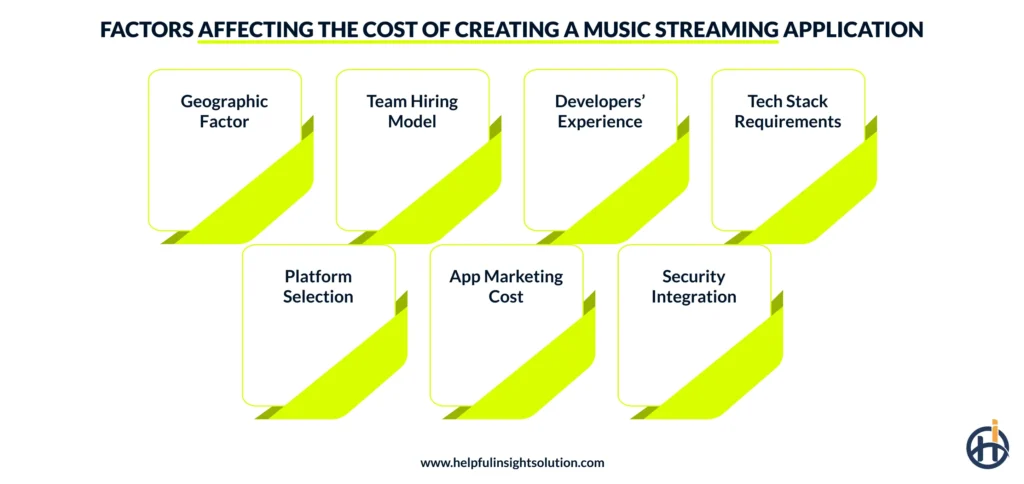
1. Geographic Factor
The place where your development team is located has an effect on how much it costs to build a music streaming application. If your team is in North America or Western Europe they will probably charge more than teams in Asia or Latin America. So companies often choose to work with teams in countries to get a good balance between quality and cost.
| Country | Average Development Cost |
| USA | $80,000–$200,000 |
| UK | $70,000–$180,000 |
| UAE | $50,000–$140,000 |
| Australia | $60,000–$160,000 |
| China | $35,000–$100,000 |
| India | $15,000–$80,000 |
2. Team Hiring Model
The app development team cost will affect the overall rate and project management tasks. Hiring people who work on their own is usually the way to go. If you hire a whole team or a special company you will get more expertise but it will cost more. Each way of hiring is different when it comes to how it can grow with your project, who is responsible for what and how much support you get in the long run.
| Hiring Model | Estimated Cost |
| Freelance Developers | $15,000–$40,000 |
| In-House Development Team | $80,000–$200,000 |
| Outsourced Development Agency | $30,000–$120,000 |
3. Developers’ Experience
You can hire dedicated developers based on their expertise, skills, and authenticity. Developers who are very experienced and know a lot about the music streaming industry will charge more because they are very good, at solving problems. Even though it costs more to hire these developers at first they can actually save you money and headaches down the line.
| Developers’ Expertise | Estimated Cost | Experience (Years) |
| Junior Developers | $15,000–$40,000 | 0–2 Years |
| Mid-Level Developers | $40,000–$80,000 | 2–5 Years |
| Senior Developers | $80,000–$150,000 | 5–8 Years |
| Expert Developers | $120,000–$200,000 | 8+ Years |
4. Tech Stack Requirements
The music streaming app tech stack you use for the frontend, backend, databases, and cloud services will affect your budget. If you want to stream music in real-time, give people personalized recommendations, and handle large user volumes, you will have to invest more money. You will also have to pay to use some technologies and to get them to work together which will add to your costs.
| Tool/Technology | Estimated Cost |
| Flutter | $5,000–$15,000 |
| React Native | $6,000–$18,000 |
| Node.js Backend | $8,000–$20,000 |
| AWS Cloud Services | $10,000–$30,000 |
| PostgreSQL Database | $5,000–$12,000 |
| AI Recommendation Engine | $20,000–$60,000 |
5. Platform Selection
When you are making a music streaming app it is usually cheaper to make it for one platform like Android or iOS of making it for many platforms at the same time. Using cross-platform frameworks can help you save time and money and it also lets your app work on more devices. If you want to use special features that only work on one platform you might have to do some extra work.
| Platform | Estimated Cost |
| Android App Development | $15,000–$60,000 |
| iOS App Development | $20,000–$70,000 |
| Cross-Platform Development | $25,000–$90,000 |
6. App Marketing Cost
You have to spend money on marketing if you want your music streaming app to be successful and for people to know about it. This can include things like advertising on media working with famous people making your app easy to find in the app store making content to attract users and paying for ads. If you have a lot of money to spend on marketing you can get users and make your brand known faster in a market with a lot of competition.
| Marketing Activity | Estimated Cost |
| App Store Optimization (ASO) | $2,000–$8,000 |
| Social Media Marketing | $5,000–$20,000 |
| Influencer & Paid Advertising Campaigns | $10,000–$50,000 |
7. Security Integration
You have to ensure security to keep user data, payment information and music safe. This means you have to use things like encryption secure ways to log in Digital Rights Management and you have to follow the rules, about keeping data private. This takes time and money to develop but it helps stop bad people from getting into your app and it makes users trust your app.
| Security Component | Estimated Cost |
| User Authentication & Authorization | $5,000–$12,000 |
| Data Encryption | $6,000–$15,000 |
| Secure Payment Gateway Integration | $8,000–$18,000 |
| DRM (Digital Rights Management) Protection | $15,000–$40,000 |
Music licensing: A key hidden factor
The music licensing cost for app is one of the major hidden factors that influence the total price of a platform. It is dependent on the legal consumption, usage, and monetization of a particular music track. There are several parameters that closely track music licensing, which include the following:
- Two-license rule: The songwriter grants permission to use the music composition. The record label allows to use a specific recording for occasional promotions.
- Public performance rights: The streaming of music on TV channels or live events require licensing. It is not granted then it may result into strict and legal actions.
- Mechanical licenses: This covers the reproduction or distribution of the music on CDs and digital platforms. It ensures that the owners and artists get the full compensation.
- Direct/Sync Agencies vs. Blanket Licenses: It involves the commercial use of a particular music in films, allowing broadcasters to access the full catalog. They provide an annual or monthly fee through an agreement with the agencies.
The music streaming app development cost is highly influenced by this hidden factor that is commercially accepted by the legal authorities. So, you must ensure that all songs that are listed in your platform have a copyright and follows standard regulations.
Other hidden factors that influence music app development cost
Several other hidden factors are there that influence the cost of music streaming app development. Here, you will observe key hidden elements, like maintenance, compliance, and platform optimization.
1. Content Delivery Network (CDN)
A Content Delivery Network helps people get music from servers around the world so they can listen to music really fast and without any problems. It does not stop or slow down but it can be really expensive to set up and use a Content Delivery Network, especially when a lot of people are using it.
2. Audio Processing Algorithms
There are different ways to make the music sound better through advanced algorithms, making it louder or quieter and getting rid of noise. These special ways are like tools that help make the music sound good. To make these tools work you need to have people who are really good at making them and you need to use a lot of computers, which can be expensive.
3. Maintenance & App Updates
When you make a music app you have to keep working on it to make sure it is good and people like it. You have to fix problems make it work better and make sure it works with phones and computers. It is crucial to add things to the app and make it more secure, increasing the cost to maintain a music app.
4. Data Privacy and Compliance
Music apps collect a lot of information, about the people who use them so they have to follow rules to keep that information safe. This means they have to store the information in a place ask people if they can use their information and use secret codes to keep it safe.
5. Scalability and Performance Optimization
When a lot of people are using a music app it has to be able to handle all those people so it does not get slow. To do this you have to use computers and ways of storing information and you have to make sure the app can handle a lot of people using it at the same time. It is worth it because people can use the app without any problems.
How to optimize the cost to develop a music streaming platform?
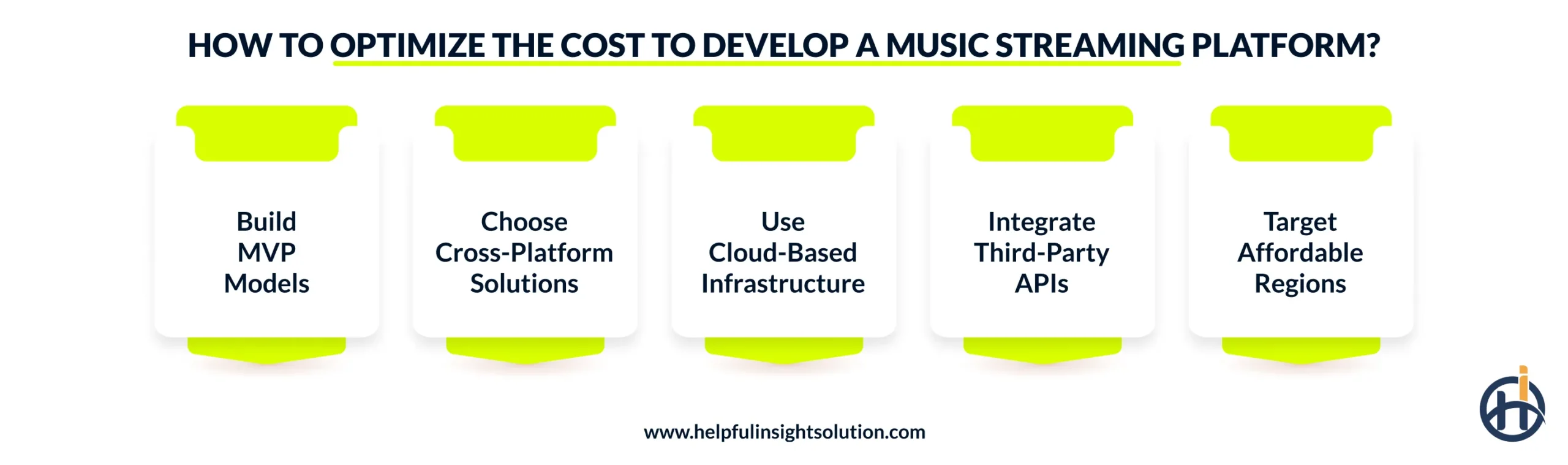
Businesses need to know various methods, like MVP and third-party integrations, to reduce the music app development cost. We are going to cover major cost-reducing strategies that are common in this section.
1. Build MVP Models
An MVP that covers only login, search, playback, and playlists can be developed in 2–4 months and cost under $40,000, which is less than the complete building cost. This basic version, called a Minimum Viable Product (MVP) includes things like user sign-up, music playback, search and playlists. The MVP music streaming app cost is less due to faster market release and testing of ideas before adding features.
2. Choose Cross-Platform Solutions
Flutter and React Native share one codebase between iOS and Android, cutting build and QA time by roughly 30–40%. This way developers can write one set of code and use it on both types of devices. Using a cross-platform mobile app development framework like Flutter or React Native saves time and money on making, testing and maintenance.
3. Use Cloud-Based Infrastructure
Cloud platforms provide the storage computing power and streaming capabilities needed for a music streaming platform. With cloud platforms businesses only pay for the resources they use. This makes it easier to manage costs and support growth.
4. Integrate Third-Party APIs
To reduce the cost to make a music streaming app use prebuilt APIs for things like payments, authentication and music metadata. This approach saves time and money on development and ensures access to reliable functionalities. By using third-party APIs businesses can focus on building their core product.
5. Target Affordable Regions
Hiring a development team from a region with lower costs can save businesses money on their project. Many countries have developers who charge lower rates. By hiring from these regions businesses can get value for their development budget and achieve a better return, on investment.
Best ways to monetize music listening apps
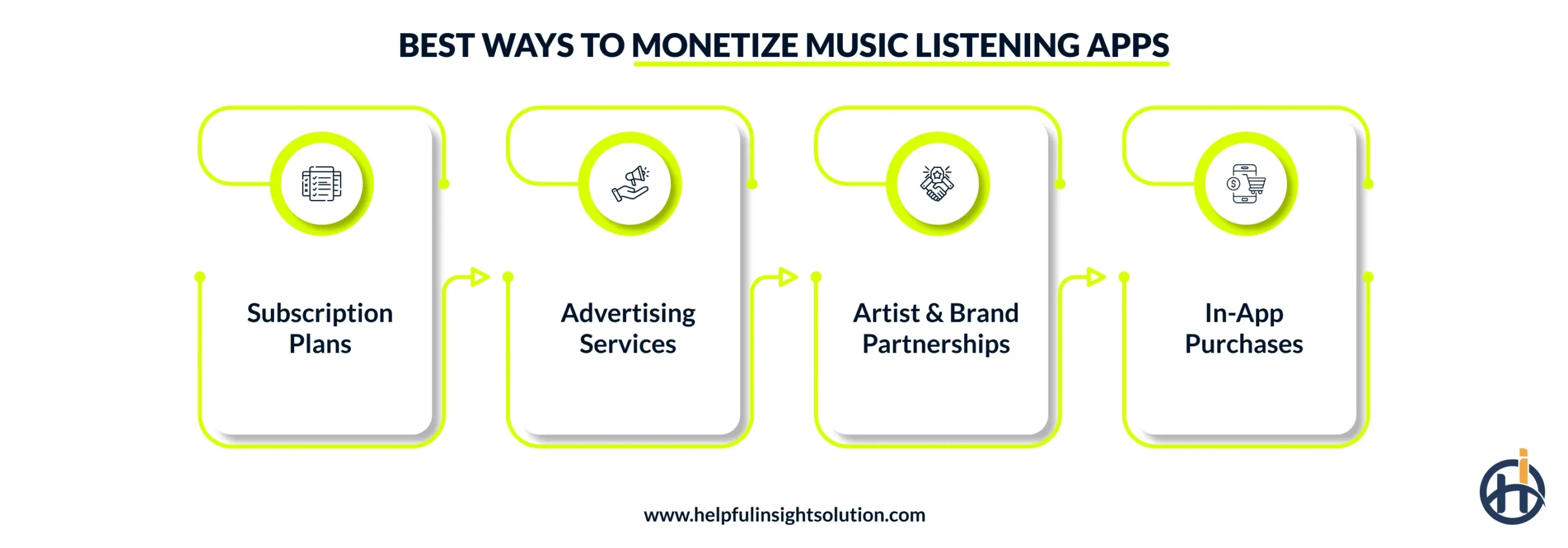
After knowing the cost factors and reduction methods, you must know various music streaming app monetization strategies. These include subscriptions, advertisements, and brand collaborations.
1. Subscription Plans
Premium subscriptions generate recurring revenue by giving paying users ad-free listening, offline downloads, unlimited skips, and high-quality audio. This way the company can get an income and make the users happy.
2. Advertising Services
Free-tier users are monetized through display banners, audio ads, video ads, and sponsored playlists. They do this by playing ads showing display banners playing video ads and making sponsored playlists. This helps the company get users and balance the cost to create a music streaming app.
3. Artist & Brand Partnerships
Partnerships with artists, record labels, and brands unlock additional income through sponsored content, featured playlists, and promotional campaigns. They do this by making content putting on sponsored events making featured playlists and running promotional campaigns.
4. In-App Purchases
Users can buy concert tickets, exclusive albums, merchandise, or premium features directly inside the app. This helps the company make money and gives users a more personal experience when they use the app. This also helps them to get more users excited about the app and makes the brand well-known.
Partner with Helpful Insight to build smart music streaming solutions
Have you understood how the music streaming app development cost is affected by different market factors? Now, it’s time to connect with a reliable and experienced partner who can deliver the best resources for budget estimation.
We ensure work integrity, ethical app-making, and constant supervision through our 10-year-old legacy. Our developers provide a collaborative business environment where all discussions and decisions are considered equally.
You can propose an idea, and we work on it through proper planning, processing, and execution. We help clients to choose the best music streaming business models for revenue generation, customer engagement, and brand visibility. It is crucial to analyze all the aspects before moving forward and ensure consistent business growth through increased user retention rate.
FAQs
The average development time for a basic music streaming application with limited functionalities ranges from 2 months to 4 months. On average, the overall duration may increase to 8 months, depending on the number of features. The total timeline may extend to 12 months or more due to AI-powered features and advanced integrations.
The maintenance cost of music apps like Spotify is dependent on server infrastructure, bug fixes, customer support, and content licensing. The average maintenance cost is between $5,000 and $10,000 for simple apps, which may increase to $30,000 based on app requirements. This enhances performance, optimizes app updates, and ensures data security across devices.
For a business investor, it is crucial to know the different advantages of creating music streaming apps. Some of the key app development benefits are discussed in the following manner:
- It is easy to generate revenue through various models and increase profit margins.
- Music company owners can increase their fan base through personalized features.
- With advanced security, businesses can claim copyright of music from record labels.
A general formula is used by mobile app experts and business owners to estimate the right cost of building music streaming apps. The total development hours are multiplied by the hourly rates, and third-party integration charges are added to the product. Some other parameters, like platform complexity and infrastructure, are also included in the formula.
Entrepreneurs can integrate AI technologies like NLP and predictive analytics in music streaming applications to enhance user experiences. They deliver personalized music suggestions based on preferences, behavior, and playlist s. Spotify is the best example of an AI-powered music streaming app that delivers adaptive recommendations to listeners.