

Key Takeaways:
- Healthcare software for workforce management automates staff scheduling, tracks credentials, manages attendance, and analyzes labor costs across medical facilities.
- With automated workforce allocation, businesses can minimize administrative work, overtime expenses, staffing gaps, and scheduling errors.
- The software can be easily integrated with HR, payroll, EHR/EMR, and ERP while maintaining strong security, access controls, and compliance.
- From ideation and interface design to deployment and maintenance, every step helps to create reliable and smart healthcare shift management solutions.
Consider a hospital that experiences difficulty in managing patients due to unstructured allocation of medical staff and recurring data handling errors. This may affect patient retention, increase workload, and reduce overall healthcare productivity.
In a report published by the National Library of Medicine (NLM), 35% of nurses and 54% of physicians in the USA report symptoms of burnout. To get rid of this situation, experts developed healthcare management software that automates administration, enhances staff scheduling, maintains clinical records, and reduces downtime risks.
Precedence Research says that the USA’s healthcare workforce management software market will generate a volume of $1.1 billion by 2030. Additionally, it will cross $1.5 billion by the end of 2034, due to increasing investment opportunities for healthcare enterprises. So, creating similar platforms to manage the clinical workforce will be a great initiative, ensuring consistent growth.
This blog helps you to understand how healthcare businesses can build a staff management platform by going through its benefits, use cases, features, and estimated costs. In the last section, we will explore some challenges that are common among entrepreneurs. So, stay tuned to explore more.
What is workforce management software in healthcare?
Workforce management in healthcare is the process of automating staff scheduling, monitoring credential compliance, and forecasting labor demands. This type of healthcare software helps hospitals to decrease employee frustration, reduce operational expenses, and improve patient care.
It uses advanced technologies like predictive analytics to determine patient volume and adjust staffing levels accordingly. It can be easily integrated with other healthcare platforms, such as electronic health records, ERP, POS, and payroll, allowing medical professionals to share information seamlessly.
How does it work?
Workforce management software for healthcare allows doctors and nurses to automatically fix schedules, manage incentives, and track progress. The working process is described as follows:
- The system gathers real-time data through digital check-ins, mobile apps, and task logs.
- It helps to build optimized shifts based on worker availability and required skill sets.
- The software analyzes historical trends and current activity to predict future staffing needs.
- Automated rules track local labor laws, overtime limits, and required rest breaks.
- Verified work hours and attendance data export directly into payroll systems, eliminating errors.
Why should businesses invest in the healthcare workforce management market?
Businesses are developing healthcare workforce management solutions because this market is growing rapidly across regions. Let’s study its revenue growth in terms of overall volume, compounding rate, and shares in various segments.
- The healthcare workforce management market will generate revenue of $2.9 billion by 2027, with an 8.6% CAGR rate.
- By 2034, the overall volume of this market will reach $5.2 billion, with the cloud-based segment having a 63% market share.
- In 2029, North America will produce revenue of $885.9 million with an expected growth of 51.1% over this period.
- Europe and Asia Pacific will generate $846.2 million and $678.8 million, respectively, by the end of 2029.
- The hospital segment in the USA holds a share of 37% in the market, as the regional market value will be $850 million by 2027.
For increased returns, healthcare providers can implement AI development services that ensure task automation and reduced workload. It will allow hospitals to predict patient volume, allocate clinical staff and equipment, and enhance business growth.
Benefits of developing workforce management software in healthcare
A hospital workforce analytics platform provides multiple benefits, like increased retention and reduced costs. In this section, you are going to observe major advantages that ensure constant engagement and growth
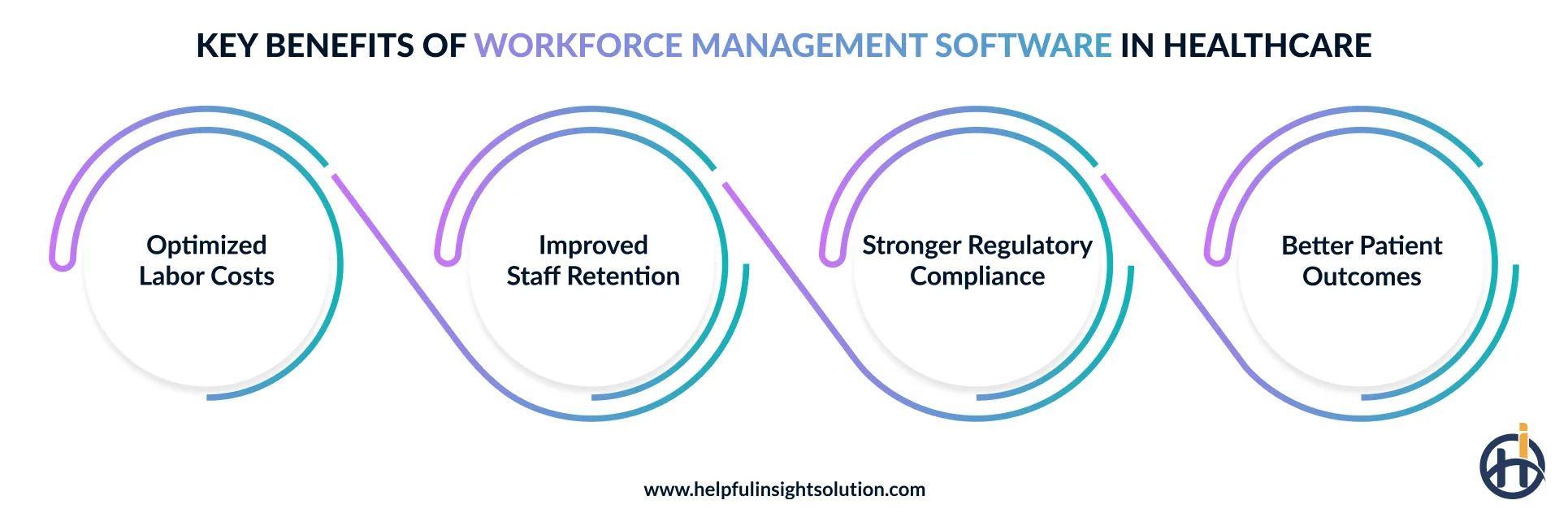
1. Optimized labor costs
Automated staffing schedules and smart shift planning ensure that unscheduled overtime and understaffing are minimized by using the latest information. This type of informed staff planning helps to reduce the costs of staff labor while still offering the highest quality of care.
2. Improved staff retention
Reduced burnout is easily accomplished when an unbiased scheduling practice, flexible self-scheduling, and interactive UI/UX design are made available to the employees. This increases their experience when they understand how their work schedules have been created, resulting in lower turnover rates.
3. Stronger regulatory compliance
Healthcare workforce management software with compliance alerts guarantees that staff certifications, licenses, and training are up to date at all times. Avoid the penalties for non-compliance and ensure the platform is ready with HIPAA, JCAHO, and other regulations at any time.
4. Better patient outcomes
By ensuring that hospitals have the right staff members with the right skills, it is easy to enhance quality of care and improve patient response times. This shortens staffing gaps and eliminates exhaustion from constant scheduling worries, ensuring a safer, more consistent patient experience.
Key features of a healthcare workforce management system
While developing hospital workforce management software, it is essential to know the commonly integrated features. Our project related to the Hospital ROAT Management System(Panora ) is the best example of this software, offering several management functionalities.
For a better idea, businesses must go through the following table that describes various scheduling and tracking features.
| Feature | Description |
| Shift Scheduling | Automates staff shift creation based on availability, skills, and demand to prevent under/overstaffing. |
| Time & Attendance Tracking | Records clock-in/clock-out times, breaks, and overtime for accurate payroll and compliance. |
| Credential Management | Tracks licenses, certifications, and mandatory training to ensure regulatory compliance (e.g., HIPAA, JCAHO). |
| Self-Service Portal | It allows staff to view schedules, request leave, or swap shifts without manual admin intervention. |
| Staff Availability Dashboard | Gives managers a live view of who’s on duty, on leave, or available for call-ins. |
| Payroll Integration | Syncs worked hours, overtime, and shift differentials directly with payroll systems to reduce errors. |
| AI-Based Forecasting | Uses historical data and patient volume trends to predict staffing needs in advance. |
| Skill & Role-Based Assignment | Matches staff to shifts based on certifications, specialties, and department requirements. |
| Communication & Alerts | Sends automated notifications for shift changes, open shifts, or urgent staffing gaps. |
| Reporting & Analytics Dashboard | Provides insights on labor costs, overtime trends, and staffing efficiency for data-driven decisions. |
Real-world applications of medical workforce management software
These platforms are used for various purposes, such as staff coordination, license tracking, and mobilization. We will discuss some of the major realistic use cases of clinical workforce management in this section.
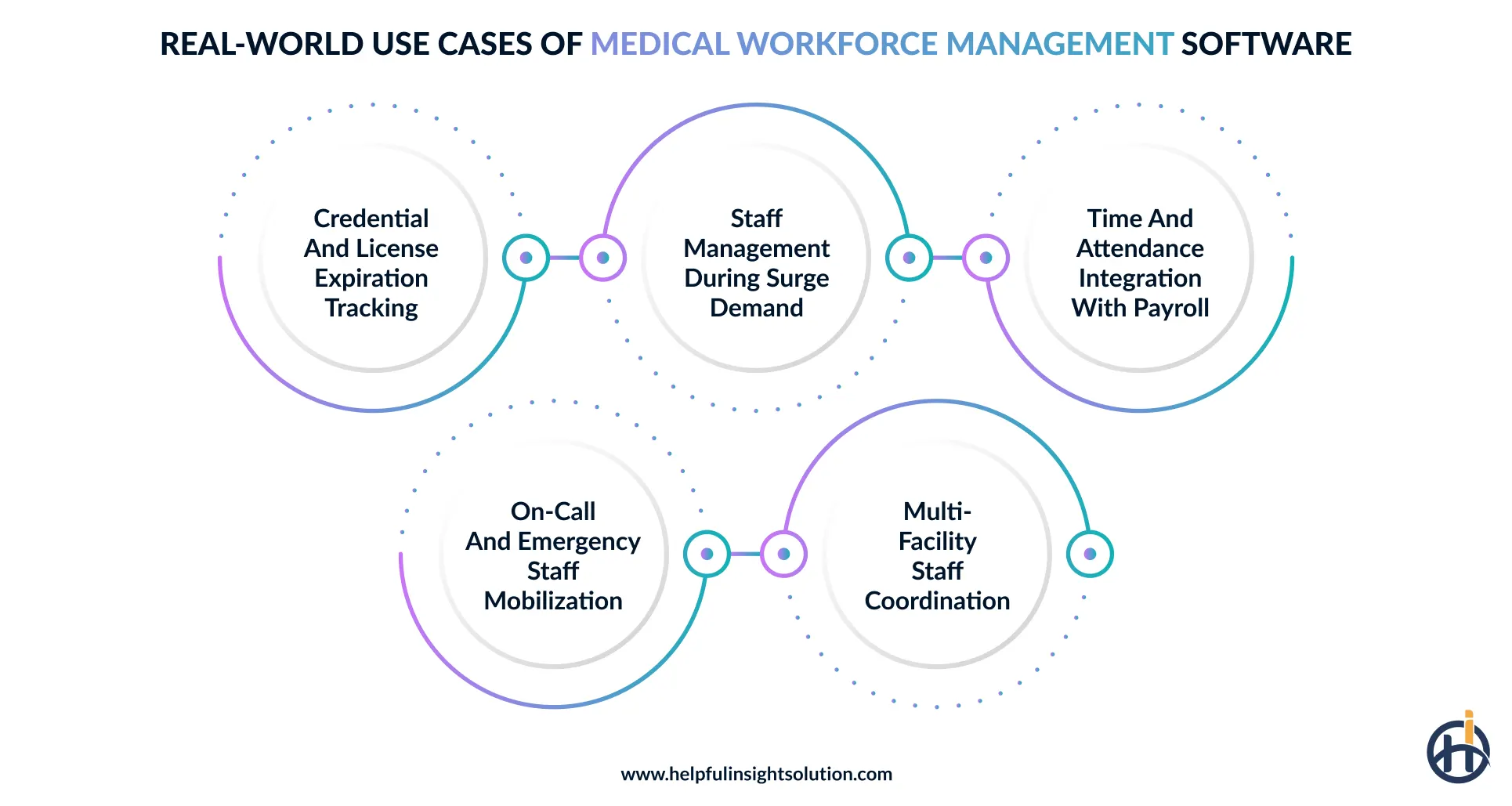
1. Credential and license expiration tracking
The workforce software for healthcare management tracks staff certifications and licenses for impending expiry dates and provides advance warnings. This ensures a company-wide compliant status and avoids cases of having an inactive license on staff when they are on the schedule at facilities.
Symplr: Enterprise credentialing system used to monitor the licensure, certification, and compliance status of providers across large health systems.
2. Staff management during surge demand
During patient emergencies such as flu epidemics, the software will identify available appropriate personnel and shift to alleviate the demand for the staffing facility. This helps to accommodate increased needs and continue to provide patient care to meet demand without overworking the employees.
Shiftboard: Workforce management platform designed to meet the high-volume demands of fluctuating staffing models that enable organizations to scale coverage up or down at a moment’s notice.
3. Time and attendance integration with payroll
Upon using the clock-in/clock-out function, the medical scheduling software links directly to a payroll system to transfer data, which can save hours of manual entry and eliminate errors. The incentives given are based on regular hours, overtime, and other differentials.
Deputy: Scheduling and time tracking platform with integrated payroll applications to reduce the complexity of hours worked and calculation of wages by the healthcare team.
4. On-call and emergency staff mobilization
Various healthcare workforce management solutions log available personnel so that, during an emergency, the nearest available team member is automatically alerted. This improves response time and reduces confusion of manual call-outs during critical situations.
QGenda: A clinical workforce management solution to automate the scheduling of physician teams and create on-call rotations efficiently to respond quickly during an emergency.
5. Multi-facility staff coordination
Healthcare networks of individual facilities will get a single, real-time look at where all employees and equipment are located so they can be reallocated between different locations. This improves flexibility and ensures no single location is understaffed while another has surplus capacity.
Infor: This enterprise workforce management software is used to coordinate and optimize personnel across complex healthcare enterprises.
Building a workforce management system for healthcare providers
A process for creating healthcare workforce optimization platforms is discussed in this section with key steps. From requirement gathering to deployment, we will study all the following generally used stages.
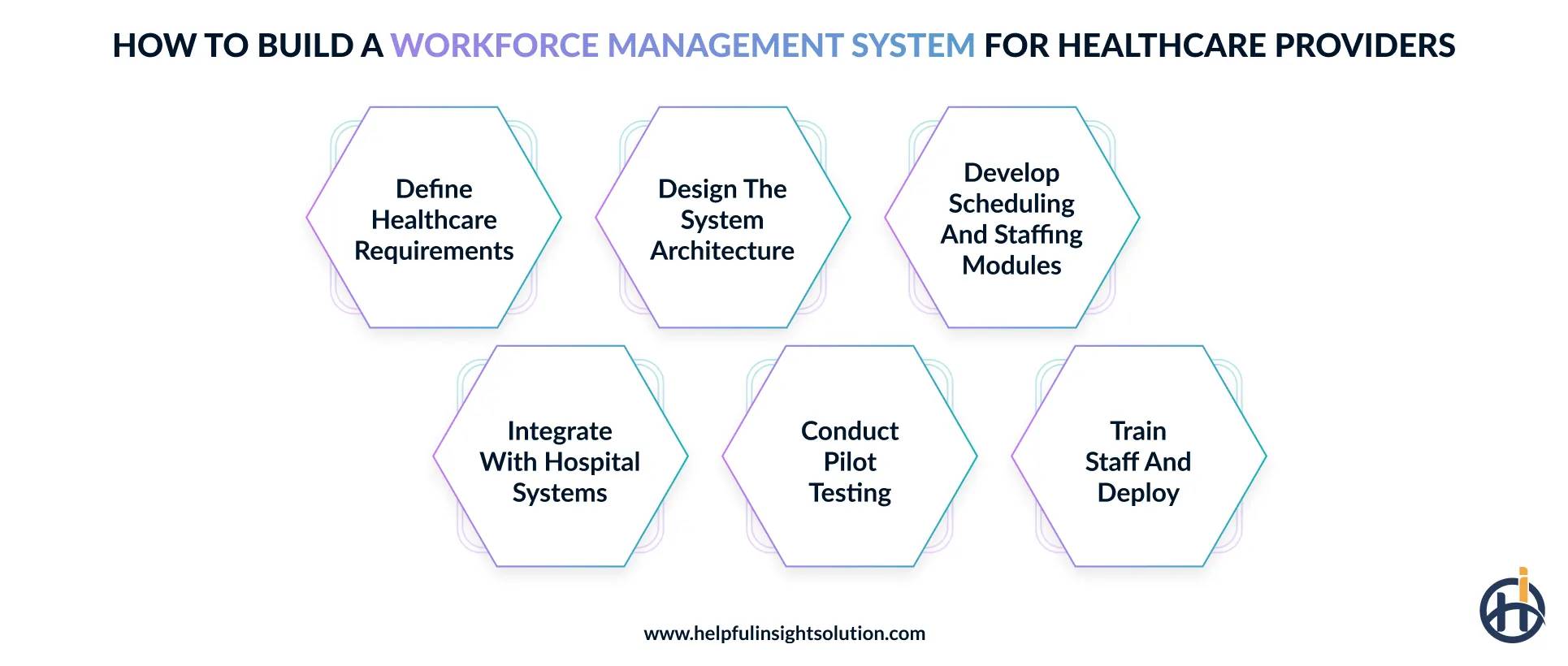
1. Define healthcare requirements
The experts gather detailed information from hospital executives, HR personnel, and clinicians about current scheduling challenges, regulatory concerns, and workflow issues.
Here, all essential features, like shift management, credential tracking, and payroll integration, are defined before development is initiated. This MVP-focused requirements document helps to avoid various expenses down the line.
2. Design the system architecture
It involves developing database schemas, designing cloud architectures, building security protocols, and addressing concerns. A healthcare workforce management software development company makes decisions about scaling limitations and sets expectations for system growth.
These include adding different facilities and defining integrations with the existing IT infrastructure of the hospital.
3. Develop scheduling and staffing modules
Developers build core functionalities like auto-scheduling, employee availability tracking, permissions, and roles. The team codes and tests core features, which include the shift swap process, a dedicated employee self-serve portal, and an integrated notification system.
They are developed through agile principles, regular testing methods, and stakeholder reviews.
4. Integrate with hospital systems
The workforce management software integrates with different hospital systems, like EHR, ERP, and payroll. It allows healthcare providers to make sure that data is flowing smoothly throughout the facility and other medical departments. Standard protocols, APIs, and secure data sharing, such as HL7 and FHIR, facilitate interaction by preventing redundant data entry.
5. Conduct pilot testing
During a pilot program with limited users, like a single department or a smaller facility, the software system goes live on a smaller scale. Here, bugs, workarounds, usability issues, and conflicts with the existing workflow that may not have been discovered during training can be identified.
This type of feedback informs the hospital system’s final modifications to achieve organization-wide implementation.
6. Train staff and deploy
This is the last stage where hospital staff and administration are given training on how healthcare workforce software works through demos, documentation, or tutorials.
Various organizations adopt new technologies through a phased approach to minimize disruption to daily operations. Ongoing support is provided to address any issues and ensure smooth adoption across the system.
Breaking down the healthcare workforce management software development cost
The healthcare workforce planning software development cost depends on several market factors, such as complexity, location, and experience. Businesses can estimate the average price by considering various parameters under each factor.
For example, healthcare app developers have different levels of experience, like junior, mid-level, and senior, which influence the overall budget. With the following table, investors may have an idea of these cost-affecting agents through their respective costs. We will also observe how they affect the investment model for businesses.
| Cost Factor | Cost Range (USD) | Description |
| Platform Complexity | $25,000 – $80,000 (basic)
$80,000 – $200,000 (advanced) |
Basic scheduling and attendance tools cost less.
Multi-facility platforms with AI forecasting and integrations push costs higher. |
| Development Location | $25,000 – $60,000 (Asia)
$60,000 – $120,000 (Eastern Europe) $120,000 – $200,000 (US/UK/Australia) |
Hourly rates vary significantly by region.
Offshore teams offer major cost advantages without compromising quality. |
| Experience Level of Developers | $30,000 – $90,000 (mid-level team)
$90,000 – $200,000 (senior/specialized team) |
Senior developers with healthcare domain expertise cost more but reduce compliance and rework risks. |
| Team Hiring Model | $25,000 – $70,000 (freelancers)
$70,000 – $130,000 (dedicated team) $130,000 – $200,000 (in-house team) |
Freelancers are cost-effective for MVPs.
Dedicated/in-house teams suit long-term, scalable builds. |
| Design Costs (UI/UX) | $10,000 – $35,000 | Custom, role-based dashboards (admin, staff, manager) with accessibility standards increase design investment. |
| Maintenance Charges | $15,000 – $40,000 annually | Typically 15–20% of the initial development cost per year for updates, bug fixes, and compliance patches. |
| Security & Compliance Fees | $10,000 – $45,000 | Covers HIPAA/GDPR compliance audits, data encryption, and secure authentication implementation. |
| Advanced Technical Integrations | $20,000 – $60,000 | Includes payroll system integration, EHR/HRMS connectivity, and AI-based predictive scheduling modules. |
Major development challenges for healthcare workforce management solutions
Healthcare providers may face multiple challenges, like security and staff adoption, while making shift management systems. A few of the important obstacles with their respective solutions are explained in this section.
1. Handling complex rules
A healthcare workforce management system may face challenges like multi-layered compliance and labor regulations, as it operates 24/7. Strict contracts, differential pay scales, and fluctuating patient rates also responsible for affecting the overall process.
Solution: By using graph databases to map credentials, deploying agnostic rule engines, and maintaining transparency through audit-proof traceability.
2. Ensuring data security
A lack of regulatory compliance, legacy system integration, and cloud deployment creates an opportunity for cyberattacks and data breaches. As these systems store sensitive patient and employee records, implementing role-based access control is also difficult.
Solution: It is beneficial to hire dedicated development teams who can combine end-to-end encryption and audit logs with RBAC to build trust and protect privacy.
3. Difficulty in technology adoption
Improper training, complex software interfaces, and poor EHR or ERP integration increase employee burnout and administrative workload. This creates data silos where separate databases prevent sharing of staff credentials and trigger double data entry.
Solution: Businesses must provide role-specific dashboards, minimal clicks, bite-sized training, and incentivized onboarding to boost adoption.
Choose Helpful Insight for transforming the healthcare workforce management space
As the investment in healthcare app development is increasing, the demand for workforce management systems is also rising rapidly. By hiring experienced and reliable developers from our team, businesses can create and deploy smart staff scheduling solutions. They deliver the latest resources, help investors to optimize budgets, and focus on specific use cases based on the project requirements.
Our experts use an advanced tech stack for developing a clinical workforce management system that offers specialized features, such as attendance tracking, payroll integration, and more.
We implement effective healthcare workforce management software development services that ensure smooth design, seamless API integration, automated testing, and quick market launch.
Now, before the competition increases, it is beneficial to start with a project discussion so we can provide numerous business models. This will help you to initiate the process, ensure future growth, and improve retention.
FAQs
The development of healthcare workforce management software may take 2-3 months for a basic MVP version. The duration increases from 4 months to 8 months for a standard custom platform that offers compliance tools. For an enterprise-grade system, the timeline may extend to 12 months or more due to ERP and EHR integrations.
A medical workforce management system that stores protected healthcare information (PHI) must be HIPAA-compliant. Businesses follow various compliance requirements to safeguard patients and audit data. This includes a Business Associate Agreement (BAA), encryption, access controls, and audit logging.
Hospitals use various software for workforce management, such as to handle 24/7 rotating shifts and credential tracking. Some of the top widely used healthcare task monitoring platforms are as follows:
- Oracle Health: Large hospitals use this platform that merges EHR with scheduling, global payroll, and resource planning.
- Dayforce: It only allows certified or licensed staff in regulated healthcare environments with real-time labor analytics.
- Infor CloudSuite: The platform uses advanced data forecasting to match staffing levels with patient admission volumes.
For smooth collaboration, healthcare providers integrate workforce management platforms with multiple existing systems. These include EHR, HRIS, payroll, billing, and ERP portals that gather both patient and admin data. It reduces staff overhead, improves care quality, and enhances patient experiences with real-time features.
Various healthcare workforce management solutions use predictive analytics and automated tools to balance workload. They provide fairer schedules, reduce fatigue, and prevent last-minute hassle by tracking real-time data. Nurses use self-service portals to manage shifts, apply for duties, and get additional incentives.
The future of healthcare workforce management is empowered by advanced technologies, like AI and IoT. Major future trends regarding medical care and scheduling are described in the following manner:
- Hospitals can predict patient volume and match staff schedules through different predictive analytics tools.
- Nurses and staff can choose working hours by using shift-swapping apps and internal marketplaces.
- Virtual consultations, wellness programs, and stress reduction campaigns will retain hospital staff.