

Key Takeaways:
- To build a successful application like Apple Music, you need proper planning, music licensing, feature selection, scalable business model.
- AI recommendations, cloud infrastructure, and cross-platform compatibility ensure a premium listening experience for users.
- The overall cost of developing Apple Music-like platforms ranges from $40,000 to $200,000 due to various market factors, like location and experience.
- Various technologies like AI, blockchain, and AR/VR help businesses keep the platform advanced and competitive in the market.
The world of music streaming has changed a lot after the introduction of advanced platforms like Apple Music, Spotify, and more. This series of apps enhanced the users’ listening experience by shifting from boring media player applications.
With built-in music libraries, smart radios, and lossless audio streaming, these apps are progressing rapidly in the market. This is the main reason that businesses want to develop an app like Apple Music and capture user preferences for future growth.
According to Persistence Market Research, the music streaming market has a valuation of $51.5 billion in 2026, which will reach $127.3 billion by the end of 2033. This is a huge number for startups and mid-sized enterprises, encouraging them to invest in the market and take advantage. Also, big media houses aim to get opportunities by developing an Apple Music clone app for their audiences.
Here, you will encounter the most valuable topics, like the development process, licensing, features, and cost, that not only guide you but also ensure proper planning. So, let’s start this blog by first understanding what Apple Music is and its working.
Apple Music: Facts and key insights
Apple Music needs no introduction, as it is one of the most premium streaming services across the world. It provides more than 100 million ad-free songs, lossless audio features, and spatial streaming.
A music streaming app like Apple Music is competing with the second-largest market share in the USA and the third-largest in Europe. This platform is also beneficial for music artists, record labels, and media houses because it keeps all information safe and secure.
How does Apple Music work?
Apple Music has a systematic program that allows users to enjoy live streaming, anytime and anywhere. Let’s see its working mechanism in this section.
- People subscribe to Apple Music through Individual, Family, or Apple One membership plans.
- They search for songs in the search bar or curated lists that include different music genres.
- The app allows users to build their own library that can be easily synced with other devices.
- It is easy to download songs from the app, enabling people to listen to music while traveling.
- Apple Music provides high-resolution sound quality that supports all speakers and devices.
Growth of the music streaming market: Global & USA
You must know how the music streaming industry is growing in the USA and across the globe. For better understanding, we will go through this section that provides information on the overall market revenue, growth, and regional share, with Apple Music statistics.
- Statista reports a global revenue of $46.8 billion in 2026, which will reach $56.9 billion by 2030, at a 5% CAGR rate. Its study is based on customer preferences and current market trends.
- The USA’s music streaming market is expected to reach $23.7 billion by 2030, as it is growing at a 13.4% CAGR rate.
- In 2026, the global subscriber base of Apple Music is 108 million, and in the USA, it is around 40 million, which is 37% of the overall volume.
- The estimated revenue share of Apple Music is $11.3 billion, and it has a share of 30.7% in the USA according to paid subscriptions.
- Around 30% of people in the USA listen to hip-hop songs, which is followed by rock music albums that have a 17% share in the market.
- The current revenue from music downloads is around $2billion, which will decline to $1.9 billion in 2027 due to increasing online experiences.
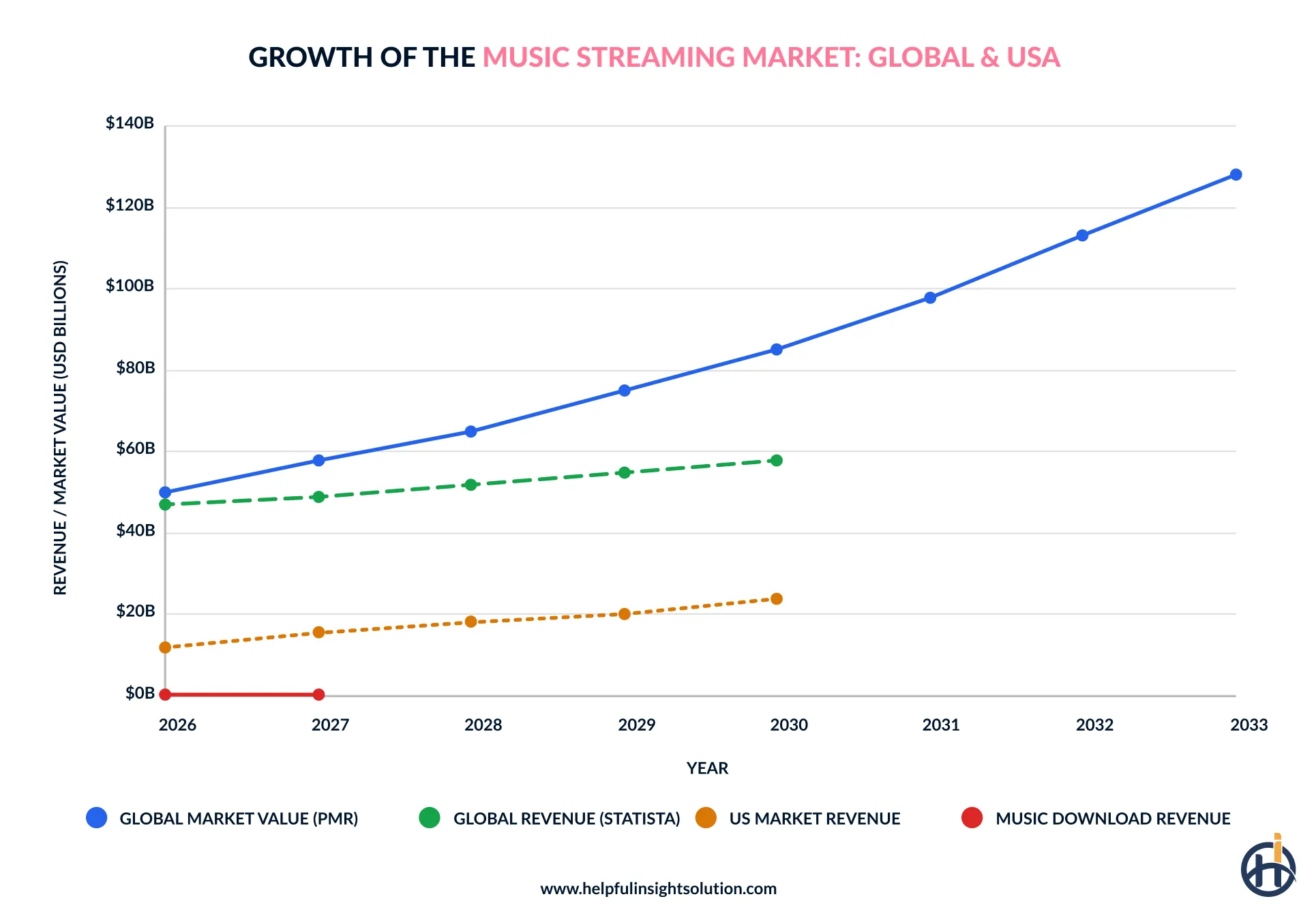
The above stats deliver insights that help businesses to invest in the online music streaming market and engage users with premium services. Just like Apple Music, you can build advanced platforms and become a leader in this industry.
Why invest in an audio streaming app like Apple Music?
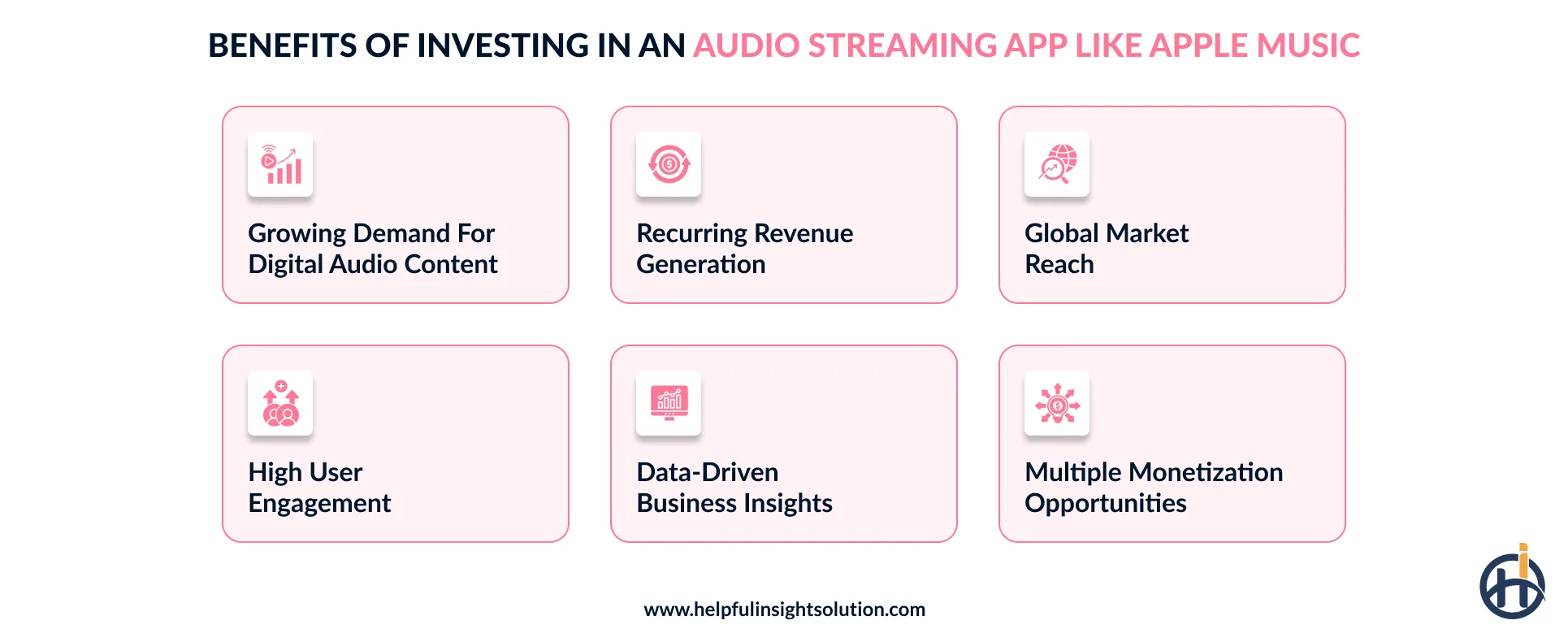
Entrepreneurs can invest in building an Apple Music clone app because it offers multiple benefits. This section provides the key business advantages, such as revenue generation and constant user retention.
1. Growing demand for digital audio content
With the global demand for live media entertainment growing rapidly, investment in a music platform creates a profitable business opportunity. Businesses can expand by offering users seamless access to music, podcasts, and personalized audio experiences.
2. Recurring revenue generation
When people pay for a subscription every month or year the company gets a stream of money. This helps the company make money for a time and stay financially stable.
3. Global market reach
Audio streaming platforms can be used by people in countries without any problems. This means companies can reach people and make more money all over the world.
4. High user engagement
Users get personalized playlists and music recommendations based on their choices. They like the services when they get content that they cannot get anywhere else. This makes people want to use the platform and be more loyal to the company.
5. Data-driven business insights
When companies look at how people listen to music and what they like, they can get some useful information. They can use Apple Music app development services to make their platform better and make future decisions.
6. Multiple monetization opportunities
There are ways that audio streaming apps can make money. They can generate revenue from subscriptions, ads, special features, partnerships and selling merchandise. This allows businesses to execute different money-making models based on the requirements and make profits by targeting millions of users.
Legal and music licensing requirements for Apple Music-like apps
Businesses must ensure music licensing for apps like Apple Music that target a global audience and collect their sensitive information. It is necessary for both iOS and Android app development, delivering a hybrid framework for all legal activities. Here is a table that describes key requirements in detail.
| Component | Description |
| Music Streaming Licenses | Obtain legal streaming rights from record labels, publishers, and licensing organizations to distribute copyrighted music. |
| Copyright Compliance | Ensure all songs, albums, artwork, and metadata comply with national and international copyright laws. |
| Royalty Payment Management | Implement systems to accurately calculate, track, and distribute royalties to artists, labels, and rights holders. |
| Regional Licensing & Geo-Restrictions | Enforce location-based content availability according to licensing agreements and territorial distribution rights. |
| Privacy & Data Protection Compliance | Adhere to regulations such as GDPR, CCPA, and other data privacy laws to safeguard user information. |
| Terms of Service & Content Policies | Establish clear legal agreements, acceptable use policies, and copyright infringement procedures for users and content providers. |
Exciting features of music listening apps similar to Apple Music
Top features of the Apple Music app include a vast music library, content management, and AI personalisation. Here, we will explore some of the best core & advanced features based on the user and admin panels.
1. Listener panel
Apple Music has a user panel that offers multiple features to enhance the streaming experience and improve listening. We will observe some common listener features with their descriptions in this segment.
| Features | Description |
| Advanced music search and discovery | Enables users to quickly find songs, albums, artists, and personalized recommendations through intelligent search capabilities. |
| Lossless & spatial audio support | Delivers high-fidelity sound and immersive 3D audio experiences for enhanced music enjoyment. |
| Custom playlist creation and sharing | Allows users to create, organize, and share personalized playlists with friends and communities. |
| iTunes/iCloud music library | Synchronizes purchased and uploaded music across devices through cloud-based storage integration. |
| Offline music download | Lets users download songs and playlists for uninterrupted listening without an internet connection. |
| Voice assistant and smart speaker support | Enables hands-free music playback and control through voice commands and smart home devices. |
2. Admin panel
Here, we will see some iOS music app features based on the admin panel that manages backend services. They monitor various transactions, resolve copyright issues, and allow ethical content for streaming.
| Features | Description |
| Artist & label dashboard | Provides artists and record labels with tools to manage content, track performance, and monitor audience engagement. |
| Content management system (CMS) | Enables administrators to upload, organize, edit, and manage music, podcasts, and multimedia content efficiently. |
| Content moderation & rights management | Helps verify content ownership, enforce licensing agreements, and prevent unauthorized distribution. |
| Geo-restriction control | Allows administrators to control content availability based on regional licensing and distribution rights. |
| Subscription & payment management | Streamlines subscription plans, billing processes, payment tracking, and revenue management. |
| Analytics & reporting | Provides detailed insights into user behavior, streaming trends, revenue performance, and platform growth metrics. |
Advanced features
You must know some advanced features of an audio streaming platform like Apple Music that reduce media buffering. These features are created with advanced technologies, such as AI, AR/VR, and more.
1. Mood & activity-based recommendations
Music fans love the way live streaming platforms work with intelligence to figure out what kind of music they like. These services look at the music people listen to how they are feeling and what they are doing to suggest songs and playlists that’re just right for them.
2. Virtual concert & event streaming
The music platform is a place to see live concerts new album releases and special events with famous artists. All of this happens in the app so people do not have to go to a physical place to have fun.
3. Collaborative listening rooms
Sometimes people want to listen to music with their friends. That is where collaborative listening rooms come in. This feature of a music streaming app let multiple people join in and listen to music together at the same time.
4. Smart lyrics translation & Karaoke
When people listen to music together, they can even see the words to the songs in time. They can also see what the words mean in their language, which is really helpful. Some people even like to sing along like they’re in a karaoke bar.
5. NFT-based artist rewards
Various music and podcast apps also work with NFTs, which are collectibles that artists can offer to their fans. They can be things like music, special pictures or even a way to join a fan club. This helps artists make money and connect with their fans in a more meaningful way.
How to make Apple Music-like mobile applications?
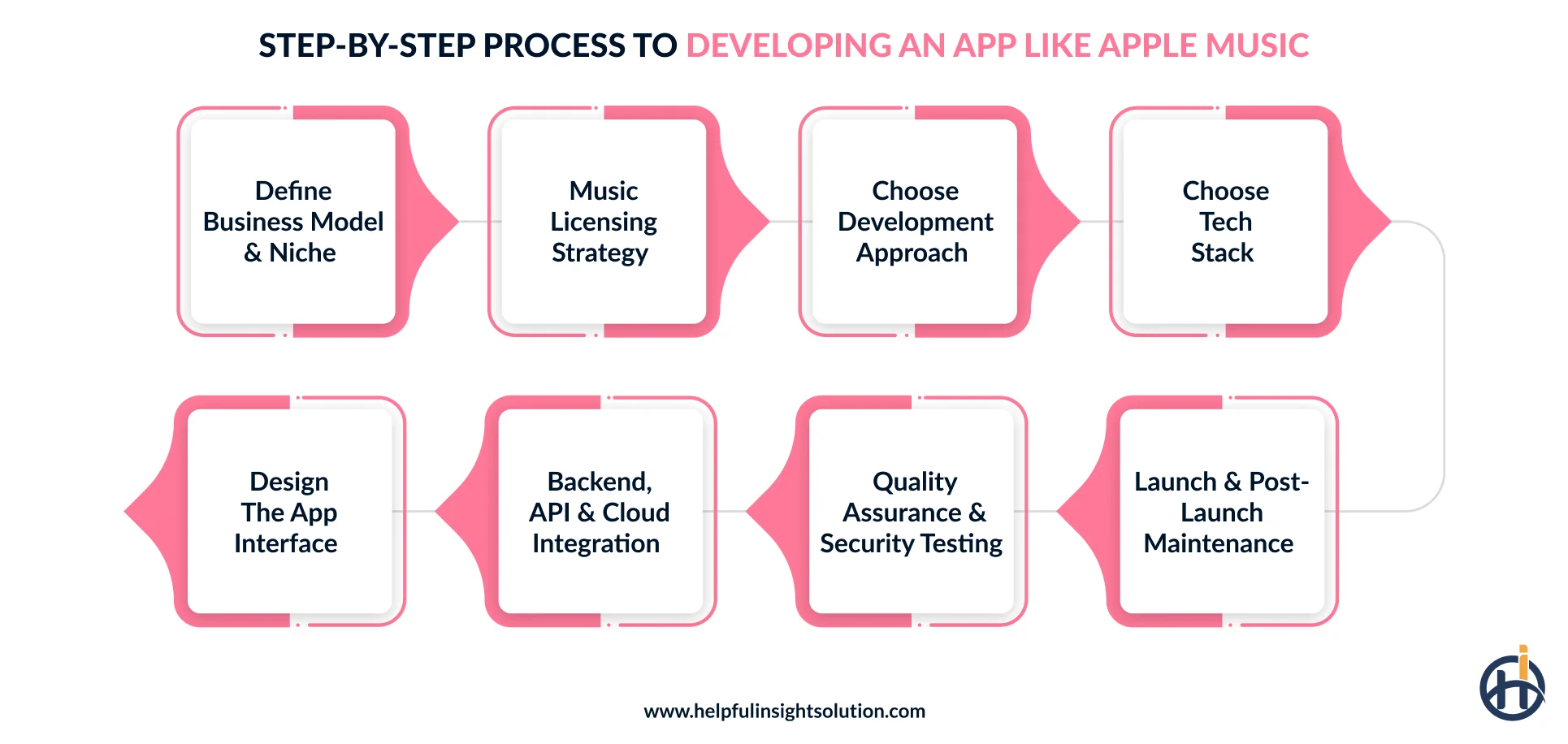
To develop an app like Apple Music, you must know various development stages, from planning to maintenance. In this section, we will study a step-by-step process through which you can easily launch a music platform.
1. Define business model & niche
When you want to make an app, the first thing you need to do is figure out who your target audience is and what makes your app special. Companies need to decide if their app will be for music, podcasts, live audio or a mix of everything.
This helps your app stand out from competitors and attract the right users. You also need a plan for how you will make money whether it is from subscriptions, ads or special content.
2. Music licensing strategy
Getting the right to play music is very important if you want to share songs and audio. Companies have to talk to record labels, publishers, artists and licensing companies to make agreements.
Your plan for licensing should cover things like what music you can stream, where you can stream it and how you will pay royalties. If you do licensing correctly you can avoid problems and make sure your app will be around for a long time.
3. Choose development approach
Businesses decide if they want to build an app that only works on one type of device an app that works on devices or an app that is a mix of both. An Apple Music app development company builds apps that work on both single and cross-platform solutions that are faster and cheaper.
The way you build your app should match your business goals, budget and plans for growing. You should also think about if you want to expand your app in the future when you are deciding how to build it.
4. Choose tech stack
Choosing the tools to build your app is very important for how well it works how secure it is and how well it can handle a lot of users. You need tools for building the parts users see, the parts that work behind the scenes, storage systems, cloud integrations, and audio streaming infrastructure.
Companies should pick tools that can handle a lot of audio and make sure users have an experience. If you plan your tools carefully it will be easier to make changes and add features to your app later.
5. Design the app interface
The audio listening platform needs to look good and be easy to use so that people want to use it and keep coming. The design should make it simple for users to find their way get music suggestions that are just for them manage their playlists and discover new music without any hassle.
If the service looks the same on all devices and the layout works well, it will feel like a high-quality service to the users.
6. Backend, API & cloud integration
Various tasks like user account management, playlist handling, and mobile subscriptions are controlled by the backend infrastructure. Businesses invest in iOS app development to integrate APIs that can easily communicate with payment systems and manage daily song recommendations.
Additionally, it is beneficial to use cloud-based solutions to store a large amount of data on a centralized server. This allows users to directly access millions of songs and albums in a secure environment.
7. Quality assurance & security testing
To make sure the mobile app for music streaming works properly it needs to be tested well before it is released. This testing should check that everything works that it can handle a lot of users that it works on devices and that music streams well.
The service also needs to be checked for security risks to keep user information payment details and music safe. If the service is tested regularly it will be stable and secure.
8. Launch & post-launch maintenance
After the music app is released the business needs to keep an eye on how it’s working what users are saying and how people are using it. They need to fix any problems release updates and add features to keep users happy.
If the service is continuously improved, it will be more stable and users will be more satisfied. To stay competitive in the music streaming market the business needs to keep supporting the service.
Tech stack required for music streaming app development
It is crucial to use a tech stack to develop an app like Apple Music that includes various frontend, backend, database, and cloud tools. Additionally, it must include cross-platform frameworks like Flutter and server programming languages. In this section, we will study a tech stack table for music streaming app development with key components.
| Component | Recommended Tools/Technologies | Description |
| Frontend Development | React Native, Flutter, Swift, Kotlin | Builds responsive and engaging user interfaces for iOS and Android applications. |
| Backend Development | Node.js, Python (Django), Java Spring Boot | Handles business logic, user management, APIs, and application workflows. |
| Database Management | PostgreSQL, MySQL, MongoDB | Stores user profiles, playlists, subscriptions, and music metadata securely. |
| Cloud Infrastructure | AWS, Google Cloud Platform, Microsoft Azure | Provides scalable storage, computing resources, and global service availability. |
| Audio Streaming Engine | HLS, MPEG-DASH, ExoPlayer, AVPlayer | Delivers high-quality music streaming with adaptive bitrate support. |
| Content Delivery Network (CDN) | Cloudflare, Amazon CloudFront, Akamai | Reduces latency and ensures fast music delivery across different regions. |
| Authentication & Security | OAuth 2.0, Firebase Authentication, JWT | Secures user accounts, login processes, and data access permissions. |
| AI Recommendation System | TensorFlow, PyTorch, Amazon Personalize | Generates personalized playlists and song recommendations based on listening behavior. |
| Payment Gateway Integration | Stripe, PayPal, Braintree, Apple Pay | Enables secure subscription purchases and in-app payment processing. |
| Analytics & Monitoring | Google Analytics, Mixpanel, Firebase Analytics | Tracks user engagement, listening trends, app performance, and business metrics. |
Challenges in building apps like Apple Music
Businesses may face different music app development challenges, like security, licensing, and consistency. We will discuss all the major issues in this section with their respective solutions.
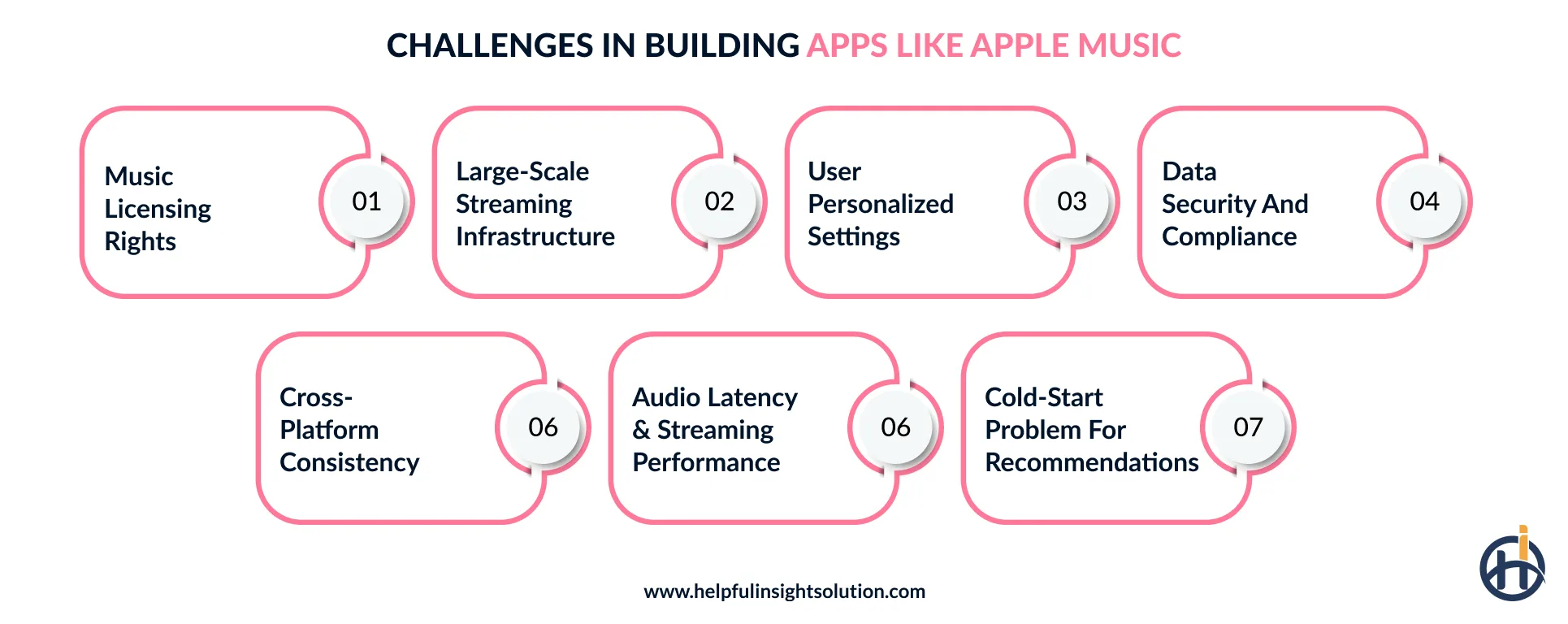
1. Music licensing rights
It is complex and time-consuming to secure legal music rights to stream millions of songs on the internet. This is because every song has two copyrights, which include music composition and sound recording.
Solution: You must ensure global music licensing rights and use B2B music APIs for integrations due to high scalability.
2. Large-scale streaming infrastructure
This includes content delivery, sound quality, data storage, and music transcoding issues. It can affect concurrent traffic overloads and reduce audio quality due to excessive user requests in a single time.
Solution: Businesses must implement edge caching and adaptive bitrate streaming services to ensure constant streaming without any interference.
3. User personalized settings
Offline song availability, predictive algorithms, and real-time music updates are the key user-centric issues. This also affects the overall cost to build a music app if the budget and resources are limited.
Solution: It is beneficial to use client-side caching and a publish-subscribe cloud architecture to monitor user preferences in real-time.
4. Data security and compliance
The key challenges include digital rights management and ensuring compliance with GDPR or CCPA laws. Additionally, it is complex to secure high-volume cloud storage and CDN data against breaches.
Solution: You must implement AES encryption standards and global regulations that target data security, protecting it from multiple attacks.
5. Cross-platform consistency
Delivering a native and high-performance experience is a challenge that affects audio playback and crossfading. CoreAudio on iOS and MediaPlayer on Android devices face these cross-platform issues.
Solution: Using Flutter is highly recommended, as it offers customized layouts for all devices and ensures seamless music controls.
6. Audio latency & streaming performance
The delay between user controls and sound streaming is a common issue that most audio platforms have. Additionally, music buffering is a major challenge that reduces listening experiences and user trust.
Solution: Businesses can use HLS or MPEG-DASH, which provide custom segmented audio buffers and adaptive bitrate streaming.
7. Cold-start problem for recommendations
In this problem, the recommendation engine struggles to suggest personalized music due to a lack of historical data. This is called a preference vacuum that occurs because of incompatible data tracking.
Solution: An automated system helps to gather user information through interactive dashboards, diverse exploration, and audio analysis.
What is the cost to develop an app like Apple Music?
The cost to build an app like Apple Music is highly affected by the project complexity and the number of features. A platform that includes simple music libraries, a playlist creation feature, and an equalizer option requires a limited budget.
More factors like platform selection, developers’ experience, security charges, and location choice also affect the Apple Music app development cost. In this section, we will observe a table, listing key factors and their respective costs with a detailed description.
| Cost Factor | Estimated Cost (USD) | Description |
| App Complexity | $12,000 – $60,000 | Advanced features such as AI recommendations, offline listening, playlists, and streaming capabilities significantly impact development costs. |
| Platform Selection | $5,000 – $25,000 | Building for iOS, Android, or both platforms affects the overall development budget and timeline. |
| Location Choice | $4,000 – $20,000 | Development rates vary by region, with costs differing across North America, Europe, and Asia. |
| Developers’ Experience | $6,000 – $30,000 | Senior developers and specialized streaming app experts typically charge higher rates for their expertise. |
| Hiring Models | $5,000 – $22,000 | Costs depend on whether businesses hire freelancers, an in-house team, or a dedicated development agency. |
| Security Charges | $3,000 – $18,000 | Security investments cover data encryption, secure payment processing, authentication, and regulatory compliance. |
| Marketing Costs | $5,000 – $25,000 | Pre-launch promotions, app store optimization, influencer campaigns, and user acquisition efforts contribute to marketing expenses. |
Ways to monetize smart apps similar to Apple Music
Various music app monetization strategies include ad campaigns, brand sales, and membership schemes. These revenue models help businesses to expand globally and gather more audience through loyalty.
1. Premium subscription plans
Premium subscriptions provide users with ad-free listening, offline downloads, and access to exclusive features. This model generates recurring revenue through monthly or annual membership fees.
2. In-app audio and display advertisements
Businesses can monetize free users by displaying banner ads, video ads, or audio advertisements between tracks. Advertisers benefit from targeted campaigns based on user preferences and listening behavior.
3. Family and group membership packages
Family and group plans allow multiple users to access premium services under a single subscription. These packages attract more subscribers while increasing overall customer lifetime value.
4. Exclusive content and artist partnerships
Partnering with artists to offer exclusive albums, live sessions, or early releases helps attract and retain users. Exclusive content creates a competitive advantage and opens additional sponsorship opportunities.
5. Affiliate marketing and merchandise sales
Streaming platforms can earn commissions by promoting music-related products, event tickets, and third-party services. Additionally, selling artist merchandise directly through the app creates an extra revenue stream.
Future integration in Apple Music app clones
You can make an app like Apple Music with future technologies like AR/VR, blockchain, and generative AI. These innovations enhance user experiences, improve engagement, and reduce churn rate for investors.
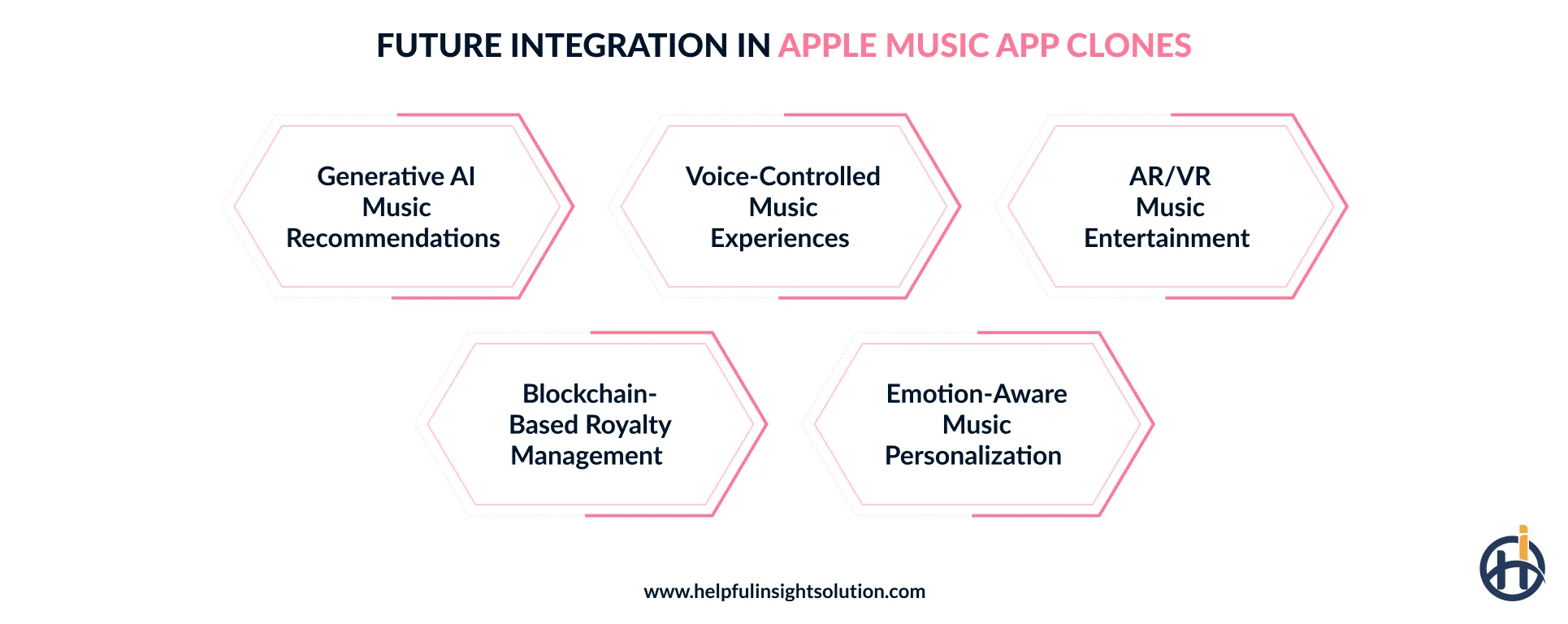
1. Generative AI music recommendations
Generative AI can create highly personalized playlists by analyzing user preferences, listening history, and contextual factors. This enables more accurate music discovery and continuously evolving recommendations tailored to individual tastes.
2. Voice-controlled music experiences
Advanced voice assistants allow users to search, play, skip, and manage music entirely through natural language commands. This hands-free interaction improves accessibility and convenience across devices.
3. AR/VR music entertainment
Augmented and virtual reality technologies can deliver immersive concerts, interactive performances, and virtual fan experiences. Users can engage with artists and music in entirely new digital environments.
4. Blockchain-based royalty management
Blockchain technology provides transparent and automated royalty tracking for artists, labels, and content owners. Smart contracts help ensure accurate payments while reducing disputes and administrative overhead.
5. Emotion-aware music personalization
AI-powered emotion recognition can analyze user moods through behavioral patterns, voice inputs, or wearable device data. The system then recommends music that aligns with the listener’s emotional state, creating a more personalized experience.
Partner with Helpful Insight to build your music streaming app like Apple Music
Are you ready to create an app like Apple Music that ensures a comfortable listening experience? So, you must not waste time and connect with a reliable company that has good expertise in making and launching such platforms.
We provide the best talent who follows a certified app-making approach and uses advanced technologies. From consulting to maintenance, our music app development services help businesses to build smartly integrated music applications.
Our experts help entrepreneurs to choose the right development platforms, prepare a suitable budget, and list necessary features. We study various apps similar to Apple Music to create a unique platform, ensuring high-quality audio streaming, consistent user engagement, and profitable revenue generation. This opens up the business potential to expand globally and maintain security through music licensing.
FAQs
The time needed to build an Apple Music app clone with limited requirements can range from 2 months to 4 months. With advanced features, like personal playlist creation, the overall duration may increase to 8 months. The total timeline may reach 12 months due to music licensing, mobile app maintenance, branding, and user testing.
The average cost is dependent on multiple market factors, like developers’ experience, platform choice, and team hiring models. For a basic music app, the cost ranges from $40,000 to $80,000 because of features like offline downloads and podcast listening. The cost can reach $200,000 or increase further due to AI, blockchain, AR/VR, and other advanced technologies.
The integration complexity is dependent on AI features like smart recommendations, personalised playlists, and generative AI music. Apple’s Musickit and APIs help developers to implement library management and audio streaming. The complexity is also affected by platforms like Android and iOS because of different tools and frameworks.
Businesses use various revenue models to monetize music listening apps similar to Apple Music. Some of the key money-making strategies are described in the following manner:
- Subscription: People choose a monthly or annual plan according to their music preferences.
- Freemium model: You can charge non-subscribed members for premium features and services.
- Podcast integration: Users also pay for podcasts and audiobooks to get a complete experience.
The USA has multiple online music platforms that offer a wide streaming experience and tough competition to Apple Music. These apps include Spotify, YouTube Music, Tidal, Pandora, and SiriusXM, which deliver advanced features. Some of the best features they provide are an AI-driven music library, offline downloads, and high-resolution music streaming.