

Key takeaways
- AI is now part of everyday coding, so the real work is checking its output, and teams that set review rules early avoid most of the pain.
- AI agents are worth testing on small, clear jobs. Rolling them out company-wide before you have results is how projects end up cancelled.
- Low-code works well for internal tools and quick prototypes. Anything that earns revenue usually needs custom code.
- Cloud costs need an owner. If nobody looks at the bill each month, waste grows quietly.
- Security works best when it runs inside the build pipeline. Finding a flaw in a pull request is far cheaper than finding one in production.
- Edge computing pays off only when speed or connectivity is a real problem. Otherwise, the cloud is simpler.
- Efficient code cuts both emissions and cloud spend, which makes green coding easy to justify.
- Treat cybersecurity as a product requirement, with owners, budgets, and tests from design to retirement.
Gartner forecasts that worldwide IT spending will reach $7.35 trillion in 2027, up 15% from 2026. Much of that growth comes from AI infrastructure and software, and it is changing how teams write, test, launch, and protect code.
Software development trends are the shifts in platforms, methods, and system design that decide how fast a team launches and how much the product costs to run. Some trends, like AI coding assistants, are already part of daily work. Others, like edge computing, are still being tested. Knowing which is helps teams plan their software development budget with fewer surprises.
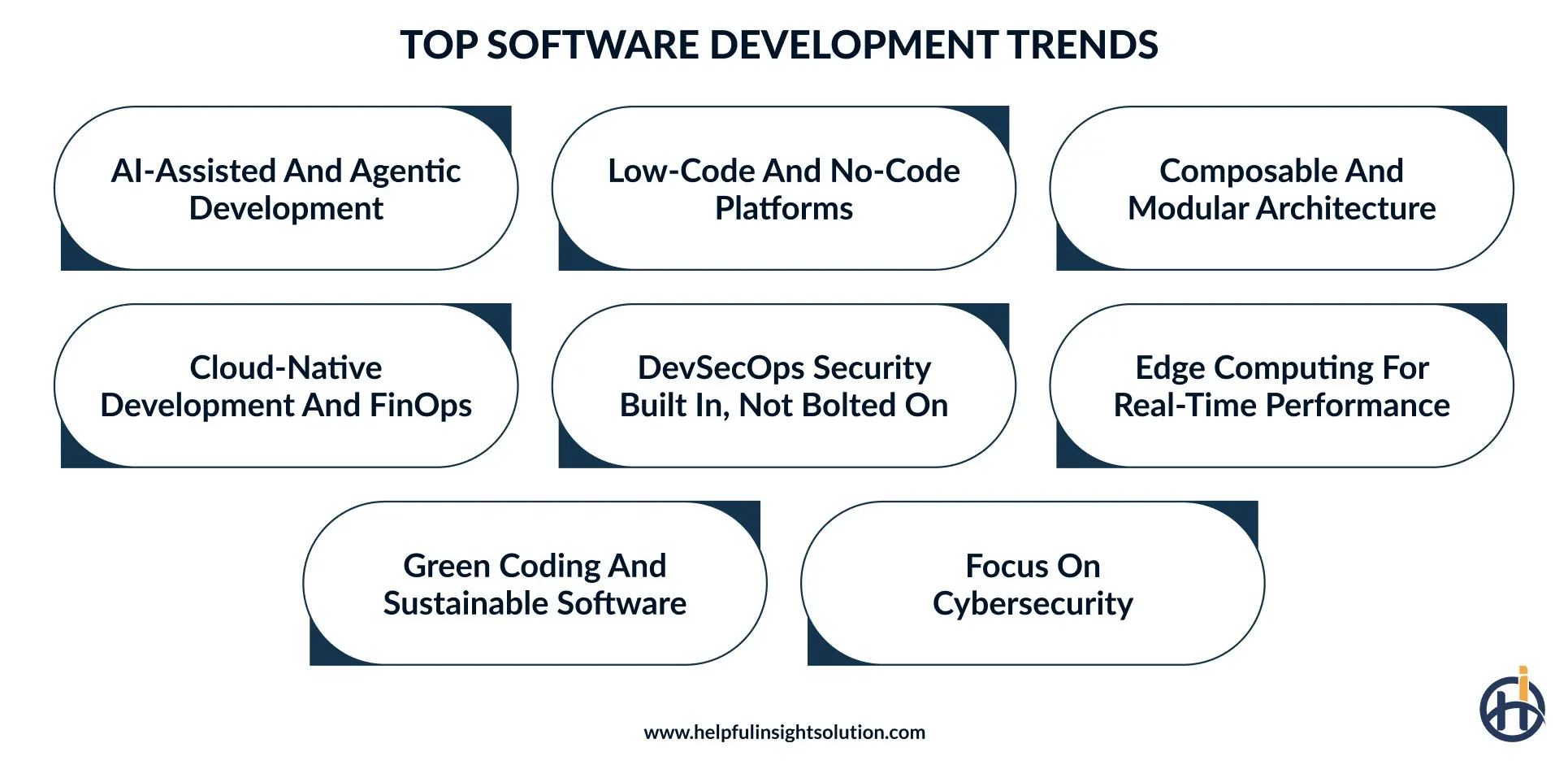
This guide covers the latest trends in software development, including AI-assisted coding, low-code, composable architecture, cloud-native work with FinOps, DevSecOps, edge computing, green coding and sustainable software, and cybersecurity. Each one comes with current data, the trade-offs, and what a team can do first.
Software development statistics
Software development industry trends follow the money, so market data is the best place to start. Software spending is growing at a double-digit pace. Research firms define scope differently, so totals vary by source. The direction is the same across all of them. Here is what the main sources say:
- In Stack Overflow’s 2026 survey of more than 30,000 people, 66% of developers said they use coding assistants or coding agents (Stack Overflow).
- Gartner predicts that 40% of enterprise applications will include task-specific AI agents by the end of 2026, up from less than 5% in 2025 (Gartner, August 2025).
- Flexera’s 2026 State of the Cloud report found that companies estimate 29% of their IaaS and PaaS cloud spend is wasted, up from 27% a year earlier (Flexera).
- IBM puts the average cost of a US data breach at $11.5 million in 2026, up from $10.22 million in 2025 (IBM).
- IDC says worldwide edge computing spending reached $265 billion in 2025 and will reach $450 billion by 2029 (IDC).
- In Deloitte’s 2024 outsourcing survey, 34% of leaders named cost-cutting as their main reason to outsource, down from 70% in 2020 (Deloitte).
For US businesses, two numbers matter most: spending is rising, and breach costs are the highest in the world. Both push leaders to build faster without cutting security corners.
Top Software Development Trends in 2027
Technology in software development moves fast, but not every shift needs action. These trends appear across market research, developer surveys, and vendor reports. Each one affects how teams plan, build, and release software, and each has trade-offs worth knowing before adoption.
AI-Assisted and Agentic Development
One of the biggest software development trends is AI-assisted and agentic development. AI now helps write, test, review, and document code.
In Stack Overflow’s 2026 survey, 66% of developers used coding assistants or coding agents, and 26% used automated agent workflows.
Agents take a task, plan the steps, and change code across files. Trust is the weak spot, so teams set review rules first: who checks AI code, which tests must pass, and what data the tools can see. Used well, AI removes repetitive work such as unit tests, documentation, and routine refactors.
What to do:
- Write down which tools are approved and what data can go into them.
- Review AI-written code in pull requests like any other code.
- Try agents on small tasks first, like writing tests or sorting tickets, and compare defect rates before you expand.
Building agents into a product is a different task from using a coding assistant. AI development needs data work, testing, and monitoring that most product teams have not done before.
Best for: Teams with solid test coverage and clear code review habits.
Low-Code and No-Code Platforms
Low-code platforms allow teams to build apps with visual blocks and little code. Finance, HR, and operations teams use them for approval flows, dashboards, and internal tools. The limit shows up at scale. Complex logic, heavy traffic, and deep system links still need custom code.
For example, a finance team can build an expense approval flow in days instead of waiting months for developer time. Without oversight, citizen-built apps also skip security checks.
Many teams use a mix of low-code for simple workflows and custom development for core products.
- Decide who can connect to which data.
- Give every app an owner.
- Ask how you would export your logic and data before you sign a contract.
- Keep revenue-critical systems in custom code.
When a team has outgrown low-code apps and linked tools, ERP software development is often the next step, because the system gets built around how the business actually runs.
Best for: Internal tools, prototypes, and workflows owned by business teams.
Composable and Modular Architecture
Composable architecture splits a system into parts that communicate with each other through APIs. Payments, search, or login can each be updated or replaced without touching the rest.
The old way, one big codebase, has a familiar problem. A small change needs a full release, and one team’s bug can block everyone. Modular parts let teams ship on their own schedules. You can also buy the parts that are not special, like tax calculation or email, and build only what sets your product apart. Technology in software development has been moving toward smaller pieces for years, and this is where that road leads.
There are costs. More parts mean more deployments, more monitoring, and more places for things to fail between services. Many teams start with a modular monolith, which is one app with clear internal boundaries, and split it only when they have a reason.
What to do:
- Agree on API contracts before anyone writes code.
- Give each module one owning team.
- Keep the number of services in line with the number of people who can run them.
- Add logging and tracing from the first release.
Parts can use different languages, so it helps to compare the top programming languages before you commit to one for each piece.
Best for: Products that change often or serve several customer types.
Cloud-Native Development and FinOps
Cloud-native means building for the cloud from day one, with containers, managed services, and automated deployments. FinOps is the habit of tracking cloud spend with engineering, finance, and product in the same room.
Docker usage rose 17 points to 71% among developers in the 2025 Stack Overflow survey.
Cloud bills have also become a design concern. FinOps ties engineering choices to cost, so teams can see what each feature costs to run. The habits are simple: tag resources, review spend weekly, and set budgets per team. Cloud-native design also sits under many software development trends, including serverless and edge computing.
What to do:
- Tag every resource with a team and a product.
- Set a budget per team and alert on overruns.
- Report cost per customer or per feature, not only a monthly total.
- Switch off idle test environments on a schedule.
- For AI features, track cost per request.
The cloud bill is only one part of software development costs, so look at the full picture before you set a budget.
Best for: Apps with uneven traffic or teams spread across locations.
DevSecOps: Security Built In, Not Bolted On
DevSecOps runs security checks during development instead of at the end. Scans for secrets, risky dependencies, and misconfigurations run on every code change.
IBM’s 2024 report found that adopting DevSecOps lowered average breach costs by about $227,000, as summarized by HIPAA Journal.
AI-generated code makes this more important, since flawed code can look correct. Policy-as-code goes a step further by blocking non-compliant changes automatically. Security belongs among the software development trends because late fixes cost more.
A flaw caught in a pull request takes minutes to fix. The same flaw in production can mean an emergency release and a ruined weekend.
What to do:
- Run static analysis and dependency scans on every pull request.
- Scan for secrets, such as API keys, before code merges.
- Keep a software bill of materials, so you know what you ship.
- Set fix deadlines by severity, for example, a week for critical issues.
- Treat AI-written code and new packages like any other change.
DevSecOps grows out of DevOps, so it helps to understand the software development methodologies behind it before you change your process.
Best for: Any team that ships weekly or faster, and regulated industries in particular.
Edge Computing for Real-Time Performance
Edge computing processes data close to where it is created, such as a store, factory, or device. It cuts delay and keeps working on weak connections. Common uses include fraud checks at the point of sale, machine monitoring, and logistics tracking.
It avoids sending everything to a distant data center and waiting for an answer. Edge makes sense when delay matters, as with video analytics or robotics. It also fits places with weak connections, data that cannot leave a site, or high bandwidth costs.
It is a narrow fit, though. Of the software development trends here, edge is the one to test before you commit. If a round trip to the cloud is fast enough, the cloud is simpler and cheaper to run. The hard part is operations: updating many devices, securing hardware you do not control, and seeing what each one is doing.
What to do:
- Set a latency target first, and choose edge only if the cloud cannot meet it.
- Plan remote updates and rollbacks before the first device ships.
- Encrypt data on the device and rotate its credentials.
Many edge projects run a trained model on the device, and machine learning development for small hardware has its own limits on size and power.
Best for: Apps where delay or connectivity matters, such as retail, logistics, and IoT.
Green Coding and Sustainable Software
Green coding means writing and running software so it uses less energy and fewer resources. It is part of sustainable software engineering, which also covers carbon tracking and designing software that needs fewer resources over its life. The reason is power demand.
The International Energy Agency estimates that data centers used about 415 TWh of electricity in 2024, around 1.5% of the global total. It projects about 945 TWh by 2030. In the US, data centers are on course to account for almost half of the growth in electricity demand through 2030.
Most teams cannot change a data center. They can change their own software. Software development trends rarely come with an energy label, but this one has a clear cost link. Less compute means a smaller bill and fewer emissions.
What to do:
- Right-size servers and turn off idle environments.
- Cache results and fix slow database queries.
- Compress images and video before delivery.
- Run heavy batch jobs when grid power is cleaner, if your cloud provider shows that data.
- Use a smaller AI model when it does the job.
These steps cut cloud bills too, so they fit with the FinOps work above. An experienced software development team can add an energy check to code review.
Best for: Teams with large cloud bills, high-traffic apps, or AI workloads.
Focus on Cybersecurity
A cybersecurity focus means treating security as a product requirement, with owners, budgets, and tests, from design to retirement. Getting it wrong is expensive.
IBM’s 2026 Cost of a Data Breach Report puts the global average at $4.99 million, up 12% and a record. The US average is $11.5 million, up from $10.22 million in 2025. IBM also found that organizations using security AI and automation widely saved $1.93 million per breach and shortened the breach life cycle by 65 days.
Cybersecurity belongs on any list of software development trends because it touches every other item here. AI agents, cloud services, and edge devices all widen the area an attacker can reach. These trends in the software industry bring new capability and new exposure together.
AI adds its own risk. Stack Overflow found that most employers have not published approved AI tools or rules. In its 2026 survey, only 24% of developers said their employer had published approved tools or AI guidance. When staff pick their own tools, company data can leave the building.
What to do:
- Require multi-factor authentication and least-privilege access.
- Review vendor access every quarter.
- Collect only the data you need, and delete it on a schedule.
- Practice incident response with a drill, not only a document.
- Decide which data AI tools may see, and enforce it.
Code that is hard to change after launch needs extra review. Smart contracts are the clearest case. Unless they are built with upgrade patterns, a bug stays live. Teams working on blockchain development often get an outside audit before release.
Best for: Any team that handles customer data, payments, or regulated information.
Conclusion
The main software development trends for 2027 share one theme. Tools are getting faster, and mistakes are getting more expensive. AI writes more code, so review matters more. Cloud makes spending easy, so tracking matters more. Software reaches more places, so security and power use matter more.
You do not need to adopt all of them. Choose two or three that match a real problem and run a small pilot. After that, measure the result against a number you set in advance and then decide whether to expand.
Software development trends will keep changing. The habits for handling them stay the same: small tests, clear metrics, and honest reviews of what worked. If you are planning to build custom software for your business, consult with Helpful Insight, one of the top software consulting companies, which can help turn your ideas into practical solutions and support your business as it scales.
Frequently Asked Questions
The main trends of software development are AI-assisted and agentic development, low-code platforms, composable architecture, cloud-native development with FinOps, DevSecOps, edge computing, green coding and sustainable software, and cybersecurity. AI has the widest adoption so far.
AI has changed daily work the most. AI tools now help write, test, review, and document code. In the 2026 Stack Overflow survey, 66% of developers used coding assistants or coding agents, and only 17% used no AI tools. Human review is still needed because only 6.6% of developers said they would trust AI for important decisions. Teams also use AI agents for multi-step tasks, though only 26% of developers use automated agent workflows today.
The biggest challenges in software development are:
- Balancing speed with quality and security. Faster releases and AI-generated code raise the risk of bugs and breaches.
- Skill gaps and rising cloud costs.
- Technical debt, since it slows every later release.
Current software outsourcing trends include a shift from cost-cutting to value, and demand for specialist skills in AI, cloud, and security. In Deloitte’s 2024 outsourcing survey, 34% of leaders named cost-cutting as their main reason to outsource, down from 70% in 2020. Buyers also look for clear scope and strong code ownership terms. Grand View Research estimates the IT services outsourcing market at $860.0 billion in 2026.
No. Low-code works for simple workflows and internal tools. Complex logic, heavy traffic, and deep integrations still need custom code, so most teams use both. Low-code is best treated as one tool in a wider stack.
The one that fixes the biggest current problem. For many small teams, that means AI-assisted coding with code review and cloud hosting with cost tracking.