

Key Takeaways:
- An on-demand healthcare platform includes patient features like doctor search, appointment booking, video consultations, e-prescriptions, and EHR management.
- For doctors and administrators, it delivers provider scheduling, patient management, consultation tools, notifications, and analytics to streamline healthcare operations.
- A dedicated development process involves market research, feature planning, UI/UX design, EHR integrations, testing, deployment, and ongoing maintenance.
- The cost of making doctor-on-demand solutions depends on platform selection, security requirements, technology stack, and development team location.
Have you ever wondered if your patients can visit you online or get remote care instantly? Not only that, they can get e-prescriptions, review lab reports, schedule appointments, and chat with medical professionals. This is a huge advantage for all stakeholders, like healthcare entrepreneurs, clinic owners, healthcare providers, or venture capitalists in health tech.
Doctor on-demand app development is a subset of telemedicine services that specifically deals with urgent patient care, allowing them to connect with doctors anytime and anywhere. Businesses must know that the growth of this market segment is positive, allowing better revenue-making opportunities.
According to Precedence Research, the on-demand healthcare market will be at $366.2 billion, whereas the USA’s market will be $87.2 billion in 2030. Investment in healthcare app development for underserved and elderly patients may be a suitable option for business expansion. For this, having the right guidance is necessary to understand the market better and make growth-oriented decisions.
In this blog, you will get valuable information on how to develop doctor on-demand apps, what the related cost is, key features, business benefits, and challenges. Additionally, we are going to explore some important ways to monetize such platforms to sustain profitability.
What is a doctor on-demand application?
A doctor on-demand application allows patients to connect with licensed doctors, therapists, or psychiatrists through video, audio, and chat. This digital telehealth platform can be accessed through a smartphone, tablet, or personal computer. Patients get immediate consultation for urgent care or book appointments for later specialized care, like mental therapy.
These types of healthcare software allow medical professionals to analyze patients’ clinical history, assess symptoms, and provide treatment plans. Some platforms allow providers to send electronic prescriptions to pharmacies or book labs for sample testing.
How does this platform work in a real-world setting?
An online doctor consultation app has a simple and easy-to-understand working process. Healthcare providers must know the steps discussed in this section before developing one for their business.
- Patients create an account by entering their information and setting up a payment method.
- They can search for doctors and review profiles to check experience and consultation fees.
- Healthcare experts get a complete view of patients’ current symptoms and medical records.
- By using the video call services, patients can connect with available doctors and discuss their health issues.
- Doctors share prescriptions or lab referrals directly to the in-app dashboard, and patients pay for the consultation.
Why should businesses invest in doctor on-demand app development?
While investing in doctor on-demand mobile app development, businesses may experience multiple benefits. From increased patient volume to faster revenue growth, we will discuss each advantage in this section.
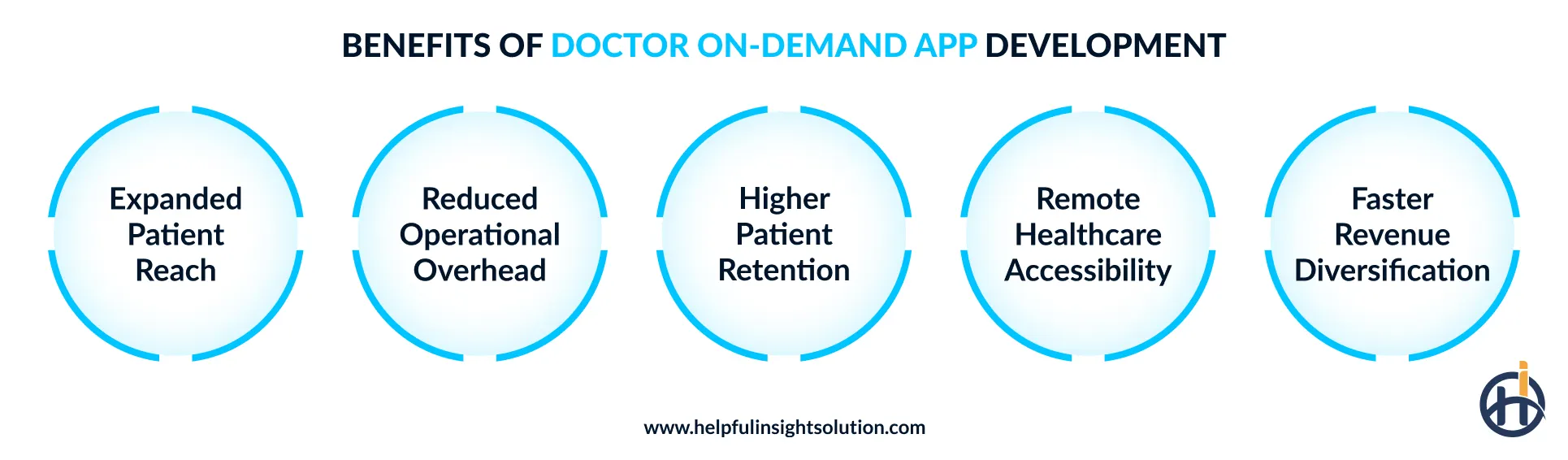
1. Expanded patient reach
A doctor on-demand app prevents geographical constraints and enables doctors to reach out to their patients in different cities, states, and even countries. This expansion in reach brings more opportunities for gaining new patients that are difficult for traditional clinics.
2. Reduced operational overhead
With online consultations, multiple healthcare organizations can decrease their expenses based on physical infrastructure, admin support staff, and in-person logistics. This model ensures higher margin value without compromising the quality of care for patients.
3. Higher patient retention
Various UI/IX design features such as appointment scheduling, digital prescriptions, and regular follow-up reminders support patient engagement for the long term. Patients receiving simple and smooth care services will be far more likely to return rather than switch to a competitor.
4. Remote healthcare accessibility
On-demand apps assist patients in outlying areas or communities where they have limited access to specialists or must travel long distances to access them. In addition to better health, on-demand apps and services enhance the reputation of a healthcare organization as an impact-driven, reliable service provider.
5. Faster revenue diversification
In addition to consultation fees, these solutions provide a number of revenue options like subscription plans, e-Pharmacy integration, diagnostics booking, and insurance partnerships. This helps businesses scale revenue faster while reducing dependency on a single income source.
Key features of a virtual doctor consultation app
Doctor on-demand apps offer varied features, which cover tasks performed by patients, doctors, and admins. Here, we are going to observe some essential features based on the three different user panels.
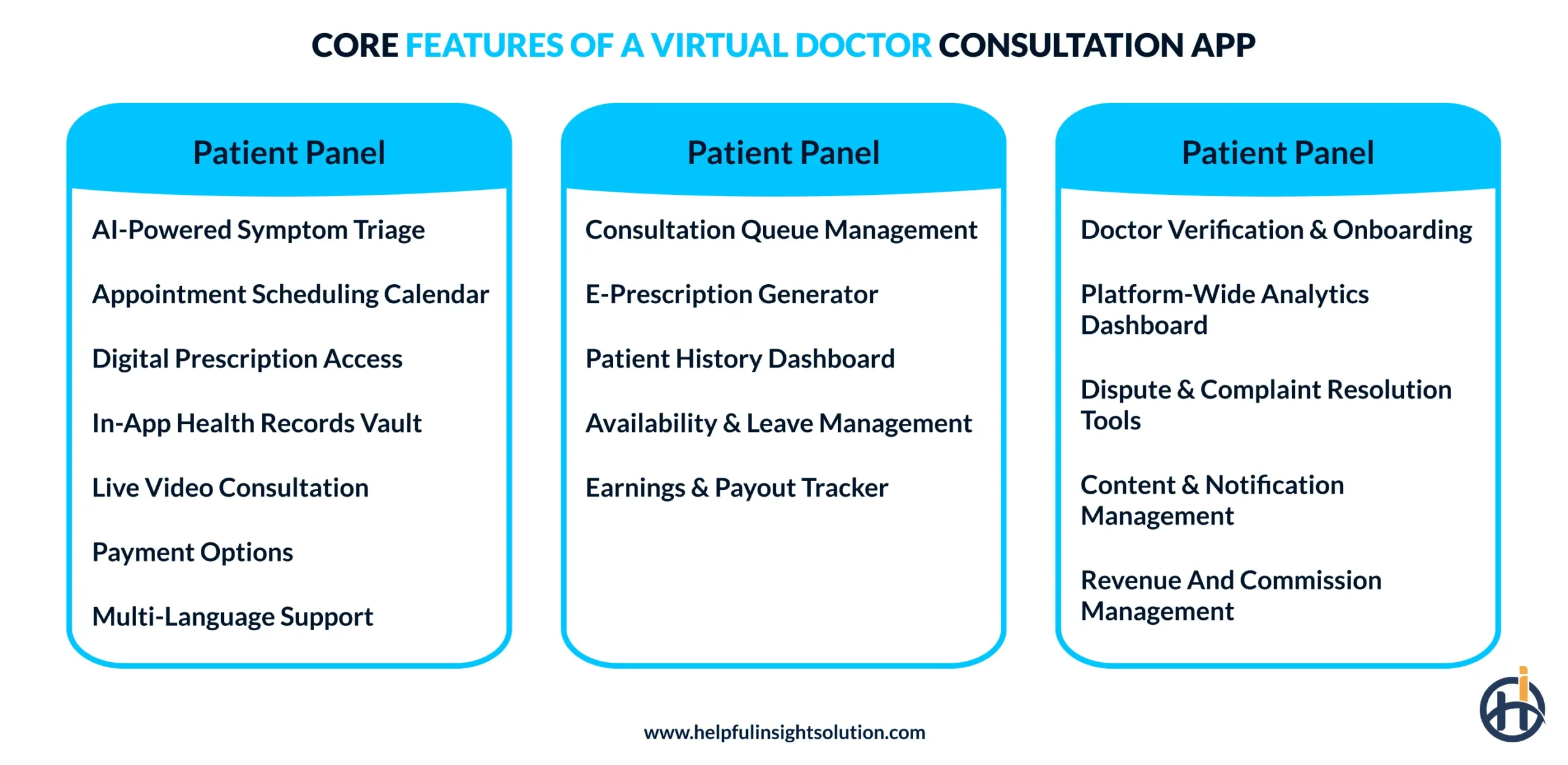
A. Patient panel
1. AI-powered symptom triage
Patients can discuss their symptoms via a chatbot that offers potential diagnoses. The app guides patients to the appropriate specialist before they book.
2. Appointment scheduling calendar
An on-demand doctor appointment app provides real-time availability of doctors through an integrated calendar. Patients can instantly book, cancel, or reschedule appointments without calling the clinic.
3. Digital prescription access
The app issues prescriptions electronically after the consultation app and saves them in electronic health record software. Patients download, print, and email them to pharmacies instantly for fast dispensing.
4. In-app health records vault
It offers a secure vault that stores test reports, prescriptions, and medical history. The patient can access the records from anywhere at any given time.
5. Live video consultation
Patients connect with doctors through secure, high-quality video calls from anywhere. Real-time interaction enables accurate diagnosis, faster care, and a better consultation experience.
6. Payment options
Users can pay for consultations through cards, digital wallets, and net banking. Secure transactions with instant receipts ensure smooth, transparent, and hassle-free payments for patients.
7. Multi-language support
The app provides consultation support and an interactive interface in several regional languages. This caters to the needs of the patients residing in remote, rural areas.
B. Doctor panel
1. Consultation queue management
Doctors can view and organize incoming patient requests in real time. This streamlines workflow, reduces wait times, and ensures consultations are handled efficiently in order.
2. E-prescription generator
Doctors can create and issue digital prescriptions instantly after each consultation. The system auto-fills patient details, minimizing errors and speeding up the prescribing process.
3. Patient history dashboard
A consolidated dashboard displays a patient’s past visits, diagnoses, and prescriptions. This helps doctors make informed decisions quickly without requesting repetitive medical information.
4. Availability & leave management
Doctors can easily update their working hours, block time slots, or mark leave. This keeps the booking system accurate and prevents scheduling conflicts for patients.
5. Earnings and payout tracker
Doctors can monitor consultation earnings, pending payments, and payout history in real time. This transparency builds trust and simplifies financial planning for practitioners.
C. Admin panel
1. Doctor verification & onboarding
Admins can verify doctor credentials, licenses, and certifications before approving a doctor to join the platform. This ensures only qualified practitioners join the platform, maintaining trust and compliance.
2. Platform-wide analytics dashboard
A centralized dashboard tracks key metrics like consultations, revenue, and user growth. This data-driven view helps admins make informed decisions to optimize platform performance.
3. Dispute & complaint resolution tools
The patient management software allows admins to log, track, and resolve patient or doctor complaints. This ensures timely issue resolution and maintains service quality standards.
4. Content & notification management
Admins control in-app content, alerts, and push messages from a combined panel. This helps you keep your users updated about the news, deals, offers, or the latest health alerts.
5. Revenue and commission management
Admins can track total revenue, doctor payouts, and platform commissions from a single dashboard. Automated calculations ensure transparent financial management across every consultation.
How to develop a doctor on-demand application?
For developing doctor-on-demand applications, healthcare organizations require a dedicated process. In this section, you will study business-specific development steps, from market planning to launch and post-development support.
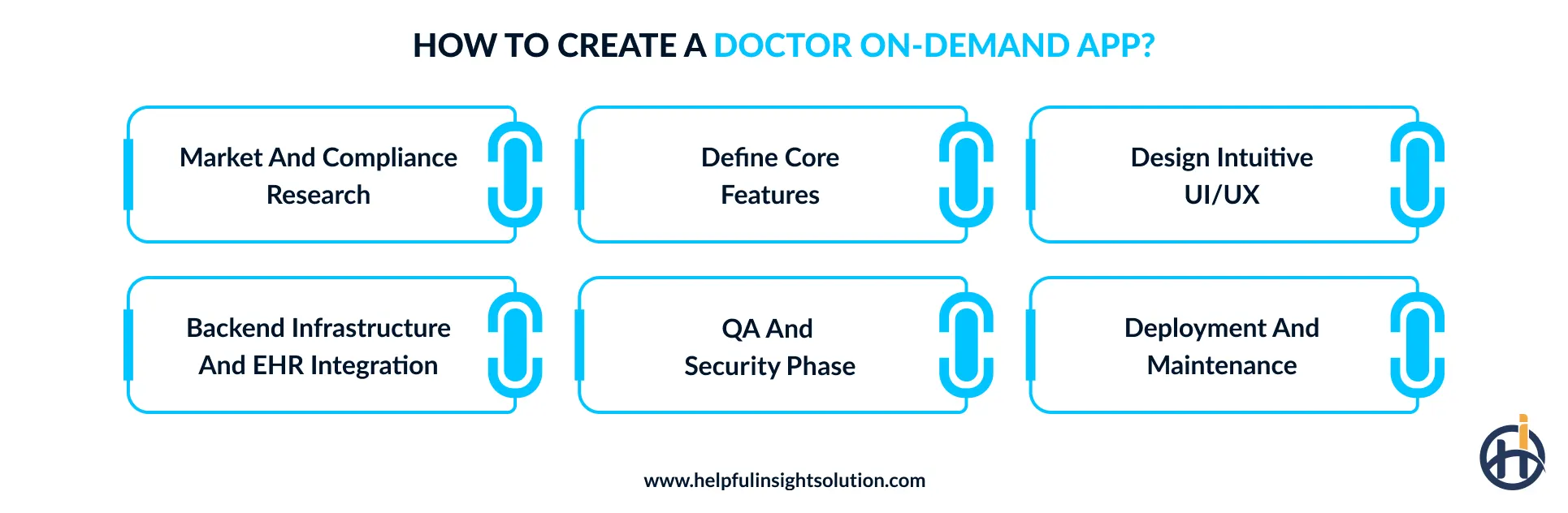
1. Market and compliance research
It is crucial to know the target audiences, competitors, and regional healthcare regulations such as HIPAA or GDPR before starting the process. This phase helps to implement strong, legal frameworks for the on-demand physician app from the beginning.
- Study the pricing structures of competitors to determine where they fall short on value or service.
- Identify pain points in the real world through interviews/surveys with potential patients and doctors.
- Determine if license coverage varies from state to state or nation to nation while expanding into various regions.
2. Define core features
According to research insights, organizations need to specify core features across various panels like patient, doctor, and admin. A telemedicine app development company helps to finalize these functionalities early so as not to add scope that results in a budget expansion.
- Feature selection as per MoSCoW (Must-have, Should-have, Could-have, Won’t-have) to enable scope for the MVP.
- Include doctors and patients in feature validation sessions to ensure practical usability.
- Plan for future scalability by identifying which features can be added.
3. Design intuitive UI/UX
As technology-savvy users and non-technical users like senior patients use online consultation services, a simple and accessible platform can be very beneficial for them. Thoughtful design reduces friction, improves accessibility, and enhances overall user satisfaction with the platform.
- Create wireframes and prototypes to test user flow prior to implementing the solution.
- Validate for accessibility compliance, such as WCAG tests, for persons with visual or motor disabilities.
- Conduct user testing with actual users to gather immediate responses and refine your design.
4. Backend infrastructure and EHR integration
The strong backend with a scalable architecture provides live video consultation, secure data storage, and integration with EHR systems. This stage in the doctor on-demand app development process ensures smooth data exchange and continuity of care for patients across devices.
- Use a cloud provider, such as AWS, Azure, or Google Cloud, that has healthcare compliance certifications.
- Design your architecture for API-based implementation so you can easily connect later to 3rd party health tools or wearables.
- Implement automated backup and disaster recovery systems to automate data backup and ensure no data loss.
5. QA and security phase
With thorough testing, it is easy for experts to identify bugs, weak points, and security flaws and eradicate them before launch. For health data especially, the importance of security audits and accessibility checks during the beta phase cannot be ignored.
- Test through penetration testing to find loopholes or cyberattack vulnerabilities in your infrastructure.
- Test the app so it functions well at scale when there are many consultations.
- Validate encryption protocols for video calling, chat, and storage of patient data.
6. Deployment and maintenance
After the app passes the testing process, it is finally launched on related platforms and continuously monitored for its performance and new versions. In this phase, continued maintenance helps to keep the app secure and compliant, meeting changing user demands.
- Go for a phased or beta launch to a limited audience before full-scale public release.
- Implement real-time crash reporting and monitoring tools that alert you of problems soon after deployment.
- Define a cycle for updates related to OS compatibility, enhancements, and regulations.
Tech stack required for live doctor consultation app development
The latest tech stack helps healthcare businesses to create smart and user-friendly platforms for doctors and patients. On-demand doctor app development solutions require advanced frontend/backend frameworks, database tools, cloud platforms, and smart integration capabilities.
For more advanced features, it is beneficial to invest in AI development services that support patient personalization and medical workflow automation. Here is a table that discusses key components with their respective tools and brief descriptions.
| Component | Tools/Technologies | Description |
| Video consultation SDK | Twilio, Agora, Vonage | Enables real-time secure video and audio calls |
| Frontend framework | React Native, Flutter | Builds cross-platform mobile apps for patients and doctors |
| Backend framework | Node.js, Django | Handles server logic, APIs, and business workflows |
| Database | PostgreSQL, MongoDB | Stores patient records, appointments, and consultation data |
| Cloud hosting | AWS, Microsoft Azure | Provides scalable, HIPAA-compliant infrastructure for app hosting |
| Real-time messaging | Firebase, Socket.io | Powers instant chat between patients and doctors |
| Payment gateway | Stripe, PayPal, Razorpay | Processes secure consultation fees and online payments |
| EHR/EMR integration | HL7, FHIR APIs | Connects the app with electronic health record systems |
| Push notifications | Firebase Cloud Messaging, OneSignal | Sends appointment reminders and consultation alerts instantly |
| Security & compliance | AES-256 Encryption, HIPAA/GDPR tools | Protects patient data and ensures regulatory compliance |
What is the cost for developing on-demand healthcare applications?
By knowing the doctor on-demand app development cost, healthcare providers can manage budget requirements and allocate resources easily. The average price depends on several market factors, such as developers’ location and experience, team hiring model, or platform choice.
Mobile app complexity is among the most commonly experienced factors that influence the cost to develop a healthcare app for on-demand doctor consultation. There is a general formula that most businesses use to estimate the expected price, which is discussed here.
Total Cost = (Total Development Hours × Hourly Rate) + Compliance & Integration Overheads + Annual Maintenance
This is an ideal equation, which is not applicable to all business situations and requirements. The following table helps us to understand cost ranges with their estimated timelines based on the complexity level. Additionally, we will also study what features impact these costs and durations.
| Complexity Level | Cost Range | Timeline | Description |
| Basic MVP | $25,000 – $50,000 | 2–3 months | Single feature, limited functionality, basic UI |
| Standard app | $50,000 – $100,000 | 4–6 months | Video calls, scheduling, payments, and chat |
| Advanced app | $100,000 – $175,000 | 6–9 months | Multi-user roles, EHR integration, custom dashboards |
| Enterprise-grade platform | $175,000 – $240,000 | 9–12 months | Multi-clinic support, analytics, third-party system integrations |
| Highly customized AI-driven system | $240,000 – $300,000 | 12–14 months | AI diagnostics, predictive analytics, complex compliance needs |
Challenges and solutions for physician on-demand app development
As an investor, you may face several challenges while developing doctor on-demand apps, such as data privacy and licensing. A few of the most crucial issues are discussed in this section with their respective solutions.
1. Regulatory and licensing complexity
Various doctor consultation platforms cannot easily connect with patients due to data privacy laws, like HIPAA or GDPR, and cross-border practice rules. These apps are classified as medical devices, which require rigid approval processes from regional medical boards.
Solution: By using geo-fencing technology, the platform can restrict unauthorized doctors from practicing in a particular region, ensuring compliance with regulations.
2. Provider credentialing & verification
Manual checking of medical licenses, board certifications, and work histories may be time-consuming, preventing doctors from taking appointments. Additionally, fake credentials, expired licenses, or malpractice claims also create trust issues, reducing patient volume.
Solution: Various medical apps for doctors can be integrated with official medical boards and include a dashboard that can identify missing documents and send expiration alerts.
3. Data privacy and security risks
APIs lacking data protection may allow attackers to enter the app through real-time chats, video calls, and electronic health record (EHR) integrations. Also, standard passwords and location data can be compromised by unethical users, increasing the risk of security breaches.
Solution: With encryption standards like AES-256, OAuth 2.0 protocols, and multi-factor authentication, it is easy to secure sensitive patient data, such as PHI.
Ways to monetize an online medical consultation platform
Businesses can generate profitable revenue by incorporating several monetization models, like subscription and wellness packages. Let’s observe which revenue strategy you can implement in a doctor on-demand application.
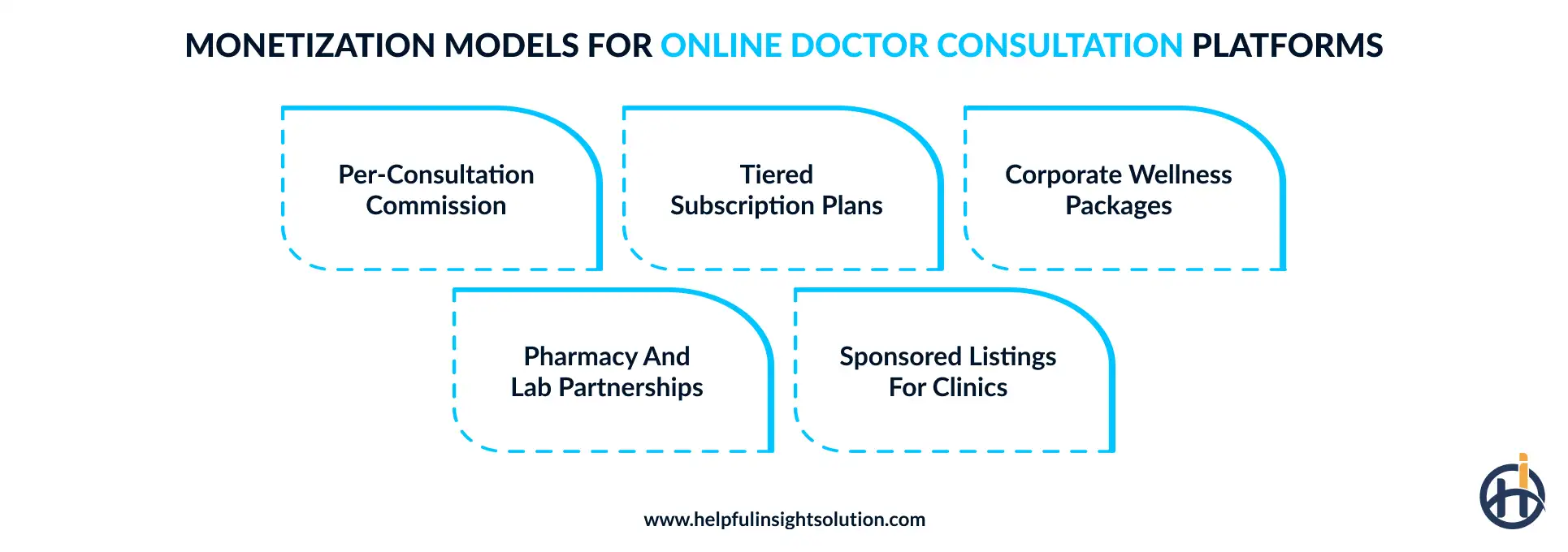
1. Per-consultation commission
The doctor on-demand app applies a flat fee or a percentage to each consultation that takes place between a patient and a doctor. This model is among the simplest and most scalable monetization methods that help to increase revenue proportionally with platform activity.
2. Tiered subscription plans
These apps offer different membership plans, like basic, premium, or family plans that patients can select based on their healthcare needs. This model helps to generate consistent revenue and provides user benefits like unlimited visits or priority scheduling.
3. Corporate wellness packages
Businesses can partner with companies to provide employees access to virtual health assistants as part of their health benefits program. The B2B model is a bulk, contract-based revenue-generating segment that can make the platform an integral corporate health partner.
4. Pharmacy and lab partnerships
By combining various e-pharmacy and diagnostic lab services, the app can earn referral commissions from patients ordering medicines and booking tests through the platform. This model ensures a completely end-to-end healthcare ecosystem while unlocking yet another high-margin revenue model.
5. Sponsored listings for clinics
Independent healthcare providers and clinics pay a fixed amount of money to advertise their services at the top of search results or in the recommended list. This income stream helps to provide a passive revenue source, helping quality providers gain greater visibility on the platform.
Partner with Helpful Insight to create smart doctor on-demand solutions for your healthcare business.
Now, you have a complete guide, which will help you to make a proper strategy to invest in doctor on-demand app development solutions. For better execution, it is highly recommended to hire a reliable and experienced team that delivers constant support, utilizes advanced tech stacks, and ensures industry-specific compliance standards.
We are a leading mobile app development company that allows healthcare investors to create a smart doctor on-demand application for streamlining patient monitoring, appointment scheduling, and care management.
Our experts provide insights on various business models and use cases specific to your business requirements. This helps to retain existing patients who need constant care and manage doctors or nurses with enhanced efficiency. So, you must not wait for long and immediately grab a chance to connect with us to launch a product that can provide on-demand services to patients and clinicians.
FAQs
The average time required for developing on-demand doctor apps ranges from 2 to 14 months, depending on platform complexity. For an MVP, the duration is between 2 months and 8 months due to features like appointment booking and prescription management. An enterprise-grade platform may take more than 14 months because of compliance frameworks and AI tools.
Various types of online doctor consultation platforms are available for patients that connect them with nearby physicians. Some of the major categories are discussed in the following manner:
- Urgent care apps: Various apps like Doctor on Demand connect users with emergency doctors for immediate care.
- Aggregator platforms: Apps like Practo allow patients to access large directories of doctors across various specialties.
- Mental health apps: BetterHelp provides counseling, psychiatry, and mental wellness sessions with licensed therapists.
The required compliance and security standards for telehealth platforms include HIPAA, SOC 2, BAA, and AES-256 encryption. They focus on patient privacy, data security, financial controls, and regulatory operations, increasing overall trust. The app should also ensure compliance with DEA regulations for effective drug management.
Businesses launching an MVP-based telehealth service should build cross-platform solutions, whereas native platforms are suitable for hardware integration. Cross-platform uses Flutter or React Native, being cost-efficient and delivering faster updates. Native solutions provide full access control, maximize performance, and support advanced integration.
Artificial intelligence in on-demand doctor applications improves administrative workflows, symptom triage, and remote patient monitoring. The technology helps doctors to cater to patients through enhanced diagnostics and personalized follow-ups. AI also automates EHR management, appointment scheduling, and prescription tracking for patients.
For integrating EHR/EMR systems into a telehealth platform, businesses should know a dedicated process. Key electronic health record software implementation steps are described as follows:
- Choose interoperability standards like HL7 and FHIR for secure communication.
- Get API keys and test for data transfer in an EHR sandbox environment.
- Connect with the EHR scheduling system and a dashboard to view patient progress.
- Configure clinical notes and e-prescriptions, allowing IoT devices to send data directly.
- Implement security compliance like HIPAA, GDPR, OAuth 2.0, and RBAC.