

Key Takeaways:
- Various trends like agentic AI, clinical documentation, and voice biomarkers are enhancing clinical and administrative workflows.
- Hospital-at-home models provide convenient and accessible patient care, which may reduce bed pressure and operating costs in real-time.
- Healthcare organizations should evaluate interoperability, cybersecurity, and privacy-preserving approaches such as federated learning based on their needs.
- With niche-specific trends, like femtech and digital therapeutics, providers can personalize healthcare services for target patients.
Healthcare institutions are now changing rapidly due to reduced paperwork, optimized workforce management, and enhanced data privacy. Experts have made this possible through the top healthcare trends that use advanced technologies like AI, cloud computing, and blockchain to improve operational workflow.
Additionally, the adoption of modern innovations in medicine has also increased with synchronized staff training and technical knowledge. But it is quite difficult for most startups or small-scale enterprises to implement AR/VR or AI in healthcare platforms due to their expensive models.
As the technology in healthcare is evolving rapidly, it is becoming more efficient, allowing entrepreneurs to implement it into their existing platforms.
Various cutting-edge tools are being developed for hospitals or clinics to cut down wait times, analyze financial loss, prevent patient churn, and ensure regulatory compliance. It is crucial for an investor to know these innovations for better implementation.
This blog provides useful insights on the most relevant healthcare app trends and their key benefits with detailed information. So, knowing them will help you to tap into the market competition and take care of your patients with higher precision.
Why are healthcare technology trends booming now more than ever?
Several healthcare trends like femtech, federated learning, and FHIR-based API standardization are evolving rapidly at present. Hospitals implement these health trends as they face multiple challenges like rising chronic diseases, medical staff shortages, and heavy administrative pressures.
The implementation of change management in healthcare is necessary to adopt modern innovations, minimizing disruptions in daily operations or patient safety.
11 leading healthcare trends to consider
Digital twins, 3D modelling, voice biomarkers, and federated learning are the top healthcare trends at present. In this section, we are going to study all these growing medical trends with detailed information.
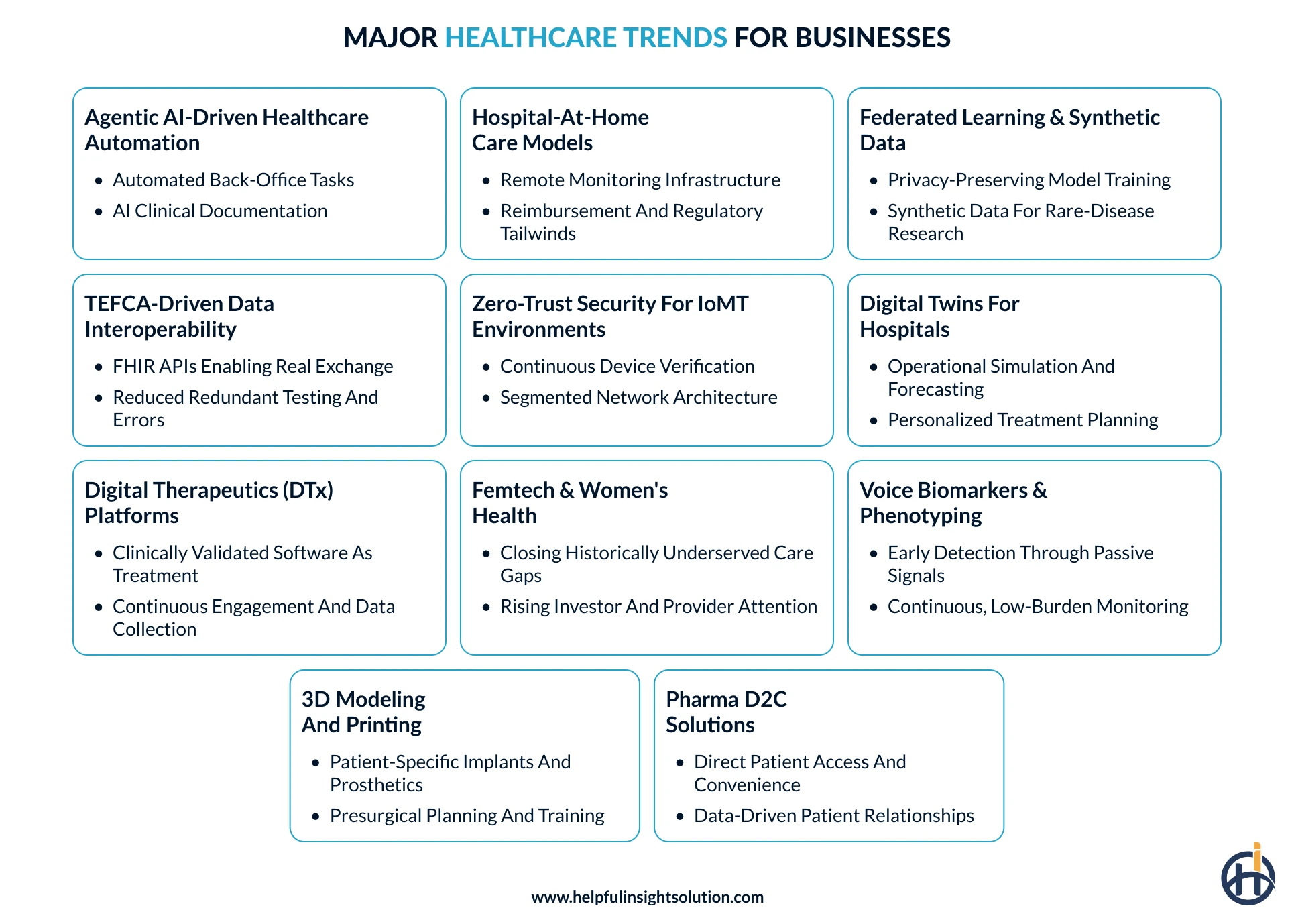
Agentic AI-driven healthcare automation
Automated back-office tasks
AI agents can assist with prior authorization, claims, and scheduling workflows, with human oversight where appropriate. This allows the admin staff to reduce administrative workload and increase time for patient care instead of repetitive paperwork.
AI clinical documentation
Ambient AI allows a system to listen during patient visits and generate more accurate clinical notes without manual typing. This reduces physician documentation hours and burnout, creating high-quality and consistent medical records for clinicians to view easily.
Hospital-at-Home care models
Remote monitoring infrastructure
From wearable devices to connected pacemakers, patients use these technologies to monitor vital signs, prescription compliance, and recovery at home. Remote monitoring may reduce avoidable readmissions for patients who require acute-level care and can support capacity management at the hospital.
Reimbursement and regulatory tailwinds
Multiple payers and regulators accept hospital-at-home programs as billable and reimbursable trends in healthcare management. This is changing the financial equation, making it economically feasible for a larger number of health systems to expand these programs beyond a demonstration or pilot level.
Federated learning & synthetic data
Privacy-preserving model training
AI algorithms are trained on data at numerous hospitals using federated learning, where the hospital’s system is not sharing its own records with others. This allows institutions to create more intelligent, transferable algorithms through AI development services while maintaining privacy standards like HIPAA.
Synthetic data for rare-disease research
Synthetic patient records replicate trends in authentic clinical data while anonymizing identities to overcome challenges like small data sets when investigating rare diseases. With this, it may supplement limited datasets for research and model development when fidelity and validation are appropriate.
TEFCA-driven data interoperability
FHIR APIs enabling real exchange
Standardized FHIR-based APIs are allowing disparate EHR systems to easily talk to each other in real time. This healthcare trend allows providers to access specific patient history at the point of care, regardless of the location of data delivery.
Reduced redundant testing and errors
When patient data flows freely between qualified health information networks, duplicate tests and conflicting treatment records drop significantly. Additionally, patients benefit from faster diagnoses, and providers save unnecessary costs on clinical procedures.
Zero-Trust security for IoMT environments
Continuous device verification
Zero-trust models do not assume that connected devices or users are inherently trustworthy, requiring ongoing authentication at every access point. This can significantly limit the average radius of a security breach if one device is compromised.
Segmented network architecture
By isolating IoMT devices like infusion pumps and monitors into separate network segments, a single compromised device cannot compromise hospital-wide systems. This architectural strategy is becoming essential as connected device counts multiply across facilities.
Digital twins for hospitals
Operational simulation and forecasting
Virtual models of hospital floor layout, equipment, and staffing patterns enable administrators to see patient flow and simulate issues before they occur. This cuts down wait times and increases the effective use of resources with no real-world trial and error.
Personalized treatment planning
Digital twins use a patient’s health data to create a virtual model of their body, allowing doctors to predict how patients may respond to a treatment or surgery before trying it in real life. This can reduce risks, support better treatment decisions, and improve patient outcomes.
Digital Therapeutics (DTx) platforms
Clinically validated software as treatment
Most DTx platforms offer FDA-approved treatments in the form of apps and software that address issues like diabetes, anxiety, and chronic pain. They provide patients with an accessible and less expensive supplement to or substitute for traditional medication-based approaches.
Continuous engagement and data collection
Unlike a one-time prescription, DTx platforms can easily track patient behavior and outcomes continuously between visits. These healthcare trends give providers real-time insight into treatment effectiveness and allow for faster adjustments to a patient’s care plan.
Femtech & women’s health
Closing historically underserved care gaps
Femtechs provide solutions for women’s health issues like menopause, endometriosis, and infertility that were previously unavailable to women. This can open up new revenue streams for healthcare providers and reach female patients with specific and underserved needs.
Rising investor and provider attention
Growing funding and clinical partnerships are leading to greater market acceptance as femtech evolves from modern startups to established healthcare providers. Various hospitals or clinics that are early adopters of these services can ensure patient growth through enhanced care and administration.
Voice biomarkers & phenotyping
Early detection through passive signals
The differences in speech patterns, tone, and cadence help to detect conditions such as Parkinson’s, depression, or respiratory disease before their symptoms occur. Health providers can screen a wide variety of health conditions by using existing resources they possess on a remote level.
Continuous, low-burden monitoring
The collection of voice and behavioral features of patients is easy through smartphones, without any special equipment, using cloud computing in healthcare. This can allow chronic illness care and preventive medicine to occur continuously with minimal extra burden to the patient.
3D modeling and printing
Patient-specific implants and prosthetics
Healthcare providers can easily generate custom implants, prosthetics, or surgical guides based on each patient’s physiology. This enhances surgical precision, patient comfort, and other medical procedures as compared to ready-made models.
Presurgical planning and training
The printed anatomical models of the patient’s organs enable surgeons to practice difficult surgeries before entering the operating room. These are current trends in healthcare that reduce time and risk, using the physical models as a learning device for less experienced practitioners.
Pharma D2C solutions
Direct patient access and convenience
Pharma companies are using this opportunity to establish D2C channels through which patients can order prescriptions and specialty drugs. This direct interaction expedites the lag between diagnosis and treatment as well as enhances medical compliance.
Data-driven patient relationships
The D2C models allow pharma companies to analyze patient behavior, medication adherence trends, and health outcomes. These healthcare industry trends allow them to use this information to provide differentiated follow-up with tailored medication assistance programs.
What are the benefits of adopting top healthcare trends?
Medical service providers should adopt various healthcare industry trends, as they ensure several benefits. These include recurring revenue growth, reduced operational expenses, and enhanced remote patient care.
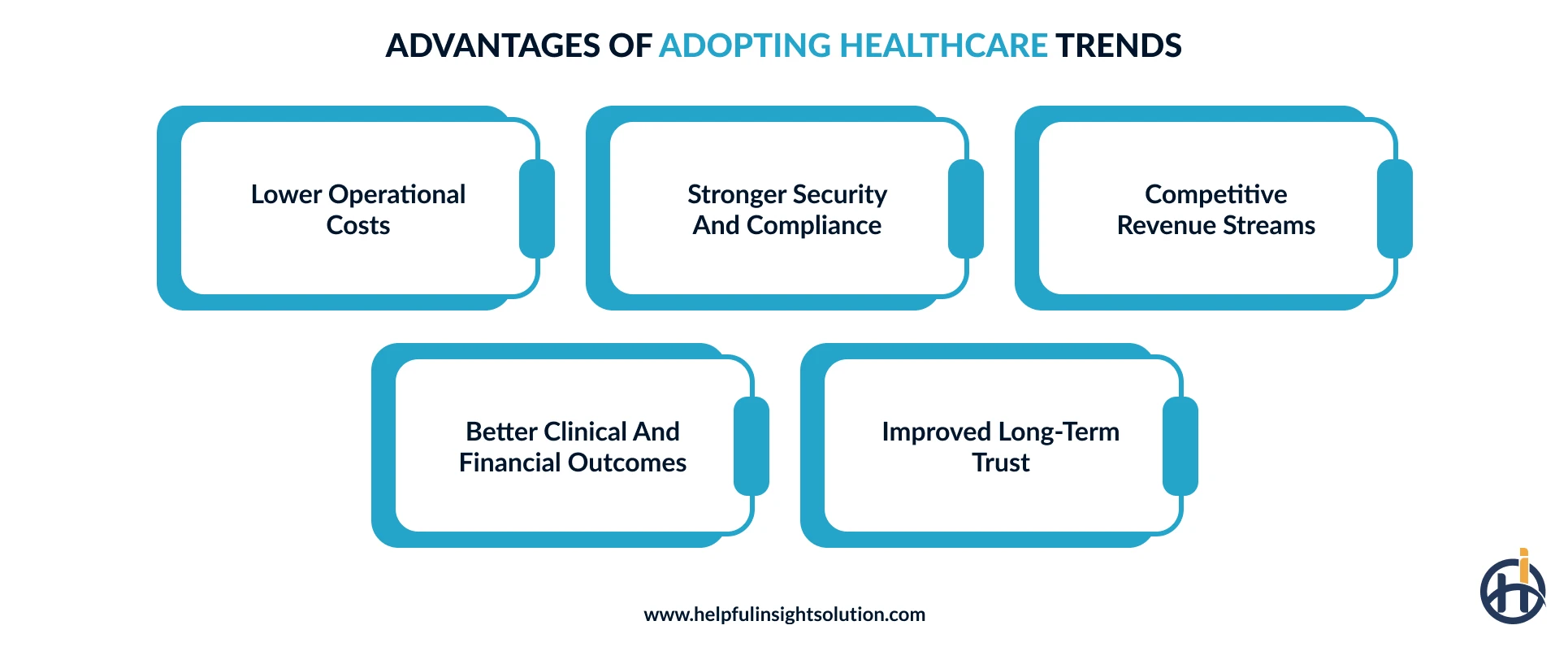
Lower operational costs
By leveraging agentic AI to automate administrative tasks such as scheduling, documentation, and pre-authorizations, it becomes easy to reduce staff hours and manual errors. These healthcare industry trends allow employees to redirect resources to patient care rather than focusing on back-office functions.
Stronger security and compliance
Businesses can invest in zero-trust architecture, medical device security, and TEFCA, or similar interoperability standards, to stay ahead of regulations. This is a better option for providers than dealing with the risk of costly breaches, fines, and compliance violations.
Competitive revenue streams
Healthcare companies embrace underserved trends such as femtech and digital therapeutics, often supported by BPM in healthcare, to ensure growth in emerging markets. They will establish themselves as innovative partners by opening up service lines and patient markets unavailable to competitors.
Better clinical and financial outcomes
With technologies such as hospital-at-home and voice biomarkers, healthcare providers can deliver care and provide intervention earlier at a lower cost without compromising quality. This helps to improve patient recovery rates and reduce the cost associated with hospital admissions.
Improved long-term trust
The use of explainable AI models and robust data security policies, along with the reliability of high-quality care, creates trust across patients, staff, and partners. These healthcare tech trends ensure a sustainable advantage and contribute to patient trust and engagement in a competitive healthcare market.
Partner with Helpful Insight to Build Your Healthcare Solution
As new healthcare trends are evolving, businesses are ready to invest in this industry and build modern solutions for patients, physicians, and medical staff. We are a leading healthcare app development company that assists our clients in building various platforms for telemedicine, workforce management, healthcare compliance, and more.
Businesses can hire dedicated teams that ensure complete market research, budget requirements, and increased ROI across clinical solutions. Our experts specialize in using advanced technologies, like AI, AR/VR, and cloud/edge computing.
Entrepreneurs must follow future trends in the healthcare industry to transform existing systems with task automation and data prediction. They will allow consistent patient retention, enhanced equipment functionality, and increased remote care without any human interference. So, it is the right time to gather all resources and start preparing a blueprint for revenue growth.
Frequently Asked Questions
Artificial intelligence has now become a foundational tool across hospitals, diagnostic centers, and global healthcare systems. It empowers medical imaging, clinical documentation, drug discovery, and telemedicine. AI uses predictive analytics to forecast patient diseases, inventory, and real-time appointments.
The HaH model provides enhanced hospital-level medical care at patients’ residences, increasing care for chronic diseases. It prevents hospital admissions for patients who require constant monitoring and diagnostic services. With better clinical outcomes, policy support, and cost efficiency, this model is growing rapidly.
Digital healthcare solutions are helping multiple patients, doctors, and medical staff, but there are also some adoption challenges. Some of the most common issues are described in the following manner:
Data interoperability: Fragmented systems can block smooth data sharing between healthcare departments.
Security risks: Data breaches and misuse of medical information affect patient outcomes, reducing trust.
Inadequate training: Healthcare staff face improper training that leads to failure in patient monitoring.
Medical institutions invest in talented experts, implement smart technologies, and redesign workflows. AI handles paperwork and scheduling tasks, reducing burnout for clinicians and increasing time for patient care. Hospitals use workforce management software to ensure the availability of staff during peak hours.
Health equity ensures that everyone gets fair treatment to stay healthy according to their needs and social requirements. The reasons behind its worldwide growth are discussed as follows:
- Increasing healthcare costs and financial sustainability across the globe.
- Advanced data collection is required to improve poor health outcomes.
- Growing healthcare issues that need constant care in remote areas.
These technologies enable ultra-fast data processing and transmission at the local level with massive IoT support. They ensure better access and higher bandwidth in remote areas, supporting virtual therapies and training. Edge computing with 5G ensures enhanced medical image analysis and diagnostic support.