

Key takeaways
- Generative AI in insurance uses AI models to create, summarize, and interpret information, helping insurers work through complex documents and knowledge more efficiently.
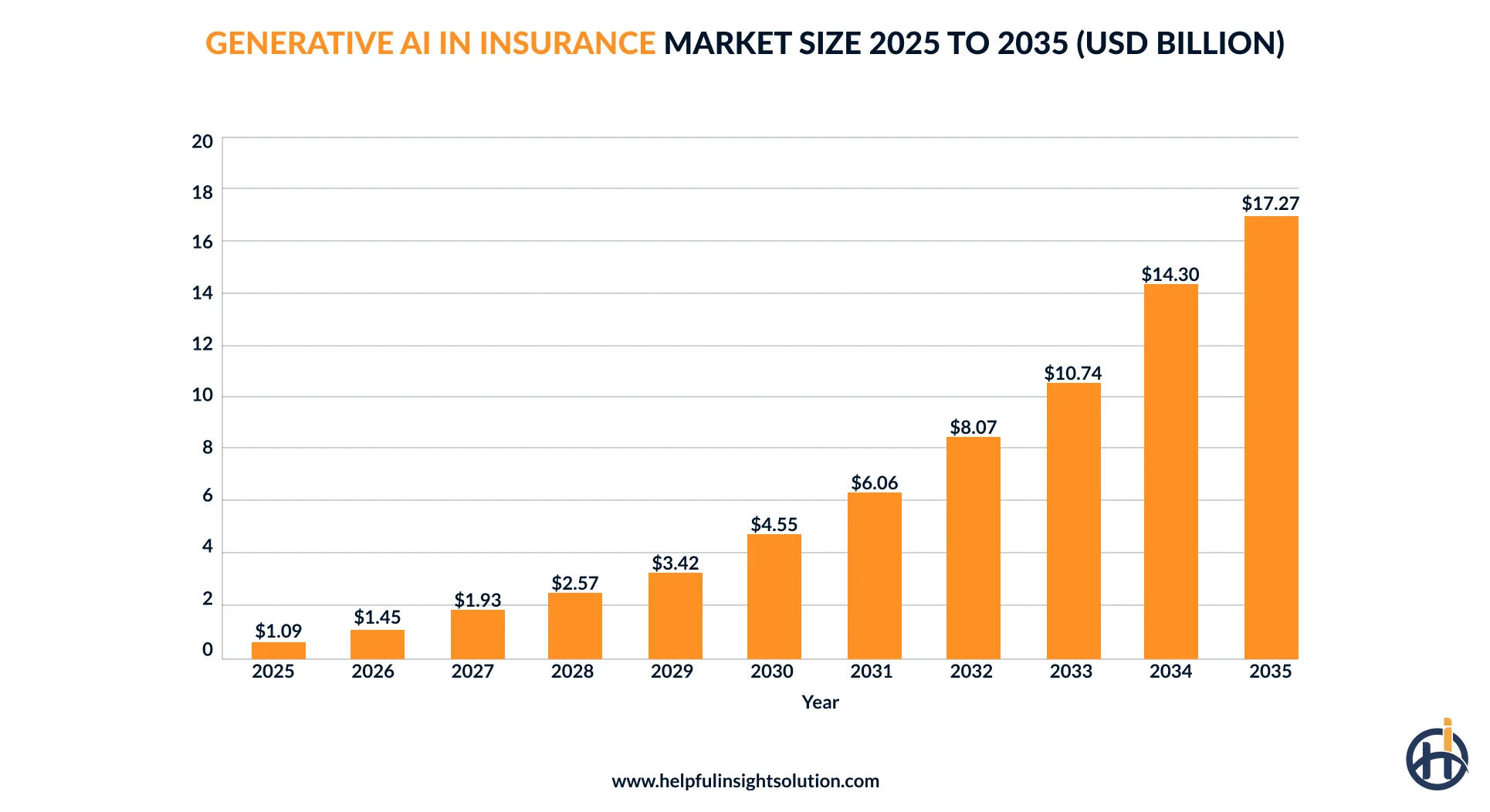
- Insurance companies are moving beyond small GenAI experiments, with growing adoption reflected in a global market expected to reach $17.27 billion by 2035.
- Underwriting assistance, policy drafting, claims documentation, fraud detection, and internal knowledge retrieval are among the highest-impact generative AI use cases in insurance.
- The benefits of GenAI in insurance span improved productivity, sharper risk assessment, more data-driven decision-making, and a stronger customer experience.
- Successful generative AI adoption in insurance depends on choosing suitable use cases, preparing reliable data, connecting AI with existing systems, and establishing clear governance from the start.
Insurance teams deal with a steady flow of policies, claims records, and other documents every day. Finding the right information and turning it into a decision can take considerable manual effort and time.
Generative AI in insurance is changing how insurers handle document-heavy work, interpret unstructured data, and support work across underwriting, claims, and customer support.
Unlike traditional AI in insurance, which is mainly used for prediction, scoring, and pattern detection, GenAI can create, summarize, and interpret content. That makes it relevant across life insurance, property and casualty, health insurance, and other lines where insurers work with large amounts of data. The market is growing, with Precedence Research projecting the global generative AI in insurance market to reach $17.27 billion by 2035.
The opportunity for insurers is not simply to add another AI tool to their technology stack. It is to identify where GenAI can take on repetitive work while giving employees better support for decisions that still require expertise. For businesses considering adoption, the practical questions are which areas to prioritize, what implementation requires, and how to introduce GenAI without compromising control or accountability.
In this blog, we explore GenAI use cases in insurance industry, business benefits, real-world examples, implementation considerations, and challenges to help insurers make informed adoption decisions.
How generative AI works in insurance?
Generative AI for insurance goes beyond a standalone chatbot. It connects large language models with an insurer’s own data, helping the system work through unstructured information and provide underwriters, claims adjusters, and other teams with useful summaries or responses.
A typical GenAI workflow in insurance involves several stages, moving information from its source through retrieval and generation to a relevant, validated output:
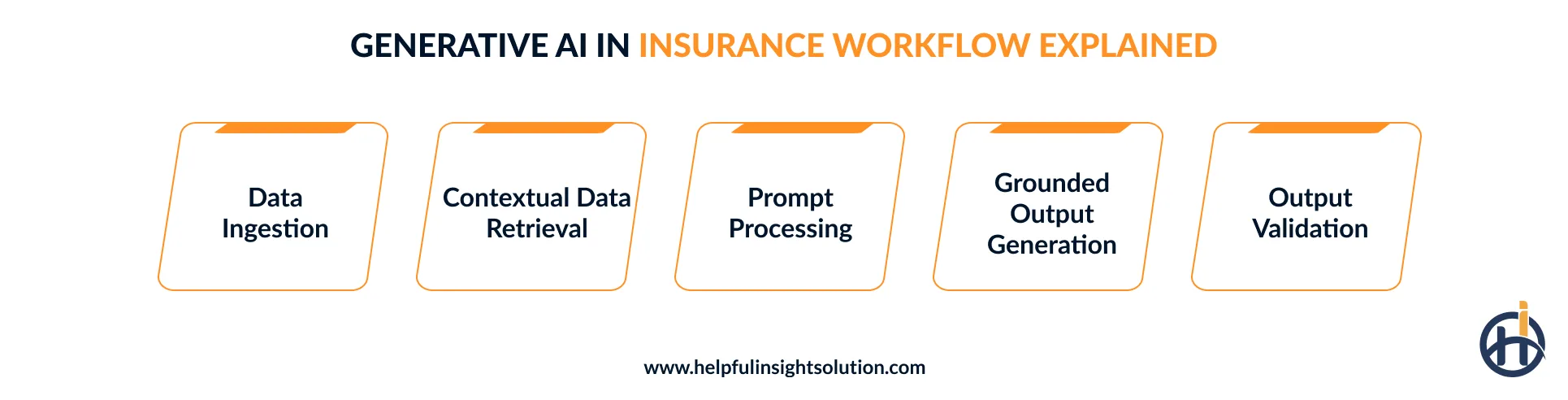
1. Data ingestion
Insurance data comes in many forms, including claims records, policies, medical reports, and emails. During ingestion, the system prepares this information for retrieval. Documents do not always need to be turned into structured records.
Their content can be extracted, broken into meaningful sections, and converted into embeddings that are indexed for retrieval, helping GenAI find the right information when needed.
2. Contextual data retrieval
Once the records are ingested, a retrieval layer searches the insurer’s knowledge sources for information related to the user’s request. It may use semantic, keyword, or vector search to find relevant passages from policies, claims records, underwriting guidelines, and other approved content. RAG then uses those retrieved passages as context for the model’s response.
This approach keeps the model focused on the information relevant to the request instead of sending an entire repository to the model. It can also help keep responses tied to approved insurance sources.
3. Prompt processing
The user’s request is combined with the relevant information retrieved in the previous step. The large language model (LLM) processes this combined input to understand the request, identify the task, and determine how the available context should shape its response. In AI for insurance, prompt design helps guide the model toward outputs that fit the specific workflow.
4. Grounded output generation
With the relevant context in place, the AI model generates a response suited to the insurance task. It may draft a claim summary or explain a policy clause using the retrieved records. Grounding gives the model relevant source material to draw from, which can reduce unsupported responses and keep the output closer to verified information.
5. Output validation
A generated response is not automatically ready to use. The final step can involve checking its content against the context provided, applying workflow rules, and sending sensitive or uncertain responses to an employee for review. For insurers, this human oversight helps keep GenAI outputs aligned with internal policies and the level of control required for the task.
High-impact generative AI use cases in insurance
Some of the strongest opportunities for GenAI are often found in insurance workflows that involve reading, summarizing, drafting, or working across multiple sources. Rather than applying GenAI everywhere, insurers can focus on processes where it can support employees and improve day-to-day operations.
Below are some of the popular generative AI use cases in the insurance industry.
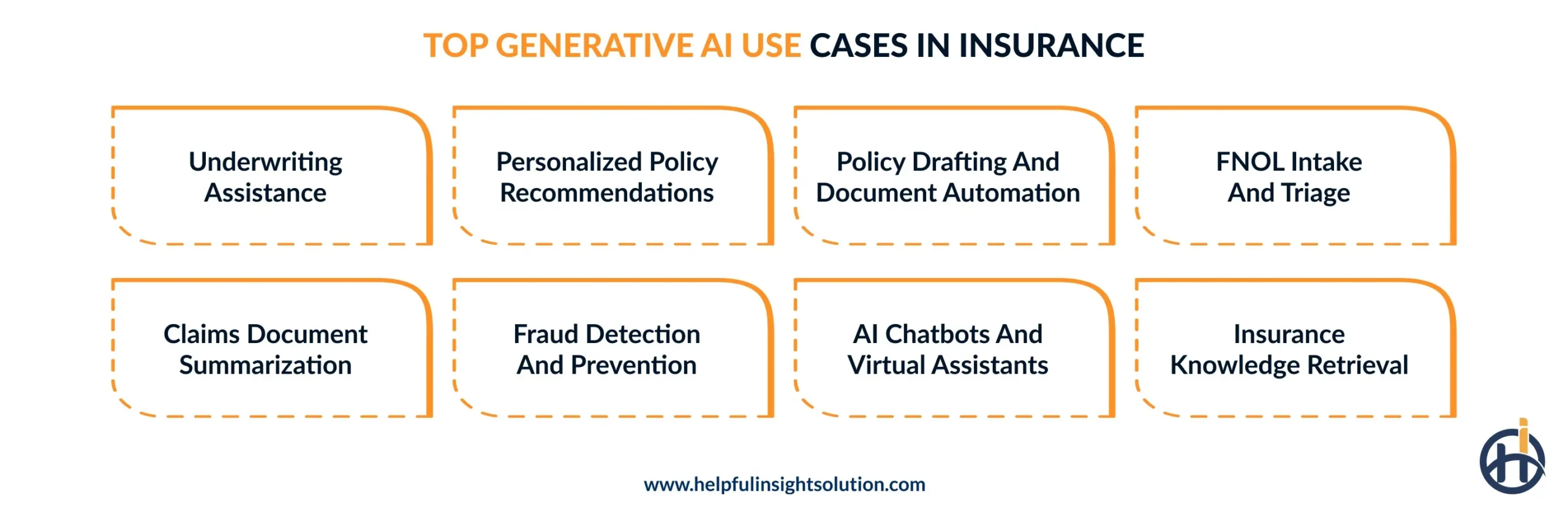
1. Underwriting assistance
Underwriters often need to bring together details from submissions, reports, financial records, and previous correspondence before assessing a risk. Generative AI in insurance underwriting can review these materials, organize key findings, and give underwriters a clearer starting point for their assessment without making the risk decision itself.
Integrated into insurance underwriting software, it can also highlight exceptions or missing details, helping underwriters spend less time on document review and more time on judgment-intensive risk assessment.
2. Personalized policy recommendations
Generative AI solutions in insurance can help insurers create more relevant coverage recommendations by bringing together customer details, existing policies, preferences, and interaction history. For example, when a customer’s circumstances change, GenAI can review their current coverage and draft a plain-language recommendation for additional protection or an updated policy.
Agents can use these recommendations during conversations instead of manually comparing multiple options. This creates a more personalized insurance customer experience while helping teams communicate why a particular coverage option may be relevant.
3. Policy drafting and document automation
A policy may use standard language, but the final document still needs to reflect the specific risk and coverage being offered. Generative AI for insurance policy creation can take the relevant policy details, prior submissions, and approved clauses and turn them into a working draft. This gives underwriting and operations teams something to review and refine instead of spending time assembling the document piece by piece.
It can also handle repetitive formatting and field population, giving underwriting and operations teams more time to review the information for accuracy and compliance before approval. The AI supports this process, but the underwriter remains responsible for the final risk assessment and decision.
4. AI chatbots and virtual assistants
A policyholder might ask a simple question about a deductible one day and have a much more specific coverage question the next. Scripted bots can struggle when the wording falls outside their predefined responses.
A GenAI-powered virtual assistant can understand the context, draw on relevant policy details, and respond in a way that fits the conversation. If the issue needs an agent’s attention, it can pass along a summary of the conversation as well.
This becomes particularly useful during periods when routine customer queries can put additional pressure on insurance service teams.
A U.S. based insurance company we worked with was facing heavy call center demand from repetitive policy and premium queries during renewal season. We implemented a generative AI assistant trained on their policy documents and FAQ base.
As a result call volume on routine queries dropped noticeably within the first quarter, and agents were freed up for actual claims handling.
5. FNOL intake and triage
One of the practical generative AI use cases in insurance is FNOL intake and triage. Instead of working through a long form, a policyholder can describe what happened through chat or voice.
GenAI tools can capture the key details, organize the claim information, and identify missing inputs, including relevant photos or documents. It can then prepare the claim for the appropriate team, reducing manual intake work and helping claims staff begin their review sooner.
6. Claims document summarization
A single claim can involve documents from several sources, often with details spread across dozens of pages. GenAI in claims processing can bring those records together and prepare a summary covering the reported loss, relevant findings, repair costs, and other case details.
Adjusters can use the draft to get up to speed without reading every document from the beginning. When this capability is integrated into insurance claims management software, it can reduce repetitive review work while keeping final assessment and settlement decisions with claims professionals.
7. Fraud detection and prevention
A claim that appears unusual can send an investigator back through several parts of the file. They may need to check the claim notes, previous records, emails, and supporting documents to work out what happened and whether anything needs further attention. Generative AI applications in insurance can help bring these details into one view and point out conflicting statements or missing details.
It can then summarize the findings and prepare a case brief for the investigator, making the initial review easier without taking the final investigation or claim decision away from the insurer.
8. Insurance knowledge retrieval
An agent may know what they need to find but not where the answer is buried. It could be in a product guide, underwriting rule, compliance manual, or internal procedure. Generative AI in insurance can retrieve the relevant material from these sources and explain it in the context of the question being asked.
With source references included, insurance agents can check the underlying guidance before acting, making internal knowledge easier to access across underwriting, sales, and policy servicing.
Business benefits of generative AI for insurers
For insurers, the value of GenAI extends beyond automating tasks. When applied to the right workflows, generative AI for insurance can help insurance companies work more efficiently, improve how customers are supported, and make better use of existing knowledge.
The following benefits show where that value can translate into business outcomes.
1. Accelerated employee productivity
Generative AI in the insurance industry can give insurance teams more time for work that requires experience, judgment, and collaboration. By taking care of smaller tasks like drafting emails, summarizing lengthy policy documents, and generating reports, it helps employees move between cases with less administrative overhead.
This can increase employee capacity without requiring teams to grow at the same pace, helping insurers manage higher workloads while keeping attention on higher-value activities.
2. Streamlined decision workflows
Many insurance decisions involve several small steps before an insurer can move a case forward. GenAI in insurance can reduce those delays by helping teams access the right context, prepare the next action, and keep routine workflow steps moving.
For example, an AI agent can manage follow-ups or route cases between teams, reducing the coordination work employees have to handle before they can focus on decisions that require their judgment.
3. Enhanced risk assessment
Risk assessment often depends on how quickly an underwriter can make sense of different sources and connect the relevant details. GenAI can support this work by organizing unstructured material, highlighting factors that deserve attention, and explaining the context behind its findings.
This can strengthen underwriting risk assessment and give professionals a fuller basis for judgment. Industry research shows that more than 50% of insurers see predictive risk assessment as an important area for future investment.
4. Improved customer experience
Small improvements in everyday interactions can make a noticeable difference to how customers view their insurance company. Generative AI in life insurance can help explain policies more clearly, personalize communications, and provide answers without making customers move between different service channels.
Questions about payments, coverage, or policy details come up every day. An AI chatbot can handle these simpler requests and give customers an answer without waiting for a representative. This also leaves service teams with more time to deal with complicated cases that require closer attention.
How insurance companies are using GenAI: Real-world examples
Insurance companies are no longer looking at GenAI only as a future possibility. Several insurers have started putting it into practice. Here’s a look at a few insurers putting this to work, what they built it for, and what actually changed once it went live.
1. Aviva
Aviva is a major UK insurer with operations spanning general insurance, life insurance, and other financial services. One example of its GenAI adoption is an AI-driven summarisation tool built for individual life insurance underwriting. It reviews lengthy GP medical reports and pulls the relevant details into a shorter summary for the underwriter.
The tool had already handled 1,000 cases during its active test after 18 months of testing and controls, showing how GenAI can reduce the time spent reviewing lengthy medical records without removing human judgment from underwriting decisions.
2. Zurich Insurance Group
Zurich Insurance Group is a global insurer serving customers across more than 200 countries and territories. One notable example of its generative AI applications in insurance is its work on complex multinational programs.
They use GenAI to compare, summarize, and verify coverage across multiple policies and jurisdictions, helping internal experts review large programs more efficiently.
Zurich has more than 8,500 multinational programs and 56,000 policies, making this a strong example of GenAI being applied to a genuinely complex insurance workflow.
3. Allstate
Allstate handles a large volume of customer and claims interactions, where adjusters and service teams spend time answering routine questions and preparing claim-related communications.
To reduce this workload, the insurer implemented generative artificial intelligence to draft daily claims emails and support customers through a virtual assistant. Its consumer-facing assistant now resolves roughly 38% to 40% of chats without human intervention.
How to implement generative AI in insurance operations
Implementing generative AI in insurance works better as a phased process than as a company-wide rollout. Insurers can begin with a defined operational need, examine the data and workflow involved, and test the solution with the people who will use it. Generative AI and insurance initiatives can then be refined and expanded once the approach proves practical.
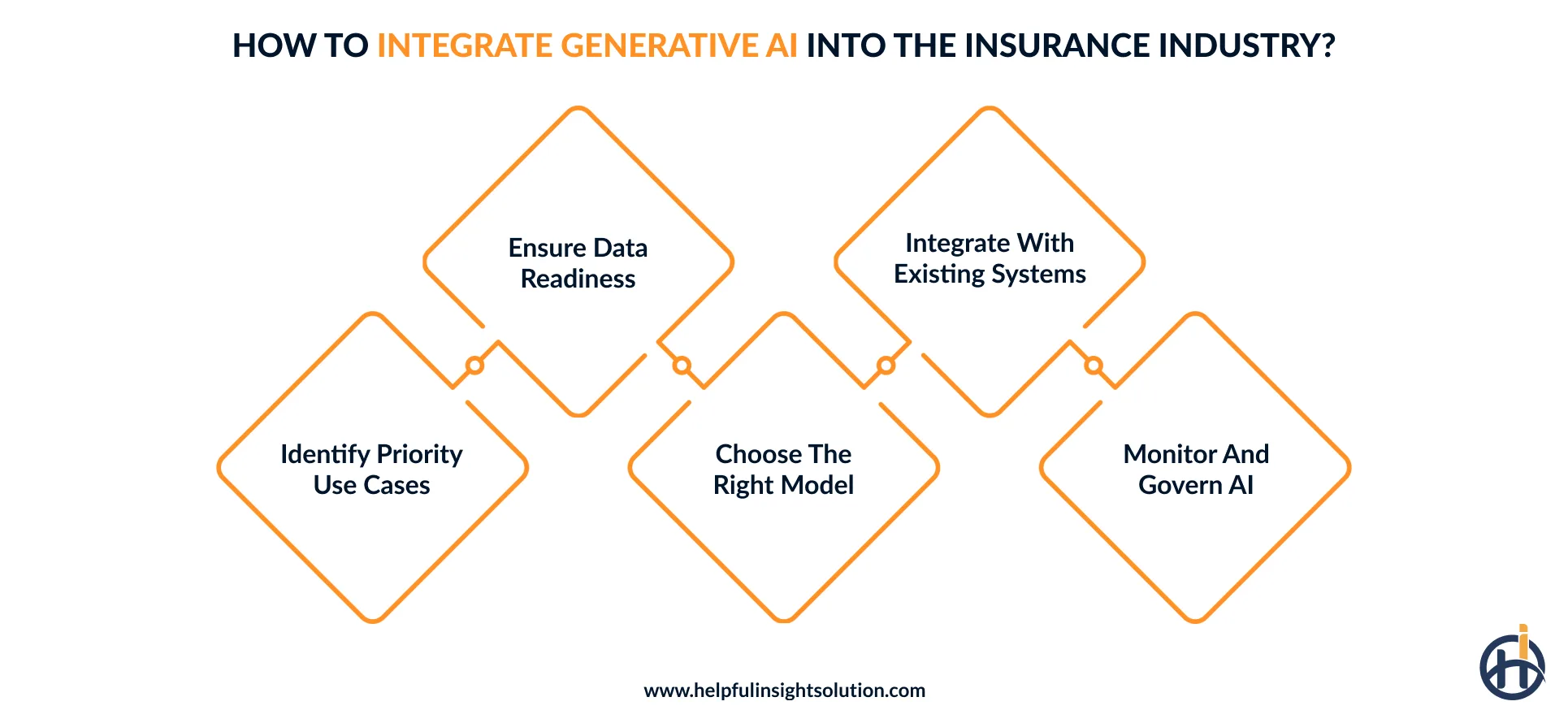
1. Identify priority use cases
Before investing in generative AI solutions in insurance, insurers should decide which business problem is worth solving first. Look for workflows where manual effort is high, delays are visible, and improvement can be measured through outcomes such as faster claims handling or shorter underwriting cycles.
This is where our insurance software development company takes a practical approach. We start by looking at the existing workflow, the teams involved, and where manual effort is creating delays. We then assess whether GenAI is a practical fit and define the scope around a measurable outcome. This gives insurers a clearer starting point and a way to evaluate the investment once the solution is in use.
2. Ensure data readiness
Before putting GenAI in insurance into production, insurance agencies need to know whether the underlying data can actually support the intended workflow. Policy, claims, customer, and operational records may use different formats or contain gaps and outdated entries.
Bringing these sources into a consistent structure makes the data easier to work with and gives the AI a more dependable foundation. Data lineage and access controls should also be established early, particularly when sensitive policyholder data is involved.
3. Choose the right model
There is no single GenAI model that fits every insurance use case. A model used for customer conversations may have different requirements from one handling underwriting support or internal knowledge retrieval. Model evaluation should therefore include accuracy, security, and scalability.
At Helpful Insight, our team looks beyond benchmark scores when evaluating a model for an insurance project. We consider the type of data involved, how the model will interact with existing workflows and the level of control the insurer needs.
Testing the model with real workflow scenarios before development moves ahead can reveal limitations that are easy to miss during a standard technical evaluation.
4. Integrate with existing systems
Most insurers already have core platforms handling policies, claims, payments, and customer records, so a GenAI solution needs to fit around that existing environment. Generative AI in insurance can be connected through APIs, middleware, or other controlled integration layers, depending on the architecture.
Teams should also define what data the model can access and where generated outputs can be written back. Fallback processes are important too, so a temporary AI issue does not stop the underlying workflow.
5. Monitor and govern AI
This is one of the most important parts of implementing generative AI in insurance operations, and it is often overlooked once the system is up and running. Insurance data, claims patterns, and business rules keep changing, so the system needs regular checks.
Therefore, insurers should review unusual responses, track changes in performance, and involve people when an AI output could affect a claim or coverage decision. Human oversight helps catch problems early, before they have a chance to affect customers.

Risks and challenges of generative AI in insurance
GenAI can improve many insurance processes, but it is not without its limitations. Looking at the possible risks early can help insurers avoid bigger issues when they move from testing to wider use.
1. AI hallucinations and accuracy risk
The core problem with generative AI accuracy in insurance is that models generate plausible-sounding text even when the underlying response is incorrect.
A claims summary could misstate a policy exclusion or a customer-facing bot could quote the wrong deductible. Since insurance decisions carry legal and financial weight, even a small error rate adds up in liability exposure.
The Solution
AI developers can use RAG to ground responses in approved source documents. For important decisions, a qualified professional should review the output before it is used.
2. Data privacy and security
Medical records, payment details, and personal identifiers make insurance a sensitive environment for AI adoption. When using generative AI in health insurance, insurers must know where customer data goes, who can access it, and how it is protected throughout the process.
The Solution
Insurers need basic security controls in place, including encryption, limited access, and regular audits. The same approach should apply across the insurance portal, mobile apps, and other connected systems.
3. Regulatory and compliance complexity
Compliance becomes harder when an insurer operates across several regions, each governed by its own IT compliance regulations spanning privacy, consumer protection, and AI requirements, including GDPR where it applies.
The Solution
Compliance should be part of the AI workflow from the beginning. Legal experts can help define what the system can and cannot do, while technical teams can track its outputs and changes. Human review should remain in place for decisions where an explanation or regulatory check is needed.
4. Legacy system integration
Another major challenge insurers face is integrating GenAI tools with their legacy systems. Many of these systems were built years ago and were never designed to work with modern technologies. Replacing everything at once is also expensive and can disrupt the systems employees rely on every day.
The Solution
Insurers can introduce middleware between the gen AI solution and existing systems to manage data exchange. API-based integration also gives more control over data movement. New connections can be tested separately before they are introduced into the live environment.
Conclusion
Generative AI in insurance is transforming how insurers approach work that has traditionally depended on large volumes of documents and manual review.
From claims management to internal operations, its role is likely to expand as insurers become more comfortable with the technology. AI in insurance underwriting and other workflow-specific applications are already showing where GenAI can deliver practical value.
The next phase will be less about experimenting with GenAI and more about building it into everyday insurance processes where it can deliver lasting business value. For insurers ready to take that step, having a technology partner with relevant experience can make the difference between a promising idea and a solution that works in practice.
We are a trusted generative AI development company with 10+ years of experience building AI solutions for complex business environments. We can help you evaluate use cases, prepare data, connect GenAI with existing insurance systems, and build the controls needed for secure deployment.
Whether you are validating a first use case or planning a broader rollout, our AI services are designed around your business processes and long-term goals.
If you’re considering GenAI for your insurance business, send us the project details. We can look at the idea and suggest where to start.
FAQs
Generative AI in insurance refers to AI systems that can create, summarize, and transform content based on the data they process. Insurers can use it to work through policy documents, claim files, customer queries, and other complex material.
Insurance companies are using generative AI in several day-to-day areas. An insurer might use it to summarize claim files, support underwriting work, draft customer messages, or answer common policy questions.
Inaccurate responses, data privacy issues, bias, and cybersecurity threats are some of the risks of using GenAI in insurance. Regulatory and compliance concerns can also arise when AI supports decisions that affect customers.
Generative AI is unlikely to fully replace agents or underwriters. It can handle things like document review and information gathering, while agents deal with cases that need experience or a judgment call.