

Key Takeaways:
- The development cost of healthcare chatbots is dependent on AI integration, regulatory compliance, cloud infrastructure, and other key factors.
- The average price ranges from $20,000 to $200,000 based on the platform requirements, from basic models to enterprise-grade solutions.
- Businesses can launch an MVP, use pre-trained AI models, implement standard APIs, and monitor performance to optimize the cost.
- AMIE-like chatbots improve patient accessibility, automate administrative tasks, and enhance symptom checking for healthcare providers.
Enterprises have started using automated assistants in their systems, across all domains, to make tasks easier and faster. Unlike other industries, healthcare requires AI chatbots that can constantly analyze patients, medical workflow, and other administrative tasks.
In research and experimentation, healthcare chatbots like Google’s AMIE are being used for drug discovery, clinical reasoning, and diagnostic dialogues. Healthcare providers are interested in knowing the market rates of similar AI-powered tools that enhance patient experience, reduce expenses, and streamline clinical tasks.
Based on a report published by Fortune Business Insights, the healthcare chatbots market value is $2.4 billion in 2026. It is going to reach $12.6 billion by the end of 2034, with a 23% CAGR rate over this period. Among different regions, North America has a share of 45.6% in the market due to rapid AI integration and technically supportive government initiatives.
To get a smart chatbot for your healthcare business, you need to know the development cost, its key factors, and tips to reduce the impact. This blog provides you with the best insights like benefits, features, the chatbot-making process, and ROI. So, let’s begin our journey.
What is Google’s AMIE?
AMIE, which stands for Articulate Medical Intelligence Explorer and is developed by Google, is an experimental AI system. This platform can simulate doctor-patient consultations, diagnose illness, and manage long-term health conditions.
AI-driven chatbots like AMIE integrate medical reasoning with conversational models and are built on large language models. It is an ongoing research project that is not currently available for real-world clinical operations and commercial use.
Key roles in healthcare
Businesses must know the roles of medical bots similar to AMIE for increased patient engagement and reduced overhead expenses. These AI chatbots in healthcare have multiple responsibilities that we will see in this section.
- Disease management: It can interpret various clinical guidelines and assist in drug discovery to resolve diseases.
- Multimodal capabilities: The platform can smartly request and response about visual data, such as organ images or medical charts.
- High performance: In research, AMIE ensures diagnostic accuracy, treatment precision, and conversational readiness.
- Self-play training: This tool is trained in an isolated environment where it simulates medical tasks for real-world practice.
How does it work?
You will study the working of AI-driven chatbots like AMIE in this section and understand how physicians interact with it. This will help you to gather information about various features that this tool provides.
- It analyzes various medical data and performs simulations in real-time to extract information.
- AMIE uses a dialogue agent to interact with patients and classify clinical queries.
- The tool can request missing information to update AI models based on the patient’s state.
- The agents perform cross-referencing to list conditions and conduct medical diagnoses.
- AMIE tracks patient symptoms based on consultations and updates treatment plans.
Average breakdown of the healthcare chatbot development cost
The healthcare industry is getting more advanced with AI-driven chatbots that help doctors to improve patient care with instant query redressal. They need to know the AMIE-like healthcare chatbot development cost, so the whole process becomes easy and fast.
By default, the total price is highly affected by the platform level, which includes basic solutions, enterprise-grade platforms, and advanced chatbots. The integration of AI development services can increase the overall cost due to large language models and algorithms.
The cost of making healthcare chatbots ranges from $20,000 to $90,000 for simple and mid-sized assistants. This can increase to $200,000 or more due to multi-modal agents and edge computing technologies. Businesses use a general formula to calculate the estimated price, which is as follows:
Total Cost = (𝚺Stage Hours * Team Rate) + AI Infrastructure + Compliance & Security + Annual Maintenance
Here is a table describing the overall cost and timeline according to different platform types with their detailed description. This gives you an idea of how the development rates are affected by market parameters.
| Development Level | Estimated Cost (USD) | Estimated Timeline | Description |
| Basic | $20,000–$45,000 | 2–3 Months | Includes an AI-powered FAQ chatbot with appointment booking, basic symptom collection, and secure patient communication. |
| Mid-sized | $45,000–$90,000 | 3–5 Months | Adds conversational AI, multilingual support, EHR/EMR integration, patient triage, and healthcare compliance features. |
| Enterprise-grade | $90,000–$150,000 | 5–8 Months | Features intelligent symptom assessment, clinical decision support, personalized recommendations, voice capabilities, and advanced analytics. |
| Advanced-featured | $150,000–$200,000+ | 8–12+ Months | Smart chatbot similar to Google’s AMIE with advanced reasoning, scalable architecture, multi-agent AI, extensive healthcare integrations, and continuous AI optimization. |
Factors affecting the cost to develop healthcare chatbots like Google’s AMIE
Compliance, cloud infrastructure, and API integration fees are the key factors that influence the cost of creating healthcare chatbots like Google’s AMIE. In this section, we are going to discuss major cost-affecting factors with their respective cost tables with detailed information.
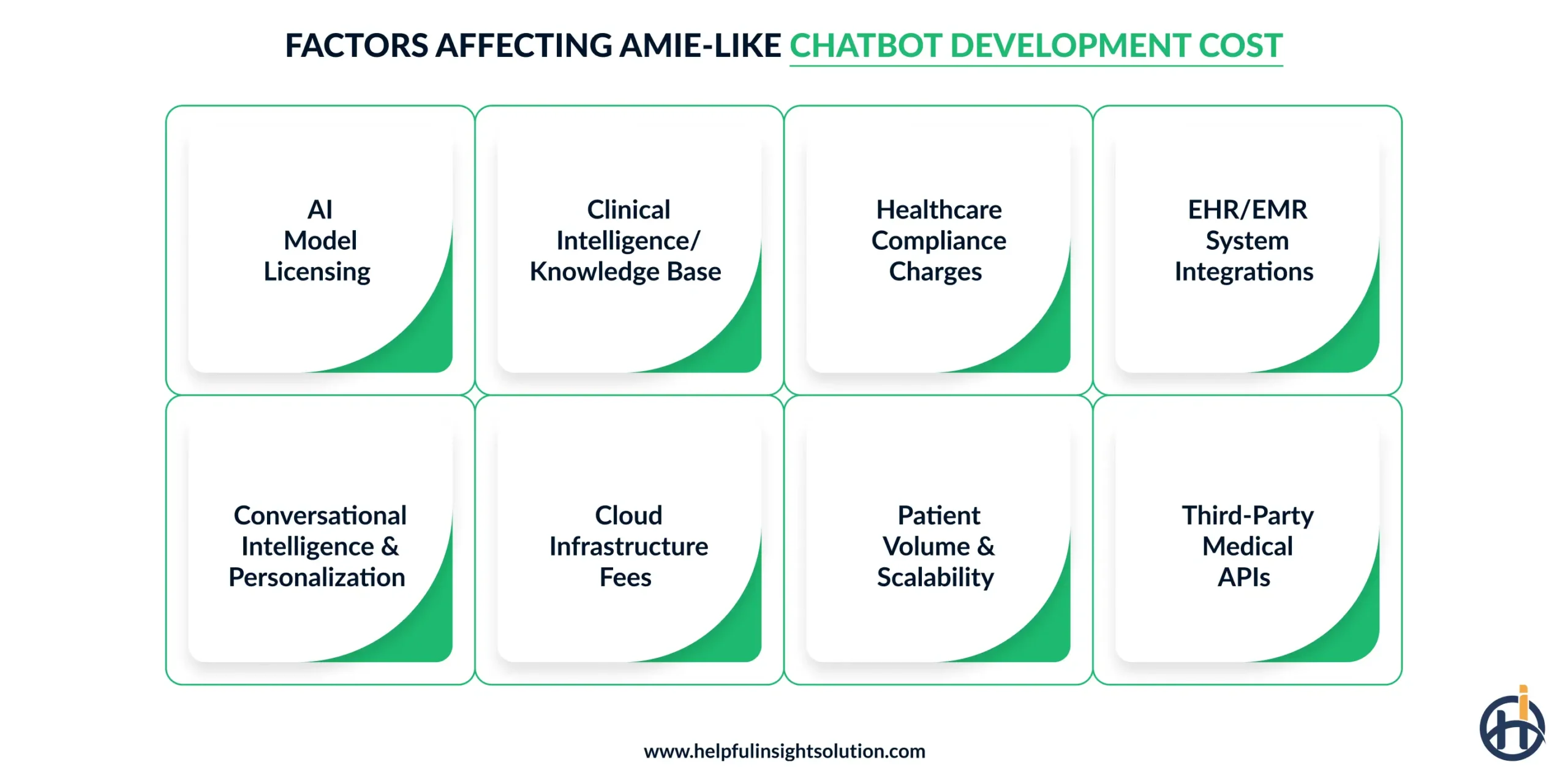
1. AI model licensing
The choice between source, commercial, or proprietary AI models has a big impact on how much you spend on development and running the system. You have to pay for licenses, subscriptions, and usage, allowing models to think like a doctor, but they cost more.
| Component | Estimated Cost (USD) | Description |
| Commercial LLM/API Licensing | $5,000–$30,000/year | Subscription or usage-based fees for enterprise AI models used for medical conversations. |
| AI Inference & Token Usage | $2,000–$20,000/year | Ongoing charges based on the number and length of chatbot interactions. |
| Enterprise AI Support & SLA | $3,000–$15,000/year | Premium support, dedicated infrastructure, and guaranteed uptime from AI vendors. |
2. Clinical intelligence/Knowledge base
If you want healthcare chatbots like AMIE to give advice, you need to add trusted medical information, lists of medicines, and clinical research to its knowledge. This makes the chatbot more accurate and reliable but costs more to set up and keep updating this information.
| Component | Estimated Cost (USD) | Description |
| Medical Knowledge Base Integration | $8,000–$30,000 | Integrating trusted clinical guidelines, drug databases, and disease libraries. |
| Medical Content Validation | $5,000–$20,000 | Clinical review by healthcare experts to ensure safe and accurate responses. |
| Knowledge Base Updates | $2,000–$10,000/year | Regular updates to align with new medical research and treatment protocols. |
3. Healthcare compliance charges
To follow healthcare rules like HIPAA, GDPR, and other local rules, you need to keep data safe, use encryption, keep track of what happens, and make sure you are doing everything correctly. This adds to how much it costs to develop the system for doctors and physicians.
| Component | Estimated Cost (USD) | Description |
| HIPAA/GDPR Compliance Implementation | $8,000–$30,000 | Developing privacy controls, consent management, and secure data handling. |
| Data Encryption & Access Control | $5,000–$20,000 | Implementing encryption, role-based permissions, and secure authentication. |
| Security Audits & Penetration Testing | $5,000–$25,000 | Performing vulnerability assessments and cybersecurity testing. |
| Compliance Documentation & Certifications | $3,000–$15,000 | Preparing compliance reports, audit trails, and regulatory documentation. |
4. EHR/EMR system integrations
If you connect the chatbot to systems that hospitals use, like EHR/EMR platforms, laboratories, and scheduling software, it can share information easily. This makes workflows better for the systems, allowing better connectivity and increasing the cost to develop a chatbot like Google’s AMIE.
| Component | Estimated Cost (USD) | Description |
| FHIR/HL7 API Integration | $8,000–$25,000 | Connecting the chatbot with standardized healthcare interoperability APIs. |
| Hospital Information System Integration | $10,000–$35,000 | Integrating with hospital workflows and patient management systems. |
| Appointment & Scheduling Integration | $3,000–$12,000 | Syncing calendars, bookings, and appointment reminders. |
| Laboratory & Pharmacy Connectivity | $5,000–$20,000 | Connecting lab reports, prescriptions, and pharmacy systems. |
5. Conversational intelligence & personalization
Businesses integrate chatbot development services with NLP that understands the context of what patients say, making interactions more interesting and accurate. To make this happen, you need to train various multimodal AI systems and put in extra work to develop them.
| Component | Estimated Cost (USD) | Description |
| Advanced NLP & Context Management | $8,000–$30,000 | Enables contextual, human-like conversations with better intent recognition. |
| Personalized Health Recommendations | $5,000–$20,000 | Delivers patient-specific advice based on symptoms, history, and preferences. |
| Multilingual AI Support | $3,000–$15,000 | Supports multiple languages to improve patient accessibility and engagement. |
6. Cloud infrastructure fees
You also need to consider the cost of hosting the system on the cloud using computers to process the AI, keeping patient information safe, and storing data. These AMIE-like healthcare chatbot development services charge money on a monthly or annual basis, and they increase rapidly as more patients use the system.
| Component | Estimated Cost (USD) | Description |
| Cloud Hosting & Compute | $500–$5,000/month | Covers virtual servers, GPU instances, and application hosting. |
| Secure Data Storage & Backup | $300–$2,000/month | Stores patient records, conversation logs, and backup data securely. |
| Monitoring & Disaster Recovery | $500–$3,000/month | Ensures high availability, system monitoring, and rapid recovery from failures. |
7. Patient volume & scalability
If you want a lot of patients to use the system at any time, you need to make sure the cloud resources can handle it, balance the load, and always be available. The more patients you have, the more resources you need, which means it costs more to set up and run the system.
| Component | Estimated Cost (USD) | Description |
| Auto-Scaling Infrastructure | $3,000–$15,000 | Automatically allocates resources during peak patient demand. |
| Load Balancing & Traffic Management | $2,000–$10,000 | Distributes user requests efficiently to maintain chatbot performance. |
| High-Availability Architecture | $5,000–$20,000 | Minimizes downtime with redundant servers and failover mechanisms. |
8. Third-party medical APIs
You can also connect the AMIE-like AI chatbots to drug information, telemedicine, medical coding, lab systems, and payment systems to make it more useful. This also means you have to pay to use these services, and this cost adds up over time as you continue to develop and maintain the system.
| Component | Estimated Cost (USD) | Description |
| Drug Information & Interaction APIs | $2,000–$10,000/year | Provides real-time medication information, dosage, and interaction checks. |
| Medical Coding & Terminology APIs | $1,500–$8,000/year | Integrates ICD-10, SNOMED CT, CPT, and other standardized medical coding systems. |
| Telemedicine & Healthcare Service APIs | $3,000–$15,000/year | Enables video consultations, e-prescriptions, payment processing, and other healthcare services. |
Best methods to optimize chatbot-making expenses
Businesses can create AMIE-like AI chatbots by adopting various cost-reducing methods, like MVP development. You should follow these strategies to reduce the impact of additional market expenses.
1. Build a minimum viable product
When you are making a chatbot for healthcare, start with the things that people need, like checking symptoms, scheduling appointments, and answering patient questions. If you start with an affordable version, then it is crucial to see if people want to use it and then add more features based on what people think.
2. Use pre-trained medical AI models
Use large language models, healthcare artificial intelligence, and natural language processing that already exist instead of making your own from scratch. This will save you a lot of time and money on virtual assistants that offer good conversations and constant customer support.
3. Adopt cloud-based infrastructure
You should put the chatbot on a big cloud platform to provide a centralized healthcare ecosystem that only charges you for necessary clinical services. This way you can reduce the cost to develop a chatbot like Google’s AMIE, allowing you to add more resources if you need them.
4. Prioritize API-based integrations
It is crucial to use codes, like FHIR and HL7, to connect the chatbot to other systems like electronic health records, telemedicine, laboratories, and payment systems. This makes it easier to transfer information anywhere and reduces the amount of work you have to do to keep it running.
5. Implement continuous AI monitoring
Businesses must keep an eye on how the chatbot’s working, how accurate it is, and how people are using it with real-time features. If you find any problems, you can fix them before they cause issues, which saves you money and time in the long run.
6. Ensure ongoing maintenance
You must make sure to optimize the chatbot so it keeps working well and stays safe by updating the AI models, medical information, security, and connections to other systems. If you do this, you can prevent the chatbot from increasing problems and make sure it ensures high scalability.
Key benefits of chatbots like AMIE for healthcare
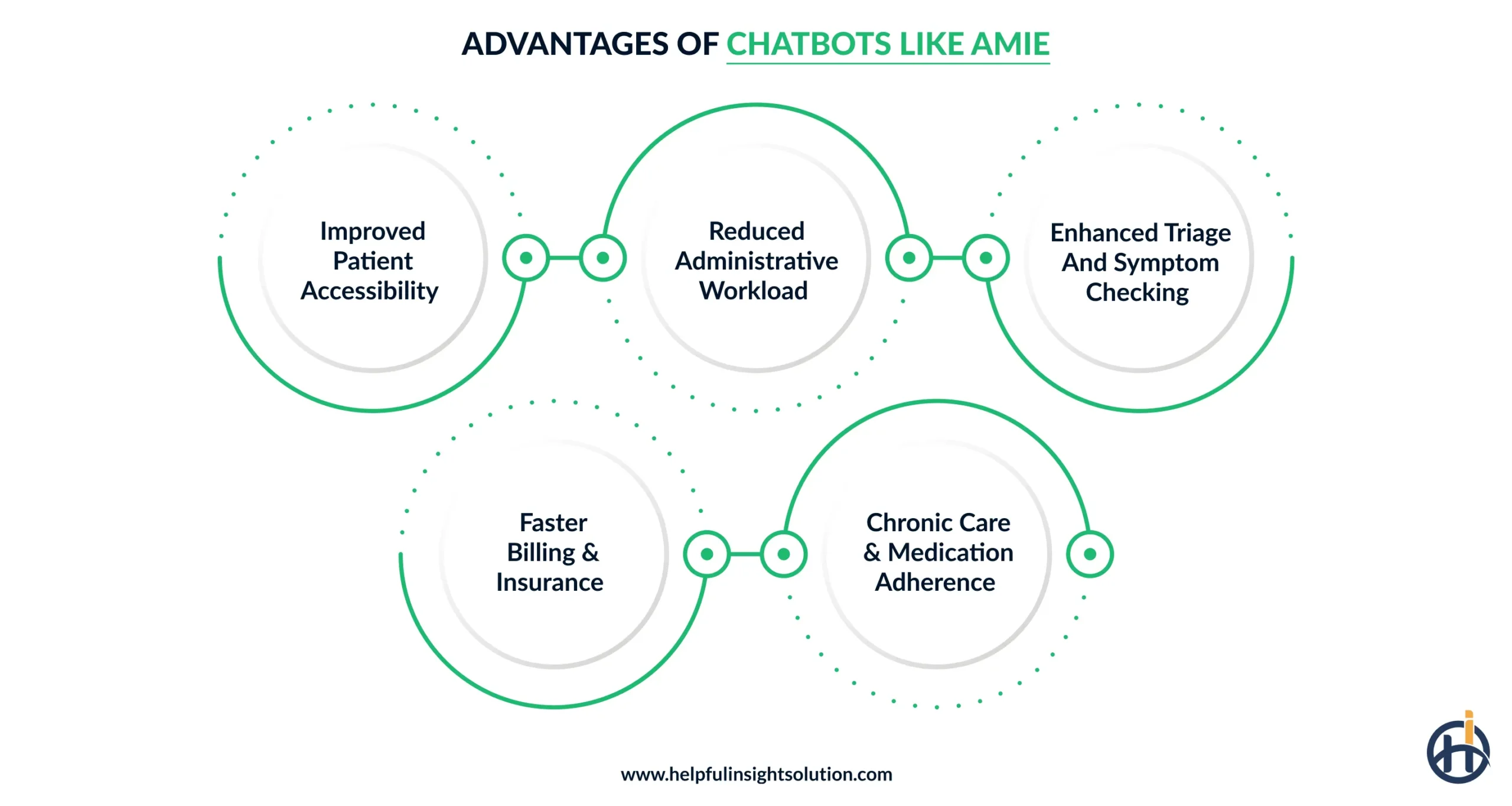
An AMIE-like AI chatbot for healthcare provides multiple benefits, such as patient accessibility and care coordination. In this section, we will study these advantages so medical service providers can invest in development.
1. Improved patient accessibility
Healthcare chatbots are available all the time to give medical guidance, ensure appointments, and enhance health information, reducing wait times. They help patients who live in remote areas and people who are in immediate non-emergency conditions.
2. Reduced administrative workload
Medical bots can do repetitive tasks like patient registration, appointment scheduling, answering FAQs, and sending reminders to patients. This gives healthcare staff time to take care of patients and do other important clinical operations in real-time.
3. Enhanced triage and symptom checking
Virtual assistants use predictive analytics in healthcare to figure out how sick a patient is and get important information before the patient sees a doctor. This helps medical professionals see the patients who need help first, making healthcare processes work better.
4. Faster billing & insurance
Advanced clinical bots can also handle insurance and billing processes, allowing medical staff to automatically check claim status updates and billing inquiries. This saves time, reduces errors, and also helps patients get their money faster.
5. Chronic care & medication adherence
The healthcare chatbot can send reminders to patients to take their medicine and follow up with them to see how they are doing. It can also give patients tips on how to manage their health and disease, reducing the number of times patients have to go to the hospital.
Must-have features of Google’s AMIE chatbot
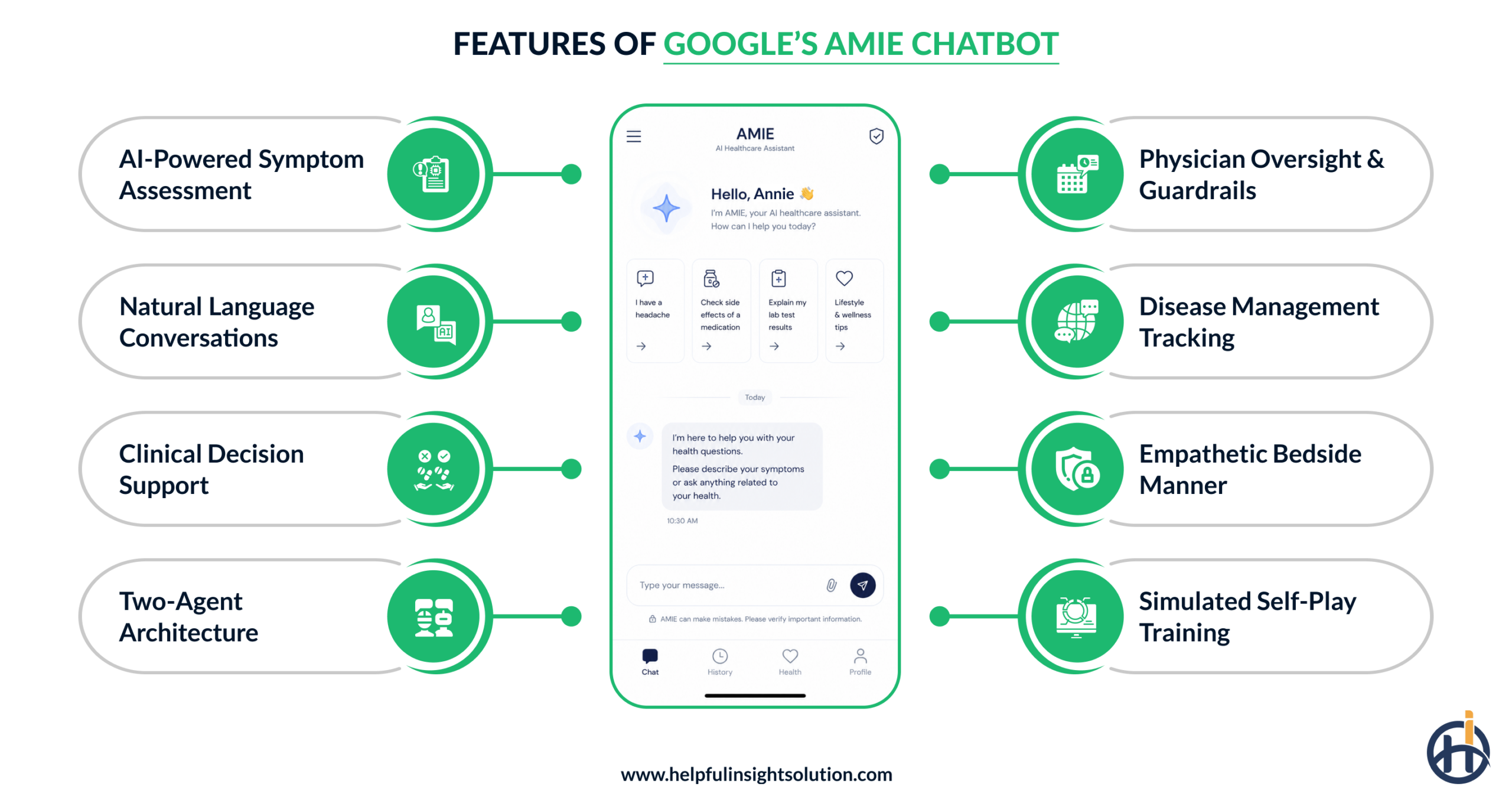
AI-driven chatbots like AMIE offer multiple advanced features, like clinical decision support, an AI symptom checker, and more. They reduce administrative tasks, allowing staff to focus on enhanced patient care.
1. AI-powered symptom assessment
The chatbot captures patient symptoms through conversational dialogue and identifies patterns of illness based on AI-powered analysis to produce initial health reports. This can identify potential risk levels and triage patients prior to them visiting a doctor.
2. Natural language conversations
Advanced natural language processing technology used by the chatbot allows it to understand patient intent, context, and subsequent questions. This can create efficient, accurate, and patient-friendly conversations within various healthcare scenarios.
3. Clinical decision support
By referring to guidelines, the history of the patient, and medical knowledge, the chatbot can offer evidence-based recommendations. It is a valuable support for both informed decision-making and clinical judgment among healthcare professionals.
4. Two-agent architecture
A two-agent system segregates patient interaction from clinical reasoning, whereby the agent involved with the patient does not analyze clinical data itself. AMIE-like AI chatbots can verify and check the accuracy of information and its contextual appropriateness, improving reliability and safety.
5. Physician oversight & guardrails
It has built-in physician oversight and clinical guardrails that ensure the chatbot operates within evidence-based medical boundaries and flags high-risk cases for human intervention. This helps improve patient safety while preventing inappropriate or unsafe medical recommendations.
6. Disease management tracking
The chatbot continuously monitors patient-reported symptoms, treatment progress, and health metrics to support long-term disease management. It provides personalized follow-ups, medication reminders, and alerts that help patients stay on track with their care plans.
7. Empathetic bedside manner
Using advanced conversational AI, the chatbot communicates with empathy, reassurance, and patient-centered language during healthcare interactions. This improves patient trust, reduces anxiety, and creates a more supportive virtual care experience.
8. Simulated self-play training
The AI is refined through simulated patient-clinician interactions, allowing it to practice a wide range of clinical scenarios before deployment. This self-play training enhances conversational reasoning, diagnostic accuracy, and the chatbot’s ability to respond effectively to diverse patient cases.
How to build a healthcare chatbot like AMIE?
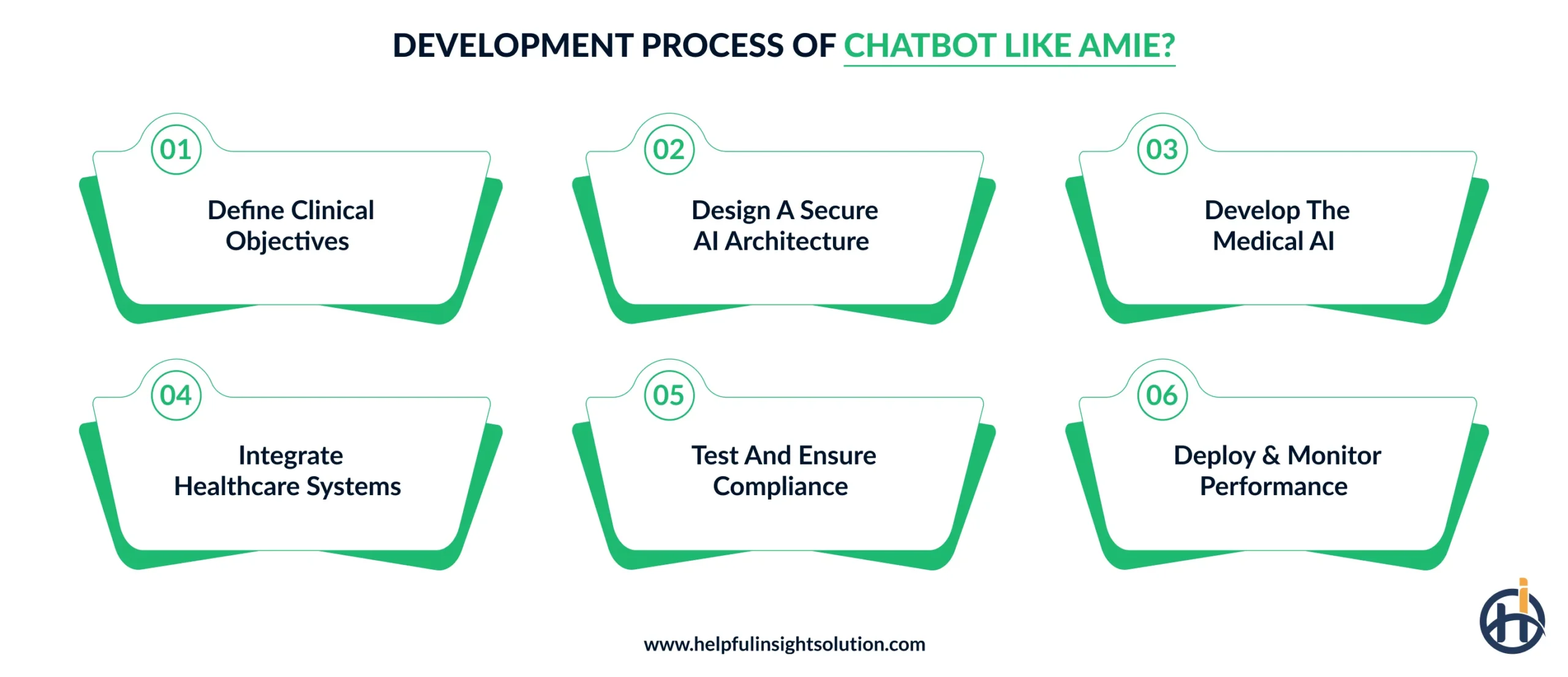
Here is a certified process to build healthcare chatbots like Google’s AMIE, covering steps from ideation to performance tracking. The following development stages are commonly accepted by clinical services providers.
1. Define clinical objectives
To start with, you need to figure out what the chatbot is supposed to do, who will be using it, and how it will fit into the healthcare system. We have to think about what the chatbot will be used for, like helping people figure out what is wrong with them, scheduling appointments, and taking care of people. This will help us make sure the chatbot is doing the right practices and meeting the business goals.
2. Design a secure AI architecture
It is crucial to build a system that can handle a lot of users and work well with AI models, secure databases, and cloud infrastructure. Businesses have to make sure the chatbot is safe and secure, so they need to use measures like encryption, access control, and user authentication. It is necessary to follow the rules to protect patient information, allowing system growth and better work efficiency.
3. Develop the medical AI
Enterprises have to train the chatbot using medical datasets, clinical guidelines, and healthcare-specific language models. You should make sure the chatbot can understand what people are saying and give them answers in real-time. Chatbots must provide optimized feedback from experts and from people who are actually using the platform, which enhances its efficiency and reduces mistakes.
4. Integrate healthcare systems
You should connect a healthcare chatbot similar to Google’s AMIE to various systems that doctors use to enhance patient care. This includes electronic health records, appointment scheduling, telemedicine services, laboratory information systems, and pharmacy APIs. We will use standards like FHIR and HL7 to access records in real time and work together to give patients the best healthcare.
5. Test and ensure compliance
Before you allow people to use the chatbot, it is crucial to make sure it works well and is safe to use with enhanced testing and security methods. Healthcare providers make sure it follows all the rules, like HIPAA and GDPR. Our experts perform testing to see if the chatbot can be hacked, if it is biased in some way, and if it gives good medical advice, keeping patients safe.
6. Deploy & monitor performance
When the chatbot is ready, enterprises can put it on a server that’s safe and always being watched to make sure it is working right. Trackers keep an eye on how accurate the chatbot’s responses are and how well the artificial intelligence is working. The system is regularly updating the AI model that the chatbot uses to make it more accurate and able to handle more users, which will lead to better healthcare outcomes.
Tips to maximize ROI from AI-powered healthcare chatbots
AI-driven chatbots like AMIE must be directly integrated with electronic health records to maximize business ROI. They automate high-frequency tasks, such as 24/7 appointment scheduling, symptom triage, and medication reminders. It helps medical professionals reduce administrative overhead, lower staff burnout, and decrease missed appointments.
- High-impact use cases: You should prioritize workflows like patient triage, appointment scheduling, and medication reminders to achieve faster adoption and operational savings.
- Integrate healthcare systems: It is crucial to connect the chatbot with EHR/EMR platforms, telemedicine solutions, and billing systems to streamline workflows.
- Use data analytics: Businesses can track patient interactions, response accuracy, and engagement metrics to refine chatbot performance and improve healthcare outcomes.
- Update AI models: You must enhance the chatbot with the latest medical guidelines, security patches, and AI improvements to maintain accuracy and compliance.
How does Helpful Insight assist in AI-powered chatbot development for healthcare?
Businesses should now start gathering the necessary resources, which include AI-driven tools, automation experts, and a budget planning strategy. We assist clients in building healthcare chatbots like Google’s AMIE with smart EHR integration and clinical workflow management.
Our developers specialize in advanced AI technologies like machine learning, NLP, and generative AI. They help medical professionals to understand project requirements, AI capabilities, market opportunities, and future trends. Additionally, businesses can build documents to keep their idea safe and authentic.
Our healthcare app development company is always a reliable partner in the field of artificial intelligence and medicine. You can believe in our chatbot solutions that ensure remote patient care, appointment scheduling, and staff management.
This will enhance patient trust in your services and boost the revenue cycle through constant engagement.
FAQs
To build a healthcare chatbot similar to AMIE, the average time required is around 12 months, which can increase further due to additional AI requirements. Compliance planning, conversational design, and AI model training are the initial phases, which take 6-8 months. Testing and security of healthcare bots may take 2-4 months because of various processes.
FDA approval of medical bots is dependent on healthcare operations, such as clinical decision support and symptom tracking. Google’s AMIE is not approved by the FDA because it is used for only experimental and academic research. Various healthcare chatbots that act as a medical device or Software as a Medical Device (SaMD) are FDA-approved.
Businesses can develop HIPAA-compliant medical bots by ensuring end-to-end data encryption and access control. The key chatbot development stages are discussed in the following manner:
- It is crucial to sign a Business Associate Agreement to protect PHI.
- You should map necessary information that can be used by chatbots.
- Businesses must implement strong authentication and identity verification.
- It is beneficial to enable the AES-256 protocol with audit logging methods.
- The clinical AI must focus on diagnosis to prevent data breaches with tamper-proof backups.
You should use hybrid monetization models to generate revenue and make profits from chatbots like AMIE. Some of the best money-making strategies that businesses must implement are described as follows:
- B2B Software-as-a-Service (SaaS): Healthcare providers pay a micro-fee or monthly revenue for clinical interactions.
- Value-based pricing: Businesses can charge revenue to reduce missed appointments and automate follow-ups.
- Premium features: Insurance companies integrate virtual assistants to handle complex healthcare and financial decisions.
Most chatbots in healthcare cannot legally diagnose patients or handle medical emergencies, as they can behave abnormally in complex situations. Clinical bots cannot analyze physical symptoms, review patient history, and take ethical responsibility for patient outcomes. They do not have a license to act as physicians, doctors, or nurses, restricting them from medical triage.