


Key Takeaways:
- AI can automate tasks, analyze market shifts, identify risks, and suggest financing strategies, improving client outcomes.
- Businesses can combine AI with human advisors who focus on relationship building and complex financial planning.
- You can use NLP, predictive analytics, or other AI technologies to increase scalability and reduce the overall expenses.
- Now, small associations can easily implement AI in their systems due to cloud infrastructure and open-source APIs.
Suppose your business revenue is expanding rapidly, and you want to manage wealth through tax monitoring, reinvestment, or expense tracking. The best way to find the right choice is to use AI in wealth management that automates decision-making and reduces false positives.
According to EY, 78% of firms have already adopted Gen AI and Agentic AI to get a strategic market advantage. It is a great motivation for young startups and enterprises that want advanced solutions to manage their wealth.
It is quite interesting to know that Robo-advisors have a 30% market share, resulting in the best option for financial advice and risk management.
As an investor, you should implement this technology to streamline business operations and reduce unknown expenditures. Businesses can manage portfolios, reduce tax burdens, and prevent fraud through AI.
There are more use cases of AI in the wealth management industry that you will study in this blog. In the further sections, you will encounter the benefits, key examples, tools, challenges, and implementation strategies. We will discuss some other important topics, such as the AI Act and future trends, in this write-up.
What is AI in Wealth Management?
Artificial intelligence acts as a ‘copilot’ in the wealth management sector that works with human advisors. It streamlines administrative operations, optimizes portfolios, and drives customer engagement, reducing time consumption on manual data entries.
The use of AI in wealth management promotes hyper-personalization in tax planning and KYC & AML automation. Robo-advisors are now becoming the best choice for financial agents, as they use natural language processing to make informed decisions instantly.
For a better understanding, it is crucial to know the current situation of the AI-enabled wealth management market. You will see some exciting figures that will encourage you to invest more in this sector.
- From a broader aspect, the global AI in financial planning and wealth management market was $24.7 billion in 2025, which is growing at a 20% CAGR between 2026 and 2035.
- By the end of 2035, this market will reach a revenue of $151.1 billion due to rule-based, ML-based, and NLP-based AI systems.
- The AI-powered wealth management solutions market size was $1.8 billion in 2025, and it is currently at $2 billion in 2026.
- This market is growing at a 12.7% CAGR rate between 2026 and 2036, which will reach $6.7 billion by the end of 2036.
- In the AI-driven wealth management solution market, China is growing at 17.1% CAGR, and the USA is growing at 12.1% CAGR during this period.
As an entrepreneur, you must know the differences between the old and AI-enabled wealth management systems. This helps you to understand key changes, business requirements, and possible technologies.
| Aspect | Traditional Wealth Management | AI-Based Wealth Management |
| Decision-Making Speed | Investment decisions often rely on manual analysis and advisor expertise, which can take time. | AI analyzes large datasets in real time and generates insights almost instantly. |
| Personalization | Personalized advice depends on the advisor’s capacity and available client information. | AI delivers highly tailored recommendations using continuous data analysis and behavioral insights. |
| Portfolio Monitoring | Advisors periodically review portfolios and make adjustments manually. | AI continuously monitors portfolios and can trigger automatic adjustments when needed. |
| Cost Efficiency | Higher operational costs due to manual processes and advisor involvement. | Lower costs through automation of routine tasks and streamlined operations. |
| Scalability | Expanding services often requires hiring additional advisors and support staff. | AI enables firms to serve more clients without significantly increasing resources. |
| Risk Analysis | Risk assessments are largely based on historical data and human evaluation. | AI evaluates vast datasets, market signals, and patterns to identify risks more proactively. |
| Client Availability | Client support is typically limited to business hours and advisor availability. | AI-powered assistants and chatbots can provide support and insights 24/7. |
Key Benefits of AI for Wealth Management
By using AI for wealth management, you can experience multiple benefits, such as cost reduction and increased scalability. We are going to observe the key business advantages of AI for managing wealth.
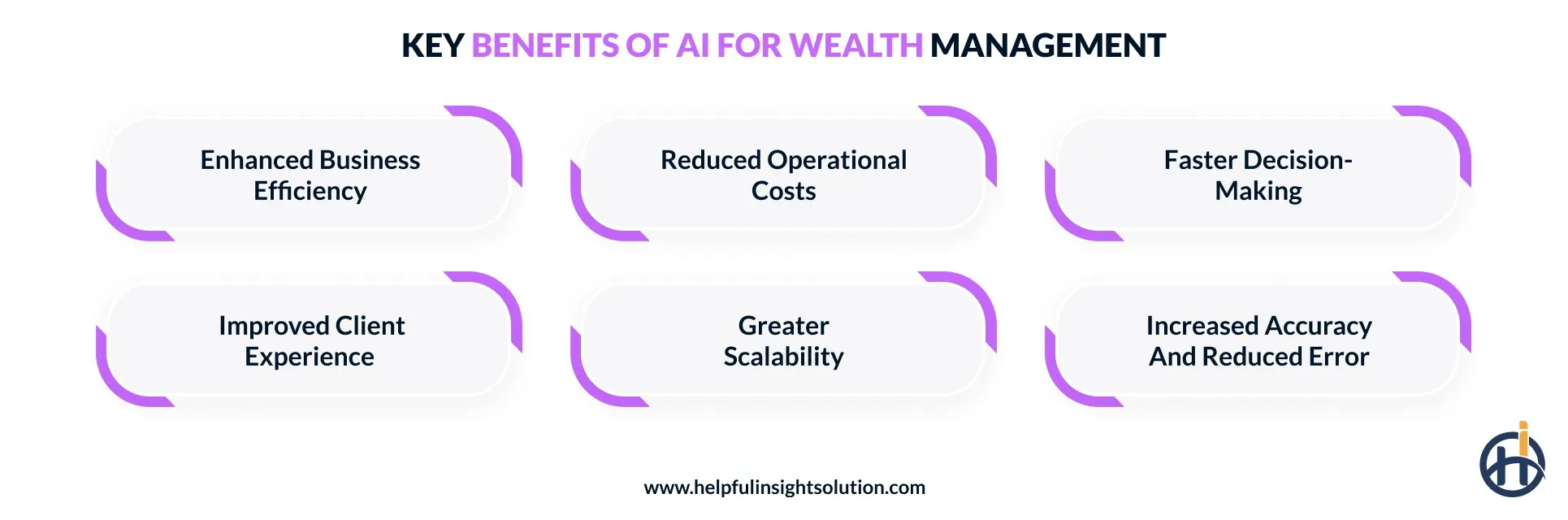
1. Enhanced Business Efficiency
AI automates routine operations, scales advisory services, and delivers predictive analytics that enhance business efficiency. It increases workflow, manages office tasks, boosts client relationships, and improves communication between advisors and customers.
2. Reduced Operational Costs
In wealth management, AI can help human advisors to easily reduce administrative and operational expenses through client behavior analysis. It handles user records, report generation, and meeting preparation, which prevents growth inhibitors and increases support.
3. Faster Decision-Making
The AI technology analyzes global data and market insights to process them for wealth managers so they can optimize portfolios and respond to economic changes. Businesses use generative AI development solutions that deliver faster decisions through sentiment analysis.
4. Improved Client Experience
Various wealth management solutions powered by AI help clients to monitor different risks, access digital assets, and build expert financial strategies. Additionally, they can review historical data and compare investment suggestions based on their requirements.
5. Greater Scalability
With AI, financial advisors can expand their client base by elevating KYC, onboarding, and investment services, reducing workloads. This enhances income planning based on expenses, goals, and behavioral data, allowing more customers to experience scalable financing.
6. Increased Accuracy and Reduced Error
Artificial intelligence manages repetitive tasks and handles information from multiple sources, increasing financial accuracy for wealth managers. Additionally, it reduces system errors by automating data entry operations, asset reporting, and compliance monitoring.
Top 11 AI-Powered Use Cases in Wealth Management
Some of the best AI use cases in wealth management include risk management, finance monitoring, and more. In this section, you will study the most common applications of AI in revenue management.
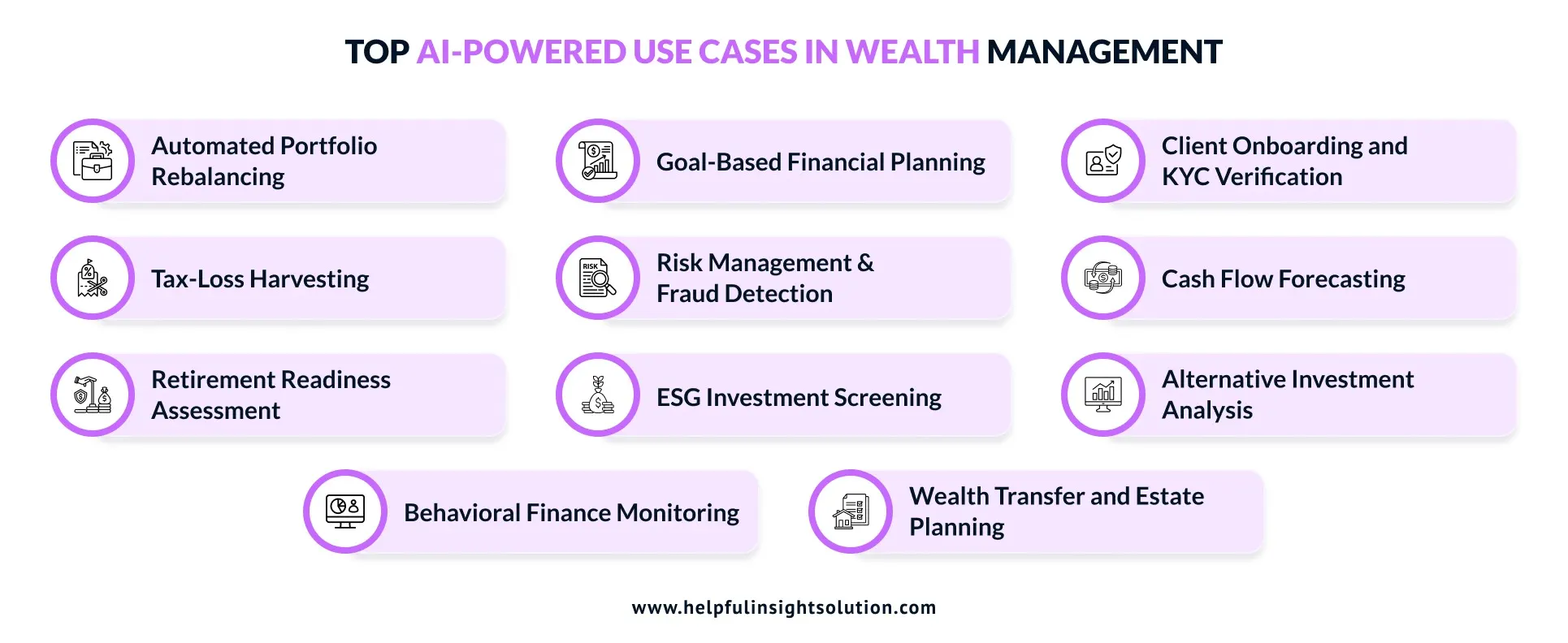
1. Automated Portfolio Rebalancing
The AI technology regularly scans multiple portfolios to detect shifts in assets, such as stocks or bonds, from original allocations. Various ML algorithms, like support vector machines (SVMs), execute necessary trades to resolve deviations in portfolios.
This aligns with the client’s target risk tolerance, reducing biased results and increasing tax efficiency. AI models analyze vast datasets and historical performance to adjust business assets across different classes.
2. Goal-Based Financial Planning
An AI financial advisor uses predictive analytics and machine learning to align client portfolios with life milestones and monitor economic variables. It transforms static asset allocation into a dynamic one to get outcome-focused strategies that track financial objectives.
AI analyzes the client’s current situation, predicts upcoming events, and models customized risks with accuracy. Additionally, it monitors market trends and alerts advisors to adjust requirements based on the success rate.
3. Client Onboarding and KYC Verification
This includes automated documentation, identity validation, and compliance screening, which eliminates manual data entry and reduces waiting times. It ensures AML protocols that decrease the operational costs, ensuring robustness across networks.
Intelligent Document Processing (IDP), biometric checks, and dynamic risk profiling are the main functions. With ML and LLMs, it is easy to analyze user inputs, financial history, and risk tolerance for investment strategies.
4. Tax-Loss Harvesting
Tax-loss harvesting is one of the most important AI applications in wealth management, where investors’ taxable accounts are regularly monitored. AI-powered tools track the purchase value of assets and execute trade functions when the market is performing well.
They analyze losses to adjust them with portfolio gains or carry them in the future to minimize tax liability. The savings are reinvested in the assets based on the compounding interest, minimizing tax burdens.
5. Risk Management & Fraud Detection
AI risk management finance strategies help human advisors to understand various market challenges by evaluating financial patterns and economic indicators. Advanced algorithms analyze global news and monitor different market trends, allowing wealth managers to make desired changes.
They can also track transactions to predict risk scores and abnormal device locations. Modern systems use federated learning to train fraud models based on customer data across multiple networks.
6. Cash Flow Forecasting
To predict future liquidity with high precision, this AI use case replaces manual spreadsheet-based predictions with machine learning models. Bayesian structural time series and neural networks detect future cash flows by analyzing different payable/receivable accounts.
The use of AI in demand forecasting helps advisors to compare predicted information with actual data. It also analyzes the payment behaviors of customers and interest rate fluctuations for businesses.
7. Retirement Readiness Assessment
Wealth managers use retirement readiness assessment tools that are powered by artificial intelligence to figure out if investors are on the right path to meet their retirement goals. These tools regularly monitor income, savings, and investments to analyze their performance.
They also think about inflation and suggest desired plans to people after retirement. This helps wealth managers give people advice on how to plan for their future and make better decisions.
8. ESG Investment Screening
By using advanced NLP, ML algorithms, and predictive analytics, AI segregates thousands of data points based on environmental, social, and governance aspects.
This includes various events, like global news, supply chain data, social media sentiment, and regulatory filings. AI ensures greenwashing, which means verifying a company’s claims by cross-checking carbon emission metrics. It assigns standardized ESG scores to emerging market assets that lack formal ESG reporting.
9. Alternative Investment Analysis
Artificial intelligence helps wealth managers look at various kinds of investments, like private equity and real estate. It can look at a lot of information, including reports on the market and financial statements, to get a better estimation.
This technology can help human advisors find different investment opportunities and identify risks in real-time. This means investors can make decisions when they are trying to diversify their investments.
10. Behavioral Finance Monitoring
Finance monitoring uses various AI technologies to look at how investors make decisions on digital assets. They can see if people are taking the right actions when they invest in multiple stocks during peak hours.
Human advisors can use generative AI wealth management tools for this information to give people advice before investing in the market. This facility helps people stick to their investment plan and do better in the long run.
11. Wealth Transfer and Estate Planning
AI and machine learning make it easier for wealth managers to help people plan for the future. It can look at all of a person’s assets. Figure out the best way to pass them on to their family. Different AI models can help identify potential problems that might come up. This means wealth managers can create a plan that works well and follows all the rules. Retirement planning and wealth transfer are parts of what wealth managers do, and AI is a useful tool for them.
Real-World Business Examples of AI Wealth Management
Various firms have implemented machine learning and NLP to handle business tasks and customer engagement. Here, we will see the top AI in wealth management examples to understand their financial planning strategies.
1. Vanguard
Vanguard is one of the best Robo-advisors in wealth management that ensures hyper-personalized client experiences, hybrid advice, and automated financial tasks.
It includes personal advisor services, a multi-goal solver, behavioral interventions, and digital advisors. This firm uses AI to offer quantitative analysis, tax management, and constant monitoring at lower costs.
2. Morgan Stanley
To streamline internal research, automate administrative tasks, and manage client investments for wealth management, Morgan Stanley uses AI technology.
It provides tools for lead generation, meeting intelligence, information retrieval, and corporate-retail funneling. Businesses can scale their operations, ensure strict compliance, and support human advisors with AI-driven insights.
3. Charles Schwab
AI helped Charles Schwab to personalize wealth insights, automate client services, and deliver hybrid financial planning, targeting a wide range of investors.
It offers generative AI portfolios, democratized wealth advice, and automated agents to resolve income issues. An internal NLP tool helps professionals reduce the time spent on handling complex queries.
4. JPMorgan Chase
With AI in asset and wealth management, JPMorgan Chase has scaled up advisor productivity, optimized portfolio construction, and automated operational tasks.
This firm provides various tools, like Coach AI, SpectrumIQ, IndexGPT, Proxy IQ, and Ask David. They increase decision-making speed by 95% faster and reduce manual research time by 80%.
5. Betterment
AI and machine learning algorithms help Betterment automate portfolio rebalancing, tax-loss harvesting, and personalized goal planning.
It can manage large investments without manual interventions by monitoring market movements and identifying securities. The system uses different mathematical models to handle specific types of assets, like high-yield funds.
5 Best AI Wealth Management Tools
You can implement AI for wealth management by using different tools that are commonly used by investors. This section discusses the top 5 solutions, which offer advanced features to manage wealth.
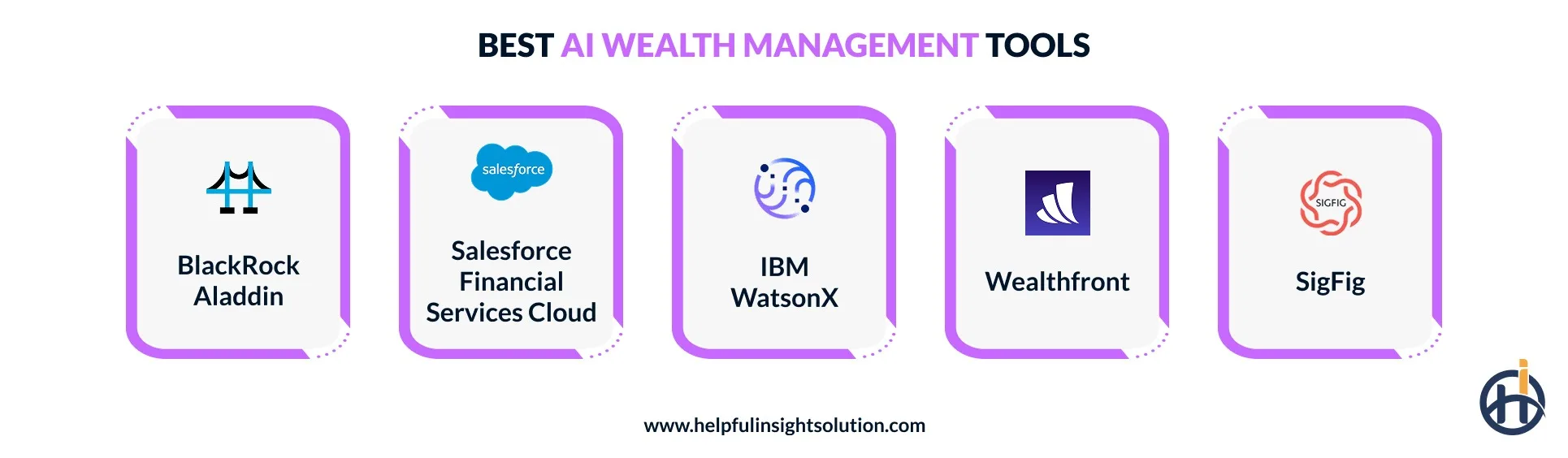
1. BlackRock Aladdin
This tool utilizes advanced risk analytics models and NLP to provide financial advisory services, which enhance business workflow. It involves a copilot, an auto-commentary feature, a portfolio analyzer, a tax evaluator, and a model evaluator that boost wealth management.
2. Salesforce Financial Services Cloud
Salesforce integrates AI into its cloud-based financial services to optimize portfolio management, automate compliance, and scale client personalization. Agentforce, Einstein AI, Tableau AI, MuleSoft, and Fini AI are the key tools that manage business assets.
3. IBM WatsonX
It is one of the most widely used platforms that allows fintech firms to build, customize, and govern their wealth management AI solutions. IBM WatsonX created Wealthbuild AI, an EY tax agent, AlphaSense, and an orchestration platform for Neuron Labs.
4. Wealthfront
It offers goal-based investment management services and a low-cost structure, allowing clients to build wealth without any human intervention. The automated agents regularly track deposits, savings, and bills based on customized financial rules, which prevent backtracking.
5. SigFig
SigFig provides smart tips, real-time conversation analysis, and automated meeting summaries for wealth and asset management. With enterprise-grade conversational AI capabilities, it ensures effective financial planning and instant portfolio-building strategies.
Challenges with AI-Enabled Wealth Management Solutions
Businesses may experience various challenges, such as security, while integrating AI for wealth management. You are going to study a few of the major AI risks with their respective solutions.
1. Data Privacy and Security
As AI needs large data volumes for training and analysis, it may leak tax records and portfolio information. Also, AI links central databases to external services, which can create new entry points for cyber attackers.
Solution: Advanced encryption methods allow AI models to detect fraud probability and take actions based on the analysis.
2. Regulatory and Compliance Complexity
Various AI compliance monitoring challenges include fragmented data privacy laws and third-party risks. This results in severe penalties and sustainability issues, reducing the financial transparency of the system.
Solution: You can use automated KYC and AML techniques with audit trails, reducing data breaches and impacting documentation.
3. Algorithmic Bias
This occurs due to improper historical data, proxy variables, and imbalanced datasets, leading to indefinite access. It can lead to decision failure and model complexity due to false information on various parameters.
Solution: It is mandatory to use explainable AI models that ensure diverse datasets based on different client information.
4. Integration with Legacy Systems
Various traditional legacy systems restrict modern API support, promote strict compliance, and include fragmented data. The stored information needs regular cleaning and transformation to become AI-compatible.
Solution: Businesses can use middleware APIs and MLOps to extract data without disturbing the existing system architecture.
Wealth Management and the AI Act
Before integrating AI and wealth management, it is mandatory to follow the European Union’s AI Act. This strict framework ensures security and transparency with compliant tools, managing human advisors and fiduciary decisions.
It encourages the integration of customer relationship management systems with AI agent development services to enhance compliance and operational efficiency.
Risk-Based Approach: This act categorizes AI into a three-tier risk model, allowing wealth managers to adjust their technology infrastructure based on user assessments.
Trust & Transparency: The clients must know how AI has achieved a particular investment recommendation, enabling human advisors to control fiduciary decisions.
Data Governance: Firms ensure that the data used for AI training is accurate and contextual, which promotes the documentation of data sources and AI system monitoring.
Growth Opportunities: Task automation, such as portfolio rebalancing, helps advisors to focus on complex wealth planning, which reduces regulatory fines and operational risks.
The need for predictive analytics in wealth management has increased rapidly over the past few years, enhancing overall business regulations. It is important to know various aspects of the AI Act to maintain a balance between the technology and human advisors.
| AI Act Aspect | Impact on Wealth Management |
| Explainability Requirements | Wealth management firms must provide clearer explanations for AI-generated recommendations, increasing client trust and regulatory accountability. |
| Risk Classification | AI systems used for investment advice and financial decision-making may require stricter oversight, documentation, and risk management processes. |
| Data Quality and Compliance | Firms must ensure that AI models are trained on accurate, unbiased, and compliant data to reduce errors and meet regulatory expectations. |
How to Get Started with AI Technology in Wealth Management?
Entrepreneurs can integrate AI in wealth management by following a simple process, from planning to deployment. The following steps are crucial and discussed with detailed information in this section.
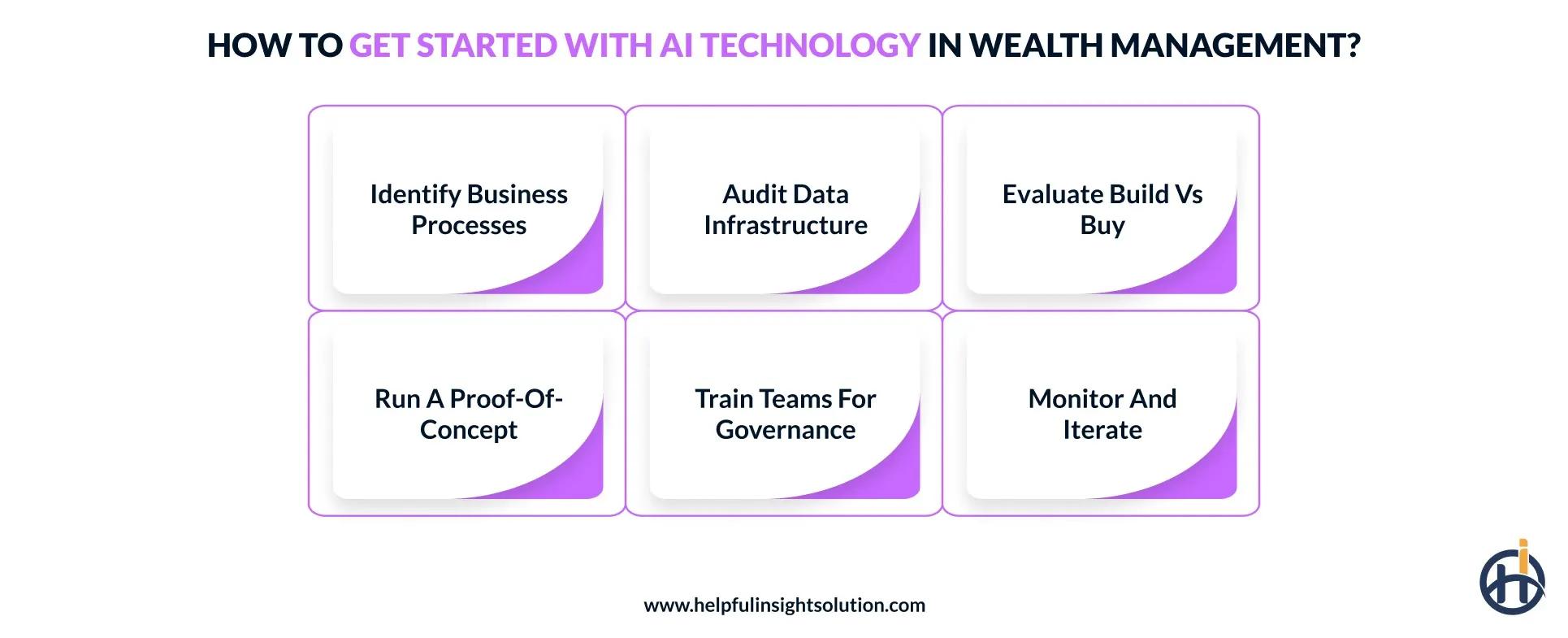
1. Identify Business Processes
Initially, businesses must find different areas for improvement by using machine learning in wealth management. It is necessary to observe the start of the process, check the client’s investment portfolios, make reports, and help customers.
By focusing on these things, investors can make a difference through money management, which is possible with different AI components.
2. Audit Data Infrastructure
Advanced AI systems need clear and structured data to work properly, preventing biased results. Wealth management companies should check where their data is coming from, how it is stored, and how it is shared.
Having a data system helps artificial intelligence work better, makes it easier to follow the law, and helps companies make more accurate decisions about managing wealth.
3. Evaluate Build vs Buy
Companies need to decide if they want to create their own artificial intelligence solutions or buy them from someone else. Making AI agents in finance gives them more control, but buying them saves time and money for wealth management companies. The choice should fit with the company’s goals, technical skills, and budget for artificial intelligence models.
4. Run a Proof-of-Concept
Before using artificial intelligence for the whole company, wealth management firms should try a small project to see if it works. Trying a project helps teams see how well it works, find problems, and see the benefits of using artificial intelligence in a controlled setting. This facility helps companies make smart decisions about investing in artificial intelligence technology.
5. Train Teams for Governance
For artificial intelligence to work well, employees need to understand the technology and what they are supposed to do when using it in wealth management.
Companies should teach their staff about artificial intelligence tools, how to use them, how to follow the rules, and how to manage risks. Having rules in place helps everyone be transparent, accountable, and responsible when using AI.
6. Monitor and Iterate
Using AI is something that needs to be watched and improved all the time for wealth management. Companies should keep track of how things are going, check to see if the models are accurate, and get feedback from advisors and clients.
Making updates and changes helps keep everything working well as the market and business needs change for artificial intelligence in wealth management.
Future of Artificial Intelligence in Wealth Management
It is important to know different trends in AI wealth management to enhance user experience in real-time. These innovations will take place in the future, allowing more investments and continued market growth.
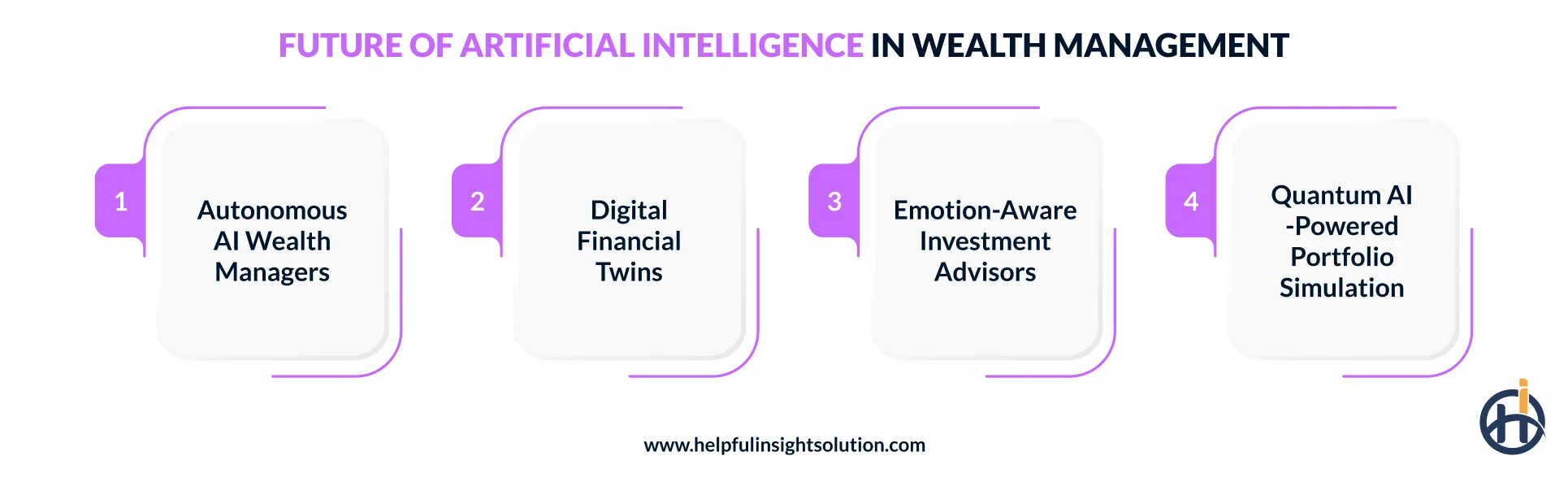
1. Autonomous AI Wealth Managers
The shift from passive generative assistants to agentic AI wealth management allowed digital systems to plan, understand, and execute complex financial operations. They can evaluate spending patterns, tax brackets, and market volatility, promoting human-AI hybrid models.
2. Digital Financial Twins
Firms can create Financial Digital Twins (FDTs) by combining machine learning with personal data to store all the client’s information for tax rebalancing. They regularly update asset allocation and estate strategies based on market changes and user lifestyle.
3. Emotion-Aware Investment Advisors
Financial systems can understand voice tones, language patterns, behavior, and facial expressions through emotion-aware AI models. They focus on qualitative data to improve communication and build trust that neutralizes biased decisions through system adjustments.
4. Quantum AI-Powered Portfolio Simulation
With quantum computing, AI systems can simulate multiple scenarios, delivering personalized, managed, and predictive wealth management strategies. The use of GANs and deep reinforcement learning can increase processing speed up to 1000 times.
Partner with Helpful Insight to Deliver AI-Driven Wealth Management Solutions
Businesses are looking forward to integrating AI in wealth management, but are confused about where to start and whom to select. It is crucial to have the right partner who knows how AI works with wealth management solutions and can deliver the best AI development services.
Our professionals ensure complete credibility and work integrity through extensive business planning. We help clients to implement machine learning algorithms, NLP, and GenAI models with real-time APIs.
You should focus on AI and wealth management to boost decision-making, reduce administrative costs, and enhance user experiences.
This is a much-needed innovation for financial enterprises that are looking to improve business communication between agents and customers. Entrepreneurs can now easily manage their wealth and make the right calls for business growth by using AI capabilities.
FAQs
AI uses machine learning algorithms, predictive analytics, and large language models (LLMs) to analyze big financial and market data. It helps advisors to enhance their services and make faster decisions through administrative task automation and portfolio monitoring. This technology personalizes investment strategies based on transaction history, lifestyle goals, and user behavior.
Artificial intelligence can perform data analysis and routine task automation, but human advisors provide personal guidance and manage emotional decisions. They work together for document filing, portfolio rebalancing, and tax modeling. Human advisors can understand various situations and use AI tools to make instant decisions through real-time analysis.
AI-enabled wealth management apps are also known as robo-advisors that can automate portfolio creation and asset management. These platforms are more affordable than human financial advisors because they lack behavioral coaching and personalized planning. Examples like Fidelity Go help users to manage investments with a low fee structure.
Businesses implement AI to deliver hyper-personalized financial strategies, 24/7 client support, and predictive market insights. The advisors use generative AI to summarize conferences and automate actions by reducing time for data handling. Chatbots can handle various inquiries, like account balance and recent transactions, by using NLP.
For creating a basic robo-advisor with third-party financial APIs, businesses have to invest between $40,000 and $150,000. The overall cost increases to $500,000 due to machine learning algorithms and generative AI models. An enterprise-grade solution may cost $1.5 million because of compliance standards and security integration.