

Key Takeaways:
- User registration, music search, audio quality control, offline listening, and playlist management are the important features of a music streaming app that every build should start with.
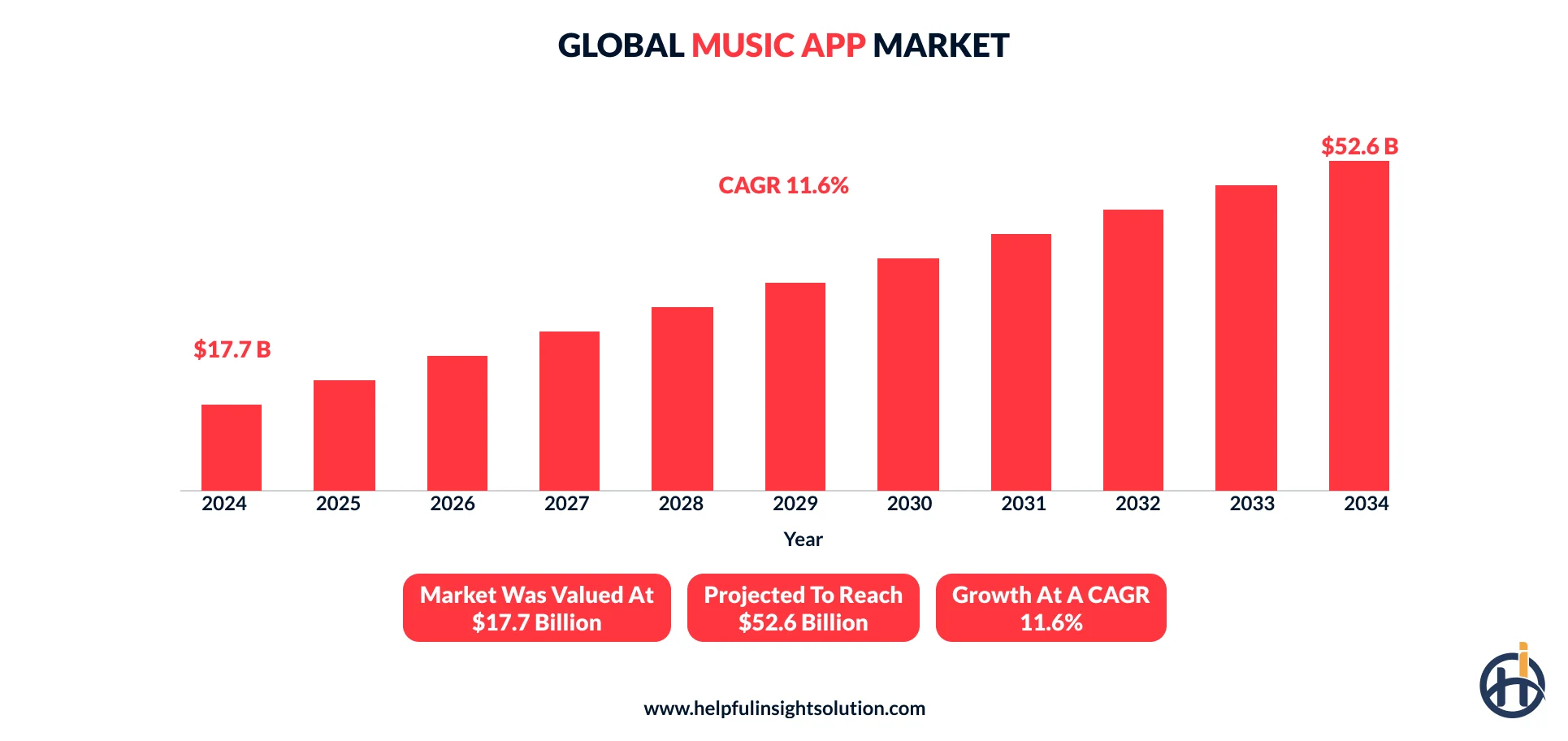
- The global music streaming market is set to reach $52.6 billion by 2034, signalling growing demand for innovative music streaming apps.
- Mood-based playlists, spatial audio, music identification, collaborative listening, and AI recommendations are advanced music streaming app features.
- Admin panel features are frequently underbudgeted despite being what keeps platform operations running efficiently at scale.
- Building core features first and validating before scaling advanced capabilities is the decision that separates music apps that survive from ones that don’t.
Offline listening, smart playlist management, high-fidelity audio, and AI-driven personalization, these are the music streaming app features that separate the apps people keep from the ones they delete after a week.
Look at Spotify, Apple Music, and YouTube Music. They didn’t succeed by being first. What they got right was the product, features users actually needed that became part of daily routines and decisions that made switching to anything else feel pointless. They have set the standard that any new app is being measured against.
More than 82% of global music consumption now happens through streaming platforms. The audience is there. The demand is real. What determines whether your app earns a place in that market is the product decisions you make at the feature level.
So, if you’re an entrepreneur or a product manager planning to build a music streaming app but unsure which features to prioritize, this blog has the answers. It breaks down exactly which features a music streaming app needs to compete, from the non-negotiables users expect on launch day to the advanced capabilities that convert casual listeners into paying subscribers.
So, let’s get started.
Why Should Businesses Build a Music Streaming App?
Developing a music streaming app helps businesses reach a global audience, improve brand loyalty, and generate revenue from multiple streams, making it a strong long-term investment for sustainable business growth.
Here are some other reasons that why you should build a music app.
1. Global Reach and High Demand
Unlike most digital products, music crosses languages, cultures, and borders without friction. A streaming app gives businesses instant access to a global audience from day one. Demand backs this up as the global music streaming market is projected to reach $52.6 billion by 2034. Few digital categories offer this combination of universal appeal and measurable, growing demand in a single product.
2. High User Engagement Rates
Music is one of the few things people interact with daily without needing a reason. The average user spends over 104 minutes listening every single day. For a business, that kind of daily habitual usage is extraordinarily difficult to build in most product categories and music apps come with it built in from the start.
3. Multiple Recurring Revenue Streams
An on-demand music app does not have to choose between making money from subscribers or advertisers. It can do both and layer in-app purchases, brand partnerships, and artist deals on top. Having multiple revenue streams running from a single platform is what gives music businesses a level of financial stability.
4. Scalable Business Model
Once the infrastructure and licensing are in place, serving ten times more users does not cost ten times more. That gap between revenue growth and cost growth is what makes a well built music streaming platform one of the more financially attractive digital products to own.
Must-Have Features to Include in a Music Streaming App
When you develop a music streaming app, the must-have features are user registration, smart music discovery, offline access, and playlist creation. Every feature decision either builds user trust or breaks it.
This section covers the core features that hold the product together, from what listeners experience on the front end to what your team controls behind the scenes.
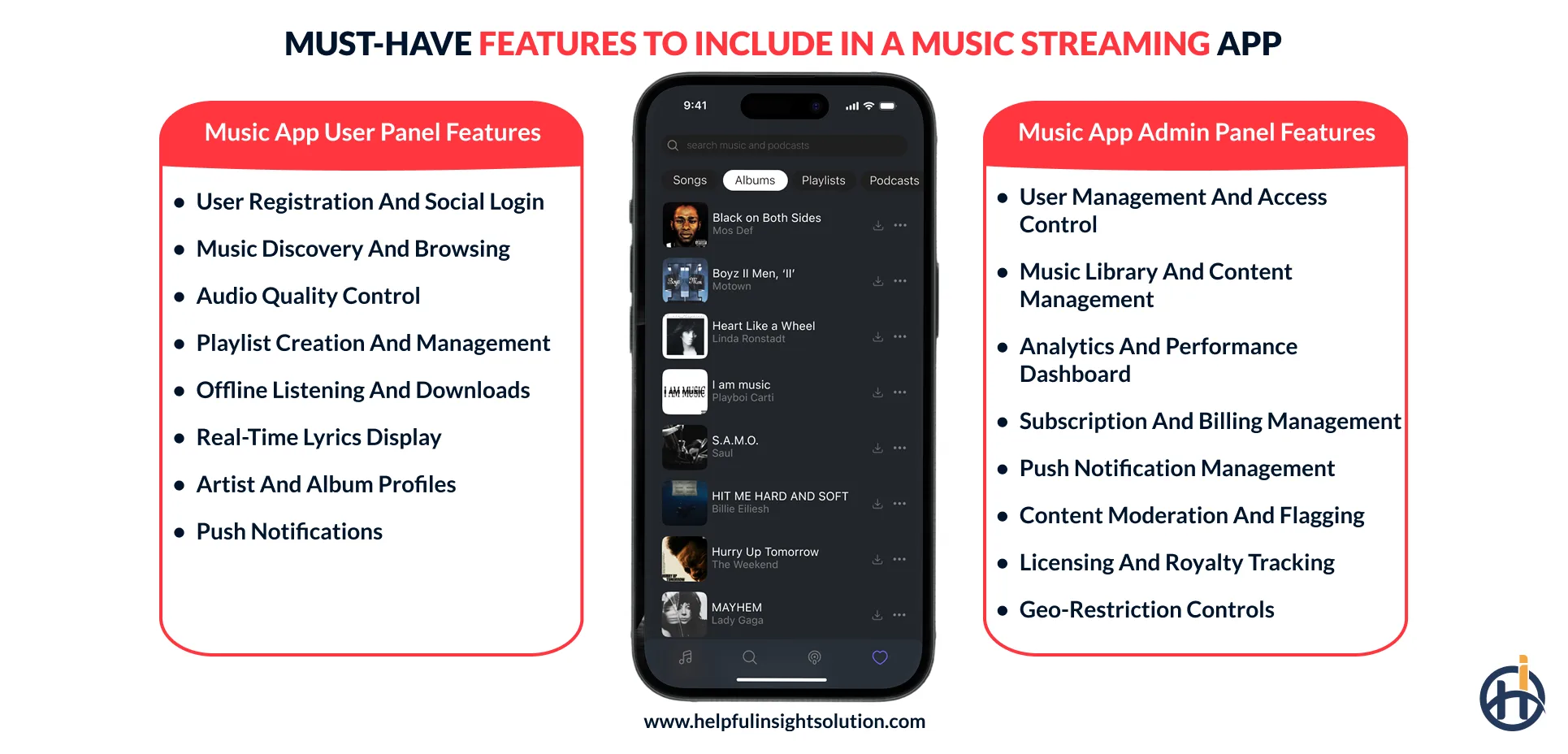
Music App User Panel Features
These are the important features of a music streaming app that your users interact with directly, the ones that shape the experience from the moment they hit play.
1. User Registration and Social Login
Users don’t like lengthy sign-up processes and they shouldn’t have to deal with one. Music app user onboarding works best when it takes one or two taps via Google, Apple ID, or social media login.
Once logged in, the app should let them create their personalized profile that tracks listening history, saved tracks, and preferences that power smarter recommendations.
2. Music Discovery and Browsing
This is one of the core features of a music streaming app that separates a good product from one users genuinely rely on. A strong search handles typos, partial song names, and artist variations without missing a beat.
But real discovery means surfacing music users didn’t know they were looking for through mood filters, curated playlists, and genre-based browsing that keeps sessions running longer than planned.
3. Audio Quality Control
With this functionality, give your users full control over how they hear their music. Supporting multiple bitrate options from standard for data saving to lossless FLAC and Dolby Atmos for audiophiles is increasingly a baseline expectation, not a premium add-on.
With music apps like Apple Music normalizing high-fidelity audio, any new app building for serious listeners needs to match that bar from launch
4. Playlist Creation and Management
Music playlist management is one of the key features of a customer-facing music streaming app. It directly influences how long someone stays on your platform.
Users build playlists for a purpose like for a workout or to listen on a road trip. Give them mood-based generators, privacy controls, and the option to collaborate with friends. A playlist someone has put time into doesn’t get deleted easily, and they will stick to your app.
5. Offline Listening and Downloads
Not everytime users have a reliable internet connection and they have stopped using the mobile apps that don’t support offline functionality. An offline mode music app lets people download playlists and albums before they lose signal on a flight, in a tunnel or wherever connectivity drops.
Give them storage controls and automatic download options inside the app. That kind of reliability is quietly one of the biggest reasons users stick around.
6. Real-Time Lyrics Display
Real-time lyrics display lets users follow along word for word as the music plays, synced precisely to the track, not a second behind. Spotify proved how much this matters when engagement climbed noticeably after they introduced it.
Clean typography, album art-driven backgrounds, and a share option for favorite lines make it more than a karaoke tool; it becomes part of how users connect with a song.
7. Artist and Album Profiles
Among the music streaming app features that users interact with almost daily are artist and album profiles. They turn a one-time listener into a long-term fan. This profile gives users everything in one place, from discography, upcoming releases and bio to related artists.
When users go deeper on an artist they’ve just discovered, they stay connected to your music and audio app instead of opening a browser to find out more.
8. Push Notifications
Users usually forget about apps they don’t open for a few days. Push notifications solve that but only when they’re worth reading. An alert about a new release from an artist someone follows, or a morning playlist suggestion, lands differently than a generic promotional message. Build notification logic around listening behavior and your re-engagement rates will reflect it.
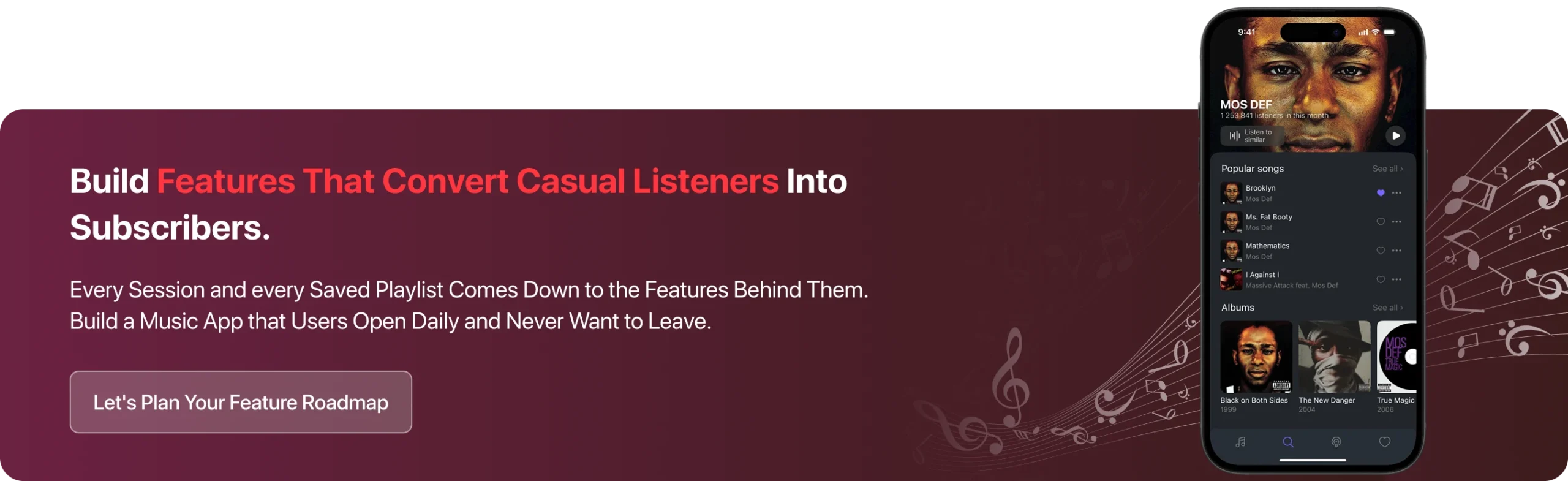
Music App Admin Panel Features
Beyond the user experience, the core features of a music streaming app include a full layer of admin controls which include:
1. User Management and Access Control
Work with dedicated developers to add user management and access control functionality that keeps your platform organized as it scales. Admins can pull up account activity, handle subscription issues, and remove users who break platform rules.
Access permissions mean a customer support agent can resolve a billing query without accidentally touching content settings or payment configurations.
2. Music Library and Content Management
Build a content management system that scales alongside your library without adding unnecessary complexity. Uploading tracks, tagging metadata, updating artist profiles, attaching album artwork, and flagging licensing information all happen from one organized place.
The bigger your catalog grows, the more a well-structured CMS determines how efficiently your team operates day to day
3. Analytics and Performance Dashboard
Every business decision on a music platform comes back to data, so this is one of the most useful features of a music streaming app for admins. The analytics dashboard shows what users are listening to, where they’re dropping off, which subscriptions are converting, and how different regions are performing.
Admins get a clearer picture of what’s working and that clarity makes content, marketing, and product decisions a lot less guesswork.
4. Subscription and Billing Management
Billing issues are one of the quieter reasons users leave a platform. A renewal that fails without warning, a refund that takes too long, a plan change that doesn’t reflect correctly, these things add up. Subscription and billing management gives admins a clear view of what is happening across all active plans so problems get caught and handled before users feel them.
5. Push Notification Management
Not every user needs the same notification. Someone who listens to indie rock doesn’t need a hip-hop album drop alert. This music app feature lets admins segment users by behavior and send messages that actually make sense to the person receiving them, new releases from followed artists, playlist suggestions, and re-engagement nudges.
When notifications are built around what someone actually listens to, open rates go up and unsubscribes stay low.
6. Content Moderation and Flagging
Spotify and Apple Music both invest heavily in content moderation because one bad experience can cost them a user permanently. For your music streaming app, admins need to review flagged tracks, reported playlists, and user comments, then act fast.
Music app development features like automated flagging help catch violations before users even report them. Warnings, removals, and account restrictions all need to be handled without raising a ticket every time.
7. Licensing and Royalty Tracking
Music rights are complicated and getting them wrong is expensive. Every track on your platform carries royalty obligations and admins need a system that tracks what is owed, to whom, and when.
An app like Spotify pays out billions in royalties annually precisely because its backend handles this without manual intervention at every step.
8. Geo-Restriction Controls
One of the best features for a market leading music app is the ability to control where content is available based on licensing agreements. Not every track is cleared for every country, and geo-restriction controls let admins manage that without manually reviewing every upload.
A song available in the US might be restricted in Germany and getting that wrong exposes the platform to rights violations that are far more costly to fix after the fact.
Advanced Features of Music Apps That Turn Casual Listeners Into Loyal Subscribers
Advanced AI-powered features like personalized recommendations, collaborative listening, and high-fidelity audio turn a decent product into one users actively recommend to others. When you work with an experienced mobile app development company that understands the streaming market, the capabilities they prioritize for long-term growth are listed below.
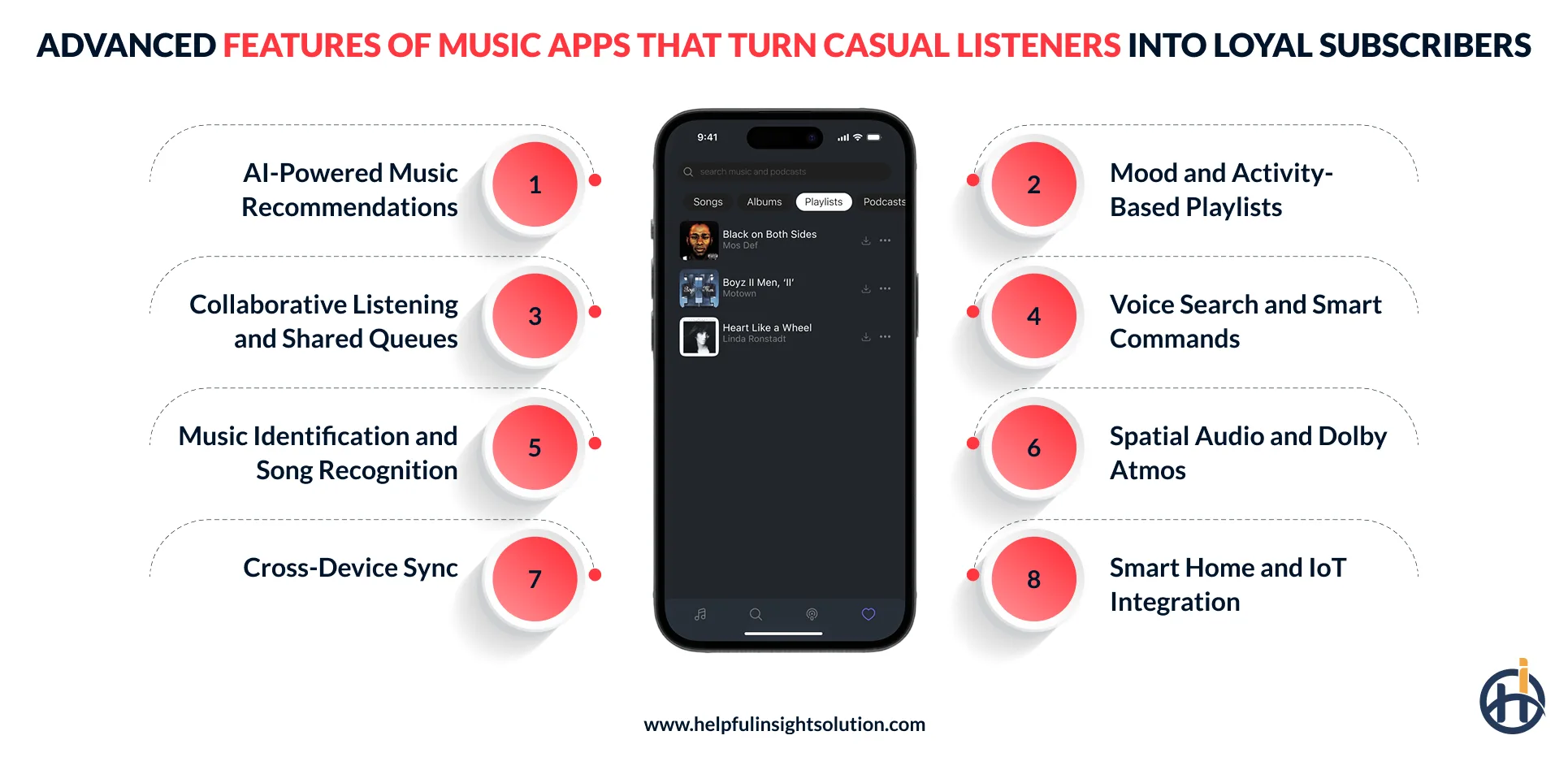
1. AI-Powered Music Recommendations
Personalized music recommendations powered by AI are one of the most in-demand music streaming app features today. Most users don’t know what they want to hear next; they just know when it’s right. Machine learning picks up on patterns humans can’t articulate like skip rates, repeat listens, and session length, and builds a picture of music taste that gets sharper over time. Pandora’s Music Genome Project is a great example of this.
2. Mood and Activity-Based Playlists
Integrating this feature helps your music app figure out what a user needs to hear before they do. A Monday morning commute sounds different from a Friday night and listening patterns, time of day, and activity signals pick up on that automatically.
Apple Music leaned into this with Focus playlists and users responded. The right playlist at the right moment is one of those things users notice and quietly appreciate every single day.
3. Collaborative Listening and Shared Queues
Collaborative listening and shared queues let friends and family add tracks, take turns controlling the queue, and listen together in real time. It adds a social layer to your app that most users don’t expect and once they’ve used it, going back to listening alone feels like a step down.
4. Voice Search and Smart Commands
Driving, cooking, working out, there are plenty of moments when pulling out a phone just to skip a song feels like too much. Voice search music app functionality handles those moments. A quick command plays a track, switches an artist, or skips ahead without breaking whatever the user is doing. People who get used to this rarely go back to tapping through menus.
5. Music Identification and Song Recognition
Businesses in the music industry planning to create their app should add music identification and song recognition as a standout capability. Users hear something they like in a cafe, on TV, or passing a store and want to know what it is instantly. Built-in song recognition handles that without sending them to a separate app.
6. Spatial Audio and Dolby Atmos
Hearing a song in spatial audio for the first time is one of those moments users actually talk about. Dolby Atmos support wraps sound around the listener in a way standard stereo simply doesn’t and on compatible devices, the difference is immediate. For an app targeting serious listeners or audiophiles, this is the kind of feature that justifies a premium subscription.
7. Cross-Device Sync
Cross-device music streaming is one of those capabilities users expect in a music app. Someone starts a playlist on the phone, switches to a laptop an hour later, and just wants it to continue. No searching, no replaying from the start. Apps that handle this well earn a kind of quiet loyalty that is hard to replicate with any other feature.
8. Smart Home and IoT Integration
Smart speakers are in millions of homes already. Users who play music through Alexa or Google Home don’t want to open a separate app every time they change a song. Smart home music integration puts your platform where those users already are and that kind of convenience is genuinely hard to walk away from.
Real Examples of Music Apps With Standout Features
The top music streaming apps like Spotify, Apple Music, and Tidal each got one thing exceptionally right. Studying them shows how specific features like social listening, songcatcher and smart recommendations define what makes a music app worth using.
Below are the standout examples worth learning from.
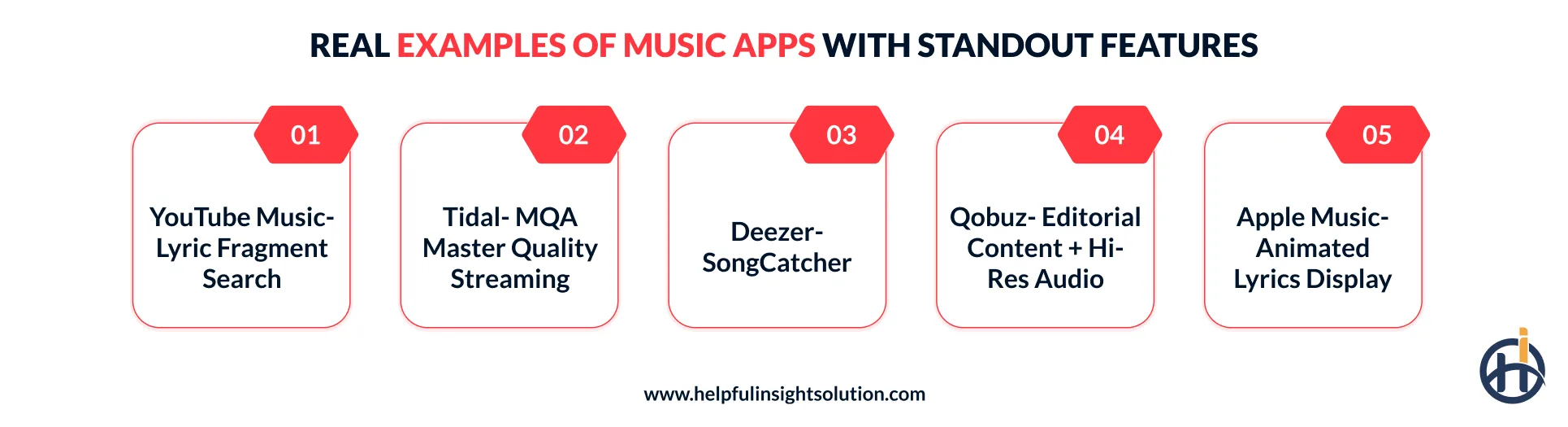
1. YouTube Music- Lyric Fragment Search
YouTube Music reaches over 2.1 billion active users globally a scale that comes with serious search infrastructure behind it. Lyric fragment search puts that infrastructure to work, letting users find a track by typing a few words they half-remember no artist name, no title needed.
For a feature-rich music streaming platform, this kind of search depth is exactly what stops users from opening a different app to find what they’re looking for.
2. Tidal- MQA Master Quality Streaming
Tidal’s MQA Master Quality streaming delivers high quality audio streaming at up to 24-bit, 192kHz capturing every detail of the original studio recording without inflating file sizes. Most platforms compress audio to make streaming easier.
Tidal made the opposite call, prioritizing what the artist actually recorded over what’s convenient to deliver. For serious listeners, that difference is audible from the first track.
3. Deezer- SongCatcher
A song playing in the background of a cafe or a store familiar enough to notice, by the time you think to search it the moment has passed. Deezer’s SongCatcher handles that directly. Hold the phone up, and it matches the audio fingerprint against millions of tracks in seconds.
It is one of the important features of a music streaming app that users don’t know they need until the first time it saves them from losing a song forever.
4. Qobuz- Editorial Content + Hi-Res Audio
It is a highly popular music app with over 100 million tracks in Hi-Res quality up to 24-bit, 192kHz. Most platforms stop at the music. Qobuz adds 500,000 plus editorial articles, artist interviews, album breakdowns, music history written by people who actually know the subject. For listeners who want to understand what they’re hearing, not just hear it, that combination is hard to find anywhere else.
5. Apple Music- Animated Lyrics Display
This music streaming app feature is worth considering to add in your app as Apple Music’s Animated Lyrics Display shows exactly how much engagement a well-executed lyrics experience can drive.
Words scroll and animate in sync with the beat, not just displayed as static text but moving with the music in a way that keeps users looking at the screen. It turns a passive listening moment into something users actually interact with and come back for.
How Do Feature Choices Affect Music Streaming App Development Cost?
Feature choices directly affect your music streaming app development cost. The more complex your features, the more time, resources, and budget your project demands. Here is what specific feature decisions actually cost your business.
- Budget between $20,000 and $50,000 for an AI recommendation engine is one of the heavier investments but the impact on how long users stay and whether they convert to paid shows up quickly in the numbers.
- Most founders underbudget for the backend. A functional admin panel runs $8,000 to $35,000 depending on complexity.
- Your tech stack affects every feature cost. The same feature built in React Native costs differently than native iOS and Android. Your music streaming app development partner’s location matters too.
- Geo-restriction is one of those things that seems optional until it isn’t. Building it in from the start costs a fraction of what it takes to retrofit it into an existing architecture after launch.
How Helpful Insight Can Help You Build a Music Streaming App With the Right Features?
Building a music streaming app is a great idea, but the time has changed, the market does not accept average products anymore. Spotify and Apple Music didn’t reach where they are today purely on marketing; the features they built and how well they executed them had everything to do with it. A new app can absolutely find its audience, but standing out means making smarter feature decisions, not just more of them.
Every core, advanced, and admin feature covered in this guide is something our team at Helpful Insight has designed and delivered for clients. With 10+ years of experience in music streaming app development services, we work with founders and product managers to identify which features deserve budget, which ones can wait, and how to sequence development so nothing gets wasted. Our team has delivered music apps across multiple markets and understands what users actually respond to at every stage of growth.
Here is why businesses choose us:
- Certified music streaming app developers
- End-to-end development support
- 92% client retention rate
- Flexible engagement models
Ready to build something users won’t delete? Let’s talk.
FAQs
User profile creation, music search, high-quality audio streaming, offline listening, playlist management and push notifications are some of the core features of a music streaming app.
- AI-powered personalized music recommendation
- Collaborative playlists
- Real-time lyrics display
- Cross-device sync
- Social sharing music features are some of the top functionalities that make a music streaming app successful.
To select the right features for your music streaming app:
- Start with core features users expect on day one
- Validate your MVP before adding advanced capabilities
- Study what competing apps do better than others
- Match features to your target audience’s listening habits
- Budget for admin and backend from the beginning
A music streaming MVP should have features like:
- User registration
- Basic playlist creation
- Audio playback
- Offline downloads
- Audio streaming with quality control
- A basic admin panel to manage content and users