

Almost every industry, from retail and manufacturing to automobiles, is continuously evolving and upgrading itself. Do you know why? To keep up with rapidly changing technology, meet higher customer expectations and stay competitive to survive. The healthcare industry is no exception.
Digital transformation in healthcare has completely changed how medical professionals deliver care, treat patients, manage data, and handle daily operations.
In fact, according to a Future Market Insights report, the global digital transformation in healthcare market is expected to reach $381.5 billion by 2036.

These numbers clearly show that healthcare is moving toward a high-tech future, with a strong focus on improving efficiency and putting patients at the center of care.
Healthcare digital adoption has immense potential to make medical services more accessible to everyone and cost-effectively provide more personalized treatment.
If you own a business in the healthcare industry and want to digitize your operations, then this blog is for you. So keep reading until the end.
What is Digital Transformation in Healthcare?
Digital innovation in healthcare simply means using modern technologies like AI, data analytics solutions, wearables, and EHRs to improve how hospitals and clinics work and deliver care to patients.
It is not just about using the latest tools and technologies but about strategically adopting them to improve patient outcomes, streamline clinical operations, and make healthcare more efficient.
Therefore, having the right healthcare digital transformation strategy is very important to achieve the desired results and high ROI.
Key Benefits of Digital Transformation in the Healthcare Industry
There are so many benefits of the healthcare industry’s digital transformation that can help both patients and care providers. If you are confused about whether you should embrace new technologies or not, then this section will clear this doubt.
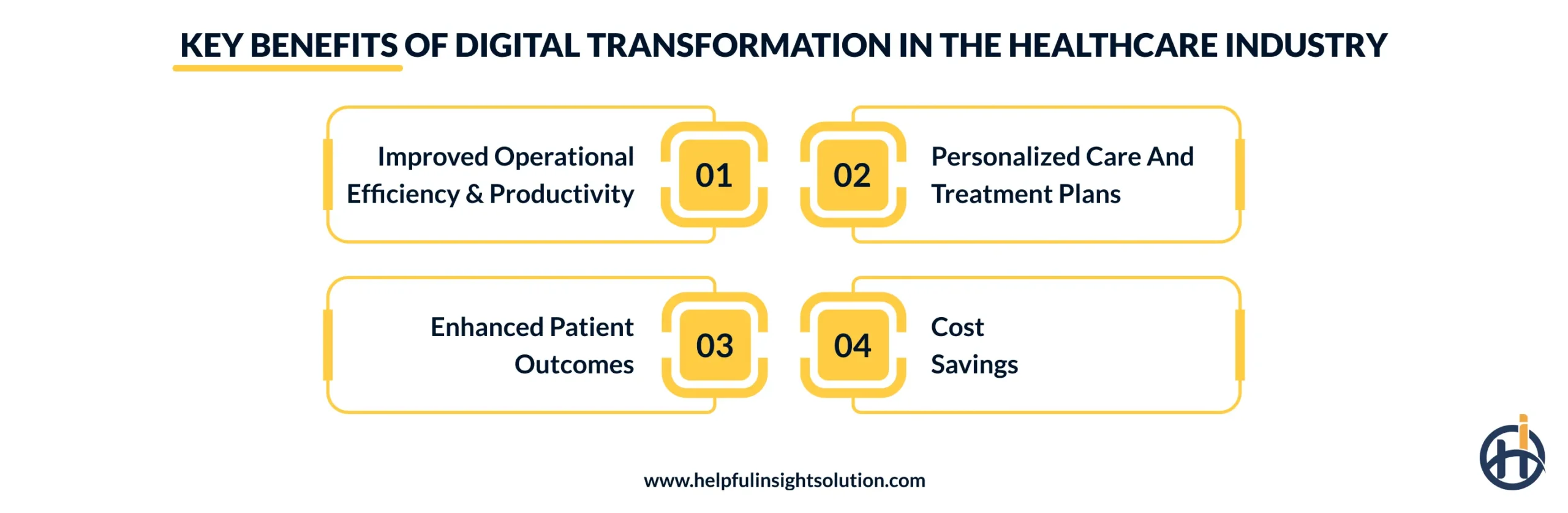
1. Improved Operational Efficiency and Productivity
Hospitals and clinics handle many tasks like paperwork, appointment scheduling, and billing. Using smart digital tools helps automate these processes, making work easier and faster.
This improves staff productivity and saves valuable time, allowing them to focus more on patient care. Automation truly plays a key role in digital transformation.
2. Personalized Care and Treatment Plans
Nowadays, patients expect personalized care, and providers can deliver using technologies like AI in healthcare and EHRs. These tools help doctors quickly access and share patient information, make faster decisions, and provide customized treatment plans, which was not possible before.
Using EHRs and EMRs alone is not enough, hospitals should use them wisely to give personalized care and make services faster.
3. Enhanced Patient Outcomes
When it comes to healthcare, every second matters, especially in life-threatening conditions. Digital transformation provides tools to quickly share medical records and lab results with healthcare professionals.
It also improves transparency, allowing patients to better understand their care plans. This leads to more informed decisions and better health outcomes.
4. Cost Savings
To make healthcare more affordable, healthcare organizations should use digital solutions. The focus should be on providing high-quality care and a better patient experience.
Hospitals can avoid wasting money by reducing unnecessary tests and slow processes. Online appointment booking and automated billing help lower staff workload and costs.
Technologies Driving Digital Modernization in Healthcare
To meet the growing patient expectations and deliver the best care, healthcare businesses are making use of some of the best modern technologies, which are:
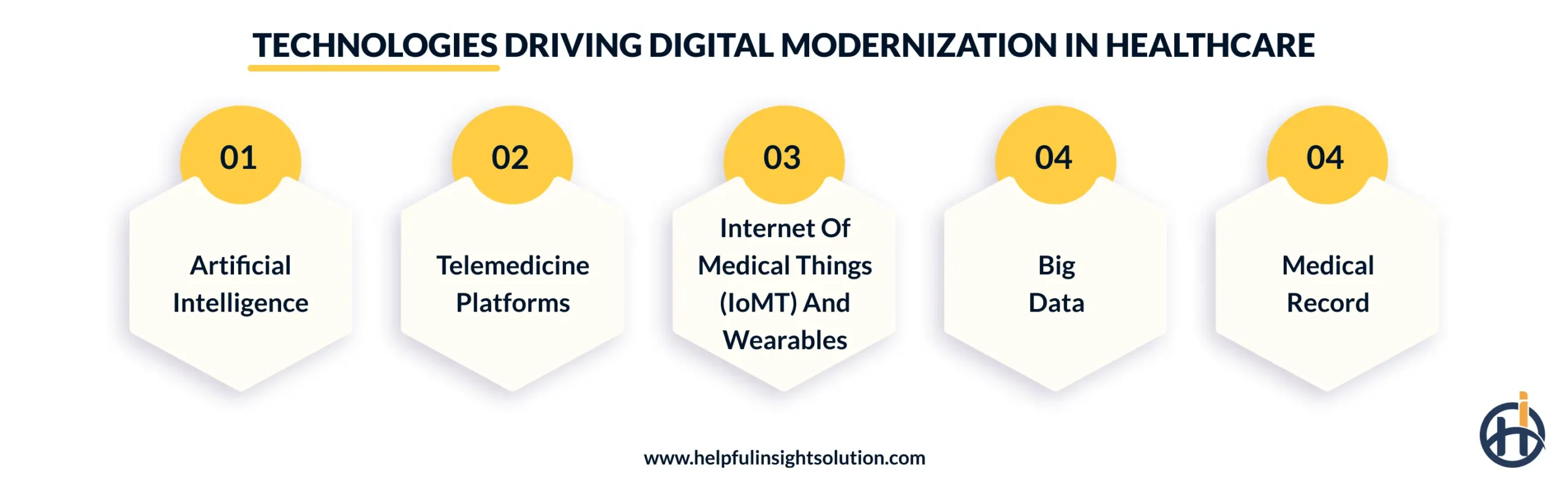
1. Artificial Intelligence
Providers widely use AI solutions to reshape different areas of healthcare, such as speeding up diagnoses and automating admin tasks, which improves the overall experience for both patients and doctors.
In fact, 22% of healthcare organizations have already implemented AI tools and are using them for tasks like clinical documentation, accelerating drug discovery, and AI chatbots to triage patient symptoms and provide 24/7 support.
2. Telemedicine Platforms
The demand for virtual consultations and remote care platforms is growing as it lets patients connect with doctors using their mobile phones, which is best for people who live far away or cannot travel easily.
Patients can book appointments, get reminders, and check reports online. Doctors can also track health using remote devices like wearables. Hence, this makes it easy for patients to get care, even when they have a packed schedule.
3. Internet of Medical Things (IoMT) and Wearables
The global Internet of Medical Things (IoMT) market is projected to reach $1,906.70 billion by 2034, underscoring the technology’s significant role in the digitalization of the healthcare industry. How?
It includes smart devices such as fitness bands, blood pressure monitors, and insulin pens that collect health data and send it to doctors in real time. This helps healthcare professionals check patients’ health metrics regularly without hospital visits.

4. Big Data
The healthcare sector has to manage a lot of paperwork, and there was a time when the industry relied only on pen and paper, making it difficult to find and store information. But not anymore, all thanks to big data.
By using data wisely, hospitals can instantly access full patient history and improve outcomes with reduced error rates. Predictive analytics solutions also help hospitals schedule the right amount of staff, so no one has to wait too long.
5. Medical Record
Healthcare leaders are using medical record technology to manage and organize patient data.
EHRs or Electronic Health Records store patient information digitally so doctors can quickly access and share records when needed. This reduces mistakes and improves patient care as care providers see the full patient medical history.
Moreover, modern solutions for digital transformation in healthcare use cloud-based storage to keep patient information private.
Steps to Follow for Successful Digital Transformation in Healthcare
If you have made up your mind to invest in healthcare technology transformation, then the main question arises: how to do that? In this section, we will discuss the key steps to achieve healthcare digital innovation.
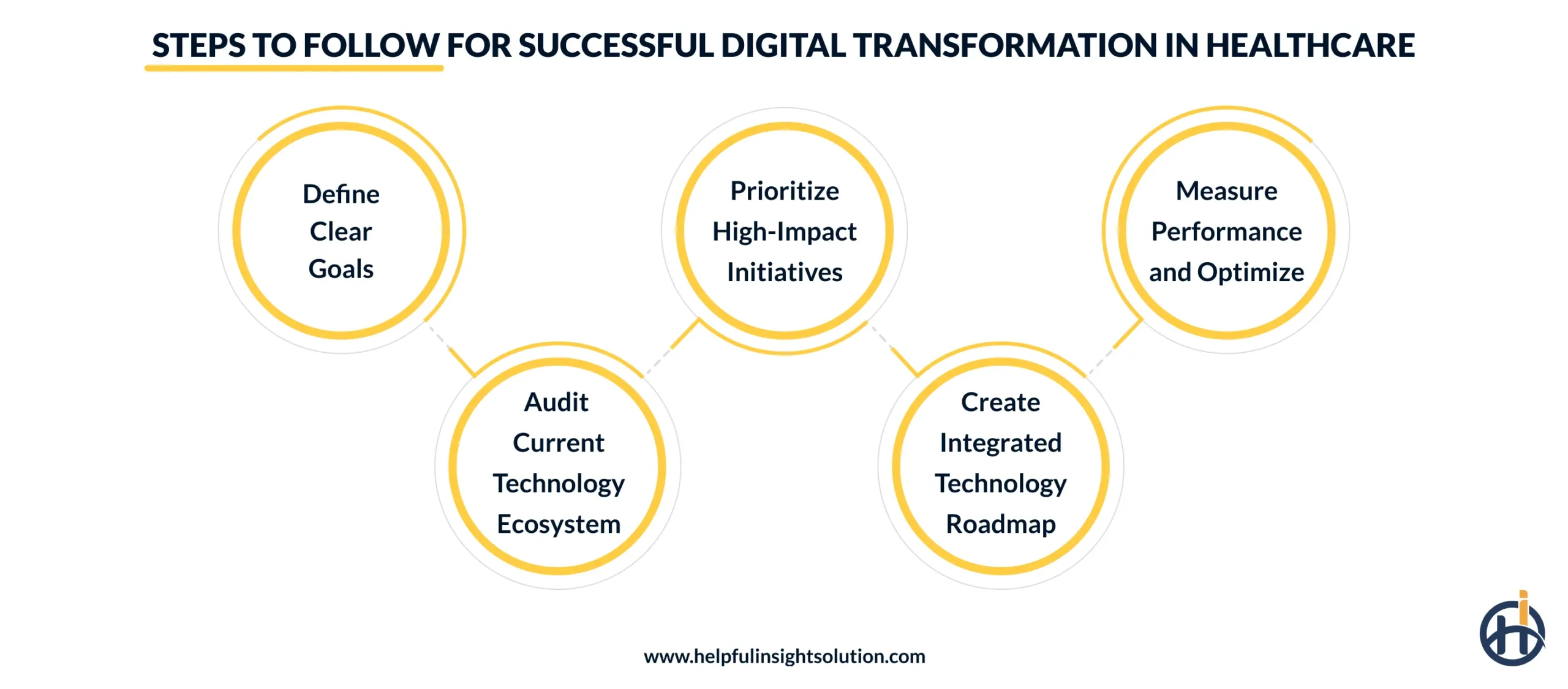
1. Define Clear Goals
Start by setting clear goals for digital change and deciding what you want to achieve. Find areas that need improvement, like patient care or everyday operational activities. This will give you clarity and help prepare a healthcare digital transformation strategy.
2. Audit Current Technology Ecosystem
Review the technologies you are already using and try to identify the issues in them, like outdated functionality, low user adoption or high maintenance cost. This helps you understand what needs fixing and where new technology can make things easier.
3. Prioritize High-Impact Initiatives
Focus on areas that provide the most benefit to patients and staff, like technology to facilitate remote consultations or smart data systems that improve care and save time.
Study patient needs to determine where technology can help the most. Choose ideas that align with your long-term goals, so you achieve better results.
4. Create Integrated Technology Roadmap
Here, experts will create a plan for adding new technology. This includes mapping out how solutions like data analytics in healthcare will work with current systems. Set timelines and assign tasks to the people with the right expertise.
Ensure all systems connect smoothly, like EHRs and telehealth. A good plan helps avoid confusion and makes the entire process simple and organized.
5. Measure Performance and Optimize
Once you have implemented the solution, keep checking how well your digital systems are working. Monitor points like waiting time, work speed, and results.
Use this data to find problems and make improvements. Update your processes regularly to get better results. This helps your system stay effective and adjust to new needs over time.
Challenges of Digital Transformation in Healthcare
The journey to adopt digital transformation solutions for healthcare is not simple; it brings certain obstacles, which are important for developers and businesses to understand.
| Challenge | Description | The Solution |
| Data Privacy | Keeping patient data safe in digital systems is difficult. Hackers can attack systems, steal records, and create serious privacy and security risks. | Developers should use strong security tools like encryption and multi-factor authentication. Check systems often and train staff to keep patient data safe. |
| Legacy System Interoperability | Outdated systems do not connect easily with new technology. This creates problems in sharing data among departments and slows down the work. | Use APIs to connect legacy systems with the new ones, or gradually replace old systems with cloud technology. |
| Resistance to Change | Healthcare professionals resist using new technologies because they fear that these will increase their workload or replace them. | Healthcare organizations should invest in training and educating the staff about the latest technologies, making them proficient with new tools. |
How Helpful Insight can Help you in Healthcare Digital Innovation?
Healthcare organizations have recognized that integrating healthcare and digital transformation is a necessary shift to make medical services faster and provide quality care. To enjoy maximum benefits, getting it done right is very important, and in that our healthcare app development company can help you.
We have hands-on experience in developing secure, scalable and intelligent digital solutions for care service providers like hospitals and healthtech startups.
Our team comprises certified developers who have the expertise to use the latest technologies like machine learning, AI and blockchain to create smart systems that facilitate digital transformation.
If you also want to future-proof your business, let us help you build a custom digital transformation solution for healthcare. To know more about our services, feel free to get in touch with our team.
FAQs
Digital innovation in the healthcare industry is of great importance as it helps boost operational efficiency, improve patient outcomes, and deliver better remote care. It also assists in making data-driven decisions and creating personalized treatment plans.
Digital modernization in healthcare can bring benefits to multiple stakeholders, including patients, healthcare providers, insurance and pharmaceutical companies.
Some of the popular examples of digital transformation in the medical and healthcare sector are:
- Telemedicine platforms
- Cloud-based patient portals
- IoT in medical care
- Electronic Health Records (EHRs)
To successfully adopt healthcare digital transformation solutions, make sure to:
- Understand your healthcare goals before choosing technologies
- Train staff to use new digital tools properly
- Start small, then slowly expand digital systems
- Choose easy-to-use and reliable technology solutions
- Regularly check and improve your digital processes