

“Strengthen your digital mobile services with a modern tech stack, offering safety and stability.”
The digital world is nothing without tools, technologies, and advanced innovations. For mobile, web, and software development, entrepreneurs need the latest components that can streamline their business tasks.
For example, selecting the right tech stack for healthcare app is crucial for hospital owners, clinics, or other medical service providers. This helps them to easily differentiate between the healthcare tech stack and solutions stack for developing mobile apps.
The choice is dependent on different phases of the app development process, like frontend, backend, API integration, and testing. Additionally, while choosing the right tech stack for your HealthTech,
It is important to focus on advanced technologies, such as AI and Blockchain. They collectively assist in the development of mobile applications, offering smart features.
In this guide to choosing a health app technology stack, we will study the major components and key technologies. At last, you will understand the methods of selecting the best possible tools for developing health applications. So, let’s first find out the need for a health tech stack.
Why Businesses Choose a Tech Stack for Healthcare App Development?
As there are multiple benefits of a mobile tech stack, businesses use it as a core function for developing mobile apps. Let’s understand some major reasons behind its extensive usage:
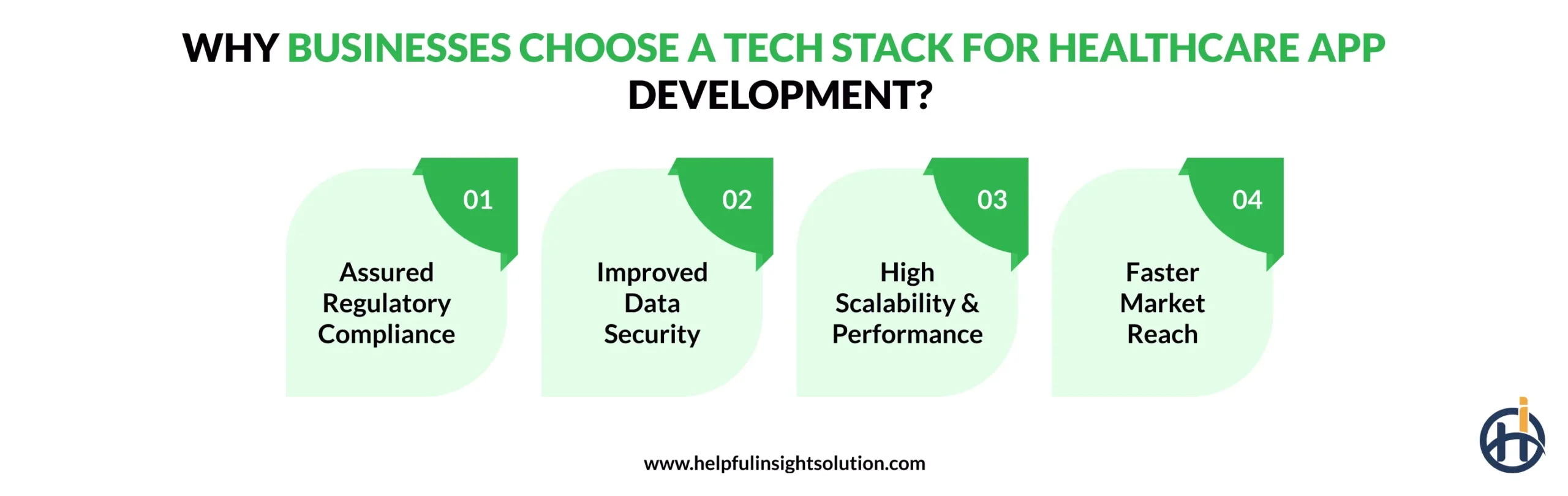
1. Assured Regulatory Compliance
Through secure data handling, the appropriate technology stack for creating a medical app facilitates adherence to industry regulations such as HIPAA. By doing this, companies can stay out of trouble with the law and keep the confidence of physicians and patients.
2. Improved Data Security
Advanced encryption, secure APIs, and access control are all provided by the appropriate technology stack in medical SaaS applications. To guarantee data integrity and defense against cyberattacks, it integrates with current ecosystems.
3. High Scalability & Performance
The tech stack is a straightforward concept that involves the performance and scaling of multiple parameters, such as features, data volume, and user demand. Without sacrificing system stability, it guarantees steady performance even during periods of high usage.
4. Faster Market Reach
Development, testing, and deployment are accelerated by utilizing the mHealth app development tech stack with frameworks and cloud technologies. This makes it possible for companies to introduce mHealth solutions more quickly and maintain their competitiveness in a market that is changing quickly.
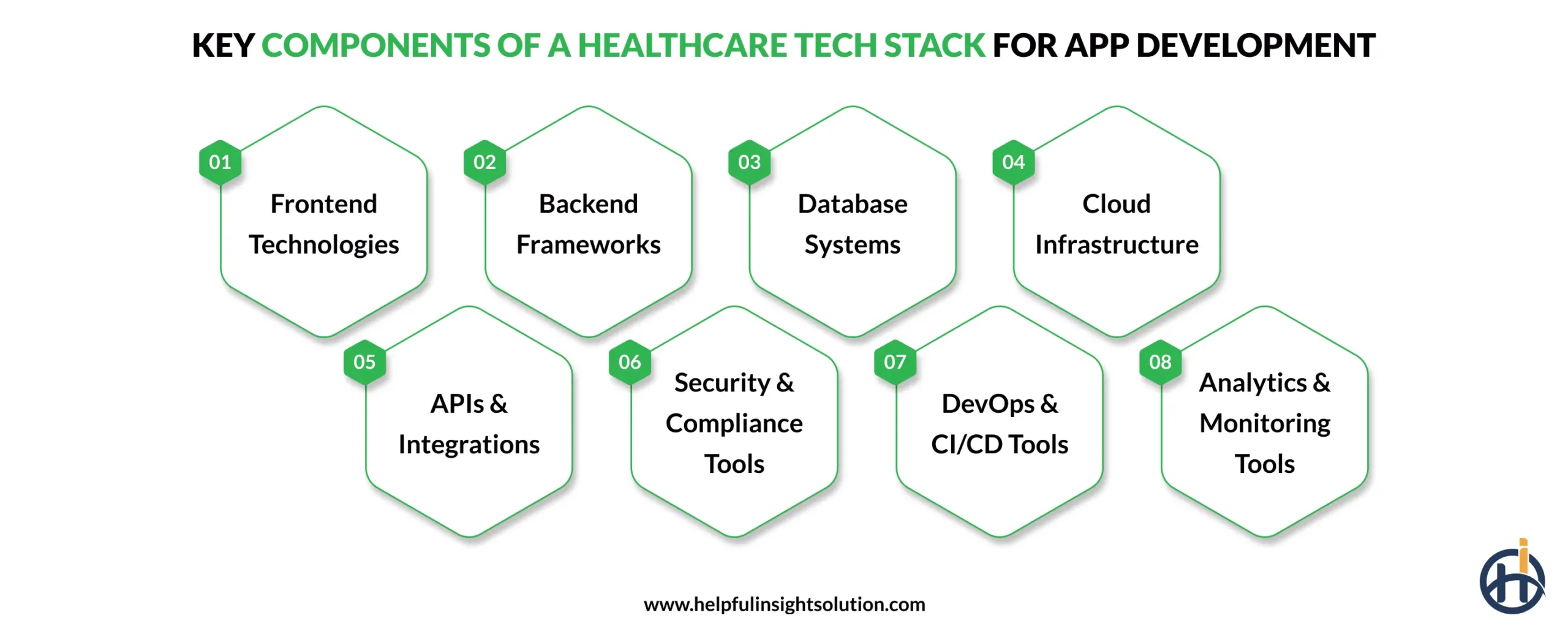
Key Components of a Healthcare Tech Stack for App Development
Now, we will explore the commonly used tech stack for health app building with the following components. These tools are based on the development stages and medical system requirements:
1. Frontend Technologies
The frontend, which guarantees user-friendly navigation for clients, is the first part of the mobile app tech stack. It makes cross-device accessibility, responsive designs, and fluid data visualization possible. In digital solutions, a robust frontend increases user trust and engagement.
- Xamarin
It enables cross-platform solutions using a single C# codebase, ensuring consistent performance across iOS and Android. This reduces development time, supporting secure patient and doctor experiences.
- TypeScript
It enhances JavaScript with static typing, making applications more reliable and easier to scale. This helps developers reduce errors in complex systems like EHRs and telemedicine platforms.
- Dart
Dart is a programming language optimized for building high-performance mobile apps, especially with Flutter. It supports fast UI rendering and smooth user experiences for patient-centric applications.
2. Backend Frameworks
The backend framework is an additional component that manages data processing, app logic, and software communication for electronic health records. To guarantee scalability, dependability, and the ability to manage intricate workflows, you can hire Flutter developers. Secure medical operations and data exchange are supported by a strong backend.
- Spring Boot
Spring Boot simplifies backend development for mobile apps by enabling the rapid creation of secure APIs. It is widely used for handling patient data, workflows, and integrations with medical systems.
- Django
Django is a robust Python framework ideal for building secure and scalable mobile platforms. Its built-in security features help protect sensitive patient data and support compliance requirements.
- Node.js
Node.js allows mobile apps to handle real-time data processing and high-volume requests efficiently. It is commonly used for chat systems, appointment scheduling, and remote monitoring applications.
3. Database Systems
Database systems store and manage sensitive mobile data, such as medical histories and patient records. This tech stack for mobile apps ensures high availability, data integrity, and fast data retrieval. Choosing the right database structure is crucial for enhanced performance and regulatory compliance.
- PostgreSQL
For structured mobile data, such as clinical reports and patient records, PostgreSQL is an effective relational database. It provides advanced querying capabilities, data integrity, and high reliability.
- MongoDB
A NoSQL database model called MongoDB was created to accommodate flexible and unstructured medical data. It also does a good job of storing device data, medical logs, and changing patient information.
- MySQL
MySQL is a widely used relational database that supports fast and secure mobile application development. It is ideal for managing transactional data such as appointments, billing, and user records.
4. Cloud Infrastructure
Scalable computing resources are made available by a cloud infrastructure to accommodate expanding mobile applications. It also makes disaster recovery, safe data storage, and worldwide data accessibility possible. While preserving performance, a cloud-based clinical information system also lowers infrastructure expenses.
- AWS
Amazon Web Services provides scalable cloud infrastructure for hosting mobile applications securely. Additionally, it supports HIPAA-compliant services, medical data storage, and advanced analytics.
- Microsoft Azure
Microsoft Azure offers cloud solutions tailored for mobile app development, including AI and data analytics. This also integrates with enterprise mobile systems and various franchise software.
- Google Cloud Platform
Google Cloud Platform enables mobile apps to leverage powerful data analytics and machine learning models. This tool supports secure storage, processing, and execution of large-scale medical data.
5. APIs & Integrations
Through API integrations, mobile apps link to external systems such as payment gateways or EHRs. The HealthTech app development tech stack guarantees platform interoperability and quick data exchange. This connectivity improves the app’s overall functionality and user experience.
- FHIR APIs
FHIR APIs standardize mobile data exchange between systems like EHRs and patient applications. They enable seamless interoperability and real-time access to clinical information in a secure manner.
- RESTful APIs
They allow mobile applications to communicate efficiently with third-party medical services. Additionally, they are commonly used for data exchange, integrations, and mobile app connectivity.
- GraphQL
GraphQL enables mobile apps to deliver precise user data in a single request without error. This improves the overall performance and reduces bandwidth usage in complex medical applications.
6. Security & Compliance Tools
Medical apps are protected from online threats and illegal data access by a variety of security and compliance tools. They are crucial technological elements that adhere to legal requirements like GDPR and HIPAA. User trust is increased, and patient data confidentiality is guaranteed by a robust security firewall structure.
- OAuth 2.0
This security tool provides secure authentication and authorization for mobile applications. Additionally, it ensures controlled access to sensitive patient and mobile data, preventing attacks.
- SSL/TLS Encryption
The SSL/TLS encryption method protects mobile data during the transmission process. This technique ensures the security of patient information from unauthorized access and multiple cyber threats.
- Keycloak
Keycloak is an identity and access management tool, providing secure solutions for mobile platforms. It simplifies user authentication, role-based access, and medical compliance with security standards.
7. DevOps & CI/CD Tools
Continuous improvement, fewer errors, and quicker updates are made possible by this tech stack component for mobile apps. Numerous tasks related to development, testing, and deployment are automated by DevOps and CI/CD tools. For many users around the world, it guarantees that mobile apps stay dependable and updated.
- Docker
Docker enables the containerization of mobile applications for consistent deployment across environments. This mobile tool improves scalability, reliability, and development efficiency.
- Jenkins
Jenkins is a DevOps tool that automates testing and deployment pipelines for mobile apps. Additionally, it regularly maintains the quality of code and ensures faster market releases.
- GitHub Actions
GitHub Actions supports advanced CI/CD automation for creating mobile applications. This tool streamlines build, test, and deployment workflows for medical systems through repositories.
8. Analytics & Monitoring Tools
System health, user behavior, and app performance are tracked by sophisticated analytics and monitoring tools. They also offer useful information to enhance patient outcomes and functionality. Operational optimization and early problem detection are achieved through ongoing analysis of successful tech stack patterns.
- Google Analytics
To track user behavior and platform engagement, Google Analytics is the best tool for mobile apps. It provides various information to improve the overall patient experience and mobile app performance.
- Firebase Analytics
Another tool is Firebase Analytics, which offers efficient mobile data based on different usage parameters. Additionally, it monitors user activities, feature adoption, and retention rate in real-time.
- New Relic
The New Relic tool provides performance-based monitoring for different mobile applications. This identifies congestion, ensures uptime, and regularly maintains smooth user experiences across devices.
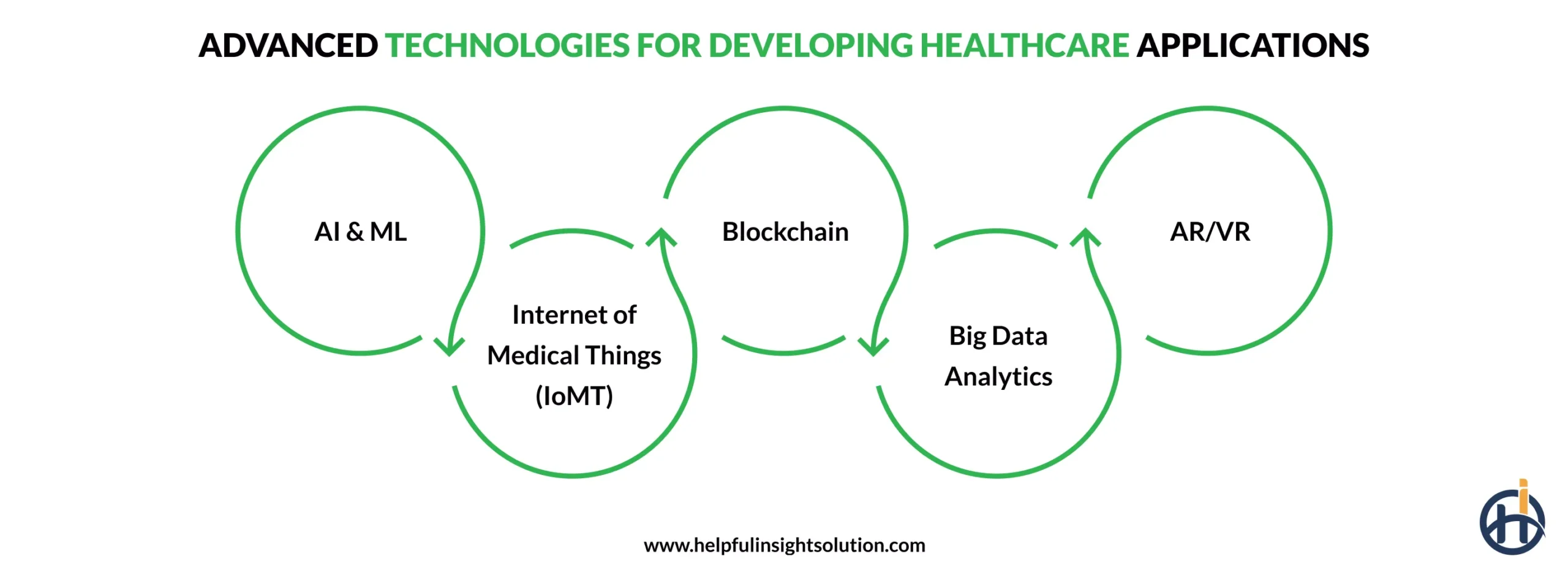
Advanced Technologies for Developing Healthcare Applications
Some advanced technologies are also used in a health tech stack that helps in streamlining mobile applications. In this section, we will study major technologies that are common among businesses:
1. AI & ML
The use of ML and AI in mobile enables mobile apps to analyze complex medical data and predict results. The smart telemedicine app tech stack provides features like disease detection, medical imaging analysis, and AI chatbots. They improve diagnostic accuracy and support data-driven clinical decisions.
- TensorFlow
It builds and deploys ML models for medical imaging, disease prediction, and clinical decision support. Additionally, it supports scalable AI solutions for real-time diagnostics and personalized patient care.
- PyTorch
This technology is widely used to develop deep learning models in areas like medical imaging analysis and genomics. Its dynamic computation graph allows rapid experimentation and faster model iteration.
2. Internet of Medical Things (IoMT)
Various medical devices and wearables are easily connected with health apps for data exchange through IoMT. It is the best mobile technology, allowing continuous patient monitoring and remote care. This innovation enhances preventive care while improving operational efficiency for mobile providers.
- Medical Sensors
They collect physiological data such as heart rate, blood pressure, and oxygen levels from patients. This plays a vital role in remote patient monitoring, early diagnosis, and preventive mobile solutions.
- IoT Gateways
It is a bridge between medical devices and health systems by transmitting sensor data to cloud platforms. This ensures secure data collection, protocol translation, and communication in health environments.
3. Blockchain
Businesses use Blockchain Development Services to ensure secure and transparent management of mobile data. It protects electronic health records, streamlines data sharing, and prevents unauthorized data access. By enhancing data integrity, the technology stack used in mobile apps improves compliance and patient data privacy.
- Hyperledger Fabric
It provides a restricted blockchain framework for secure mobile data exchange. Additionally, it enables transparent record management, access control, and interoperability among mobile stakeholders.
- Ethereum Smart Contracts
Ethereum smart contracts automate mobile workflows such as insurance claims, consent management, and clinical trials. They ensure trust, transparency, and tamper-proof execution of mobile transactions.
4. Big Data Analytics
One of the best full-stack mobile technologies that easily processes mobile data from multiple sources is Big Data Analytics. It supports population health management, predictive analytics, and personalized medicine. Medical apps use it to optimize treatments, reduce costs, and improve patient care.
- Apache Hadoop
The technology enables health apps to store and process massive volumes of structured and unstructured medical data. It supports large-scale analytics for population health management and clinical research.
- Apache Spark
Apache Spark delivers memory-based fast data processing for mobile analytics and real-time insights. It is ideal for predictive modeling, patient risk analysis, and streaming mobile data processing.
5. AR/VR
Augmented and Virtual Reality transform mobile apps through interactive user experiences. This technology in the health domain is used for medical training, patient education, and therapy sessions. Additionally, it improves clinical accuracy, learning outcomes, and the patient engagement model.
- Unity
The Unity platform helps in developing interactive mobile apps such as medical training simulations and rehabilitation programs. It supports realistic 3D environments for enhanced learning and patient engagement.
- ARKit/ARCore
ARKit and ARCore enable augmented reality experiences in mobile apps for surgical guidance and medical visualization. They enhance precision, training efficiency, and interactive patient education.
How to Choose the Right Health Tech Stack for Developing Mobile Apps?
As a business investor, you must select the correct mobile app tech stack for mobile. Here, we are discussing some important ways that help in choosing the right development tools and technologies:
1. Assess Medical Requirements
Businesses should identify various mobile problems, such as patient engagement and remote monitoring, that an app can solve. Understanding user roles, compliance needs, and data flow helps in selecting the most suitable mobile app development tech stack.
2. Prioritize System Privacy
You must know how to choose the best health tech stack based on remote patient care, data privacy, and hospital management. Choose technologies that support data encryption, secure APIs, and compliance with mobile regulations like HIPAA and GDPR.
3. Consider Development Cost
Evaluating the total cost of ownership, including development and maintenance, is among the most important factors in selecting a tech stack for mobile. A balanced tech stack ensures high performance without exceeding the healthcare app development cost and budget constraints.
4. App Type & Features
The type of mobile app, such as telemedicine, fitness tracking, or EHR, directly influences technology choices. Features like data management, AI analytics, or wearable integration require the best tech stack for mobile apps with advanced frameworks and tools.
5.Evaluate Platform Needs
It is important to select the right tech stack for your mobile app based on native, cross-platform, or hybrid platforms. This compatibility impacts the overall user experience, development time, and long-term scalability.
How Helpful Insight Helps Businesses Select the Right Framework for Building Health Apps?
You can now start listing your business requirements and target the best tech stack for creating advanced health platforms. It is highly recommended to approach a healthcare app development company to access the latest tools and technologies for creating medical apps.
The health tech stack used by our experts helps businesses to easily integrate AI solutions, advanced EHR models, and patient tracking features in their existing platforms.
We identify the correct business model with requirements and suggest the medical app development tech stack accordingly. This helps you to provide efficient patient care features and hospital management services.
You must invest in building your health tech stack foundation, resulting in optimized mobile features and increased brand value.
FAQs
In a healthcare application, the frontend is an important part that directly contacts the user. You must use the following methods for selecting a frontend framework for health platforms:
- Choose frameworks with strong security, accessibility, and regulatory compliance.
- Prefer scalable and high-performance options like React or Angular for complex UIs.
- Ensure easy integration with APIs, EHR systems, and cross-platform capabilities.
For making a mobile app with high security and compliance, it is important to select appropriate programming languages. They are described in the following manner:
- Java and Kotlin: They are used in Android due to their strong security and stability.
- Swift: Used in iOS because of performance, memory safety, and security standards.
- Python and Node.js: Integrated for backend with robust security libraries and frameworks.
A technology stack for developing mobile healthcare applications always includes testing and security tools. It helps in identifying potential bugs and errors in the system code, making it lightweight for smooth execution. The major mobile app testing tools for healthcare include Appium and Espresso, which are common among developers.
It is important to know the best cloud-based services for data storage used to develop healthcare applications. These cloud solutions are discussed through the following points:
- AWS for HIPAA-eligible services, scalability, and advanced AI/ML healthcare tools.
- Microsoft Azure for healthcare compliance, HL7/FHIR support, and enterprise security.
- Google Cloud for secure data analytics, AI-powered insights, and healthcare APIs.