

“Strategize your business growth by automating all operations with AI technologies.”
Have you ever wondered how to simplify various operations and extend the lifecycle of your business? By utilizing AI for business process automation, you can streamline various tasks, including billing, inventory management, customer care, development, and marketing.
According to PwC, one of the biggest accounting firms, the use of AI in business operations can boost efficiency and ROI to 60%, with a 55% improvement in the user experience.
This shows how AI is revolutionizing automation and predictive maintenance for various industries, like healthcare, finance, logistics, and manufacturing.
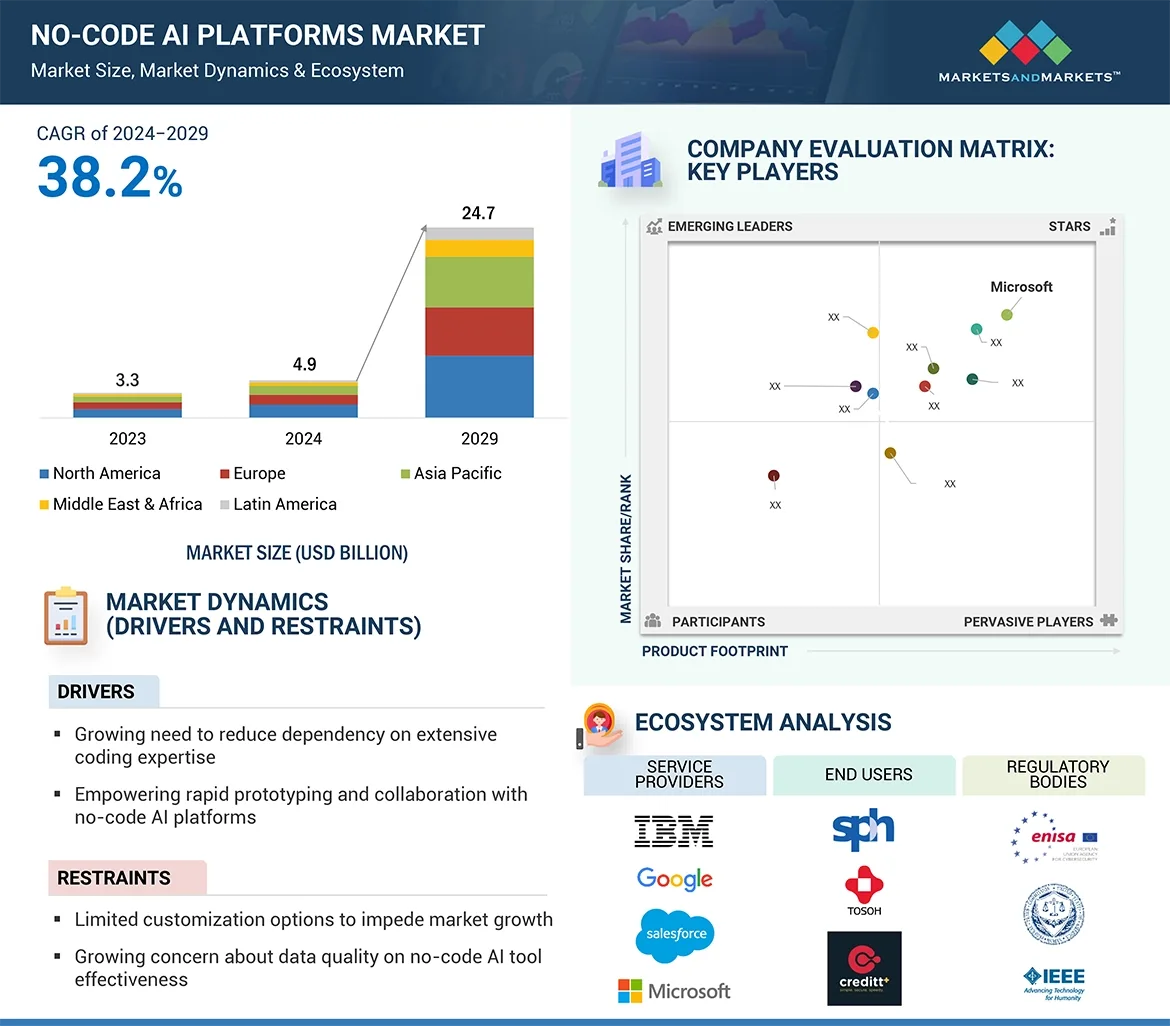
If we talk about the revenue, the overall market size will be $24.8 billion by 2029 with a 38.2% CAGR rate between 2025 and 2029. It becomes mandatory to accept the business process automation with AI technologies.
Here, you will understand different aspects connected with AI development solutions for business process automation. So, focus all your strength and start along with us in this journey to enhance your business value. Let’s dive into the content and explore the power of AI.
What is Business Process Automation?
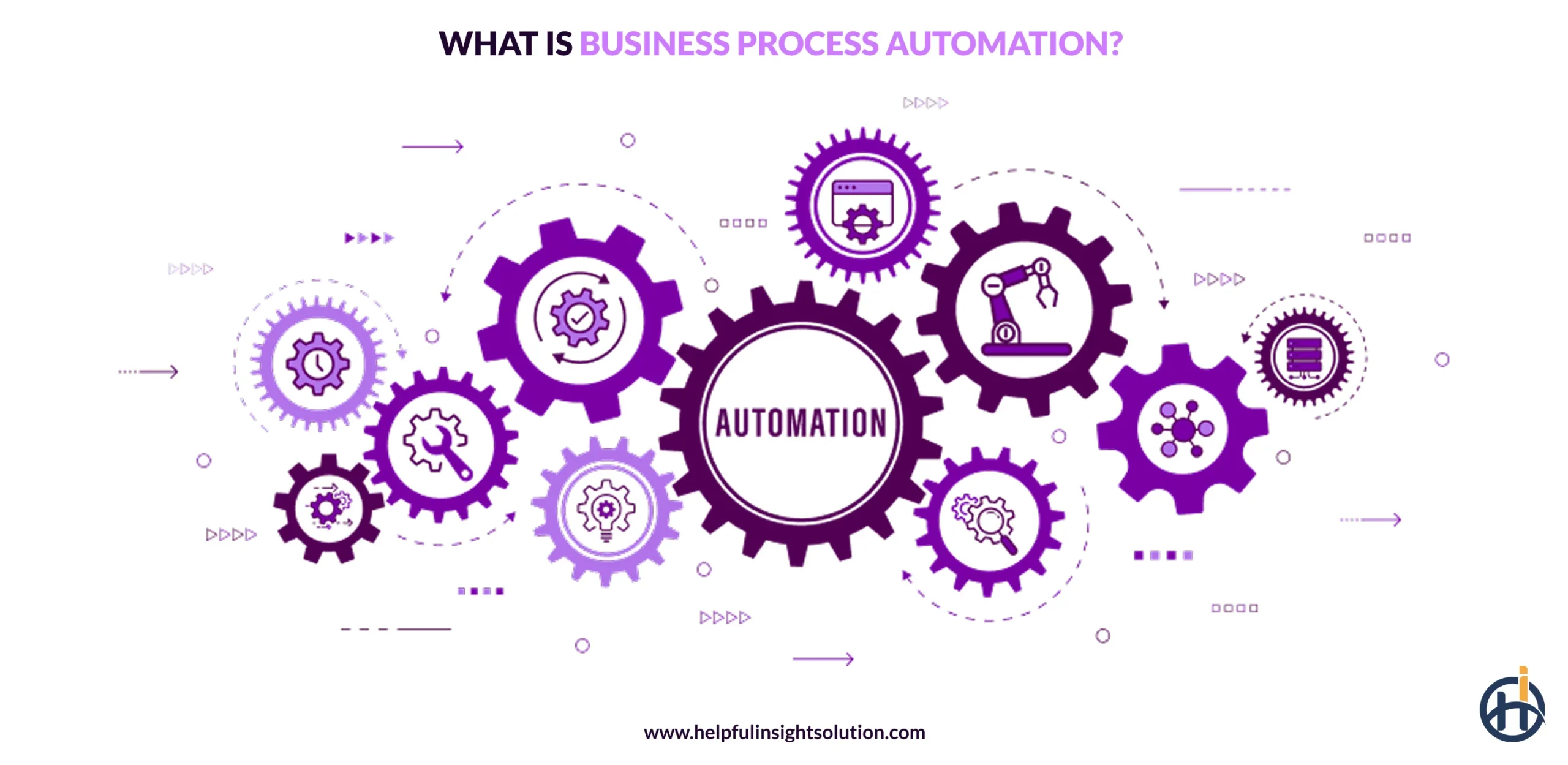
The automation has now become a need for all, whether it is a business investor or a common person. Talking particularly about business process automation, it helps entrepreneurs to manage daily repetitive tasks, multi-stage operations, and digital workflow. With advanced AI automation solutions, these processes are becoming more efficient and productive at reduced costs.
Additionally, new AI business ideas, focusing on different domains, are already automated and smartly integrated with personalized user preferences. Only for automation,
the global revenue will reach $19.6 billion in 2026 with a 12.2% CAGR rate. So, it is necessary to use AI-powered solutions in business process automation to improve the overall user experience.
- Improved Efficiency: Automates repetitive tasks to speed up workflows and reduce manual effort.
- Cost Reduction: Minimizes operational costs by lowering errors and labor dependency.
- Better Accuracy & Security: Ensures consistent processes with fewer mistakes and easy tracking.
Role of AI in Business Process Automation
Artificial Intelligence is the core technology behind multiple business operations, tasks, and processes. It is one of the most powerful technologies that allows different systems to work on their own with limited human intervention.
The use of AI for business process automation software enhances resource management, improves accuracy, and focuses on strategy-making.
By the end of 2027, the market size of intelligent process automation will be $25.9 billion, growing at a 13.8% CAGR rate. The integration of business process automation with AI involves the benefits of Machine Learning, NLP, and virtual robotics.
So, the first step towards business innovation is to use AI development services, from consulting to deployment, at affordable rates.
- Workflow Automation: Streamlines repetitive tasks by automating end-to-end workflows.
- Intelligent Decision-Making: Analyzes large datasets to provide real-time insights.
- Process Optimization: Identifies inefficiencies to improve speed, accuracy, and efficiency.
- Predictive Analytics: Forecasts demand, risks, and performance trends to enable business actions.
- Customer Support Automation: AI-powered chatbots handle queries, reducing response time and costs.
Key Benefits of AI for Business Process Automation
There are several industrial benefits of AI-powered automation for business processes that you must know. In this section, we will observe some of the major BPA advantages:
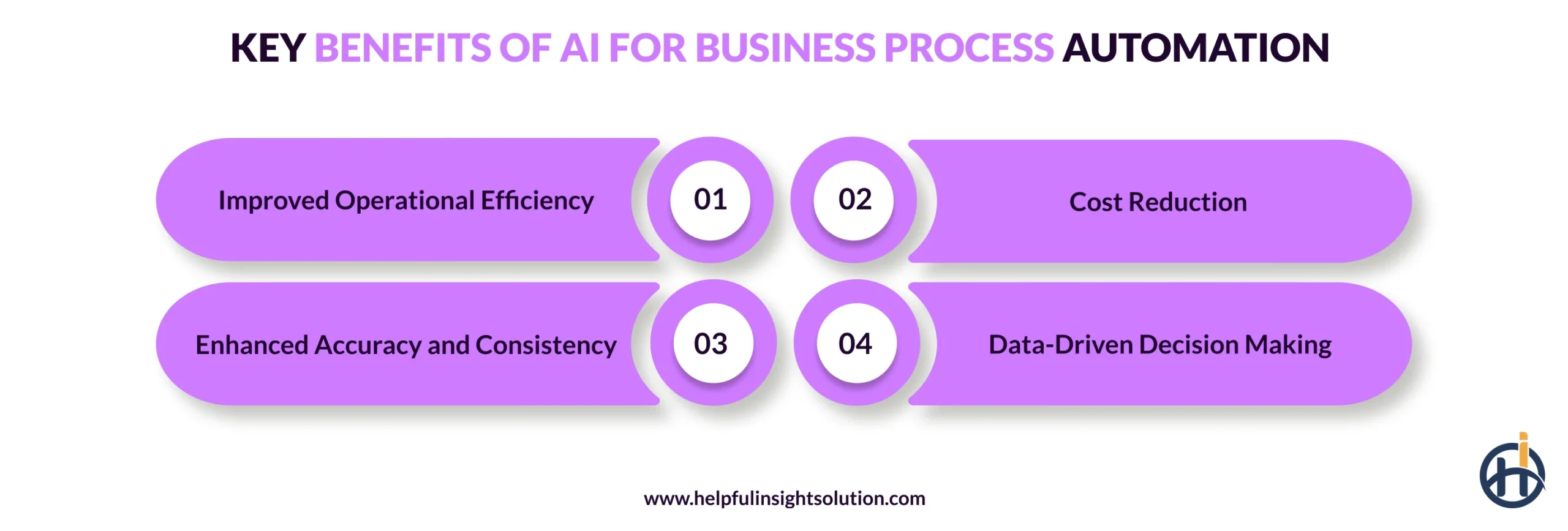
1. Improved Operational Efficiency
AI automates repetitive tasks, allowing workflows to run faster with minimal human intervention. The business process automation services help focus on high-value activities that ensure smooth operations.
2. Cost Reduction
Artificial Intelligence business process automation reduces manual labor, minimizes errors, and lowers maintenance costs. Businesses can optimize resource utilization, leading to long-term financial savings.
3. Enhanced Accuracy and Consistency
The AI in portfolio management follows rules and learns from data, ensuring consistent outcomes. This is another benefit of AI business process automation that improves reliability and reduces risks.
4. Data-Driven Decision Making
AI analyzes large volumes of data in real time to uncover patterns for business process automation using machine learning. This enables businesses to make strategic decisions based on accurate information.
Top Use Cases of AI Business Process Automation
As an entrepreneur, you should know various use cases of AI for business process automation. Here, we will study the top 10 industrial uses of AI-powered BPA with detailed information:
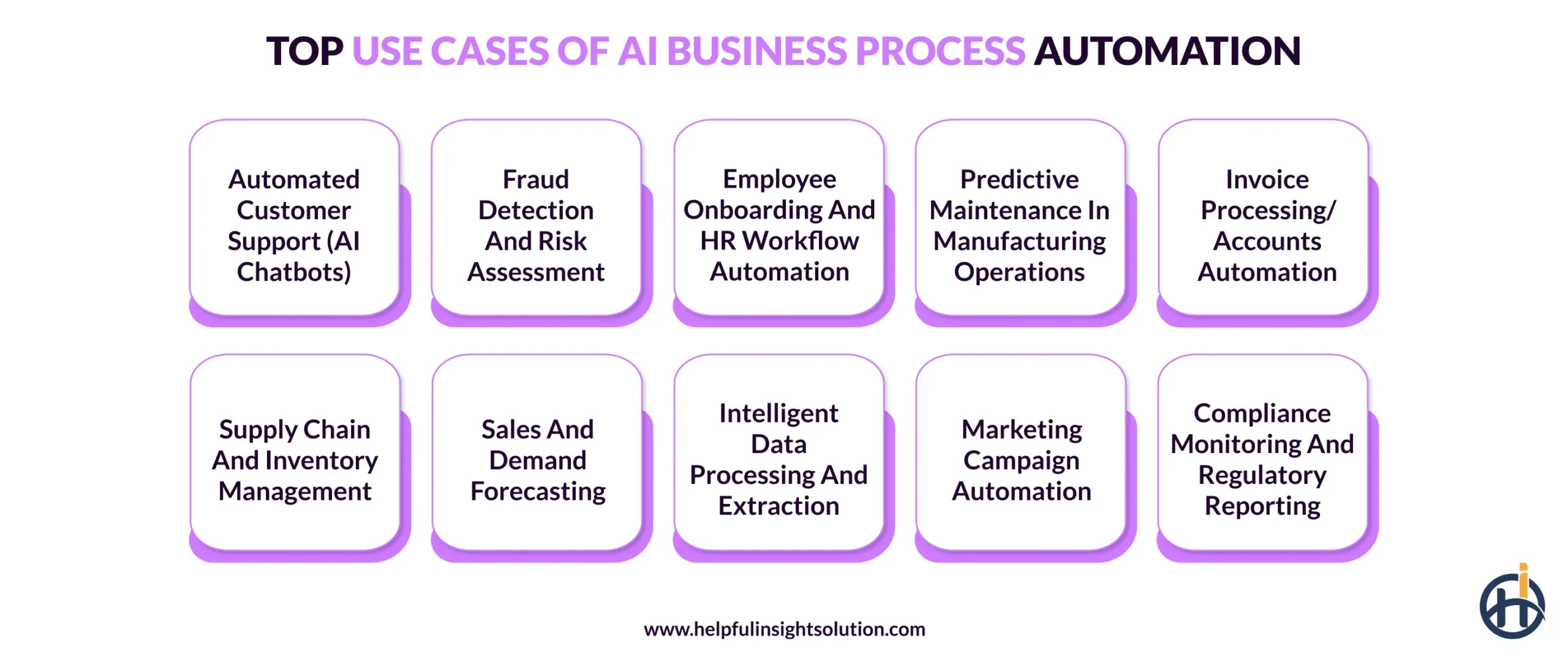
1. Automated Customer Support (AI Chatbots)
AI chatbots automate customer support by handling common queries across chat, email, and voice channels. They provide 24/7 assistance, reduce response time, and improve customer satisfaction.
AI-driven bots are the future of AI in business process automation, delivering accurate and personalized responses. This automation lowers operational costs while ensuring consistent service quality.
2. Fraud Detection and Risk Assessment
AI-powered fraud detection systems analyze large volumes of transactions to identify unusual patterns. These AI agents in finance help businesses prevent financial fraud by flagging suspicious activities early.
Machine learning models continuously improve accuracy by learning from historical data. This business process automation software reduces financial losses and strengthens overall risk management.
3. Employee Onboarding and HR Workflow Automation
AI automates employee onboarding by streamlining document verification, training schedules, and policy distribution. HR workflow automation reduces manual effort in payroll, attendance, and performance tracking.
Intelligent systems ensure faster onboarding and better employee experience. AI business process automation allows HR teams to focus on strategic workforce planning.
4. Predictive Maintenance in Manufacturing Operations
AI-driven predictive maintenance monitors equipment performance using real-time sensor data. It is one of the important use cases of AI business process automation that predicts potential failures before they occur, minimizing unexpected downtime.
Automated alerts help schedule timely maintenance and reduce repair costs. This improves asset lifespan and ensures uninterrupted manufacturing operations.
5. Invoice Processing/Accounts Automation
AI automates invoice processing by extracting, validating, and matching invoice data with purchase orders. It reduces manual data entry errors and speeds up approval workflows.
Intelligent automation with business process automation services ensures accurate payments and better cash flow management. Businesses gain improved efficiency and financial transparency.
6. Supply Chain and Inventory Management
AI optimizes supply chain operations by forecasting demand and monitoring inventory levels. Automated systems reduce stock shortages and excess inventory by analyzing the overall workflow.
It is among the best AI business process automation use cases that improve supplier coordination and logistics planning. This leads to cost savings and smoother end-to-end supply chain operations.
7. Sales and Demand Forecasting
AI analyzes historical sales data, market trends, and customer behavior to predict future demand. Automated forecasting helps businesses plan inventory, pricing, and promotions more accurately. It reduces uncertainty in sales planning and improves revenue predictability.
This use case shows how AI is transforming business process automation with smarter support and decisions.
8. Intelligent Data Processing and Extraction
AI automates data processing by extracting information from documents, emails, and scanned files. Technologies like OCR and NLP convert unstructured data into usable formats, which is the main role of AI in sports and fitness.
It is among the key AI business process automation use cases that reduce manual workload and improve data accuracy. Businesses can quickly access insights for faster decision-making.
9. Marketing Campaign Automation
AI automates marketing campaigns by analyzing customer behavior and segmenting audiences intelligently. It enables personalized content delivery across email, social media, and ads.
The business process automation software uses automated optimization to improve campaign performance and ROI. Marketers benefit from real-time insights and reduced manual effort.
10. Compliance Monitoring and Regulatory Reporting
AI automates compliance monitoring by continuously tracking regulations and business activities. It is one of the best AI business process automation use cases that identifies potential violations and ensures timely reporting.
The use of automated regulatory reporting reduces human errors and compliance risks. This helps various organizations maintain transparency and avoid penalties.
Real-World Applications of AI-Driven BPA
Some realistic applications of AI for business process automation are available, providing effective operation handling. Let’s study each of these platforms with a unique feature:
-
UiPath
UiPath uses AI-powered robotic process automation to streamline repetitive business tasks like data entry, invoice processing, and reporting. These AI automation solutions help organizations improve efficiency, accuracy, and scalability across departments.
AI Document Understanding: Automatically reads, classifies, and extracts data from invoices, forms, and emails to speed up document-heavy business processes.
-
Automation Anywhere
Automation Anywhere combines AI and machine learning to automate complex business workflows in finance, HR, and customer support. Artificial Intelligence for business process automation enables faster decision-making while reducing manual effort and operational costs.
Intelligent Process Discovery: Uses AI to analyze user actions and system logs to identify automation opportunities and optimize workflows.
-
ServiceNow
ServiceNow leverages the top AI business process automation solutions to optimize IT service management, customer service, and enterprise workflows. The use of AI for enterprise improves service delivery, issue resolution, and overall operational visibility.
AI-Powered Virtual Agent: Handles employee and customer service requests automatically by understanding intent and routing issues without human intervention.
-
IBM Business Automation Workflow
IBM Business Automation Workflow integrates AI with process management to automate business operations. This is among the best real-world applications of AI in business process automation that enhances productivity, improves workflow orchestration, and manages compliance.
Predictive Task Routing: Applies AI to assign tasks to the best employee based on skills, workload, and past performance.
-
Pega (Pegasystems)
Pega uses AI-powered decisioning and workflow automation to personalize customer journeys and streamline business processes. These applications in business process automation enable adaptive automation for improved customer engagement and efficiency.
Real-Time Decision Management: Uses AI to make instant, personalized decisions within workflows, improving customer engagement and operational efficiency.
How to Integrate AI Automation in Business Processes?
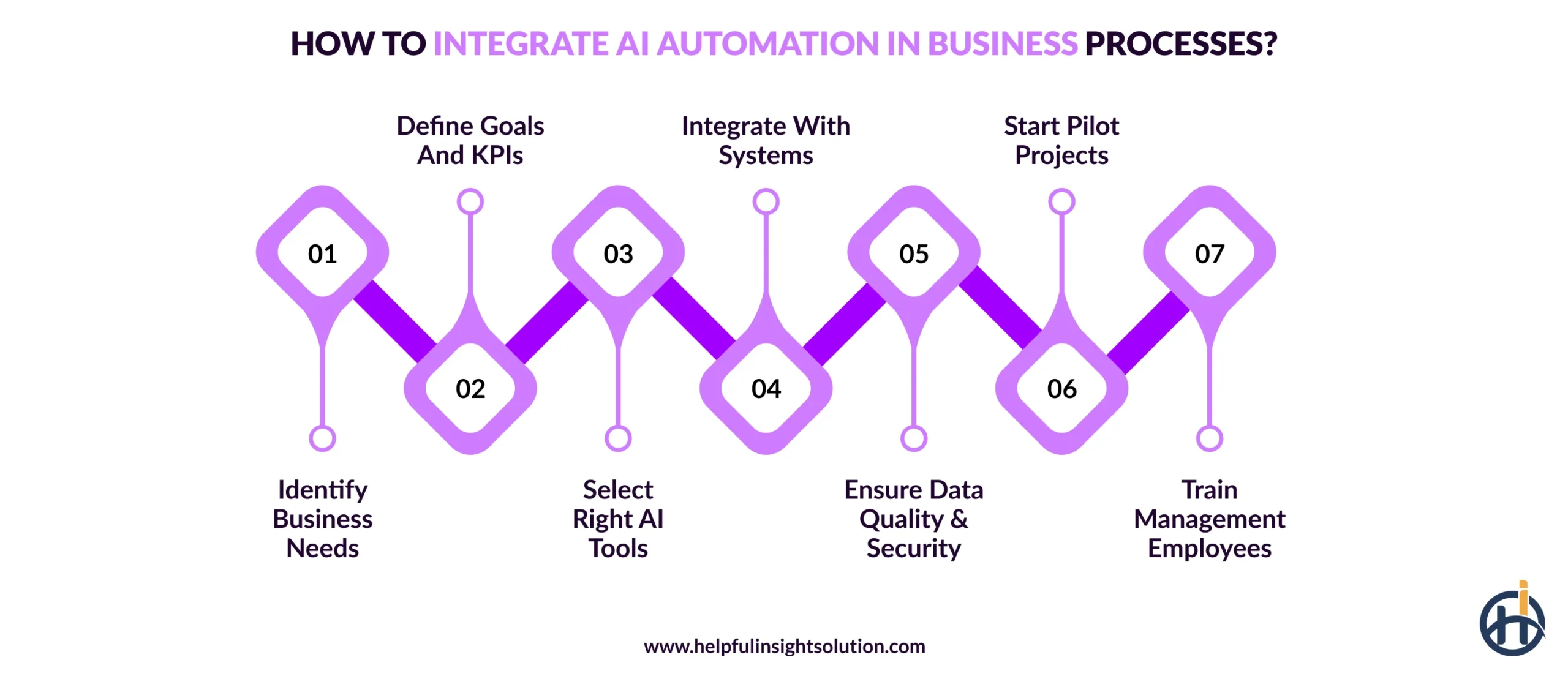
It is important to know the process of integrating AI for business process automation software. We will deeply understand the complete procedure with the following steps in this section:
-
Identify Business Needs
You should begin by analyzing existing workflows to find inefficiencies, repetitive tasks, and crucial areas. Engage stakeholders from different departments to understand how to implement AI automation in your business.
This ensures AI automation targets practical problems rather than theoretical use cases. A clear needs assessment forms the foundation of successful AI adoption.
-
Define Goals and KPIs
It is important to clearly outline AI-powered business process automation goals to achieve, such as cost reduction, faster processing, or improved accuracy. You must set measurable KPIs like turnaround time, error rates, or customer satisfaction scores. For example,
AI in healthcare helps track progress and justify investment. Well-defined goals keep AI initiatives aligned with business strategy.
-
Select Right AI Tools
Entrepreneurs must choose top AI business process automation tools that match their business requirements, data maturity, and scalability needs. Consider factors such as ease of integration, customization, vendor support, and cost.
Avoid overly complex solutions if simpler tools can deliver results. The right selection ensures faster adoption and better ROI efficiency.
-
Integrate With Systems
As an investor, you should connect AI development services for business process automation with existing systems like ERP, CRM, or HR platforms.
Proper integration enables smooth data flow and minimizes operational disruptions. APIs and middleware often play a key role in this process. Strong integration ensures AI becomes part of daily business operations.
-
Ensure Data Quality & Security
AI automation relies heavily on accurate, clean, and well-structured data that increases reliability. You should implement AI in business process automation with data governance practices to maintain consistency and reliability.
At the same time, ensure compliance with data privacy laws and security standards. High-quality and secure data trends lead to trustworthy AI outcomes.
-
Start Pilot Projects
In this stage, businesses must launch small-scale pilot projects to test AI business process automation services in real-world scenarios. It is beneficial to hire dedicated app developers to identify potential issues, measure impact, and gather user feedback early.
They help reduce risk before full-scale deployment in the market. Successful projects build confidence and support wider user adoption.
-
Train Management Employees
It is highly recommended to educate managers and employees on how business process automation software works and its roles. Training reduces resistance to change and encourages collaboration with AI systems. Focus on both technical understanding and strategic benefits. A well-trained workforce maximizes the value of AI automation.
AI Tech Stack for Business Process Automation
To integrate AI for business process automation software, it is necessary to use the latest tools and technologies. As a business investor, you should know about this AI-powered tech stack before automating business processes.
We are looking at two different tables in this section related to AI tools and technologies:
(A). Technologies
The key components of AI business process automation are Machine Learning, NLP, Computer Vision, and RPA, which enable task automation. The use of AI in mobile apps helps businesses streamline workflows, reduce manual effort, and improve operational efficiency.
| Technology | Application | Description |
| Machine Learning | Predictive analytics, workflow optimization | Enables systems to learn from historical data to automate decision-making, detect patterns, and continuously improve business processes. |
| Natural Language Processing | Document processing, customer communication | Allows automation of text-based tasks such as email handling, chat analysis, sentiment detection, and document classification. |
| Robotic Process Automation | Repetitive task automation | Automates rule-based, high-volume business tasks such as data entry, invoice processing, and system integration without human intervention. |
| Computer Vision | Image and video data processing | Helps automate visual tasks like document scanning, invoice validation, ID verification, and quality inspections. |
| Intelligent Process Automation | End-to-end workflow automation | Combines AI, ML, and RPA to create adaptive, decision-driven automation for complex business processes. |
(B). Tools
AI tools include automation platforms, AI frameworks, workflow orchestration software, and analytics solutions that support process automation. Various AI technologies used for business process automation allow businesses to deploy, monitor, and scale AI-driven automation with greater accuracy and control.
| Tool | Application | Description |
| UiPath | Enterprise process automation | A leading RPA platform that automates repetitive workflows, integrates with AI models, and improves operational efficiency. |
| Automation Anywhere | Scalable business automation | Provides cloud-based RPA with intelligent bots for automating complex business and IT operations. |
| Microsoft Power Automate | Workflow automation | Enables businesses to automate tasks across Microsoft and third-party applications with minimal coding. |
| TensorFlow | Machine learning model development | An open-source framework used to build, train, and deploy ML models for intelligent automation solutions. |
| OpenAI API | AI-driven automation and chatbots | Powers conversational AI, document summarization, and intelligent decision-making for automated business processes. |
Major Risks Involved With AI-Powered Business Process Automation
The implementation of business process automation services involves multiple challenges and market risks. You will know most challenges in this section with an effective solution for each:
-
Data Security Risks
The security of user data gets compromised, as AI is an open-source technology, offering multiple public libraries. This reduces the security standard and increases the chances of information theft from databases.
Solution: Implement advanced AI-powered security solutions for process automation and prediction.
-
Lack of Transparency
Most businesses experience a lack of transparency and fairness in the automation processes. This is because of choosing the wrong set of business process automation services before integration.
Solution: You must hire AI developers who can ensure trust and reliability in BPA services.
-
High Implementation Cost
As AI is an expensive technology, both the cost of AI development and integration are high. Its complex architectural model and infrastructure require additional investment with budget flexibility.
Solution: Use cost-effective proxy solutions, which are the future of AI in business process automation.
-
Workforce Displacement Concerns
The level of AI technologies is different in various regions, which influences the overall business model. The shifting of technical domains may disturb the complete development plan for businesses.
Solution: Manage AI-powered automation solutions based on business requirements and user needs.
Let’s Summarize!!
In the end, it’s time to recall what you have learned in this blog about the AI-powered business process automation. This will help you to easily implement advanced AI business services that can automate all tasks and operations to reduce human efforts.
You can approach a mobile app development service provider to integrate existing systems with the latest AI development models.
Among different models, it is beneficial to choose the Generative AI for business process automation that can produce results by analyzing user data. Additionally, you can invest in the AI agent development for business process automation to launch your own version.
For this, entrepreneurs must follow new future trends of AI in business process automation that help increase the overall brand value and visibility.
FAQs
AI-powered automation processes are different from existing ones in multiple ways. Some of the major differences are described as follows:
- Intelligence: AI uses ML to improve decisions, while Traditional BPA follows fixed workflows.
- Flexibility: AI handles unstructured data, but Traditional BPA works with structured processes.
- Efficiency: AI automates complex tasks, while Traditional BPA requires frequent manual updates.
A lot of industries are influenced by the implementation of AI in business process automation. A few of them are discussed in the following manner:
- Healthcare: Improves patient care, medical diagnosis, and prescription management systems.
- Finance: Robo-advisors track payments, detect fraud, and resolve financial queries.
- Logistics: Inventory management, traffic control, and GPS-enabled product tracking.
The use of AI to automate various business processes, like billing, sales, and maintenance, does not directly impact the job roles of employees. It enhances multiple operations to reduce downtime, cut additional costs, and improve the capability of resources. So, it requires that employees be updated according to their job roles and AI requirements.
The average cost to integrate Artificial Intelligence in business process automation is dependent on various factors, such as components and complexity. With the lowest parameters, the rate is between $2,000 and $5,000 that offer limited services. The cost may increase to $8,000 or more due to increasing demand and innovation in business systems.
Artificial Intelligence helps businesses to automate systems with high security and data protection. Some of the important security measures are discussed as follows:
- Uses advanced encryption algorithms to prevent unauthorized user data access.
- Implement 2-factor authentication, biometrics, and pattern recognition for secure login.
- Perform various searching methods to detect uneven patterns in the existing system.