

Key Takeaways:
- The core features of Spotify-like applications include playlists, offline listening, AI recommendations, and advanced search.
- It is necessary to follow a certified process that includes research, design, integration, testing, deployment, and maintenance.
- The total cost of making apps similar to Spotify is dependent on various factors like platform choice, hiring models, and expertise.
- Music app licensing and compliance are necessary to launch a digital platform within legal frameworks.
People of all age groups, genders, regions, and occupations love to listen to various kinds of music, and media houses know this thing. They are aware that the idea to create a music streaming app like Spotify is always beneficial because of its popularity and increased revenue.
Businesses keep an eye on the growing music streaming market, as it creates multiple profit-making opportunities for them. By 2034, both the commercial and individual listener segments of the music streaming market are expected to grow further.
Additionally, it is going to attract millions of users worldwide through smart music recommendations. While Spotify leads the market, competitors still hold a significant presence, proving the industry remains open for emerging brands. This determines that entrepreneurs can still invest in this industry and build advanced solutions similar to Spotify.
In this blog, you are going to study the Spotify-like app development process with its key features, overall costs, and other important topics. So, to explore this guide in detail, you have to come along with us on this journey and get the best insights for your business growth.
Spotify: Everything you need to know
Spotify is a well-known music streaming app similar to other platforms, but it offers more advanced audio and podcast features. It is highly acclaimed across the globe due to its AI-enabled personalization, vast sound boxes, and music licensing services.
-
Why is it famous?
Through the free-to-play model, cross-platform availability, and daily or weekly chartbusters, Spotify is an unrivaled music listening platform. Users can control music playback on smart speakers and gaming consoles directly from their smartphones. It allows social sharing, which enables people to exchange playlists, daily feeds, and saved records with their friends or family.
-
How does it work?
The Spotify app has different functions that allow users to listen to music without any interruptions. It offers the following facilities:
- A dual-tier model for both free and subscribed members.
- It allows users to build custom music playlists with real-time features.
- The app is a highly personalized platform with AI functionalities.
- It has a central server that provides instant music within a network.
- Spotify always recommends fresh music based on search history and preferences.
Why businesses invest in music streaming application development?
To develop an app like Spotify, you need to understand the current music streaming market and the benefits of investing in this sector. Here, we will study the leading stats with key advantages that are crucial from a business perspective.
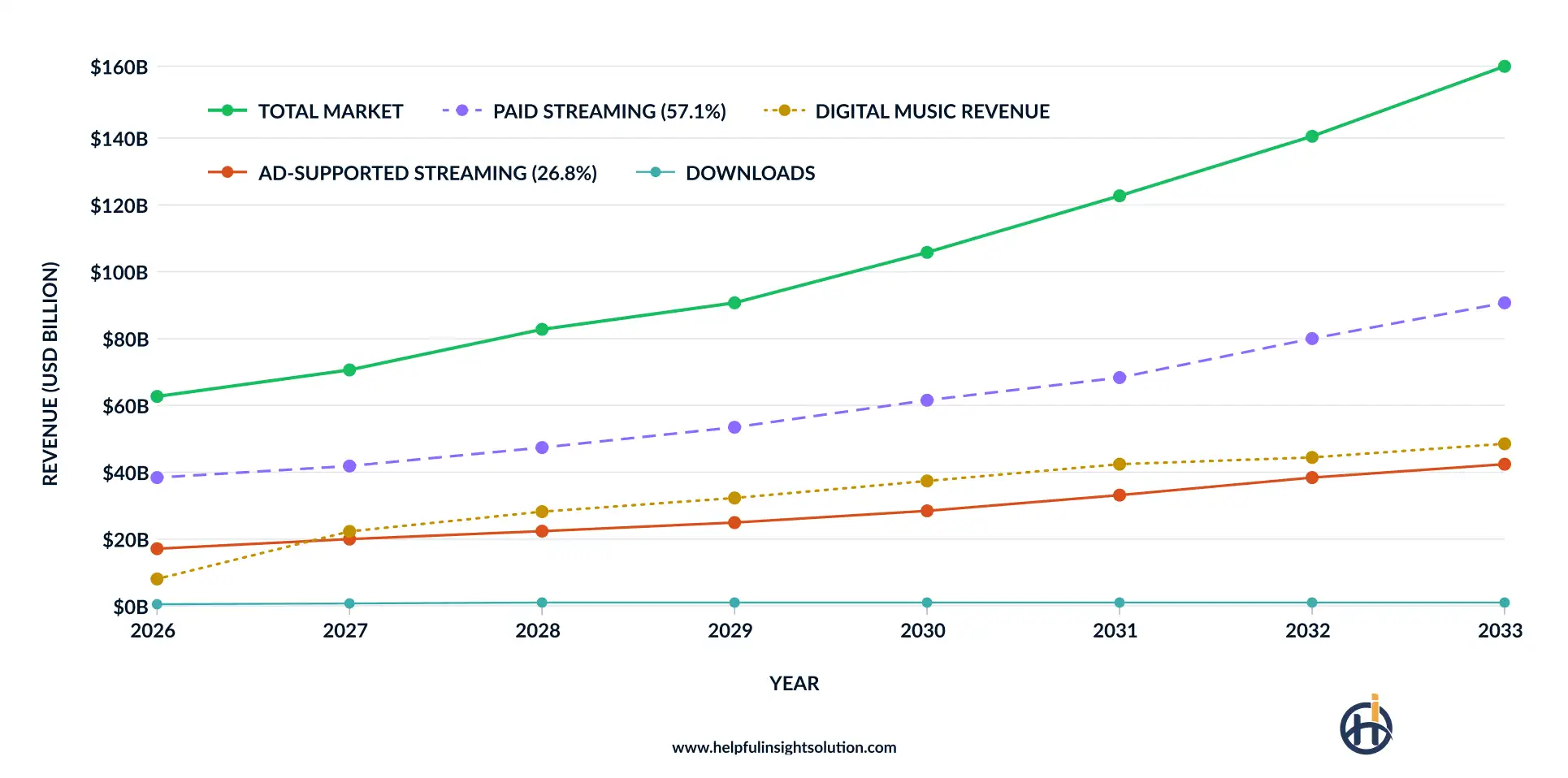
- The value of the music streaming market is $62.5 billion in 2026, with North America having a share of 34.1% in the industry.
- The on-demand music streaming segment has a share of 71.1% in the market, whereas the audio segment has 61.9% market share.
- The two major music revenue sources include paid streaming with a 57.1% share and ad-supported streaming with a 26.8% share.
- By 2027, the music downloads revenue will hit $1.9 billion, and digital music revenue will reach $26.4 billion, respectively.
1. Recurring income opportunities
Music streaming applications are a way to make money over and over again. These platforms make money from various revenue models like subscriptions, ad campaigns, in-app purchases, and licensing. This means businesses get a stream of money coming in which helps them make money for a long time.
2. Digital audience reach
The online music portals can easily reach a lot of people through advanced technologies. They can connect with users over the world no matter where they are or what device they use. This helps businesses get customers and grow faster.
3. Valuable user personalization
People get music albums according to their preferences and search history. By looking at what people like to listen to, businesses can suggest music. This makes people happy so they keep using the app. Tell their friends about it.
4. Strong brand growth
Having a mobile app for music listening is good for a company reputation, as it helps people know who the company is and what they do. If the app is really good people will like the brand and want to use their app again and again. This is because the company has features, good music and an app that is easy to use.
Core & advanced features of Spotify that businesses integrate
Here, you will focus on the key features of apps like Spotify, divided into different categories. From playlists and predictive content to copyright management, we are covering all the major features.
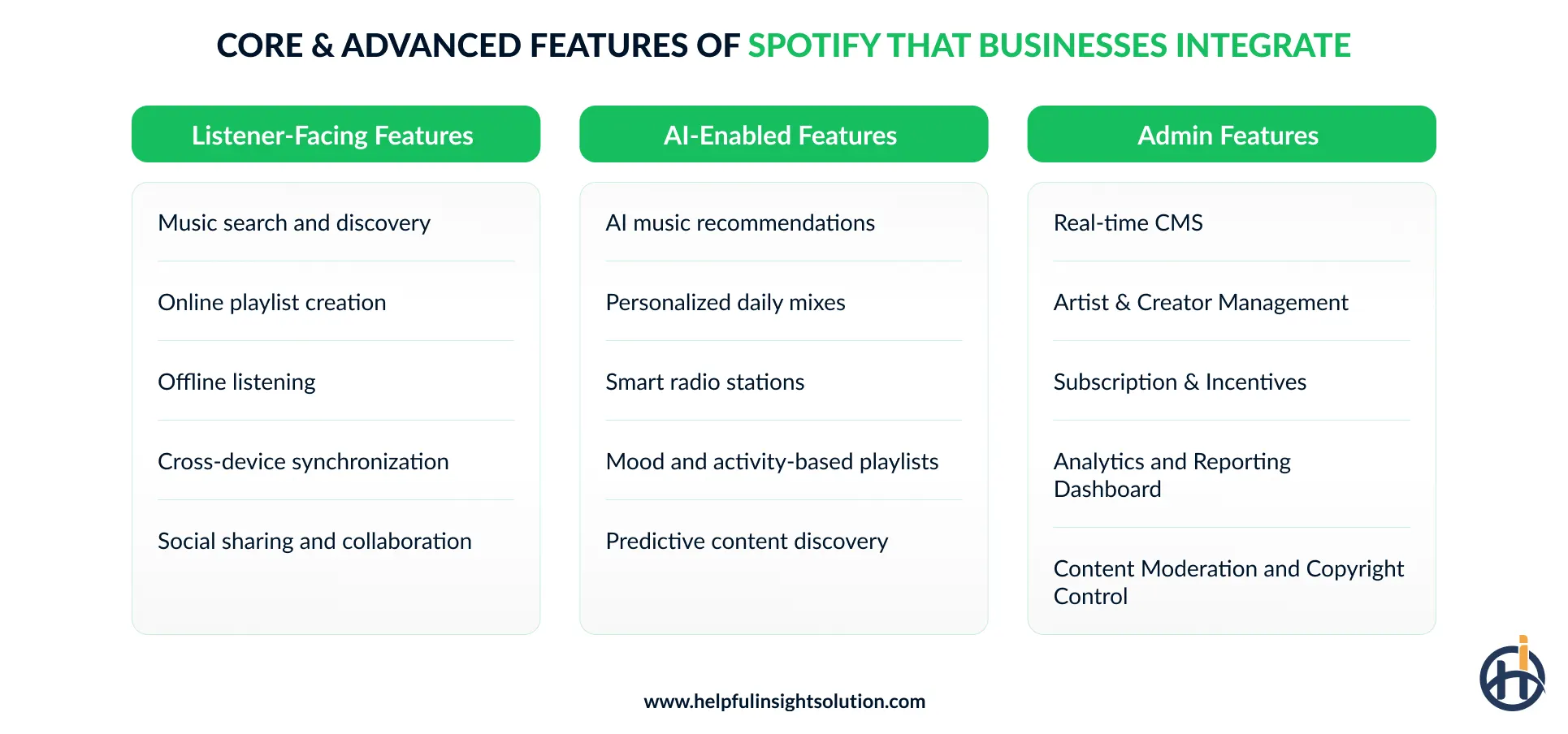
1. Listener-facing features
-
Music search and discovery
This feature enables users to find songs, albums, artists, podcasts, and playlists through keyword searches and curated recommendations. It improves content accessibility and helps listeners discover new music that matches their interests.
-
Online playlist creation
Users can create, edit, organize, and manage personalized playlists directly within the app. This enhances engagement by allowing listeners to customize their music experience and save favorite tracks.
-
Offline listening
Offline listening allows users to download songs and playlists for playback without an internet connection. It is one of the most widely used music streaming app features that provides uninterrupted access to content in low-connectivity areas.
-
Cross-device synchronization
This feature synchronizes user accounts, playlists, preferences, and playback progress across multiple devices. It ensures a seamless listening experience whether users switch between smartphones, tablets, desktops, or smart speakers.
-
Social sharing and collaboration
Social sharing enables users to share songs, albums, and playlists with friends through social media and messaging platforms. Collaborative playlist functionality allows multiple users to contribute tracks, fostering greater interaction and community engagement.
2. AI-enabled features
-
AI music recommendations
Music recommendation engines that use intelligence look at what people listen to how they use the music service and what kind of music they like. This helps them suggest songs, artists and playlists that’re a good fit.
-
Personalized daily mixes
The Daily Mix feature makes a playlist for each person every day. It uses the kind of music they like their artists and what they usually listen to. This gives people music to listen to that is similar to what they already like.
-
Smart radio stations
There are also radio stations that play music continuously based on a song, artist or type of music someone likes. The artificial intelligence changes what music is played based on what people do like skipping songs or listening to some songs than others.
-
Mood and activity-based playlists
Some playlists are made to fit how people are feeling or what they are doing like working out, studying, relaxing or traveling. These playlists use intelligence to pick music that is right for that moment.
-
Predictive content discovery
The music service also uses machine learning to find music that people will like. It looks for songs, new artists and popular music that people are listening to. Music recommendation engines that use intelligence help people discover new music and keep them coming back to the service.
3. Admin features
-
Real-time CMS
Admins can easily add, change, or remove songs and other media items through a content management system. This helps users to get updated lists of albums, podcasts, and music without searching for them.
-
Artist & Creator Management
It helps businesses handle artist profiles, creator accounts and permissions from one place. This makes it easier for teams to work together and ensures that content owners get their share.
-
Subscription & Incentives
Administrators can easily manage special plans, payment schedules, discounts and offers. This helps get users and keep them interested with perks and benefits.
-
Analytics and Reporting Dashboard
The analytics tool gives information about what users are doing what they are listening to how much money is being made and how users are engaging with content. This information helps businesses decide what to do and grow their platform.
-
Content Moderation and Copyright Control
Admins can look at reported content find copyright issues and make sure licenses are, in order. This protects creators rights and keeps the streaming platform safe and legal.
Steps to create a music streaming app like Spotify
In this section, we are going to study the most important steps to make smart solutions like Spotify. From market planning to post-launch support, you will understand all development stages in detail.
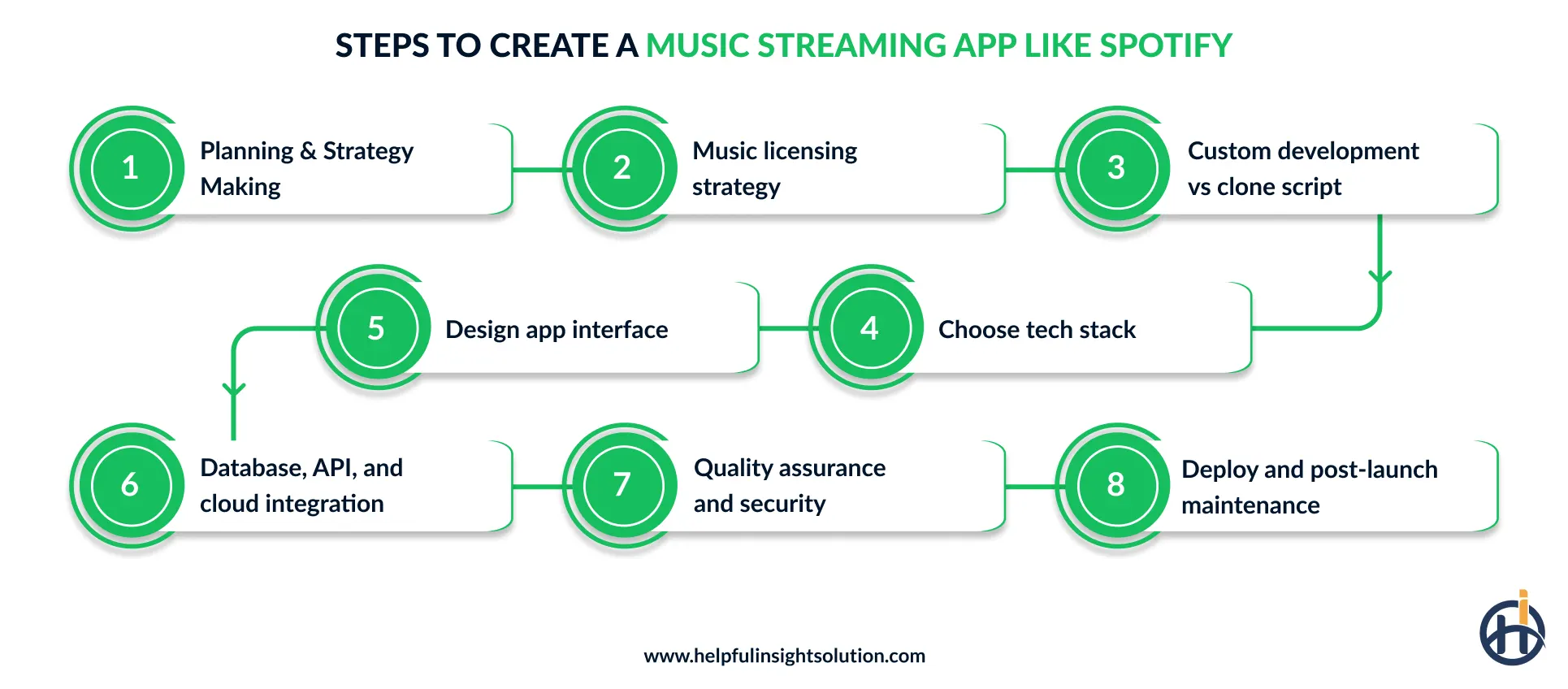
1. Planning & Strategy Making
-
Pick a Business Model
The business model you choose is really important for a music listening platform like Spotify. You can make money from people who pay for a subscription. You can show them advertisements, offer special premium memberships, charge people to download music, or use everything.
-
Understand Market Demand
Before you start building your app you need to do some research to see what people want what is popular and what other companies are doing. You should look at the people you want to use your app see what kind of music they like to listen to and find out what is missing from online music apps. This will help you make an app that people will like.
2. Music licensing strategy
Building a music app like Spotify requires getting the music licenses and distribution rights from record labels and other people who own the music. Companies have to make agreements about streaming music, paying royalties, and using the music. This activity legalizes the app and prevents copyright issues, ensuring better compensation. It also decides how songs the app can offer to users and how different the music is.
3. Custom development vs clone script
-
MVP approach
This is a primary approach that allows businesses to identify necessary features of a music platforms, like search filters and login panels. It helps to validate the project idea through user feedback and beta testing, allowing investors to use an advanced tech stack for smart integrations.
-
White-label solutions
You can hire dedicated developers to use a white-label music streaming solution. This saves a lot of time and money when you are building the sound streaming app and it helps businesses get their music and podcast streaming app out faster so they can start selling.
-
No-code/Low-code platforms
You can use no-code or low-code platforms to make a music streaming application without knowing how to code much. These platforms have tools that you can drag and drop and parts that are already built so you can make the audio listening app quickly.
4. Choose tech stack
-
Frontend
The frontend is important for giving users an experience. It helps users interact with the app through music player controls, playlists and search. To make the app work well on devices developers use technologies like React Native, Flutter, Swift and Kotlin.
-
Backend
The backend handles user authentication, music catalog, streaming, recommendations and API integrations. It uses technologies like Node.js, Python Java. Go to make sure the app works well and can handle many users.
-
Database
The database stores user information, playlists, listening history, subscriptions and music details. Databases like PostgreSQL, MySQL, MongoDB and Redis help manage amounts of data and make it easy to retrieve.
-
Testing
Testing is crucial to ensure the app works on different devices, operating systems and networks. Testing helps find bugs improve security and make sure users have an experience.
-
DevOps
DevOps helps developers build, deploy and maintain the app efficiently. It uses tools, like Docker, Kubernetes, Jenkins and cloud platforms to make releases faster handle users and manage infrastructure better.
5. Design app interface
Businesses must design Spotify-like music apps, as it directly impacts user engagement and satisfaction. The interface should include intuitive navigation, visually appealing layouts, easy music discovery, personalized playlists, and seamless playback controls.
Mobile app designers create wireframes and prototypes to map user journeys and ensure a consistent experience across devices. An intuitive UI/UX design helps users find, play, and manage music effortlessly, increasing retention rates.
6. Database, API, and cloud integration
The backend of the app is where all the user information, playlists and music data are stored safely. The app uses codes to work with payment systems, analytics tools and social media. This helps the app work with services and makes it more useful. The company that builds the app uses a system that makes sure the app works smoothly loads music quickly.
7. Quality assurance and security
The app is thoroughly tested to find any problems, bugs or issues that might happen on devices or operating systems. The app also has security measures to protect user information, such as encrypting data, secure login and safe payments. The testing team checks the quality, how fast the app responds and if all the features work. This step makes sure the app is stable, secure and easy to use.
8. Deploy and post-launch maintenance
Once the testing is done the app is made available to the public through app stores. The company keeps an eye on how the app’s working what users are doing and if any technical issues come up.
The app is updated regularly with features, security fixes and bug fixes to keep it competitive. This ongoing work affects how much it costs to build an app like Spotify. It is necessary, for making sure the app keeps growing and making users happy.
What music licensing and legal frameworks do streaming apps require?
Various organizations like ASCAP and RIAA in the USA ensure music licensing for streaming apps, allowing them to use millions of songs. Here is a checklist that businesses must know before adding a mutual playlist on their mobile applications.
| Area | What It Covers | Real-World Examples |
| Master Rights | Ownership of the sound recording | Major labels like Universal Music Group, Sony Music Entertainment, and Warner Music Group |
| Performance Licenses | Right to perform music publicly via streaming | Collected through PROs like ASCAP, BMI, and PRS for Music |
| Mechanical Licenses | Right to reproduce music during digital playback and caching | Handled in the US by The MLC, and through regional societies in other markets |
| Synchronization Licenses | Permission to pair music with visual content | Required for in-app videos, artist reels, ads, or branded content, usually negotiated directly with rights holders |
| Direct Label Agreements | Licensing music straight from record labels | Used by large platforms negotiating directly with Universal, Sony, Warner, and leading indie labels |
| Aggregators and Distributors | Pre-licensed music distribution to platforms | Services like DistroKid, TuneCore, and CD Baby |
| Region-Specific Licensing Bodies | Territory-based rights management | PPL (UK), SACEM (France), IPRS (India) |
What architecture does a music streaming app need?
Most music apps like Spotify use a distributed architecture that supports low-latency playback, adaptive bitrate delivery, and real-time analytics. Additionally, for seamless mobile app development, it includes data-driven metadata and personalized recommendations across devices.
| Architectural Component | Application | Description |
| Mobile & Web Frontend | User Interface and Experience | Provides the user-facing interface for music discovery, playback, playlists, and account management across devices. |
| Backend Application Server | Business Logic Processing | Manages user authentication, subscriptions, content requests, notifications, and platform operations. |
| Music Content Database | Data Storage and Management | Stores song metadata, artist information, playlists, user profiles, and listening history securely. |
| Cloud Storage Infrastructure | Audio File Hosting | Hosts large music libraries and media assets while ensuring scalable and reliable content storage. |
| Content Delivery Network (CDN) | Fast Music Streaming | Distributes audio content through geographically distributed servers to reduce latency and improve playback speed. |
| API Integration Layer | Third-Party Service Connectivity | Connects the app with payment gateways, social media platforms, analytics tools, and recommendation engines. |
| AI & Analytics Engine | Personalization and Insights | Processes user behavior data to deliver personalized recommendations, smart playlists, and business intelligence reports. |
Development cost and timeline for streaming apps like Spotify
The cost to build platforms like Spotify for music streaming is highly dependent on the complexity level. The average price of a basic MVP app is less than that of an advanced AI-driven audio and podcast platform. To know the expenses based on other factors, like platform choice, developers’ experience, and location, businesses may use a cost calculator. In this section, we will discuss the Spotify clone app development cost with detailed information.
| App Type | Estimated Cost | Timeline | Best For |
| Basic App | $15,000–$40,000 | 2–4 Months | Startups and entrepreneurs are looking to launch an MVP with essential features such as user registration, music search, playlist creation, and audio streaming. |
| Intermediate App | $40,000–$100,000 | 4–8 Months | Growing businesses that need enhanced functionality, including offline playback, social sharing, personalized recommendations, subscription plans, and analytics. |
| Advanced App | $100,000–$200,000 | 8–14 Months | Enterprises and established music platforms require AI-powered recommendations, live streaming, podcast integration, high-end security, multi-device synchronization, and large-scale cloud infrastructure. |
Best revenue models for Spotify-like music streaming apps
You must know various music app monetization strategies to generate revenue and make profits. These models include membership schemes, freemium plans, ad campaigns, and promotions.
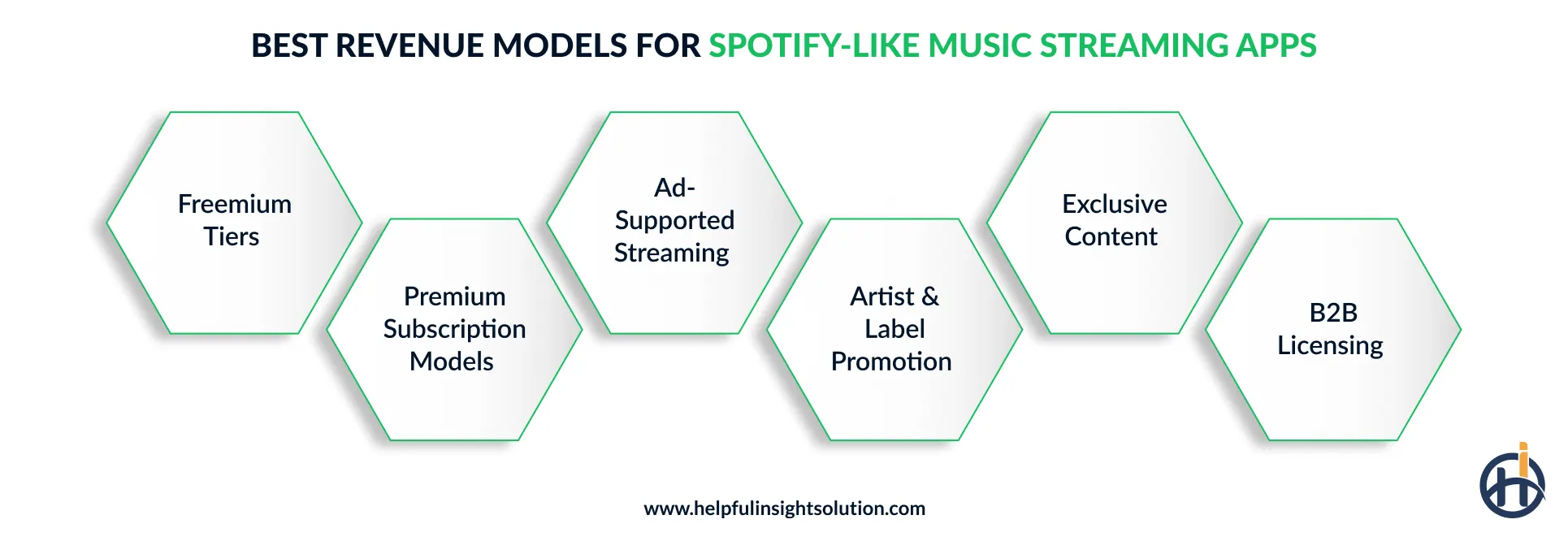
1. Freemium tiers
Freemium models give you music streaming for free, as they have limited features and ads. This way a lot of people sign up and some upgrade to different paid plans.
2. Premium subscription models
Premium subscriptions let you listen to music without ads. You can also download music for listening get better sound quality and have exclusive features. You pay a fee for these. They bring in money and keep customers longer.
3. Ad-supported streaming
You can make an app like Spotify that lets users listen to music for free. They hear ads. You make money from these ads as well as from videos. This way you make money without needing users to buy a subscription.
4. Artist & label promotion
Music streaming services can make money. They offer artists and record labels paid chances to promote their music. This can include playlists, highlighted music and music promotions. These help more people hear the music and bring in money.
5. Exclusive content
Exclusive content is music. Shows that you can only get on our platform. This can include music before anyone else gets it special podcasts, live music sessions and music that only certain artists make for us. This gets people to sign up and makes our service different from others.
6. B2B Licensing
B2B licensing is when we let other businesses use our music streaming service or parts of it. This can be for their customers or businesses. This way we make money beyond just people signing up for our service.
Challenges in music app development like Spotify
Businesses may face different challenges while developing music apps like Spotify, such as data security. You will discover various other obstacles in this section with their respective solutions in detail.
1. Music royalty management
This legal issue occurs due to the splitting of global subscriptions and ad revenues into two royalty pools. It includes master rights and publishing rights, which affect accounting logic and increase music expenses.
Solution: Partnering with third-party aggregators or using royalty-free libraries is beneficial to prevent licensing issues.
2. High scalability requirements
Real-time audio delivery, massive catalog sizes, and global traffic spikes are the key scalability issues. It affects both infrastructure and data processing that leads to music playback buffering and system latency.
Solution: You can adopt a microservice architecture that increases server capacity through distributed event streaming.
3. Advanced recommendation engine
This includes advanced data science, audio processing, and high-performance engineering, increasing complexity. It requires large datasets and machine learning models like CNNs to convert raw information.
Solution: Businesses can implement hybrid recommendation engines that mix content-based and collaborative models.
4. Data security & user privacy
Various music apps collect personal data and copyrighted content, which increases the security issues. Global compliance and digital rights management may lead to DDoS attacks and unauthorized data scraping.
Solution: It is important to maintain strong cybersecurity standards, like end-to-end encryption and secure payment gateways.
Future trends of music streaming applications like Spotify
You must know different future music streaming trends that will enhance user experience and ensure growth. Entrepreneurs can make apps similar to Spotify by integrating the following innovations in reality.
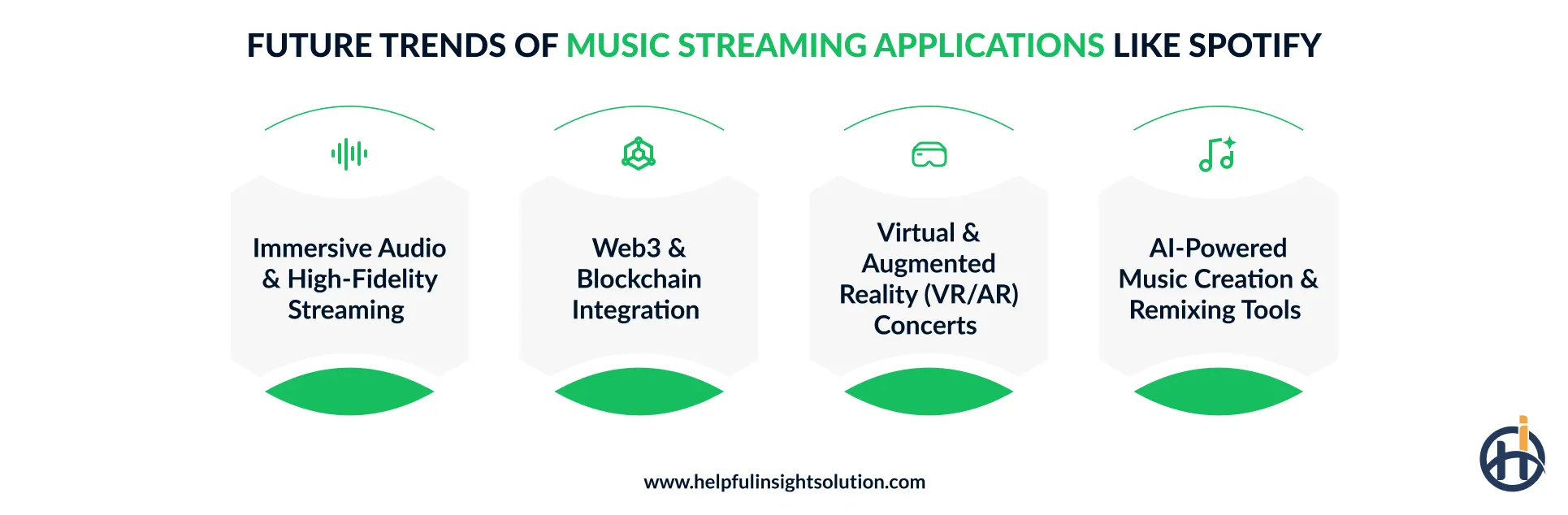
1. Immersive Audio & High-Fidelity Streaming
Music streaming platforms are increasingly adopting spatial audio, 3D sound, and lossless streaming technologies to deliver a richer listening experience.
These advancements provide greater depth, clarity, and realism, making users feel more connected to the music. As consumer demand for premium audio grows, immersive listening is expected to become a key differentiator.
2. Web3 & Blockchain Integration
Blockchain technology is transforming music streaming by enabling transparent royalty distribution, smart contracts, and direct artist-to-fan transactions. Web3 ecosystems can reduce intermediaries and ensure creators receive fair compensation for their work.
This trend allows you to create an app like Spotify with digital ownership, fan engagement, and decentralized music communities.
3. Virtual & Augmented Reality (VR/AR) Concerts
VR and AR technologies are creating immersive concert experiences that allow fans to attend live performances from anywhere in the world. Users can interact with virtual stages, artists, and fellow attendees in highly engaging digital environments.
These experiences help streaming platforms expand beyond traditional audio consumption into interactive entertainment.
4. AI-Powered Music Creation & Remixing Tools
AI-driven tools are enabling users and artists to generate music, create remixes, and customize tracks with minimal technical expertise. Advanced algorithms can assist with composition, sound enhancement, and personalized audio production.
As AI capabilities evolve, live music listening apps may become platforms for both content consumption and creative collaboration.
Spotify vs Competitors: How does it compare?
No doubt, Spotify is one of the best music streaming mobile apps with more than 1 billion downloads, which is commonly used by people. But there are several Spotify alternatives available in the market that have also increased their popularity. Here, we will observe a table listing the top 10 competitors of the Spotify application with their downloads and ratings.
| Top Spotify Alternatives | Supported Devices | Downloads | Ratings |
| YouTube Music | Android & iOS | 5B+ | 4.4 |
| Amazon Music | Android & iOS | 100M+ | 4.3 |
| Apple Music | Android & iOS | 100M+ | 4.7 |
| SoundCloud | Android & iOS | 100M+ | 4.7 |
| Deezer | Android & iOS | 50M+ | 4.4 |
| TIDAL | Android & iOS | 10M+ | 4.2 |
| Pandora | Android & iOS | 100M+ | 4.1 |
| JioSaavn | Android & iOS | 100M+ | 4.3 |
| Gaana | Android & iOS | 100M+ | 4.2 |
| Audiomack | Android & iOS | 50M+ | 4.8 |
How does Helpful Insight assist businesses in making an app like Spotify for music streaming?
Now, businesses can easily invest in music streaming app development to launch smart solutions in the market for their audience. They must approach the right partner who has great experience in this domain and can deliver the best talent for app-making.
We help our clients to develop an audio streaming app like Spotify with advanced technologies, curated audio & podcast features, and legal licensing. Our developers ensure a seamless experience through work integrity and project security.
Businesses can discuss their ideas with our expert analysts and get valuable information on revenue growth and user engagement. We enable businesses to focus on global branding and marketing through modern ad-based strategies. So, you should not miss these opportunities and start with our solutions to deliver the best music listening services.
FAQs
The development timeline for a Spotify-like music listening app depends on its complexity, features, and platform support. A basic MVP with essential features can take 2–4 months, while a fully featured solution may require 8–12 months or more. Development time also includes UI/UX design, testing, integrations, and deployment.
AI improves the user experience by analyzing listening habits and delivering personalized song, playlist, and podcast recommendations. Additionally, it powers smart search, mood-based music suggestions, and predictive content discovery. This technology also helps to optimize user engagement and retention through tailored experiences.
Businesses should approach skilled and reliable developers to make advanced audio streaming platforms. A dedicated process to hire Spotify app developers is described in the following manner:
- You should clearly outline app features, target audience, budget, and development goals.
- It is crucial to decide on a hiring model to choose freelancers, in-house teams, or agencies.
- Businesses must assess candidates’ experience with cloud services and mobile technologies.
- Now, you should examine previous projects, case studies, and testimonials to verify capabilities.
- Finally, discuss timelines, communication processes, pricing, and project objectives.
Music streaming platforms must ensure they have legal rights to distribute copyrighted songs and audio content to users. Unauthorized streaming can lead to copyright infringement claims, legal penalties, and content removal requests. Proper royalty payments and compliance with intellectual property laws are essential for platform operations.
Yes, music licenses are required if your app streams copyrighted music to users, ensuring music ownership. These licenses grant permission to distribute, perform, and reproduce music legally while ensuring artists and rights holders receive royalties. Operating without the necessary licenses can result in lawsuits, fines, and service restrictions.