

Key takeaways
- In 2026, businesses have several machine learning trends to consider. These include ML agents that work independently, models that handle different types of data, smaller language models, RAG for business data, and edge ML
- The global machine learning market will reach about $1,709.98 billion by 2035. Still, start small, test one trend, then expand once results hold.
- Predictive analytics, edge ML, and MLOps help businesses improve forecasting, process data closer to where it is generated, and keep machine learning systems reliable in production.
- Before adopting a machine learning trend, assess your business needs, evaluate how well each trend fits your operations, and weigh its key benefits and drawbacks.
For many businesses, the question is no longer whether machine learning has a place in their operations. It is where the technology can make a difference and whether the investment is worth it.
The top machine learning trends give businesses a starting point for exploring their options, although the value of each trend will depend on their particular needs.
The decision starts with identifying the problems a business needs to solve. The use cases of machine learning vary by industry, and the right approach depends on those needs as well as the company’s ability to put new systems into practice.
According to the Precedence Research report, the global machine learning market is projected to reach approximately $1,709.98 billion by 2035. That figure indicates how much the market is expected to grow, although businesses will still need to decide which developments are relevant to their work.
This blog explores the latest machine learning trends worth watching and the factors CTOs and CEOs should consider when deciding which ones are relevant to their business.
Emerging machine learning trends every business should know
There have been several changes in how machine learning models are built and used. Models can now work with different types of information, run on smaller devices, or support tasks that once needed more manual effort. The current trends in machine learning below look at these approaches and their practical applications.
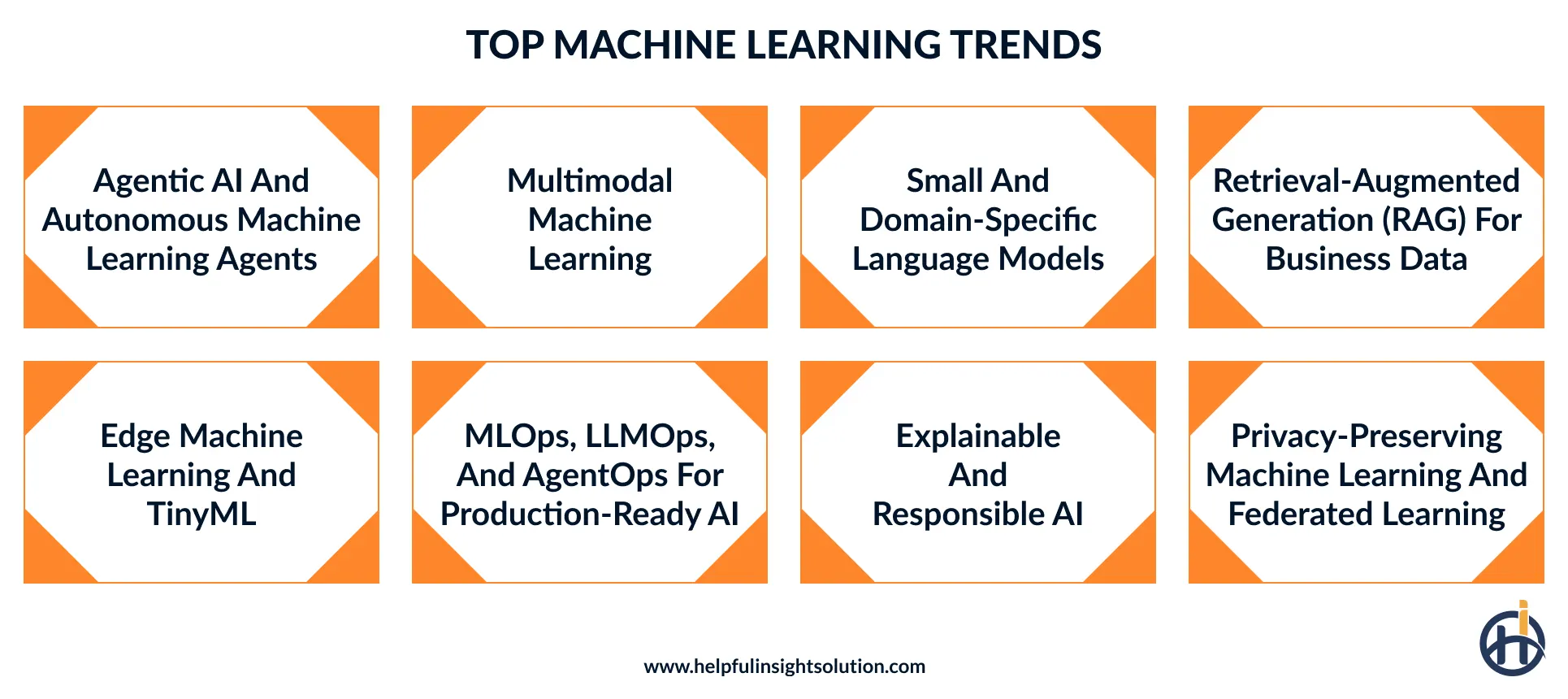
1. Agentic AI and autonomous machine learning agents
Agentic AI takes a different route to automation. Rather than reacting to a single instruction, an agent can collect information, call on the tools it’s linked to, and move step by step toward a goal that has been defined in advance.
Businesses can use these agents to
- Resolve routine customer queries across connected systems
- Match invoices and flag payment discrepancies
- Investigate IT alerts and trigger approved actions
- Update records across different business applications
This machine learning trend is still taking shape, and its results rest on how smoothly agents connect with current systems. Businesses need clear permissions, reliable data, and oversight for actions that could have wider consequences.
2. Multimodal machine learning
Most business information comes in different forms. A lot of it is images, video, and audio too, and those usually get handled apart from each other. Multimodal machine learning changes that. One model can look at all of them at once and make sense of the full picture.
This gives businesses more ways to use the data they already have. For example, a system could review a written customer query along with an attached image to better understand the issue. It is one of the top machine learning trends worth following as companies look for practical ways to use different types of data.
3. Small and domain-specific language models
More companies are starting to ask a simple question: does our AI really need to know everything? For many jobs, the answer is no. That is behind the growing interest in small and domain-specific language models, which are built around one subject or task.
They’re trained on industry data, so they pick up the terms and habits of that field. It’s an ML technology trend worth watching if you want AI for specialist work.
- Where businesses can use them:
- Legal teams reviewing contract documents
- Healthcare staff summarizing medical records
- Finance teams processing loan applications
The shift is towards choosing a model based on the work it needs to do, rather than its size alone.
4. Retrieval-augmented generation (RAG) for business data
Retrieval-augmented generation, or RAG, is getting a lot of attention from companies using generative AI. The reason is a familiar problem that these tools can sound sure of themselves even when they’re wrong.
RAG connects the model to trusted business sources. When a question arrives, the system retrieves the relevant details and uses them to shape the reply.
This approach is useful when answers need to reflect a company’s own records and procedures. For example, an internal AI assistant could use company guidelines and approved documents to answer staff questions, with access controls helping protect sensitive information.
5. Edge machine learning and TinyML
Until recently, most smart devices sent their data to the cloud and waited for an answer. Edge ML flips that. The model runs on the device, so a camera, sensor, or wearable can make a call on the spot.
TinyML takes the idea further by running smaller models on devices with very limited memory and power. It is one of the machine learning industry trends worth watching, particularly as more than 45% of emerging embedded-AI use cases are expected to prioritize on-device inference.
Typical uses include:
- Equipment sensors that flag unusual vibration
- Shelf cameras that track stock in stores
- Wearables that read health signals all day
6. MLOps, LLMOps, and AgentOps for production-ready AI
Machine learning trends for businesses aren’t just about building new models. They also cover what happens once those models are in use. Changes in data can affect accuracy, so teams need ways to spot problems and make updates. That’s where MLOps comes in for standard ML models.
LLMOps focuses on managing large language models, including tracking prompts and improving output quality. AgentOps follows what AI agents do on their own. Organizations taking production AI past the pilot stage are setting these up early, so a system keeps working after launch.
7. Explainable and responsible AI
It’s one thing for a machine learning model to produce an answer and another for a business to understand how it got there. Explainable AI helps make the reasoning behind a result easier to examine. Responsible AI focuses on using these systems carefully, checking for unfair results, and keeping people involved when needed.
Take hiring as an example. If a model keeps rejecting qualified candidates, the company needs to find out why. Perhaps the model has learned patterns from past hiring decisions that weren’t fair to begin with. This is one of the top AI trends for businesses that matters a lot because models learn from past data, and past data can carry bias. Better to find that early than explain it later.
8. Privacy-preserving machine learning and federated learning
Training a machine learning model usually means gathering all the data in one place. For many businesses, that’s the part that gets stuck. Patient records, bank transactions, and customer details can’t just be copied around.
Federated learning offers a way out. The model travels to the data instead. Each hospital, branch, or device trains it locally, and only the learning comes back, not the records. It’s one of the trends in machine learning that’s picking up speed, because more companies want to learn from customer data without giving up data privacy.
How to choose the right machine learning trends for your business
As technology keeps getting upgraded, new artificial intelligence and machine learning trends keep coming, and it’s hard to know which ones deserve your attention. Most businesses can only adopt a few. This section shares practical tips for picking the right ML trend that suits your business needs and brings real value.
Moreover, an experienced AI development services provider can shorten that search. They look at the data a company already has, the team that will maintain the system, and the budget, then suggest which options are worth testing first.
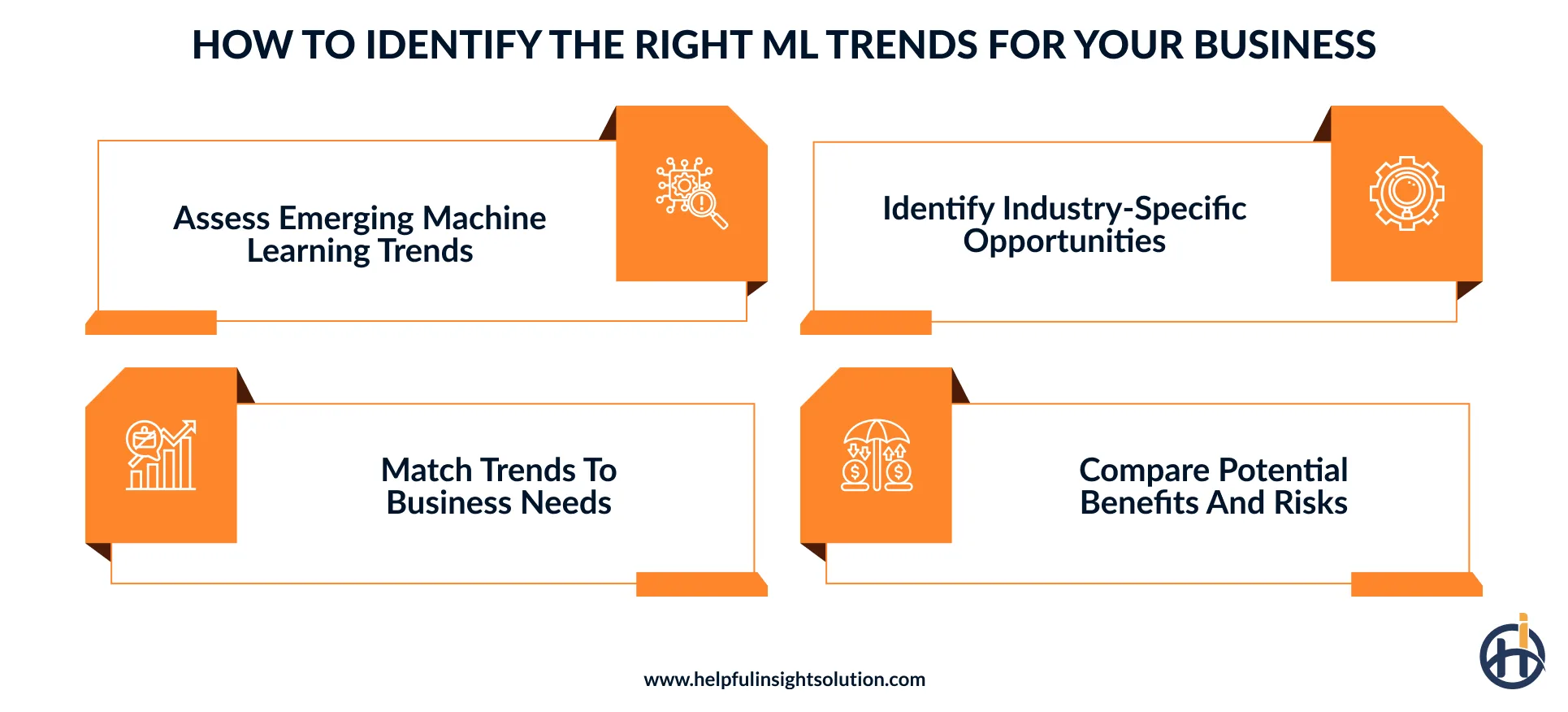
1. Assess emerging machine learning trends
Just because something is new doesn’t mean it suits your business yet. Before you pick from the recent trends in machine learning, find out if other companies have made it work. Check that it can handle the workload you expect, too.
Then turn to your own setup. If it won’t fit your systems or your team can’t run it, it isn’t the right trend for you, however popular it is.
2. Identify industry-specific opportunities
Every business has different problems to deal with. A bank might use it to flag unusual transactions. A retailer might use it to work out which products customers will want. So, choosing a trend starts with knowing what your business needs.
Look at machine learning trends and predictions that fit your industry. For example, machine learning in healthcare can help doctors review patient records and notice signs that someone may need extra care.
3. Match trends to business needs
Start with the problem, not the trend. What do you want to get better at? Cutting costs, answering customers faster, or keeping them around longer are all common goals.
The top machine learning trends give you different ways to work on them, and some won’t suit your business at all. So choose the one that helps with an issue you’re actually facing.
4. Compare potential benefits and risks
Don’t focus only on what a machine learning system can do. Think about the problems it might bring, too. Will it need expensive infrastructure? Could it put private data at risk? What happens if its predictions are wrong? These questions matter when comparing ML trends.
Every trend comes with a price and a few risks. So before you commit, set those next to the benefits you’re hoping for. That comparison will tell you whether the trend really makes sense for your business.
How Helpful Insight helps businesses implement machine learning trends
Until now, much of machine learning has focused on predictions and analysis. That’s changing. Systems are getting better at acting on their own, handling different kinds of data, and finishing tasks with less human intervention. Businesses could see quicker decisions, less repetitive work, and better use of the information they already have.
The ones that adopt these machine learning trends early will have the stronger position in the years to come. New machine learning approaches keep emerging, and knowing which ones are worth your time isn’t always easy.
Our machine learning development company keeps a close watch on machine learning trends and understands what each one can realistically do for a business. We help you work out which trend is worth your attention and which can wait.
Once the right idea is clear, we turn it into a working solution, from selecting the technology to building and integrating it, so machine learning becomes a useful part of your business.
Book a free consultation with our team today to explore the latest ML trends and discuss what could work for your business.
FAQs
Agentic AI, multimodal ML, small and domain-specific models, and TinyML are among the top machine learning trends. Each one makes ML easier to use in a business’s everyday workflows.
Machine learning helps businesses make informed decisions, reduce time spent on routine tasks, and understand customer needs. It can also help control expenses and identify opportunities to increase revenue.
Adoption is hard mainly because of data security, a shortage of trained staff, and difficulty maintaining models in production. Changing regulations and uncertain returns make the decision harder.
Preparing for future machine learning trends starts with reliable data. From there, businesses should develop their team’s technical skills, confirm that new ML tools work with existing systems, and keep monitoring how those tools perform.